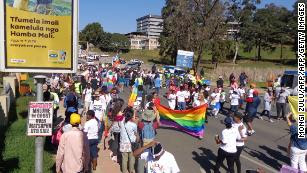
In a historic and festive celebration, Swaziland held its first-ever LGBT pride parade over the weekend.
Hundreds of people marched down the streets of the capital Mbabane waving rainbow flags and holding signs that read, “Turn hate into love” — a scene almost unimaginable not so long ago.
The small southern African country, recently renamed the Kingdom of eSwatini by its king, is Africa’s last absolute monarchy and has a bleak record on LGBT rights. The country of 1.4 million also has the world’s highest HIV/AIDS rates and suffers from severe poverty.
Saturday’s parade was organized by the Rock of Hope, a local nonprofit, and supported by international LGBT advocacy organizations.
“This is a small country, an absolute monarchy that makes same sex love illegal and is not often on the radar of the international community and media,” said Matt Beard, Executive Director of the advocacy group All Out, in a Medium post. All Out helped fund and promote the parade, which featured well-known Swazi musicians and artists.
“At certain moments during the parade, the infectious joy of this community was so intense, it was difficult to hold back the tears,” Beard added.
The pride parade was also supported by Human Rights Campaign (HRC), the largest LGBT rights group in the United States.
Swaziland was part of HRC’s Global Partnerships in Pride program, which supports LGBT communities abroad and emphasizes international solidarity.
Marchers in Swaziland’s first-ever pride parade in Mbabane.
In Swaziland, same-sex relationships are illegal and the country maintains a colonial-era law against sodomy. The US State Department’s report on global human rights practices in 2017 stated that Swazi people open about their sexual orientation “faced censure and exclusion from the chiefdom-based patronage system.”
The pride celebration was not endorsed by King Mswati III.
Nonetheless, the parade marks a major milestone for Swaziland’s LGBT community and brings June’s pride month celebrations to a new part of the world.
Saturday’s celebration in Mbabane was held the day before hundreds of people defied a Turkish government ban to take part in a Pride Parade in Istanbul before being dispersed by police.
In A Workplace Divided: Understanding the Climate for LGBTQ Workers Nationwide, HRC Foundation seeks to uncover the prevalence of LGBTQ workers feeling pressure to hide their sexual orientation and/or gender identity on the job and the cost of that hiding both to individuals and employers writ large. We also research the benefits to employers and workers when workplace climates are more welcoming of LGBTQ people.
46% of LGBTQ workers say they are closeted at work, compared to 50% in HRCF’s groundbreaking 2008 Degrees of Equality report;
1-in-5 LGBTQ workers report having been told or had coworkers imply that they should dress in a more feminine or masculine manner;
53% of LGBTQ workers report hearing jokes about lesbian or gay people at least once in a while;
31% of LGBTQ workers say they have felt unhappy or depressed at work;
and the top reason LGBTQ workers don’t report negative comments they hear about LGBTQ people to a supervisor or human resources? They don’t think anything would be done about it — and they don’t want to hurt their relationships with coworkers.
The Supreme Court (SCOTUS) has upheld President Donald Trump’s travel ban, in a landmark decision which has been announced on the third anniversary of the SCOTUS decision to allow same-sex marriage.
The ban is a major victory in the administration’s mission to restrict the number of immigrants and visitors into the United States.
However the ruling marks a distinct change from the same day in 2015, when the Court voted for marriage equality rights. Critics say the latest Court ruling will dangerously impact the LGBT community.
In a 5-4 decision, the judges confirmed the president’s powers over matters of national security.The ban levels a range of restrictions against five majority-Muslim countries – Iran, Libya, Somalia, Syria and Yemen. But there’s also travel restrictions on North Korea and Venezuela.
Human rights defenders have attacked the decision and highlighted how the LGBT community will be impacted by the SCOTUS decision.
In a podcast discussing Trump’s third order of the ban, LeGaL’s (a New York LGBT group of lawyers) Executive Director Eric Lesh said: “Trump’s travel ban is dangerous particularly for members of the LGBTQ community. In addition seven of the eight countries that have been targeted by Trump’s ban, explicitly criminalise homosexual conduct, some of them authorise or even mandate a death penalty for such offences.”
While Human Right’s First’s Shawn Gaylord spoke about the impact of the ban on queer and trans communities, in 2017: “Barring LGBT people from these seven countries creates an additional burden and makes them increasingly under threat to violent acts,” he said.
“LGBT refugees already face heightened risks based on their sexual orientation or gender identity. They are vulnerable to violence during the entire resettlement process and may have additional challenges as they adjust to their new lives after resettlement,” Gaylord added.
CEO Rachel B. Tiven said: “As a queer woman and a Jew, I am outraged and frightened. The LGBT community knows what it’s like to be red meat for a demagogue’s base. Future generations will ask us what we did to object. We stand in solidarity with our Muslim family – straight and gay – and pledge our continued support to fight the ban and the stigma, discrimination, and violence it helps encourage.”
Deputy legal director with the American Civil Liberties Union, Cecillia Wang, tweeted that the decision marked “a dreadful day” for the United States. “But we Americans will fight on to express the will of the people to uphold equality and freedom,” she wrote.
The travel ban’s history began in December 2015, when Trump called for “a total and complete shutdown of Muslims entering the United States until our country’s representatives can figure out what is going on,” during his Presidential campaign.
During his first week in office Trump signed the executive order to ban people from seven Muslim-majority countries. The Supreme Court halted enforcements of most of the ban, until March 2017 when Trump issued a “watered down” second order. The Supreme Court allowed the second order to go into effect in part.
But in September Trump issued a third ban with more changes. After challenges, the Supreme Court allowed this version to go into effect while appeals were heard.
On the 3rd anniversary of Obergefell v. Hodges, the 5th anniversary of U.S. v. Windsor, and the 15th anniversary of Lawrence v. Texas, DNC Chair Tom Perez released the following statement:
“Before the Supreme Court handed down its decision in U.S. v. Windsor five years ago, Edie Windsor said, ‘I think justice will prevail. Is that crazy?’ Because of her indomitable spirit and the activism of millions of LGBTQ Americans, justice did prevail. Love is love. And America is better for it.
“All across the country, LGBTQ Americans and their allies have organized for equal rights and brought our nation closer to fulfilling its promise of equality for all people – no matter who they are or who they love. Today’s anniversaries remind us that while it may not happen overnight, progress is possible. As long as people raise their voices for what’s right, we can bend the arc of the moral universe toward justice.
“But our fight must continue. LGBTQ Americans still face inequality across our society – from bathrooms and boardrooms to bakeries and the ballot box. Every day, Republicans in Congress, the White House, and at the state and local level are trying to turn back the clock on LGBTQ rights. Even though marriage equality is the law of the land, that hasn’t stopped Republicans from trying to demean and delegitimize LGBTQ marriage through discriminatory adoption bills and so-called ‘religious liberty’ laws.
“The Democratic Party stands with LGBTQ communities in America and around the world. We believe that no one should face discrimination, bullying, or violence because of who they are or who they love. That’s why we’re working to enact legislation like the Equality Act to protect LGBTQ Americans. We believe in the values of inclusion and opportunity for all, and we will never stop fighting for the equality every human being deserves.”
“The march toward LGBTQ equality has been long and hard-fought — and it’s far from over. But some days, we’re reminded of just how far we’ve come. June 26th is one of those days.”
In the new plan announced on Monday, Starbucks said that in addition to covering bottom surgery, they will now cover all other medical steps in a person’s transition.
This will cover several other procedures that were previously considered cosmetic – which can often be hard to obtain as insurers typically refuse to cover them.
The international coffee chain will now cover procedures including top surgeries in the form of breast reduction or augmentation, hair removal or transplants and facial feminisation surgery.
As well as covering all gender-confirming surgeries, the coffee chain will also help trans employees find appropriate doctors and healthcare providers.
Starbucks has covered bottom surgery since 2012, making it one of the first national employers to do so in the US.
Trans advocates have highlighted that medical transition is often represented as one surgery, when it actually involves multiple procedures that take many years.
Ron Crawford, vice president of benefits at Starbucks, explained that the new plan hoped to be fully inclusive.
“The approach was driven not just by the company’s desire to provide truly inclusive coverage, and by powerful conversations with transgender partners about how those benefits would allow them to truly be who they are.
“You have to think of it from an equity perspective.”
He added: “Nobody else is doing this. We would love to see more employers doing this.”
Over time and exposure to the elements exterior concrete can develop cracks due to temperature changes, ground movement, improperly placed joints and excessive loads.
Starbucks worked with the World Professional Association for Transgender Health (WPATH) in order to determine which procedures were required to help transgender employees.
Jamison Green, who worked with Starbucks on behalf of WPATH, said that the company was the first to ever partner with the charity.
Green said: “Starbucks was not afraid to ask all the right questions and demand that people get the best possible care.
“We produced a list of the most crucial benefits and those that are deemed problematic to insurance companies, such as facial feminization and electrolysis.”
The complaint from Paul Bray was originally thrown out but was then reinstated after an appeals court maintained the suit.
Bray is filing complaints against Starbucks coffee shops in Eden Prairie and Edina, Minnesota, saying their treatment of him changed after he told them he was transgender in March 2013, after changing his name.
Bray shared the information with an employee, Adam Voth, so as to explain any confusion with the names on his credit card, and Voth promised to keep it confidential.
However afterwards, another Eden Prairie Starbucks employee, Sophia Peka, who Bray had formed a friendship with over a year of visiting the coffee shop, began to discriminate against him.
An evangelical leader who is a member of President Donald Trump’s Religious Advisory Council praised First Daughter and senior White House advisor Ivanka Trump, the Christian Broadcasting Network reported Monday.
Pastor Jack Graham of the Prestonwood Baptist Church received a $50,000 personal donation from Ivanka, who earned $82 million in outside income with her husband Jared Kushner in 2017, while both were working in the White House.
Prestonwood has a long history of anti-LGBT activism.
“This is an old fight dating back to the Garden of Eden when Satan seduced the first family with lies and deception. The same lies are in play today,” Graham wrote. “The biblical design of marriage is clear: a man and a woman living and loving together in a monogamous relationship in the image of God.”
“Gay marriage violates God’s standard and is outside God’s plan for men and women. The Supreme Court of the United States has now reached their goal of legalizing gay marriage in every state in the country,” he continued. “We have set a course for disaster in our beloved nation and there seems to be no turning back.”
Now Graham is praising Ivanka Trump.
“I’ve had the opportunity to meet with Ivanka Trump a number of times over the last year, and I’ve been struck by her kindness and concern for those in need, so, it wasn’t that surprising to know she would want to help these families,” Graham said. “Hopefully, Ivanka’s generosity will inspire many other Americans to get off the sidelines and actually provide tangible help to those in need.”
“The beauty of America and the people in our church is that we don’t have to wait for our politicians to sort out their disagreements in order to do what is right,” said Graham, who has served two terms as president of the Southern Baptist Convention.
Graham has been a fierce defender of the president.
In 2016, just before the election, Graham stood by Trump following his “Access Hollywood” comments admitting to sexual assault.
In 2017, following the deadly “Unite the Right” rally in Charlottesville, Graham stood by Trump despite the president’s claim that there were “fine people” among the white nationalists.
Donald Trump and his administration are cruelly separating children from their families.
But we won’t allow it to continue. On June 30, we’re rallying in Washington, D.C., and around the country to tell Donald Trump and his administration to stop separating kids from their parents!
Trump and his administration have been systematically criminalizing immigration and immigrants, from revoking Deferred Action for Childhood Arrivals (DACA) to ramping up intimidating ICE tactics.
Join us on June 30 to send a clear message to Donald Trump and Republicans in Congress: Families Belong Together!
If there’s not an event near you, keep checking back or create an event at the link below.
Petaluma Mail Depot , parking lot (4th & C streets)
Petaluma, CA 94952
296 attendees
It is time to rally and march against the trump administration’s horrendous treatment of families seeking refuge at the border! These families are being cruelly separated and sent to prison camps. The children are being ripped from their parents’ arms! We must stand united with others across the nation on June 30th and let trump and GOP know no more! The time to stand up is NOW!
Santa Rosa is standing with the national Families Belong Together protest on June 30th, demanding that families not be separated at the US-Mexico Border … Our current administration’s policy of separating children from their parents must stop. Join us in action and solidarity … schedule for the rally will be posted soon on our facebook event page https://www.facebook.com/events/1913293655399367/
Directions: Take 101 N to Downtown Exit and turn right onto 3rd Street – park in parking garage at 3rd and D or at 1st and Santa Rosa Ave. you will pass Courthouse Square on way to parking garage Take 101 S to Downtown Exit and turn left onto 3rd Street – following directions above or park under freeway and walk through Santa Rosa Plaza onto 4th Street – Courthouse Square is 1 block from Mall/Plaza
Stand with your neighbors and our community to say, “NO” to the brutal and inhumane internment, family separation and criminalization of immigrants. Let’s help lead the way to a brighter future for the children of the world! As a very diverse community with many residents who have immigrated from different countries, let’s make the voices of Vallejo and Benicia part of the wave of cities rising up to say “No, we are not okay with this!” We’d like this peaceful, non-violent action to include protest, music, art, testimonies and representation from different faith communities (including faithful and faithless humanists). This will be a youth, elder-friendly and accessible event. Everyone participating in this event will be required to abide by all applicable laws and lawful orders of authorities. This Event will be nonviolent and will not involve any civil disobedience or other violation of law.
Directions: Unity Plaza in downtown Vallejo — the corner of Georgia and Santa Clara Streets by the MLK Library.
June 30th is the anniversary of the Immigration and Nationality Act of 1965, signed into law in front of the Statue of Liberty. Let’s show our State and our Nation that babies are not bargaining chips in your politics. Bring diapers, baby blankets, kids books and toys, your signs and your friends. We can leave the baby items there as a symbol of who they are harming, in hopes that they will get the items to the kids who need it. All while we stand there in protest of this abominable policy, leaving our signs there as a reminder to anyone who enters that they are complicit in this abuse. Come when you can. Bring who you can. The time is 11 AM – 2 PM, but show up, leave a sign, show your support, whenever you can. Facebook event for further planning: https://www.facebook.com/events/438561293282798/
Stand with your neighbors and loved ones say NO to the brutal and inhumane internment, family separation and criminalization of immigrants. Join our multi-racial, multi-faith protest and demand Let Our People Go! Organized by people from Solidarity Sundays and the Kehilla Community Synagogue Immigration Committee. Let Our People Go is a youth-and-elder-friendly, accessible action that opposes the detentions/deportations and mass incarceration with protest, music, art, testimonies and representation from different faith communities (including faithful and faithless humanists).
Join us in peacefully protesting the inhumane treatment of children and families seeking asylum at our borders. Remember that silence is consent. If you have any questions call Kathy Timberlake at 305-587-1712
Old City Hall Steps, 2134 Martin Luther King Jr Way
Berkeley, CA 94704
592 attendees
Family separation is another Trump-created crisis. This is not at all required under current law — despite the lies coming out of Trump’s mouth — and Trump could put an end to this with a phone call. And like so many other Trump-created crises, Republicans in Congress are letting it happen. Some may have expressed concerns about the policy, but none have done anything about it. That’s where you come in. Join our rally as part of a national day of action (like the airport protests) in support of keeping families together. (Why do we even need to say that?!)
Directions: The Old City Hall Steps are on Martin Luther King Way between Center St. and Allston Way in Berkeley
This is a peaceful, non-violent, family-friendly gathering to hold signs and protest the separation and detainment of children from their parents at the border. This event will be about visibility and adding one more city to the number of cities who stood up to say “No, we are not okay with this.” We welcome drummers, musicians, artist and poetry to help set the mood of this event. Join me in making our voices heard! Please help lead the way to a brighter future for the children of the world!
After siding with a baker who refused to make a wedding cake for a gay couple, the U.S. Supreme Court on Monday sent back to lower courts a similar dispute over a florist who declined to create flower arrangements for a same-sex wedding based on her Christian beliefs.
The justices threw out a 2017 ruling by Washington state’s Supreme Court that Barronelle Stutzman, owner of Arlene’s Flowers in the city of Richland, about 200 miles (320 km) southeast of Seattle, had violated the state’s anti-discrimination law and a consumer protection measure.
The court ordered the top Washington state court to revisit the case in light of its ruling on June 4 in favor of Colorado baker Jack Phillips, who similarly cited his Christian beliefs in refusing to make a wedding cake for a gay couple.
Stutzman in 2013 refused to provide the arrangements to Robert Ingersoll and Curt Freed, who were getting married after the state legalized same-sex marriage the prior year. She was hit with a $1,000 fine and directed to make floral arrangements for same-sex weddings if she does so for opposite-sex weddings.
In the baker case, the court ruled that a Colorado state commission had showed hostility to religion in violation of his religious rights under the U.S. Constitution’s First Amendment. The state court will now re-examine Stutzman’s case for any evidence of anti-religious bias.
Stutzman’s lawyers argue that such bias existed, noting that the state did not take action against the gay owner of a Seattle coffee shop who threw out anti-abortion activists. The activists said they were discriminated against because of their religious views.
Washington state Attorney General Bob Ferguson has said there is no evidence of hostility against religion in Stutzman’s case.
The Supreme Court’s 7-2 ruling in favor of Denver-area baker Jack Phillips left significant legal issues unresolved that the justices potentially could have addressed had they taken up the florist case.
Washington state’s Supreme Court last year rejected Stutzman’s argument that forcing her to create floral arrangements for a same-sex wedding would violate her free speech rights under the First Amendment of the U.S. Constitution and would be tantamount to endorsing same-sex marriage.
Stutzman, a member of the Southern Baptist denomination, has said she believes marriage should be exclusively between a man and a woman.
The couple was shocked and hurt by Stutzman’s refusal, stopped planning for a big wedding and decided to have a small wedding at their home, the ACLU said.
The state and the couple sued Stutzman in 2013, accusing her of violating the state anti-discrimination and consumer protection laws. A trial judge ruled against her in 2015, prompting the state Supreme Court to review the case.
In the baker ruling, the court’s five conservatives were joined by two liberals in issuing a narrow decision written by Justice Anthony Kennedy limited to the facts in that particular case.
Like the baker, Stutzman is represented by the conservative Christian group Alliance Defending Freedom, while the gay couples in both cases are represented by the American Civil Liberties Union.
Making the same argument that they did in the baker case, Stutzman’s lawyers said creating flower arrangements is a form of creative expression protected by the First Amendment and that she should not be forced to deliver a message through her work that she disagrees with.
Stutzman’s lawyers said she has had gay employees and was friendly with Ingersoll, who had been a long-time customer, before refusing to create the wedding floral arrangements.
(Reporting by Lawrence Hurley; Editing by Will Dunham)
Pierre-Cédric Crouch, nursing director of the sexual health clinic Magnet at San Francisco AIDS Foundation, said that this method “has some promise,” but that it’s definitely not a perfect solution and that more research is needed on the effectiveness of STI prophylaxis before it can be recommended.
Pierre-Cédric Crouch, PhD, ANP-BC
“Syphilis can cause a lot of harm and anything to help reduce the increasing rates would be helpful,” he said. “We don’t know the impact this would have on drug resistance and I would be concerned people would get complacent and not get tested for STIs as often. Gonorrhea is not covered by this strategy so it’s definitely not perfect. If someone came in to the clinic asking for it, I would counsel that this is still being studied and we would need more data before STI PEP [post-exposure prophylaxis] can be recommended.”
Jared Baeten, MD, PhD, director of the Center for AIDS Research at the University of Washington shared a similar view. “I absolutely would at least consider prescribing now, but I’d love to see some strong science to help me know if I should set aside my reasons to give pause. There isn’t a perfectly right answer right now.”
Keith Henry, MD, from Hennepin County Medical Center shared a more conservative view. “I don’t think prophylactic doxycycline is ready for prime time. Regularly testing for all STDs every three months and treatment for STDs diagnosed is my recommendation for sexually active men [who do not use condoms].”
Jeffrey Klausner, MD, MPH, who has conducted research on STI prevention with doxycycline, views this strategy as appropriate on a case-by-case basis.
Jeffrey Klausner, MD, MPH
“I have a few patients who are using doxycycline in addition to PrEP,” he said. “On an individual level, this method of STI prevention might be right for someone, for instance, who has had syphilis twice, and doesn’t want to get it again,” said Klausner.
For people interested in this method of STI prevention, Klausner said he encourages people to talk to their health care providers. “I’ve talked about this with other providers in urban areas,” said Klausner. “Doctors understand there is a role for this, and see it as an opportunity for select patients.”
What are the pros and cons?
Baeten counted four reasons to consider prescribing doxycycline to someone at high risk of STIs (e.g., a person with a history of STIs and frequent condomless sex). Namely, that STI rates are on the rise among men who have sex with men in the U.S. (with rates as high as 25-50% each year among people taking PrEP in research studies); evidence that doxycycline prophylaxis works to prevent chlamydia and syphilis; the opportunity to synergistically deliver STI prevention with PrEP; and, the fact that—other than condoms—there are not many effective ways to prevent STIs.
“If you’re a sexually active—if you have multiple partners in a given week, if you’re in a situation where you enjoy group sex, if you visit sex clubs, this could be a real solution for you,” said Klausner. “Obviously, it should be used in addition to condoms, but condoms don’t work for some people for various reasons.”
Baeten also counted four “reasons to pause” in using antibiotics to try to prevent STIs. First, he said that “it isn’t totally clear if prophylaxis is that much more beneficial than frequent screening and treatment.” It would be a waste of resources to prophylactically treat everyone for STIs, if increased screening and treatment are as effective in curbing new infections. Pill fatigue is another concern, as is drug resistance.
Jared Baeten, MD (Photo: Liz Highleyman)
“There’s legitimate concern that regular use of an antibiotic can result in resistance developing to that antibiotic—in this case, resistance to doxycycline and related antibiotics, for STI organisms and potentially for other bacteria that live naturally in our bodies and occasionally cause disease. The type of bacteria that causes gonorrhea already is often resistant to many antibiotics, including doxycycline, when it once was not, for example,” said Baeten.
“Everyone raises concerns about drug resistance,” said Klausner. “In some ways it’s a non-conversation when you talk about gonorrhea because we haven’t used tetracycline or doxycycline to treat gonorrhea since the mid-1980s, and it’s already resistant. The amount of tetracyclines that would be introduced by the increasing use of this practice and into the whole population—who already exposed to massive amounts of tetracyclines in the food industry, human health, acne treatments, malaria prophylaxis—is actually miniscule. I don’t think it would have a substantial impact.”
The research on STI chemoprophylaxis
Two studies with men who have sex with men have evaluated the efficacy of doxycycline to prevent sexually transmitted infections.
The first study, published in Sexually Transmitted Diseases by R. K. Bolan and colleagues, found that HIV-positive men who have sex with men who took 100 mg of doxycycline daily reduced the risk of contracting syphilis, chlamydia or gonorrhea during the study by 70%.
A total of 30 men were randomized to either take the antibiotic for 36 weeks or not. At each study visit (at baseline, 12-, 24-, 36- and 48-weeks post-baseline) participants received rectal and urine gonorrhea and chlamydia tests, a pharyngeal (throat) gonorrhea test, and a syphilis blood test.
During the study, there were 15 cases of any STI (gonorrhea, chlamydia and syphilis) among men not taking the antibiotic, compared to six cases of STIs among men taking doxycycline. This translated into a risk reduction of 70%.
The second study, published in Lancet Infectious Diseases, tested whether doxycycline prevented STIs in HIV-negative MSM taking PrEP. In this study, 232 participants were randomized to take 200 mg of doxycycline “on demand” (within 72 hours of having sex), or to not take an antibiotic.
A total of 73 participants presented with a new STI during the study period, 45 in the no-antibiotic group and 28 who were taking doxycycline. This translated into a risk reduction of 47%, with the antibiotic significantly reducing the number of chlamydia and syphilis infections (but having no effect on the number of gonorrhea infections).
The take-away
Overall, the clinicians who shared their thoughts with BETA recognized the potential benefits—to individuals and on a population level—of allowing people to take doxycycline preventatively to treat STIs, but were acutely aware of the issues raised by this approach as well.
Although STI prophylaxis is not (and may not ever be) a strategy that health care providers recommend for people to reduce their risk of STIs, there are a number of things you can do if you’re concerned about STIs.
The study examined the use of Facebook among LGBT youth, including how they interacted with managing the disclosure of their sexual orientation or gender identity.
The results showed closeted young people were less connected on social media, in part, over fears their sexuality or gender identity could lead to potentially negative consequences, such as homophobic, biphobic or transphobic comments.
According to the researchers, social media has introduced “new complications” in balancing public and private selves.
“Information which may previously have been shared with only a few close network members is now easily communicated to the farthest reaches of one’s Facebook network, which may be just as likely to include close friends as it is to include old classmates, casual acquaintances, and extended family members with strong political differences,” the study states.
This means LGBT+ young people are now faced with negotiating how they manage their sexual and gender identities on social media.
“Social media has become too often an arena that amplifies all our conflicts and builds walls between us,” he said, speaking at the National AIDS Trust’s Diana, Princess of Wales Lecture on HIV.
“Prejudice we thought had disappeared has crawled out from under stones. People are using the privilege of anonymity to say things they would never say in person, or to boast about their privilege in ways we thought we left behind a century ago.
“We are in real danger of losing the essential element of human connection in our society… but with care and a new understanding of its potential, social media could be an engine of change.”
He added that “hyperconnectiveness” should be used to help others.
“Homophobia fuels shame, isolation, cruelty and anger, and therefore HIV. But if we found ways to automatically respond to hatred with fact, the truth could be all the way around the world before falsehood has even got its boots on,” he added.
“Let’s do something dramatic and remind ourselves of the incredible reach of the connected world.
“At a stroke we can reach two billion people in a single moment on Facebook.”

 Marchers in Swaziland’s first-ever pride parade in Mbabane.
 If you could take a pill to prevent sexually transmitted infections (STIs) like gonorrhea, chlamydia and syphilis—would you?

