Brands that are supportive of LGBTQ+ rights or social justice movements see greater consumer engagement and loyalty from customers, a new study found. The study comes after several major brands have distanced themselves from their previous pro-diversity initiatives.
Unstereotype Alliance, a business initiative convened by UN Women, more inclusive advertising campaigns positively impact profits, sales, and brand worth.
Researchers at Saïd Business School at Oxford University analyzed data from Diageo, Kantar, and Unilever in collaboration with the Geena Davis Institute. The research, based on an analysis of 392 brands across 58 countries, reveals that inclusive advertising can boost short-term sales by nearly 3.5% and drive long-term sales by over 16%.
The study spanned various product categories, including confectionery, snacks, personal care, beauty, pet food, pet care, alcohol, consumer healthcare, and household products across diverse regions.
Inclusive advertising also persuades 62% of consumers to choose a product and enhances brand loyalty for 15% of shoppers. The study highlights that ads that authentically portray people without using stereotypes have a clear competitive advantage in the marketplace, influencing consumer preferences and long-term success.
Sara Denby, head of the Unstereotype Alliance secretariat at UN Women, emphasized that the long-held belief that inclusive advertising could harm a business – or, in conservative parlance, “Go woke, go broke” – has hindered progress for too long. “This claim is consistently unfounded,” she said, “but we needed evidence to counter it. These undeniable findings should reassure any business and motivate brands to strengthen their commitment to inclusivity—not only to serve their communities but also to drive growth and boost profitability.”
Unstereotype Alliance was founded in 2017 and has 240 member companies. The organization seeks to end harmful stereotypes in advertising and has 12 national chapters across five continents.
In the effort to be more inclusive, some companies have fumbled. Kendall Jenner and Pepsi were ridiculed after an ad from the soda company showed Jenner solving a clash between protestors and the police by handing a cop a soft drink.
On the other side, the beer brand Bud Light also faced right-wing rage after partnering with trans influencer Dylan Mulvaney. After the incident, Jason Warner, CEO of the European branch of Bud Light’s parent company, Anheuser-Busch InBev, said that the company would no longer attempt inclusivity and “stay in our lane.”
The study comes after right-wing influencer Robby Starbuck pressured multiple companies to cave by accusing them of having “woke agendas” and sending a social media mob after them. Starbuck succeeded in getting companies such as Lowe’s, John Deere, Harley Davidson, and more to drop their DEI initiatives, stop partnering with the Human Rights Campaign, and end sponsorship of Pride festivals. When fear of Starbuck caused Ford Motors to follow behind the other brands, president of the Human Rights Campaign, Kelley Robinson, called Starbuck a “MAGA bully and Republican-reject.”
It later released a study that details how rollbacks on DEI from large corporations in recent years are wildly unpopular with LGBTQ+ individuals and alienating many consumers. The latest research adds even more weight to that argument.
GLAAD is calling on Meta, the parent company of Instagram, Facebook, and WhatsApp, to take stronger action against anti-transgender content, submitting a public statement to Meta’s Oversight Board that urges the company to enforce its policies on hate speech and bullying.
The advocacy group’s involvement comes as the Oversight Board reviews two cases in which Meta failed to remove videos from Facebook and Instagram that misgendered transgender people despite being flagged multiple times for violating the platform’s policies.
Senior director of GLAAD’s Social Media Safety Program, Jenni Olson, told The Advocate in a statement that Meta must follow its existing guidelines.
“Meta’s Bullying and Harassment policy clearly states that users are ‘protected from … Claims about romantic involvement, sexual orientation or gender identity.’ By intentionally misgendering these two trans people, the two videos in this case are making a ‘claim about a person’s gender identity.’ It’s very clear that the company should enforce its own policies and mitigate the posts accordingly,” Olson said.
The cases in question involve one video on Facebook showing a confrontation between a woman and a transgender woman in a public restroom and another on Instagram of a transgender girl participating in a sporting event where her gender identity is challenged. Both posts received thousands of views, but Meta opted not to take them down, ruling that the content did not violate its Hate Speech or Bullying and Harassment Community Standards. Misgendering, referring to someone using incorrect pronouns or gendered language, is not explicitly considered a violation under Meta’s hate speech policies.
Olson pointed out that Meta’s inaction perpetuates harm against transgender users.
“Meta’s failure to enforce its own policies continues to cause immense harm, and we look forward to the ruling of the Oversight Board on this case,” she noted.
GLAAD’s public comments to the Oversight Board highlighted how both videos should have been removed under Meta’s current guidelines. Regarding the Instagram post, which misgendered a transgender athlete, GLAAD pointed out that Meta’s own Bullying and Harassment policy states that users are protected from claims about their gender identity. The video, they argue, clearly violates this standard. GLAAD wrote, “Clearly, this policy is applicable to cover targeted misgendering (as well as targeted deadnaming) — which is a ‘claim about a person’s gender identity.’ Specifically here, the account denies the minor’s gender identity by asserting that she is a boy.”
In the Facebook case, where a transgender woman was misgendered in a restroom confrontation, GLAAD again emphasized that Meta’s policies regarding claims about gender identity should have applied. GLAAD’s statement said the post “intentionally misgendered” the woman and should have been removed under the company’s Bullying and Harassment guidelines.
GLAAD’s critiques build on previous rulings by the Oversight Board that have faulted Meta for failing to enforce its policies onLGBTQ+ hate speech. In a January 2024 decision involving an anti-trans post in Polish, the Oversight Board ruled that “the fundamental issue in this case is not with the policies, but their enforcement,” concluding that Meta had repeatedly failed to take appropriate action.
GLAAD publicly criticized Meta following the company’s independent Oversight Board’s ruling on a post from Poland, where a user shared content implying that transgender people should die by suicide. Despite multiple reports from users, Meta initially left the post up, claiming it didn’t violate the company’s Hate Speech and Suicide and Self-Injury Community Standards. The post was only removed after the Oversight Board selected it for review and ultimately overruled Meta’s decision.
Sarah Kate Ellis, president and CEO of GLAAD, responded at the time by calling on Meta CEO Mark Zuckerberg to publicly address the company’s failings in protecting transgender people from hate speech and harassment. Ellis emphasized the urgency for Meta to demonstrate that it prioritizes the safety and dignity of LGBTQ+ users. Meta has defended its decision to leave the posts up, citing the broader social and political debate around transgender issues, including restroom access and sports participation. The company argued that these discussions are part of public discourse and should be protected under its “newsworthiness allowance,” even if the content misgenders individuals. However, GLAAD contends that such debates should not rely on dehumanizing rhetoric or misinformation.
The Oversight Board’s ruling on these cases is expected in the coming months. While its decisions are not binding, Meta must respond and take action based on the board’s recommendations.
Olson reiterated that protecting LGBTQ+ users must be more than a promise on paper.
“In previous rulings on Meta’s moderation of anti-LGBTQ content, the Oversight Board has repeatedly criticized Meta’s failures to enforce its own hate speech policies,” Olson said. “This reflects the daily experience of so many LGBTQ users on Instagram, Facebook, and Threads — which over time seems to indicate that protecting LGBTQ users is simply not a priority for the company.”
Meta did not respond to The Advocate’s request for comment.
LGBTQ+ Ukrainians have stood in defiance at Kharkiv Pride just 18 miles (30km) from the Russian border as the war between the two countries rages on.
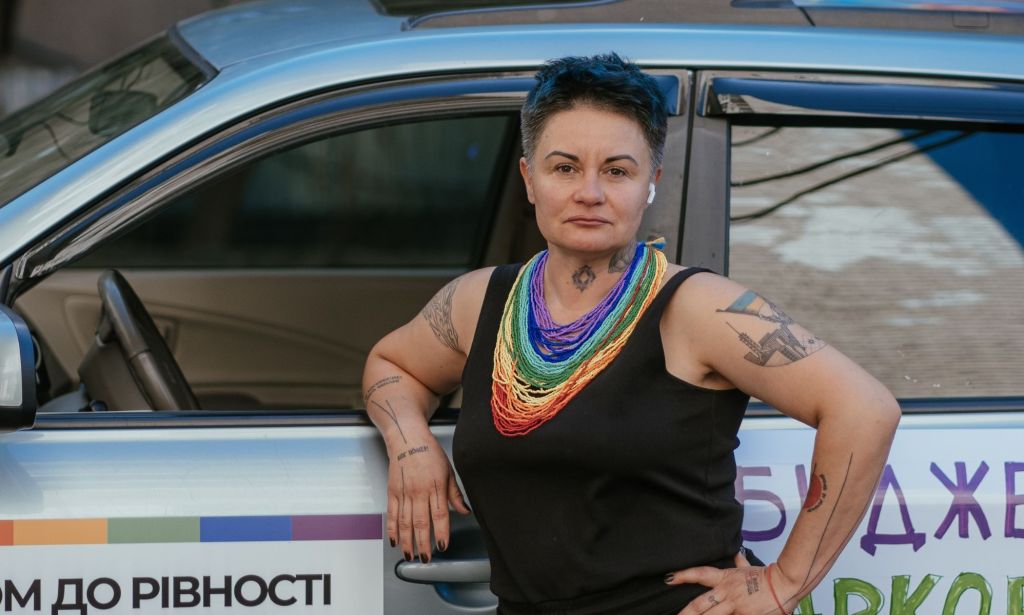
The sixth annual Kharkiv Pride parade took place on Sunday (15 September) with scores of queer people taking part in an “auto Pride”, where cars were driven through the town centre, with Ukrainian and LGBTQ+ Pride flags flying from their windows.
A similar event took place in Kharkiv during the pandemic in 2020 as a way to uphold social-distancing regulations.
Organisers estimated that 13 cars filled with about 60 passengers drove across the city’s main avenues, promoting the need to uphold human rights, as onlookers celebrated. Auto Pride was chosen to “ensure maximum safety” of participants considering the challenges faced by Russia’s invasion more than two-and-a-half years ago.
Each car carried messages urging the Ukrainian parliament to pass legislation criminalising hate crimes, including Bill 5488, which recognises different sentences for crimes committed on the grounds of sexual orientation or gender identity.
Cars drove through the city as part of Kharkiv Pride. (Supplied/KharkivPride)
While LGBTQ+ rights in Ukraine are improving, same-sex marriage is still banned under Article 51 of the constitution, passed in 1996, which defines marriage as a union between a man and a woman. Animosity toward homosexuality remains high, with more than 62 per cent of Ukrainians believing it is “not justifiable”, according to a World Values Survey in 2022.
Others in the parade urged European countries to help protect Kharkiv and support Ukraine in the war.
“We remember every day how important Ukraine’s victory is,” Kharkiv Pride co-organiser Anna Sharygina said. “Just as important to us is the fight for equal rights and the protection of the LGBTQ+ community. People who are fighting, risking their lives, cannot be denied their rights. It is both unjust and undignified, and the war has only highlighted these challenges.”
Several LGBTQ+ participants have served in the Ukrainian armed forces, or still are.
One of them, who uses the call sign “Sapsan,” urged the Ukrainian forces to acknowledge the presence of queer people in the army.
“Those who attend the march represent the voices of those on the front lines and, sadly, those who are no longer with us,” he said, before urging the government to pass Bill 5488.
The new ride-share was launched over the weekend in the country’s cultural capital of Lahore. It’s called SheDrives and will service only trans people and women, according to Ammaz Farooqi, the company’s chief executive.
For now, it will service only Lahore, but expansion is possible, Farooqi said.
There are an estimated 30,000 trans people in Lahore, and organizations working for their welfare estimate that across Pakistan, the transgender community numbers about 500,000 out of the total population of 240 million.
Trans people are considered outcasts by many, especially in conservative areas of Pakistan, a predominantly Muslim country. They are often sexually abused, assaulted and even murdered. They hesitate to enroll in regular schools to avoid discrimination, and when they travel on public buses or trains many are exposed to ridicule, hurtful jokes and other forms of harassment.
Pakistani women also face similar harassment when daring to travel alone in bus or train coaches with other, male passengers.
“A unique aspect of this app and ride service is that the drivers and passengers will be women and transgender persons,” Farooqi said.
Pink logos painted on the vehicles would allow women and trans people to recognize them.
Farooqi, who is not trans, said he feels optimistic the future will be more inclusive for everyone.
“I have taken a small step and we may expand this service to other cities,” he said.
Pakistan in 2022 established a hotline for trans people connected to police offices and the Ministry of Human Rights, and the year before, authorities opened the country’s first government-run school for transgender students in the central city of Multan.
The country’s parliament also drafted a transgender rights bill to allow trans people choose their gender identity for previously issued government documents, educational certificates and national identity cards.
But the proposed amendments have caused controversy, with hard-line clerics opposing them. Human rights experts say a lot is still to be done to ensure recognition of trans people on a social level.
The hotly anticipated results are in from a landmark pair of major clinical trials of a long-acting, injectable HIV-prevention drug that only requires dosing every six months.
They are sensational.
Thrilled over the news Thursday that lenacapavir was 89% more effective at preventing HIV than daily oral preventive medication among gay, bisexual and transgender people, plus previous news that the injectable drug was 100% effective in cisgender women, HIV advocates are looking to the future. They hope that if rolled out broadly and equitably, lenacapavir could be the game changer the nation badly needs.
“These kinds of results are unprecedented,” said Dr. Jared Baeten, senior vice president of virology clinical development at Gilead Sciences, which manufactures lenacapavir. “I have moments like this where I truly am speechless. What this can mean for the trajectory of the HIV epidemic is everything that all the world has imagined for years. We can actually turn off new infections.”
And yet, as battle-worn public health advocates stand on the front lines of an over four-decade effort to finally bring the U.S. HIV epidemic to heel, they find a cold, hard fact staring back at them: Lenacapavir is extraordinarily expensive.
Calling lenacapavir’s clinical trial results “nothing short of amazing,” Jen Kates, director of global health and HIV policy at the nonpartisan health nonprofit KFF, said the news “raises the stakes on the importance of getting this new tool to all those who need it, in the United States and around the world. The track record thus far has unfortunately not been a good one.”
Gilead also manufactures Truvada and Descovy, the two daily oral tablets approved for use as pre-exposure prophylaxis, or PrEP. The pharma giant has already secured approval for the injectable drug in treating highly drug-resistant HIV.
Lenacapavir’s current list price for use as HIV treatment is $3,450 per month. Gilead has not yet indicated whether it will set a different price for the drug’s use as PrEP. A company spokesperson told NBC News on Thursday, however, that the reference point for the price of lenacapavir as PrEP will not be its current use as treatment. It remains unclear whether that statement signals a willingness on the part of the pharmaceutical giant to bring the injectable drug’s price down closer to Earth for its use as HIV prevention.
Given that Truvada has been available as a generic since 2020 and now costs as little as $20 per month (Descovy remains on patent and has a $2,200 sticker price), it remains unclear whether, absent some perhaps novel form of government intervention, insurers will indeed make lenacapavir available widely enough to have what epidemiologists predict could be a sweeping public health impact.
Gilead plans to submit lenacapavir for approval for use as PrEP to the Food and Drug Administration by the end of the year. So this powerful new HIV-prevention tool could hit the U.S. market by mid-to-late 2025.
An HIV-prevention upgrade is badly needed. Since Truvada was approved as the first form of PrEP 12 years ago, the drug has failed to achieve anything in the U.S. approaching its awesome impact on HIV rates among gay and bisexual men in wealthy Western nations such as Australia and the United Kingdom. Those countries boast the type of streamlined sexual-health-care systems that the fragmented U.S. health care system lacks.
“The entire story of PrEP is a missed opportunity,” said Amy Killelea, a health consultant in Arlington, Virginia, and a prominent HIV advocate.
Unprecedented clinical trial results
The advanced clinical trial of lenacapavir in gay men was launched in 2021 at 88 sites across the U.S. and Latin America, and in South Africa and Thailand. It enrolled more than 3,250 cisgender men and transgender and nonbinary people who have sex with male partners.
The participants were randomized to receive either lenacapavir or Truvada on a placebo-controlled, double-blind basis, meaning neither the participants nor the researchers knew who was getting which drug. They were instructed to return every six months for an injection and to take the one dose of the provided pills daily.
A planned interim independent analysis of the trial results indicated that two out of 2,180 participants who received lenacapavir contracted HIV during the trial, as did nine out of 1,087 people who got Truvada. For the lenacapavir group, this represented an 89% lower HIV rate than those in the Truvada group and what Gilead estimated was a 96% lower infection rate than would be expected absent either drug.
Given the clear statistical superiority of lenacapavir over Truvada, the trial’s blinded phase will now be ended several months early. The participants will be informed of which drug they received and provided the option of receiving either going forward.
Lenacapavir proved safe and well-tolerated, with no major safety concerns, according to Gilead. One catch is that the subcutaneous, or under the skin, injection of the drug in the abdominal area leaves a small deposit that can be visible among those with low body fat. It is possible that in real-world use, some will find this off-putting or stigmatizing.
When taken as prescribed, Truvada is over 99% effective at preventing HIV; Descovy is comparably effective. But poor adherence to the daily oral PrEP regimen compromises oral PrEP’s efficacy. And gay and bisexual Black men in particular — the group with the highest HIV rate — have often posted particularly low adherence rates in oral PrEP studies.
The Centers for Disease Control and Prevention estimated in May that between 2018 and 2022, annual U.S. HIV transmissions declined by a modest 12%, from 36,200 to 31,800 cases. Approximately 7 in 10 new HIV cases are in gay and bisexual men, with Black people and Latinos in this group acquiring the virus at much higher rates than their white counterparts. Transgender women, in particular those of color, are also at substantial risk of the virus.
A problem that has bedeviled the CDC and HIV advocates for over a decade is that, in particular given the disproportionately high rates of the virus in their respective demographic groups, Black and Latino gay and bisexual men have never adopted PrEP use at the critical mass needed to truly bring the U.S. epidemic to heel among them. Meanwhile, PrEP has accelerated a long-standing decline in HIV among their white counterparts, exacerbating the gap between the groups.
HIV advocates worry that lenacapavir could only widen such racial disparities further.
“Oral PrEP has been around since 2012. Look at our failure,” said Jirair Ratevosian, an associate research scientist at the Yale School of Nursing.“How do we learn from the past so we don’t squander the opportunity?”
Excitement about lenacapavir’s potential
Dr. Hansel Tookes, a professor in the infectious diseases division at the University of Miami Miller School of Medicine, was the most bullish HIV expert to speak with NBC News about lenacapavir’s prospects.
“I am borderline delusional,” Tookes said of his excitement about how lenacapavir could benefit, in particular, the Southern gay men of color he’s charged with helping protect from HIV.
The South, where the effort to treat and prevent HIV remains hampered by the refusal by seven of 11 states to expand Medicaid under the Affordable Care Act, accounts for half of all new HIV cases, according to the CDC.
“Right now, the challenge is having people take a pill every day to prevent something that they don’t have,” said Tookes of the difficulty of engaging young people in particular in such a banal, forward-thinking routine. “Having to get an injection twice a year is an easier sell.”
Dr. Boghuma Titanji, an infectious disease specialist at Emory University, said she frequently sees new HIV diagnoses in Atlanta, where her university is based, especially among young Black and Latino men who have sex with men.
“These groups often lack access to and information about existing PrEP options,” she said. “While lenacapavir is a valuable addition to our toolkit, for it to reach its full potential, it must be made accessible to those who stand to benefit the most from its effectiveness.”
After Gilead released its initial findings in June from an advanced clinical trial of lenacapavir in cisgender women and adolescent girls in sub-Saharan Africa, HIV advocates immediately put pressure on Gilead to provide the drug at a scalable cost to lower-income nations. This chorus is sure to get louder now that lenacapavir is officially highly effective at protecting gay and bisexual men and trans people as well. Still to come are results from ongoing clinical trials of the drug in people who inject drugs and cisgender women in the U.S.
On Thursday, Gilead stated in a release that the company is committed to delivering “lenacapavir swiftly, sustainably and in sufficient volumes, if approved, to high-incidence, resource-limited countries, which are primarily low- and lower-middle-income countries.” The company is in “active discussions with the HIV community” about these plans.
“It’s not progress if lenacapavir’s cost and other structural challenges impede access, domestically or globally,” said Tim Horn, director of medication access at the public health nonprofit NASTAD. “The results of the drug’s clinical trials, he said, “must be to the benefit of all people at risk for HIV, including those with cost-related hurdles to state-of-the-art prevention and care.”
CORRECTION (Sept. 12, 2024, 3:15 p.m. ET): A previous version of this article misstated the monthly sticker price of ViiV Healthcare’s injectable drug Apretude. It’s $1,965 monthly, not $3,930. The price per injection, which is administered every two months, is $3,930.
Saturday, Sept. 21 @ 8 pm. Electric Tumbleweed at Occidental Center for the Arts. Electric Tumbleweed is back for our first dance party of the season! Join us for a fun evening of lively, jammy outlaw originals and your favorite jam tunes from Sonoma County’s busiest performers: Bud Dillard, Rhyne Erde, Riley Hill, Dave Zirbel and Scotty Brown.Limited seating – open dance floor. Refreshments for sale, art gallery open during intermission. Tickets are $20 GA, $15 for OCA members at www.occidentalcenterforthearts.org. OCA is wheelchair accessible. 3850 Doris Murphy Ct. Occidental, CA. 95465. 707-874-9392. OCA is a 501 K community-based arts organization with volunteer staffing
A school district in northeastern Florida must return three dozen books related to race and the LGBTQ community to school libraries as part of a settlement reached Thursday with authors, parents and students.
The Nassau County School Board removed 36 books last year after the titles were challenged by Citizens Defending Freedom, a conservative advocacy group. The books included “And Tango Makes Three,” a popular children’s book by Peter Parnell and Justin Richardson based on the true story of two male penguins who raised a chick together at New York’s Central Park Zoo, as well as classics such as “The Bluest Eye” by Toni Morrison and “Crank” by Ellen Hopkins.
“This settlement — a watershed moment in the ongoing battle against book censorship in the United States — significantly restores access to important works that were unlawfully removed from the shelves of Nassau County, Florida’s public school libraries,” said Lauren Zimmerman, an attorney with the New York law firm Selendy Gay, which sued the district on behalf of Parnell and Richardson, along with Florida parents Sara Moerman, Toby Lentz and their children.
“Students will once again have access to books from well-known and highly-lauded authors representing a broad range of viewpoints and ideas,” Zimmerman added in a statement.
The Nassau County School Board did not immediately return a request for comment.
The suit was among several that challenged the removal of books by school districts across Florida under a law signed by Republican Gov. Ron DeSantis that made it easier for community members to challenge books they found to be inappropriate in school libraries. The law, which has since been rolled back, was part of a handful of bills that restricted how schools can provide information about race and the LGBTQ community.
The plaintiffs filed their suit in May, arguing that the school board used “unlawful censorship” to remove “the children’s book behind closed doors and without community involvement or comment.” The suit also argued that the district violated the state’s “Sunshine Law” by removing the books without a public meeting.
“They have a statutory right to get the opportunity to attend and comment on these types of decisions, the removal of books or the restriction of books, and they weren’t given that opportunity here,” Zimmerman told First Coast News at the time. “All 36 books, including ‘Tango’, were removed without any public hearing whatsoever, which means there wasn’t any community commentary on, you know, whether this was the appropriate decision.”
From July 2021 through December 2023, Florida had the highest number of book-ban cases in the U.S., at 3,135 bans across 11 school districts, according to an April report from PEN America, a nonprofit that works to protect free expression and has also filed a lawsuit against another Florida county over book bans.
Books with LGBTQ characters and themes made up 36% of all book bans from 2021 to 2023, while books about race and racism and books with characters of color made up 37% of all bans, PEN America found.Book ban numbers from the full 2023-2024 school year have not yet been released but by midway through that school year, according to PEN America, book bans had already surpassed the previous school year’s total.
GLAAD, the LGBTQ media advocacy organization, has released its 12th annual Studio Responsibility Index tracking films released during 2023. Despite “a huge increase in LGBTQ characters who were front and center in their own narratives,” the study found the number of films with LGBTQ characters dropped in 2023.
The survey looked at 256 films from 10 major distributors and their subsidiaries and streaming services. GLAAD says the index can serve as a guide for studios to identify priorities and opportunities to increase and improve fair, accurate and inclusive LGBTQ representation and storytelling.
Key findings of the study included:
70 of the 256 films, or 27.3%, contained an LGBTQ character, a decrease from 28.5% in 2022.
Those 70 films included 170 LGBTQ characters, of which 46% were characters of color, representing an increase of 6% from the 2022 study.
Of the 170 LGBTQ characters surveyed, only two were transgender, from the films “Next Goal Wins” and “¡Que Viva Mexico!,” down from 13 the previous year. GLAAD noted the “¡Que Viva Mexico!” character was played by a cisgender man and called the number “alarmingly low.”
Just two of the 170 LGBTQ characters had a disability, a decrease from 11 in the previous year.
The survey ranked the 10 distributors based on the quality, quantity and diversity of LGBTQ inclusion in addition to GLAAD’s Vito Russo Test, a set of criteria to analyze how characters are included in a film. Distributor ratings found A24 to be insufficient, while Amazon was good, Apple TV+ was failing, Lionsgate was insufficient, NBCUniversal and Netflix were fair, Paramount Global, Sony and Walt Disney Studios were insufficient, and Warner Bros. Discovery was poor. (NBCUniversal is the parent company of NBC News.)
“Though there is inconsistent progress on LGBTQ representation from major distributors year to year, recent films with LGBTQ leads prove that our stories can absolutely be both critical and commercial successes — when they have the full support of the studio behind them,” GLAAD President and CEO Sarah Kate Ellis said in a statement. “As the film production and distribution model continues to evolve, major distributors must deepen investment and intention in storytelling efforts to retain the attention of growing young diverse audiences, who crave stories that reflect their experience and their values. If LGBTQ representation continues to decline in major releases, these companies will lose relevance with a crucial buying audience. GLAAD is committed to continuing and deepening our work with studios and the creative community to ensure we meet this moment together.”
Megan Townsend, GLAAD’s senior director of entertainment research and analysis, said the decrease in trans representation was particularly concerning.
“This year’s study found a significant and concerning decrease in representation of transgender characters and stories, down from 12 titles to just two — and one of those films was blatantly transphobic, she said. “We know that less than 30% of American adults personally know someone who is transgender, therefore they may be more susceptible to lies and misinformation about trans people spread by anti-transgender politicians and activists.”
With the aim of achieving more representation in LGBTQ content, GLAAD is spearheading initiatives such as the GLAAD List of unproduced scripts; the Communities of Color team which launched the Black Queer Creative Summit and Equity in Media and Entertainment Initiative; GLAAD Spirit Day on Oct. 17; the GLAAD Media Institute and the GLAAD research department.
Meta on Monday said that it planned to bar Russian media outlets including RT, the state-owned television network that has come under scrutiny in the United States, from posting to its platforms, saying the outlets had carried out covert influence campaigns across social media sites to manipulate discourse online.
Meta, which owns Facebook, Instagram and WhatsApp, said the ban would take place in the coming days. The move escalates actions against Russian state media actors that U.S. intelligence officials have said run disinformation operations across the world’s largest social networks.
Georgian lawmakers on Tuesday approved the third and final reading of a law on “family values and the protection of minors” that would impose sweeping curbs on LGBT rights. The bill would provide a legal basis for authorities to outlaw Pride events and public displays of the LGBT rainbow flag, and to impose censorship of films and books.
Leaders of the governing Georgian Dream party say it is needed to safeguard traditional moral standards in Georgia, whose deeply conservative Orthodox Church is highly influential.
Georgian President Salome Zourabichvili [photo], a critic of Georgian Dream whose powers are mostly ceremonial, has indicated that she will block the bill. But Georgian Dream and its allies have enough seats in parliament to override her veto.