Friday, June 7, 2024 6:00 – 8:00 PM$5.00 – $10.00 | Free for members GLBT Historical Society Museum 4127 18th Street San Francisco, CA 94114
About the ExhibitionThis exhibition preserves the memory of San Francisco’s bohemian past and its essential role in the development of American adult entertainment. It highlights the contributions of queer women, trans women, and women of color who were instrumental in the city’s labor history, as well as its LGBTQ and sex workers’ rights movements.
In the 1960s, topless entertainment became legal in the city for the first time in US history, though cross-dressing continued to be criminalized. In the 1990s, stripper-artist-activists led the first successful class action lawsuits and efforts to unionize. The exhibit sheds light on intersectional communities in the making and the women who played a critical role in this history, which has often been hidden from view.
This exhibit is titled after Gigi Otálvaro-Hormillosa’s dissertation, now published as Erotic Resistance: The Struggle for the Soul of San Francisco (University of California Press, 2024). During her research, she encountered objects in the GLBT Historical Society’s archives that are featured in this exhibition and that tell the story of the cross-pollination of LGBTQ venues, strip clubs, and burlesque theaters by sex worker and LGBTQ communities alike, during the latter part of the twentieth century.About the CuratorGigi Otálvaro-Hormillosa, PhD, is an artist-scholar who teaches and writes about art and activism, queer of color critique, erotic performance, and the intersections of mindfulness and creative practice. She holds a doctorate in Theater and Performance Studies with a minor in Art History from Stanford University, where she currently leads the LifeWorks Program for Integrative Learning.About the ExhibitionAbout the Reception The reception will include light refreshments and brief remarks. We are no longer requiring proof of vaccination to enter the museums, but masks are encouraged and will be made available to guests at check in. Visit our COVID-19 page or more information.Purchase your tickets
Photo Credits: Isis Rodríguez, Zapatista Stripper, developed during Guillermo Gomez-Peña’s The Mexterminator Project (1998).
San Francisco District Attorney Brooke Jenkins announced this week that her office secured a conviction of Ronald Anthony Silveria (27), of Fremont, after a trial by jury for attacking and stealing from a man he met on the Grindr application.
Silveria was convicted of first-degree robbery (PC 211), false imprisonment by violence or menace (PC 236/237(a)), identity theft (PC 530.5(a)), and misdemeanor assault (PC 240) and false imprisonment (PC 236).
“The jury’s verdict holds Mr. Silveria accountable for his despicable crimes,” said District Attorney Jenkins. “My office will always stand with victims of crime and work to ensure there are consequences for criminal behavior.”
According to evidence and other testimony presented at trial on September 15, 2022, Silveria met a man in Fremont through the Grindr app. They traveled in separate cars to a San Francisco motel where the victim had rented a room.
After hanging out in the room for a while, Silveria pulled out a gun and tied the victim, who was naked, to the bed. He then proceeded to go through the victim’s bags and electronics, hitting the victim and demanding passwords for bank apps. Silveria eventually agreed to release the victim if he withdrew $400 from an ATM and gave it to him.
The victim agreed and Silveria allowed him to dress, then forced him to wipe down the room, and get into his car to drive to a nearby ATM. After taking the $400, Silveria refused to return the victim’s car keys and belongings. Silveria then drove across the Bay Bridge and abandoned the victim in Emeryville, California at 4:30am. He drove off with all of victim’s belongings including his phone, iPad, and wallet.
The case against Silveria was successfully prosecuted by Assistant District Attorney Edward Mario, with assistance from District Attorney Investigator Mike Beaver, and paralegal Melissa Cruz. The case was successfully prosecuted based on the thorough investigation of the San Francisco Police Department’s Robbery Division and the ongoing participation from the victims.
“Mr. Silveria preyed on a man who was in a trusting, compromised, and vulnerable position,” said Assistant District Attorney Edward Mario. “I thank the victim for his bravery in testifying and re-living traumatic life events. This conviction ensures accountability for Mr. Silveria’s actions and provide a measure of justice for the victim.”
Silveria is currently in custody. He faces up to twelve years in state prison for his crimes. Sentencing is scheduled for May 22, 2024.
The Huge-hearted Musical Hit of Unlikely Business Partners!
A young businessman is desperately trying to save the near-bankrupt gentlemen’s shoe factory he suddenly, reluctantly, inherited. A chance encounter with a drag diva in need of a boot repair unites the two in a business venture that takes them from a fading industrial town in England to the glamorous catwalks of Milan. Inspired by true events.
The South Carolina legislature has just passed a ban on gender-affirming care, making it the 25th state to do so. The ban also requires educators to out trans students to their potentially unsupportive parents. Gov. Henry McMaster (R) has signaled that he’s likely to sign it into law. If he does, the law will take effect immediately.
House Bill 4624 will prohibit healthcare professionals from providing puberty blockers, hormone therapy, or surgeries to people under the age of 18, even though such surgeries are rarely ever performed on minors. Any professional who provides these to a minor can risk being disciplined by the state medical licensing board or have their licenses revoked.
The bill states that any minors receiving gender-affirming medications must quit receiving them by the end of January 2025. Major American medical associations have said that gender-affirming care is safe, effective, and essential to the overall well-being of trans youth. Ending such care can worsen a trans youth’s sense of gender dysphoria and increase their risk of suicide.
The Campaign for Southern Equality, a state LGBTQ+ advocacy organization, has launched the Southern Trans Youth Emergency Project to help fund and provide information to families so that trans youth can continue receiving gender-affirming care despite the coming ban.
The bill additionally states that healthcare professionals in South Carolina who provide gender-affirming care can be sued by a patient or their parents until the patient in question turns 39 years old.
The bill forbids public funding, including Medicaid, from being used “directly or indirectly” for gender-affirming care. This provision may face an immediate challenge since the 4th U.S. Circuit Court of Appeals, which includes South Carolina, ruled in April that government- and state-funded health care and insurance plans cannot exclude coverage for gender-affirming medical care, The Hill reported.
The bill also requires school principals and counselors to notify parents if a child indicates in any way that their gender identity doesn’t match the sex they were assigned at birth. This provision will make trans, nonbinary, and gender-fluid students less likely to seek help from trusted adults in schools, leaving them without any adult support if their parents disapprove of their gender identity.
In January, Gov. McMaster called the bill “a good idea,” adding, “If they wanna make those decisions later when they’re adults then that’s a different story, but we must prevent our young people from making irreversible errors.” Several studies have shown that most people who receive gender-affirming healthcare do not regret it.
A March 2024 poll found that 71% of South Carolina voters felt that the government should not intervene in LGBTQ gender-affirming healthcare decisions that regard individuals under the age of 18.
LGBTQ+ advocates condemn the ban & promise to sue
Responding to the law’s recent passage in the state legislature, Cathryn Oakley, senior director of legal policy for the Human Rights Campaign, wrote, “This is a major violation of South Carolinians’ liberty. South Carolina legislators abused their power today by substituting their judgment for that of parents, medical professionals, mental health care professionals, and other experts.”
Chase Glenn, Executive Director of the Alliance for Full Acceptance wrote, “Denying transgender people access to medically-necessary healthcare is not only a violation of their basic human rights but also an egregious display of intolerance. We will not back down and will continue to stand in solidarity with our transgender community today in their fight for their dignity, respect, and equal rights.”
Ivy Hill, a leader in the South Carolina United for Justice & Equality coalition, wrote, “We will be organizing tirelessly in the hours ahead to ensure that we’ve left everything on the field and pushed back against this legislative attack with everything we have.”
In a post on the social platform X, the Campaign for Southern Equality wrote, “We are sending so much love, support and solidarity and want trans people in SC to know that you are loved, affirmed, and seen – and that there is an entire community ready to fight against these oppressive laws.”
Editor’s note: If you or someone you know is struggling or in crisis, help is available. Call or text 988 or chat at 988lifeline.org. The Trans Lifeline (1-877-565-8860) is staffed by trans people and will not contact law enforcement. The Trevor Project provides a safe, judgement-free place to talk for youth via chat, text (678-678), or phone (1-866-488-7386). Help is available at all three resources in English and Spanish.
The Milwaukee LGBT Community Center is working to keep its doors and services open for hundreds of people with a funding campaign. The financial outlook currently is dire as the center has a May 31 deadline to raise the required funds so that the Leonard-Litz Foundation will match it.
The community center is attempting to raise $25,000. When it achieves that goal, the Leonard-Litz LGBTQ+ Foundation will match the funding for a total campaign of $50,000.
In an interview with ABC News affiliate WISN 12 News in Milwaukee, Ricardo Galaviz, the center’s associate director said keeping the center’s doors open is not only his goal, but also a full circle moment for him.
“Everyone was telling me, like being gay is going to hinder you,” Galaviz told WISN 12 News journalist Diana Gutierrez. “You’re never going to be successful because of who you are,” he added.
WISN 12 reported that at 16, Galaviz found support at Project U, a youth program at the Milwaukee LGBT Community Center. “At the time, my family was not accepting,” he said.
Years later he’s the associate director of the same center that saved him.
“Not only was I able to find people like me, but I was also able to see people who are like me in positions of success,” Galaviz said. He stressed that currently, the center is in need of some saving, too. “The sustainability of the center is what we’re trying to lock down right now,” he said.
In a Facebook post the center noted: “Free activities like yoga classes, potlucks, teen nights, crafternoons, discussion groups, book clubs, and so many more would not be possible without the generosity of our members and donors.”
According to the website of the Leonard-Litz LBGTQ+ Foundation, its mission is to “fund organizations which advance the interests and well-being of the LGBTQ+ community.” The foundation gives grants to local LGBTQ+ organizations, usually focusing most on the U.S. Northeast.
WISN 12 reported the fundraising plan is meant to bring the organization, located at Dr. M.L.K. Jr. Drive and Court Street, back to its full operating status. The organization’s new Interim Executive Director Ritchie T. Martin Jr. and the board of directors created this plan and partnership.
“We are extremely grateful to the Leonard-Litz Foundation for providing us with a grant to keep our doors open and a further matching grant,” said Martin Jr. “Now we look to our donors and community to help us in this next step of getting the Milwaukee LGBT Community Center to a stronger future.”
“From the people that were utilizing services prior to the pandemic. Compared to now, the numbers have multiplied quite quickly,” Galaviz told WISN 12. “We understand the importance of self-care, of taking care of ourselves, not just health wise, physical health, but also emotional and mental health. So, we’re seeing a lot of those services be the ones that people are looking for.”
He stressed it’s important to keep this center running. And although this might be a tough time, he wants to highlight the positives.
“There’s a lot of things that are happening socially, politically to this community. But there’s also a lot of things to celebrate here in Milwaukee. The great things that the center is doing, the great things that we’re able to provide the community,” Galaviz said. “I want people to know too that this is a thriving community. It’s not just a community that’s, you know, in crisis mode. We are in crisis mode. But as history has taught us, we have to come together. We’re all we have, but we’re also all we need.”
Target Corp. won’t sell LGBTQ-themed merchandise in some stores during Pride Month in June, after a backlash dented revenue last year. Target faced threats from some customers last year over its Pride merchandise.
The Minneapolis-based retailer plans to offer the full assortment online but is considering store-level data to decide which physical locations will carry the products, people familiar with the matter said, declining to be identified discussing private information.
Target is likely to stock the products in about half of its nearly 2,000 stores in the US, the people said. The company has typically sold the Pride assortment in all of its stores in recent years.
The U.S. Food and Drug Administration (FDA) has granted a priority review for a trans-inclusive cervical screening at-home test to become approved in the US, and we think it’s high time for a change.
For women, trans and non-binary people with uteruses, undergoing a regular cervical smear to prevent and detect cervical cancer can be an unpleasant experience due to the cold and down-right uncomfortable speculum used. Some gender-diverse people also experience gender-based discrimination in such appointments.
The outdated device used in pelvic appointments to separate the vaginal walls can be cold and uncomfortable. The clamp-like instrument was invented in the mid-19th century and hasn’t adapted much since its bleak origins.
But the wait for a trans-inclusive and women’s-forward cervical screening at-home test might not be much longer, as the Teal Wand has been granted Breakthrough Device Designation status from the FDA. This means once the women-owned brand Teal Health submits its final study, it will be fast-tracked for a review.
This status is reserved for devices which the FDA believes could provide more effective diagnosis or treatment of life-threatening diseases, as well as their potential to benefit populations impacted by healthcare disparities.
The new device allows people at risk of cervical cancer (all those with a cervix who are or have been sexually active) to perform their pap smear in the comfort of their own home with less discomfort, nerves and pain, compared to in-clinic collection methods, according to clinical trial results.
The tool combines a wand designed to fit all bodies”, a dial which “moves up and down to extend and retract the sponge”, and a soft sponge which collects the cervical cells for testing.
Similar self-collection screenings for cervical cancer are already available in other countries. In Australia, the government introduced such tests in July 2022.
A Roman Catholic high school in Charlotte, North Carolina, did not violate federal civil rights law by firing a gay teacher after he announced that he would marry his same-sex partner, a federal appeals court ruled Wednesday, overturning a lower court ruling.
Lonnie Billard, a longtime teacher at Charlotte Catholic High School, shared a post on Facebook in 2014, shortly after the state legalized same-sex marriage, saying that he and his partner were engaged. He was fired several weeks later. Billard then sued the school for sex discrimination under Title VII of the Civil Rights Act, and a district court judge ruled in his favor in 2021.
Wednesday’s decision by the 4th U.S. Circuit Court of Appeals, however, reversed that ruling, finding that the religious high school’s termination of Billard “falls under the ministerial exception to Title VII.”
“We conclude that the school entrusted Billard with ‘vital religious duties,’ making him a ‘messenger’ of its faith and placing him within the ministerial exception,” the ruling, written by Judge Pamela Harris, states.
Title VII prohibits employment discrimination based on race, color, religion, sex and national origin, and in the 2020 landmark Supreme Court case Bostock v. Clayton County, Georgia, the high court ruled that workplace sex discrimination includes discrimination based on sexual orientation and gender identity. However, the Supreme Court has upheld that nondiscrimination laws are subject to a carve out, known as a “ministerial exception,” which permits religious organizations from being subjected to government interference in the hiring and firing of people in religious roles.
The Becket Fund for Religious Liberty, which represented the school and the Roman Catholic Diocese of Charlotte, applauded the ruling.
“The Supreme Court has been crystal clear on this issue: Catholic schools have the freedom to choose teachers who fully support Catholic teaching,” Luke Goodrich, Becket’s vice president and senior counsel, said in a statement. “This is a victory for people of all faiths who cherish the freedom to pass on their faith to the next generation.”
The American Civil Liberties Union, the ACLU of North Carolina and Tin Fulton Walker & Owen, which represented the plaintiff, issued a statement that referenced the Bostock decision and its protection for LGBTQ workers.
“This is a heartbreaking decision for our client who wanted nothing more than the freedom to perform his duties as an educator without hiding who he is or who he loves,” the statement said. “While today’s decision is narrowly tailored to Mr. Billard and the facts of his employment, it nonetheless threatens to encroach on that principle by widening the loopholes employers may use to fire people like Mr. Billard for openly discriminatory reasons.”
Billard and his lawyers have 14 days to request a rehearing by the 4th Circuit or 90 days to appeal to the Supreme Court. The ACLU declined to comment on whether they would make a rehearing request or appeal.
Two Russian online film distributors, including a company owned by Nasdaq-listed internet giant Yandex have been charged with offenses under the country’s so-called LGBT propaganda law, a notice on a Moscow court’s website said.
Russia last year expanded its restrictions on the promotion of what it calls LGBT propaganda amid a broader clampdown on queer rights, which President Vladimir Putin has sought to portray as evidence of moral decay in Western countries.
The companies, Kinopoisk and Restream Media, face an administrative case for the “propaganda of non-traditional sexual relationships” or “gender reassignment” online, according to the notice posted on Wednesday.
Separate charges were filed on Wednesday against two Kinopoisk and Restream Media executives for the same offense, an online court notice showed.
Yandex-owned Kinopoisk and Restream Media, majority-owned by digital services giant Rostelecom have both been fined repeatedly under a similar article banning the “demonstration” of LGBTQ relationships to minors.
That resulted from them listing films such as “Bridget Jones’s Diary” and “Perfect Strangers” without an 18+ label.
A spokesperson for Kinopoisk told Reuters that the charge was related to its listing of the U.S. television series “Supergirl,” which features a same-sex relationship, and that the company planned to challenge the court ruling.
“The laws and regulations as currently drafted do not provide sufficient objective criteria for determining propaganda of non-traditional relationships,” the company said in a statement provided to Reuters.
“We hope that the current practice of fines against online cinemas will be revised to warnings.”
Restream Media did not immediately reply to an emailed request for comment.
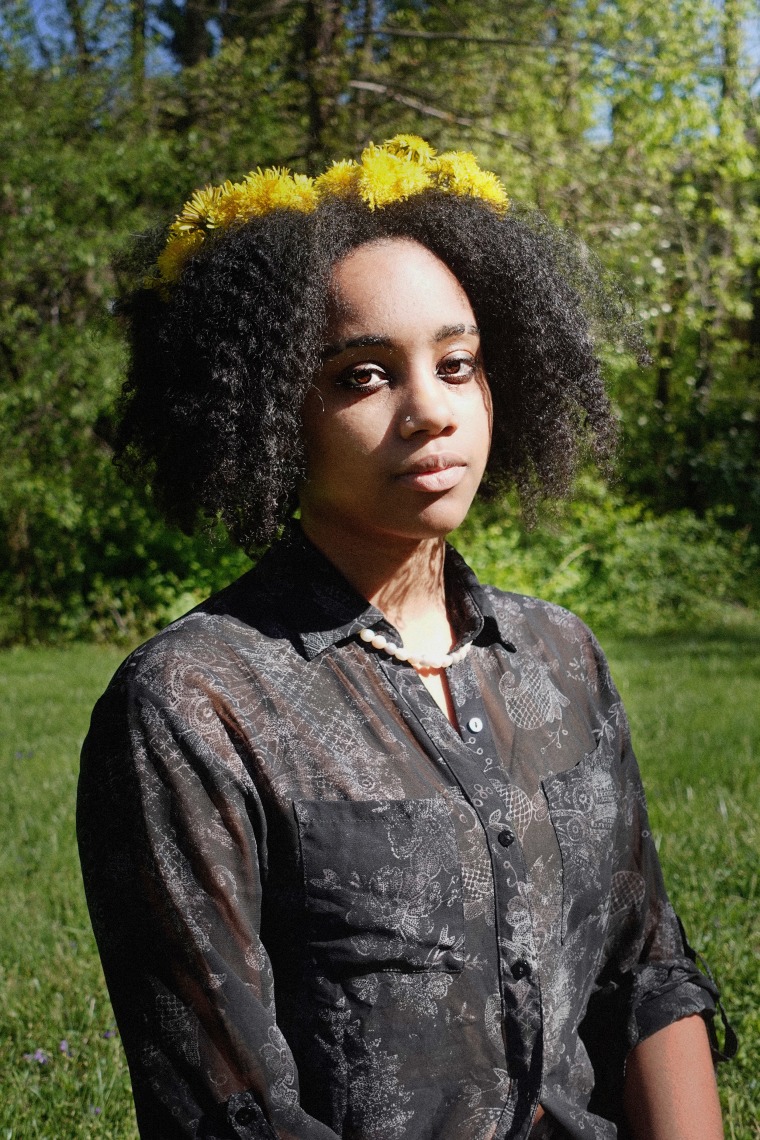
When people look at images captured by Ty Busey, the photographer says she wants them to know that the pictures and films were captured by a queer woman. Drawing on Renaissance paintings as inspiration, Busey poses her subjects, who are LGBTQ women and nonbinary people, with halos and textured backgrounds in lounging postures. She describes her artistic eye in one word: “Sapphic.”
The term derives from Sappho, a lyrical poet who lived in ancient Greece and created verses about pursuing women lovers that were rich in sensuality and nostalgia — and even libertine at times.
A self-portrait of photographer Ty Busey.Courtesy of Ty Busey
The style of Busey’s work is a fitting way to rectify its namesake’s historical legacy. In the hundreds of years after her death around 570 B.C.E., Sappho was often portrayed in art as heterosexual when her own poetry said otherwise.
When asked what she hopes viewers take away from her visuals, Busey said, “I want the person watching the video to be like, ‘Yes, this is what it feels like to be with a woman.’”
Busey, a Maryland resident who has identified as a lesbian since she was a teenager, first learned about the label “Sapphic” on TikTok in 2021. In the years since she’s embraced the term, it has abounded, appearing on social media meme pages, as a literary genre, as a descriptor for events in brick and mortar spaces and even as a noun for self-identification.
Photographer Ty Busey draws on Renaissance paintings for inspiration.Courtesy of Ty Busey
Over two-and-a-half millennia removed from its namesake, the term Sapphic does not have a precise definition that’s agreed upon by all of those who currently embrace it. However, its current use is generally as an umbrella term for lesbians, bisexuals, pansexuals and other women-loving women, and for transgender and nonbinary people who may not identify as women themselves but align with this spectrum of attraction and community.
While Sapphic may evoke ancient images of romance, it has a lesser-known political undercurrent: The poet Sappho resisted tyranny in her own era by the military general Pittacus, making her a potent queer symbol during a tenuous time for LGBTQ rights.
A rebirth on the internet
Describing herself as “chronically online,” Tyler Mead, 28, said she learned about the term Sapphic “funnily enough, actually, on the internet.”
As a singer, songwriter and producer under the moniker STORYBOARDS, she came across queer artists like Fletcher using the term.
“It got me intrigued, and I was like, ‘What does this term mean? What does this mean to them? And, what could it also mean for me?’ Because it’s been a bit of a journey for me of coming out in multiple layers,” Mead said.
In 2018, Mead came out as pansexual, then in 2020 as a trans woman. For the past year, she’s identified as a lesbian and as Sapphic, which she said captures a philosophy of “softness” in her approach to romance and dating.
“An interesting part of being a trans woman who is Sapphic is that, even before I started transitioning, I always knew that I was attracted to women … but not in a straight way,” Mead, who lives in Los Angeles, said.
The expansiveness of the term, she explained, is a strong draw, adding that she knows people who are trans masculine that use it.
A songwriter since middle school, Mead not only considers her music Sapphic but sums up her entire “energy” on the bio section of her TikTok profile as: “Sapphic fairy.”
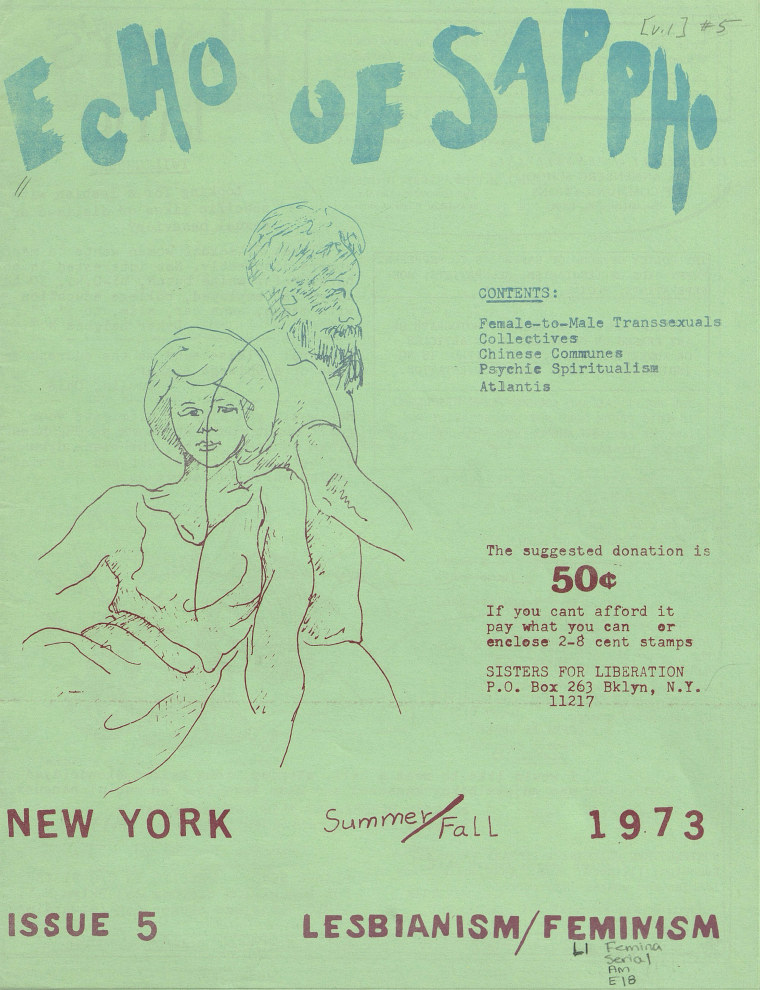
The word “Sappho” appears to have first emerged digitally in 1987 on an early iteration of an email list, according to Avery Dame-Griff, curator of the Queer Digital History Project.
The Greek poet, it seems, was the namesake of an English language mailing list for LGBTQ women during a time when email would have only been accessible to those in academic or computer-related fields, according to Dame-Griff.
A name like Sappho, he explained, would have signaled that the mailing list was for queer women without using a term like “gay” or “lesbian,” which would have drawn unwanted attention.
Since 2004, the first year for which Google Trends provides search data, the term “Sapphic” peaked in December 2005 before steadily declining for the next 15 years. Since 2020, however, it has been on a steady upward trajectory.
Perhaps nowhere is the term currently more prominent than social media, where Sappho-themed meme accounts — Sappho Was Here, Suffering Sappho Memesand Sapphic Sandwich, just to name a few — have amassed tens of thousands of followers on Instagram. And, on TikTok, a wildly popular social media platform among those in the 18-29 demo, the term has been hashtagged over 340,000 times.
Some of those hashtags lead to 26-year-old New Yorker Nina Haines. During the pandemic, Haines said, she was craving queer community. Unable to see LGBTQ friends in person because of Covid, she started posting about Sapphic literature on TikTok in an effort to find connection.
Then, in 2021, Haines founded Sapph-Lit, a book club that today boasts 8,200 members from over 60 countries, with members who identify as queer women and nonbinary people. Her book picks have included modern romances, like Casey McQuiston’s “I Kissed Shara Wheeler,” and classics like Audre Lorde’s “Zami: A New Spelling of My Name.”
Nina Haines, founder of Sapph-Lit, and her Sappho tattoo, inked by Yink of Golden Hour Tattoo in Brooklyn, N.Y.Courtesy of Nina Haines
“At the end of the day, we really want to prioritize Sapphic literature, because Sapphics have been historically rendered invisible throughout history,” she said.
For Haines, who has a tattoo of Sappho on her arm, the term Sapphic “captures the women-loving-women experience” in a way that is “rooted in history” and that signals “that we have always been here.”
A historical legacy
Hailing from the Greek island of Lesbos and living from roughly 630 B.C.E. to 570 B.C.E., what is known of Sappho’s life comes from surviving fragments of her poetry and what was written about her by other ancients, according to Page duBois, the author of 1995’s “Sappho Is Burning” and a professor of classics and comparative literature at the University of California, San Diego.
Sappho’s queer legacy, duBois added, emerges from an expression of romantic and sexual desire toward women in her poems, often with a tint of nostalgia.
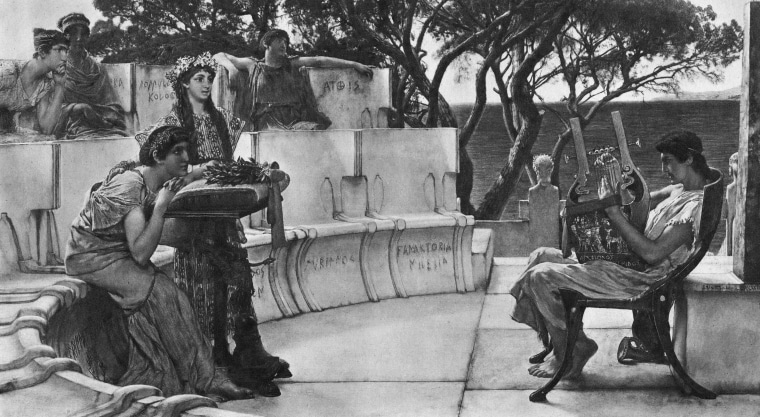
Greek lyric poet Sappho and another woman listen to a performance by fellow poet Alcaeus on the lyre circa 610 B.C. Hulton Archive / Getty Images
“They are really lovely and project that kind of world of voluptuous, flower filled, scented eros [desire] directed toward women,” duBois said.
But a passive “pink, romantic Valentine” she was not. “An aggressive pursuer of her lover,” Sappho described intimate memories of a far away, beloved woman, according to duBois.
“She talks about anointing her with beautiful ointments and putting garlands on her, and satisfying each other on soft beds,” duBois said of Fragment 94 of Sappho’s poetry.
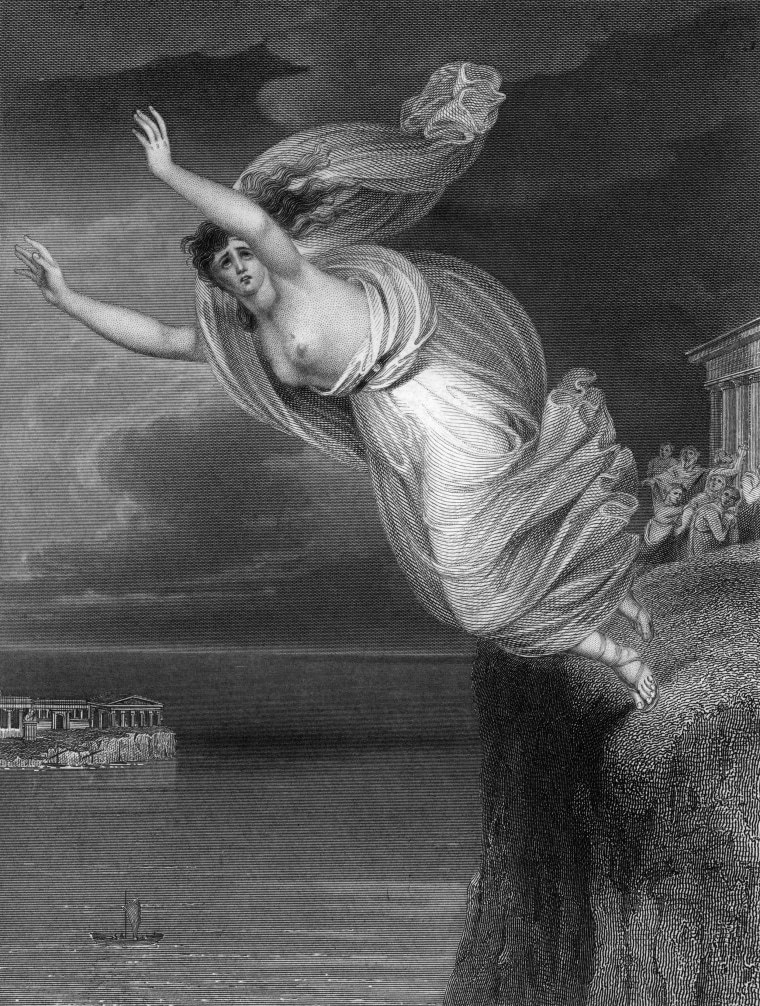
A painting depicting Sappho throwing herself into the sea due to unrequited love, circa 580 B.C.Archive Photos / Getty Images
There are contradictory interpretations that Sappho was a schoolteacher, an aristocrat or a hetaira (a sex worker who operated like a courtesan or geisha), and that she was perhaps enslaved. In the Middle Ages and Victorian periods, she was presented as heterosexual in art, portrayed as a forlorn woman who threw herself off a cliff after she was rejected by a ferryman she loved.
Finding a new generation
For the past 100 years, an ever-evolving lexicon — and a debate about the best terms to use — has been a consistent feature of LGBTQ culture.
Of course, butch, femme, dyke, stud and a host of other terms have been embraced by queer women, each shaped by the communities that created them and the social movements of their time.
“Maybe in some ways, the terms are changing because it’s about a break from a past generation,” said Woolner, an associate professor of history at the University of Memphis.
Though Woolner and others have noted that there are those who eschew certain terms or identifiers, for one reason or another. Some LGBTQ women, for example, don’t identify with “Sapphic” due to a perceived chasteness and the ancient aura.
A photograph from Maryland-based photographer Ty Busey.Courtesy of Ty Busey
For the past three years, Busey has organized a “Sapphic picnic” outside of Washington, D.C. For this year, Busey chose the theme “For the Gods,” an ode to Greek gods and goddesses and conducted a photo shoot to match.
“There’s something about those ancient photos and the way that they’re all falling on each other — I really love them so much,” she said. “I just want to recapture it specifically with women, especially if I could put a Black woman in there.”
More than 2,500 years after Sappho walked the earth, champions of the term Sapphic see the parallels between finding their own power and the erasure and subsequent embrace of the lyrical poet’s queer identity.
“I see her as this reclamation,” Haines said of Sappho. “As this statement of, ‘No, I actually mean the words that I say, and don’t twist them.’”