Senator Scott Wiener (D-San Francisco) released the following statement after receiving a bomb threat targeting his home and office:
“Early this morning, I was informed by the San Francisco Standard and the police that someone had issued a bomb threat against me, listing my specific home address and also threatening to shoot up my Capitol office. The email said ‘we will fucking kill you’ and called me a pedophile and groomer.
“This latest wave of death threats against me relates to my work to end discrimination against LGBTQ people in the criminal justice system and my work to ensure the safety of transgender children and their families. Rep. Marjorie Taylor Greene and MAGA activist Charlie Kirk recently tweeted homophobic lies about me, falsely accusing me of supporting pedophiles and child ‘mutilation.’
“The extreme homophobic and transphobic rhetoric that has escalated on social media and right wing media outlets has real world impacts. It leads to harassment, stalking, threats, and violence against our community. People are dying as a result. Responsible political leaders on the right must call it out and stop tolerating it.
“I will always fight for the LGBTQ community — and for the community as a whole — and will never let these threats stop that work.”
A death threat was made against State Sen. Scott Wiener, D-San Francisco, on Tuesday morning. The Standard received the threat via email and reported it to the police and Wiener. San Francisco police responded to Wiener’s home at roughly 6:00 a.m. on Tuesday morning.
Sent by a person using the name Zamina Tataro, the email said that they placed bombs at Wiener’s San Francisco home and threatened to shoot up his Sacramento office “in 20 minutes, I am willing to die.”
The subject line read “Scott Wiener will die today,” and the author called him a pedophile and accused him of grooming children. SFPD searched Wiener’s home but did not locate any explosive devices.
According to the linked outlet, a person using the same name has made other LGBTQ-related bomb threats.
OutWest Holiday Dance Saturday, December 17 6:30 – 9:30 pm Wischemann Hall 465 Morse St. Sebastopol “OutWest events are open to everyone. (The events are predominantly attended by lesbians, but open to everyone, men, women, trans, straight, queer, pan… etc.) Thanks for asking! Joy outwestdance@gmail.com
Exciting Announcement! LGBT+ Movie Night We are launching a monthly evening activity at our Senior Center for our LGBT+ folks. LGBT+ Movie Night (Bring your own dinner / snacks / drinks)
LGBT+ Movie Night The 3rd Thursday of each month Date: Jan 19th & Feb 16th & Mar 16th
Time: 5:30pm meet and greet 6 pm movie starts (Bring your own dinner / snacks / drinks) 7:30 Movie discussion 8 clean up Cost: $5 for members; $10 for non-members; scholarships are available.
Other Activities? email Scott and let him know what you want Please email SCOTT
Men’s Connection Group for Gay, Bi and Trans Men Every Thursday 4 PM on Zoom, Free Brothers! We can enjoy each other online. You are welcome to connect with us in this safe and supportive Zoom Group to explore issue of aging, friendship, sexuality, and more! We also have fun teasing each other and cracking jokes too. All Men who love men are welcome: gay, bi, trans. We all agree to confidentiality. What is shared in this group, stays in this group. Many friendships have been formed since we started meeting in June of 2020. And we are ready to welcome new members.
What: Gay Bi & Trans Men’s Connection Zoom group 4:00 pm – 5:00 pm (1 hour) When: Thursdays at 4 to 5 PM Where: Your Home, On Zoom Why: Be connected and make Friends with Gay Bi & Trans Men Cost: Free Go HERE to register and to receive the Zoom link, email SCOTT with any questions.
The Sebastopol Area Senior Center is pleased to say that we can add additional LBGT+ services, thanks to the Community Foundation of Sonoma County and its commitment to increasing the mental health and wellness of local residents.
“The Community Foundation recognized that formal counseling services is not the only way to increase people’s mental health. Many counselors suggest participating in positive social activities as one way of improving your sense of well-being. The Senior Center offers many opportunities for people to participate in positive social activities, so we are a natural partner. The Community Foundation was also looking for organizations that support “Lesbian, Gay, Bisexual, Transgender, plus” (LGBT+) communities and again the Senior Center came to mind. With a one-time seed grant, the Senior Center will expand our LGBT+ programming starting with a monthly potluck and movie night, starting in January. (Look for the exact dates in our weekly E-Blasts and on our website.) We are still analyzing additional activities, including a book club, hiking and potential game nights. Send your ideas and enthusiasm to Scott King at scotty@sebastopolseniorcenter.org. We are very happy to be inviting more people who identify as LGBT+ to our supportive programs that help people feel the comfort of a caring community. Thank you, Community Foundation, and we look forward to welcoming many more people to experience our mixers, support groups, LGBT+ blog and other resources.”
Joan Churchill, Executive Director She/her/hers Sebastopol Area Senior Center
And that is all for this time. Please don’t hesitate to reach out if you have any questions or suggestions. You can call or email me. We’d love to hear what part of this blog you enjoyed the most. Please email SCOTT
Sincerely,
Scott King Manager of Special Services Volunteer Driver Program ∙ LGBT+ Liaison 707-827-8429 direct 707-829-2440 main Sebastopol Senior Center 167 N. High Street Sebastopol CA 95472 scotty@sebastopolseniorcenter.org Remember when Giving a Ride was the Neighborly Thing to Do? It Still Is! Come Join our Team of Volunteer Drivers! Make a Senior Very Happy!
FYI Hello LGBT+ Friends, Neighbors and Allies, When I started this blog, I included all of my LGBT+ friends and allies here in the Sonoma County area, and we have added many more folks since then. I write this blog to let you know of the valuable work I am doing here, as the LGBT+ Liaison for the Sebastopol Senior Center. I love my job and the important ways we bring folks together: Panel discussions, Monthly friendship mixers, Dances, Day trips, Garden tours, Pride events, Parades, Art shows, Hikes, Weekly zoom groups, and our Guided tour of the Castro.In this blog you will find information about what LGBT+ activities are happening here at your Center, and events and notices from around our county. Please hit “reply” at any time and let me know your thoughts, suggestions or even compliments are always welcome. Enjoy!
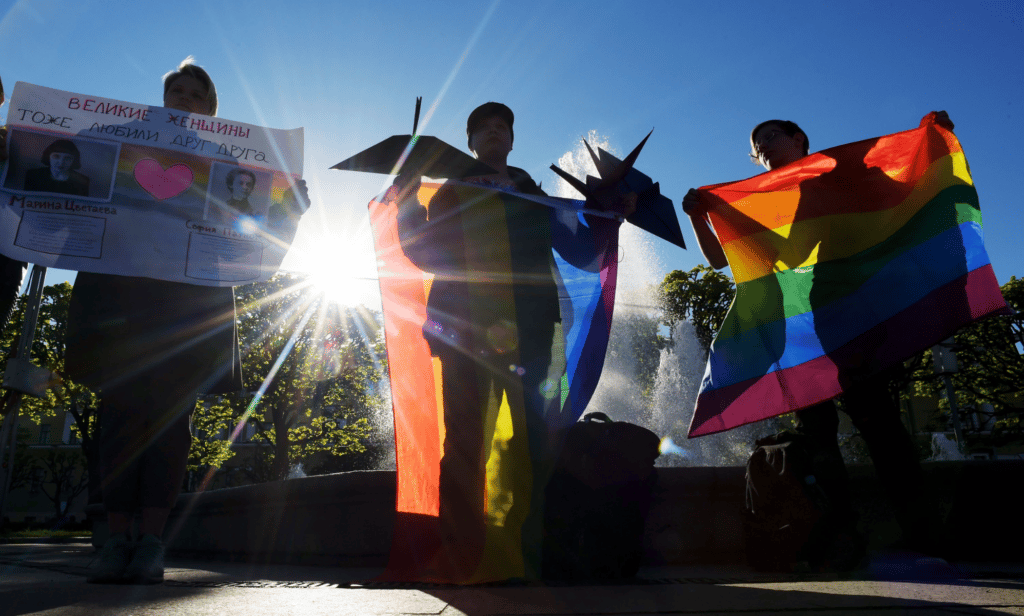
After Russia voted to extend its LGBTQ+ propaganda law to adults, artist and activist Yulia Tsvetkova has been forced to flee.
Tsvetkova was acquitted of distributing pornography and so-called LGBTQ+ “propaganda” by the Komsomolsk-on-Amur court in July, in a rare win for the queer community in Russia.
Tsvetkova was arrested and charged with distributing pornography in 2019 after she posted drawings of vaginas on social media in a bid to combat societal body norms. She was also charged over the same drawings in 2020 after Russian officials claimed she violated the country’s LGBTQ+ “propaganda” law.
After the acquittal, prosecutors attempted to relaunch proceedings against Tsvetkova, but on 22 November a court decided to uphold the decision.
On Friday (25 November), Tsvetkova’s mother, Ann Khodyreva, said the artist and activist left Russia days after the court’s most recent ruling.
She added it was “obvious” the family had left Russia in the wake of political leaders updating and extending an anti-LGBTQ+ law, Radio Free Europe/Radio Liberty reported.
“Why they left, I think it’s obvious,” Khodyreva said. “Yulia is [regarded as] a ‘foreign agent’, with a new law [criminalising “LGBT propaganda”] – it’s easier to die than to live in Russia.”
In June, Tsvetkova was declared a “foreign agent” by the Kremlin – joining a constantly growing list of activists, journalists, LGBTQ+ advocates and non-governmental organisations deemed hostile by the Russian state.
Russian lawmakers unanimously approved a bill banning all forms of so-called LGBTQ “propaganda” in a final reading on Thursday (24 November). The bill now needs the approval of the upper house of the Duma and anti-LGBTQ+ president Vladimir Putin before officially becoming law.
The legislation expands on a 2013 law banning the dissemination of information about LGBTQ+ people in the media, literature, advertising, online and other forms of media aimed at minors. The new law will forbid the “promotion of non-traditional sexual relations” for all ages.
The Russian state has increasingly targeted queer activists and allies amid a crackdown on so-called ‘LGBTQ+ propaganda’. (Getty)
She detailed how the artist’s first attempted “departure” in July “ended with the arrest of 10 people” and other bids to escape “stopped before starting”.
Khodyreva added a “new criminal case” against Yulia Tsvetkova had begun, making it impossible for the artist to remain in Russia. She confirmed Tsvetkova was not in France, where she, her mother, had been visiting for a time.
“The repressive architecture built by Vladimir Putin’s administration over the last two decades aims to stage absurd trials based on spurious accusations – it’s rare that anyone escapes the clutches of this system,” Zviagina said.
Zviagina described how Tsvetkova faced “house arrest, travel restrictions, fines and reprisals simply for exercising her right to freedom of expression” over the past three years.
About 710,000 (59.2%) of the same-sex couple households were married, and about 500,000 (41.7%) were unmarried.
The number of married same-sex households started to outnumber unmarried same-sex households in 2016, following the Supreme Court’s landmark 2015 Obergefell vs. Hodges ruling, which effectively legalized gay marriage across the U.S.
The release of this new data coincides with the advancement of landmark legislation that codifies federal protection for marriages of same-sex couples. The Respect for Marriage Act was approved 61-36 in the Senate and now returns to the House for a final vote before it can go to President Joe Biden, who has said he looks forward to enacting it.
Hawaii has the highest percentage of same-sex couple households of any state, at 1.4%, followed by Oregon and Delaware, both at 1.3%, the Census Bureau data reveals. The District of Columbia, however, blows them all out of the water at 2.5%.
South Dakota has the lowest percentage of same-sex couple households of any state, at 0.4%, followed by Kansas, Mississippi, Idaho, North Dakota and Montana, which are all at 0.5%.
There were some notable differences between same-sex and opposite-sex households.
Same-sex households, for example, are significantly more likely than opposite-sex households to be interracial: In 2021, 31.6% of married same-sex couples were interracial, compared to 18.4% of married opposite-sex couples.
Opposite-sex households, however, were much more likely to have children under 18. In 2021, 38.2% of married opposite-sex couples and 18% of married same-sex couples had children under 18 in their household.
There were also some notable differences between female-female and male-male households, which comprised 52% and 48% of total same-sex households, respectively.
For example, the median household income in male same-sex couple households ($116,800) was 26% higher than in female same-sex couple households ($92,470).
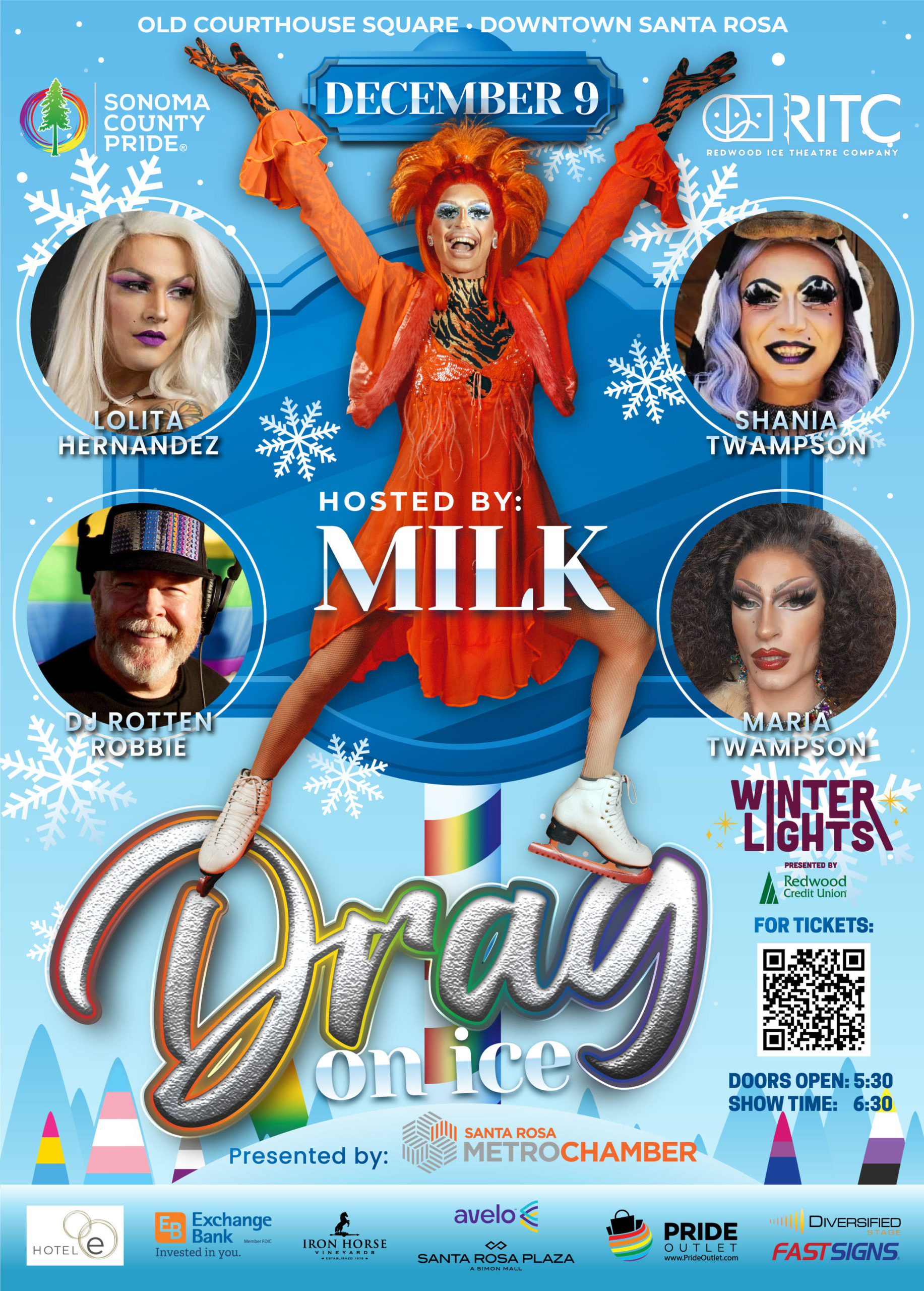
Sonoma County Pride & Redwood Ice Theatre Company have teamed up to present Sonoma County’s first-ever DRAG ON ICE show with Milk from RuPaul’s Drag Race! Presented by Santa Rosa Metro Chamber. Get ready for a 90’s theme drag show with host MILK from RuPaul’s Drag Race Season 6 and DJ Rotten Robbin with performances by Lolita Hernandez, Shania Twampson, Maria Twampson & Milk!
As part of this event, Sonoma County Pride will be donating its portion of proceeds from Drag on Ice to the Colorado Healing Fund to help the victims of the Club Q shooting.
The 32-year-old was sentenced in August to nine years in a Russian penal colony after pleading guilty to drug charges. She was reportedly found at an airport with vape cartridges containing cannabis oil.
At her sentencing, Griner told the court she had made “an honest mistake” and she “never meant to break any laws”.
In early November, Griner was moved from a detention centre to the IK-2 penal colony in Yavas, Mordovia – some 480 kilometres southeast of Moscow.
University of Helsinki sociologist Olga Zeveleva told The Guardian prisons in the area “are notoriously terrible, even by Russian standards”.
“It is a place any prisoner wants to avoid”.
University of Oxford professor Judith Pallot, who specialises in the human geography of Russia and has visited IK-2, also told The Guardian it is “very sterile and sad”.
“The Russian prison system isn’t interested in rehabilitation, it is based on retribution and punishment. It is a system underpinned by violence.”
According to The Nation, IK-2 is a penal colony notorious for racism and homophobia, with locals expressing shock someone as famous as Brittney Griner would be held there.
Nadya Tolokonnikova, a member of Russian activist band Pussy Riot, spent two years in a Mordovia prison.
She told MSNBC Reports she was terrified for Griner, with IK-2 is “literally the harshest colony in the whole Russian prison system”.
People could be left working up to 17 hours a day and punished – “that includes torture” – if they don’t meet quotas, Tolokonnikova said.
Similarly, the head of Rus Sidyashchaya (Russia Behind Bars), an organisation defending the rights of inmates in Russia, Olga Romanova, told The Moscow Times some detainees at IK-2 have reported labour conditions being “not far from slavery”.
Romanova said Brittney Griner being “lesbian, American, and Black” could make her a prime target for harassment.
“It’s a good thing she doesn’t speak Russian, she won’t be able to understand what people say to her.”
Romanova thought “that could solve some of her problems”.
However, she said Griner “will be in danger” if negotiations for a possible prisoner swap between the United States and Russia ended.
On Monday (28 November), Reuters published the US chargée d’affaires in Moscow, Elizabeth Rood, as telling Russia’s state-owned RIA news agency that the US “has not received a serious response” to “a significant proposal”.
Ten days prior, Russian deputy foreign minister Sergei Ryabkov said he was hopeful of a prisoner swap.
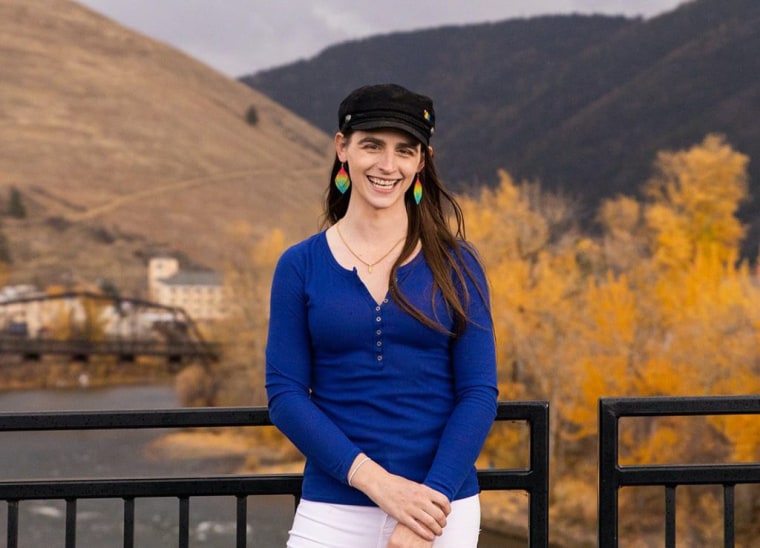
Zooey Zephyr, the first out transgender woman elected to the Montana Legislature, was inspired to run after her state passed three pieces of legislation targeting the LGBTQ community.
“My goal has always been to be in the room where my voice can do the most good,” the Democrat told NBC News after her win this month.
Zephyr said she had been working with the city of Missoula to draft human rights legislation but came to the conclusion that real change would have to be made at the state level.
“It became clear that is where the bulk of the attacks and damage was happening, and that was the most valuable room to be in,” she said.
Zooey Zephyr of Montana.Courtesy Victory Fund
So far this year, at least 340 anti-LGBTQ bills have been proposed in state legislatures across the United States, with more than 140 targeting transgender rights specifically, according to Human Rights Campaign, the country’s largest LGBTQ advocacy group.
Gabriele Magni, an assistant professor of political science at Loyola Marymount University in Los Angeles and the founding director of the university’s LGBTQ+ Politics Research Initiative, said this wave of bills inspired an increasing number of queer candidates to run “to protect LGBTQ rights.”
“If you have so many more candidates, some of them are going to be strong candidates,” he added.
The historic number of bills targeting LGBTQ rights coincided with a record number of openly lesbian, gay, bisexual, transgender and queer political candidates: At least 1,065 LGBTQ people ran for office this year, with an estimated 416 running for seats in state legislatures, according to an October report from the LGBTQ Victory Fund, an organization that supports queer people running for office. Of these 416 candidates, 281 made it to the general election, and 185 won — an Election Day win rate of 66%, its post-election analysis found.
The success of these candidates means that more openly LGBTQ people, including more transgender and nonbinary people, will hold office in state legislatures than ever before. Once all of the newly elected officials are seated, there will be nine transgender state legislators (up from eight this year) and nine nonbinary state legislators across the U.S., according to the LGBTQ Victory Institute, the group’s research arm.
The 26-year-old said he decided to run for office due, in part, to the wave of anti-LGBTQ legislation introduced in states across the country, including in New Hampshire.
“Especially as a trans person, seeing all of the new political action happening towards my community really kind of inspired me to be a voice for trans people to be visible and help be a concrete part of making these decisions,” he said.
Roesener’s platform included expanding nondiscrimination laws in health care, affordable housing, raising the state minimum wage to at least $15 per hour and legalizing marijuana.
“I think that people do care about others,” he said. “I think people are all concerned about really basically the same thing. It’s like, are we going to have enough food to eat? Do we have a roof over our heads? Am I going to have time with my family off of work? These are very unifying issues.”
James Roesener of New Hampshire is the first transgender man elected to a state legislature.Courtesy James Roesener
Get the Morning Rundown
Get a head start on the morning’s top stories.SIGN UPTHIS SITE IS PROTECTED BY RECAPTCHA PRIVACY POLICY | TERMS OF SERVICE
Another new state legislator will be Leigh Finke, who earlier this month became the first transgender person elected to the Minnesota state Legislature. She told the Minnesota Reformer in June that her decision to run was “largely in response to the building anti-trans movement and seeing bills introduced and laws starting to pass last year” in her home state and beyond.
“It suddenly became an absolute top-level priority for state-level Republicans to attack trans communities and not just to make it a talking point, but to actively take away rights from trans people and trans youth,” she said.
Finke specifically mentioned a bill proposed in Minnesota last year that, if it had passed, would have made participation in girls’ athletics or accessing a women’s locker room a misdemeanor for trans girls. The bill failed, but she told the Minnesota Reformer that it “really shook me and made me realize that someone has to be in the room.” StartingJan. 3, she will be that someone.
‘Real, tangible effects on trans people’
State legislatures have increasingly become battlegrounds over LGBTQ rights. Republicans began introducing legislation targeting queer rights at an increased clip in the wake of the 2015 Supreme Court ruling in Obergefell vs. Hodges, which legalized same-sex marriage nationally.
This year, at least 340 such bills have been introduced in 23 states, with at least 25 bills becoming law in 13 states so far,according to the Human Rights Campaign.
More than 40% of these proposed bills specifically target transgender people, limiting trans people’s ability to play sports, use bathrooms that correspond with their gender identity and receive gender-affirming health care. At least 17 of these bills have become law, the Human Rights Campaign said.
“The legislation has real, tangible effects on trans people and their families that love them and their communities that care for them,” Zephyr said. “I lost friends who fled the state, and I lost friends who ended their lives.”
A strategy that ‘probably backfired’
Whether or not bills targeting the LGBTQ community — particularly transgender people — pass, they act as a “wedge issue” to motivate right-wing voters in advance of an election, Magni said.
He said this strategy worked in the primaries by helping conservative candidates raise money and motivate their base to show up at the polls.
“But then in the general election, when you have a broader electorate, it didn’t really work. It didn’t convince moderate voters,” Magni said. “As an electoral strategy, it probably backfired.”
In addition to inspiring people such as Zephyr, Roesener and Finke to run for office, he said, this strategy may have also helped pro-LGBTQ candidates fundraise and may have motivated supporters to head to the polls.
Given the Democrats’ better-than-expected performance in the midterms, Republicans could change course with their legislation, though Magni and Zephyr said they expect to continue to see anti-LGBTQ bills for the time being.
“We are seeing pre-filed legislation in Tennessee, in Montana, in states across the country,” Zephyr said. However, she believes bills targeting LGBTQ rights are ultimately a losing strategy.
“My feeling is, the more the right pushes this, the more they will lose. People are standing up for us,” she added.
In a terrorism advisory bulletin, the Department of Homeland Security on Wednesday raised concerns about potential threats to the LGBTQ, Jewish and migrant communities from violent extremists inside the United States.
Americans motivated by violent ideologies pose a “persistent and lethal threat,” a senior DHS official told reporters in a briefing on the bulletin. Intelligence officials across the federal government have consistently highlighted the growing threat of American extremistsin recent years, while explaining that foreign threats such as the Islamic State terrorist group and Al Qaeda are no longer as persistent as they once were.
The bulletin was the latest summary of national terrorism threats, a document that has been updated about every six months since the insurrection at the U.S. Capitol on Jan. 6, 2021.
Some extremists have been inspired by recent attacks, including the shooting at the LGBTQ bar in Colorado Springs, Colorado, the bulletin said.
The report also highlighted an “enduring threat” to the Jewish community
Asked if recent antisemitic remarks by Ye, the rapper formerly known as Kanye West, contributed to increased threats to Jewish people, a senior DHS official said any high-profile official or celebrity trafficking in conspiracy theories only serves to ignite violence among extremists.
Get the Morning Rundown
Get a head start on the morning’s top stories.SIGN UPTHIS SITE IS PROTECTED BY RECAPTCHA PRIVACY POLICY | TERMS OF SERVICE
“Certainly the Jewish community seems particularly targeted in recent days by that kind of activity in our discourse,” the official said.
The bulletin also said “potential changes in border enforcement policy, an increase in noncitizens attempting to enter the U.S. or other immigration-related developments” may heighten calls for violence.
In compliance with a court order, the DHS is preparing to lift Covid restrictions known as Title 42 on Dec. 21, which will allow many more migrants into the U.S. to claim asylum.
The previous National Terrorism Advisory System bulletin issued by the DHS in June raised concerns about potential violence surrounding the November midterm elections.
Wednesday’s advisory said such violence was “isolated.” But it said the DHS did “observe general calls for violence targeting elected officials, candidates and drop box locations,” specifically mentioning the attack on House Speaker Nancy Pelosi’s husband.
Singapore’s parliament on Tuesday decriminalized sex between men, but, in a blow to the LGBTQ community, also amended the constitution to prevent court challenges that in other countries have led to the legalization of same-sex marriage.
The moves come as other parts of Asia, including Taiwan, Thailand and India are recognizing more rights for the lesbian, gay, bisexual and transgender and queer community.
Activists cheered the repeal, but said the amendment to the constitution is disappointing because it means citizens will not be able to mount legal challenges to issues like the definition of marriage, family, and related policies since these will only be decided by the executive and legislature.
The government has defended amending the constitution saying decisions on such issues should not be led by the courts. Prime Minister Lee Hsien Loong and his successor have ruled out any changes to the current legal definition of marriage as being between a man and a woman.
“We will try and maintain a balance…to uphold a stable society with traditional, heterosexual family values, but with space for homosexuals to live their lives and contribute to society,” Home Affairs Minister K. Shanmugam said in parliament this week.
Both the repeal and the constitutional amendment were passed with an overwhelming majority, thanks to the ruling People’s Action Party’s dominance in parliament. There is no timeline yet for when the new laws take effect.
The changes do, however, leave room for a future parliament to expand the definition of marriage to include same-sex relationships.
Bryan Choong, chair of LGBTQ advocacy group Oogachaga, said it was a historical moment for activists who have been campaigning for a repeal of the law known as Section 377A for 15 years. But he added that LGBTQ couples and families also “have the right to be recognized and protected”.
In Singapore, attitudes towards LGBTQ issues have shifted toward a more liberal stance in recent years especially among the young, though conservative attitudes remain among religious groups. Of those aged 18-25, about 42% accepted same-sex marriage in 2018, up from 17% just five years prior, according to a survey by the Institute of Policy Studies.