The Church of Jesus Christ of Latter-day Saints said Tuesday it would back proposed federal legislation to safeguard same-sex marriages, marking the latest show of support for the measure from conservative-leaning groups.
The nearly 17-million member, Utah-based faith said in a statement that church doctrine would continue to consider same-sex relationships to be against God’s commandments. Yet it said it would support rights for same-sex couples as long as they didn’t infringe upon religious groups’ right to believe as they choose.
“We believe this approach is the way forward. As we work together to preserve the principles and practices of religious freedom together with the rights of LGBTQ individuals much can be accomplished to heal relationships and foster greater understanding,” the church said in a statement posted on its website.
Support for the Respect for Marriage Act under consideration in Congress is the church’s latest step to stake out a more welcoming stance toward the LGBTQ community while holding firm to its belief that same-sex relationships are sinful. Still, its stance toward LGBTQ people — including those who grow up in the church — remains painful for many.
Patrick Mason, a professor of religious studies at Utah State University, said the church’s position was both a departure from and continuation of its past stances — respecting laws yet working to safeguard religious liberty and ensuring they won’t be forced to perform same-sex marriages or grant them official church sanction.
“This is part of the church’s overall theology essentially sustaining the law of the land, recognizing that what they dictate and enforce for their members in terms of their behavior is different than what it means to be part of a pluralistic society,” he said.
The faith opposes same-sex marriage and sexual intimacy, but it has taken a more welcoming stance to LGBTQ people in recent years. In 2016, it declared that same-sex attraction is not a sin, while maintaining that acting on it was.
The bill, which has won support from Democrats and Republicans, is set for a test vote in the Senate Wednesday, with a final vote as soon as this week or later this month. It comes after the U.S. Supreme Court overturned the constitutional right to abortion, with Justice Clarence Thomas issuing a concurring opinion indicating that an earlier high court decision protecting same-sex marriage could come under threat.
The legislation would repeal the Clinton-era Defense of Marriage Act and require states to recognize all marriages that were legal where they were performed. It would also protect interracial marriages by requiring states to recognize legal marriages regardless of “sex, race, ethnicity, or national origin.” It makes clear that the rights of private individuals and businesses wouldn’t be affected.
Utah’s four congressmen — who are all Latter-day Saints — each came out in support of the legislation earlier this year.
The church’s public stance is a stark contrast from 14 years ago, when its members were among the largest campaign contributors in support of California’s Prop. 8, which defined marriage as between a man and a woman in response to cities such as San Francisco granting marriage licenses to same-sex couples. It has since made incremental changes, including allowing the children of same-sex couples to get baptized.
Troy Williams, the executive director of Equality Utah, said it was “thrilling” to see the church part of the coalition in support of the legislation.
“Despite differences we may have, we can always discover common ground on laws that support the strengthening of all families,” Williams, who grew up a church member, said.
The faith opposes laws that would make it illegal for churches to not allow to same-sex couples to marry on their property. But it has supported state-based efforts to pass laws that prohibit employment and housing discrimination as long as they clarify respect for religious freedom.
Looking for an activity that benefits others? Want to share your creativity? Send artwork and letters of encouragement to seniors with the Sonoma County Library’s Send Our Seniors Mail program! Send Our Seniors Mail offers kindness and support for elders in our community and is an easy—and fun!—way to spread cheer throughout the holiday season. Interested? Visit the Send Our Seniors Mail page for a list of participating senior living facilities.
Create cards, artwork, and letters for seniors who might need a little extra happiness during the holidays.
Pop your goods in the mail! Addresses of senior facilities will be added to the Send Our Seniors Mail webpage as they become available. If you know of a potential Send Our Seniors Mail facility, please email the library at sendourseniorsmail@sonomalibrary.org.
A Reminder from Your Library: Upcoming Holiday Closure
All library branches will be closed Thursday, November 24, and Friday, November 25, for Thanksgiving. We look forward to seeing you when we reopen on Saturday, November 26!
Thank you for being a member of the Sonoma County Library community. Visit us online or in person at one of our branches. Be sure to check out open jobs at Sonoma County Library here. Questions? Please call your local library branch or click here to send us a message. Sáquele jugo a su creatividad y conéctese con su comunidad ¿Busca una actividad que ayuda la comunidad? ¿Desea compartir su creatividad? ¡Puede enviar dibujos de arte y cartas de apoyo a los adultos mayores con el programa de Envíos de correos postales para adultos mayores! Este programa fomenta la simpatía y el apoyo para los adultos mayores de nuestra comunidad y es una fácil y divertida manera de repartir la alegría de las fiestas. ¿Le interesa? Solo tiene que:Visitar la página web de Envíos de correo postales para adultos mayores para una lista de facilidades de viviencia para adultos mayores que están participando.
Crear tarjetas, dibujos y cartas para adultos mayores que estarán encantados de recibir estas joyas de alegría.
¡Enviar sus creaciones a través del correo postal! Continuaremos a añadir nuevas direcciones en cuanto las recibamos. Si conoce de una posible dirección para esta iniciativa, por favor mándenos un mensaje en sendourseniorsmail@sonomalibrary.org. Reparta la alegría
Un aviso de su biblioteca: Cierre por feriado
Todas bibliotecas estarán cerradas el jueves 24 y el viernes 25 de noviembre para el Día de Acción de Gracias. ¡Nos complace verle de nuevo cuando reabrimos el sábado 26 de noviembre!
Gracias por ser miembro de la comunidad de Bibliotecas del Condado de Sonoma. Visítenos en línea o en persona en una de nuestras sucursales. Asegúrese de consultar los trabajos disponibles en la Biblioteca del Condado de Sonoma aquí. ¿Preguntas? Por favor llame a su biblioteca local o haga clic para mandar un mensaje.
The prospect of another Donald Trump presidency would pose a “serious risk” to LGBTQ+ rights, but queer advocates say they’re “battle-ready”.
On Tuesday (15 November), Trump announced he would be running for president in 2024, making him the first president in history to be attempting another presidential bid following impeachment.
As the most anti-LGBTQ+ president in modern history, he couldn’t help including a transphobic dig in his announcement from Mar-a-Lago, insisting that if elected, he would not “let men… participate in women’s sports”.
During the torturous four years that Trump was in office, he relentlessly attacked the LGBTQ+ community, stripping discrimination protections, banning trans people from serving in the military, and erasing LGBTQ+ language, data, and resource pages from government websites.
But, since he left the Oval Office, anti-LGBTQ+ rhetoric has continued to escalate in US politics, meaning that a second Trump presidency could be even more disastrous than the first.
Human Rights Campaign interim president Joni Madison said: “We in the LGBTQ+ community have watched over the past seven years as Donald Trump’s hateful language and discriminatory policies have emboldened waves of bigotry, disinformation and violence.
“Even as Republican voters have become increasingly supportive of LGBTQ+ people – registering majority approval of nondiscrimination projections and marriage equality – he and his extremist MAGA supporters have worked tirelessly to try to slander and demonise us, our relationships, and our families.
“His time in office saw a relentless onslaught of unconscionable executive orders that made it harder to live as an LGBTQ+ person in this country.”
Madison noted the “rainbow wave” seen in the US during the midterm elections, and the fact that Trump-backed candidates underperformed spectacularly, and urged voters to “stand together in opposition to his candidacy, and to ensure Trump forever remains a one-term president”.
GLAAD President and CEO Sarah Kate Ellis reflected on the more than 200 attacks on the LGBTQ+ community by the Trump administration, tracked by the organisation’s Trump Accountability Project, and said: “It was an administration defined by anti-LGBTQ actions and rhetoric, and policy that empowered white supremacists and fueled racism, xenophobia, antisemitism and misogyny.”
‘Political pawns’
Mayor Annise Parker, president and CEO of LGBTQ Victory Fund, said that “another Donald Trump presidency presents a serious threat to our nation’s LGBTQ community which continues to face rampant homophobia and transphobia fueled by his divisiveness”.
Parker continued: “Donald Trump and those who wish to follow in his footsteps continue to use our community – and LGBTQ kids in particular – as political pawns in their quest for power.
“When our fundamental rights are challenged, our kids’ safety and wellbeing are threatened and our leaders are terrorised, going back is not an option.
“Donald Trump is one of the most bigoted leaders of our time and his continued anti-LGBTQ rhetoric and actions are dangerous and unqualifying… The next presidential election is an opportunity for voters to break from candidates who promote the politics of hate and instead choose a leader who supports fairness and equality for all Americans.”
The American Civil Liberties Union (ACLU) filed 424 legal actions against the Trump administration during the four years of his presidency, and ACLU executive director Anthony D Romero said that the organisation is ready to keep fighting.
“Trump appointees on the federal bench have done their best to gut abortion rights, limit voting rights, and strip immigrants and LGBTQ individuals of their basic rights,” Romero said.
“Even as we are engaged in those battles today at all levels of government, the ACLU will be battle-ready for a second Trump administration.
“If Donald Trump believes that a second term would allow him to continue with the unconstitutional and un-American policies of his first term, the ACLU will be ready to fight back at every turn.”
Actor Kevin Spacey is to be charged with a further seven sexual offences after an investigation by the Metropolitan Police.
The Crown Prosecution Service has said Spacey will face charges over alleged offences against one man between 2001 and 2004.
The charges include three counts of indecent assault, three counts of sexual assault, and one count of causing a person to engage in sexual activity without consent according to the Crown Prosecution Service.
Evidence gathered by the Metropolitan Police allowed for further charges against the 63-year-old to be authorised. Spacey has pleaded not guilty to a string of allegations that stretch back 17 years.
Rosemary Ainslie, head of the CPS Special Crime Division, clarified the charges against the House of Cards actor in a statement, adding that officials had “also authorised one charge of causing a person to engage in sexual activity without consent”.
“The authority to charge follows a review of the evidence gathered by the Metropolitan Police in its investigation,” Ainslie added. “The Crown Prosecution Service reminds all concerned that criminal proceedings against Mr Spacey are active and that he has the right to a fair trial.”
Earlier legal action dismissed
Spacey is already facing five charges of sexual offences in the UK, including four counts of sexual assault and one count of causing penetrative sexual activity without consent.
He is set to begin the trial for these charges in June 2023.
“I will voluntarily appear in the UK as soon as can be arranged and defend myself against these charges, which I am confident will prove my innocence,” he said following the initial charges.
The actor was dropped from his role in House of Cards shortly after allegations against him were made in 2017 by actor Anthony Rapp and was ordered to pay $31 million in lost revenue.
Rapp initially accused Kevin Spacey of making sexual advances towards him in 1986 – when Rapp was 14 years old.
After filing a legal action in September 2020, Rapp testified that he had decided to go to a bedroom during a party at Spacey’s Manhattan apartment, when Spacey walked into the room, seemingly intoxicated.
Rapp then alleged that Spacey touched him inappropriately, claiming he put him on the bed and climbed on top of him.
“It felt very wrong,” Rapp said. “I didn’t want him to do it, and I had no reason that made any sense of why he would do it. I felt like a deer in headlights.”
The case was later dismissed by the New York court after the jury found that Rapp did not sufficiently prove his claim that Spacey made the unwanted sexual advances.
Two transgender soldiers at Fort Leonard Wood in Missouri are set to retire with a rare distinction — they transitioned fully while on active duty and will be honorably discharged with full pensions.
“Open transgender service in the military is becoming more commonplace and accepted, but the number of those who are honorably discharged into full retirement and transitioned while on active duty remains low,” explains a press release from Missouri LGBTQ+ rights group PROMO.
Defense Secretary Ash Carter, who served under President Barack Obama, lifted the ban on open service by trans troops in 2016, but Donald Trump reinstated it during his presidency, with it going into effect in 2019. President Joe Biden lifted the ban shortly after taking office in 2021.
“We were forced to ask ourselves whether we wanted to deny who we were and serve, in the hopes that one day it would change, or whether we should wait to serve entirely until it did change,” Army Staff Sgt. Alleria Stanley, a trans woman stationed at Fort Leonard Wood who will retire February 28, said in the press release.
Stanley and Army Sgt. First Class Kinzie Maxfield, also a trans woman, both participated in Fort Leonard Wood’s Retiree Appreciation Day celebration last Thursday. Maxfield will retire December 31. The two are part of the small but growing group who transitioned on active duty and will retire with full benefits after being honorably discharged. Both have served 20 years under four presidents — George W. Bush, Obama, Trump, and Biden.
Stanley is a radiology technologist within the Army and deployed to Afghanistan as an Apache helicopter repairer in 2005. “Being one’s authentic self is incredibly empowering and uplifting affecting parts of your life that are unrelated to being transgender,” she said in the release. “One of the stronger memories I have since serving openly and living authentically is the scores of people who have come up to me to either come out themselves, to share a story of someone they know, or to ask for advice on how to approach a relationship they have with LGBTQ+ friends and family.”
Maxfield is a military dog handler who deployed to Afghanistan four times and was awarded the Purple Heart. “I have had a great experience in my current unit, but before coming out I was absolutely terrified that people would not treat me the same,” she said. “I was an excellent dog trainer and did really high-speed deployments. I was afraid that was going to change. However, all of my commanders were very supportive, helping me with all the necessary paperwork while always treating me with respect and dignity.”
As Americans, we encounter diversity daily. While we continue to see some signs of progress, the 2021 LGBTQ Youth Mental Health Study by the Trevor Project noted that at least once in their lifetime, 75% of LGBTQ youth reported experiencing discrimination based on their sexual orientation or gender identity. No matter how much progress we make, discrimination in any form hurts and can have a grave impact on one’s mental health.
As the Director of Health Care International’s (HCAI) Youth & Family program, I have the good fortune of being able to speak to teachers, parents, school administrators and kids about how the power of kindness and acceptance can save lives.
We will always encounter diversity, in some form throughout our lives, and inclusivity is not guaranteed. But the fact is that in the LGBTQ community, if a person has just one individual to support and include them, it can make a lifesaving difference.
According to the Trevor Project study, lower suicide rates were reported for LGBTQ youth who had access to spaces that affirmed their gender identity and sexual orientation. The statistics are even more significant in the transgender and non-binary community where youth suicide rates were cut in half when pronouns were respected by the people they lived with compared to individuals whose pronouns were not respected by anyone with whom they lived.
I know this to be true because I am often that one person for many of these kids. Through my work with HCAI, I am often called upon when a child is in a dire situation. There have been many instances when I am meeting with a child in a psychiatric hospital after an attempted suicide. Most times, these kids are there because of the anxiety and depression they experience due to feeling a lack of love or acceptance.
The foundation of HCAI’s Youth & Family Program is empathy, kindness and acceptance. Most of all, these kids and families need to know they aren’t being judged and that they are in a safe environment to speak and feel freely. When they come to us or when we are called in to help, the first thing we do is listen.
It’s human nature to tell someone “Don’t worry, everything is going to be okay.” But, in most cases, the kids that I encounter do not feel okay. In fact, they are very close to committing self-harm or even worse, committing suicide. The key is to empathize and listen and connect them with the right assistance. The first thing we say is “We are sorry you are suffering; how can we help?”
During one of our recent school trainings, a transgender student asked to meet with me prior to the workshop. He shocked me when he said, “You helped me when I was in the hospital two years ago.” It was a total surprise to see a transformed teenager who was previously nonverbal and refused to communicate with me at that time.
I realized I had previously worked with him while he was at a psychiatric hospital after a suicide attempt – nearly two years prior. At the time, he had no support system and was nonverbal simply because he felt like his voice was not heard. I knew at that moment that we needed to help him. We started by assuring him that he could be his authentic self and that we believed him.
HCAI provided him with a binder – a compression undergarment to flatten the chest – and today he is continuing his journey to transition. It only takes one person or organization’s unconditional support to significantly reduce the suicide risk.
Sometimes the only support that kids will experience is outside their home – at school and with friends. Therefore, it is important for schools to set the tone of acceptance. When we meet with schools, we ask administrators and teachers, “Do your students walk into your building and see themselves represented every day?” Kids cannot be what they do not see. If they see themselves in the curriculum, in the library, in the Pride flag that is flown year-round, their path to acceptance and reduced mental health crises increases.
In fact, the Trevor Project study noted that LGBTQ youth had lower rates of attempting suicide when they found their school to be LGBTQ-affirming.
How can we expect a student to give 100% when they can’t be 100% of who they are? Imagine students that must worry about getting beaten up, teased or even which bathroom they need to use simply if they try to live their truth. If gender identity and sexual orientation is all they can think about because they aren’t being accepted and living freely, it is not only preventing them from moving forward but also from being their best selves both physically and mentally.
The indisputable reality is that the LGBTQ community – and transgender and non-binary individuals even more so – are facing mental health concerns at an alarming rate. The benefits of something as simple as a sense of belonging is lifesaving. In HCAI’s Youth and Family Program workshops and trainings, we ask parents, caregivers and educators to lead with empathy, kindness and acceptance. Diversity happens. Inclusion is a choice that can save a life.
It is critically important for LGBTQ youth to have access to resources, services and support that enables them to feel accepted and included. Even more, the support of one family member, friend, mentor, coach, or teacher could be the relationship that saves a life. In their 2019 Youth Mental Health Study, The Trevor Project found that LGBTQ youth who reported having at least one accepting adult were 40% less likely to report a suicide attempt in the past year.
HCAI can be a resource to connect LGBTQ youth with the people and services they may need. If you know someone who is struggling with their mental health, be the person who makes a difference and act today.
As director of HCAI’s Youth and Families program, Tony Ferraiolo helps to provide a safe, supportive place for LGBTQ youth and their families. Tony joined the HCAI family in 2021. The program aims to build bridges within communities so every child can be their authentic self and walk a path of happiness filled with love and kindness. After years of struggling with his own gender identity, Tony transitioned in 2005. Realizing that he went through this difficult time not knowing any other transgender person, he made it his life purpose to support LGBTQ youth and their families. Tony is also a certified life coach, published author, and holds a teaching certification in mindfulness. He is co-founder of the Jim Collins Foundation, a nonprofit providing financial assistance for gender-confirming surgeries. Tony was the subject of the award-winning documentary A Self-Made Man. To learn more about Health Care Advocates International visit https://www.hcaillc.com/.
Editor’s note: This article mentions suicide. If you need to talk to someone now, call the Trans Lifeline at 1-877-565-8860. It’s staffed by trans people, for trans people. The Trevor Project provides a safe, judgement-free place to talk for LGBTQ youth at 1-866-488-7386. You can also call the National Suicide Prevention Lifeline at 1-800-273-8255.
After a successful effort earlier this year to ease longstanding restrictions on service members living with HIV, LGBTQ rights advocates are now pushing for more change. They want to end the U.S. military’s decades-old policy of barring people with HIV from enlisting.
LGBTQ advocacy group Lambda Legal filed a federal lawsuitThursday on behalf of three individuals living with HIV: Isaiah Wilkins, a gay police officer in Georgia; a transgender lesbian woman who left the military in 2013 to transition and a straight woman who had dreams of becoming a parachute rigger. (The women are identified in the lawsuit with pseudonyms because they fear further discrimination, according to Lambda Legal.) Minority Veterans of America, a minority-serving organization for current and former service members, is also named as a plaintiff in the suit, which lists Defense Secretary Lloyd Austin and Army Secretary Christine Wormuth as defendants.
Isaiah Wilkins, 23, tested positive for HIV while trying to join the Army Reserves.Lambda Legal
The lawsuit describes the ban on HIV-positive recruits as “incompatible” with modern medical advancements. The policy, the suit notes, has been in place since 1991 — years before the development of groundbreaking medical innovations that eventually transformedHIV from a death sentence into a mostly nontransmittable, manageable condition, with early detection and the right treatment.
Because of medical breakthroughs over the past decades, a 25-year-old living with HIV who is diagnosed early and receives appropriate treatment has approximately the same life expectancy as a 25-year-old living without HIV, the lawsuit says. A study published in 2014 in the Journal of the International AIDS Society found HIV patients who are successfully treated with antiretroviral therapy have normal life expectancies.
Thursday’s lawsuit, filed in U.S. District Court for the Eastern District of Virginia, follows Lambda Legal’s landmark victory in April, decided by the same court, that requires the Pentagon to now allow HIV-positive service members to be promoted and to deploy overseas.
Before the court ruling, U.S. military policy was to place restrictions on service members if they were diagnosed with HIV after they had successfully enlisted. In a memo to military leadership in early June, Austin eased the restrictions on those currently serving, but he didn’t address the policy that banned HIV-positive recruits.
Kara Ingelhart, a senior attorney at Lambda Legal representing the plaintiffs, called the April ruling “incredibly clear.”
“There should be no barrier for folks like Isaiah who want to serve,” she said, referring to the Georgia police officer.
Discriminating against people based on their HIV status has been illegal in the U.S. for every employer other than the U.S. military since the passage of the Americans with Disabilities Act of 1990.
“I think that there’s still just a ton of stigma around HIV,” Ingelhart said. “The military could really set an example for equity and inclusion.”
Wilkins, 23, served in the Georgia National Guard for more than two years. He tested positive for HIV while trying to join the Army Reserves as part of the application process for the United States Military Academy at West Point and was discharged from the Army Reserves in 2019. He called the discharge traumatic, and he said his long-held goal of becoming an Army pilot was “cut off” solely because of his HIV status.
The policy “really does discriminate against people who not only have the ability but the desire to serve,” he said.
NBC News reported in June that every branch of the U.S. military has experienced major challenges in meeting its recruitment quotas this year, as a record low number of Americans are eligible to serve because of increasing health- and crime-related disqualifications — and an even smaller number of them want to.
A Defense Department spokesperson declined to comment on the ongoing litigation. The United States Army did not immediately respond to a request for comment.
The New York City Police Department confirmed Monday that it is investigating a string of robberies and assaults that may be connected to the deaths of two gay men earlier this year shortly after they left gay bars in Manhattan’s Hell’s Kitchen neighborhood.
In an emailed statement, Julian Phillips, a spokesperson for the NYPD’s Office of the Deputy Commissioner, Public Information, confirmed that the deaths of Julio Ramirez and John Umberger are being investigated among “several incidents where individuals have been victims of either robberies or assault.” No arrests have been made in Umberger’s death, which remains under NYPD investigation, according to a department official.
In April, Ramirez, a 25-year-old social worker, was found dead in the back of a taxi an hour after being seen leaving the Ritz Bar and Lounge with three unidentified men. His family previously told NBC News that approximately $20,000 had been drained from his bank accounts and that they believed he was drugged.
About a month later, Umberger, a 33-year-old political consultant, was found dead after he and two unidentified men left another popular Hell’s Kitchen gay bar, the Q. The unidentified men transferred about $20,000 out of Umberger’s bank accounts and maxed out his credit cards, according to Umberger’s mother, Linda Clary, who also believes her son was drugged.
Get the Morning Rundown
Get a head start on the morning’s top stories.SIGN UPTHIS SITE IS PROTECTED BY RECAPTCHA PRIVACY POLICY | TERMS OF SERVICE
The NYPD spokesperson said the city’s medical examiner is still determining the official causes of deaths for Ramirez and Umberger and added that some, though not all, of the victims in their investigation are believed to be part of the LGBTQ community.
Over the weekend, New York City Council member Erik Bottcher, who represents a swath of Manhattan’s West Side that includes Hell’s Kitchen, released a statement on Instagram saying that his office has been in contact with the NYPD and the New York County District Attorney’s Office regarding the investigation.
“The monsters responsible for these crimes need to be apprehended and prosecuted to the fullest extent of the law,” he wrote, adding that “significant resources” are being dedicated to the case.
A representative for Bottcher’s office did not immediately provide a comment. A representative for the New York County District Attorney’s Office did not respond to a request for comment.
A bipartisan group of senators released an updated version of a bill Monday to codify federal protections for same-sex marriages that they say they feel confident can get enough Republican support to pass in the Senate.
The leader of the effort, Sen. Tammy Baldwin, D-Wis., fellow Democratic Sen. Kyrsten Sinema of Arizona and Republican Sens. Rob Portman of Ohio, Susan Collins of Maine and Thom Tillis of North Carolina were working on an amendment to the bill to entice more Republican votes to overcome a filibuster.
The senators said in a statement Monday that they are “confident that this amendment has helped earn the broad, bipartisan support needed to pass our commonsense legislation into law.”
Senate Majority Leader Chuck Schumer, D-N.Y., promised Monday to hold a vote this week on the bill, which the group said has the 10 GOP votes needed to pass, during the lame-duck session after the midterm elections and before the start of the new Congress in January.
A vote was delayed before the midterms to give senators more time to review the five-page amendment after some Republicans suggested the vote tally would be higher after Election Day.
A version of the legislation cleared the House in July, with 47 Republicans joining all Democrats in voting yes.
If you’ve never had a lawmaker attempt to label you as a child abuser for providing gender-affirming care, threaten to incarcerate you and send your kids to one of Texas’ notoriously dangerous foster homes, that makes one of us.
And that’s why one humid June morning, after having squeezed the last of our things into our car — a stack of comic books, a dog who hates road trips and a Nintendo Switch — we fled our Houston home seeking safety for our transgender son, Noah, in the mountains of Colorado.
As time ticked down, we lived in fear of knocks on the door and calls from unknown numbers that could have been CPS investigators.
Our story will be told in a new NBC Out short-form doc, “Dear Noah: Pages from a Family Diary,” premiering at the Meet the Press Film Festival at DOC NYC on Tuesday.
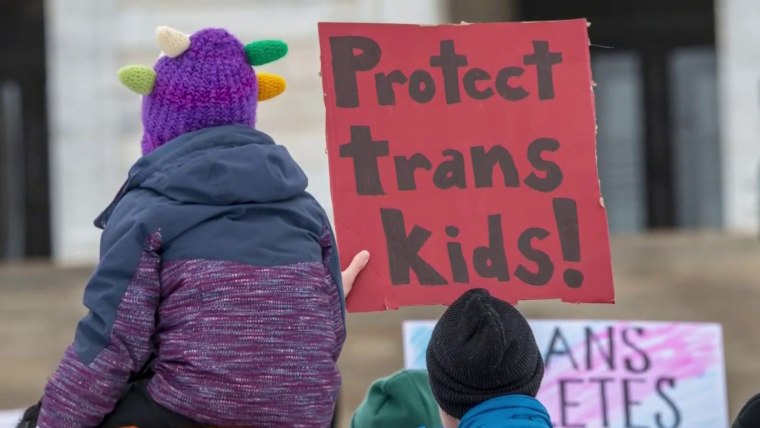
Audiences will see how the battle in the Texas Legislature over gender-affirming care for trans children is far from a mere partisan philosophical argument or campaign talking point for me. We are a family with a trans kid, and this heated public debate about the very existence of my innocent child has wreaked a level of fear and uncertainty in our lives that we could never have imagined.
For many, the political and media attention on the transgender community might feel new and perhaps surprising, almost as if the existence of trans people and the best-practice medical care that supports them has come from nowhere. But that couldn’t be further from the truth.
My family’s connection to the trans community has been anything but out of nowhere, as our 16-year-old son (15 at the time of filming) has spent the past 11 years of his young life actively coming to terms with his true gender identity. From kindergarten, our sweet Noah felt out of place in his own body, confused by how starkly different the world viewed and treated him compared to who he knew himself to be. At this young age, he battled bouts of seemingly inexplicable depression and anxiety as he privately grappled with these pressing questions of his identity while trying to navigate elementary school life.
Watch “Dear Noah: Pages from a Family Diary” Friday at 10:30 p.m. ET on NBC News NOW and Peacock.
At the age of 12, Noah finally found the language to articulate his gender dysphoria and discovered incredible examples of healthy and happy trans people modeling the fully realized and genuine life he craved. When Noah finally came out to us as transgender, our lives changed in marvelous ways; he simply glowed. He spoke more hopefully of the future than ever before. The puzzle pieces began to click satisfyingly into place for us.
It was incredibly important that we as parents moved ahead thoughtfully and deliberately. We leaped into research papers, books, online communities and articles, trying to educate ourselves to support him to the fullest. Over the next couple of years, we assembled a trusted team of medical professionals to support Noah’s mental and physical wellness. We watched in awe as he continued to blossom.
And then 2021 happened.
That’s the year a flood of anti-LGBTQ bills were introduced in the Texas Legislature — the majority of which directly targeted trans kids and their families. These bills were as varied as prohibiting trans kids from playing interscholastic sports with their friends (one of which, unfortunately, was passed) to criminalizing the evidence-based, age-appropriate medical care that literally saved my son’s life.
During that session and the three brutal special sessions that followed, Noah and I made numerous trips to the Texas State Capitol to protest these transphobic bills and to walk the halls to meet with legislators. For the first time in my life, I testified in front of a state House committee in October 2021.
Sitting in my car afterward, I felt beaten down by the inattention of the Republican members in attendance — and bewildered by the transphobia of the small group of supporters of these harmful bills who did seem to capture their interest. It was clear to me then that our family needed a Plan B to get out of the state to ensure our son’s safety. A just-in-case place to run to, a soft place to land. The far-right rhetoric was already so skewed and vicious, and the potential for violence felt too close to a child who had already survived so much. Little did I know that less than a year later that car would be packed and headed to the mountains.
This year dealt Texas trans families a double blow when state Attorney General Ken Paxton delivered a nonbinding legal opinionthat gender-affirming care for children was child abuse — followed by a directive from Gov. Greg Abbott that families just like ours should be investigated by Child Protective Services for supporting our kids. Loving families of trans kids we knew were under investigation for simply supporting their children, even though no law required the state’s Department of Family and Protective Services to conduct such investigations.
There’s a tremendous amount of guilt in leaving a community you love in turmoil; many families are at this very moment grappling with this decision of a potential move, while others simply can’t or won’t pick up their lives and leave.
These threats affected Noah’s grades and wholly altered his relationships with teachers and school counselors. He began to fear that these mandatory reporters would feel compelled to report our family to CPS despite their previous close relationships. The bouts of depression and self-harm intensified, and his glow darkened and was replaced by those old feelings of hopelessness and loneliness.
When Texas Children’s Hospital announced that it was pausing gender-affirming careindefinitely for fear of losing state contracts and funding, our family felt the floor fall from underneath us. Even though every major medical association in America supports gender-affirming care, the trusted medical professionals whose decadeslong careers we relied on to keep Noah healthy and safe were unable to fulfill their Hippocratic Oath and their commitment to my son. Plan B was now turning into Plan A. With even our medical institutions failing us in Houston, it was time to move our son to a safer place where he could simply be himself — to go to school to learn without fear and to have consistent access to best-practice, lifesaving medical care.
We acted quickly as a family, breaking the news of our pending out-of-state move to Noah over an unforgettably sad dinner. “I kind of figured, Mom. I hate it, but it’s for the best,” was his response. And that was that.
Over the following weeks, we researched safe states, schools and gender clinics. I called local LGBTQ organizations, tried to negotiate with doctors about their 18-month-plus waitlists for new patients and looked up museums, parks, bookstores and taco stands (we’re Texan; it’s a major food group). And we found that soft place to land in Colorado — an inclusive, affirming place with a far more visible trans population, incredible nature and seemingly never-ending sunshine.
That 1,028-mile drive to Colorado uprooted our family from all that we knew and every support system that we had ever had.
We took a gamble by staying in Texas until the summer so Noah could finish up the school year and have a couple of more months with friends and family. As time ticked down, we lived in fear of knocks on the door and calls from unknown numbers that could have been CPS investigators. The threat of a potential investigation of our family loomed over us as we packed our lives away in cardboard boxes and large plastic storage containers. When our June move date arrived, we were heartbroken but ready for peace.
That 1,028-mile drive to Colorado uprooted our family from all that we knew and every support system that we had ever had. It was the outcome of an impossibly unfair decision forced upon a loving family who refused to lose their child for political gains. Noah’s right to exist as himself — a transgender young man — shouldn’t be up for debate, nor should a politician be allowed to dictate how our family partners with our medical team to care for him and prepare for his bright future ahead.
There’s a tremendous amount of guilt in leaving a community you love in turmoil; many families are at this very moment grappling with this decision of a potential move, while others simply can’t or won’t pick up their lives and leave, refusing to allow Gov. Abbott and his cronies to push them away. There are remarkable organizationsleading this fight against the assault on trans children and their families, and we will continue to support them and fight for the basic human rights of Texans for the rest of our lives.
Despite it all, Texas is where our hearts reside, no matter how many miles might separate us and how directly damaging Republican rhetoric has been. In years to come, we hope to pack up that car again (car-sick dog included) and view the mountains from the rearview mirror this time — on our way home.