Australia’s national men’s football team, the Socceroos, just became the first FIFA World Cup side to collectively speak up on human rights issues in Qatar. In a powerful video released on October 27, sixteen current and former Australian players, supported by the broader playing group, expressed their solidarity with migrant workers and LGBT people, making it clear that “universal values like dignity, trust, respect and courage should define football values.”
Players correctly assessed the situation in Qatar, where important reforms have been introduced but require better implementation. More importantly, they acknowledged that the decision to host the World Cup in Qatar resulted in preventable suffering and harm to “countless migrant workers,” who are not covered by recent reforms.
FIFA did not require Qatar to make labor rights commitments for the millions of migrant workers that FIFA knew Qatar would need to build the World Cup infrastructure.
“These migrant workers who suffered are not just numbers. Like the migrants that have shaped our country and our football, they possessed the same courage and determination to build a better life,” said president of the players union and former Socceroos player Alex Wilkinson
In the video, the Socceroos strongly endorsed an effective remedy for migrant workers who have been denied their rights, supporting a migrant workers center and the decriminalization of all same-sex relationships.
Qatari authorities responded to the video insisting that “no country is perfect,” and that “Protecting the health, safety, security and dignity of every worker contributing to this World Cup is our priority.” But they fell short of committing to set up a remedy fund for workers who faced abuses because reforms came too late or were weakly implemented.
In May, Human Rights Watch, Amnesty, and a global coalition of rights groups, unions, and fans, launched the #PayUpFIFA campaign, demanding FIFA provide financial compensation for serious abuses against migrant workers, including deaths, injuries, unpaid wages, and exorbitant recruitment costs.
Unprecedented, bold acts of solidarity by both current and former Australian football players have set an important example. FIFA should follow up by announcing it will make right the abuses it has both enabled and will profit from.
D.C. police have used DNA testing technology that could help solve the 1987 murder of a lesbian woman.
On May 13, a 35-year-old woman named Greta Denise Rainey was found raped and strangled in her Capitol Hill apartment. Eighteen months before her death, a 22-year-old named Florence Eyssalenne was also found raped and murdered in her apartment, which was next to Johnson’s.
At the time, investigators took DNA samples as part of a police rape kit. Now, using contemporary DNA-testing technology that wasn’t available at the time, police have tested the samples and formed a DNA profile of an unidentified male suspect.
“Essentially, the identity of this person is still unknown to us, however, we can say the individual is a male. We believe him to be of African American descent,” D.C. Metropolitan Police Department Captain Kevin Kentish told WRC-TV.
Kentish added that investigators may even look into whether the DNA samples match those donated by users of genealogy websites. However, he added, “That may take a little longer, so we don’t want to put all our eggs in that one basket.”
In the days following Rainey’s murder, D.C. police arrested her then-girlfriend Roxanne Johnson as a suspect, though it’s unclear what evidence compelled them to do so. Four months later, the Office of the U.S. Attorney for D.C. dropped the charges against her for unknown reasons. Johnson, who has always claimed innocence, said her landlord later evicted her because her arrest made other tenants nervous, The Washington Blade reported.
Johnson said she had left the apartment to go to work when the murder took place. She didn’t know how someone entered the apartment. Police said there were no signs of forced entry in either Rainey or Eyssalenne’s apartments.
Eyssalenne’s brother, Bernard Eyssalenne, has said he’d never given up on the hope of finding his sister’s killer. “I’ve always stayed in touch with all the investigators,” he said.
Police are offering a $50,000 reward for information that leads to a conviction in the two cases. People with information can call 202-727-9099.
A free legal clinic hosted by Crocker Law, North Bay LGBTQI Families, and Positive Images LGBTQIA+ Center will take place on the Empire College of Law Campus (3035 Cleveland Avenue, Santa Rosa) on Saturday, November 12 from 11am-3pm to help our community. Specifically, attorneys and paralegals will be available to assist with forms and procedure for securing legal parentage between parents and children, as well as legal name and/or gender marker changes. This event will be held in combination with the November Social Saturday Intergenerational Gathering hosted each month by Positive Images LGBTQIA+ Center and North Bay LGBTQI Families.
In light of the recent US Supreme Court rulings, it is more important than ever to secure the rights of LGBTQIA+ families and people. In California, if you are married or in a state registered domestic partnership, you are automatically legal parents to children born during the marriage or partnership. However, marriage or domestic partnership certificates and birth certificates are not court orders and thus not required to be recognized by other states as proof of legal parentage. Only a court order (a document signed by a Judge) will be recognized across state lines. For people who are married or registered domestic partners, the second parent adoption process results in the necessary court order. For those who are not married or registered domestic partners or who conceived via reciprocal IVF (one spouse/partner provides genetic material and the other carries the child in the pregnancy), the legal parentage process results in the necessary court order.
Art activities and/or childcare will be available for those who are interested during or while they are waiting for their appointment time(s) with an attorney or paralegal. Spanish translation and ASL interpretation are also available.
Please sign up if you need these services with regard to legal parentage and/or legal name and/or gender marker changes. Submit the interest form below to assist us with planning, and we will reach out soon with further details such as individual appointment times and information regarding what you should bring. Contact us at northbaylgbtqifamilies@gmail.com with any questions!
[Image Description: An image graphic with a rainbow stripe frame in the upper left corner and black text on a white background with the clinic details listed in the caption above, and the logos of the sponsoring organizations along the bottom. Image 1 is in English, Image 2 is in Spanish.]
*********
Una clínica legal gratuita organizada por Crocker Law, North Bay LGBTQI Families y Positive Images LGBTQIA+ Center se llevará a cabo en el Empire College of Law Campus (3035 Cleveland Avenue, Santa Rosa) el sábado 12 de noviembre de 11 a. m. a 3 p. m. Específicamente, lxs abogadxs y asistentes legales estarán disponibles para ayudar con los formularios y procedimientos para asegurar la paternidad legal entre lxs adultxs responsables e hijxs, así como los cambios de nombre legal y/o marcador de género. Este evento se llevará a cabo en combinación con la reunión intergeneracional del sábado social de noviembre organizada cada mes por Positive Images LGBTQIA+ Center y North Bay LGBTQI Families.
A la luz de los recientes fallos de la Corte Suprema de los EE. UU., es más importante que nunca garantizar los derechos de las familias y personas LGBTQIA +. En California, si está casadx o forma parte de una pareja de hecho registrada en el estado, automáticamente es adultx responsable legal de lxs niñxs nacidxs durante el matrimonio o la pareja de hecho. Sin embargo, los certificados de matrimonio o de pareja de hecho y los certificados de nacimiento no son órdenes judiciales y, por lo tanto, no es necesario que otros estados los reconozcan como prueba de paternidad legal. Solo una orden judicial (un documento firmado por un juez) se reconocerá a través de las fronteras estatales. Para las personas casadxs o parejas de hecho registradas, el proceso de adopción del segundx adultx responsable resulta en la orden judicial necesaria. Para aquellas que no están casadxs ni tienen parejas de hecho registradas o que concibieron por FIV recíproca (un cónyuge/pareja proporciona material genético y el otro lleva al niñx en el embarazo), el proceso de paternidad legal resulta en la orden judicial necesaria.
Las actividades artísticas y/o el cuidado de niñxs estarán disponibles para aquellxs que estén interesadxs durante o mientras esperan su(s) cita(s) con un abogadx o asistente legal. La traducción al español y la interpretación de ASL también están disponibles.
Regístrese si necesita estos servicios con respecto a la paternidad legal y/o el nombre legal y/o los cambios de marcador de género. Envíe el formulario de interés a continuación para ayudarnos con la planificación, y pronto nos pondremos en contacto con más detalles, como horarios de citas individuales e información sobre lo que debe traer. ¡Contáctenos en northbaylgbtqifamilies@gmail.com si tiene alguna pregunta!
[Descripción de la imagen: un gráfico de imagen con un marco de rayas de arcoíris en la esquina superior izquierda y texto negro sobre un fondo blanco con los detalles de la clínica enumerados en la leyenda anterior y los logotipos de las organizaciones patrocinadoras en la parte inferior. La imagen 1 está en inglés, la imagen 2 está en español.]
A Chicago couple whose home has been repeatedly vandalized by a Trump supporter is combatting hate with love.
Erica Hungerford and Peter Charnley rallied their community last weekend to create a massive display of LGBTQ Pride on their garage.
ADVERTISING
The couple has refused to be intimidated by a man who has repeatedly destroyed their Pride flags and left them threatening MAGA messages at their home in the city’s Jefferson Park neighborhood, where they have only lived since February.
The couple was joined by about a dozen members of their community on Sunday to paint a rainbow mural on their garage door that would cover up the perpetrator’s vandalism and send him a message that they refuse to let his hatred win the day.
Hungerford told the Chicago Tribune that she was “astonished at the number of people who wanted to help.”
Photos of the project depict a massive “Love Wins” message on the garage door, as well as rainbow-painted panels on the side of the structure.
In addition to their friends and neighbors, members of the Chicago Police Department also showed up to help. The department’s Facebook page posted photos of the officers painting and declared, “Hate has no place in Chicago.”
The couple has endured five separate anti-LGBTQ incidents since May, all of which they believe were perpetrated by the same man.
In the first incident, he cut up their Progress Pride flag that was on display. The couple knew it was an anti-LGBTQ act because the perpetrator left their Michigan flag and only destroyed the Pride one.
After that, they set up a Ring doorbell camera, which recorded the perpetrator returning to destroy the new Pride flag they had put up.
Over the next several months, they found a banana on the porch that had “Republic” on the peel, a “Let’s Go Brandon” sticker on their garage, and messages proclaiming: “Bidens Clintons for jail”; “Obama for prison”; “Impeach Biden”; and “Hack Harris.”
“I heart MAGA” was also painted onto their garage and their Pride flag was spray painted – even though they had hung it on a higher pole to try to keep it out of reach.
The man even waved to them on their security camera before cutting up their Pride flag over the Fourth of July weekend. Photos obtained by Block Club Chicago show the masked man in a zip-up waving.
The harassment got the attention of out Chicago Mayor Lori Lightfoot (D), who tweeted in support of the couple and said she was “outraged that this family has endured this hateful and bigoted attack.”
“It’s stressful, it’s anxiety-inducing, it’s infuriating,” Hungerford told the Tribune. “I’m glad that we are able to not back down. At this point, I have extra Pride flags at the house, so the same day that he vandalizes a flag, I go out and put another one out there because I’m not going to let him intimidate me.”
While the couple has only lived in the neighborhood since February, they say their neighbors have told them this situation is not typical of the area at all.
“This vandalism seems very out of character for the neighborhood,” said community resident Megan Dunning, who brought her two children to help paint the garage on Sunday. “This community supports their LGBTQ neighbors. Everyone should be welcomed. We’re not going to tolerate hate.”
Chicago victim advocate Dawn Valenti called the home “the most Prideful house in the city.”
“Everywhere you look, from the tree to the flag to the canopy, to the garage to the side of the garage. Everything says Pride. This hopefully shows this person, especially the mural, that love wins. That’s what it’s about. It’s about love and just loving each other.”
Since his death more than 500 years ago, multihyphenate genius Leonardo da Vinci and his spectacular works have inspired respect and wonder in generation after generation the world over. An icon of the Renaissance, an inventor so ahead of his time that it’s taken centuries for many of his ideas to come to fruition, and the painter of some of the most stirring and famous works of art on the planet, Leonardo has also become a hero for LGBTQ people, who’ve long seen in his works and biography a host of beguiling clues to his queerness.
Yet non-Italians are often surprised to learn that it was Milan, not Florence, where Leonardo spent the bulk of his profusely productive professional life, and where one of his most recognizable works, “The Last Supper,” still graces the wall of the convent dining room where he painted it at the end of the 15th century. Milan is also where he met Gian Giacomo Caprotti, more commonly known as Salaì, the young male assistant and pupil who many historians believe also became his longest-term lover.
This week, as Milan plays host to the annual global convention for IGLTA, the International LGBTQ+ Travel Association, Italian tour operator Quiiky will be offering queer-themed Leonardo tours of the city, as it first began doing in 2017. The Milan IGLTA convention is a full-circle moment for the northern Italian city — originally slated for May 2020, the conference was rescheduled after Milan tragically became one of the world’s first major Covid hot spots early that year, just months after it had triumphantly completed in 2019 celebrations of the 500th anniversary of the master’s passing.
“Leonardo spent an important part of his life, more than 20 years, in Milan,” Quiiky CEO Alessio Virgili explained. “Here, he met Salaì in his artisan shop just close to the Duomo. Here, people can see one of his main masterpieces, ‘The Last Supper.’ In Milan, he also demonstrated himself to be an important engineer.”
Piazza del Duomo in Milan. Atlantide Phototravel/Getty Images file
Indeed, it was Leonardo’s engineering prowess that first brought him to Milan in 1482, when he was 30. Though his motivations for leaving Florence are unclear — some historians say he may have been at least partially prompted by a desire to escape the cloud of sodomy allegations lodged against him in Florence a few years earlier — he sent the ambitious duke of Milan, Ludovico Sforza, a meticulous list of the advanced engineering projects and war machinery he could help him construct. Almost as an afterthought, he mentioned at the end of his pitch to Sforza that he was also an artist. “Likewise in painting, I can do everything possible as well as any other, whosoever he may be,” da Vinci offered, not incorrectly.
Today, his engineering genius and the advancements it inspired are showcased at Milan’s Museo Nazionale Scienza e Tecnologia Leonardo da Vinci, the largest science museum in Italy. The museum’s Leonardo da Vinci Galleries, reimagined for the 2019 celebrations, use more than 170 historical models, artworks, codexes and installations to bring the artist’s story to life.
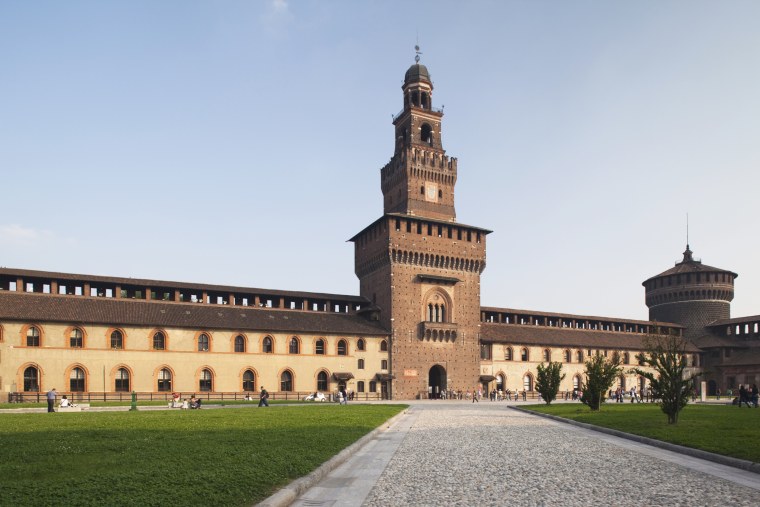
Much of his time in Milan was spent working in the duke’s castle, Castello Sforzesco, still one of the top attractions in the city. The artist’s most lasting legacy at the castle itself is the Sala delle Asse, where he painted the walls and the ceiling to resemble a pergola of mulberry trees, bringing the outside in for the duke who loved beauty and hosting elaborate parties. Unfortunately, the Sala delle Asse has been off- limits to visitors for most of the last decade while it undergoes painstaking restoration, but its completion is promised soon.
Castello Sforzesco in Milan.Walter Bibikow / Getty Images
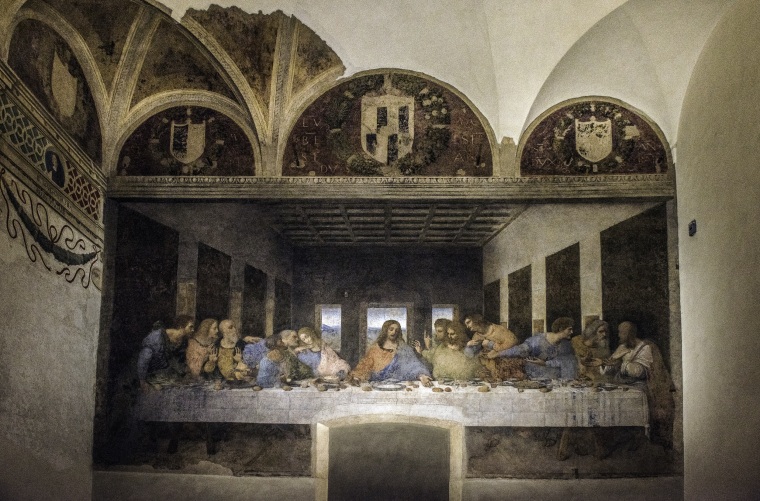
A few blocks from the castle is Milan’s most popular Leonardo attraction by far, his mural “The Last Supper,” painted about 1495 to 1498 on the refectory wall of the Convent of Santa Maria delle Grazie. While paintings depicting Jesus’ final meal as surrounded by his 12 apostles were commonplace, if not obligatory, for important churches of his day, it was the artist’s wholly unique approach to the subject matter that stunned contemporary viewers as it still does today. Surrounding a world-weary Jesus, each apostle distinctly reacts with palpable animation to the shocking news that Jesus has just delivered to them: that one of them will soon betray him.
For centuries, conjecture has been rampant regarding a particularly curious element of “The Last Supper”: the androgyny of John the Apostle, seated just to the right of Jesus. So delicate are John’s features that they even spawned one of the main plotlines in the blockbuster book and film “The Da VinciCode,” which claimed that the figure is not John at all, but Mary Magdalene.
Leonardo da Vinci’s “The Last Supper” in the Santa Maria delle Grazie in Milan.Mark Edward Harris / Getty Images file
Just across the street from Santa Maria delle Grazie is La Vigna di Leonardo (Leonardo’s Vineyard), a favorite site for modern LGBTQ visitors, thanks both to its queer history and its tranquil beauty.
“I imagine the master and his boyfriend lying in this vineyard he owned next to the place where he painted ‘The Last Supper,’” shared Italian journalist and documentarian Stefano Paolo Giussani, author of the 2020 book “Leonardo andrebbe al Pride?” (“Would Leonardo Go to Pride?”). “We know that Leonardo spent most of his life with Gian Giacomo Caprotti, known as Salaì, a nickname meaning ‘little devil.’ Salaì joined his household in 1490 as an assistant and went on to train as a painter. From then on, they lived, worked and traveled together, even sharing the same wardrobe.”
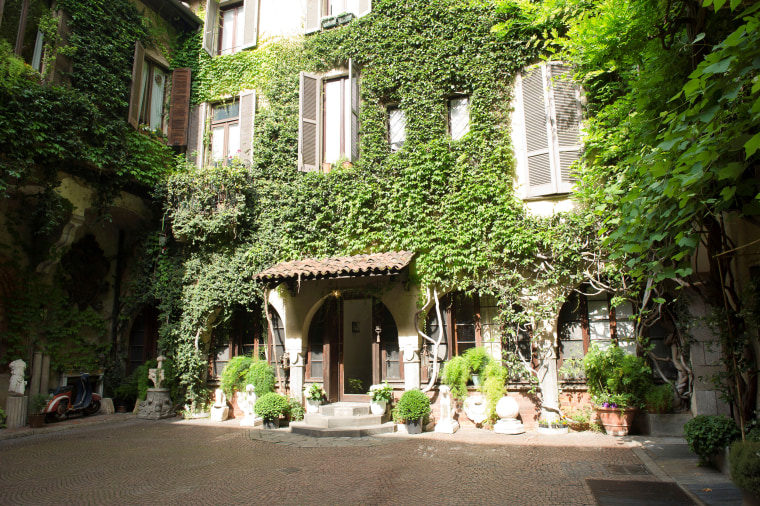
Leonardo da Vinci’s home, Casa degli Atellani, in Milan.Villa Elio/AGF/Universal Images Group via Getty Images file
Leonardo’s Vineyard lies at the bottom of the garden at the 15th century mansion Casa degli Atellani, exactly as it did when Sforza gave the land to the artist more than 520 years ago.
“In his will, Leonardo left the property to Salaì, which means a lot,” Giussani said. “After five centuries, the courtyard is nearly untouched, and it is a small silent corner right in the city center.”
Get the Morning Rundown
Get a head start on the morning’s top stories.SIGN UPTHIS SITE IS PROTECTED BY RECAPTCHA PRIVACY POLICY | TERMS OF SERVICE
Virgili concurred, saying, “This is an enchanting place in the center of Milan where sometimes it’s possible to do some Italian wine tasting surrounded by greenery.”
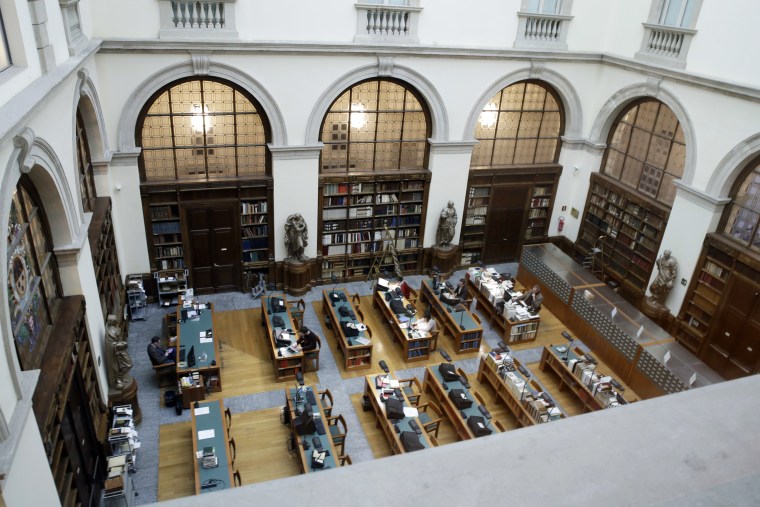
Another top Milan site for diving into Leonardo is the Biblioteca Ambrosiana (Ambrosian Library), which houses the Codex Atlanticus, the largest collection of his bound original writings and drawings. In all, the codex consists of 12 volumes of 1,119 pages dating from 1478 to 1519, covering a vast litany of his interests including astronomy, music, mathematics, recipes, fables, weaponry, botany and flight.
Ambrosian Library in Milan.Luca Bruno / AP file
The Ambrosiana also houses the 1511 painting “Head of Christ the Redeemer,” inscribed with the name Salaì and thus attributed to the artist’s pupil/partner, though some scholars believe Salaì may have been the model for the painting rather than the painter.
While speculation has also swirled around Leonardo’s romantic links to other men, it is Salaì who remains the most enduring candidate as his probable partner. Some historians even believe that the “Mona Lisa,” hiss most famous painting — if not the most celebrated work in the history of art — is a portrait of Salaì, and they see further evidence in the fact that the piece’s very name is an anagram of Mon Salaì, French for “My Salaì.”
So, was Leonardo what we would now consider gay? And does it matter for modern LGBTQ society?
“Gay is a modern expression that has several meanings and connotations that cannot easily be applied to a man who lived in the 15th century,” said Roberto Muzzetta, secretary of international relations for Arcigay, Italy’s first and largest LGBTQ rights organization. “However, there are many facts about Leonardo’s life that make us think that he might have been homosexual. He was charged of sodomy when he was young, and there were many substantial rumors about the nature of his relationship with some of his pupils such as Salaì or Francesco Melzi, who became his principal heir at Leonardo’s death.”
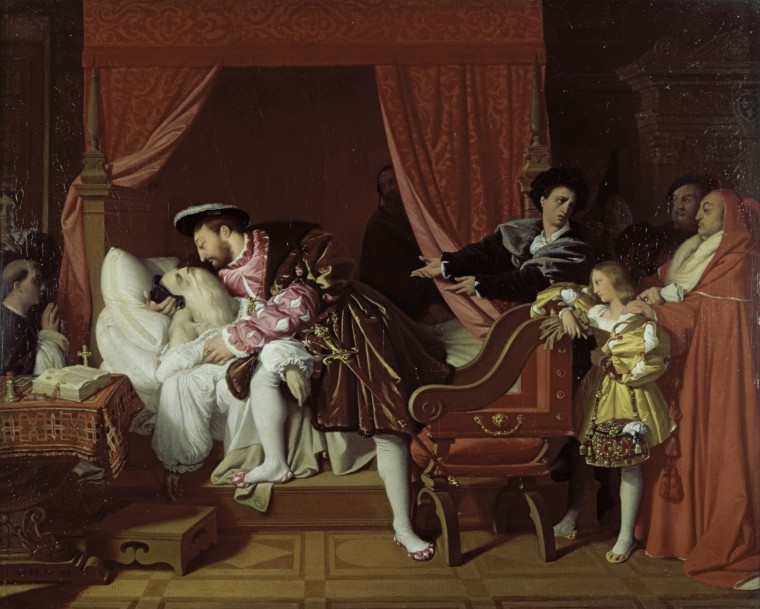
Jean Auguste Dominique Ingres’ painting “Francesco collects the last breath of Leonardo da Vinci.”Walter Mori/Mondadori Portfolio via Getty Images file
Giussani noted that there is “no evidence at all that Leonardo ever slept with a woman.”
“Regarding his work, during his whole life Leonardo was much more interested in drawing men and in dealing with studies related to men’s bodies,” Giussani added. “He also drew the anus giving it the guise of a gentle flower. That’s why I like to think of him as a very fascinating man [who was] probably gay.”
As for Virgili, he said he believes Leonardo “was gay and maybe something more.”
“I personally believe that he was a real genius, and for this reason his mind was very open,” he explained. “A person’s sexuality did not matter to him, as he was attracted by souls.”
Giussani agreed that as a queer icon, Leonardo’s legacy is just as vital to us in terms of gender expression as sexuality.
“He was the first very popular artist of his kind who painted and drew figures that we could define as gender fluid,” Giussani said. “Some of his work can be defined as genderless. The lesson he is giving us is much more related to the soul rather than the sex.”
Cheryl King is producer of the Wednesday Weirdness performance series at The California, the latest new nightspot in Santa Rosa.
She recently interviewed Hector Zavala about his new solo show, Buscando al Último Hombre Gay (Seeking the Last Gay Man) prior to his upcoming performance at The California on November 30. Hector’s answers provide not only a great preview for the show, but also a thoughtful examination of many hot-button issues in current culture.
CK: First a question about the title – What does it mean? Who is doing the seeking? And who is the last gay man?
HZ: When I first wrote the show I wrote it based on the experiences of five of my closest friends and myself. We began talking about our recent break-ups and questioned what it meant to be in a relationship, what we gave up during our relationships and what we wanted from a relationship. After all, we all wanted the same thing, to be gay–happy. After several workshops and rewrites I came to the conclusion that I wanted to talk about the search for happiness. All of us humans want to be happy, gay. In this story, I take humanity as a whole as seeking that last moment of happiness.
CK: In your show you share some of your first experiences as a gay man – actually as a gay 16-year- old. At what point in your life were you aware that you were different, that you liked boys more than girls? How did that manifest itself?
HZ: I always knew I was different, I know it may sound/read cliche, but it’s the honest truth. I still feel different. But my complete awareness came after my coming out, which is a story I talk about in my show. I was “pushed out” of the closet after a night of romantic exploration with another young man my age. That night I knew I was different, I wasn’t gay, I didn’t know what that was, but I was pointed out as different.
As for my attraction to boys, I can say that I’ve always been attracted to both boys and girls. I wanted to be around girls all the time, play with them, dance with them… with boys, I felt my sexuality was more intrigued by them. Since I was very young. My first exploration was at the age of six with a boy my age.
CK: Your show compares the desire for sweetness and intimacy with the desire for sex. How do those two drives work together? How do they conflict?
HZ: Yes, my show also touches on the search for validation. Sex is a big motivation for acceptance and validation in the gay community and culture. In the story, this character is conflicted by his yearning for a love that is sweet and intimate, yearning for a successful romantic relationship, but as we all know, we do not have many positive examples of successful gay couples in media. So in his search, this character is trying very hard to fit to the standards of a community that has been outcast, ridiculed, and marginalized.
CK: Like many people in our culture, you seem to have reached out for the rebound relationship. Do you think there is a value to taking more time after the ending of a relationship to get on solid emotional ground before seeking out a new partner?
HZ: I truly believe that we all have our own journey and we each do the best we can in our search for happiness. A rebound relationship, for me, was the best thing that could happen after my separation.
Imagine believing in a fairy-tale idea of marriage, add the Catholic belief that “marriage is forever” imposed by a matriarchal family and words like “You wanted to get married; now suffer the consequences”. I felt like the worst human after deciding to leave my husband; I needed that human interaction I got from a rebound relationship.
CK: How can self-love heal the wounds of too-casual sex?
HZ: Self love allows for space to make decisions based on what the self truly wants. Sometimes he/she wants casual sex, sometimes he/she wants a burger. Casual sex with out self love can be fogged by the external search for validation and that’s where the troubles begin.
CK: You recently performed this show in Mexicali. What was your audience response there? Did you make any changes to the show based on that Mexican tour?
HZ: Well.. my first run was back in 2019. It was in English and I had a very limited budget. It was produced in the Bay Area and performed at the Marsh, SOMArts and the Queer Arts Fest in SF. For the Mexicali performance, which was part of my tour throughout Mexico, I was able to increase the production value with sets, costumes, props and original music, with the same budget I had in the Bay Area performances. I also translated into Spanish with the aid of a dramaturg and added a whole new concept to the piece by hiring an up-and-coming director in Mexico City.
Many people in the audience waited for me at the end of the show to hug me and talk to me about how the show spoke to and about them, both female and male. I had to go back and schedule three more shows.
CK: What do you see as the differences between how the Mexican culture treats homosexuals versus how they are treated in the US?
HZ: I’ve been a resident of the US since I was very young. I grew up in San Jose, CA with my mother, which is where I accepted my queerness. I saw Heklina in drag on TV on the Ricky Lake show at the age of 12. Queer folk were begining to take a space in media and the community. MTV released “My So-Called life”, a reality show, with a young gay Latinx man who had HIV. Space was being carved out in the US for folks like me. When I moved to Mexico to continue with my higher education, I was faced with a brick wall. I “had to hide” my gayness. Two of my dearest friends were un-a-lived for being gay. Three others were beaten and taken to the hospital. I can not compare, it would be unfair, because I can also say that Mexico has legalized same sex marriage in every state in the last two years.
CK: How can parents support their homosexual children’s life dreams and hopes in a world that still has difficulty accepting homosexuality?
HZ: How? I’m not a parent. Nor do I want to be. Lol. But maybe I can speak for what I wish I had. My father was such an understanding, trusting and playful Dad, he sadly was un-a-lived in a tragic accident. I think back on the Christmas before he passed. He asked me what I wanted. I told him I wanted a boombox. He then said, “Are you sure, I know you get up late at night and use your mother’s sewing machine to make dresses for your sister’s dolls. Do you want your own? If you keep using your mother’s you may break it and she won’t be happy”.
Allow space for children to dream, imagine and play. Don’t judge. Life it’s just a game. We are all here to have fun and be happy.
CK: What message, if any, do you want your audiences to take with them after seeing Seeking The Last Gay Man?
HZ: Enjoy life. Life is but a series of stories we create in our mind. It’s much more fun when we play with others, live in the present with awareness and we share our experience and desires with our “cast members”.
Showtime is 7:30 pm. Tickets are $19-$22 at https://www.caltheatre.com/wednesdayweirdness
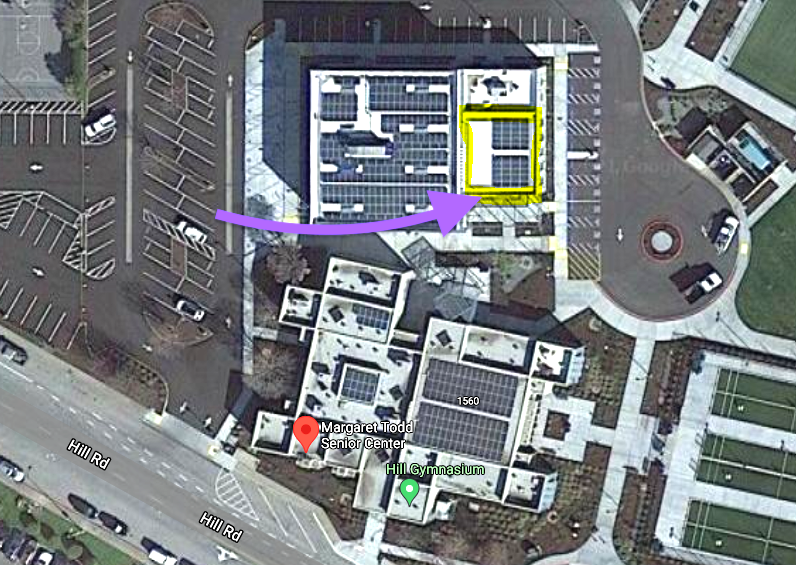
SECOND TUESDAY!In-person at Mgt Todd Senior Center 1560 Hill Road, NovatoHill Community Roombehind the main buildingsee site map below new people warmly welcomed! 12:30 to 1 pm brown bag & social1 to 2:30 pm discussion We’ll have the windows open for safety so dress warmly and wear a mask if you wish. And let’s be sensitive to others needs for safety, approaching with a hug only if the other is open to hugging. Topic: Laughter!Laughter is Good Medicine, if I remember the Readers’ Digest of old correctly. What makes you laugh? Let’s share our good medicine and remember that we can still step beyond our concerns and share laughs. Whether they are belly or bray, cackle or chuckle, giggle or guffaw, it’s a joy to share a laugh with friends.
A big thanks to The Social Committeefor hostingTRICKS, TREATS & TOKENSon Saturday, October 29,at Miwok Park in Novato Thirty-two of us joined together for a fun time meeting old and new friends, playing a fun game, and eating great food! Though a Tyrannosaurus Rex showed up, no one was injured.
Please note: The monthly Fourth Tuesday event at San Geronimo Valley Community Center will be postponed one week while the Center upgrades their wifi system. See you on the Fifth Tuesday, November 29!
Check out the Community Notices section below for new entries about prescriptionless hearing aids and the new bivalent covid booster.
UPCOMING EVENTSall events are free unless otherwise noted(more info below) November 8Second TuesdayIn-person at Mgt. Todd Senior Center, Novato12:30 t0 1 pm brown bag, 1 t0 2:30 discussionwatch for more detailsTopic:Laughter November 9Monthly Mixer at San Rafael Joe’splease RSVP to Will: wboemer@thespahrcenter.org4:30 to 6 pm -from 4th Street entrance November 15Games Day *at Sam’s Place, Novato meal at 2 pm, games at 3 pm November 17Senior Breakfast Club *at Sam’s Place, Novato 9:30 am November 22Fourth TuesdayWest Marin LGBT Senior Town Hall postponed! while SGVCC revamps their wifisee November 29 below November 25Men’s Brown Bag Lunchat Spahr Center’s Conference Roomsemi- (ramp and elevator but no automatic door)noon to 1:30 November 29Women’s Coffee *at Sam’s Place, Novato 10 am November 29Fifth Tuesday on the Fifth Tuesday!West Marin LGBT Senior Town Hall at San Geronimo Valley Community Center 12:30 to 1 brown bag/1-2:30 discussion
*Social Committee event, RSVP required;to RSVP or get on their email list, write to them atsocialcommittee@comcast.net;find a link to their calendar and flyers below ** See flyer below
To join the Spahr Senior Groupon ZoomMondays, 7 to 8 pm, &Thursdays, 12:30 to 2 pm,click the purple button below the Butterfly Heart or here:
New participants are warmly welcomed!If you’re zoom-challenged, let me know and I’ll work with you!
Topical Thursdays12:30 to 2 pm November 3Topic to be chosen by participants…
Living Room Mondays7 to 8 pm We share with each other about how we’re doing and have unstructured conversations focused on listening from our hearts and deepening community.
The Northbay LGBT+ Senior Social Committee has been consistently offering fun events to offset the boredom of the pandemic. Everyone born in any month will be celebrated in that month’s email – including your birthday if you’ll let them know when it rolls around! To see their calendar & flyers for November,click here. To sign up for their emails or register for events, clickhere.
Coronavirus Updates A new Bivalent Covid Vaccine is availableand it is recommended that most seniors get that shot. Contact your health provider for more information. The Spahr Center has coronavirus rapid home test kits& masks and they are available for free in the office – 150 Nellen Avenue, Suite 100, Corte Madera 94925; 415/457-2487. The office is open 10 am – 3 pm weekdays. Only vaccinated people may come to the office and masks must be worn inside the building. Any staff person can direct you to the kits. This is a great resource we are pleased to offer, please don’t hesitate to get these kits! In order to keep track of new infections, the County asks that we report self-test resultshere. To see Marin County’s latest pandemic information, click here. The mask recommendations of the Mask Nerd– an aerosol scientist who studies mask effectiveness – are featured in this article and highly informative video. May we all be safe and well!
Community Notices
A recent “bivalent” covid booster is available and is especially advised for older people and those with immune-compromised conditions, etc. Contact your health provider for more information. Hearing Aids will now be available without prescription at places like Costco, Walmart and Walgreens at a saving of upwards of $3000. You can learn more by clicking here. Social Security Opens to Survivors of Same-Sex Couples Who Could Not MarryThe Social Security Administration now allows lesbians and gay men to receive survivor’s benefits if we can show that we were in a committed relationship and would have married had that been possible. More information here.
The Spahr Center’s Food Pantryis open to seniors who need support in meeting their nutrition needs. We want to help! Items such as fresh meats, eggs and dairy, prepared meals, pasta, sauces, and canned goods are delivered weekly to people who sign up.
Vivalon Resources for Seniors Whistlestop, now renamed Vivalon, offers many resources for us seniors, now listed in this easy-to-print one-page guide. Access to rides, food, classes, activities, resources, referrals, and more. Membership not required for most classes and services during the pandemic. Some in-person events are being planned. To get Vivalon’s listings, click here. They also provide access to resources including rides for older adults. Please note: there is a 3-week registration process for the ride program so register now if you think you may need rides in the future. Click here for their website. The Jackson Cafe has great specials, a roomy dining room, small tables and big round tables for groups. Open 11:30 to 1:45; $8 for members, $10 for guests, with takeout readily available. You can find their daily changing menu and more information here.
Building Community in the Midst of Sheltering-in-PlaceSee old friends and make new ones! Join us!The Spahr Center’s LGBT Senior Discussion Groupscontinue everyMonday, 7 to 8 pm& Thursday, 12:30 to 2 pm on zoom
To Join Group by Video using Computer, Smart Phone or TabletJust click this button at the start time, 6:55 pm Mondays / 12:25 pm Thursdays:Join GroupAlways the same link! Try it, it’s easy!
To Join Group by Phone CallIf you don’t have internet connections or prefer joining by phone,call the following number at the start time,6:55 pm Mondays / 12:25 pm Thursdays:1-669-900-6833The Meeting id is 820 7368 6606#(no participant id required)The password, if requested, is 135296#If you want to be called into the group by phone, notify Bill Blackburn at 415/450-5339
California Department of Aging ResourcesThe CDA has a website that is packed with information and resources relevant to the lives of seniors in our state. From Covid-19 updates to more general care for age-related health issues, access to legal assistance to getting home-delivered meals to help with housing, you may well find answers to your questions by clicking: here.
Adult and Aging Service’s Information and Assistance Line, providing information and referrals to the full range of services available to older adults, adults with disabilities and their family caregivers, has a new phone number and email address: 415/473-INFO (4636) 8:30 am to 4:30 pm weekdays473INFO@marincounty.org
Questions? Assistance? Suggestions? We have resources and volunteers for:grocery deliveryfood assistanceproviding weekly comfort calls to check in on youplus more!
Funding for this program, at least in part, is made available by the Older Americans Act, administered locally by the Marin Department of Health & Human Services, Aging & Adult Services.
Less than two weeks before the midterm elections, the window for transgender voters to verify their identities for voting is closing fast.
Roadblocks for trans people to acquire accurate identification abound, while ID requirements to vote are getting stricter in a growing number of states. The predictable result will be fewer trans people voting in 2022, just as their rights are coming under attack from anti-LGBTQ candidates.
According to the latest research from UCLA’s Williams Institute, over 200,000 trans voters could be disenfranchised this November.
It could be worse. A 2015 study from the National Center for Transgender Equality reveals voter participation from trans people is higher than among all eligible voters, 54% to 42%, meaning more trans voters will manage to cast a ballot despite the barriers to their participation.
Trans people face numerous challenges in changing their official ID gender markers. The process can take time, money, and access to medical care that many trans people, particularly younger individuals, don’t have.
According to the Movement Advancement Project, 10 states require documentation from a medical provider in order to change a trans person’s gender marker. Eight states require proof of surgery, a court order, or an amended birth certificate. And ten states have “burdensome” or “unclear” policies on changing gender markers.
Changing a birth certificate to get a new ID can also present problems. 12 states require trans people to undergo some form of gender-affirming surgery before officials will revise a birth certificate. Four states don’t allow changing a birth certificate gender marker at all.
Name changes aren’t easy, either. Nine states require people to publicly post a name change request online, which can lead to harassment or violence.
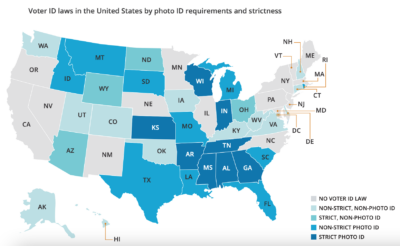
“Such obstacles can impact voting in the 35 states that have voter ID laws,” according to the Williams study. “In these states, voters encounter additional verification requirements at the polls on top of federal standards for voter registration and eligibility determination. The strictest of these voter ID laws require voters to present a government-issued photo ID at the polling place, and provide no alternative for voters who do not have a photo ID, or as is often the case for transgender voters, have an inaccurate photo ID.”
UCLA Williams Institute
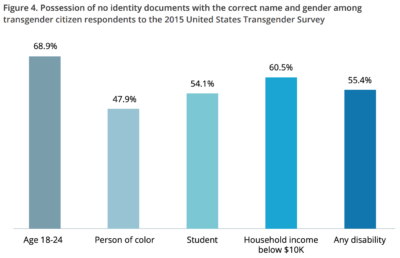
According to the Williams study, “Transgender people who are Black, indigenous, or people of color, young adults, students, people with low incomes, people experiencing homelessness, and people with disabilities are overrepresented among the over 203,700 voting-eligible transgender people who may face barriers to voting due to voter ID laws in the 2022 midterm election cycle.”
UCLA Williams Institute
Trans voters can seek help updating their state and federal identification with organizations like the National Center for Transgender Equality, which provides up-to-the-minute requirements for voter ID state by state, and other gender and name ID change information.
Voter ID laws are promoted by their primarily-Republican sponsors as a way to protect against voter fraud, a nearly non-existent problem in the United States, despite the hype. Both the American Civil Liberties Union and The Brennan Center for Justice have called voter ID laws a form of “voter suppression” that mostly disenfranchises Democratic voters.
“Regardless of whether you’re transgender, every eligible voter should be able to cast their ballot without fear of harassment or discrimination,” Olivia Hunt, policy director for the National Center for Transgender Equality, told LGBTQ Nation. “Onerous ID requirements are just one of the many strategies used to exclude marginalized people from participating in the political process. This kind of voter suppression is contrary to the guiding principles of American democracy, and is a blatant violation of the fundamental constitutional rights of all Americans.”
After five hours of tense testimony and protests, the Florida Board of Medicine voted Friday to start drafting a rule that would bar all minors in the state from receiving puberty blockers, hormone therapy or surgeries as treatment for gender dysphoria.
Florida’s medical board is the first in the country to pursue such a rule, but Florida is among a wave of states where officials have attempted to restrict gender-affirming medical care for transgender minors.
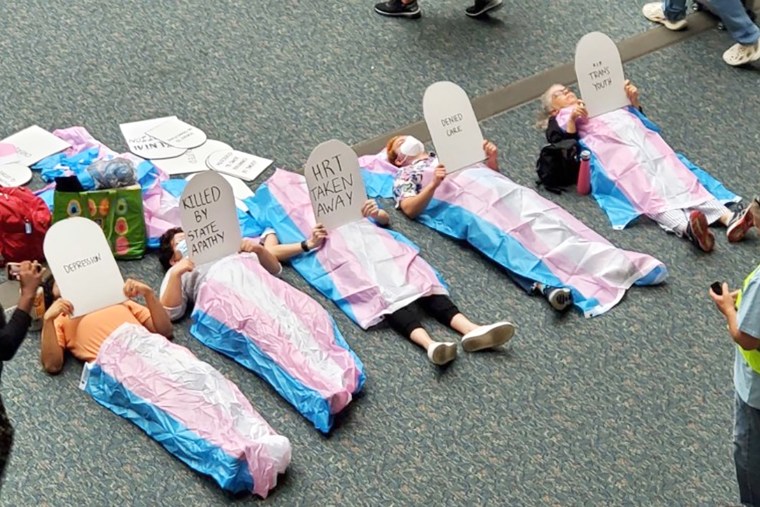
By the end of Friday’s five-hour meeting, protesters began yelling “Shame!” at the board members, and some of them staged a “die-in” in the lobby of the Orlando International Airport, where the meeting was held.
Protesters stage a “die-in” in the lobby of the Orlando International Airport on Oct. 28, 2022.Courtesy Kat Duesterhaus
The vote is the latest update in a months-long effort led by Gov. Ron DeSantis’ administration to restrict transition-related care for people under 18.
The effort to restrict such care began in April, when DeSantis and Florida Surgeon General Joseph Ladapo issued nonbinding guidancethrough the Florida Health Department that sought to bar both “social gender transition” and gender-affirming medical care for minors.
Despite that support, Florida’s Agency for Health Care Administration issued a report in June that “found that several services for the treatment of gender dysphoria — i.e., sex reassignment surgery, cross-sex hormones and puberty blockers — are not consistent with widely accepted professional medical standards and are experimental and investigational with the potential for harmful long-term affects.”
Just hours after the report’s release, Ladapo sent a letter to the Board of Medicine and asked it to establish a standard of care “for these complex and irreversible procedures.”
The board held its first meeting on the issue in August, and on Friday it officially voted to draft a ban on certain gender-affirming therapies for minors. The meeting began with expert testimony in favor of and against such care.
Dr. Michael Laidlaw, an endocrinologist in Rockland, California, cited often-criticized research that found 50% to 90% of children whose gender identity isn’t consistent with their assigned sex at birth grow out of the condition by adulthood.
“The basic problem with this treatment as I see it is: ‘What happens when you force a square peg into a round hole?’” he said. “You end up injuring or destroying the peg in the process.”
However, Dr. Meredithe McNamara, an assistant professor of pediatrics at Yale School of Medicine who treats transgender people between the ages of 10 and 25, told the board that the research Laidlaw cited and the June report issued by the Florida Agency for Health Care Administration are methodologically flawed.
“Neither of the authors of the state’s review is a subject matter expert,” McNamara said. “One individual is a dentist. The other is a post-doctoral fellow in biostatistics. At a bare minimum, the systematic review should be conducted by those who are qualified to assess the literature. I wouldn’t trust a dermatologist review of the literature on a neurosurgical procedure, for instance.”
After expert testimony, the board began the public comment period, which was scheduled to last two hours, according to multiple attendees.
The first nine attendees who spoke were in favor of restricting gender-affirming care for minors. Eight of them said they have detransitioned, or come to identify with their assigned sex at birth after having previously identified as trans. Only one of the eight had received gender-affirming medical care as a minor.
Chloe Cole, who described herself as an 18-year-old detransitioned female from California, said she began transitioning at 12 and received a double mastectomy at 15. At 16, she said, she realized she regretted her transition.
“All the talk about mental health, self perception, pronouns and ideology leads me to the question, why is a mental health epidemic not being addressed with mental health treatment to get at the root causes for why female adolescents like me want to reject their bodies?” Cole said.
The board also heard from the parents of transgender youths. Hope McClay, who has a 9-year-old trans daughter, said that she used to have to force her daughter to get short haircuts before she came out as trans.
“At one point she came up to me, at about three-and-a-half years old, and begged me, crying, and said, ‘Please, don’t make me be this way anymore. This is not who I am. I want to die,’” McClay said.
She said she and her family have consulted with medical professionals on medical care for their daughter, and they have found that allowing her to go through male puberty would be “psychologically damaging.”
“So we do not make these decisions lightly, but these are the decisions that should be made by the families, not by the state, and not by a board,” McClay said.
Jude Spiegel, the only transgender person to testify at Friday’s meeting, read the names of 17 trans teens who died by suicide “over living in a world that refused to acknowledge or accept them.”
With about 45 minutes left in the public comment period, board member Dr. Zachariah P. Zachariah said only one more person would be allowed to testify. The crowd protested, and he offered to provide an email where they could share their testimonies.
At one point, an audience member yelled that trans youths would suffer if the board voted to bar care: “The blood is on your hands!” To which Zachariah responded, “That’s OK.”
Emile Fox, a trans nonbinary person from Orlando who uses “they” and “he” pronouns, said they signed up to testify and weren’t able to, which frustrated them after the first eight people who testified were all in favor of restricting care, but none of them were from Florida.
“What was so appalling to me is how obviously staged this all was,” Fox said, adding that the board members didn’t appear to know that much about gender-affirming therapies. “They’ve been fed a narrative, and they ate it up.”
A spokesperson for the board said the committee “heard from subject matter experts and allowed for members of the public to speak on the issue at today’s workshop.”
“The content of public comment is not ‘stacked’ by Boards,” the spokesperson said in an email Saturday. “Any members of the public who were unable to provide comment can submit written comment via email to BOMpubliccomment@flhealth.gov within 24 hours of the conclusion of the workshop. These comments will be included in the rulemaking record and reviewed just as all other public comments.”
After the public comment period, the board attempted to come up with a rough draft of a rule. Initially, members considered making trans youths who were already receiving gender-affirming medical care exempt from the ban if they underwent an informed consent process, but they decided to cut that proposal.
Then, in a rushed exchange that attendees described as confusing, Zachariah pushed for a vote even as some board members asked for the proposal to be read aloud once more. He then said the motion was passed without saying what the final tally was.
Florida Rep. Anna Eskamani, a Democrat whose district includes parts of Orlando, said that there would be another meeting on Nov. 4 at the Holiday Inn, Disney Springs, to discuss the drafted rule, and then there would be a 28-day approval process that would include additional time for public comments.
She believes the timing of the rulemaking process — just ahead of the election — is intentional.
“It’s so clearly intentionally designed to create a news cycle that further polarizes and politicizes gender-affirming care to distract from the affordable housing crisis, to distract from the impact of Hurricane Ian and property insurance rates,” she said. “We have some actual real problems to solve, big health disparities that we need to address and yet, instead of talking about those real-life concerns, trans issues are going to be front and center, and that’s truly designed to continue to divide us.”
Just in case you missed it, the 2022 U.S. Trans Survey is now LIVE! If you haven’t taken the survey already, now is a great time. For the first time in 7 years, you have a chance to be part of the largest survey of trans people in the United States. We hope you’ll take about 60 minutes to share your story and be a part of history.
If you are trans and plan to take the survey, here’s what you need to know:
The survey is open to people of all trans identities (binary and nonbinary), ages 16 and older, living in the United States and U.S. territories, regardless of citizenship status.
If you pledged to take the survey, you are not obligated to take the survey. Participation is voluntary. When you click on the link to start the survey, you will be asked to consent to take the survey.
The U.S. Trans Survey is an anonymous survey. Your response will be kept confidential and will not be used to identify you.
The time required to take the survey may vary, but make sure to set aside at least 60 minutes to take the survey.
The survey will be available in both English and Spanish.
Please let your trans friends and siblings know about the survey too!
The U.S. Trans Survey is a survey for trans people, by trans people. The 2022 U.S. Trans Survey is conducted by the National Center for Transgender Equality in partnership with the National Black Trans Advocacy Coalition, the TransLatin@ Coalition, and the National Queer Asian Pacific Islander Alliance.






 meal at 2 pm, games at 3 pm