Nearly 50 percent of transgender people travel outside of their state of residence to get gender-affirming genital surgeries, according to a new study from Oregon Health and Science University (OHSU). The percentage could increase as more states put bans against gender-affirming healthcare for trans people in place, the study’s authors say.
The study, published Wednesday in JAMA Surgery, looked at 771 transgender patients who had a vaginoplasty or phalloplasty between 2007 and 2019. It found that 49 percent left their state of residence to get the procedure. People who lived in southern states were more likely to have to leave their home states in order to receive the surgery.
That’s because there’s a lack of surgeons who provide such care in the South. A 2020 studyfound that just 11 doctors in the South could provide such surgeries, and four of the doctors resided in Florida.
The number of such doctors could decrease as more Southern states ban gender-affirming care for trans youth. Genital surgeries aren’t typically performed on young trans people, but some doctors could choose to locate their practices outside of states with such bans in place because the bans increase doctors’ legal and financial liabilities if they treat young patients.
Of additional concern, the OHSU study found trans people who left their states to get surgery ended up paying up to 50 percent more in out-of-pocket medical expenses than those who were able to obtain surgeries in their home states. This included costs for post-surgical visits and foll0w-up care.
Only one of the 771 patients included in the study had their surgery paid for by their commercial health insurance provider, The Hill noted. This suggests that the life-saving surgical procedures may not be affordable for many trans people. Trans people living in transphobic states will face even greater financial and time costs just to receive gender-affirming care.
“We already knew that traveling for health care requires patients to take time off work and pay for travel and lodging on their own, and that it can make receiving follow-up care from qualified providers who are familiar with each patient’s unique needs challenging,” Jae Downing, the study’s lead author, said in a press release.
“This study helps quantify how severely we need more gender-affirming surgeons,” Geolani Dy, an assistant professor of urology and plastic and reconstructive surgery at OHSU School of Medicine, added.
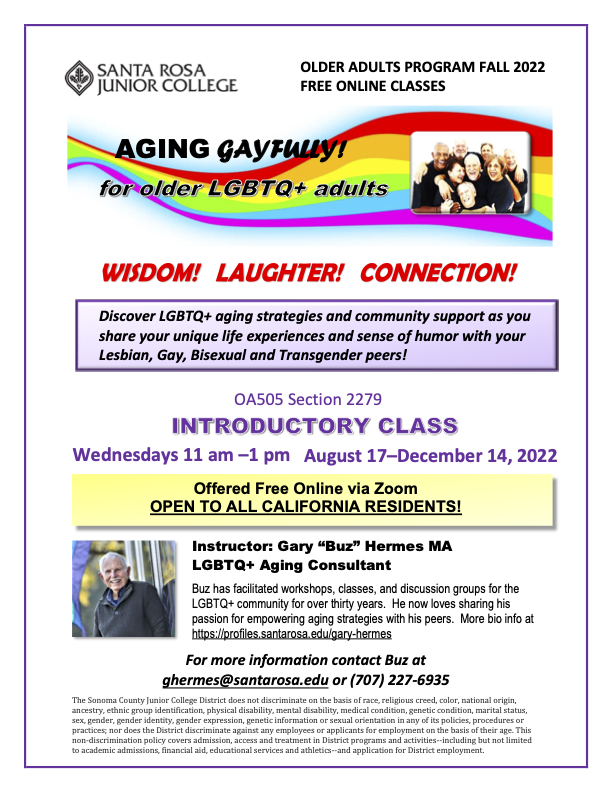
“Aging Gayfully!” is a unique class being offered online as part of the Older Adults Program of Santa Rosa Junior College. It is free to all California residents. The class provides a comfortable space for lesbian, gay, bisexual, transgender, queer and questioning adults to explore skillful aging strategies that address their unique aging issues. The Fall 2022 semester session begins online on Wednesday, August 17 th from 11 am to 1 pm and continues weekly until December 14th. For more information or for instructions on how to enroll email the instructor Gary “Buz” Hermes MA at ghermes@santarosa.edu.
All are welcome at the Sonoma County Library, an institution built on free speech where people come together to discover, learn, and share. On June 10, a patron came into the Rohnert Park-Cotati Library and checked out all of the books on the children and teens side of the Pride Month display. Shortly after, an anti-LGBTQ+ effort claimed responsibility for the act as part of a national Hide the Pride action. Intended to restrict readers from accessing books about LGBTQ+ characters or subject matter, Hide the Pride is an effort toward censorship that is against the library’s values. After an article detailing the incident came out in the Press Democrat on June 24, the library received an outpouring of support from the community. We thank those who stand up for all members of our community and we will continue to offer diverse and inclusive materials and serve all Sonoma County patrons. Sonoma County Library is for everyone.
Check out our news post for more information, resources, and kind words from library supporters.
Read MoreThank you for being a member of the Sonoma County Library community. Visit us online or in person at one of our branches. Be sure to check out open jobs at Sonoma County Library here.
Questions? Please call your local library branch or click here to send us a message. Lea libremente Todos son bienvenidos en la Biblioteca del Condado de Sonoma, una institución construida sobre la libertad de expresión donde la gente se reúne para descubrir, aprender y compartir. El 10 de junio, un usuario entró en la Biblioteca Rohnert Park-Cotati y sacó todos los libros para niños y adolescentes de la exhibición del Mes del Orgullo. Poco después, un esfuerzo anti-LGBTQ reclamó la responsabilidad del acto como parte de una acción nacional de Ocultar el Orgullo (Hide the Pride). Con la intención de restringir el acceso de los lectores a libros sobre personajes o temas LGBTQ, Hide the Pride es un esfuerzo hacia la censura que va en contra de los valores de la biblioteca. Después de que un artículoque detalla el incidente salió en la Press Democrat el 24 de junio, la biblioteca recibió una gran cantidad de apoyo. Agradecemos a aquellos que defienden a todos los miembros de nuestra comunidad y continuaremos ofreciendo materiales diversos e inclusivos y sirviendo a todos los patrocinadores del Condado de Sonoma. La Biblioteca del Condado de Sonoma es para todos. Echa un vistazo a nuestra post de noticias para obtener más información, recursos y palabras amables de los partidarios de la biblioteca.
Lea másGracias por ser miembro de la comunidad de Bibliotecas del Condado de Sonoma. Visítenos en línea o en persona en una de nuestras sucursales. Asegúrese de consultar los trabajos disponible en la Biblioteca del Condado de Sonoma aquí.
¿Preguntas? Por favor llame a su biblioteca local o haga clic para mandar un mensaje.
Saturday July 30 @ 8 pm. David Rosen in Concert at Occidental Center for the Arts. Singer/songwriter/guitarist David Rosen has toured across the globe as a member of Peter Tork’s band and the Elvin Bishop Band. He’s been featured on recordings by Steve Seskin, Tom Paxton, David Rea, Grant Baldwin, Doug Closson, Mary Miché and many others, and on The Best of Blasphemy album alongside Tom Lehrer. In 40+ years of touring he has shared the stage with Buddy Guy, Boz Skaggs,Taj Mahal, Joan Jett, Greg Kihn and Marty Balin. On his debut album ‘Ordinary Miracles’ David played over 15 different instruments, and the album features legendary drummer Joe Vitale . Now a Sonoma County resident, David’s solo show features a diverse range of original songs touching on very real themes in a unique and deeply personal way. Tickets $20 GA, $15 for OCA members @ www.occidentalcenterforthearts.org. Fine refreshments available for purchase, art gallery open during intermission. OCA is wheelchair accessible. 3850 Doris Murphy Ct. Occidental, CA. 95465. 707-874-9392
On a sultry Tuesday evening in New York City, Luke Brown excitedly opened a newly delivered bottle of black-and-orange pills, popped his first dose in his mouth, and washed it down with root beer.
Having contracted monkeypox this month, the lanky, bespectacled 29-year-old project manager had been suffering from what he called “the most severe pain of my life” for over a week before he finally was able to obtain a course of antivirals — a treatment he hoped would soon clear up his lesions and alleviate his suffering.
For Brown, this was cause for celebration. But it was also a sobering moment for him to reflect on how, to gain access to this medication, he had to leverage high degrees of personal privilege, medical literacy and self-advocacy that he said he was guiltily aware most people at risk for monkeypox probably lack. Because to join the fortunate few who have obtained this prized medication, called TPOXX, he had to navigate what he characterized as the exasperatingly byzantine maze of the medical and public health system.
“Here we are in the epicenter of an outbreak primarily affecting gay men in the city,” Brown said of his hometown, New York, which as of Thursday had 778 confirmed monkeypox cases out of 2,593 nationwide. “The city that of anywhere in the world should have the most impressive and robust infrastructure to respond to the health care needs of gay men. And at every level it has fallen flat on its face.”
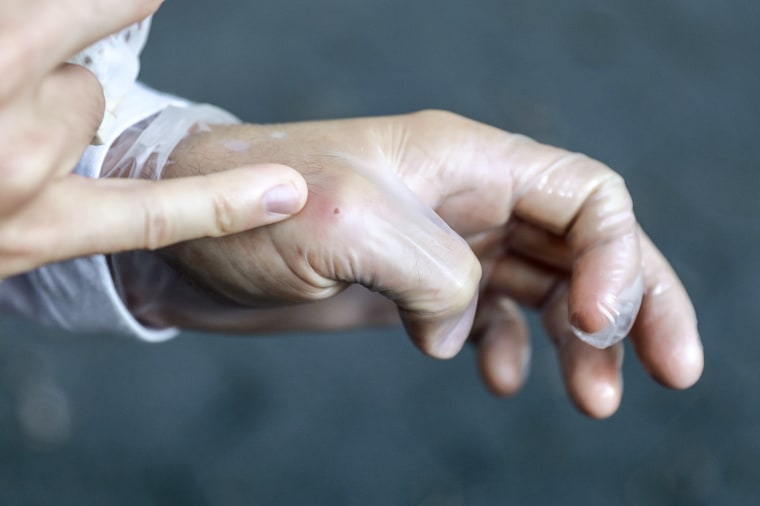
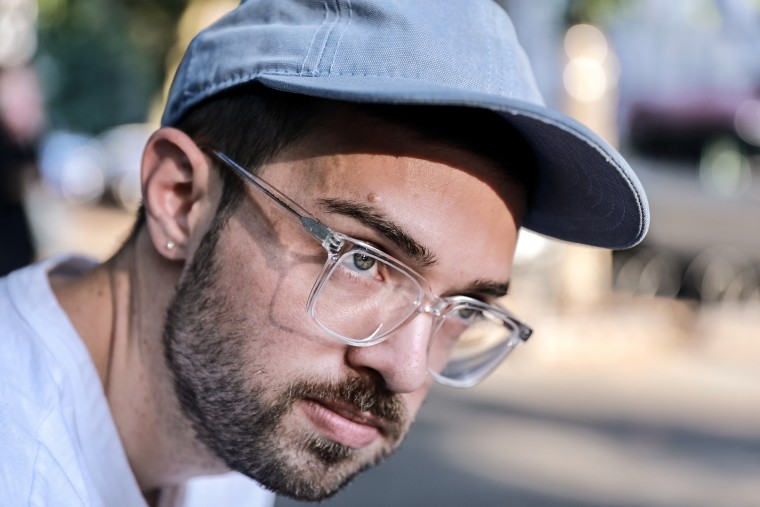
Luke Brown points to a monkeypox lesion on the knuckle of his thumb.Benjamin Ryan for NBC NewsAnother lesion is visible just above Brown’s right eyebrow.Benjamin Ryan for NBC News
Like many of his fellow gay and bisexual men — a demographic that comprises the vast majority monkeypox cases in the global outbreakthat has ballooned to 15,848 cases — Brown said he has grown increasingly appalled and infuriated by the nation’s response to a virus spreading so swiftly that many epidemiologists now believewill likely become endemic in the U.S. and around the world.
Supply of the antiviral is not the problem; there are 1.7 million courses in the nation’s Strategic National Stockpile, according to Dennis Hruby, chief scientific officer of the U.S. pharmaceutical company SIGA, TPOXX’s manufacturer. But the drug, also known as tecovirimat, is not approved by the Food and Drug Administration to treat monkeypox as it is by regulators in the United Kingdom and the European Union; the drug is approved only for smallpox in the U.S.
This is bad news for the Americans with monkeypox who like Brown suffer from excruciating physical pain or other severe outcomes from the infection and who are desperate for treatment to speed their healing. They, and the health care providers who care for them, are up against the U.S. regulatory system.
Even as the Centers for Disease Control and Prevention continues to reduce the red tape that impedes TPOXX access, announcing new changes Friday, public health experts pointed to a complementary means of leveraging the drug’s potential power to alleviate suffering: large clinical trials of the antiviral as a monkeypox treatment.
Plans for such trials are already in advanced stages in Canada, the U.K. and the European Union, according to Hruby. The National Institutes of Health is also planning one in the Democratic Republic of the Congo. But the federal agency’s efforts to launch such research in the U.S. are only in the earliest planning stages.
“This points to a persistent issue we saw during Covid,” said James Krellenstein, a public-health activist and cofounder of the activist group PrEP4All, “where the United Kingdom and European researchers were really able to mount much quicker clinical studies than the United States was.”
Excessive barriers to prescribing
In addition to Brown, NBC News spoke with a dozen people who have taken TPOXX, all of whom suffered from extreme pain before starting the antiviral. They generally reported that within a few days of treatment, their monkeypox symptoms — the pain in particular — began to ease, much to their relief. Most reported no bothersome side effects, or, in one case at least, not bad enough to discontinue treatment. While they all acknowledged that they could not be certain how the course of the disease might have unfolded had they not taken the drug, they generally believed it had been effective for them.
The FDA approved TPOXX as a treatment for smallpox in 2018 based on studies that had infected rabbits with rabbitpox and nonhuman primates with monkeypox. (Smallpox and monkeypox are close viral relatives, so treatments for one are expected to work for the other.) Researchers had to rely on these proxy models of similar viruses because there is no smallpox to investigate, as the virus has been eradicated; and even if there were, it would be unethical to study such a lethal pathogen in humans.
The data indicating the drug is safe for humans comes from a studyof 449 healthy people.
Typically, physicians may use their own judgment to prescribe medications off label for purposes other than those for which they were granted explicit FDA approval.
But given the lack of research on TPOXX’s efficacy in humans, federal health regulations dictate that health care providers may only prescribe the drug for monkeypox through a compassionate-use system overseen by the CDC. Physicians such as Dr. Marshall Glesby, an infectious disease specialist at Weill Cornell Medicine in New York City, said that these strict rules are excessive, including the need to review a more than 100-page treatment-protocol document to qualify as a TPOXX prescriber and to thoroughly document each case.
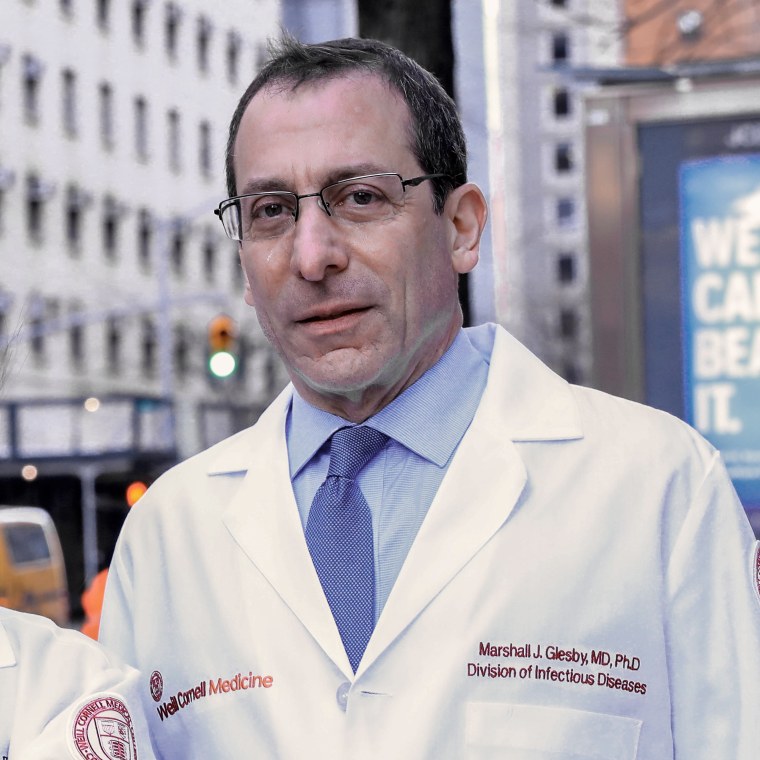
Dr. Marshall Glesby, an infectious disease specialist at Weill Cornell Medicine in New York City, said the strict rules around prescribing TPOXX are excessive.Benjamin Ryan for NBC News
Such burdens sharply limit the number of health care providers who are willing and able to prescribe TPOXX, according to clinicians who have gained such authority.
“It’s a cumbersome process,” said Dr. Anu Hazra, a physician at Howard Brown Health in Chicago who recently began prescribing the treatment.
“Because we don’t yet know how well this drug is going to work for monkeypox patients,” said Dr. Jennifer McQuiston, who leads the CDC’s monkeypox response, “it is important to ensure we have some data from patients who use it, so we can better understand the risks and benefits and ultimately help other people as well.”
Responding to health care providers’ recent complaints about the TPOXX compassionate-use system, the CDC has, for example, made optional previous requirements that clinicians submit photographs of patients’ monkeypox lesions and ship viral specimens to the agency.
In a July 15 letter to the heads of various federal health agencies, PrEP4All and the nonprofit Partners in Health called on the CDC and FDA to end all restrictions on TPOXX’s use and to allow health care providers to freely prescribe it for monkeypox.
Friday, the CDC announced further revisions to the compassionate-use system, including plans to reduce the 100-plus-page document to under 50; pare back the number of reports physicians must fill out about each patient from six to two; and to permit virtual appointments.
“We have reduced the data we need down to the most critical pieces,” McQuiston said “and have worked to make using this drug simpler, in order to ensure doctors can get the drug to patients who need it.”
Dr. Jason Zucker, an infectious disease specialist at Columbia University Department of Medicine whose team has prescribed the antiviral to 45 patients, said that the U.S. should launch a large randomized clinical trial including people with mild monkeypox disease. If anyone in the placebo arm should progress to severe disease, he proposed, they could be switched into a parallel compassionate-use group. This would not only address the crucial question of the drug’s efficacy but also expand access to treatment while also collecting data on people receiving it in a much more rigorous and organized fashion than he said occurs through the current system.
Jumping through hoops to get TPOXX
Luke Brown said that he first tried to gain access to TPOXX through his primary care provider, who submitted the request to New York City’s health department. The request was denied on the grounds that his case wasn’t serious enough. But then he began to suffer pain so severe all he could do was pace around his apartment for hours; even then, his physician delayed in resubmitting the request. So the well-connected Brown tapped into his contacts on social media and finally found someone who linked him to a local doctor with prescribing authority.
Get the Morning Rundown
Get a head
“It’s infuriating,” he said of the hoops he had to jump through to obtain the drug.
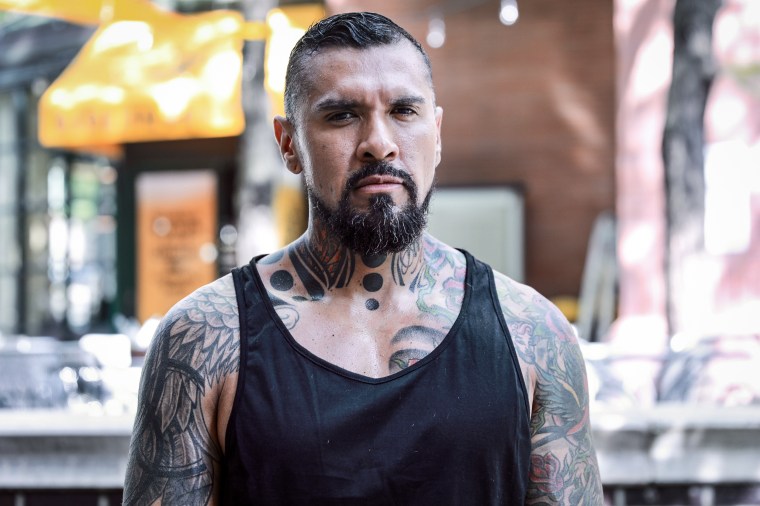
Boomer Banks, an online content creator in New York City, said that he went through a maddening ordeal to obtain TPOXX.Benjamin Ryan for NBC News
“I had to fight for the TPOXX meds,” said an online content creator known as Boomer Banks, also a New Yorker, about what he said was a maddening ordeal finding someone at the city’s health department who could help him access the treatment. “I had no privilege to leverage, just my mouth,” said Banks, who did not want to use his real name used to protect his privacy. “I’m a brown immigrant, 42-year-old HIV-positive sex worker with no insurance. I didn’t take ‘no’ as an answer.”
A recent nonpeer reviewed study posted to a pre-print server found that in laboratory experiments, TPOXX was highly effective at neutralizing the monkeypox strain circulating in the global outbreak.
Under current CDC guidelines, TPOXX is reserved for those with severe disease, including those who are hospitalized or at high risk of a severe outcome because, for example, they are immunocompromised. Those suffering from a common symptom of the virus, intense anorectal or genital pain, qualify for TPOXX, Zucker said.
Brooklyn resident Sebastian Kohn, 39, who had a particularly severe case of monkeypox, said that days after he started TPOXX, the difference in his anorectal pain was “night and day.”
“I can wash myself without wanting to cry,” Kohn said.
Luke Brown holds his bottle of TPOXX pills.Benjamin Ryan for NBC News
Where is the U.S.-based clinical trial?
Asked about the NIH’s plans to back a U.S.-based clinical trial of TPOXX, Judith Hewitt, deputy director of the Office of Biodefense, Research Resources and Translational Research at the National Institute of Allergy and Infectious Diseases, said that “it’s super early days” for such plans.
“There are now just beginning to be discussions about a trial in people living with HIV or at risk of HIV,” she said.
In an email, Dr. Judith Currier, a professor of medicine at the UCLA Division of Infectious Diseases and the chair of a major HIV-related clinical trial network funded by the NIH, confirmed that a trial is being discussed. “I think the holdup is identifying the funding for this work.”
“Money is obviously the real issue here,” Hewitt said. “And so people are scrambling to do what we can do with the resources at hand.” She said the agency is debating whether, for example, to fund a study examining whether a lower dose of the Jynneos vaccine would be highly effective against monkeypox. “So that’s within the same treatment area. But then we’re still up to our eyeballs in Covid.”
Krellenstein, the activist, said, “It’s bizarre, given that we have such large supply in the strategic national stockpile and TPOXX was approved without any human efficacy data, that there weren’t ready-to-go plans for actually doing a U.S. clinical study in the event that we needed to use it.”
According to SIGA’s Hruby, the company might not even look to U.S.trial data on TPOXX to submit to the FDA. Instead, they might rely on the combined findings of the trials already primed to launch in other nations, along with safety data from compassionate-use programs worldwide.
As for how long before the company would submit the drug for FDA approval, Hruby wouldn’t speculate.
“These things always take longer than expected, especially when working with large teams,” Hruby said.
Even on a drug given priority review, the FDA typically takes six months to reach a decision.
TPOXX could help blunt monkeypox’s impact
If approved, TPOXX would offer a future in which the antiviral complements widespread vaccination among at-risk individuals to mitigate monkeypox’s impact on public health, experts said.
The virus could be treated at the very first sign of symptoms, and possibly even during the asymptomatic incubation period if testing technology advances to permit detection at that stage. Such early medical intervention would not only prevent pain and suffering, but would also very likely block transmission of the virus by shortening or eliminating the disease’s infectious period.
Treatment could also save people from the personal and financial hardship of isolating at home for what can be weeks of illness with monkeypox that’s left to resolve on its own.
What’s more, TPOXX could be used as post-exposure prophylaxis among people exposed to monkeypox, either among unvaccinated people or those who cannot be vaccinated, such as the immunocompromised, according to Columbia’s Zucker.
The U.S. Army Medical Research and Development Command does have an established study to assess such a preventive use of this drug. And while a listing of the trial indicates participants must be Department of Defense–affiliated personnel, according to Hruby, there actually is no such restriction.
Friday morning, Luke Brown said his pain had begun to subside and he was watching in wonder as his lesions were steadily sinking back into his skin — “like magic.”
Reflecting on the ordeal monkeypox has been for him, he said it had inspired him to become a public-health activist.
“I’m resolved to see that no one suffers like I did, because no one needs to,” he said.
Anticipating that the U.S. monkeypox outbreak will only continue to expand, he said, “We are just at a crest of avoidable pain unless access to this drug becomes easier.”
Greece’s parliament has banned “sex-normalizing” surgeries on babies born intersex, with atypical chromosomes that affect their bodies in a way that does not fit with the normative definitions of male or female.
Under a new law approved by parliament on Tuesday, surgeries that seek to ensure a child ascribes to traditional notions of male and female on people under the age of 15 years are banned in Greece, unless there is a court decision stating otherwise.
The bill stipulates fines and a prison term for doctors conducting such surgery.
Operations, including corrective surgeries or hormonal therapies to change face or body characteristics, on intersex people over the age of 15 years will be permitted if the teenagers consent, according to the law.
Rinio Simeonidou, mother of an intersex teenager and secretary general of Intersex Greece, told parliament before the vote that the approval of the bill would be “a truly historic moment for all intersex children in Greece” and a good start in eliminating violations of intersex people’s rights.
Malta, Portugal and Germany have already banned such surgeries, which in the past have led intersex people to sterilization, loss of sexual sensation, psychosomatic trauma and health problems, Simeonidou said.
Earlier this year, Greece banned so-called conversion therapy for minors, practices aimed at suppressing a person’s sexual orientation or gender identity and which health experts have condemned as psychologically harmful and unethical.
“I was truly saddened by the mistakes of the past that led to dramatic situations because we were lacking the knowledge and courage,” Prime Minister Kyriakos Mitsotakis, who faces elections next year, told parliament before the vote as he urged lawmakers to endorse the legislation.
A Republican Congress member from Arizona is getting sued for using a picture of his male primary opponent with a male friend and implying that they are a gay couple.
The lawsuit involves a mailer sent by the campaign for Rep. David Schweikert (R-AZ) as well as some street signs about one of his primary opponents, Republican and car insurance company founder Elijah Norton. The mailers and signs used a 2018 picture of Norton with his friend Leslie Hammon, 34, where they’re outside of a bar and have arms around each other’s shoulders. Hammon is gay.
“Elijah Norton Isn’t Being Straight With You,” the caption read.
Hammon’s face was blurred out in the mailer and signs, but he’s saying that his image was illegally used.
Hammon and Norton met years before Norton ran for office through his then-girlfriend.
“Although Hammon and Norton are friends, they are not and have never been in any romantic or sexual relationship,” the lawsuit says.
“The letter said I’m a private citizen. Please leave me out of this,” Hammon said. “My mental health has taken a pretty rapid decline. I had to take a leave from work for a couple weeks.”
Hammon also took issue with the implication that “someone who is gay is unfit for office,” according to AZ Central.
He said that people at his work recognized him in the photo on the street signs earlier this year.
“It’s extremely unsettling because I am openly out,” he told 12 News. “But at what point is my privacy going to be respected?”
He said that he sent a cease and desist letter to Schweikart in June but he got no response. Instead, in late June, the campaign sent out mailers with the same image and caption as the street signs had. Hammon believes that they sent around 50,000 such mailers.
Now Hammon is suing for defamation.
“Schweikert’s advertisements are intended to convey, and clearly do convey, a message that gay people do not belong in Congress or any other public office,” the lawsuit states. “They also clearly convey the patently false assertion that Hammon and Norton are currently or have previously been in a romantic or sexual relationship.”
“Pandering to homophobic narratives in the hopes of being re-elected is truly despicable and demeaning to the congressional office.”
“If your client… is concerned about privacy, I would suggest he not pose for photographs in public places such as bars,” said the lawyer for the pro-Schweikert PAC Americans for Accountability in Leadership. “But my client will not be deprived of its First Amendment rights.”
“This is harkening back to decades ago when gay people were afraid to come out of the closet,” said Bridget Sharpe, HRC’s Arizona state director.
This isn’t the first time that Schweikert has been accused of lobbing anti-LGBTQ insults at political opponents. In 2012, his campaign sent a mailer implying that his opponent bisexual, the Norton campaign said.
The mailer said of then-Rep. Ben Quayle (R-AZ): “He goes both ways.”
In 2014, Schweikert’s campaign sent an email to supporters that said “Politics Is Not for Pansies” in the subject line. Schweikert said that people were “freakishly sensitive” and that he wasn’t using the word as an anti-gay slur but claimed that he was literally referring to the flower.
Schweikert has gotten a score of “0” on the last three HRC Congressional Scorecards, showing his solid opposition to equality for LGBTQ people.
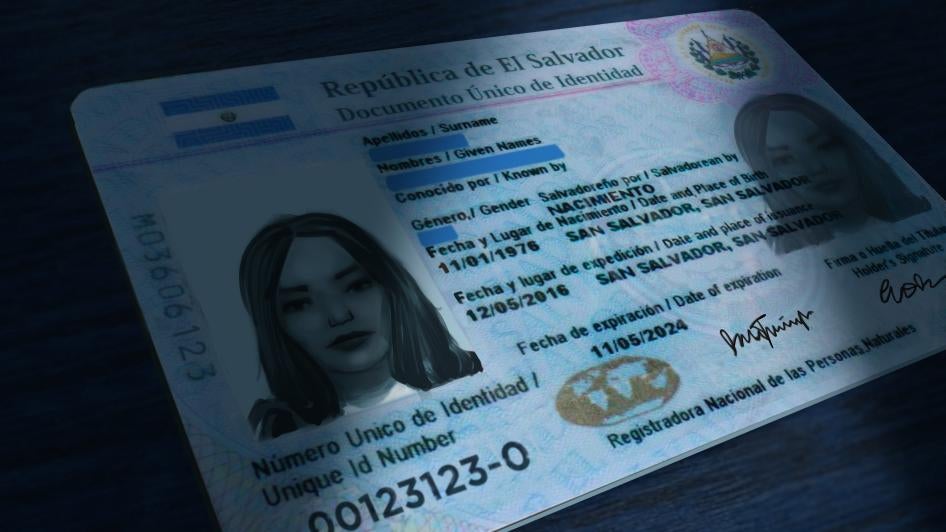
Transgender people in El Salvador experience significant discrimination in daily life because there is no procedure for legal gender recognition, Human Rights Watch and COMCAVIS TRANS said in a report released today. The Legislative Assembly should comply with a recent Supreme Court ruling and create a simple, efficient procedure to allow trans people to accurately reflect their self-declared gender identity on identity documents.
The 40-page report, “‘We Just Want to Live Our Lives’: El Salvador’s Need for Legal Gender Recognition,” exposes the pervasive discrimination that trans people experience due to a mismatch between their gender and their identity documents. The researchers focused on discrimination in four key areas: health, employment, voting, and banking. Human Rights Watch and COMCAVIS TRANS found that a lack of accurate documents, often in combination with anti-trans bias, seriously impedes the realization of these rights for trans people.
“El Salvador’s Supreme Court has made patently clear that trans people have a right to their identity, and now the Legislative Assembly should comply with the ruling and ensure the rights of trans people,” said Cristian González Cabrera, LGBT rights researcher at Human Rights Watch. “Without such legislation, trans people will continue to be disadvantaged in society, exacerbated by the generalized violence and discrimination they face in all aspects of life.”
In February 2022, the constitutional chamber of El Salvador’s Supreme Court ruled that the constitution prohibits discrimination based on gender identity and gave the legislature one year to create a procedure so that trans people can change their names in identity documents. To fully comply with international human rights standards and minimize discrimination, the Legislative Assembly should also allow trans people to modify the gender markers in their documents, via a simple, efficient, and inexpensive administrative procedure based on self-declaration.
To understand and document the harm related to a lack of legal gender recognition in El Salvador, Human Rights Watch and COMCAVIS TRANS interviewed 43 transgender people in San Salvador, San Luis Talpa, Santa Ana, Santa Tecla, La Unión, and Zacatecoluca, as well as remotely.
In August 2021, lawmakers, in collaboration with trans organizations, introduced a draft Gender Identity Law that would create a legal gender recognition procedure, but members of the parliamentary Committee on Women and Gender Equality have not yet discussed it. In May 2021, the same committee blocked a similar bill introduced in 2018 in the previous legislature, along with 29 other bills on various other subjects calling them “not in accordance with reality.” Trans activists sharply criticized the move.
Most trans people interviewed told researchers that they experienced discrimination when they visited public healthcare facilities. They said that clinic staff exposed them as transgender by calling out their legal names in waiting rooms, subjected them to onerous questioning about their identities, and humiliated and mocked them.
People interviewed also described their experiences seeking jobs, with potential employers realizing the interviewees were trans when they looked at their documents. In some cases, potential employers explicitly told trans people they would not be hired because they are transgender.
Most of the trans people interviewed said that they faced obstacles accessing bank deposits and remittances from family living abroad, with bank employees questioning their identity because it didn’t match their documents.
Many of the people interviewed said they faced no impediment to their right to vote in the February 2021 elections. But two trans women said that they were not allowed to vote because their identity document did not match their gender, while several others said they were allowed to vote but faced questioning that left them feeling humiliated.
A growing number of countries in Latin America have created procedures for legal gender recognition, such as Argentina, Chile, Colombia, Costa Rica, Mexico, and Uruguay, providing for simple administrative processes based on self-declaration. The president of neighboring Honduras recently announced that country would make the necessary reforms to allow for this right, in compliance with a 2021 Inter-American Court of Human Rights landmark ruling in a case involving Honduras.
In 2017, the Inter-American Court, which is charged with interpreting the American Convention on Human Rights, affirmed that states must establish simple and efficient legal gender recognition procedures based on self-identification, without invasive and stigmatizing requirements.
The International Covenant on Civil and Political Rights (ICCPR), to which El Salvador is also a party, provides for equal civil and political rights for all, everyone’s right to recognition before the law, and the right to privacy. The United Nations Human Rights Committee, in charge of interpreting the ICCPR, has called on governments to guarantee the rights of transgender people, including the right to legal recognition of their gender.
In 2017, the Salvadoran government acknowledged in a report that LGBT people face “torture, inhuman or degrading treatment, excessive use of force, illegal and arbitrary arrests and other forms of abuse, much of it committed even by public security agents.” A 2021 Human Rights Watch reportconfirmed the Salvadoran government’s assessment and found that social and economic marginalization further increase the risk of violence, making trans people especially vulnerable to abuse.
“El Salvador has a historic debt to the trans community, which the creation of a legal gender recognition procedure can begin to address,” said Bianka Rodríguez, executive director of COMCAVIS TRANS. “We will continue to be objects of violence and discrimination in society until our self-determination, dignity, and freedom are recognized.”
The tasteless, anti-LGBTQI+ comic is scheduled to perform three shows at Luther Burbank Center for the Arts in Santa Rosa, July 26-29. Perhaps the LBC staff and board are unaware of Chappelle’s numerous anti-Trans comments that are well-documented and of which he has offered no apologies. Chappelle identifies as a so-called “TERF (Trans Exclusionary Radical Feminist)” joining author KJ. K Rawlings in such dangerous hate speech. Netflix has come under fire for producing and airing two recent Chappelle shows that feature anti-Trans comments. Recently, a Minneapolis show switched locations as a direct result of a protest organized after Chappelle refered to Monkeypox as “a gay disease.” Should the North Bay’s LGBTQI+ Community allow hate speech and inflammatory comments to be staged in our backyard? Make no mistake – this is not an attack on free speech. This is about making LBC aware that Trans people are harmed and even killed as a result of such despicable comments. We value this venue, but should not allow them to present a show that so many members of this community finds offensive, inflammatory and even dangerous.
If you aren’t aware of this man’s exploits, check out these articles:
PLEASE FORWARD THIS TO AS MANY OF YOUR FRIENDS AND FAMILY AS POSSIBLE.
Let the Staff and Board of Luther Burbank Center for the Arts, its sponsors, those who share the Center’s campus, and elected officials know that such hate results in harm to members of the LGBTQI+ Community. Email and call, as many as possible and as often as possible.
Let’s stop these shows and send a message to every venue in the North Bay that anti-LGBTQI+ hate speech will not be tolerated!
Several men have alleged they had sex with anti-LGBTQ+ pastor and conservative radio host Jesse Lee Peterson.
The allegations emerged after Church Militant – a far-right Catholic group and website – released an almost 30-minute video in June featuring interviews with men accusing Peterson of making sexual advances toward them.
Patrick Rooney, one of the men in the video, claimed he had a sexual relationship with Peterson that he said lasted about 10 years. Rooney, who has known Peterson since 1992, alleged in the video that the Los Angeles-based pastor made sexual advances toward him for years before they became sexually involved in 2005.
But Rooney admitted in a subsequent investigation by the Daily Beasthe didn’t have any emails, texts, recordings or other documentation that could back up his claims.
“Jesse Lee Peterson is a very smart person, he’s a sly person,” Rooney said. “He’s not going to leave a lot of extraneous evidence out about what he does.”
PinkNews has contacted Jesse Lee Peterson and his Brotherhood Organization of a New Destiny (BOND) for comment.
Another man, named Samuel Arambula, alleged in the Church Militant video that Peterson subjected him to unwanted sexual touching at the “BOND house”, a Los Angeles House where Peterson reportedly lives with other members of his organisation.
Robert Santner – who described himself as the BOND house’s former manager – claimed in the video that he witnessed Peterson “intensely” hugging another man. He said he saw a man wrapped up in blankets “like a burrito” while the pastor hugged and kissed his forehead.
According to the Daily Beast, the video followed an online feud between Jesse Lee Peterson and Church Militant’s founder Anthony Michael Voris, who has been described as “one of the US Catholic Church’s most infamous agitators”.
Peterson has reportedly refused to address the allegations he had sexual relationships with men. He told one caller on his radio show, who asked about the claims, that “it’s not concerning me”, the Daily Beast reported.
The outlet reported the video has caused leading figures in the online “manosphere” – which the Daily Beast described as “Peterson’s hyper-masculine conservative community” – to distance themselves from the pastor. One of the leaders reportedly banned Peterson from future events.
In 2019, Jesse Lee Peterson described then-presidential candidate Pete Buttigieg as a “radical homosexual”. He complained that same-gender married couples – who he described as “radical homosexuals” in “phoney relationships” – had “taken over terms ‘husbands’ and ‘wives’”, forcing straight couples to call each other “partners”.
Peterson also claimed that queer couples are not “mentally capable” of raising children and alleged LGBTQ+ people are “violent toward each other”.
He said in 2016 that intellectual “nutcases” are responsible for same-sex marriage and drag queens.
Last year, Jesse Lee Peterson tweeted the baseless claim that “‘diversity’ and ‘inclusion’ based on race, gender sexual orientation or any other physical attribute is a cancer on America culture”.