But no other state has created such a comprehensive strategy — a legislative bill package with more than a dozen proposals, new funding to expand abortion access and a proposed November ballot measure that would enshrine the right to abortion in the state Constitution.
The Supreme Court decision, on a 5-4 vote, clears the way for more than half the states in the country to swiftly ban the procedure, a move that puts great pressure on states where abortion will still be legal. California wants to be an abortion haven for pregnant people living under new laws hostile to abortion.
A restrictive Texas abortion law prompted Newsom last fall to establish a council on the future of abortion. The group drafted a list of recommendations that turned into the long list of abortion-related bills introduced in the California Legislature this year. But it was only until after POLITICO’s reporting of an early majority draft opinion that lawmakers proposed amending the state constitution to explicitly protect the right to abortion, as well as contraception.
Senate Constitutional Amendment 10, which is on track to be placed on the November ballot in the coming days, would ask voters to change the California Constitution to declare that “the state shall not deny or interfere with an individual’s reproductive freedom in their most intimate decisions, which includes their fundamental right to choose to have an abortion and their fundamental right to choose or refuse contraceptives.”
Newsom on Friday afternoon signed into law a bill to shield abortion clinicians and out-of-state patients from abortion laws that threaten to impose criminal penalties. It took effect immediately. Other proposals moving through the Legislature would offer financial help to people coming from other states for abortion-related services.
The Supreme Court’s decision to overturn nearly 50 years of legal precedent upholding a right to end a pregnancy won the support of five of the court’s six conservative justices. Chief Justice John Roberts and the court’s three liberal justices opposed overruling Roe.
“We hold that Roe and Casey must be overruled,” Justice Samuel Alito wrote in the majority opinion, referring to Planned Parenthood v. Casey, the case that barred states from banning abortion before the point of fetal viability. “The Constitution makes no reference to abortion, and no such right is implicitly protected by any constitutional provision. This Court cannot bring about the permanent resolution of a rancorous national controversy simply by dictating a settlement and telling the people to move on.”
The Biden administration proposed a dramatic overhaul of campus sexual assault rules on Thursday, acting to expand protections for LGBTQ students, bolster the rights of victims and widen colleges’ responsibilities in addressing sexual misconduct.
The proposal, announced on the 50th anniversary of the Title IX women’s rights law, is intended to replace a set of controversial rules issued during the Trump administration by Education Secretary Betsy DeVos.
The proposal is almost certain to be challenged by conservatives, and it is expected to lead to new legal battles over the rights of transgender students in schools, especially in sports.
I am always surprised when I hear someone proudly say “after two years Pride is back!” If you are ‘out’ and didn’t have Pride in yourself and your community for the past two years there is a real problem and it’s not about missing the parades and parties.
Pride needs to be about having Pride in who you are, being comfortable in your own skin, with a willingness to be open and ‘out’ sharing with others who you are. Even today, that’s not always easy everywhere. Clearly it is easier than when I was young back in the dark ages. I knew I was gay, not knowing the term, but knew I was attracted to boys. When going through puberty in the early 1960s I felt as if I was the only one who felt that way and it embarrassed me. I managed to hide it from myself, often convincing myself it was phase, most of the time until I left New York City and moved to D.C. Even then it took me a few years to come out.
I was 34 going to my first Pride event and hid behind a tree in Dupont Circle, afraid someone would take my picture. Today I think Pride parades are most important for people who are still struggling with their identity to enable them to see there are many others like themselves and being LGBTQ is OK. In June 2021, friends participated in a walk from Dupont Circle to Freedom plaza and told me how great it was to celebrate Pride in a simpler way without all the parades and parties just walking together in sisterhood and brotherhood. I missed that walk as it was the day of my friend Clark Ray’s memorial service. Clark lived a life we all admired with his husband Aubrey and their four adopted children. No one was a better role model for younger members of the community everywhere, for what it meant to be ‘out and proud,’ compassionate and successful.
Don’t get me wrong I’m not opposed to parades and parties. When I was younger, I fully participated and still think it’s great to see all the people who do. I was even honored as a Pride Hero in 2016, riding in a convertible at the front of the parade — a long way from hiding behind a tree in 1981.
But in these difficult times parades and parties must have a purpose. They should focus on the next generations and show them what it’s like to be part of a strong, successful community. It is the reason I fought so hard for marriage equality. At the time I was asked if I would marry and answered “most likely no, I don’t even have a boyfriend.” Yet to me it was important every young boy and girl who realized they were gay or lesbian knew they could be married and live a full and open life like all their straight friends.
Pride month is about celebrating how far we have come, and also recognizing how far we still have to go. Today we must understand if the Supreme Court can overturn Roe v. Wade, it can overturn marriage equality and even interracial marriage. All things a pig like Alito and his co-signers of the leaked draft opinion on Roe v. Wade can claim are not explicitly written into the Constitution.
The slogan for all Pride parades in the United States this year should be “Show your Pride by voting!” I hope each Pride event across the nation has that as a focus. Each Pride event needs multiple opportunities for people to register to vote.
I consider myself lucky to live in D.C. with politicians who support me and a large open and welcoming community. Yet I am well aware not everyone has that luxury. It means those of us who do must lead the way and be examples for what it means to support each other and support every minority community. We are all in this together. Women may not be a minority but too many in the world still treat them as such and we must support them.
Maybe this year we ask every participating float, in every parade, to have a sign saying ‘Show your Pride by voting!’ If we stand shoulder to shoulder, committing to each other to work at it and vote, we can continue to move forward making progress toward what the Constitution calls “A more perfect union.”
Peter Rosenstein is a longtime LGBTQ rights and Democratic Party activist. He writes regularly for the Blade.
The Supreme Court must revisit and overrule past landmark decisions that legalized the right to obtain contraception, the right to same-sex intimacy and the right to same-sex marriage, conservative Justice Clarence Thomas wrote Friday.
Thomas, in a concurring opinion to the court’s precedent-breaking decision overturning Roe v. Wade and wiping out constitutional protections for abortion rights, said that he would do away with the doctrine of “substantive due process” and explicitly called on the court to overrule the watershed civil rights rulings in Griswold v. Connecticut, Lawrence v. Texas and Obergefell v. Hodges.
Griswold was a 1965 Supreme Court decision that established the right for married couples to buy and use contraceptives. It became the basis for the right to contraception for all couples a few years later. Lawrence was a 2003 Supreme Court decision that established the right for consenting adults to engage in same-sex intimacy. Obergefell was a 2015 Supreme Court decision to establish the right for same-sex couples to be married.
The legal reasoning in all three monumental decisions — as well in the two decisions, Roe v. Wade and Planned Parenthood v. Casey, that had prior to Friday established a legal right to abortion care — relied heavily on the doctrine of substantive due process.
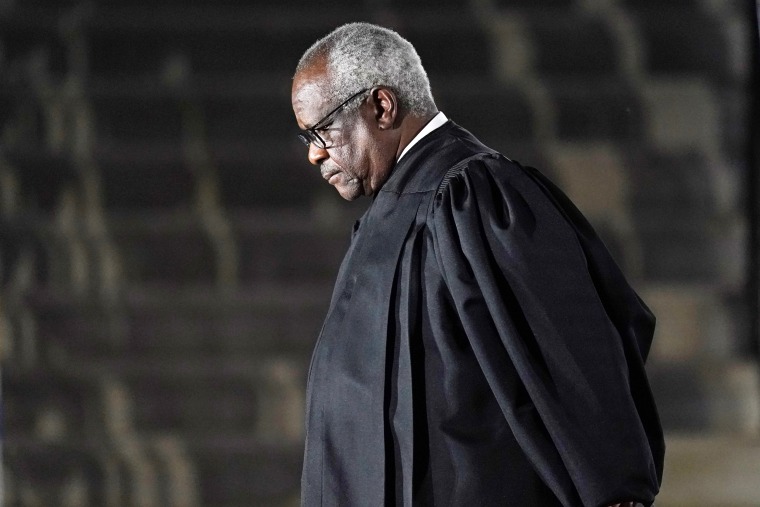
Supreme Court Justice Clarence Thomas listens as then-President Donald Trump speaks before he administers the Constitutional Oath to Amy Coney Barrett at the White House in Washington, D.C. on Oct. 26, 2020.Patrick Semansky / AP file
“As I have previously explained, ‘substantive due process’ is an oxymoron that ‘lack[s] any basis in the Constitution,’” he wrote. He later called it a “legal fiction” that is “particularly dangerous.”
Substantive due process is a term in constitutional law that essentially allows courts to protect certain rights, even if those rights are not explicitly enumerated in the Constitution. It has been interpreted in many cases to apply to matters relating to the right to privacy — including over matters like love, intimacy and sex — which is not explicitly mentioned in the Constitution.
Conservative jurists have long dismissed the legal reasoning that supported that interpretation of substantive due process. And Thomas, a member of the bench’s conservative wing, made that clear in his writings in Friday’s decision.
“In future cases, we should reconsider all of this Court’s substantive due process precedents, including Griswold, Lawrence, and Obergefell. Because any substantive due process decision is ‘demonstrably erroneous,’ we have a duty to ‘correct the error’ established in those precedents,” Thomas wrote.
And because the court, in its ruling Friday, drew heavily on that very idea — that substantive due process is not in the Constitution — Thomas concluded that almost all other precedents that relied on the doctrine should also be overturned.
“I join the opinion of the Court because it correctly holds that there is no constitutional right to abortion. Respondents invoke one source for that right: the Fourteenth Amendment’s guarantee that no State shall ‘deprive any person of life, liberty, or property without due process of law.’ The Court well explains why, under our substantive due process precedents, the purported right to abortion is not a form of ‘liberty’ protected by the Due Process Clause. Such a right is neither ‘deeply rooted in this Nation’s history and tradition’ nor ‘implicit in the concept of ordered liberty,’” he wrote.
Thomas then went even further, writing that the court, after overruling those particular decisions, should eliminate “substantive due process” altogether.
Get the Morning Rundown
Get a head start on the morning’s top stories.SIGN UPTHIS SITE IS PROTECTED BY RECAPTCHA PRIVACY POLICY | TERMS OF SERVICE
“In future cases, we should ‘follow the text of the Constitution, which sets forth certain substantive rights that cannot be taken away, and adds, beyond that, a right to due process when life, liberty, or property is to be taken away,’” he wrote. “Substantive due process conflicts with that textual command and has harmed our country in many ways.”
“Accordingly,” he added, “we should eliminate it from our jurisprudence at the earliest opportunity.”
Thomas, who joined the court in 1991 as only the second Black justice in Supreme Court history, dissented in both the Lawrence and Obergefell decisions.
In Friday’s opinion, Thomas made no mention of Loving v. Virginia, the landmark 1967 ruling by the Supreme Court that struck down laws prohibiting interracial marriage. That decision relied in part on the substantive due process doctrine — and was cited in several subsequent decisions that did as well, including Obergefell in 2015.
But Thomas, whose wife is white — meaning their interracial marriage could have been deemed in illegal in certain states had the court not ruled the way it did in Loving — did not mention the 1967 decision as one that should be revisited.In their own opinions, Justices Samuel Alito and Brett Kavanaugh both referred to Loving, writing that it should not be revisited despite its reliance on substantive due process.
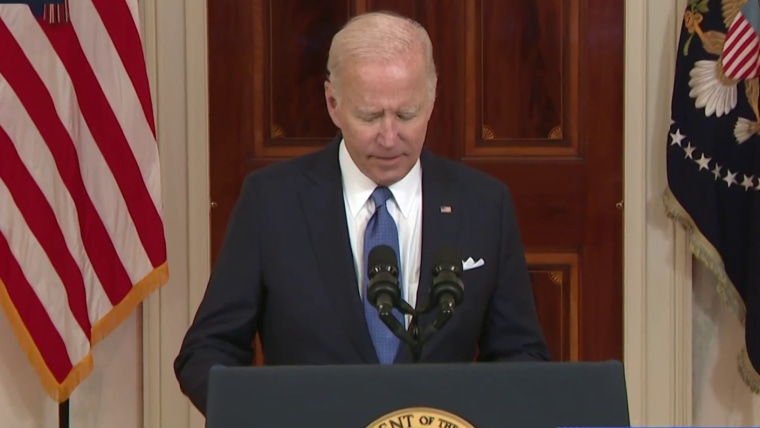
President Joe Biden, speaking to the nation following the ruling Friday afternoon, specifically addressed Thomas’ analysis, saying it paves an “extreme and dangerous path” that the “court is now taking us on.”
“I’ve warned about how this decision risks a broader right to privacy for everyone,” Biden said. “That’s because Roe recognized the fundamental right to privacy and has served as a basis for so many more rights that… we’ve come to take for granted, that are ingrained in the fabric of this country: the right to make the best decisions for your health, the right to use birth control, a married couple in the privacy of their bedroom for God’s sake, the right to marry the person you love.”
“Justice Thomas said as much today. He explicitly called to reconsider the right of marriage equality, the right of couples to make their choices on contraception,” Biden added.
Thomas’ opinion also attracted the ire of prominent civil rights groups, as well as Jim Obergefell, the plaintiff in the 2015 decision that Thomas wants the court to overturn.
“The millions of loving couples who have the right to marriage equality to form their own families do not need Clarence Thomas imposing his individual twisted morality upon them,” Obergefell told NBC News in a statement. “If you want to see an error in judgment, Clarence Thomas, look in the mirror.”
Sarah Kate Ellis, head of the LGBTQ advocacy group GLAAD, called Thomas’ opinion “a blaring red alert for the LGBTQ community and for all Americans.”
“We will never go back to the dark days of being shut out of hospital rooms, left off of death certificates, refused spousal benefits, or any of the other humiliations that took place in the years before Obergefell,” Ellis said in a statement. “And we definitely will not go back to the pre-Lawrence days of being criminalized just because we are LGBTQ.”
“But that’s exactly what Thomas is threatening to do to the country,” Ellis added.
Students at a Washington state high school Monday staged a walk-out in solidarity with a trans student, who was beaten in the school’s hallways the week before.
The walk-out prompted a threat by another student “to aim a machine gun” at the rallying students, according to Kalama police. The Kalama Middle and High Schools, which share a campus, were put into lockdown.
Last week, a transgender student was assaulted in the school’s halls just as students were leaving for the day.
Witnesses say another student repeatedly kicked the transgender student, who is a boy, with steel-toe boots, while yelling homophobic and transphobic slurs.
“The student had been on the ground, begging him to stop and he just kept going,” said Katrina Rick-Mertens, a sophomore at the school and rally organizer.
The victim was subsequently treated in hospital and has returned to class, according to the school district.
At Monday’s walkout, the boy threatening “to aim a machine gun” at protesters made the comment to another student not affiliated with the protest. That student, who says he didn’t see a gun, reported the comments to school officials.
Police say they located the student and took him into custody.
The attack, walkout, and subsequent threats followed reported inaction by the school against what students say is the growing influence of hate groups. Students have posted Nazi imagery in the school, which is just across the state border from Portland, and on social media.
According to parent Melissa Cierley, bullying at the high school is endemic.
“There’s a certain population that seems to be able to get away with whatever they want,” she said.
Her daughter Lillie says she’s been the victim of sexually harassing insults and threats, and things thrown at her like books, staplers, or “anything they can get their hands on.”
Cierley and Rick-Martens say while they tell school administrators about the bullying, they’re never told about anything being done about the incidents, only to see the bullying continue.
“It’s just really heartbreaking to not be taken seriously,” Cierley says.
“You’d think that after so many students go to them about hate speech and going to them that we need these bullies to stop, that they would do something. We shouldn’t have to come to this point to rally together for them to listen to us,” Rick-Mertens said.
“If students are saying that they feel like this, they feel like there is a problem, then there is truth to that,” Kalama School District Communications Manager Nick Shanmac said. “As a school, as a district, we need to be listening.”
Rick-Mertens posted on Instagram after the rally: “Remember, staying silent only helps the oppressor and never the victim. Use your voice for good.”
In Birmingham, Alabama, families, and friends of students of Magic City Acceptance Academy attended the charter school’s inaugural graduation ceremony. MCAA is a charter school that promises an “LGBTQ-affirming learning environment” for students who “have dropped out, are not thriving at traditional schools.”
Although the classes are small, 12 seniors graduated this year, the hearts of the school’s community remain large as crowds of families cheered on the graduates with lots of pride, appreciation, and love.
In its early stages, MCAA overcame three rejections from the Alabama Public Charter School Commission. However, the school won its approval and opened its doors in 2021 in the Birmingham suburb of Homewood with 250 students in grades six through 12.
Mike Wilson, the school’s principal, noted that when students first arrived at MCAA, they were “wrapped up in their trauma.” The students came from environments where they’d been bullied and marginalized. At the Academy, the staff and faculty worked to educate and empower their students.
One graduating senior, Clover, said it wasn’t until they came to the Academy that they saw their grades improve. Along with good grades, Clover has also created strong bonds with other students that they never thought they’d have.
Clover’s mother, Rachel, said that from the beginning of the school year she’s seen a change in her child. Previously, Clover was “miserable” in school, and there weren’t many options. But when Rachel discovered MCAA, she thought it could be a solution. And she was right.
MCAA creates an environment that focuses on both the mental and social development of students by creating a trauma-informed space. Trauma-informed care helps professionals change their focus away from asking questions like “what’s wrong with you?” and instead asks questions like “what happened to you?”
Along with trauma-informed care, MCAA also focuses on social justice initiatives, restorative justice, and social and emotional learning, while also providing strong academics.
MCAA has already seen the payoff of these focus areas during both the graduation ceremony and an eighth graders’ promotion ceremony where students seemed full of joy as they played with friends and went to teachers to offer them heartfelt goodbyes and handwritten letters.
The Academy has been a beacon of support within the community, already amassing its target enrollment of 350 students. The school plans on adding more staff in the future to meet the needs of more students.
MCAA comes at a time when bullying in schools have reached the need for intervention. The ACLU has stated it’s illegal under federal law for public schools to ignore anti-LGBTQ harassment of students.
“Public schools that fail to adequately protect LGBTQ students from severe bullying and harassment can be held liable under Title IX and the Equal Protection Clause. Cases thathave found school districts are liable for anti–LGBTQ bullying as a result of their deliberate indifference have led to damages awards and settlements as high as $1.1 million for students whose schools failed to protect them from anti–LGBTQ harassment,” an open letter to schools states.
It looks like MCAA is solving that problem and is a leader in education when it comes to anti-LGBTQ bullying initiatives.
Growing up queer on Wyoming’s Wind River reservation, Sharmaine Weed has faced more than her share of troubles—but her love of extreme bareback horseracing has sustained her throughout. A ten-time undefeated champion until she’s forced to give up racing to care for her sister after a terrible accident, Sharmaine finds solace and support in her burgeoning relationship with Savannah, a city girl who moves to the rez to help her care for her family.
When the two young women relocate to Denver to escape the increasingly toxic atmosphere at home, Sharmaine finally earns enough cash to realize her dream of buying a horse of her own and begins plotting her racing comeback. But the path we choose doesn’t always take us where we want to go… as Sharmaine and Savannah soon discover. Filmed over the course of three years in the breathtaking Wyoming landscape, this affecting documentary from Kim Bartley (The Revolution Will Not Be Televised) is an exuberant tale of love, loss, and resilience among the Native American community.
This film will be screened JUNE 26, 2022 1:30 PM — 3:17 PM
And stream online JUNE 24, 2022 12:01 AM — JUNE 30, 2022 11:59 PM
Health officials on Wednesday recommended that men in Florida who have sex with other men get a meningococcal vaccine following what the Centers for Disease Control and Prevention called “one of the worst outbreaks of meningococcal disease among gay and bisexual men in U.S. history.”
The CDC said in a statement that there have been at least 24 cases and seven deaths among gay and bisexual men caused by the bacteria in Florida recently. The CDC also recommended that gay and bisexual men traveling to Florida should ask their health care provider about getting the vaccine.
Students and alumni at Seattle Pacific University have been staging a sit-in for weeks, protesting the private Christian university’s policy banning employees from being gay.
The protest culminated with students handing rainbow flags to SPU President Pete Menjares in exchange for their diplomas at their graduation ceremony.
The protests came in response to a decision by SPU’s board of trustees in May not to change the school’s “Employee Lifestyle Expectations,” which bar employees from engaging in “sexual behavior that is inconsistent with the University’s understanding of Biblical standards.”
According to the policy, that includes same-sex sexual activity.
“Employees who engage in any of these activities may face disciplinary action up to and including termination of employment with the University,” the policy states.
“The board made a decision that it believed was most in line with the university’s mission and statement of faith and chose to have SPU remain in communion with its founding denomination, the Free Methodist Church USA, as a core part of its historical identity as a Christian university,” SPU board chair Cedric Davis said in a statement last month. The Free Methodist Church USA, which according to The Guardian has contributed $324,000 to the university, had threatened to cut ties with the school if the policy was changed.
SPU has not filed for a religious exemption under Title IX, the federal education law barring discrimination based on sex, or Title VII, the law prohibiting employment discrimination based on sex, according to The Guardian. The Supreme Court ruled in Bostock v. Clayton Co.in 2020 that Title VII’s ban on discrimination based on sex outlaws anti-LGBTQ job discrimination as well, and President Joe Biden issued an executive order saying that Title IX’s protections include LGBTQ people as well.
A 2021 lawsuit brought by an SPU professor claiming the school had denied him tenure because he is gay was settled out of court. SPU’s faculty senate subsequently passed a vote of no confidence in the school’s board of trustees, which had upheld the anti-gay policy. In early June, the faculty senate passed a resolution in support of changing the policy to allow same-sex sexual activity within the context of marriage.
Summing up the protesters’ outrage, 22-year-old Leah Duff posed a question for SPU’s administration: “You’re going to charge me thousands of dollars every quarter to come here and to get an education, but you’re not going to provide me the education that I deserve as a queer person by having queer staff and faculty?” The Guardian reports. “You talk about being ecumenical, being so diverse. And it’s like, where is it?”
SPU student government president Laur Lugos says students plan to continue the sit-in well after graduation. As Lugos tellsThe Seattle Times, “Students have organized it and have been the ones putting it together, but the entire community is backing this and supporting this.”
Two transgender journalists are pulling out of the Guardian’s Pride special coverage due to the paper’s alleged “ingrained prejudice against trans women.”
In a letter to the U.K. newspaper’s bosses, freelance journalists Freddy McConnell and Vic Parsons said they were declining all future work with The Guardian. They were commissioned to write pieces about their experiences of being transgender for the paper’s upcoming Pride special.
The pair say they have a “moral duty to stand in absolute solidarity” with transgender women and trans feminine people who are receiving negative attention from the paper, adding they will “no longer write for The Guardian until it changes its trans-hostile and exclusionary stance.”
The letter continues: “For far too long, the UK’s supposedly most progressive mainstream media outlet has routinely monstered trans women, undermined non-binary people, and misrepresented our desire to simply live in peace and safety.”
“It has amplified conspiracy theories about trans healthcare and trans and gender non-conforming children and has contributed to attempts to smear those working to support trans people. On social media, it’s even worse, with prominent writers routinely amplifying and generating misinformation about trans women, trans men, and nonbinary people.”
McConnell and Parsons say they believed a recent opinion piece was “misleading and discriminatory” about cisgender lesbians dating transgender women and said it was “the final straw” for them.
The opinion piece was published in The Guardian’s sister paper The Observer and online on The Guardian’s website. The article has been criticized as anti-trans, with the author of the article repeatedly calling transgender women “biologically male” and labeling transgender campaigners working for transgender equality as pushing “gender ideology.”
McConnell said that he was “disgusted” by the article, “I was like, oh God, here we go again. I’m still shocked that the Guardian is putting out pieces that are so obviously incorrect, inaccurate, and offensive. What is going on?”
In their letter to newspaper bosses, the writers claim the article “contravenes The Guardian’s editorial code on fairness, verification, accuracy, and discrimination,” as well as going against the paper’s “foundational values.”
“This decision was not reached quickly or easily,” they write, adding, “since 2017, trans writers, staffers, and allies have been working politely and tirelessly to help editors understand the harm that misinformed hostility to trans equality is doing, both to trans people and to the paper itself.”
“When I saw that opinion piece I was just like – why? Not again. I was sent it by multiple people and it’s exactly why I’ve had to stop reading the news for the past few months,” Parsons said. “It was impossible for me to go ahead and write something for the Pride edition, knowing that the organization had supported that article.”
The two journalists call on other writers, especially LGBTQ writers, to end their working relationships with The Guardian “until it stops attacking trans women and trans equality,” they say that all of the newspaper’s transgender staff have already left.
“The Guardian can no longer point to trans staffers as evidence of not having a transphobia problem because they’ve all left, either wholly or partly due to said transphobia,” the letter claims.
McConnell and Parsons have several demands within their letter. They want The Guardianto change how it approaches transgender people. They also ask for a change in the editorial stance to reflect that transgender women having rights does not disadvantage cisgender women.
Both writers don’t have any regrets when it comes to leaving The Guardian. When asked if leaving could lead to transgender people being silenced, or more anti-transgender negativity in the newspaper, both McConnell and Parsons said “no.”
“We’re not included in the debate at this point anyway, and certainly not by The Guardian,” Parsons said. “This is a statement against the continued exclusion of our voices from the debate – not us removing ourselves from a debate that we were included in.”
They added: “If you call yourself a trans ally, this is the moment for you to do something. Yes, it might come at a financial cost to not have a working relationship with The Guardian, as it does for me and Freddy, but sometimes you have to do what’s right.”