Malaysia is pushing for Sharia law to be tougher against LGBT+ Muslims even as it makes a bid for a spot on the UN Human Rights Council.
On Tuesday (6 April) the Malaysian government announced plans to move forward with an amendment to the Sharia Courts Act that would allow heavier punishments to be imposed on the LGBT+ community.
The country’s strict Islamic laws already penalise any form of anal or oral sex with up to 20 years in prison and mandatory caning – but ministers want to push it further still.
Religious affairs minister Datuk Zulkifli Mohamad has strongly endorsed the amendment, initially tabled by his deputy, which would drastically increase the maximum sentencing limits Sharia Courts can impose against Sharia offences.
LGBT+ people are “violating the norms” of human behaviour, the minister declared as he defended the proposal.
“We cannot accept such practices. We just need to manage the issue with wisdom, inviting and educating them to return to the right path,” Free Malaysia Today reported him saying.
The government’s insistence on draconian anti-LGBT+ laws was slammed by the Joint Action Group for Gender Equality (JAG), a coalition of 14 women’s rights organisations in Malaysia.
Speaking to Malay Mail, the group reminded Malaysia’s government of its intention to join the UN’s Human Rights Council, a body that opposes everything the Sharia law amendment represents.
“It is ironic that these proposed discriminatory measures – a clear violation of human rights – coincide with the minister of foreign affairs, Datuk Seri Hishamuddin Hussein’s bid for Malaysia’s membership on the United Nations’ Human Rights Council,” they said.
“The government’s decision to move forward with a harsher sentence against Muslim LGBT+ persons would stand at odds with the UN Declaration of Human Rights.
“As such, JAG requests the cabinet of ministers to prevent the proposal from being tabled at the next parliamentary session and to refrain from persecution of the LGBT+ community.”
JAG said it is also concerned that religious affairs minister Zulkifli has openly endorsed government-run conversion therapy programmes by masking it as a softer approach.
The German government has pledged to do more to uphold the rights of lesbian, gay, bisexual, transgender, and intersex (LGBTI) people abroad, Human Rights Watch said today. The commitment is included in its multifaceted strategy for foreign policy and development cooperation, adopted on March 3, 2021.
Among its many goals, the LGBTI Inclusion Strategy aims to further Germany’s role in promoting LGBTI people’s rights at international and regional human rights institutions. It commits Germany’s diplomatic missions to do more to engage in dialogue on LGBTI issues with host countries and, where appropriate, with religious, business, and other sectors. The policy also highlights the importance of monitoring human rights abuses and collaborating closely with civil society.
“The German government’s important policy comes at a time when the Covid-19 pandemic has exacerbated the discrimination that many LGBTI people experience around the world,” said Cristian González Cabrera, LGBT rights researcher at Human Rights Watch. “The policy’s focus on strengthening civil society organizations recognizes the crucial role they play as front-line human rights defenders and the violence and harassment they face for their pro-LGBTI work.”
The policy says that Germany may provide assistance for at-risk activists by raising relevant issues with the host governments, expressing solidarity through official statements where needed, observing trials, and, in urgent circumstances, providing asylum.
In the area of development cooperation, the strategy says that Germany will pay “appropriate attention” to LGBTI rights, including by expanding funding and technical support, capacity building, and networking opportunities for organizations serving LGBTI populations abroad.
As a member of the Equal Rights Coalition, the Global Equality Fund, and the UN LGBTI Core Group, Germany already plays an important role in advocating LGBTI rights abroad, Human Rights Watch said. The LGBTI Inclusion Strategy formalizes and expands upon those activities, including by aiming to streamline LGBTI rights support through “appropriate initial and continuing training measures” for public servants working on foreign policy and development cooperation.
With the adoption of the Inclusion Strategy, Germany joins other countries like the Netherlands, Canada, and Sweden in setting LGBTI rights as a priority in their foreign policy. In February, US President Joe Biden issued a memorandum on advancing the rights of LGBTI and queer people around the world. As Germany is one of the European Union’s most influential members, its added support for a pro-LGBTI foreign policy agenda is significant.
The LGBTI Inclusion Strategy is noteworthy for highlighting the importance of improving access to comprehensive sexuality education, children’s right to age-appropriate learning material that can help foster safe and informed practices when it comes to sexual development, relationships, and safer sex. It can also prevent gender-based violence, gender inequality, sexually transmitted infections, and unintended pregnancies. Expanding access to such information can be a key tool to combat violence and discrimination on the basis of sexual orientation, gender identity, and sex characteristics.
The policy is also significant in noting that “[l]ocal history and the life stories and traditions of LGBTI people, including relevant aspects of mission and colonial history, are essential considerations” in carrying out the policy. A representative of the Hirschfeld-Eddy Foundation told Human Rights Watch that they pushed for the inclusion of these concerns as a way to recognize the nefarious impact of European colonial and missionary interventions on questions of gender and sexuality in certain contexts in the Global South, such as in the case of colonial-era laws criminalizing same-sex conduct.
The implementation of the ambitious LGBTI Inclusion Strategy will require close monitoring in collaboration with civil society in Germany and beyond. The government proposes to evaluate the policy after three years, which may offer an opportunity to identify areas for improvement and expansion.
“Organizations working to advance the rights of LGBTI people worldwide need supportive governments, like Germany’s, to provide moral and material support in the face of national and transnational forces that aim to block or roll back advances,” González said. “Germany has taken an important step toward a holistic human rights-based foreign policy, and the authorities should ensure that the policy will be carried out.”
Georgia lawmaker Park Cannon has vowed to continue knocking on the “doors of injustice” after it was confirmed she will not be prosecuted for knocking on the governor’s door.
Cannon, an out, Black state representative, was arrested and forcibly removed from Georgia’s state capitol building for knocking on governor Brian Kemp’s door as he signed a voting bill that has been condemned as racist. She was subsequently charged with obstruction of law enforcement and disrupting the general assembly.
Two weeks after her arrest, Fani Willis, district attorney of Fulton County, Georgia, said the office will not file charges against Cannon, telling the Atlanta Journal-Constitution that she considers the case closed after reviewing the evidence surrounding her arrest on 25 March.
“While some of Rep. Cannon’s colleagues and the police officers involved may have found her behaviour annoying, such sentiment does not justify a presentment to a grand jury of the allegations in the arrest warrants or any other felony charges,” Willis said.
Park Cannon tweeted following the news she would not be prosecuted: “Doors of injustice are everywhere, and we cannot stop knocking.”
Gerald Griggs, an Atlanta attorney who is representing Cannon, welcomed the news.
He said the “facts and evidence showed to the world” that Cannon “committed no crime and should not have been arrested”.
He added: “We thank the district attorney for her thorough review of the evidence and are weighing our next legal actions.”
Three North Carolina Republican lawmakers have introduced a bill that would force teachers to out any trans or gender non-conforming child to their parents.
Senate Bill 514 would make it illegal for any “government agents” to not “immediately” inform the parents or legal guardians of any child or young adult if that “minor under its care or supervision has exhibited symptoms of gender dysphoria, gender nonconformity, or otherwise demonstrates a desire to be treated in a manner incongruent with the minor’s sex”.
This would compel any state employee, teacher, volunteer or contractor of a school district in North Carolina to out trans students under the age of 21 to their parents.
The bill – introduced by Republican senators Ralph Hise, Warren Daniel and Norman Sanderson – will also prevent doctors and other healthcare professionals from giving gender affirming care to trans youth under the age of 21. This includes performing gender affirming surgeries and administering puberty blockers, testosterone or estrogen.
Under the bill, medical professionals who provide gender affirming treatment to trans patients could have their license revoked and face a civil penalty of up to $1,000 per occurrence.
Kendra R Johnson, executive director of Equality NC, said in a statement that it is “heartbreaking” – but “not unexpected” – to see these “direct, repeated attacks” against trans and gender non-conforming youth in North Carolina.
“These attempts to control the bodies and medical decisions of parents and their transgender children are invasive, inappropriate and outright dangerous,” Johnson said. “Decisions about a child’s medical welfare should be made between that child, their doctor, and their parents or guardians – not lawmakers.”
She added that it is the “job of all lawmakers” to thoroughly understand the “entirety of their constituency” and “mitigate challenges instead of creating barriers”. Johnson said: “We cannot legislate the transgender community out of existence.”
Chantal Stevens, executive director of the ACLU of North Carolina, added SB 514 is the latest in a “series of coordinated attacks on healthcare access” for LGBT+ youth across the US. She explained the “true aim” of such legislation is to “push trans and non-binary people out of public life”.
“Not only are these bills rooted in falsehoods, hate and fear-mongering, but they also invade the private interactions between each of us and our medical providers,” Stevens said.
The North Carolina bill comes after Arkansas became the first state to ban gender-affirming healthcare for trans youth. The Arkansas bill was passed by the state’s House of Representatives and Senate in March before making its way to governor Asa Hutchinson for approval. However, Hutchinson vetoed the bill on Monday (5 April), saying it was a “vast government overreach”.
“Serious concerns” about hostile attitudes towards human rights in the UK, including the government’s failure to reform gender recognition laws and “transphobic fear-mongering”, have been raised by international human rights group Amnesty International.
The stark rebuke of the British government comes in Amnesty’s annual reporton human rights around the world.×ADVERTISING
Policies on immigration, housing and current efforts to curtail the right to protest mean the UK is “speeding towards the cliff edge” when it comes to upholding and preserving human rights legislation.
In its 408-page report, Amnesty also condemns the Conservative government’s failure to reform the Gender Recognition Act (GRA) in September 2020 as a move that “fell short of human rights standards”.
The GRA is the 2004 law that adult trans men and women use to get legal recognition of their gender. It is widely seen as outdated, overly bureaucratic, expensive, and exclusionary of non-binary people and under 18’s.
A huge consultation into potential reforms of the GRA attracted more than 108,000 responses, with 80 per cent of respondents in favour of de-medicalising the process of obtaining a gender recognition certificate, and three-quarters in favour of dropping a requirement for trans people to provide “evidence” of living in their chosen gender.
But shelving the reforms, Conservative minister for women and equalities Liz Truss claimed it was “not a priority” for transgender people.
Moreover this, Amnesty said there is “growing transphobic rhetoric and fear-mongering in the media” in the UK.
“For years, the UK has been moving in the wrong direction on human rights – but things are now getting worse at an accelerating rate,” said Amnesty International’s UK director, Kate Allen.
“Having made mistake after lethal mistake during the pandemic, the government is now shamefully trying to strip away our right to lawfully challenge its decisions, no matter how poor they are.”
The report also highlights Britain’s poor handling of the coronavirus pandemic, recent assaults on the right to protest, police discrimination against Black and Asian communities, and the resumed arms trade with Saudi Arabia.
“On the right to protest, on the Human Rights Act, on accountability for coronavirus deaths, on asylum, on arms sales or on trade with despots, we’re speeding toward the cliff edge,” said Allen.
Sonoma County residents who accumulated rent debt due to economic hardship during the COVID-19 pandemic will soon be able to apply for aid, and down the road legal assistance, to stave off evictions.
Sonoma County government officials are set to begin distributing more than $32 million in federal and state dollars within two weeks. The county’s Community Development Commission will open the program April 19 and process applications until the funds are exhausted, Tina Rivera, the commission’s assistant director, told the the Board of Supervisors on Tuesday.
A half century is a long time in the history of the modern LGBTQ rights movement, encompassing more change than could have been imagined in the early 1970s. Nowhere is this better reflected than in the archives of the Bay Area Reporter (BAR), “America’s longest continuously published and highest-circulation LGBTQ newspaper,” which is celebrating its 50th anniversary with special coverage, events and a new online exhibition with the GLBT Historical Society. The exhibition, “Stories of Our Movement: The BAR at 50” is made possible by generous support of the Bob Ross Foudation, and will debut on the society’s website on April 26; information is available here.
“Back in 1971, the mainstream media wasn’t really covering gay and lesbian people, much less bi and trans people,” said Cynthia Laird, the BAR’s news editor for the last 22 years, who joined the paper as assistant editor in 1996.
From its first issue, published April 1, 1971, the BAR laid out its independent but unifying mission: “This publication is in no way connected with any organization and will publish the views and thoughts of all groups. This paper will also try to help bridge the communication gap that seems to exist between groups in our own community.”
A RELIABLE WORKHORSE
Surely, this goal is still a work in progress, but over the intervening decades, the Bay Area Reporter became a reliable workhorse of original LGBTQ political and cultural reporting and, like many alternative weeklies around the country, an advocacy paper, influencing elections and helping to advance a civil rights movement that changed the world. Bob Ross, who founded and published the paper until his death in 2003, “had a real keen vision and foresight to see that a newspaper could bring the community together,” said Laird, one of a very few women news editors in LGBTQ media.
As the LGBTQ community and the broader culture have evolved, so has the BAR, said Michael Yamashita, who began working with the paper as an assistant editor in 1989. Now the publisher and perhaps the first LGBTQ Asian man to publish a legacy LGBTQ newspaper, he notes a more inclusive trend in the paper’s coverage and intended audience. “During Bob’s time … the focus really was on the, how would you say it? The power brokers in the gay community, which was really a lot of men,” Yamashita said in a recent interview. “White men who were heading up the agencies and running businesses and attempting to run for office. And increasingly women became part of that, (especially) in terms of the [San Francisco] board of supervisors. And so the focus really did have to enlarge, but I don’t think he would have ever imagined that it would enlarge and change as much as it has in the last, maybe 10 years.”
In 2018, with funding from the Bob Ross Foundation, the GLBT Historical Society completed a project to digitize the entire run of the BAR, from 1971 to 2005, when the paper went online. Since then, the key-word searchable version at the California Digital Newspaper Collection has proven a treasure trove for historians, and provides ample evidence of the breadth and depth of the BAR’s coverage. Laird notes in particular the paper’s reporting on HIV/AIDS, and now COVID, which continues to be critically important to the community’s survival. Nowadays, of course, LGBTQ issues are frequently covered in print and online outlets serving the general public, a fact Yamashita acknowledges, but he thinks there is still a clear need for the LGBTQ press. “I mean, [the mainstream press] just doesn’t have the bandwidth. They don’t have enough people to cover all the subjects that they should be covering and so one of the first things to go are minority and LGBTQ in any kind of reporting.”
EXPANDING THE FOCUS
“The BAR still plays an extremely critical role because we do publish stories that you won’t really find anywhere else. A lot of our content is original. Or if it’s something that everyone else is covering like a major event or major news or something, we will often speak to other voices that the mainstream media don’t speak to,” said Laird. “I think you see that especially in transgender coverage today, and trans women of color in particular. What I’ve tried to do in my story assignments in our coverage is really focus on other communities within the LGBT umbrella.”
Both Laird and Yamashita also spoke of their efforts to be more fully representative of all races and classes within the LGBTQ community. “After the George Floyd killing and all the Black Lives Matter actions and activity,” said Laird, “we’ve worked hard to feature people of color, queer people of color, in our stories, and photos of queer people of color with our stories even before that. But I have been really more aware of it in that context.”
Like many community newspapers and businesses, the BAR faces many challenges, particularly in the midst of the COVID pandemic. Last year, the paper was forced to lay off two long-time employees as print advertising revenue plummeted and online advertising has not made up the difference, despite an increase in online traffic. But Laird and Yamashita expressed confidence that, with the community’s support, the BAR will persevere. “Part of survival, I think, is paying attention to meeting your readers where they are and giving them what they want. So we’ve tried to stay away from sensational, quick clickbait things which work, but we’re hoping to cultivate a more consistent and loyal readership, “said Yamashita. “We hope to provide a steady diet of the kind of news coverage that local people here are looking for.”
Regardless of what comes next, 50 years — or some 2,600 weeks — of writing the first draft of LGBTQ history is an extraordinary contribution . “It’s really amazing,” commented Laird on the BAR’s quinquagenary. “It’s really a milestone and I’m really proud of the paper. I’m proud of everyone that’s contributed to it over the years to make it this great resource. I think the Bay Area is really lucky to have it.”
Terry Beswick is the executive director of the GLBT Historical Society. He spearheaded a successful campaign to preserve the Castro Country Club for the queer recovery community in San Francisco, co-founded the Castro LGBTQ Cultural District and co-chaired the LGBTQ Cultural Heritage Strategy.
Hundreds demonstrated in Jerusalem on Tuesday (6 April), protesting the swearing in of a group of viciously anti-LGBT+ Knesset members.
The protest was held outside parliament as all 120 members of the Knesset, Israel’s national legislature, were sworn in following last month’s elections, according to AFP.
Among them were six members of the far-right Religious Zionism alliance, which includes the parties Noam and Otzma Yehudit, and the Religious Zionist Party (National Union–Tkuma).
The “beast parade” saw right-wing activists trace the Pride parade route with donkeys and goats, claiming the animals were above LGBT+ people because they hadn’t “sinned”.
Other Knesset members under the Religious Zionism alliance umbrella include Itamar Ben-Gvir, who leads the Otzma Yehudit party, and Avi Maoz, founder of the anti-LGBT+ party Noam.
en-Gvir has celebrated the killing of Palestinians, has previously been convicted of inciting violence and supporting a terror group, and believes the “Arab enemy” must be “expelled” from Israel.
Maoz’s Noam party has compared those who fight for LGBT+ rights to Nazis and suicide bombers, and was founded solely to oppose LGBT+ rights.
Protesters outside parliament in Jerusalem on 6 April, 2021. (AFP via Getty/ EMMANUEL DUNAND)
Activist Or Keshet told AFP: “Already during the 2019 elections, when it first appeared, Noam was targeting the LGBT+ community with humiliating slogans bordering on incitement to hatred.”
Now, with six Knesset members belonging to the Religious Zionism alliance, he fears “a step backwards” for LGBT+ rights in Israel.
It was when the governor of Arkansas vetoed his state’s bill to criminalize trans health care on Monday that it really hit me: The only thing protecting trans children right now is our anger. That anger is likely to run out.
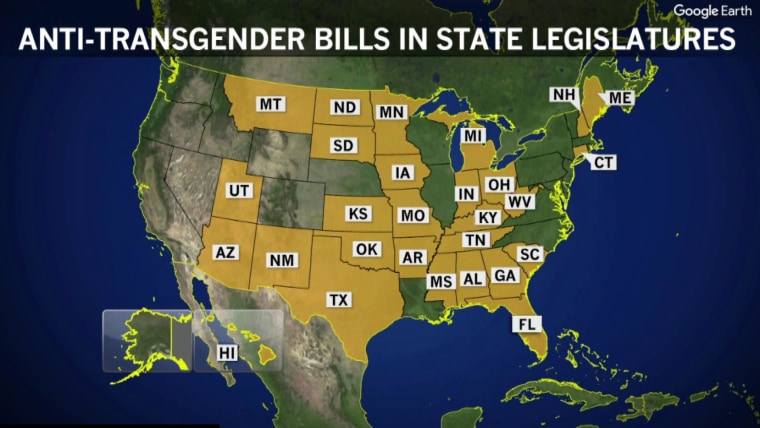
There are more than a dozen proposed bills in state legislatures intended to effect the same changes, and the next bill may not generate the same uproar.
On Tuesday, Arkansas became the first state to ban gender-affirming health care for minors. Yet there are more than a dozen proposed bills in state legislatures intended to effect the same changes, and the next bill may not generate the same uproar. For one thing, it won’t be quite as new. With each bill, and each cycle of outrage, the thought of children being hurt won’t shock us quite so much. Many of the cisgender people who were passionate about this case will turn their attention to some other, fresher outrage; every partial victory will feel like proof they’ve won and permission to move on.
None of this should be that surprising. Trans children have been the subject of a very loud moral panic for years. You may already know the greatest hits: Abigail Shrier’s book “Irreversible Damage: The Transgender Craze That’s Seducing Our Daughters,” in which she argues that transmasculine teenagers are deluded victims of “peer contagion,” or Jesse Singal’s notorious Atlantic cover story “When Children Say They’re Trans,” a sympathetic piece on parents who “convinced” their children not to transition.
This rhetoric has consequences, and we’re seeing them. In the U.K., the Tavistock v. Bell decision found that teenagers were unable to consent to gender-affirming health care, even though they are considered competent to consent to most other forms of medical treatment. This effectively bans trans health care for children. On March 26, Tavistock was largely overturned when a court found that parents could consent to gender-affirming care on their children’s behalf.
In the U.S., we have the onslaught of bills intended to create the same ban. The bill in Arkansas was vetoed, but the General Assembly voted to overrule the governor, making the state the first to ban gender-affirming treatments and surgery for transgender youth. Chase Strangio at the American Civil Liberties Union has already promised legal action against the Arkansas bill, but the groups mobilizing to prevent these children’s transitions are not going to stop with one defeat, or even one big victory. If Arkansas is currently the worst state in America for trans kids, it won’t be for long.
This is not about who is “right.” If facts could win this, trans people and their allies would be winning.
This is not about who is “right.” If facts could win this, trans people and their allies would be winning.
“Transition,” for children, is not some risky medical decision entailing hormones and surgery. For the most part, it isn’t a medical decision at all; most trans children only need appropriate outfits and haircuts, and teens will also take fully reversible puberty blockers until they’re old enough to decide on surgery.
Denying children transition, however, is a major, irreversible, seriously body-altering process with lots of risk involved: It forces kids through the wrong puberty, keeps them in dysphoric pain through the already vulnerable years of adolescence and makes their adult transitions much harder. This assumes the children survive to adulthood. Many will not.
Yet inflammatory rhetoric has been allowed to seep into the nation’s bloodstream as anti-trans activists astroturf state after state with identical bills targeting these kids. When I say the only thing protecting trans children is adult anger, I mean it: Their lives and futures hinge on some (probably conservative) elected representative looking outside his window or at his social media feed and thinking, “Wow, if I actually make this stuff illegal, people will be really mad.”
Though I’m not a mind-reader, it seems clear that the governor of Arkansas almost certainly signed that veto because there was a national uproar over the brutality of the policies his state was enacting. He had a rational belief that the political cost he would incur outweighed the political benefits of siding with transphobes. Countless children’s lives depend on men just like him doing that same math and getting the same results.
The relentless catastrophes of the Trump years showed us exactly how carpet-bombing campaigns like this one play out: Bills criminalizing trans health care will keep coming, one after the other after the other, until almost no one registers the headlines any more, until some other big cause or crisis arrives to divert our attention. And then, when we’re all exhausted and everyone has stopped getting angry, the bills will pass and more children will probably die.
Trans people will obviously fight this until the end. Yet trans people are a tiny minority in this country, less than 1 percent by some estimates, and the success of any political fight depends on lots and lots of cis people caring too. It depends on cis people acting as if their own lives are at stake.
So here is what I will tell you: They are. If you are a parent, any one of these kids could be your kid. Any caring parent to a trans child is feeling some extremely deep terror right now. There’s nothing more painful on this planet than losing a child and nothing that frightens a good parent more than believing someone will hurt your child because you weren’t able to protect them. Even if your child isn’t hurt or killed, someone else’s will be. But you can get in there and fight for them, rather than making them carry it all alone.
Everyone who survives to adulthood incurs a certain obligation to children, especially those of us whose own childhoods were not ideal. If you suffered for lack of a safe adult, you know exactly why you need to be that safe adult now. Every child on this planet deserves someone who will speak up for them and defend them from bullying, whether that bullying comes from a peer or a parent or the great state of Arkansas.
There are so many adults in this country who want to harm trans children. Sometimes it seems like the bigots outnumber the allies, but I have to believe they’re just more visible than us right now. We have to get loud enough to drown them out; we have to make ourselves seen, in huge numbers, every time one of these bills comes up. Everything depends on our anger. All the protection these kids receive will come because we refused to quiet down or look away.
Nearly 20 years after the Supreme Court struck down laws criminalizing consensual same-sex activity, the legacy of sodomy bans is still felt across the United States.
In 1993, then-18-year-old Randall Menges was charged under Idaho’s “crimes against nature” law for having sex with two 16-year-old males. All three worked and lived at Pratt Ranch, a cattle ranch in Gem County that doubled as a live-in foster program for troubled teenagers.
Menges was convicted despite police reports indicating the activity was consensual, and the age of consent in Idaho when a defendant is 18 is 16 years old. After serving seven years in prison, he was placed on probation and required to register as a sex offender.
Today, what Menges did wouldn’t be considered an arrestable offense. The U.S. Supreme Court ruled in 2003 that laws criminalizing consensual sodomy or oral sex were unconstitutional. But Idaho still requires people convicted of sodomy or oral sex before the Lawrence v. Texas ruling to be on the state sex offender registry.
His attorney, Matt Strugar, has challenged a similar statue in Mississippi and is representing Menges and a John Doe in a suit against Idaho’s sodomy ban.
Idaho, South Carolina and Mississippi still require people who were convicted of consensual sodomy before the Supreme Court’s decision in Lawrence to register as sex offenders, Strugar said, even though the court said what they did wasn’t a crime. There are probably hundreds of people in Menges’ predicament, and forcing them to register as sex offenders is a violation of their right to due process and equal protection under the 14th Amendment, he added.
“I’m outraged that in 2021 that we have what is essentially a registry of gay sex,” Strugar said.
Randall Menges.Courtesy Randall Menges
Hoping to start a new life, Menges moved to Montana in 2018.
“I love the mountains and taking care of horses,” he said. “And I thought the fewer people I had to deal with the better.”
Even before the Montana Legislature officially repealed the state’s ban on same-sex activity — which the Lawrence ruling declared unconstitutional — in 2013, people convicted under the statute weren’t required to register as sex offenders. But a law passed in 2005 mandates that individuals on a registry in another state must register as sex offenders if they move to Montana.
Menges filed suit in the U.S. District Court for the District of Montana in December, challenging the constitutionality of Montana’s policy. In filings shared with NBC News, he said being on the registry “has damaged dozens of employment opportunities and personal relationships.”
No one believes him about why he has to register as a sex offender, he told NBC News. “If they find out, I lose their friendship,” he said. “Even girlfriends, they don’t buy it.”
The same month he filed his suit, Menges said he was turned away from a homeless shelter in Boise, which he returned to temporarily in 2020.
The U.S. Attorney’s Office for the District of Montana did not return a request for comment on the case. In opening arguments March 30, Montana Assistant Attorney General Hannah Tokerud argued Menges was trying to get a Montana court to weigh in on Idaho law.
According to the Missoulian, she said the case doesn’t hinge on the validity of that statute, but rather “it hinges on whether he is required to register in Idaho.”
“Montana requires Menges to register not because of his criminal offense,” the state wrote in a motion to dismiss in January, “but because Montana gives credit to other states’ determinations about convicted offenders who are required to register.”
“Idaho has determined that Menges must register, and thus, when Menges moved to Montana he was required to register,” the state wrote.
But Strugar said Montana is trying to “pass the buck” to another state while continuing to enforce what he calls an “unlawful” policy.
Menges isn’t seeking to overturn his conviction, he said — the statute of limitations passed a year after his conviction. He just wants to be free of the shadow that’s been cast over his life.
“If someone’s not a molester or a rapist, they shouldn’t be subjected to what I have,” Menges said. “If we can change the law, at least it’ll have been worth it.”
Ultimately he’d like to return to Montana, where the cost of living is lower and he can work with horses.
“I’ve had a passion for horses since I was 6. I’d like to get my equine veterinary nursing degree and take care of them, maybe for a rodeo or for private individuals,” he said. “I just want to go where I want and make the choices I want without this hanging over me.”