Black trans army veteran Jamel Young is suing the New York Police Department for their “dehumanising” treatment of him during what began as a routine traffic stop in 2019.
Young, 33, had driven to New York from Atlanta, with his girlfriend, in March 2019.
His ordeal began when, after dropping his girlfriend at a friend’s apartment, he began looking for somewhere to park.
When an unmarked NYPD car pulled him over, Young said he didn’t panic.
“I’m feeling like, OK, I didn’t do anything wrong, whatever this is I’ll take care of it,” Young toldBuzzFeed News.
But the US citizen said was still aware that as a Black man in the Bronx late at night, he needed to be careful. “The only thing on my mind is to comply,” he said.
It was after he disclosed to the police officers that he is transgender that the problems began.
According to Young’s lawsuit against the corrections department and the NYPD, filed last month, the police then misgendered, assaulted and sexualised him. Officers also dismissed his fears for his safety and failed to provide for his basic needs, Young alleges.
His case comes one year after New York City was sued over the death of Layleen Polanco, the Afro-Latinx trans woman who died in solitary confinement in Rikers Island prison.
After asking him “basic traffic stop questions”, police asked Jamel Young if he had a gun on him. He did – and though it was registered, what Young didn’t know was that he needed a separate license to take it out of Georgia.
He also didn’t know whether the gun was in the car with him or if it was in the bags he’d dropped with his girlfriend at his friend’s house. He says he also didn’t know that you need a different license to carry a gun on your person and in your vehicle.
The police – who arrest hundreds of tourists every year for bringing firearms to New York, which has some of the strictest gun laws in the country – placed him under arrest.
“I didn’t know or think that I was doing anything wrong, I thought I was doing everything completely, 100 per cent right,” Young said.
As police pulled him from his car, he panicked and told them he’s trans – hoping they’d be respectful. But instead, several officers grabbed his chest and crotch like they were “trying to confirm” that he’s trans.
Young also alleges another officer sexually assaulted him while transporting him to the police station.
His lawsuit also alleges that police officers joked about him being trans and called him “he, she, her, him, miss and sir” at various points in the night.
Young was taken to prison, where his problems continued. He said he feared for his life, and that when he asked his legal-aid lawyer what to do, he was told to tell officers that he was female.
“I felt worthless,” he told BuzzFeed News. “I felt like all those triggers that trans people try so hard to manage throughout the transition, all of it just exploded.”
The NYPD said in a statement: “NYPD recognises and supports the rights and dignity of transgender and gender non-conforming persons. We endeavour to treat all individuals with the utmost respect.
“This lawsuit will be reviewed in the normal course when service is effected.”
Jamel Young said he’s suing because he wants to see changes that will ensure the safety of transgender people in custody.
“I’m not asking for anything special. I don’t think I need to get coffee three times a day. I literally just need my safety,” he said.
When Theresa Jean Tanenbaum changed her name last summer, she realised she was now deadnamed in two decades worth of professional accomplishments.
A trans woman who transitioned in her 40s, Tanenbaum is a designer and scholar of human-computer interactions who’s been published in dozens of journals.
Not only was her deadname a traumatic reminder of her past, in her own words, but having new work published in her correct name meant she would lose the continuous record of her life’s work.
“I was faced with what felt like an impossible choice: to abandon past work, or accept that I would never escape an identity that for decades had felt like a prison,” Tanenbaum writes for Nature.
So, she decided on a third path: she would contact her past publishers, a total of 15 legal entities that are responsible for 87 different publications, and ask them to update their records.
But Tanenbaum immediately encountered a problem: none of the 83 academic publications she had published research with would agree to change her name in their digital archives.
A year on, and Tanenbaum explains why this refusal is so dangerous.
“Public connections between my name and my deadname put me in the way of other, more concrete harms,” she wrote for Nature – a journal published by Springer Nature, which was one of those that refused to update her name.
“Fifteen countries criminalise the gender identity or expression of trans people — a crime that in some cases carries the death penalty.
“And until the Supreme Court ruling [making it illegal to fire workers for being gay or trans], at least 20 US states did not protect transgender individuals against employment discrimination. Even when the law protects us, de facto discrimination remains real.”
Though she was initially refused, Tanenbaum has been persistent. The Association of Computing Machinery (ACM) Digital Library, which is the largest scholarly repository of computing, is where most of her work is published.
Digging into their name-change policies, Tanenbaum got in touch – and the ACM board agreed to set up a working group, consisting of her, board members and three other trans scholars, to look into tackling the issue of drafting an inclusive name-change policy.
There were more problems ahead. One of these, Tanenbaum writes, is that cis people object to trans people updating their names because of an “insinuation that the request is a form of deceit or fraud”.
But in fact, Tanenbaum says, it’s the opposite.
After 16 months, the working group have an inclusive name-change policy approved by lawyers and voted through by the rest of the ACM board.
“The plan is for the ACM to update all publicly accessible digital materials related to an author whose name has been changed,” Tanenbaum explains, with the caveat that a previous version remains available in a separate repository, in case of legal challenges regarding the work.
Tanenbaum concludes: “When implemented, it will be, to my knowledge, a first in the publishing world: a trans-inclusive approach to retroactively changing author names on public records.
“These changes will not completely solve the problem of being deadnamed, outed and misgendered. However, it could make the often traumatic, frustrating and dehumanising process of transitioning less fraught.
“That will allow people like me to spend more time doing the scholarship that we’re trained to do, and less time fighting to be called by our names.”
Mike Feuer, Los Angeles City Attorney, announced charges against a man in connection with a “heated altercation” at Las Perlas bar in downtown Los Angeles that ended with transgender women and gay men being dragged out of the bar.
Eduardo Gonzalez has been charged with one count of making a criminal threat and a second count alleging the criminal threat constituted a hate crime.
The incident happened almost a year ago on the night of August 23 last year.
On that night, several transgender women and gay men met at Las Perlas bar for drinks following the DTLA Proud Festival.
During that time Gonzalez and his girlfriend sat at a table with the group and allegedly “made multiple transphobic and misgendering slurs toward the transgender women, leading to an argument with the group,” officials said.
Eventually a security guard at the bar forcibly removed everyone involved but while being kicked out, Gonzalez allegedly shouted threats that he would return with a gun.
Video of the altercation went viral over the weekend, the footage shows one person being carried out of Las Perlas. It then pans to a woman, identified as Jennifer Bianchi, shouting, “Don’t touch me like that,” before she is shoved into a wall. Bianchi shoves back and says she needs her shoe before she’s carried out as well.
A third woman is put into a chokehold before being forced out.
The group was made up of staff and volunteers from Bienestar Human Services, a non-profit social services organization for Latino and LGBTQ groups. They said in a statement later that they were treated unfairly because of their identity.
After the incident, a protest was started at Las Perlas the following day, as well as support by Mayor Eric Garcetti, who vowed that a thorough investigation will be done.
In a tweet after the incident occurred Mayor Garcetti wrote “Los Angeles is a place where hate against any person, regardless of gender identity, is not tolerated. My office is in communication with @LAPDHQ about the incident at Las Perlas, and will ensure a proper investigation is completed.”
Feuer echoed the sentiment in announcing the charges against Gonzalez and he is scheduled to be arraigned on August 7th.
Las Perlas bar also issued an apology on their Facebook account stating a new security staff — one that has received sensitivity training — is being hired.
They went on to say “Our first and primary concern, and has been from day one, is to operate a safe place for all people,” the bar posted. “Period, no exceptions. We regret that didn’t happen Friday night, and want to apologize to all of our guests, including the Transgender community, a community who has come to our bar as well as works there.”
In 1985, New York Gov. Mario Cuomo urged the public to have safe sex by using condoms to help stop the spread of AIDS. Condoms were the face masks of the 1980s.
Some people wanted to use them during sex, some did not; many who chose the latter, including myself, suffered the consequences. In 1986, I decided to ignore Cuomo and every medical expert — and became infected with HIV.
Today we are once again in the middle of a war being waged between these two camps, personal freedom and staying alive. Too many people still don’t seem to accept that if they are fighting for the right to not wear a mask, it will very likely come at the price of their life or that of someone they love. The power of free choice can kill you.
I also know the feelings of regret, anger and guilt that come with the decision to value free choice above all else.
But the allure of that power is, well, powerful. As clinical psychologist Steven Taylor, author of “The Psychology of Pandemics,” recently noted, people do not like to be told what to do even if the measures could protect them.
“People value their freedoms,” Taylor told CNN. “They may become distressed or indignant or morally outraged when people are trying to encroach on their freedoms.”
I know this to be true firsthand. But I also know the feelings of regret, anger and guilt that come with the decision to value free choice above all else. I hope that by sharing the story of the mistake I made in similar circumstances, some who scorn the idea of wearing a mask — whether it’s because they don’t want to look “silly” with it on or because they are “a real American” — can see that these desires are in no way worth killing yourself or others over.
My life-altering error in judgment happened the first night I was with my then-boyfriend, Jason, who’d told me he’d “been tested and was fine.” So I disregarded the warnings and the facts, along with that little voice in my head telling me to reach for the condom that was in my pocket. I had unprotected sex with Jason that night and for the next two months that we dated, even though it was 1986 and the height of the AIDS crisis. The euphoric feeling of having someone desire me was powerful and gave me a naive feeling of invincibility.
After the relationship ended, I refused to have unprotected sex with anyone else. I will not become a victim of this disease, I told myself. But it was too late. Two years after we’d broken up, when I went to visit him in the AIDS ward of St. Luke’s Hospital, Jason told me he had been tested for the first time eight months ago, when he started getting sick.
Timothy Hedden.Courtesy Timothy Hedden
I wanted to scream at him or strike him, but he looked so frail; virtually unrecognizable as the man I had dated, he was withered and shriveled, his skin covered in purple sores. So I said nothing to him, though I knew his deceit was going to cost me my life.
But I spent years after that telling myself that Jason and his lie were the sole reason for my getting infected. It wasn’t until this April, when the mask debate began, that I realized I, too, was responsible for my infection. As I questioned how people could brazenly refuse to take accountability for their own health and not wear a mask in public, I realized I had done the same thing and put my own life in danger.
Within a decade of my diagnosis, my immune system was so compromised that my doctor told me to let my family know I was going to die. But luckily, at the end of that year I was put in a drug trial for a new class of drugs called protease inhibitors, which allowed me to survive.
The decision I made to not use a condom has led to irrevocable damage to my immune system and my life. For 32 years, I’ve lived in fear of germs and catching the flu or even a cold. Every cough that lingers too long sends my thoughts spiraling: Is this the beginning of the end? When the coronavirus was first being discussed seriously in this country, the most vulnerable were people over 50 with pre-existing conditions. I’m a 56-year-old HIV-positive man. It paralyzed me.
It also felt very familiar. Both of these epidemics are rampant viruses that have no cure, both have stumped global scientists and, just as at the height of the AIDS crisis, countless people are dying every day.
A glaring difference is that AIDS was labeled a “gay disease,” even though it afflicted heterosexuals as well. That misnomer allowed the Republican government and most of society in the ’80s to look away and pretend it wasn’t happening. Yet there is a parallel in this, as well: Once again, the Republican government is denying the severity of this pandemic, distorting statistics and the effectiveness of face coverings and otherwise not showing leadership or seriousness in tackling this deadly disease.
What I see now when I come across people not wearing masks is familiar, too — a familiar stupidity. Witnessing the actions of these arbiters of freedom, I do not see patriots. I see people cloaking themselves in the rhetoric of “civil rights” and the idea of a “free country“ who don’t understand the awesome personal and communal responsibility that free choice carries with it. I see people who are making the same error I made 34 years ago when I ignored all of the warnings, all of the news and all of the numbers.
As with having HIV, once you become a carrier of this virus, it is not only your own life you’re playing with. Both illnesses have periods of latency where someone can spread the virus before knowing they have it. So even if you feel that you have the right not to wear a mask, since you’ll be paying the consequences of that choice personally, do you feel you also have the right to kill someone else because you don’t want to cover up?
Too many people still don’t seem to accept that if they are fighting for the right to not wear a mask, it will very likely come at the price of their life or that of someone they love.
Before Edafe Okporo founded New York City’s first and only shelter for asylum-seekers and refugees, he was wandering the streets of Elizabeth, New Jersey, a refugee with nowhere to go. Although he was homeless, Okporo was happy to be in the United States.
“Everything just changed when I stepped my feet into this country,” said Okporo, 30, an LGBTQ activist who fled his homeland, Nigeria, in 2016, “because there is an opportunity to dream of a better future, to have a path here as a gay man.”
Okporo grew up in Warri, a city in southern Nigeria. Not only was he poor growing up, but he also struggled with his sexuality. When high school classmates discovered that Okporo was interested in boys, he said, they outed him to his parents, who made him undergo conversion therapy.
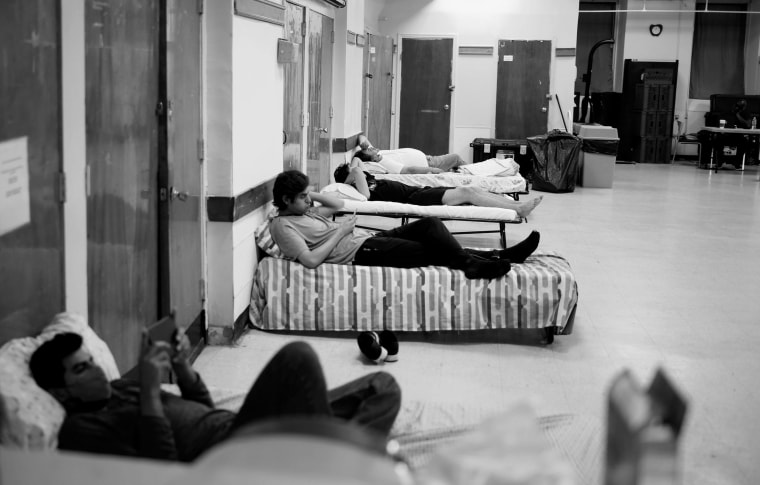
Guest lay in beds provided at the shelter.Zac Hacmon
Later, while attending college in Enugu, Nigeria, he arranged a meeting with a man he had met through a dating website. What he thought was a date, he said, turned out to be a “siege.” Once he was inside the man’s apartment, he said, a group of men jumped out of a closet and held him hostage while they stole money from his bank account.
“That was the first time I realized that it’s not just that my parents were trying to prevent me from being gay,” he said, “but they were trying to protect me from such kind of persecution.”
Many such laws are thought to be rooted in the British Empire: According to a report published in the Cambridge Review of External Affairs in 2014, former British colonies are “much more likely” to criminalize same-sex acts than other countries. Since 1999, however, some parts of northern Nigeria that are governed by Sharia law punish homosexual activity with “caning, imprisonment or death by stoning,” according to Human Rights Watch.
Traumatized by the attack, Okporo spent the rest of college forcing himself to date women. He joined a church and even became a pastor. But after he graduated in 2014 — the same year Nigeria made same-sex relationships punishable by up to 10 years in prison — he decided he could no longer live a lie. He moved to the Nigerian capital, Abuja, where he helped found the International Centre for Advocacy on Right to Health, an LGBTQ rights organization and HIV clinic.
But Okporo’s activism made him a target. One night in 2016, alone in his apartment, he was startled awake by a loud noise. A mob, he said, was ramming down his door. They rushed in, dragged him into the street and beat him unconscious. Some good Samaritans found him, saw his ID card and carried him to the clinic where he worked.
“When I woke up in the clinic, I knew I had to leave Nigeria for me to be safe,” he said.
After fleeing to Dubai and then returning to Nigeria, he obtained a visa to attend the International LGBTQ Leaders Conference, organized by the Victory Institute, in Washington D.C. — a chance to seek asylum in the U.S., where same-sex marriage had recently been legalized and which he pictured as “a very accepting place.”
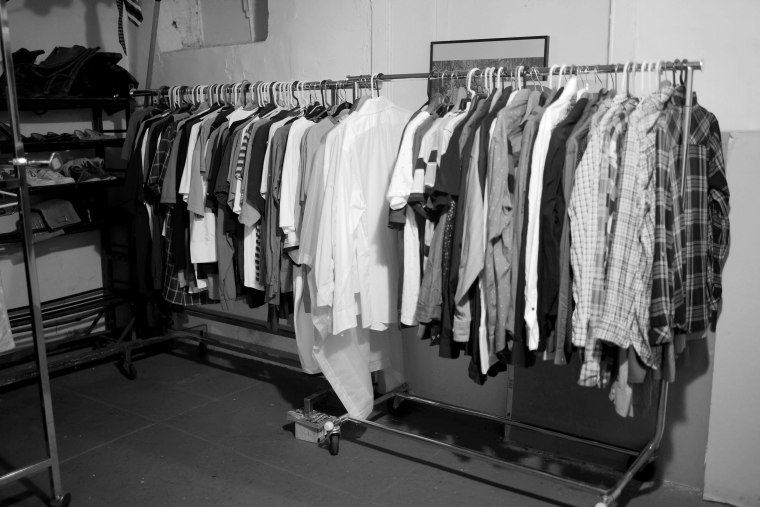
Clothes at the RDJ Refugee Shelter thrift store.Zac Hacmon
That image, he said, turned out to be different from the reality. Okporo approached an admission officer at New York’s John F. Kennedy Airport and explained that he was seeking asylum. He said the officer took him to an airport jail cell, where he was forced to sign deportation papers.
“The officer came and he put handcuffs on me,” Okporo said, “and drove me to the detention center in New Jersey.”
Okporo would spend five harrowing months in a detention center in Elizabeth. Immigration Equality, a group that advocates on behalf of LGBTQ and HIV-positive immigrants, connected him with a lawyer who helped him fight deportation in court. After winning his case, he was released from detention, but he had nowhere to go.
His only resource was a phone number advertised on a flyer tacked to the wall of the detention center. The number belonged to First Friends of New Jersey and New York, an organization that supports detained immigrants and asylum-seekers.
A volunteer picked Okporo up and drove him to a YMCA shelter in Newark, New Jersey. He used a computer at the public library to connect with a former colleague from the International Centre for Advocacy on Right to Health, who was living in Queens, New York. She agreed to let him stay with her for three months while he found work, first at a New Jersey-based catering company and then at a nearby HIV clinic.
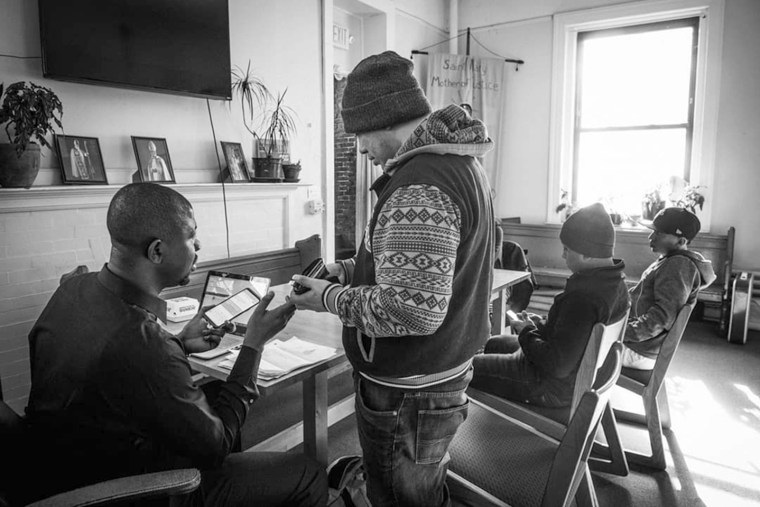
But Okporo wanted to do more to help asylum-seekers and refugees like himself. He persuaded the leaders of the RDJ Refugee Shelter in Harlem — named after homeless advocate Robert Daniel Jones — to turn the shelter into a full-time transitional refuge for migrants fleeing violence and persecution abroad.
Housed in a former church, the shelter is New York City’s only full-time refuge for asylum-seekers and refugees. The 10-bed shelter has provided temporary housing for more than 80 migrants, said Okporo, the shelter’s director. The shelter also provides legal counseling and job assistance.
The number of refugees in the U.S. is the lowest since 1980, according to the Pew Research Center. The Trump administration last year capped the number of refugees permitted into the U.S. at 18,000, down from 30,000. The administration also enacted a rulelast year that prevented immigrants from claiming asylum in the U.S. if they did not first try to claim it in a country they passed through on their way to the U.S. border.
Late last month, a federal judge ruled that the restriction was illegal. However, a newly proposed rule would allow the Trump administration to deny asylum to immigrants who are considered public health risks because of the COVID-19 pandemic.
Under those restrictions, Okporo said, asylum-seekers would face more barriers coming to the U.S. than ever before.
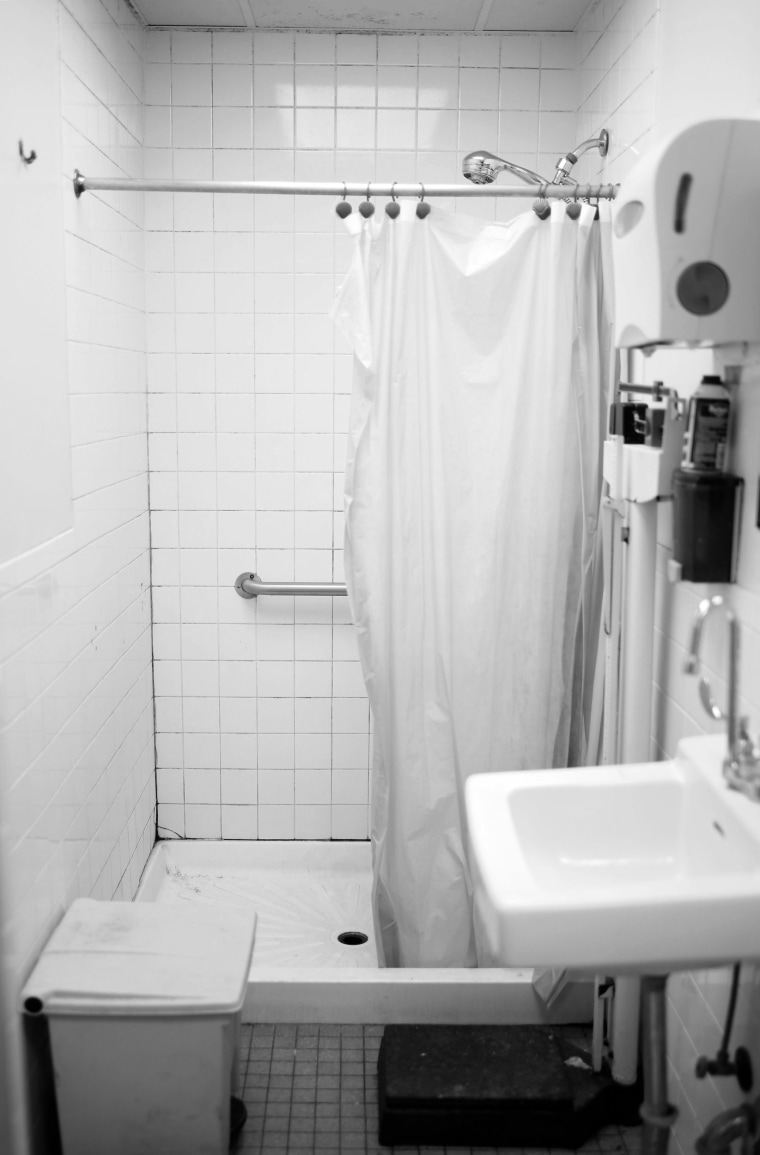
A bathroom at the shelter.Zac Hacmon
“The pandemic has given the administration an opportunity to really close the door for a lot of the refugees and asylum-seekers who usually expect America to be that place of safety when they think about fleeing their countries,” he said.
Not everyone fleeing homophobic and transphobic violence abroad is from a country that criminalizes homosexuality, he said, noting that a majority of those housed in the RDJ Refugee Shelter who have received asylum are from Honduras and Jamaica. While sex between men is outlawed in Jamaica, same-sex activity is legal in Honduras. Still, LGBTQ migrants, particularly those who are transgender, face widespread persecution in both countries, Okporo said. Many non-LGBTQ migrants, he added, are fleeing war-torn regions.
All too often, LGBTQ asylum-seekers who make the journey across the border end up homeless, he said, because family and friends with permanent residence in the U.S. will not open their doors to them.
“Most of them face a kind of rejection even from their community in New York,” Okporo said. “The shelter provides them that space to be themselves even in New York City.”
Okporo, who has a degree in food science, considers himself lucky. Many asylum-seekers do not have the education or proper documentation to qualify for jobs or shelter, he said. Transgender asylum-seekers and refugees in the process of transitioning are especially vulnerable, he said, because they often lack documentation and frequently experience discrimination and violence in shelters.
“Knowing that New York is one of the most liberal places in the world and people are still subjected to such kind of persecution just makes me wonder where else in the world can LGBTQ migrants be safe,” he said.
Edafe Okporo and Juan, a guest at the shelter for asylum seekers in New York City.Zac Hacmon
Okporo is a finalist for the David Prize, an initiative of the Walentas Family Foundation that awards grants to New Yorkers who are making a difference. Okporo said that if he is selected, he will use the money to expand the RDJ Refugee Shelter, which subsists largely on grants and donations. He would also train faith leaders around New York City to use their churches, mosques and temples as places of refuge for migrants fleeing violence and persecution.
Okporo no longer feels the need to hide who he is.
“I have wanted to be open about my sexuality all my life,” said Okporo, who is unashamed to hold hands with his boyfriend, Nicolas, when they walk the streets together. “There is no way I’m going to hide it.”
In June, for the second year in a row, Okporo shared his story during NYC Pride’s annual LGBTQ celebrations, which this year were virtual. He has also written a book, “Compassion is Worth More: Using Your Civil Power to Create Change.” He said it is important for people to listen to the struggles of LGBTQ migrants, who are unable to vote, and to understand that the fight for civil rights did not end with marriage equality.
“When I came to the U.S., I discovered that some states, they have laws that permit conversion therapy. I was shocked. … In the U.S., I thought that gay marriage had eliminated such kind of struggles,” he said.
“A lot of gay people in America after gay marriage think that it is over,” Okporo added. “It’s not over.”
CORRECTION (July 26, 2020, 11:30 p.m. ET): An earlier version of this article incorrectly described Okporo’s hometown of Warri. It is a city of more than 500,000 people in southern Nigeria; it is not a village.
Japan’s government should pass the Equality Act ahead of next year’s Tokyo Olympics and Paralympics, Human Rights Watch, Athlete Ally, and Japan Alliance for LGBT Legislation (J-ALL) said today. The groups will launch #EqualityActJapan on July 23, 2020 in support of the proposed law, which would protect lesbian, gay, bisexual, and transgender (LGBT) people from discrimination on the basis of sexual orientation and gender identity.
The groups involved in the campaign worked with Japanese and international athletes to highlight the need for the Equality Act and an end to discrimination in sport.
“LGBT people in Japan are entitled to equal protection under the law,” said Yuri Igarashi, co-representative director of J-ALL, an umbrella organization of 100 LGBT organizations in Japan. “Postponing the Olympic Games to 2021 has given the government time to introduce and pass historic protections to benefit everyone in Japan.”
Everyone, not just athletes, can take part in the campaign, which will featurea series of online and in-person opportunities for action throughout 2020 and 2021 to demonstrate the widespread support for the Equality Act and protection from sexual orientation and gender identity-based discrimination in Japan.
Tokyo was slated to host the 2020 Olympics this summer, but the International Olympic Committee (IOC) and the Japanese government postponed the games for a year due to the Covid-19 pandemic. The postponed games are scheduled to begin on July 23, 2021.
The Olympic Charter bans “discrimination of any kind,” including on the grounds of sexual orientation.
IOC President Thomas Bach has met with LGBT rights advocates and led reforms to the Olympic Charter and as part of Olympic Agenda 2020. “The IOC is an organization firmly opposed to all forms of discrimination in sport,” he wrote to Human Rights Watch in 2015.
In line with the IOC’s commitment, the Tokyo metropolitan government in October 2018 adopted a landmark ordinance that protects LGBT people from discrimination on the basis of sexual orientation and gender identity, in line with the Olympic Charter. In doing so, the city not only demonstrated its commitment to equal rights for all, but also to making the Tokyo Summer Olympic and Paralympic Games a springboard for human rights in Japan and beyond.
Tokyo’s action was important, but several Olympic competitions, including the marathon, golf, fencing, race walking, and surfing, have since been announced to take place outside of Tokyo, in Hokkaido, Saitama, Chiba, Shizuoka, Kanagawa, Miyagi, and Fukushima prefectures. LGBT fans, athletes, and visitors in these prefectures will not be protected under Tokyo’s anti-discrimination ordinance.
Japan has also ratified core international human rights treaties that obligate the government to protect its citizens against discrimination, including the International Covenants on Civil and Political Rights and on Economic, Social, and Cultural Rights.
The Tokyo Olympics are advertised as celebrating “unity in diversity” and “passing on a legacy for the future.” In March 2015, Prime Minister Shinzo Abe publicly proclaimed Japan’sintention to “stamp out discrimination and respect human rights” andmade clear at the National Diet that “discrimination or prejudice against sexual minorities is not allowed in any aspect of society.”
“The Olympics is an important moment for athletes and fans to speak out for what they believe in,” said Hudson Taylor, founder and executive director of Athlete Ally. “Now is the time for the global sporting community to stand in solidarity with the LGBT community in Japan and urge the passage of the Equality Act.”
Japan has increasinglytaken a leadership role at the United Nations by voting for both the 2011 and 2014 Human Rights Council resolutions calling for an end to violence and discrimination based on sexual orientation and gender identity. But LGBT people in Japan continue to face intense social pressure and fewer legal protections than other Japanese.
“Japan has an opportunity to be a true global LGBT rights leader by protecting against discrimination at home,” said Kanae Doi, Japan director at Human Rights Watch. “The Tokyo metropolitan government has shown solidarity with the LGBT community by passing its historic Olympic LGBT nondiscrimination law, and the national government should urgently follow suit.”
Manal was driving home from a New Year’s party on the first day of 2019, dressed to the nines in her laced blue dress, when she got into a minor traffic accident. When police arrived, they arrested Manal, harassed her based on her gender expression, then exposed her identity by posting photos of her and a copy of her ID online, in violation of Moroccan privacy laws.
In AfroQueer Podcast’s latest episode, “One Night in Marrakech,” Manal describes the persecution she faced as a transgender woman in Morocco, where legal obstacles prohibit her from possessing ID that reflects her gender identity and her chosen name. She speaks from France, where she sought asylum after the unlawful disclosure of her private information and the online bullying, harassment, and threats she faced.
Manal links her experience to the recent “outing” campaign against gay men and trans people in Morocco. People created fake accounts on same-sex dating apps and endangered users by posting their private information on social media, sparking bullying and hate speech. Morocco criminalizes same-sex relations, and those “outed” are exposed to the risk of eviction, loss of employment, and social ostracization.
Manal, who had worked tirelessly to keep her job as a medical assistant and a roof over her head, lost everything when the police “outed” her. Her story encapsulates the vulnerability of many trans people in Morocco, forced to practice self-censorship to navigate their daily lives.
Manal also exposes the different experiences of trans people in Morocco. She says, “economic power and fame determine which trans woman is abused and which is protected. Trans identities are accepted in Morocco as long as they serve as entertainment on stage, but not in ordinary life.”
“Where is the justice?” Manal asks from Paris, where she remains unemployed and worries about her parents aging while she is forced to be far from them. This should never be the cost trans people have to pay to live their truth.
The Directorate General of the Moroccan police reportedly issued an order to punish the officers who harassed Manal, but the government failed to protect her and will continue to compromise others unless it repeals discriminatory laws and protects queer and trans people from violence and harassment.
This dispatch is the second of a six-part collaboration between Human Rights Watch and AfroQueer Podcast, seeking to amplify the voices of lesbian, gay, bisexual, and transgender (LGBT) Africans.
Revry, the first global queer streaming network, today announced a new partnership with Comcast Xfinity’s Beltway Region to introduce The Beltway Pride Screening Series – a collection of six compelling films that explore life through the lens of the LGBTQ community.
Thought-provoking panel discussions will follow each screening and highlight the unique needs and challenges that LGBTQ members face. Panelists will include filmmakers, cast members and members of local LGBTQ organizations discussing such topics as race, gender, sexual identity, politics and culture.
Each of the six movies in the The Beltway Pride Screening Series can be watched for free online via the Revry.tv network. A new film will be showcased each month through October. The first film VINTAGE – Families of Value is available now through July 30. The impressionistic documentary film, which is in its 25th year, intimately explores three African-American families through the eyes of lesbian and gay male siblings – two or more in the same family. On Thursday, July 30 from 8-8:45 p.m. EDT/5-5:45 p.m. PDT, filmmaker Thomas Allen Harris and other cast members will join Pride Center of Maryland’s LaKesha M. Davis to discuss this groundbreaking documentary, which was partially filmed in Baltimore. “We know that Pride isn’t just a month-long celebration, but a year-long commitment to supporting the LGBTQ community,” said Tabitha Williams, Senior Manager of Events & Multicultural Marketing for Comcast’s Beltway Region. “In a season where Pride and LGBTQ festivals are either canceled or postponed, Comcast’s Xfinity together with Revry hope to drive deeper, authentic engagement with LGBTQ members in our region.” Following the online screenings, Xfinity X1 and Flex customers who subscribe to Revry can access the films directly on the TV. Revry’s programming is accessible to Xfinity customers over the Internet on X1 and Flex and can be found by saying “Revry” into the Xfinity Voice Remote or within Xfinity on Demand’s LGBTQ Film & TV collection—the largest first-of-its-kind collection of LGBTQ content available at home and on-the-go. “As the first LGBTQ+ virtual cable TV network, Revry offers free live TV channels and on-demand viewing of its global library featuring LGBTQ+ movies, shows, music, podcasts, news and exclusive originals all in one place – reaching up to 250+ million people in over 130 countries,” said Alia J. Daniels, COO / Co-Founder of Revry. “In a time where division is easily amplified, we recognize Comcast’s commitment to honor diversity, and are thrilled to partner with the company in sharing this quality programming, especially with the diverse Beltway Region.”
About This Month’s FilmVINTAGE: Families of Value is an essay style film that gives a thoughtful and sometimes painful examination of three African-American families through the eyes of gay and lesbian siblings, including the film director Thomas Allen Harris and his brother, Lyle Ashton Harris. The director confronts the issue by asking his mother to talk about her two sons being gay. This documentary weaves together stories from all three families with impressionistic scenes that express what some are unwilling to say. Awarded Best Documentary by the 1996 Atlanta International Film Festival and a Golden Gate by the 1996 San Francisco International Film Festival, this lyrical and impressionistic film blends intimate and sometimes painful conversations between family members, with dramatic recreations, improvisations, performance, audio visual collage and archival photos and films to sketch a provocative tableau of three modern families negotiating sexuality and identity. For more information on The Beltway Pride Screening Series and its upcoming screenings, click here.
About RevryWatch Queer TV 24/7 with the first LGBTQ+ virtual cable TV network. Revry offers free live TV channels and on-demand viewing of its global library featuring LGBTQ+ movies, shows, music, podcasts, news and exclusive originals all in one place. Revry is currently available globally in over 250 million households and devices and on seven OTT, mobile and desktop platforms. Revry also can be viewed on nine live and on-demand channels and connected TVs including: The Roku Channel, Samsung TV Plus, Comcast Xfinity X1, Dell, XUMO TV, Zapping TV, STIRR, TiVo+ and as the first LGBTQ+ virtual reality channel on Littlstar (available on PlayStation devices). Revry – an inaugural member of the Goldman Sachs Black and LatinX Cohort – is headquartered in Los Angeles and led by a diverse founding team who bring decades of experience in the fields of tech, digital media and LGBTQ+ advocacy. Follow us on Facebook, Twitter and Instagram @revrytv or online at revry.tv.
LGBTQI History: A Sonoma County Timeline 1960s – 1990sNext Wednesday, 7/29, 1:30 – 3pm we will be talking with Maddy Hirshfield about Project 10 which provided LGBTQ youth support in SoCo schools 1992-2002.We are online this summer via Zoom!Please contact me to enroll in this FREE class and receivea Zoom invite: cdungan@santarosa.edu