Dykes on Bikes zooming by on motorcycles wearing leather jackets. A little boy holding a sign professing his love for his trans parent. Hundreds of thousands of people crowding into San Francisco’s Civic Center Plaza. These are but three of the images on display in a new photography exhibition, “50 Years of Pride,” opening online on May 15 on the GLBT Historical Society’s website. The exhibition is presented by the society and the San Francisco Arts Commission Galleries with the support of San Francisco Pride, which celebrates its 50th anniversary this year. In addition its online incarnation, the exhibition will ultimately be displayed on the ground floor and North Light Court of City Hall.
“50 Years of Pride” is one of two online exhibitions the society is organizing to commemorate Pride’s golden jubilee. This colorful and exuberant show features nearly 100 photographs, drawn both from the society’s archives and contributed by over a dozen independent queer photographers. The exhibition has been curated by Lenore Chinn and Pamela Peniston, two San Francisco artists with deep roots in the city’s queer arts and culture milieu. As we approach the virtual unveiling of “50 Years of Pride,” History Happens interviewed Chinn and Peniston, who provided joint responses, about their curatorial vision.
What was your conception for “50 Years of Pride” when you began planning the exhibition?
When we set out, we knew only a few things that we wanted to establish and bring forward. First, that by “Pride” we meant what has developed into an entire weekend of events made up of Pride and Pink Saturday, the Dyke March and the Trans March. Although these are run by independent boards and in entirely different ways, they are all showcasing the breadth of the LGBTQ communities. We also wanted as large a representation of diversity in the photographers as in the photographs. Finally, we also decided that we would choose each photo initially on its ability to convey how people were experiencing the events, as well as the beauty of the image itself.
How did your curatorial choices evolve as you researched in the archives and reached out to photographers?
As we examined the archives of the GLBT Historical Society and solicited photographs from many photographers in the community, we saw that the work was naturally dividing into two main categories: people participating in the parade and people watching. So we mirrored that by separating photographs of participants and spectators. Whether marching or waiting for the parade to begin, the excitement on both sides is palpable! Also, we chose not to organize the entire exhibition along a chronological timeline, but rather to focus on the “onstage” and “offstage” aspects of the events. We had certain focal points in mind: politicians of or in support of our community, or heroes within it; issue-oriented contingents and affinity groups. We wanted to show how all of our people and organizations constantly queered the way we celebrated!
What do you want viewers to take away from this exhibition?
We would like people to view this as an experience of Pride as it has evolved over the years, from a relatively small, grassroots event that has grown, along with the LGBTQ community, into a celebration. But we also wanted to chart the growth of a movement politically and culturally from an era marked by resisting homophobia, to challenging the treatment of HIV/AIDS, and through the victory of marriage equality. We want people to know that through politics, alliances, celebrations, demonstrations, drag or the arts, queers embrace all our identities.
NOTE: “50 Years of Pride” opens on the GLBT Historical Society’s websiteon May 15. The installation at San Francisco City Hall will follow when the state’s shelter-in-place order has been relaxed. Lenore Chinn is a painter, photographer and cultural activist, and was a founding member of Lesbians in the Visual Arts.
Pamela Peniston is a founding member and artistic director of the Queer Cultural Center, and has won numerous awards for her work designing and painting sets for national and Bay Area theatrical and dance companies.
Mark Sawchuk is the communications manager at the GLBT Historical Society.
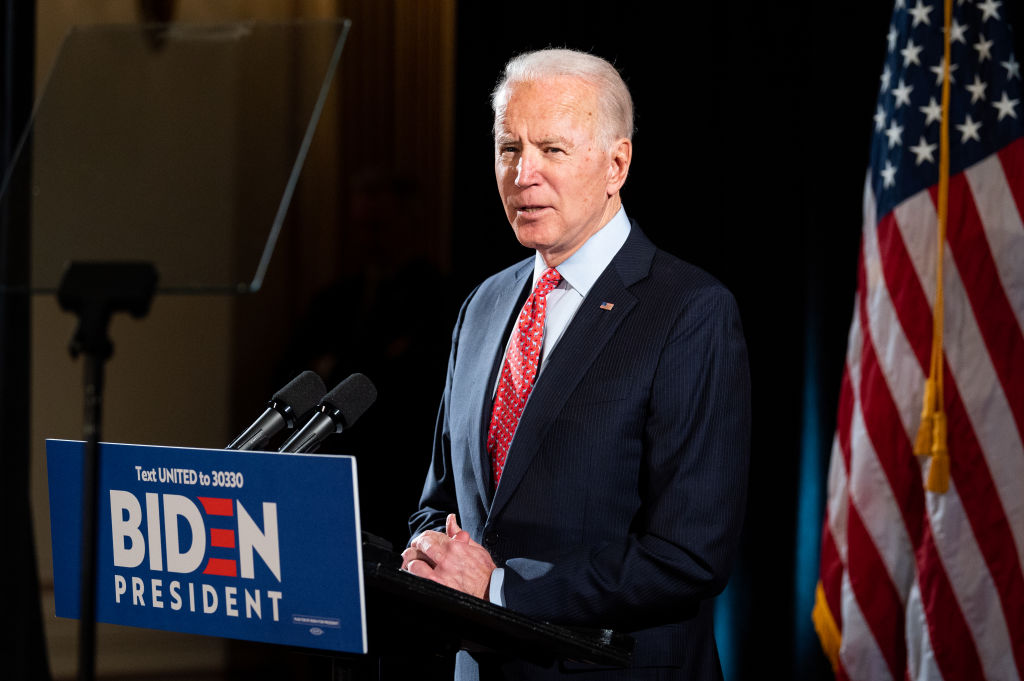
Presumptive Democratic presidential candidate Joe Biden has accused Donald Trump of giving “safe harbour” to anti-LGBT+ hate.
In a message marking the International Day Against Homophobia, Transphobia and Biphobia, Biden called out the Trump administration’s “odious” agenda on LGBT+ issues.
He wrote: “The Trump-Pence administration has done everything it can to undermine LGBT+ rights: giving safe harbour to hate and rolling back protections for LGBT+ persons, blocking the ability of transgender individuals to openly serve their country, denying LGBT+ people access to critical health care, and failing to address the epidemic of violence against transgender people, among other odious policies.
“Today, many LGBT+ people in the United States live in fear, and LGBT+ activists in other countries, who are often fighting desperately for their rights and personal safety, are no longer sure that the United States is their friend and ally.”
Democrat vows to ‘reinvigorate’ efforts to support LGBT+ rights internationally.
Biden stressed that if-elected, he would work across international boundaries to “eliminate discrimination and violence based on sexual orientation and gender identity”.
Former Vice President Joe Biden (Michael Brochstein / Echoes Wire/Barcroft Media via Getty Images)
He wrote: “As president, I will reinvigorate and expand US efforts to advance the human rights of LGBT+ people at home and around the world.
“The United States will again be a beacon of hope for people anywhere in the world who suffer violence and discrimination for the simple fact of who they are or who they love.
“We will strengthen the coalition of countries determined to eliminate discrimination and violence based on sexual orientation and gender identity. Anything less would be un-American.”
LGBT+ rights group are falling in behind Joe Biden.
Human Rights Campaign endorsed the former vice president earlier this month.
HRC president Alphonso David said: “This November, the stakes could not be higher. Far too many LGBT+ people, and particularly those who are most vulnerable, face discrimination, intimidation, and violence simply because of who they are and who they love.
“But rather than have our backs, Donald Trump and Mike Pence have spent the last three and a half years rolling back and rescinding protections for LGBT+ people.
“Joe Biden will be a president who stands up for all of us. HRC and our more than three million members and supporters will work day and night to ensure he is the next president of the United States.”
HRC says that ahead of the 2020 election, it has identified seven key target states – Arizona, Michigan, Nevada, Ohio, Pennsylvania Texas and Wisconsin – where there are 3.4 million voters who support equality “at risk of not turning out” on election day.
Attacks and insults against the LGBT+ community in France surged by more than 36 per cent in 2019, according to figures released Saturday by the interior ministry.
The figures released on the eve of International Day Against Homophobia, Biphobia, Intersexism and Transphobia (IDAHOBIT) showed a steady drumbeat of rising hate crimes against queer folk in the European country, Agence France-Presse reported.
GBT+ men were more likely to be victims, the data showed, with the majority of crimes stemming from larger cities (36 per cent).
In 2019, Twitter timelines were seized by startling video footage of a trans woman brutally assaulted during a demonstration in central Paris.
The incident sparked fury from LGBT+ activists as well as amplifying the increasing visibility of the violence facing one of the most marginalised and vulnerable groups in French society.
Moreover, the data marked 30 years since the withdrawal of homosexuality from the list of mental illnesses by the World Health Organization.
Homophobia is ‘anchored’ in France, ministry says.
French law enforcement identified 1,870 victims of homophobic or transphobic offences, compared to 1,380 in 2018, the ministry said in a statement.
The data hints towards a two-fold change. A potential rise in the number of hate crimes carried out against the LGBT+ community, and/or an increase in the number of victims filing complaints.
This 36 per cent upswing in physical and verbal violence eclipsed what activists described in 2018 as a “black” year. The year was pockmarked by a severe surge in anti-LGBT+ violence.
“These figures testify to the deep anchoring of homophobia and transphobia in society,” the ministry said.
Department officials said that they form part of a broader increase in “hate acts and identity extremism” in France.
Verbal attacks account for 33 per cent of offences, the data showed. Around 28 per cent of complaints concerned physical and sexual violence.
Victims were predominantly men – 75 per cent –with around six in 10 offences perpetrated against those under 35 years of age.
But the number might be higher, activists and police warn, as many hate crimes still go unreported as victims never file a complaint to authorities.
The governing body for psychologists in Albania banned Saturday the long denounced, discredited and debased practise of conversion therapy to both the surprise and delight of countless LGBT+ activists across the European country.
Albania now joins Malta and Germany in stonewalling the harmful practice, while lawmakers in Spain and the UK are all considering nationwide bans, and Switzerland has a de facto ban.
A statement from the LGBT+ organisation Pink Embassy, seen by AP News, said the decision: “Places the Order of Psychologists in Albania in the forefront of the institutions respecting LGBTI rights.”
Psychologists in Albania now prohibited from conversion therapy, LGBT+ rights group say.
All registered psychologists in Albania must be members of the Order of Psychologists. As a result, the body’s decisions are “legally valid”, Pink Embassy stressed, and no hurdles loom ahead.
“This is the final decision which does not need to go through either the legislative or executive to enter into force,” said Pink Embassy head Altin Hazizaj.
“Although reports of the use of such therapies in Albania have been small, allowing them has been a serious concern.”
The measure could, activists hope, be one that reinvigorates Albania’s stalled LGBT+ rights movements. Negative attitudes against the community continue to lurk in the conservative country, at times colliding with lawmaker’s urgency in pressing ahead with equality laws.
Marriage, adoption and the right to change legal gender have long been kicked into the long grass by government. The annual Rainbow Map – which ranks European country’s commitment to LGBT+ rights – gave Albania a 31 per cent rating.
Rainbow Map emphasised that gender recognition measures had vastly stagnated in Albania.
What is conversion therapy?
Also called reparative therapy, medical organisations across the world have widely debunked and rejected the treatment as traumatising and psychologically scarring, especially to minors.
The practice, which has been around more than a century, has many techniques. Most commonly, talking therapy.
However, some physicians who practise the therapy are known to use shock treatments and induce associative nausea in patients, according to a 2018 study by the Williams Institute of the School of Law at the University of California, Los Angeles.
The family of a transgender woman with HIV who died in U.S. Immigration and Customs Enforcement custody in 2018 has filed a federal lawsuit against five private companies that were responsible for her care.
The Transgender Law Center and two immigration lawyers — Daniel Yohalem in Santa Fe., N.M., and R. Andrew Free in Nashville — filed the lawsuit on Wednesday in U.S. District Court for the District of New Mexico. Management and Training Corporation, LaSalle Corrections, Global Precision Systems, TransCor America and CoreCivic are named as defendants.
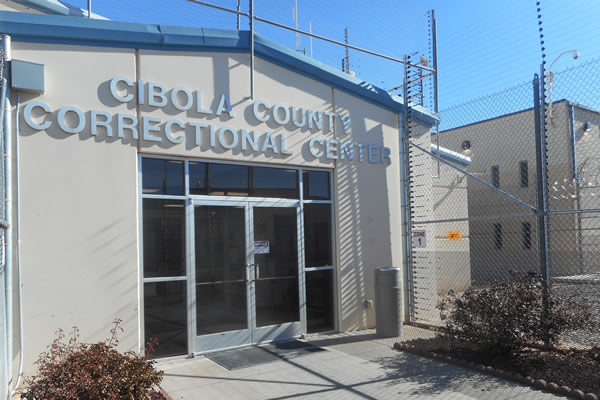
Hernández, who was from Honduras, entered U.S. Customs and Border Protection custody on May 9, 2018, when she asked for asylum at the San Ysidro Port of Entry in San Diego. She was later sent to the Cibola County Correctional Center, a facility in Milan N.M., that CoreCivic, which was previously known as the Corrections Corporation of America, operates.
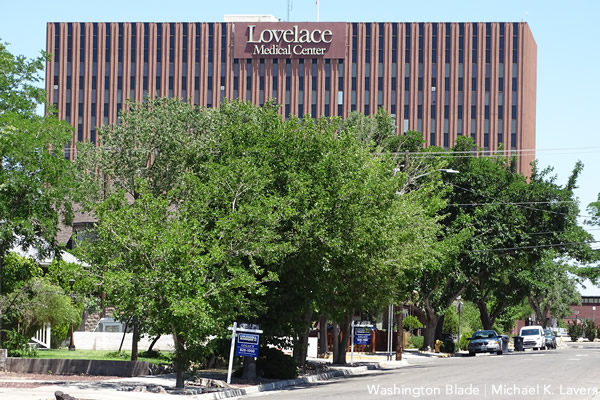
Hernández was admitted to Cibola General Hospital in Grants, N.M., shortly after she arrived at the detention center. Hernández died at Lovelace Medical Center in Albuquerque, N.M., on May 25, 2018.
Lovelace Medical Center in Albuquerque, N.M. (Washington Blade photo by Michael K. Lavers)
The lawsuit alleges Hernández on May 14, 2018, “exhibited visible signs of deterioration requiring immediate medical intervention” when Management and Training Corporation transported her and 12 other trans detainees from San Ysidro to the San Luis Regional Detention Center, a facility in San Luis, Ariz., that LaSalle Corrections operates.
“MTC denied Roxsana and her fellow detainees food, water, and restroom access throughout their transfer,” reads the lawsuit.
The lawsuit notes one detainee said Hernández appeared “very weak and pale, almost yellow in pallor, with dark circles under her eyes” when she was at the San Luis Regional Detention Center.
Hernández was at the facility for only a “few hours,” but she “used the bathroom several times to vomit or spit up phlegm.” The lawsuit claims Hernández “was so weak from fever that she spent most of her time at SLRDC (San Luis Regional Detention Center) laying on the floor, coughing.”
“Officers of Defendant LaSalle Corrections witnessed Roxsana’s obvious state of medical need and failed to offer her emergency medical assistance,” reads the lawsuit. “Eventually during her time at SLRDC Roxsana was so ill she could not eat and had to use the restroom approximately every 15 minutes because she had such bad diarrhea.”
The lawsuit states Hernández and more than two dozen other trans detainees at around midnight on May 15 boarded a bus that took them to the Phoenix-Mesa Gateway Airport in the Phoenix suburb of Mesa.
“Roxsana was very ill during the four-hour bus ride and pleaded for help to a person who sat with her, saying words to the effect of, ‘Help me! I don’t know if I’m going to survive,’” reads the lawsuit.
The lawsuit alleges a LaSalle Corrections officer “threatened” Hernández and the other detainees with whom she was traveling. The lawsuit says one detainee asked officers in both English and Spanish to provide medical care to Hernández, but they “ignored her.”
“When they arrived at the airport, one of the people being transported by LaSalle alongside Roxsana told an officer with beige pants and long red hair that Roxsana was very sick and needed immediate medical attention,” reads the lawsuit. “The officer refused to respond to her. During her five hour stay in the Mesa airport Roxsana remained in LaSalle’s custody and was provided no medical care or assistance for her sickness.”
The lawsuit states Hernández and the other detainees flew to El Paso, Texas, and arrived at the El Paso Processing Center at around 3:15 p.m. The lawsuit notes Hernández remained at the facility until the morning of May 16, 2018.
“She and her fellow asylum seekers woke up to ICE officers presenting them food that they were instructed to eat for breakfast at around 5:00 a.m.,” reads the lawsuit. “Roxsana attempted to eat the meal provided, but ended up vomiting and then going back to sleep.”
“By this time, Roxsana appeared to all around her to be gravely ill,” reads the lawsuit. “Despite LaSalle’s knowledge of Roxsana’s urgent need for medical care, during the entire time Roxsana was in LaSalle’s custody LaSalle did not provide her with medical care or assistance to alleviate her suffering.”
The lawsuit says Hernández and 29 other detainees who were going to the Cibola County Correctional Center boarded a bus at around 9 a.m.
“Each person was provided an 8-ounce bottle of water and sandwich to last the entire five and-half hour journey to the Cibola detention center in New Mexico,” says the lawsuit, which notes the temperature in El Paso that day reached 97 degrees before noon.
The lawsuit notes Hernández asked an officer for water during the trip, but he told her that he did not speak Spanish.
Hernández reportedly “had a fever and produced a significant amount of phlegm during the trip” and had bloody sputum when she blew her nose. The lawsuit also notes Hernández “felt dizzy and extremely exhausted, and her stomach hurt badly.”
The lawsuit says the bus arrived at the ICE Criminal Alien Program facility in Albuquerque at around 2:30 p.m.
“Despite GPS’s knowledge of Roxsana’s urgent need for medical care, during the entire time Roxsana was in GPS’s custody GPS did not provide her with medical care or assistance to alleviate her suffering,” it reads.
The lawsuit says officers from TransCor drove Hernández and 28 other trans detainees to the Cibola County Correctional Center, which is roughly 80 miles west of Albuquerque. The detainees arrived at the facility shortly after 8 p.m.
“Throughout this trip, Roxsana continued to appear gravely ill,” reads the lawsuit, noting she was unable to eat. 94. “Roxsana required immediate medical assistance that TransCor employees neglected to provide.”
The Cibola County Correctional Center in Milan, N.M. (Photo courtesy of U.S. Immigration and Customs Enforcement)
The Cibola County Correctional Center at the time had a unit specifically for trans women who were in ICE custody.
The lawsuit states Hernández was booked into the facility at around 1:15 a.m. on May 17. It notes she spent the night in the facility’s “medical waiting room.”
“Roxsana lay on the floor, only getting up to use the restroom or drink a beverage officers brought around 4 a.m.,” reads the lawsuit. “Roxsana was so weak and ill that she became delirious.”
The lawsuit states Hernández was brought to an “onsite medical provider who conducted an intake screening.” Hernández received “electrolytes and Ensure” before she returned to a holding cell.
The lawsuit says “an onsite medical provider” examined Hernández at around 10 a.m. She reportedly weighted 89 lbs., and was diagnosed with “dehydration, starvation, extreme weight loss, muscle wasting, untreated HIV, fever and cough.” The lawsuit also notes Hernández’s blood pressure was 81/61 and she had “rough breathing sounds and increased amount of white phlegm mucus excreted in abnormally large quantities.”
The lawsuit states officers at the detention center called an ambulance that brought Hernández to Cibola General Hospital at 11:44 a.m. Hernández later that day was airlifted to Lovelace Medical Center where she died.
“Throughout her hospitalization, CoreCivic officers shackled Roxsana at her wrists and both ankles to her hospital bed except when medical personnel needed to remove them for certain medical procedures,” reads the lawsuit. “At least one armed CoreCivic officer guarded Roxsana at all times and checked that her restraints were secured at least every 20 minutes.”
“Each time medical staff needed CoreCivic officers to remove her restraints, the officer on duty made a call to ‘central’ to receive approval to remove them, delaying Roxsana’s receipt of medical care,” notes the lawsuit. “CoreCivic officers kept Roxsana shackled even after her treating medical providers medically paralyzed her and when she first went into cardiac arrest.”
‘Every private entity tasked with Roxsana’s care failed her’
An autopsy the New Mexico Office of the Medical Investigator performed concluded Hernández died from Castleman disease associated with AIDS.
A second autopsy` that former Georgia Chief Medical Examiner Kris Sperry performed at the Transgender Law Center’s request concluded the cause of death was “most probably severe complications of dehydration superimposed upon HIV infection, with the probable presence of one or more opportunistic infections.” The second autopsy also found “evidence of physical abuse” that included bruising on Hernández’s rib cage and contusions on her body.
“Every private entity tasked with Roxsana’s care failed her,” said Dale Melchert, a Transgender Law Center staff attorney, in a press release that announced the lawsuit. “What we know about the short time that Roxsana was in immigration custody is that the officers tasked with transporting her saw her health deteriorate, heard her cries for help, and did nothing. She needlessly suffered as a result of their inaction.”
ICE has denied allegations that Hernández was abused while in its custody.
Amanda Gilchrist, a spokesperson for CoreCivic, on Thursday told the Washington Blade in a statement the company offers “our deepest condolences to the family and friends of Roxsana Hernández.” Gilchrist also noted Hernández was “gravely ill” when she arrived at the Cibola County Correctional Center.
“When she arrived, she went through the intake process, which includes a medical evaluation,” said Gilchrist. “The medical team made the determination that she needed to be immediately transported to an outside hospital.”
“Ms. Hernandez was only at Cibola for 12 hours, where she stayed in the intake area before being transported to the hospital where she passed away nine days later,” she added.
Issa Arnita, a spokesperson for the Management and Training Corporation, on Thursday told the Blade in an email the company “disputes the allegations in the lawsuit, but is unable to comment any further because of the litigation.” Arnita in a second email noted Hernández was in Management and Training Corporation’s custody for “less than four hours, more than a week before her death.”
A transgender service member in the US Navy has been granted a waiver to present as the correct gender for the first time since Trump’s trans military ban became law.
Trump’s infamous ban came into force in April 2019, almost two full years after the president first announced his intention to exclude all trans people from the military.
The Navy confirmed that a trans service member has been granted a waiver in a statement provided to CNN on Friday (May 15).
“The acting secretary of the Navy has approved a specific request for exemption related to military service by transgender persons and persons with gender dysphoria,” said spokesperson Brittany Stephens.
Stephens said the transgender service member “requested a waiver to serve in their preferred gender”, including “obtaining a gender marker change… and being allowed to adhere to standards associated with their preferred gender, such as uniforms and grooming”.
Transgender people have had a chequered history in the US armed forces. They were prevented from serving until 2016, when the Barack Obama administration put an end to the ban.
In July 2017, Trump announced on Twitter that he intended to ban all trans people from serving in the military.
“After consultation with my generals and military experts, please be advised that the United States government will not accept or allow transgender individuals to serve in any capacity in the US military,” he wrote.
“Our military must be focused on decisive and overwhelming victory and cannot be burdened with the tremendous medical costs and disruption that transgender in the military would entail.”
Trump’s ban means trans people who come out will be discharged.
The legislation was eventually enacted in April of last year – following four failed injunctions — and plunged an estimated 13,700 transgender service members into uncertainty.
Under the law, a trans person who comes out or is outed while serving in the military will be discharged, unless they agree to suppress their identity.
The Navy subsequently announced that service members would be allowed to live in their correct gender while off duty, but the US Naval Academy later said that it would bar trans students from enrolling for 2020.
The U.S. Supreme Court seems poised to grant religious schools an expanded ministerial exemption in employment decisions based on oral arguments Monday in litigation that could have significant bearing on LGBTQ teachers at these institutions.
The cases, Our Lady of Guadalupe School v. Morrissey-Berru, Agnes and St. James School v. Darryl Biel, were brought by Catholic schools seeking immunity under the law to conduct employment practices for non-ministerial jobs — such as the hiring and firing of teachers — consistent with their religious beliefs under the exemption granted by the First Amendment.
The schools raised the claims in response to a lawsuit from teachers alleging wrongful termination. One alleges she was terminated based on age discrimination, the other based on disability after having to request time off to treat cancer. The schools have maintained the termination was the result the teachers not fulfilling their ministerial roles at the schools.
Predictably, the five conservative justices on the bench seemed amenable to the idea of an expanded ministerial exemption, while the four liberal justices were against it.
U.S. Associate Justice Ruth Bader Ginsburg was blunt in her questioning about the possible implications of a ruling in favor of Catholic schools, calling it “staggering.”
“Suppose a teacher who does everything the two teachers in these cases do as a faith leader also reports a student’s complaint of sexual harassment by a priest and is terminated,” Ginsburg said. “She has no remedy?”
U.S. Associate Justice Clarence Thomas, on the other hand, appeared to justify a decision for the Catholic schools by indicating the work of teachers there would be considered a violation of the Establishment Clause at a public schools.
“It’s my understanding they actually let them from time to time in prayer or took them to service, things like that,” Thomas said.
The cases have broad implications for workers at religious schools, including LGBTQ teachers. The ruling could impact whether gay teachers have a legal right to sue a Catholic school if they’re terminated for entering into a same-sex marriage, or transgender teachers if they’re fired for undergoing a gender transition.
Shannon Minter, legal director for the National Center for Lesbian Rights, said based on the arguments the court seems ready to grant Catholic schools the considerable leeway they’re requesting.
“It seems likely there are enough votes to broaden the scope of the so-called ‘ministerial exception’ for religious employers, which would give religious schools and other religious employers more leeway to fire workers without regard for anti-discrimination laws, including those that protect LGBTQ people,” Minter said.
Jeffrey Fisher, an attorney with the Menlo Park, Calif.-based law firm O’Melveny & Myers LLP, represented the teachers who were terminated and estimated hundreds of thousands of lay teachers across the country may be affected.
“The schools’ argument would strip more than 300,000 lay teachers in religious schools across the country of basic employment law protections — and necessarily included in this number are teachers who teach so-called secular classes,” Fisher said.
The Trump administration backed the arguments from the religious schools during oral arguments by sending — completely on a voluntary basis because the U.S. government isn’t a party in the litigation — a high-level attorney to argue in favor of an expansive ministerial exemption.
Assistant to the U.S. Solicitor General Morgan Ratner maintained a ruling in favor of an expanded ministerial exemption would be consistent with Supreme Court precedent.
“Under Hosanna Tabor, those teachers are ministering to their students by teaching them how and why to be Catholic, so this should fall within the ministerial exemption regardless of what the school calls them,” Ratner said.
Much of the argument in favor of the expanded ministerial exemption rested on the Supreme Court’s 2012 decision in Hosanna Tabor v. EEOC, the 2012 ruling that determined federal discrimination laws don’t apply to religious organizations’ selection of ministerial leaders. However, that decision didn’t specify which employees are considered ministers and which aren’t.
Eric Rassbach, an attorney with the Becket Fund for Religious Liberty who represented the Catholic schools before the court, said the court’s decision in Hosanna Tabor compels to rule in favor of an expanded ministerial exemption.
“Eight years ago in Hosanna Tabor — the pretext inquiry, the notice requirements, the idea that freedom of association makes freedom of religion entirely unnecessary — all were raised in Hosanna Tabor and rejected unanimously,” Rassbach said. “Eight years later, respond to arguments are not any more convincing. In short, there’s no reason for government to get into business of teaching religion.”
U.S. Associate Justice Elena Kagan sought to clarify the implication of what Rassbach was seeking by peppering with questions on hypothetical jobs for which he thinks the ministerial exemption should apply.
A math teacher who is told to teach something about Judaism for 10 minutes a week? “Probably not.” A press or communications staffer who prepares press release for a religious institution? “That should fall within it.” An employee at a soup kitchen who distributes religious literature and leads grace before meals? “My guess is that that would be de minimius.” A church organist who provides musical accompaniment and selects hymns for religious services? “I think that would fall within it because that’s an important religious function.”
A nurse at a Catholic hospitals who prays with sick patients and is told otherwise to tend to their religious needs? “I think a nurse doing that kind of counseling and care may well fall within the exception.”
Fisher seized on Rassbach’s admission nurses at Catholic hospitals would have no recourse under non-discrimination law with an expanded ministerial exemption as evidence of the breadth of such a decision.
“If you write an opinion that says all important religious functions trigger the ministerial exception, I don’t think there’s any way to escape — you’re going to have the cases with the nurses, you’re going to have the cases with the football coaches, you’re going to have the cases with the summer counselors,” Fisher said. “The only thing the other side says to that in our brief is, ‘Well, those cases haven’t been brought so much,’ but my answer to that is that just shows how revolutionary their case would be, because there’s no good answer to those cases and Mr. Rassbach himself said nurses would be covered.”
U.S. Associate Justice Sonia Sotomayor also expressed fear about the potential ruling for an expansive ministerial exemption because the two teachers in the cases “are not claiming that they were fired because the school thought they were teaching religion wrong.”
“You’re asking for an exception to the Family & Medical Leave Act, to wage and hourly laws to all sorts of laws, including breach of contract, because at least one of the schools here, contract with the teacher says they won’t discriminate because of the teachers age or disability,” Sotomayor said.
The conservative justices, nonetheless, devised scenarios in their questioning that appeared to justify having an expanded ministerial exemption for employment at religious schools.
U.S. Associate Justice Neil Gorsuch raised the possibility of a religious school with limited funds that hires a full-time teacher, but asks the teacher to act as a religious leader part-time, or a religion that believes all its members are leaders of the faith.
“You said we shouldn’t focus on their sincerely held religious beliefs, but that is what we do elsewhere in First Amendment jurisprudence,” Gorsuch said. “We don’t second guess those sincerely held religious beliefs. Why would we do it here?”
Although the issue of titles was brought up as a way to distinguish between ministerial and non-ministerial positions, U.S. Associate Justice Samuel Alito said that would be insufficient because titles don’t always give a clear indication of role.
“How does it even help to understand the person’s role?” Alito said. “Suppose you have two people who do exactly the same thing in two different religiously affiliated schools but one has a title and the other one doesn’t have a title, other than the title of the teacher. Why should the presence or absence of this title make any difference?”
It’s true LGBTQ people, as of now, have extremely limited explicit non-discrimination protections under federal law, but the Supreme Court will soon issue a ruling on the Title VII of the Civil Rights Act of 1964 that will determine whether the law covers LGBTQ people. A ruling for Catholic schools in these cases would undercut an LGBTQ-inclusive in the Title VII litigation.
Further, a ruling in favor of an expanded ministerial exemption would undermine the laws in 21 states and D.C. that bar anti-LGBTQ discrimination in the workforce. Not just LGBTQ people would be affected. A ruling for Catholic schools would also allow them to discriminate based on race, national origin, disability or any other category in non-ministerial jobs.
U.S. Associate Justice Stephen Breyer noted various categories of people with histories of discrimination against which a religious institution could lawfully terminate if the ruling came out in favor of the Catholic schools.
“This case has to do with a religious organization might dismiss someone on the basis of race or religion or national origin…where that isn’t related to the carrying on of the religious activity, for example, a person who’s handicapped,” Breyer said.
Minter echoed that concern in his assessment of the oral arguments based on the way judges appeared to lean in favor of an expanded ministerial exemption.
“If the schools win today’s cases, religious schools would be able to fire many more LGBTQ teachers based purely on anti-LGBTQ animus or for any other reason, regardless of whether they have a religious reason for doing so,” Minter said.
A decision in the case is expected before next month at the end of the term for the Supreme Court.
My phone buzzed the other day with a long missive from a friend to a group Facebook chat we share with my husband and his fiancé. Earlier in the day, he had invited me and my husband over for dinner at their apartment. In the spirit of social distancing, I responded by suggesting maybe we do something outdoors—perhaps a picnic or a walk in the park?
He was furious. He felt like we were avoiding their “COVID germs.” After a series of angry messages, he left the group chat—the digital equivalent of a gauntlet-drop.
I looked at my husband, speechless. Had COVID-19 just caused a different kind of loss, our friendship?
We all manage and respond to risk differently—and with varied emotions. Most of us are becoming well acquainted with the small daily frustrations of encountering people engaging in behaviors once considered perfectly normal but now labeled as risky: shopping for groceries without a mask, walking too closely to others, or coughing without covering your face. But as my friend made clear, we can also find frustration in others we believe are being overprotective or too risk-averse.
As a sociologist who has studied how gay men practice and manage HIV risk, I think a lot about the way diseases shape our behaviors, emotions, and, ultimately, our social worlds. HIV is fundamentally different from COVID-19 in that it cannot be transmitted through casual contact like handshakes or shared Uber rides. Nonetheless, in order to navigate HIV risk, we engage in a similar kind of mental calculus.
Some gay men think the risk of contracting the disease is well worth the potential pleasures of eschewing condoms with a one-night stand. Other gay men recoil at the thought, so wary of HIV that they meticulously practice condom use or even avoid casual sex altogether (indeed, that recoil can at times translate into shame projected onto anyone who doesn’t take the same precautions). As anyone who has spent time cruising for sex online knows well, clashing views on risk and pleasure can lead to plenty of hurt feelings and libidinous disappointment.
HIV and COVID-19 risk can both put distance between us, but the pleasures interrupted are of a different stripe. For HIV, we take risk in search of human connection and sexual pleasure. For COVID-19, even the most ordinary of behaviors have become suddenly risky: sharing a meal, taking a walk, going to a movie. Avoiding COVID-19 is forcing us to deprive ourselves of all the many pleasures of life, both sexual and platonic.
Our new marching orders for our now-COVID-ridden lives seems straightforward enough: avoid gatherings, wear masks in public, wash your hands vigorously. But for most of us, the truth is more complicated. We are faced with a social isolation that hurts. And the promise of connection is not trivial or superfluous: we crave it. We need it.
Whether we are aware of it or not, we’ve all been doing a sort of risk-calculus in our heads these last few weeks. Is it OK to take a walk with my friend? Do we need to wear masks? Should I say yes to the invitation from my parents to come stay with them for a long weekend? For those of us that are single, is dating even possible anymore?
A tipping point in those risk-equations we all have been making these last few weeks is coming. As the loss of human connection and intimacy takes an ever-greater emotional and psychological toll, the potential risk of contracting COVID-19 won’t be enough to keep us away from those we love. For some, especially those suffering from depression, isolation will become unbearable to the point of even becoming deadly.
As restrictions lift and we come out of our isolation, many of our phones will buzz with eager invitations from friends asking to get together and connect—for dinner, a walk, or to get coffee. But we won’t all be ready to take those risks at the same time.
Try not to take it personally. The truth is we are all aching from the pain of isolation. We miss you. And in the words of Queen Elizabeth, I long for the day that “we will meet again.”
Please read this Order carefully. Violation of or failure to comply with this Order is a misdemeanor punishable by fine, imprisonment, or both. (California Health and Safety Code § 120275, et seq.)
UNDER THE AUTHORITY OF CALIFORNIA HEALTH AND SAFETY CODE SECTIONS 101040, 101085, AND 120175, THE HEALTH OFFICER OF THE COUNTY OF SONOMA (“HEALTH OFFICER”) ORDERS:
On May 12, 2020, Governor Newsom announced that the state would be moving further into the reopening process by allowing office workspaces where teleworking is not possible, outdoor museums, botanical gardens, car washes, pet groomers, dog walking services to operate statewide with health safety modifications. The Governor also clarified that childcare facilities can open to those outside of the essential workforce and retailers in shopping malls, strip malls, and outlet malls may offer retail sales by curbside pickup, delivery, or shipping. This Amendment implements the full breadth of the Governor’s Roadmap by amending Health Officer Order C19-09 to allow all businesses authorized to reopen statewide to similarly open in Sonoma County. This Amendment becomes effective at 12:01 a.m. on May 15, 2020, and continues in effect until Order C19-09 is rescinded, superseded, or amended in writing by the Health Officer or by the State Public Health Officer.
This Amendment incorporates by reference the May 1, 2020 Order of the Health Officer No. C19-09 and the May 7, 2020 Amendment 1 to Order of the Health Officer No. C19-09. Except as otherwise amended herein, all provisions of that Order remain in full force and effect. This Order incorporates all provisions of these Orders that are not in conflict.
All businesses operating in the County shall comply with local and state orders and guidance, including preparing, posting, and implementing a Social Distancing Protocol (https://socoemergency.org/wp-content/uploads/2020/05/Appendix-A_05-01-2020extended.pdf) at all facilities operating in the County.County Orders and Guidance are located here:
The following businesses are allowed to operate and persons are allowed to leave their home and travel for the purpose of working at or patronizing the following businesses:
Businesses that provide outdoor services such as, but not limited to, arborists, landscapers, gardeners, pool maintenance, and environmental site remediation; as well as car washes, pet groomers, dog walkers, and residential and commercial janitorial and cleaning services subject to the Social Distancing Protocol and applicable State and local requirements and guidance, include those cited above in paragraph 3. This section does not allow outdoor restaurants, cafes, or bars, and does not apply to personal care services that necessitate close customer contact, such as, but not limited to, hair salons, barbershops, nail salons, massage parlors, aestheticians and cosmetology, ear and body piercing salons, and tattoo parlors.
Outdoor museums, open air galleries, botanical gardens, and other outdoor exhibition spaces. Indoor exhibits and convention space shall remain closed to the public, and gift shops, cafes, and restaurants shall comply with the retail and restaurant sections of the Order. Hands-on interactive exhibits and playgrounds and areas where it is not possible to keep customers or visitors from congregating where social distancing cannot be maintained shall remain closed. This section does not apply to zoos, amusement parks, or indoor gallery and museum spaces.
Childcare facilities, subject to conditions in subsection 16.f.xxviii.
Paragraph 16.g. to Order C19-09 allowing “Minimum Basic Operations” for non-essential businesses shall be amended as follows:For the purposes of this Order, “Minimum Basic Operations” include the following activities when they cannot be performed remotely, provided that there are only the minimum number of persons on-site and persons comply with Social Distancing and Hygiene Requirements as defined this Section:
The minimum necessary activities to maintain and protect the value of the business’s inventory and facilities; ensure security, safety, and sanitation; process payroll and employee benefits; and related functions.
The minimum necessary activities to facilitate owners, personnel, and contractors of the business being able to continue to work remotely from their residences, and to ensure that the business can deliver its service remotely.
Retail or wholesale curbside pickup, shipping, or delivery of goods, including but not limited to bookstores, jewelry stores, toy stores, clothing stores, shoe stores, home and furnishing stores, sporting goods stores, antique stores, music stores. Retail sales by curbside pickup, delivery, or shipping is authorized from shopping malls, strip malls, and outlets. Retail or wholesale businesses operating under this subsection shall prepare, post, and implement a Social Distancing Protocol at each of their facilities at which they are maintaining operations. Storefront and indoor mall access shall remain closed to the public. This provision shall only apply to the sale of goods and does not apply to provision of services.
Activities in office workspaces where teleworking is not possible. This does not apply to office activities already being performed by teleworking, and shall not necessarily permit teleworking to be converted into in-person operations. These office workspaces shall not be open to the public. All in-office operations must be conducted in accordance with applicable State and local guidance.
For clarity, this Amendment does not apply to outdoor restaurants, cafes, bars, or personal care services that necessitate close customer contact, such as, but not limited to, hair salons, barbershops, nail salons, massage parlors, aestheticians and cosmetology, ear and body piercing salons, and tattoo parlors.
Copies of this Amendment shall promptly be: (1) made available at the County Administration Center at 575 Administration Drive, Santa Rosa CA 95403; (2) posted on the County Public Health Department website (https://sonomacounty.ca.gov/Health/Public-Health/) and (https://socoemergency.org/); and (3) provided to any member of the public requesting a copy of this Order.
If any provision of this Amendment or related Order is held to be invalid, the reminder, including the application of such part or provision to other persons or circumstances, shall not be affected and shall continue in full force and effect.
IT IS SO ORDERED:
Dr. Sundari R. Mase, MD MPH Health Officer of the County of Sonoma
Following the death of Aimee Stephens — the transgender woman at the center of a high-profile LGBTQ discrimination case pending before the Supreme Court — a different name appeared in several news articles announcing that she had died Tuesday.
The New York Times, The Associated Press and the Detroit News were among the media outlets that published Stephens’ former legal name, the male name she had used prior to her gender transition in 2013. The publication of her previous name, colloquially referred to as “deadnaming,” drew swift and fierce reaction from LGBTQ rights groups and advocates.
“It serves no purpose of integrity to publish a transgender person’s ‘deadname,’ or former name, as the @nytimes did here in Aimee Stephens’s obituary. This should be immediately revised. Aimee deserves better,” Lambda Legal, an LGBTQ legal organization, tweeted Tuesday evening.
“The Grey Lady should know better than this in 2020,” the National Center for Lesbian Rights tweeted later that night. “Deadnaming and misgendering individuals is wrong, and also sends a message to trans or non-binary people that their existence is not valid.”
Both the Times and the AP amended their articles shortly after.
“An earlier version of this obituary included the name Ms. Stephens was given at birth, which she no longer used. That reference has been removed,” an editor’s note in the Times obituary stated.
Times editor Patrick LaForge also apologized on Twitter and said the incident would lead to updated style guidance.
“The first published version of the article our reporter wrote did not include the name,” LaForge wrote. “It was added later in an honest mistake by editors trying to interpret what we now realize is a confusing style rule for obituaries.”
The AP amended its obituary Wednesday and included the following note: “The story has been edited to remove a former name in accordance with AP Style to use the name by which the person lived and avoid former names unless relevant.”
Lauren Easton, a spokesperson for the news organization, told NBC News that the AP Stylebook was updated in June 2019 to include guidance on deadnaming.
The stylebook, which is influential in guiding the way many U.S. newsrooms write about complex topics, now reads: “Use the name by which a transgender person now lives. Refer to a previous name, sometimes called a deadname, only if relevant to the story.”
“The spirit of the entry is to make NOT printing a person’s deadname the default; to assume a person does not want their deadname used unless they say or you confirm otherwise,” Easton wrote in an email. “And then print it only if it’s newsworthy.”
As of Friday morning, the Detroit News’ article still included Stephens’ former name.
“The reality of trans lives is that we struggle against the interpersonal and systemic beliefs that we are only putting on our genders and that beneath them lies some ‘truth’ of who we really are — and that notion fuels violence and discrimination against members of the trans community,” Strangio, who is transgender, wrote.
“To then write about a woman who is trans and remind the reader of her deadname under the pretense that what she was called at birth is important to understanding who she is today actually evokes the image of a man for readers and contributes to the insidious social understanding that ‘this person claimed to be a woman but was really a man,’” Strangio continued.
In a 2019 op-ed titled “Stuck on how to refer to trans people in the past? The answer is actually really simple,” Parker Molloy, editor at large for Media Matters for America, a progressive nonprofit that monitors the media, argued that in the “overwhelming majority” of instances, “it’s completely unnecessary to draw attention to former names or pronouns.”
“The best way to refer to a trans person — even when discussing their past — is to use whatever name and pronouns that individual currently uses,” Molloy, who is transgender, wrote.
Raquel Willis, a transgender activist, writer and former editor at Out Magazine, said in 2020, there’s not much excuse anymore for continued deadnaming in major publications: “We have to call it what it is: ignorance.”
“As a black woman I liken it — and this might get me into some hot water — but I liken it to a news reporter in the ‘70s saying ‘colored’ instead of ‘black’ or ‘African American,’” Willis said. “Sure, we can extend some grace to you not understanding, but it’s also your job to be aware of the communities you’re reporting on and what language they’re using.”
Something as simple as asking an interviewee which pronouns they use no matter your impression of their gender identity, Willis suggested, goes a long way.
So when, if ever, do transgender advocates think it is relevant and acceptable to use a trans person’s former name in a news article?
Willis said there are some “special cases where you would need to use a name that someone doesn’t currently use.”
“Someone who was a public figure, who people knew as one name, and this was about trying to educate the rest of the public about them changing their names or pronouns,” she explained.
However, once the new name of a public figure — Caitlyn Jenner and Chelsea Manning, for example — “becomes common knowledge, it is unnecessary and disrespectful to continue referring to their old name,” Nick Adams, GLAAD’s director of transgender media and representation, said in an interview with Media Matters last year.