A lawyer named Susel Paredes and her wife, Gracia Aljovin, are battling to legalise same-sex marriage in Peru.
Paredes and her wife married in Miami in 2016 and have since been campaigning to get the union recognised in the heavily Catholic, conservative country.
On April 4, a local court asked authorities to treat the couple’s marriage like they would any other stating that not to do so would be unconstitutional.
“We want to trigger a legal process that moves us toward obtaining the equal right to marriage in Peru,” Paredes told Reuters.
Peru does not recognise same-sex marriage
Reneic responded to the request by saying the couple’s marriage cannot be legally recognised, as same-sex marriage isn’t legal in Peru.
In official documents, Reneic noted that Article 2347 of the Civil Code states that “marriage is the union voluntarily arranged by a man and a woman, and since the plaintiffs are the concerted union of two women, it is not effective.”
However, the Paredes appeal could potentially result in the legalisation of gay marriage in Peru, which is one of the few countries in Latin America not to recognise same-sex unions.
Cardinal Juan Luis Cipriani voiced his disdain for same-sex marriage. (Djacobo)
Catholicism compromises up to 90% of Peru’s population. And despite Paredes also being a Catholic herself, religious officials disagrees with her decision.
“A judge has basically said that God was wrong, that it’s not just man and woman (who can marry),” Peru’s Catholic Cardinal Juan Luis Cipriani told a local broadcaster on the matter.
Susel Paredes asks other gay people to come out
In an interview with local media Paredes made an appeal to other gay people in the country. “Christ said the truth will set you free. That’s why I call on you to come out of the closet,” she said. “Who can be happy leading two lives?”
Paredes has vouched to take the battle to Peru’s high court, the Constitutional Tribunal, or even the Costa Rica-based Inter-American Court of Human Rights if needs be.
A gay foreign policy expert who worked in the Obama administration on international LGBT issues has declared his intention to run for U.S. Senate in Colorado.
Daniel Baer, who’s 42 and a former U.S. ambassador to the Organization for Security & Cooperation in Europe, announced his candidacy Tuesday in an email blast referencing his spouse, Brian Walsh.
“Like many of you, Brian and I are dismayed by the chaos unfolding in Washington under this president,” Baer said. “But we’ve also realized that the best way to find hope and optimism is by putting ourselves on the line, taking risks for the values we believe in, and fighting for the country we want.”
If Baer succeeds if his campaign bid, he’d become the first openly gay man elected to the U.S. Senate and would join Sen. Tammy Baldwin (D-Wis.), the first out lesbian elected to the Senate, and Sen. Kyrsten Sinema (D-Ariz.), the first open bisexual elected to the Senate.
One of seven openly gay ambassadors in the Obama administration, Baer as U.S. ambassador to OSCE was charged with deescalating tensions in Europe during the Ukraine crisis in 2014.
Previously, Baer served as deputy assistant secretary for the Bureau of Democracy, Human Rights & Labor under Hillary Clinton when she was secretary of state. Baer worked on international LGBT issues, including the integration of LGBT human rights abuses in the State Department’s annual human rights report.
In a campaign video announcement titled “Driving Change,” Baer touts his foreign policy experience at OSCE as well his relationship with his spouse and their dog.
It’s not the first time Baer has pursued a run for Congress. In 2017, Baer launched a campaign to run for a U.S. House seat representing Colorado’s 7th congressional district. But Baer later dropped that bid after incumbent Rep. Ed. Perlmutter (D-Colo.) changed his mind and decided to keep the seat he said he’d vacate.
By seeking the Democratic nomination to run for U.S. Senate, Baer is potentially challenging Sen. Cory Gardner (R-Colo.), one of the most vulnerable senators up for election in 2020. According to the Democratic Senatorial Campaign Committee, Gardner is currently polling eight points behind a generic Democratic on the ballot.
In an interview with the Denver Post, Baer touted his foreign policy experience in explaining why he’d be superior to the sitting Republican incumbent currently representing Colorado.
“Cory Gardner sits on the Foreign Relations Committee,” Baer said. “I think one of the things I offer as a candidate going up against him is that I can go toe-to-toe with Cory Gardner on foreign policy issues.”
But Baer is one of seven Democrats seeking their party’s nomination to run against Gardner and it remains to be seen if Baer will claim victory. The filing deadline and primary for Colorado aren’t yet scheduled.
It’s been less than four years since gay marriage was legalized in the U.S., and LGBTQ people still face hurdles in adopting children, joining the military and buying wedding cakes. But on primetime TV Monday night, a remarkable conversation took place: A presidential contender and one of the country’s most-watched cable news hosts discussed the weight of the metaphorical closet and their experiences in coming out as gay.
“You went through college, and then the Rhodes Scholarship process and getting the Rhodes scholarship and going to work for McKinsey and joining the Navy and deploying to Afghanistan and coming home and running for mayor in your hometown and getting elected before you came out at the age of 33,” MSNBC host Rachel Maddow said to Mayor Pete Buttigieg of South Bend, Indiana, on her show Monday night. “I think it would have killed me to be closeted for that long.”
“It was hard,” replied Buttigieg, who announced his bid for the 2020 Democratic presidential nomination over the weekend. “It was really hard.”
“Coming out is hard, but being in the closet is harder,” said Maddow, a fellow Rhodes scholar who came out during college.
In addition to coming out to others, Buttigieg, now 37, revealed it also took him “plenty of time to come out to myself.”
“There were certainly plenty of indications by the time I was 15 or so that I could point back and be like, ‘Yeah, yeah, this kid’s gay,’ but I guess I just needed to not be,” he explained. “There’s this war that breaks out, I think, inside a lot of people when they realize they might be something that they’re afraid of, and it took me a very long time to resolve that.”
In addition to the struggles many people face coming out as gay, at the time Buttigieg was planning to come out, he was also an officer in the United States Navy Reserve and an elected official in Indiana. He told Maddow he assumed at the time that both roles were “totally incompatible with being out.”
Initially, Buttigieg said, the demands of his job as mayor forced him to put his personal life on the back burner.
“I did get a lot of meaning from that work, and in some ways, because it was so demanding, I almost didn’t mind for a sort of inordinately long time that I didn’t have much of a personal life,” he said. “The city was a jealous bride for a long time and kept me busy.”
However, a seven-month deployment to Afghanistan in 2014 really put him “over the top.”
“I realize that you only get to be one person,” he told Maddow. “You don’t know how long you have on this earth, and by the time I came back, I realized, ‘I’ve got to do something.’”
Buttigieg came out in a June 2015 op-ed in The South Bend Tribune just before the Supreme Court’s landmark Obergefell v. Hodges decision, which legalized same-sex marriage across the U.S.
“I was well into adulthood before I was prepared to acknowledge the simple fact that I am gay. It took years of struggle and growth for me to recognize that it’s just a fact of life, like having brown hair, and part of who I am,” Buttigieg wrote. “Like most people, I would like to get married one day and eventually raise a family. I hope that when my children are old enough to understand politics, they will be puzzled that someone like me revealing he is gay was ever considered to be newsworthy.”
When Maddow asked if Buttigieg thought coming out could cost him re-election, he revealed he was unsure.
“I felt like I had done a good job by the people of South Bend, and I had some level of trust that I would be rewarded for that with a re-election, but there’s no way to really know,” he said. “There’s no playbook, no executive in Indiana had ever been out, and so it was kind of a leap of faith.”
Buttigieg was re-elected in 2015 with nearly 80 percent of the vote — a wider margin than his election in 2011.
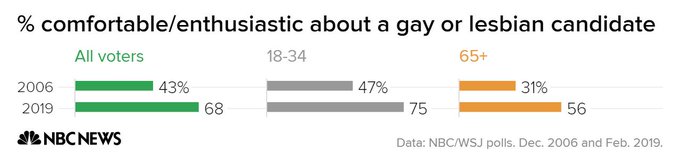
When it comes to the presidential election, Buttigieg said most people are “either supportive or even enthusiastic about the idea of the first out person going this far.” And he’s right: A recent NBC News/Wall Street Journal poll found nearly 70 percent of U.S. voterswere either enthusiastic (14 percent) or comfortable (54 percent) with a gay or lesbian presidential candidate. This is up from 43 percent in 2006.View image on Twitter
Buttigieg told Maddow at the very least, he hopes his presidential campaign will make it easier “for the next person who comes along.”
The conversion between Maddow and Buttigieg garnered a significant amount of social media attention. The country singer Chely Wright, who is lesbian, revealed she was in “tears” watching the segment.
“I came out 9 years ago and I feel like now— in this very moment— there’s is a tangible shift,” she wrote on Twitter.
A transgender student who is studying at the University of Texas in Austin (UT) has lost his scholarship after Donald Trump’s trans military ban came into effect last week.
Map Pesqueira was awarded a national three-year Reserve Officers’ Training Corps scholarship to fund his studies, according to Daily Texas Online.
However, due to Trump’s trans military ban—which came into effect last Friday (April 12)—his scholarship has been revoked by the US Department of Defence. He is now at risk of not being able to continue his studies and has started a fundraiserto finish his degree.
Transgender student Map Pesqueira’s dream was to serve in the military
“Since I’ve already had top surgery, hormone replacement therapy, gender marker and [a] name change, I can’t go in under this policy,” Pesqueira said.
“I’d automatically be discriminated. I really do see [the policy] as a waste of resources, money, time and personnel. It’s made figuring out my future education so much harder.”
Pesqueira went to UT to study and achieve his dream of serving in the military and becoming a filmmaker. He hopes that he can pursue a career in the military in the future.
“Because I have started medically transitioning, my scholarship is now void.”
– Transgender student Map Pesqueira
He has started a GoFundMe with the goal of raising $20,000 so he can continue studying through his sophomore year.
In a lengthy post on his GoFundMe page, Pesqueira wrote: “Since I was a kid, one of my biggest dreams was to pursue a career in the Army to serve my country.
Specna Arms/Pexels
‘I can no longer afford to attend without financial assistance’
“I happen to be a transgender male who started medically transitioning in 2018. I have been on hormone replacement therapy and living in my preferred gender for 15 months, just recently had top surgery, and have legally changed my name and gender marker.
“In January of 2019, the Supreme Court gave the green light to the Department of Defense to begin implementing a new policy that prohibits transgender people who have begun their transition as well as transgender people with a gender dysphoria diagnosis from entering the military.
“Because I have started medically transitioning, my scholarship is now void.
“Since my scholarship is now invalid, I can no longer afford to attend without financial assistance. I received little financial aid from the university despite having a single mother with a low-income and struggled to pay my own way through my first year.
“Until now, I remained under the impression that my scholarship would take care of my remaining 3 years, but that is no longer the case.”
He is now pleading with people to help him raise the required funds to continue his education.
Productions about gay men in New York City, friendship after the Sept. 11 attacks and love in Mississippi dominated Britain’s prestigious Olivier Awards for best theatre on Sunday.
In a distinctly American-themed night, “The Inheritance”, a play about the generation after the peak of the AIDS crisis, was joint overall winner with four awards: best new play, best director (Stephen Daldry), best actor (Kyle Soller) and best lighting.
Written by Matthew Lopez, the two-part play transposes E.M. Forster’s classic 1910 novel “Howards End” to modern New York, where a group of young, ambitious men ponder their existence and the previous generation’s legacy.
“I don’t have the proper vocabulary … It feels like an out-of-body experience … a bit crazy,” Soller told Reuters after winning the award over other nominees like Ian McKellen and David Suchet.
“To be speaking for a community where there’s so much pain, so much healing to be done, it is just really incredible, very emotional,” he added.
In his acceptance speech, Soller paid tribute to the victims of AIDS and lamented that in some nations people can still be stoned to death for being gay.
“Come From Away”, a musical about the power of kindness among air passengers grounded in Canada after the 2001 attacks on New York and Washington, also won four awards including best new musical.
“Company”, a reworking of U.S. composer Stephen Sondheim’s comedy with a woman instead of a man in the lead role, took three prizes including best musical revival.
“Summer And Smoke”, a rarely-staged Tennessee Williams’ drama about love, loneliness and self-destruction set in small-town Mississippi, took two honours for best actress (Patsy Ferran) and best revival.
“I wasn’t expecting it … Nobody knows who I am,” Ferran told Reuters afterwards, clutching a glass of champagne. “I might be slightly hung over tomorrow, don’t tell anyone!”
Prince Charles’ wife Camilla joined stars of British theatre for the glitzy ceremony at the Royal Albert Hall in London.
The Russian River Chamber of Commerce invites you to join us in a celebration of food and wine to kick off the summer season. Celebrate the Rise of the Russian River after the rainy winter. On April 27th, 2019 from 1-4 pm over 30 gourmet restaurants and wineries will be serving up a variety of local Sonoma County foods and delicious wines. The event is taking place in the tree-lined, center of town right next to Trios Restaurant. Nearby you’ll find art galleries and shops to browse after enjoying tastings from world class restaurants and wineries in the casual and relaxed atmosphere of Guerneville along the Russian River. Cost is $50 for unlimited Food & Wine, $30 for food only. Come and enjoy world class tastings from restaurants and wineries along the Russian River. First 100 tickets sold will be entered to win a Magnum of Woodenhead Pinot Noir! Advance Tickets here. A sampling of the wineries and food purveyors sampling for you at the Spring Fling:
The California National Guard will continue to welcome transgender troops despite a military-wide ban.
The Trump administration rule that bans transgender people from serving in the armed forces went into effect on April 12.
However, California’s National Guard has made clear that it will not be following suit in adopting the policy.
Transgender soldiers ‘will remain in’ California National Guard
Major General Matthew Beevers told The Hill that gender identity of soldiers is “the least of our concerns.”
He said: “Every [transgender] soldier or airmen currently serving in the California National Guard will remain in our ranks. We will not treat any soldier or airmen any differently today, than we did yesterday.”
The general added that the guard “will explore every avenue to ensure that [transgender] people who want to serve in the California National Guard are afforded every opportunity to serve.”
He continued: “Anybody who is willing and able to serve state [and] nation should have the opportunity to serve.
“It’s unconscionable in my mind that we would fundamentally discriminate against a certain class of people based on their gender identity.
“That should be the absolute least of our worries.”
California National Guard Major General Matthew Beevers
Beevers added that the guard would “exercise every available avenue” to welcome transgender troops while abiding by the guidelines.
He continued: “It’s a bit frightening where we’re at today.
“However, we’re compelled as military officers to follow the rules of the folks that are elected and appointed above us and we’ll continue to do that.”
13,700 people could face discharge under Trump ban
“After consultation with my generals and military experts, please be advised that the United States government will not accept or allow transgender individuals to serve in any capacity in the US military,” he wrote.
“Our military must be focused on decisive and overwhelming victory and cannot be burdened with the tremendous medical costs and disruption that transgender in the military would entail.”
Any person who comes out or is outed as trans in the US Armed Forces from April 12 will be discharged, unless they are willing to suppress their identity. The military will not pay for any gender confirmation surgeries, apart from those which will “protect the health” of people who have begun to medically transition.
After April 12, those applying to join the services with a record of gender dysphoria will have to adhere to the gender they were assigned at birth in order to serve. A doctor will have to certify that they have been stable in that gender for at least 36 months, and that they have not medically transitioned.
The US Supreme Court has rejected an appeal by gay death row inmate Charles Rhines amid claims he was given a harsher sentence because of his sexuality.
According to sworn statements from 2016, the South Dakota jury that convicted Rhines may have given him the death sentence instead of life imprisonment because of anti-gay prejudice.
“If he’s gay, we’d be sending him where he wants to go,” Frances Cersosimo noted another juror saying.SPONSORED CONTENT
“We also knew he was a homosexual and thought he shouldn’t be able to spend his life with men in prison,” said juror Henry Keeney in his sworn statement at the time.
Charles Rhines’ many appeals against death row
Rhines made a similar appeal last year. His appeals follow a New York Times reportin 2017 where the jury’s deliberations were used to prove evidence of racial bias in Miguel Angel Peña Rodriguez’s case.
Usually proof of misconduct cannot be used to alter a conviction as the jurors’ thoughts should remain private.
“Mr. Rhines’s case represents one of the most extreme forms anti-LGBT bias can take.”
“Sexual orientation is not immutable to the same extent as race,” Ravnsborg wrote. “No politician has ever proposed constructing a wall to keep homosexuals out of the country.”
“The alleged juror comments here are not clear and explicit expressions of animus toward homosexuals,” Ravnsborg added. “At best, they fall into the category of an ‘offhand comment’.”
Charles Rhines believes he would’ve received life imprisonment rather than the death sentence if he wasn’t gay. (Pexels)
LGBT+ right groups such as Lambda Legal, the National LGBT Bar Association and the ACLU advocated on Rhines’ behalf.
“The constitutional right to a fair trial must include the right to establish whether a verdict or sentence was imposed due to jury bias,” said Ethan Rice, Lambda Legal Fair Courts Project Attorney. “Mr. Rhines’s case represents one of the most extreme forms anti-LGBT bias can take.”
Top leaders of the Church of Jesus Christ of Latter-day Saints have reversed a policy that prevented minor children of same-sex married couples from joining the church and participating in its sacred rituals since 2015.
Many conservative churches oppose same-sex relationships and have done so with increased intensity since the second half of the 20th century. In the case of Latter-day Saints, the reasons for opposing same-sex marriage are based in their theology of a “real family,” as willed by God.
However, as a scholar of gender and sexuality in Mormonism, I argue that the 2015 decision to bar children of same-sex parents from the church was tied to the conservative fight against same-sex marriage that was finding an increasing acceptance at the time in courts and elsewhere.
Mormon theology
Mormon theology is based on a divine heterosexual archetype that sets the pattern for all intimate human relationships.
Latter-day Saints hold an ideal that heaven is a domestic paradise where families will live together in eternal harmony. In Latter-day Saints’ view of God, there is a divine Father in Heaven, but also a Mother in Heaven, who are believed to be the heterosexual parents of human spirits.
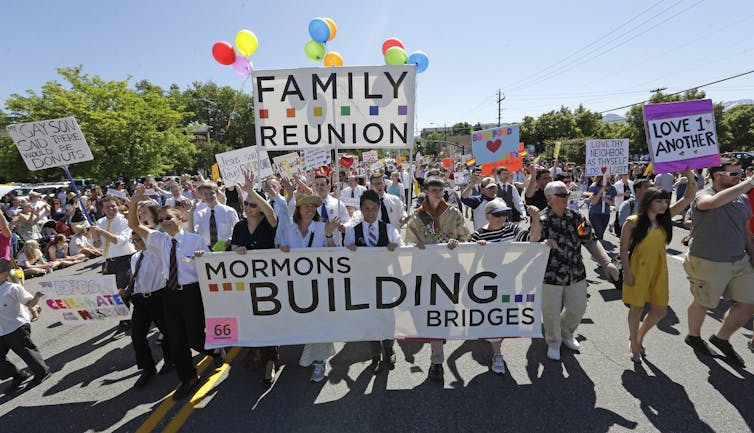
Mormons protest over the 2015 rule change by church officials that bars children of same-sex couple from being baptized. AP Photo/Rick Bowmer, File
When the policy was adopted in 2015, the church deemed same-sex married Latter-day Saints as “apostate” and excommunicated them. This involved removing their names from the records of the church and nullifying any previous rituals.
‘Protecting children’
In order to explain why the children were also deserving of official sanction, the church said it was an effort to “protect” them.
One senior church leader claimed that it was an act of “love” and “kindness” to prevent the children of same-sex families from participating and joining the church. One church leader, Elder D. Todd Christofferson, said, “We don’t want the child to have to deal with issues that might arise where the parents feel one way and the expectations of the Church are very different.”
In the religious practice of Latter-day Saints, a child’s name on church records initiates visits to their home and an expectation of attending church-sponsored activities. Christofferson claimed, that it would not be “an appropriate thing” for a child living with a same-sex couple.
The church even issued an official statement about not wanting to subject children to teachings that their same-sex married parents were “apostates.”
Mormons and politics
What I argue is that the roots of rhetoric of the focus on family goes back to the emergence of the anti-gay politics of religious conservatives starting in the 1970s.
At the time, several preachers and anti-gay activists such as Billy Graham, Jerry Falwell, Tim LaHaye and others increasingly spoke out against the gay rights movement as a threat to “family values” that would undermine society. Latter-day Saints joined this opposition.
These conservatives, advocating for “family values,” opposed same-sex marriage. These efforts often relied on claims that same-sex marriage would harm children belonging to same-sex families as well as those children who interacted with them.
In 1977, evangelical activist Anita Bryant launched a national campaign against the gay rights movement, specifically to keep gays and lesbians out of schools, and successfully rallied conservatives to this cause.
Bryant’s campaign was a simple slogan, “Save Our Children,” which depicted gay men and lesbians as pedophiles recruiting young people into “perversion.” Her campaign also suggested that “our children” belonged only to heterosexual people.
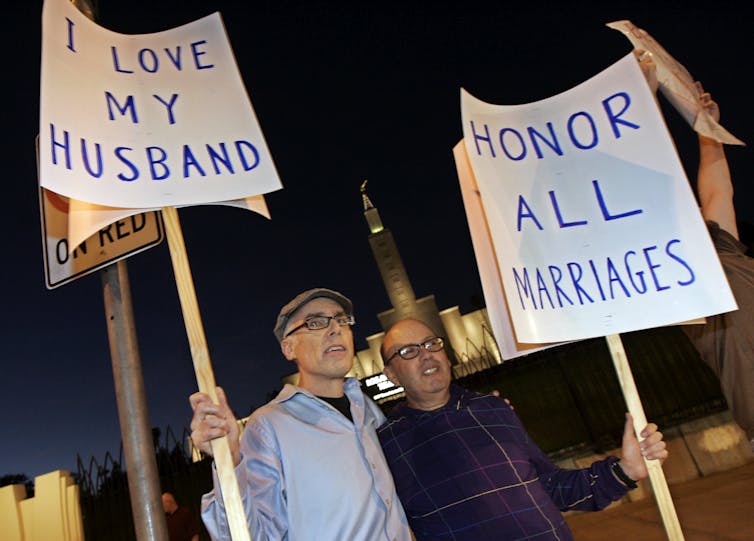
Gay rights activists protest against the Mormon Church’s alleged heavy support of the anti-gay marriage initiative in 2008, AP Photo/Reed Saxon
In the 1990s, the Church of Jesus Christ of Latter-day Saints backed campaigns and mobilized members and money to deny same-sex couples the right to create legally protected families.
The policy on children was a response to a U.S. Supreme Court decision earlier that year that legalized same-sex marriage.
What’s not changed
When it was first announced, the policy was deeply unpopular among the rank and file. The truth is that many members of the church increasingly support same-sex marriage.
A Public Religion Research Institute survey found that 55% of Mormons opposed same-sex marriage in 2016. But this number was rapidly declining. In 2015, the same survey had found 66% of Mormons opposing same sex marriages. In one year, it noted, there was an 11-point drop in opposition, with a corresponding 11-point increase in support.
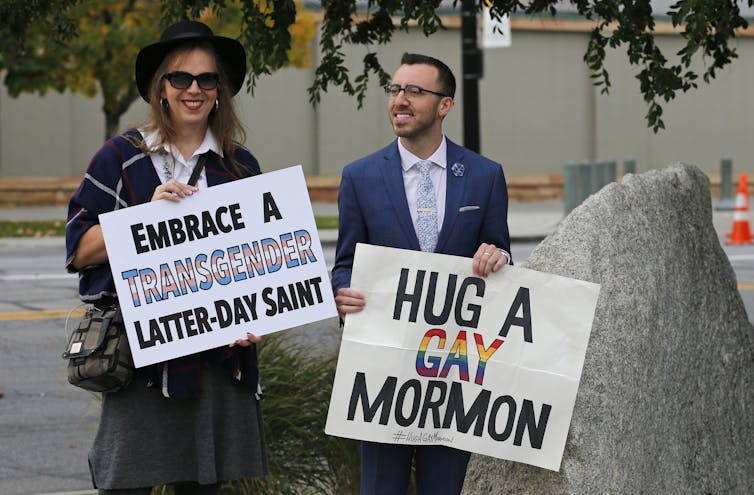
People holding placards at an annual conference of The Church of Jesus Christ of Latter-day Saints in Salt Lake City in 2018. AP Photo/Rick Bowmer
In light of this trend, it was no surprise to see the unpopular policy reversed.
The reversal of the 2015 policy, however, does not change the status of same-sex relationships in the church. These relationships are still forbidden and subject couples to potential excommunication. Only their children can once again participate fully in the church without sanction.
In my view, the church faces a real conceptual problem when it comes to imagining same-sex families as “real families” that may include children. How can it support the children of same-sex families when its teachings claim that they are “counterfeit and alternative lifestyles” and not part of the family organization willed by God?
Some of the world’s biggest banks have stopped their employees from staying at hotels owned by the Sultan of Brunei. This follows his decision to change laws which would stone people to death for having homosexual sex.
The new laws include stoning to death for those convicted of sodomy. Those convicted of abortions, adultery or rape will receive a public flogging and the amputation of hands and feet for convicted thieves.
Since the news broke celebrities and businesses have announced they would boycott Brunei owned businesses such as luxury hotels and the national airline.
Now, leading banks have joined the boycott. Citigroup, Deutsche Bank, Goldman Sachs, Jefferies and Nomura have removed 45 hotels globally owned by Sultan Hassanal Bolkiah from a list of approved places to stay for all its employees.
Rich Handler, chief executive of Jeffries, told Financial News that the bank ‘supports human rights for all people regardless of race, religion, colour or sexual preference’.
Deutsche made the decision earlier in the month in support of LGBTI rights. Chief risk officer, Stuart Lewis said Deutsche had a ‘duty as a firm to take action against them’.
Dorchester hits back
Some of the hotels affected include the Hotel Bel-Air in Los Angeles, Paris’ Le Meurice and Hotel Plaza Athénée and Rome’s Hotel Eden. In the UK, multiple Dorcherster Collection hotels were affected.
‘We understand people’s anger and frustration but this is a political and religious issue that we don’t believe should be played out in our hotels and amongst our 3,630 employees,’ the Collection said in a statement.
‘We’re deeply saddened by what’s happening right now and the impact it is having on our employees, guests, partners and suppliers in particular. Our values are far removed from the politics of ownership.’