Sunday, April 11th @4pm. Occidental Center for the Arts’ Virtual Book Launch Series presents Barbara Gonnella and Gaye le Baron in conversation on newly published Occidental, Images of America. Admission free, all donations gratefully accepted. Visit OCA website (occidentalcenterforthearts.org) for link to this event live-streaming on YouTube. Book sales through author or at the Union Hotel.
Revry celebrates Easter and Oscar season with an entire April calendar highlighting incredible Queer content made by and for the community including multi-award winning festival favorites God’s Own Countryand TransMilitary. Revry kicks off April Fools with it’s hysterically charming, absurdist, original game show, Versus, hosted by RuPaul’s Drag Race icon, Deven Green, where instincts and fun override smarts and knowledge. As Jesus rises on Easter, step into conversations about religion and sexuality with films like Mercy’s Girl, Hell or High Water, Deviant…or the powerful documentary Call Me Troy, about the first gay Reverand who started the queer friendly Metropolitian Community Church, now, with over 200 congregations. Throughout the month, Revry will continue to celebrate special holidays including the World Premiere of the dark comedy series Pet Peeves on National Pet Day (4/11) about pet psychic and ex-con Milton Michaels; the mockumentary comedy series Dope State on 4/20; Denial, a documentary about electricity, identity, family on Earth Day (4/22); for Perfect Date Day the comedy Sweater on 4/25; and on Lesbian Visibility Day 4/26, the appropriate I Lesb You.
Also this month, a week before the Oscars is the annual star-studded Dorians Film Toast, the official GALECA (The Society of LGBTQ Entertainment Critics) awards show highlights the best films and performances of the year. And starting on April 20th, Revry will launch its first weekly news show, Culture Q starting every Thursday. The full calendar of events is below, including hyperlinks on titles available to watch immediately.
APRIL HIGHLIGHTS CALENDAR ON REVRY
Thursday, April 1, 2021 (April Fool’s Day)Boys Town (s1) – BoysTown is a modern day gay episodic drama about friendship, sex and relationships, exploring the everyday lives of seven friends and lovers. In a cross between a gay Desperate Housewives and Sex in the City, the guys are always getting themselves into messes they can’t get out of. Versus (s1) – From Ru Paul’s Drag Race icon Deven Green and musician Ned Douglas, VERSUS pits contestants against each other in six rapid-fire challenges that will test their trivia skills, memory, and even knowledge of their own social media. Each episode features a new set of mini-games that no-one can prepare for! Chica Busca Chica(OML on Revry) – This hot and hilarious lesbian soap opera takes you on a wild ride through the mixed up love lives of a group of sexy Madrid lesbians including the unbelievably gorgeous Spanish TV star Celia Freijeiro. Think: The L Word meets Almodovar. Haunters – Iggy is a jerk who takes pleasure in other people’s pain and embarrassment. But when Iggy suddenly dies and is sent to her version of purgatory – she gets a taste of her own medicine.
Sunday, April 4, 2021 (Easter)Mercy’s Girl – Mercy lives a double life. In one she is dating a sexual and loving college student named Jesse. In the other she is living by her family’s religious standards. As her two world’s begin to collide she must find her identity in both. Chance – Trevor’s life has become a void, following the passing of his wife and long term companion, Doris. Days run into weeks, as Trevor slowly finds himself isolated and alone, and unconcernedly slipping towards death. A chance encounter in the park with a mysterious stranger equally troubled by his own dark past jarringly reawakens him, and forces both men to once again start to live. Call Me Troy – Call Me Troy is a truly inspirational story about a remarkable and dynamic individual whose activism was decades ahead of its time. Rev. Perry is perhaps best known as the founder of the Metropolitan Community Church – the first church to recognize the spiritual needs of the gay community – but his “firsts” don’t stop there. In 1969, Perry performed the first public same-sex wedding in the U.S. setting the stage for a lifetime of activism of behalf of the LGBT+ community. Deviant – In the early sixties, a sexually conflicted teenager finds faith and acceptance after escaping the tortures of electrotherapeutic conversion therapy. Room to Grow – Room to Grow is a Revry Original film which chronicles the lives of LGBTQ+ youth and their families across North America, offering a raw, intimate glimpse into their daily lives as they endeavor to find their identity and a place in their communities. Hell or High Water – Hell or High Water is a short film that tells the story of a young pastor loved and adored by the people around him. Things change for him when he must confront a hidden truth about himself, a truth that could make or break him psychologically. But, whatever decision he makes, he is still going to crash and burn, for life as he once knew it would never be the same again. The story explores the reality of sexuality amidst spirituality, exorcism, blackmail, and family life. ”Hell or High Water” challenges stereotypical narratives about sexuality.
Monday, April 5, 2021 (American Music Awards)Indiana Queen (Music Videos for “Walk with Strength”, “I Don’t Know What To Do”) – Fronted by Kevin James Thornton, Indiana Queen is a queer-folk band blazing a new path in a traditionally conservative genre. Faultlines – (Music Videos for Rain, Wooden Bridges, If You Only Knew, Starting at the Finish Line) – Faultlines, an acoustic folk-pop group known for their three-part harmonies that warm like the California sun and lyrics that speak to the gritty, universal interhuman experience. Seeking Dolly Parton – When Charlie (Kacey Barnfield) and her partner Cerina (Anya Monzikova) decide to have a baby, they go to Cerina’s estranged ex-boyfriend Josh (Michael Worth) to help fill in the “blanks”. But when old feelings return to the surface, the new feelings are not coming in without a fight. This unique threesome must each confront their own “closeted” emotions before allowing a new light to shine into all their lives. Queens & Cowboys – Roping and riding across North America, the International Gay Rodeo Association’s courageous cowboys and cowgirls brave challenges both in and out of the arena on their quest to qualify for the World Finals. Along the way, they’ll bust every stereotype in the book. Paisley Fields (Music Videos for “How Low”, “She’s No Angel”, “Not Gonna Be Friends”, “Windows Fogged Up In Your Pickup Truck”)
Tuesday, April 6, 2021Twenty (OML on Revry)– Twenty follows the story of Maya, her girlfriend Catalina, and her group of eclectic friends as they navigate careers, love, and life in their early twenties.
Wednesday, April 7, 2021 (National Beer Day)Beer, Beer – “Beer! Beer!” is an “anti-romantic comedy” set in the early morning following a wild party in Berlin. When Tao, a Chinese guy, meets Sebastian, a local German. As they seem to get more and more intimate with each other, suddenly a mattress changes everything…
Sunday, April 11, 2021 (National Pet Day)Pet Peeves – After spending 15-years behind bars in a Florida prison, Milton Michaels (Jonah Blechman from “Another Gay Movie”) moves in with his sister in California to restart his pet psychic career. While there Milton reconnects with his childhood dog, as he discovers the urn containing his ashes. But Milton is torn from the beloved ashes when his childhood tormentor, Candice, comes to visit. Candice tricks Milton into a dog-napping scheme that could jeopardize his freedom, just as he starts to connect the dots in his love life. Watch the trailer.
Sunday, April 18, 2021Dorian Film Awards – The Dorian Awards are film and television accolades given by GALECA: The Society of LGBTQ Entertainment Critics, founded in 2009 as the Gay and Lesbian Entertainment Critics Association.
Tuesday, April 20, 2021 (4/20)Dope State – Dope State is a mocku-comedy that chronicles a modern day gold rush, a civil rights movement and, potentially, the end of a prohibition. From stoner celebrities to politicians and corrupt cops, a marijuana journalist documents the daily life of producers, distributors, and consumers in the California weed industry.. From the mind of comedic tour-de-force Gabriel Sunday (who stars as all of the lead characters), Dope State is a dreamy, absurd love letter to pot culture. Twenty (OML on Revry) Culture Q – Culture Q is the world’s first weekly queer-centric news series brought to you by the leading global queer streaming network, Revry. This innovative, weekly news series creatively features entertainment, pop culture, lifestyle and political news with wit and insightfully nuanced perspectives. Emphasizing the queer millieu, Culture Q stands to be the penultimate, weekly forum for boundary-pushing discussions and commentary.
Thursday, April 22, 2021 (Earth Day)Denial– DENIAL is a documentary about electricity, identity, family, and the many ways we lie to ourselves when faced with overwhelming facts. It is the story of a family coming to terms with complex personal truths against the backdrop of a global crisis.
Friday, April 23, 2021TransMilitary – TransMilitary chronicles the lives of four individuals (Senior Airman Logan Ireland, Corporal Laila Villanueva, Captain Jennifer Peace and First Lieutenant El Cook) defending their country’s freedom while fighting for their own. They put their careers and their families’ livelihoods on the line by coming out as transgender to top brass officials in the Pentagon in hopes of attaining the equal right to serve. The ban was lifted in 2016, but with President Trump trying to reinstate it, their futures hang in the balance again.
Sunday, April 25, 2021 (Perfect Date Day)Sweater – Corey’s day couldn’t be worse. Then he gets a free coffee. God’s Own Country – In Yorkshire a young unhappy farmer is living with his grandmother and sickly father. He numbs his frustrations with drinking and casual sex until a Romanian migrant worker sets him on a new path.
Monday April 26, 2021 (Lesbian Visibility Day)I Lesb You – Alcohol, music, and one wild night take control of 4 parallel stories in a lesbian bar in Santiago de Chile. The Night Is Ours – Tomboy Morgan is shattered by the sudden death of her best friend Olivia. But when Olivia mysteriously comes back to life, the two go on a final road trip that takes them beyond friendship into a special place that Morgan learns can’t go on forever. Suicide Kale – While having lunch with another couple, new couple Jasmine and Penny stumble upon an anonymous suicide note and proceed to work to uncover the identity of the author.
Thursday, April 29, 2021 (Billboard Music Awards)Boy Untitled(Music Videos for “Skin”, “Spark”, “Sacrifice”) – Boy Untitled is a L.A-based queer artist exploring the boundaries of music, mixing vulnerability with world pop-inspired tracks that jump from ethereal to vibrant, dancey electronica. Music Artists: John Chandler, Keekai, Gabby B., Jack Rayner, Malou Beauvoir, Chelzzz and Yaeji
Friday, April 30, 2021 (Arbor Day)The Millennial Experience – The Millennial Experience is one part dance-for-film and one part documentary. The film explores cultural appropriation vs appreciation, LGBTQIA+ culture, feminism and how these topics impact the Millennial generation.
ABOUT REVRYWatch Queer TV 24/7 with the first LGBTQ+ digital cable TV network. Revry offers free live TV channels and on-demand viewing of its global library featuring LGBTQ+ movies, shows, music, podcasts, news, and exclusive originals all in one place! Revry is currently available globally in over 280+ million households and devices and on seven OTT, mobile, and Desktop platforms. Revry can also be viewed on nine live and on-demand channels and Connected TVs including: The Roku Channel, Samsung TV Plus, Comcast Xfinity X1, Cox, Distro TV, Plex, Galaxy TV, Local Now, VIZIO, Zapping TV, STIRR, TiVo, and as the first LGBTQ+ virtual reality channel on RAD (available on PlayStation devices). The company–an inaugural member of the Goldman Sachs Black and LatinX Cohort–is headquartered in Los Angeles and led by a diverse founding team who bring decades of experience in the fields of tech, digital media, and LGBTQ+ advocacy. Follow on Facebook, Twitter, and Instagram @revrytv, Revry.tv
Sonoma Film Institute Virtual Screenings Continue for Spring 2021
Sonoma Film Institute Virtual Screenings Continue for Spring 2021The link for watching the films will be posted on the SFI website by Friday at noon and will be good for 72 hours https://sfi.sonoma.edu
Acasa, My HomeFriday, April 02, 2021 – Sunday, April 04, 2021
IIn the wilderness of the Bucharest Delta, an abandoned water reservoir just outside the bustling metropolis, the Enache family lived in perfect harmony with nature for two decades, sleeping in a hut on the lakeshore, catching fish barehanded, and following the rhythm of the seasons. When this area is transformed into a public national park, they are forced to leave behind their unconventional life and move to the city, where fishing rods are replaced by smartphones and idle afternoons are now spent in classrooms. As the family struggles to conform to modern civilization and maintain their connection to each other and themselves, they each begin to question their place in the world and what their future might be. With their roots in the wilderness, the nine children and their parents struggle to find a way to keep their family united in the concrete jungle. With an empathetic and cinematic eye, filmmaker Radu Ciorniciuc offers viewers, in his feature debut, a compelling tale of an impoverished family living on the fringes of society in Romania, fighting for acceptance and their own version of freedom. (in Romanian w/English subtitles) FREE for SSU Students (get code from your professor)$12 for 72-hour rental to the General Public (Correction from 03/17/21 email) Released: 2020Run time: 86 min.
Martin EdenFriday, March 16, 2021 – Sunday, March 18, 2021
Adapted from a 1909 novel by Jack London yet set in a provocatively unspecified moment in Italy’s history, MARTIN EDEN is a passionate and enthralling narrative fresco in the tradition of the great Italian classics. Martin (played by the marvelously committed Luca Marinelli) is a self-taught proletarian with artistic aspirations who hopes that his dreams of becoming a writer will help him rise above his station and marry a wealthy young university student (Jessica Cressy). The dissatisfactions of working-class toil and bourgeois success lead to political awakening and destructive anxiety in this enveloping, superbly mounted bildungsroman. Winner of the Best Actor prize at the Venice Film Festival and the Platform Prize at the Toronto International Film Festival. Directed by Pietro Marcello. (in Italian w/English subtitles) FREE for SSU Students (get code from your professor)$12 for 72-hour rental to the General PublicReleased: 2019Run time: 129 min.
Reading International, Inc. announced its Reading Cinemas with TITAN XC in Rohnert Park, California location will be welcoming back movie lovers on Friday, March 19 with extensive sanitization and safety measures in place. In an environment carefully designed to address COVID-19 concerns, and to comply with the various governmental guidelines, guests can return to share the magic of movies again on the big screen.
Taylor Green, the theater’s general manager, said “Our audience has always enjoyed watching a wide variety of films on the big screen at Reading Cinemas, and we so look forward to seeing everyone again. For our reopening weekend, we are excited to continue to offer moviegoers with Sonoma County’s Best Movie Value – $8.50 tickets for all movies, all ages – to enjoy family-friendly films such as Raya and the Last Dragon, The Croods: A New Age and Tom & Jerry – alongside action-packed blockbusters and Oscar nominated hits.”
“Reading Cinemas has been working hard to enrich safety protocols and to train our team to abide by federal, state, local and industry guidelines,” said Division Manager Jennifer Deering.
“We are delighted to welcome back our guests and the community to enjoy movies in a safe and responsible way.” Reading Cinemas has implemented the following policies and procedures to help keep the community safe: • Masks are required to be worn by all guests and staff. Guest are permitted to remove masks when seated in their auditorium enjoying fresh popcorn and other refreshments.
• Guests will be encouraged to skip the box office and buy tickets in advance, either online or through the Reading Cinemas mobile app in order to decrease physical contact. • Only credit, debit, or gift cards will be accepted to limit monetary exchanges. A designated transactional space will be available on site at each location where cash amounts can be transferred onto a gift card. • Guests should arrive no earlier than 30 minutes before their showtimes in order to decrease building traffic and allow for increased sanitization. • To keep a safe distance from others, guests will be required to sit in their assigned seats, and ticket purchases for each party will automatically account for six feet of social distancing between parties, by blocking off the seats surrounding each group. Reading Cinemas further encourages parties to be made up of immediate household members where possible. • Increased cleaning and sanitation will take place regularly, with extra sanitation at high-touch point areas. Auditorium seating and armrests will be disinfected after each use. • To improve air quality, each cinema has upgraded all HVAC filters and increased maintenance frequency. • Floor decals and signage have been placed throughout the theaters to help guests maintain a safe distance from others. • Hand sanitizer stations will be placed throughout the theaters. Guests will be encouraged to wash their hands before and after consuming food and drinks. Reading Cinemas Rohnert Park’s opening weekend lineup features something for everyone: for families, The Croods: A New Age, The War with Grandpa, Tom & Jerry and Raya and The Last Dragon; for action fans, Monster Hunter, Chaos Walking and Wonder Woman 1984; and for those looking to see the Oscar nominees on the big screen, Minari, Nomadland, and Promising Young Woman. Advance tickets are on sale now for Warner Bros. Godzilla vs. Kong, scheduled to open March 31. A complete list of all films and showtimes are available at readingcinemasus.com/rohnertpark. In addition to new releases, beginning in April, Reading Cinemas will offer a variety of private screening options for guests: • VIP screenings, allowing groups to enjoy a private screening, and select their movie from the list of over 60 options! Film categories include Family, Date Night, Action/Adventure, Sci-Fi Hits and 80s Favorites. • Private Rental Events, in which groups can provide their own content via Blu-Ray, streaming device, or even gaming console, and make their own VIP Event. • Buyouts, in which guests can reserve all the seats in an auditorium to view any of the theater’s current releases to enjoy a private screening.
Reading Cinemas Rohnert Park with TITAN XC is located at 555 Rohnert Park Expressway West. For more information, please visit readingcinemasus.com/rohnertpark or follow us on Facebook, Twitter and Instagram.
About Reading International, Inc.Reading International Inc. (NASDAQ: RDI), an internationally diversified cinema and real estate company, is a leading entertainment and real estate company, engaged in the development, ownership and operation of cinemas and retail and commercial real estate in the United States, Australia, and New Zealand. The family of Reading brands includes cinema brands: Reading Cinemas, Angelika Film Centers, Consolidated Theatres, and the State Cinema in Tasmania; live theatres operated by Liberty Theatres in the United States; and signature property developments, including Newmarket Village, Auburn Redyard, Cannon Park, and The Belmont Common in Australia, Courtenay Central in New Zealand, and 44 Union Square in New York City. Additional information about Reading can be obtained from the Company’s website: http://www.readingrdi.com.
Nearly all of us in the LGBTQ community were raised in a very heteronormative family lacking in role models that as gay men and women we could actually relate too. That is rapidly changing and hopefully future generations of queers will benefit from those who a whole slew of LGBTQ ‘pioneers’ we can now take our leads from.
Queerguru would like to suggest an addition to the ranks. RYAN J HADDAD may be still in his late 20’s but after seeing him perform his autobiographical play about being gay and having cerebral palsy , he is definitely a very impressive role model.
Actually the play “HI ARE YOU SINGLE” is not just about Haddad being queer, it is about his lifetime search for a boyfriend. In the space of an hour he takes you from having phone sex literally on stage, through his exploratory years through College, to all the pitfalls and joys of gay bars and dating.
He has a very infectious sense of humor but it is his sheer honesty that warms you most to him. There is a point where he is zealously staking his claim for attention and tolerance, when he inadvertently fails to offer the same to a bald black man in a bar. It is totally understandable however. as Haddad has spent his entire adult life making his disability seemingly acceptable to the men he wants to bed.
Haddad milks the details of some awkward sexual encounters that most of us would have never revealed. But he does it with such joie de vivre that makes each story a sheer joy to share with him.
It’s through his sheer energy and wit that we start to question ourselves ….. possibly for the first time ….. about the reality of gay men and women with any disabilities and how we interact with them . Or not. Like Haddad we also admire RYAN O’CONNELL for his award winning TV series SPECIAL which showed gay man with cerebral palsy actually naked and going at it with another man.
It is way past time that we consider them not as disabled, but sexual beings, something that both Ryans are determined to drum into us.
Haddad’s ability to also intimately share the non-sexual intimate parts of his piece is very impactful. He fearless bares his soul that we cannot but fail to fall in love with just a little bit. And it’s not just because of those lips of his.
It leaves us wanting more, and also wanting to know what happens next. I’m sure he has a lot more to share with us.
Jen Silverman’s debut novel, We Play Ourselves, reads like the work of a more established novelist. Silverman is no novice though. She has a body of work as a playwright and staff writer for TV shows and her sense of pacing shows clearly in the book’s plot. The reader learns from the first two pages they’re in the assured hands of a writer who knows how to immediately captivate. The protagonist, a playwright named Cass, has fled the theatre world in New York, where she has become infamous, to hide out in relative anonymity in LA. She did something horrible in New York, this act is not initially disclosed, but it’s bad enough to destroy her professional life. And that’s just the first few pages. The richness doesn’t stop there.
Part of the engrossing tension of the book is waiting to find out what it is Cass did, but plenty happens before that startling reveal. The plot weaves between two time periods, one delves into Cass’s life as an up-and-coming playwright in New York City, and the other focuses on her post-NYC life in LA, where she seeks to escape from her past foibles. But of course, as the cliché goes, everywhere you go there you are.… Cass is forced to confront her demons in LA despite her desire to escape them. Silverman does a masterful job of creating a protagonist who does unlikeable things and has unlikeable thoughts but whom the reader still roots for her. Silverman imbues Cass with a fully-realized personality; she is funny, vulnerable, sardonic, and soft-hearted beneath the carapace she hides behind. To Cass, success equals happiness. She desperately wants to be famous, the star playwright, the woman of the moment. Despite her flaws, or maybe because of them, we want her to do well.
When we see her in NYC, Cass, the winner of a prestigious playwriting award, is having her first major play produced. It’s a high-profile production with a big-name director and a TV star in the lead. Cass falls in love with the director, Helene, and starts an affair with the TV star. Helene rejects Cass’s advances and offers sage advice about her career and putting her art first. The director tells Cass to never sabotage herself in order to punish someone else. The idea that Cass may wish others ill is central to this character exploration. When her play receives a spectacularly bad review, her worst fears are realized; her actions following this fallout force her to flee New York.
When she lands in LA, Cass is at an emotional low point. While seeking anonymity, Cass meets Caroline, her charismatic next-door neighbor who is directing a film about a group of teenage girls in a fight club. She becomes the director’s number two and grows increasingly appalled at the uber-manipulative way the girls in the film are treated. Cass grows to care for one of the girls, BB, and wants the best for her. Her compassion toward BB is in stark contrast to the wholly self-centered existence she’s been living. As Cass slowly realizes the extent of the artifice of the film and the exploitation of the girls, she becomes engaged in a furious campaign to free the young women from mistreatment.
Through these various plotlines, philosophical questions arise. Where does happiness come from? Is it the heady feeling that comes with great success or the peace of mind that comes with some humility? Cass’s story is about how our worst thoughts and impulses can diminish our world. How do we work our way back? Is success the only route to happiness?
Along with Cass’s personal journey to redeem herself is a narrative rich with details on both the Hollywood system and the New York theatre scene, details that don’t put either in a particularly good light. Silverman has inside knowledge of both, and she seamlessly guides the reader through these well-drawn worlds.
We Play Ourselves contains a page-turning plot, with a truly complex character at its core. Silverman is a talented writer and knows exactly how to pace the story so the reader remains suspended in the intense world of the novel. I had a hard time putting the book down, which is always one of the best compliments a writer can receive. Silverman deserves it.
We Play Ourselves
by Jen Silverman
Penguin Random House
Hardcover, 9780399591525, February 2021
Saturday, March 27 @ 8 pm.’Celebrating Women in Music’ . Occidental Center for the Arts proudly carries on it’s longstanding Women’s History Month tradition with a blockbuster lineup performing songs written by women .This virtual event showcases a rich variety of exceptionally talented musicians across multiple genres, including Elliott Peck • Jenny Kerr & Philbilly Milner • Essence • Lara Louise • Emily Lois & Dave Monterey • Ariel Marin • Mariah Parker • Kate Vargas • Rainbow Girls • Solid Air • Nina Gerber & Chris Webster • Tumbleweed Soul • Nagavalli • Lucy Kaplansky • The Musers. This most excellent program will premier at 8 pm March 27th on YouTube and Facebook; available thereafter to replay from the comfort of your home. Free; Donations appreciated. OCA looks forward to when we can all gather safely again for live music! Keeping the Arts in Our Hearts atwww.occidentalcenterforthearts.org.
One of three World Premieres at this year’s QUEER SCREEN’S MARDI GRAS FILM FESTIVAL in Sydney Australia is a truly delightful feel-good road movie, The debut feature from queer Greek filmmaker STELIOS KAMMITSIS is one of those romances you are never sure will work, but the journey is so worth it anyway.
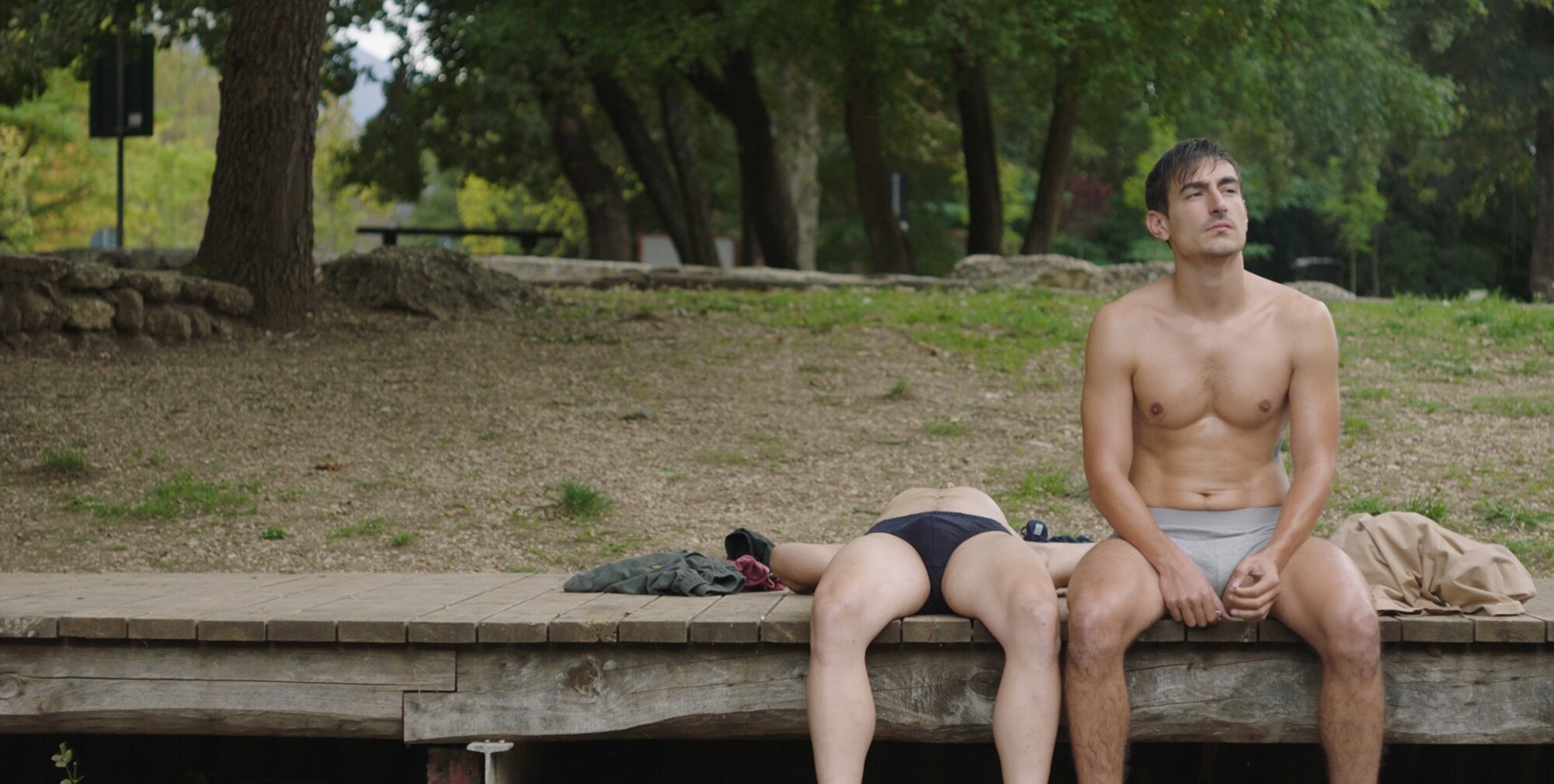
It all starts in a seaside town in Greece where Victor VASILIS MAGOULIOTIS an ex-Olympic diving champion is now looking after his very sick grandmother. He’s quite a loner content to get part time work in a local upholstery factory, but when his granny dies, he decides its time to leave town.
Many years ago his mother had done just exactly that taking of with a hot German who became her husband and together they started their own family in Bavaria. We gather from odd phone calls that this is still a sore point for Victor who has unresolved issues.
She just didn’t leave Victor at the time, but she also left her old Audi which up to now had been collecting moths in the garage. It does at least still work so Victor sets forth to drive on to the Ferry that will take him to Italy.
Whilst onboard he attracts the attention Matthias ANTON WEIL of an overly confident German ‘student’ who is returning home after another summer running wild on Greek island beaches. Victor may be totally unaware, but we can see Matthias is flirting with him but we are not sure if it is to get a lift in the car, or if he has an alternative motive.
They make strange traveling companions . The uptight Victor doesn’t want to talk about why he is making the journey, and insists that they take the fastest route using the big motorways. Chatty Matthias on other hand, outs his foot down and makes Victor drive on secondary roads that take them through some stunning Italian scenery.
At one point Matthias makes him pull over on the pretext he wants to go toilet at the roadside whereas in fact he wants to swim in the lake. It takes so persuading to get Victor to join him, and when he does we can finally see him starting to relax.
The trip is not without incident as they get pulled over for speeding and Victor is also ticketed for not having a driving license. We have no real idea of Victor’s sexuality at this point as it is quite irrelevant, yet what we see is the two of them bickering at times like an old married couple.
At a side stop to attend a wedding of friends of Matthias, a very relaxed and drunk Victor is starting to realise that his feelings for his new friend is something that he wasn’t prepared for.
When they finally reach Victor’s mother home there is a birthday party in full swing for his very young step -brother, and we know that this reunion is not going to turn out like anything he had planned in his mind. But then again, neither will this road trip.
Beautifully written, and kudos to Kammitsis for making two extremely authentic and well-rounded characters so well played by his two talented leads. Its a refreshing wee tale that is totally unpredictable https://www.youtube.com/embed/rSQAqHwgsVs
Since the events of January 6th, I have been struggling with how to respond. What should engaged citizens and residents do when democracy is under attack, particularly amid a global pandemic? Perhaps I have been struggling since quarantine began in March and April of 2020. Maybe I have been struggling since the election in November of 2016. Perhaps even longer. It is hard to pinpoint when the struggle began. Maybe you, too, have been feeling similarly? Through these struggles, I have been reading, particularly poetry. Recent books remind of one powerful aspect of poetry by queer and lesbian women: the call to community. These are some reflections.
I.
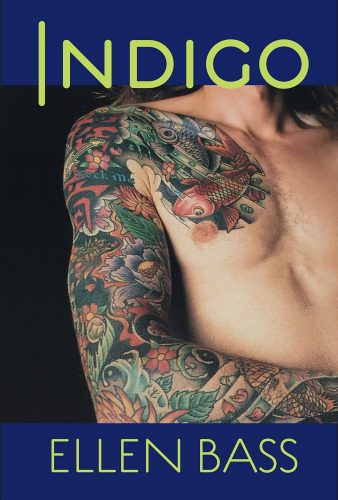
Ellen Bass’s newest poetry collection, Indigo, arrived nearly a year ago. I have been savoring it. Bass’s work continues to deepen in its power. She expresses complex experiences in the world with beauty and joy. In Indigo, ample poems are quintessentially Bass; her poems demonstrate the power of lesbian sexuality and exuberantly celebrate life in the body, richly observed, deeply felt, joyful even—or especially—as the body ages.
Bass’s poems accumulate power because she is as willing to explore emotions with more negative valences with the same wonder and appreciation as positive. Poems in Indigo explore failure, loss, and despair with vivid clarity. For example, Bass describes her “first / entrance into the land of failure” as a “country / I would visit so often / it would begin to feel like home.” In a litany of regrets in the poem, “Pearls,” Bass beings “I’m sorry I didn’t buy my father the cashmere sweater with suede trim the summer / I went to Europe. And I’m sorry I didn’t stay longer with my mother when he died.” Each regret invites readers to understand how the speaker has disappointed people, causes, the beloved one; each regret a reminder of the vital web of shared life, finally concluding, “Forgive me, the sun will burn out. / I can’t hear your heart beating in the silence between us.” One remedy: listen more closely, more intensely, to the sound of a beating heart. Bass calls readers to the intimate and vital pulse of life. I understand it as a call to community.
The gesture is not only in Indigo; it marks Bass’s entire career. It can be easy to forget the scope of Ellen Bass’s work and linger only on the four collections of published poetry: Mules of Love, The Human Line, Like a Beggar, and now Indigo. There is so much pleasure to experience in these books, but they are only a part of her public poetic work. In 1973, with Florence Howe, the founder and publisher of The Feminist Press, Bass edited No More Masks an anthology of poetry by women; it galvanized poetry as an art form of the women’s liberation movement. In the 1980s, with Laura Davis, Bass published The Courage to Heal, another transformative book about recovery from sexual abuse. It is not too bold to assert that the #MeToo movement could not exist without Ellen Bass and Laura Davis’s work—along with the work of many thousands of feminists naming sexual violence. In The Courage to Heal, Bass and Davis named the problem and, just as importantly, provided a path for recovery. I posit that The Courage to Heal—the book itself and public engagements with it—is a poem. It is a language that transforms readers’ understanding and lives in the world. Considering these two books, The Courage to Heal and No More Masks, in combination with her own poems, Bass is one of the most influential public poets today. The break-through of inaugural poet Amanda Gorman reminds us of the power of poetry in public life. Public poets occupy spaces such as inaugural poets or city and state poet laureateships; some public poets like Mary Oliver and Rupi Kaur are best-seller authors. All of these public roles are vital. Ellen Bass is another type of public poet: a poet who is a transformative thinker and writer in the world, a poet who brings new formations into being, a poet who convenes and conjures vibrant communities.
II.
Bass’s work extends five decades, fifty years of community-making. Kelly Rose Pflug-Back’s work is just beginning. Her impressive debut collection, The Hammer of Witches, uses magic and mythology as central metaphors to conjure the communal. Pflug-Back draws on an eclectic array of mythology—in one poem alone alluding to the Vedas and the Edda—as well as the practice of witchcraft to highlight the magical and mysterious of contemporary life.
“We were witches once, you and I,” Pflug-Back asserts in the opening poem, “Malleus Maleficarum.” This artful poem blends the history of woman/witch hating with contemporary lesbian life, confiding “your love is a heathen ritual” then concluding, “the two of us lost together / still / / in this forest / of tall buildings.” Rich history combined with current imaginative practices is a defining characteristic of this collection.
In “After the Fall,” Pflug-Back writes,
every vast and ancient magic that this world of men has killed and pined for
alive somewhere just out of site
The conclusion is an ars poetica:
Outside the realm of clumsy words there are no such things as endings only new things made from the old.
Like many religions, witchcraft is communal, practiced in covens. Part of its spiritual and material work is providing human explanations for the inexplicable, magical as well as painful. Pflug-Back’s poems evoke magic as in “Grimoire” or the delightful “Hepatomancy,” a practice of divination from entrails. They also recognize communal gatherings as a vital part of magic. In “Hepatomancy,” Pflug-Back writes,
I am sewn together from the flesh of many and we ache.
Human life is both constituted by others and sharing in the pain of others. Elsewhere, Pflug-Back mines magic in human relationships. “For Dave” begins:
The day after you died my son asked me to draw a picture of you holding a blue balloon.
This lamentation concludes,
And now here I am wishing I could have found and afternoon somehow
to take that trip across town
and show up at your door
with a big blue balloon while you were still alive.
Perhaps unknown to the Pflug-Back, “For Dave” echoes Maureen Seaton’s stunning poem “White Balloon” demonstrating a generational shift but the endurance of lesbian lyrical poetry. United by the image of a balloon, white for Seaton, blue for Pflug-Back, these poems also document the material changes of queer lives. Seaton’s poem emerges from a communal memorial for people who died from AIDS; Pflug-Back’s is a domestic scene with a child. Both poems call readers into a community for mourning. Seaton laments “the ease with which we love”; Pflug-Back wishes for more time with beloved friends. Both poems call us to community.
III.
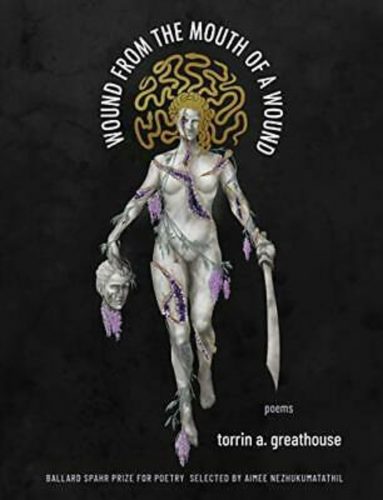
torrin a. greathouse’s new collection Wound from the Mouth of a Wound, selected by Aimee Nezhukumatathil for the Ballard Spahr Prize for Poetry, is in a dynamic conversation with Pflug-Back’s collection. greathouse’s opening poem, “Medusa with the Head of Perseus” introduces many of the themes of this collection: disability, body dysmorphia, rape. It also artfully demonstrates greathouse’s proficiency with language and her energetic ability to transform images in service to her story.
Many will read Wound from the Mouth of a Wound with admiration for the way that it brings language and visibility to trans experiences and the realities of living with disabilities. greathouse and this collection join vibrant conversations in contemporary poetry communities on trans identities and living with disabilities. I appreciate both of these elements and particularly the way greathouse calls readers into a community that values trans people and people with disabilities.
“Weeds” demonstrates greathouse’s extraordinary poetic power. With short lines and stanzas between four and six lines, greathouse establishes the “shower stall” as the “body’s confessional” where she admits, “I love / most what can be / removed from me.” She builds an extended metaphor between unwanted parts of the body and weeds with a moving meditation on weed removal as “women’s work.” She writes, “Nothing’s more / femme than empty / / field, a place to bury / seed.” The poem concludes with the voice of the weeds:
We were your first teachers. Even in the harshest season, we survive. We bloom forever where we are told we don’t belong.
This poem reworks communal formations in meaningful ways, echoing feminist insights from the 1970s with contemporary trans sensibilities, making vibrant connections between human bodies and nature, and calling readers into the collective first-person plural with weeds. We were your first teachers. We survive. We bloom. This vision of community is one that leaves me awed.
IV.
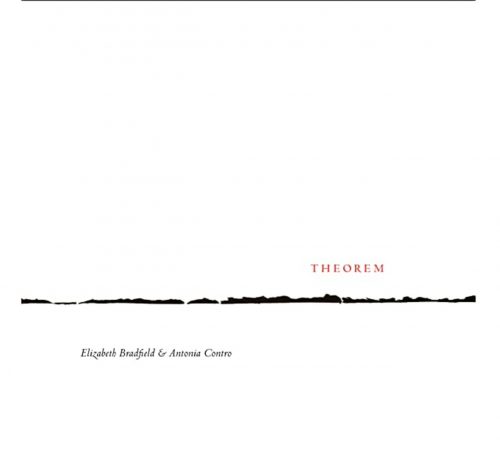
Theorem, Elizabeth Bradfield’s newest collaboration, is a departure from her earlier work. Created with artist Antonia Contro, Theoremcounterpoints the words of Bradfield with the art of Contro. While Bradfield’s previous books establish her as a naturalist concerned with human-created conditions on the natural world, Theorem looks to mathematics, particularly geometry, as a tool to refract her childhood experiences. Bradfield writes:
There were five of us. And a dog. Only one dog at a time.
No one else.
The results are fractal The trajectories radiate.
The combination of Bradfield’s words with Contro’s art demonstrates the energy of collaborative enterprises; each element opens meanings for the other. In the afterword, they describe their collaboration as “words and image influencing, pushing, urging, questioning each other. Artist and writer finding new ways to articulate what is embedded in what they create.” In addition to inspiring more collaborations between artists, Theorem is a physical manifestation of community, a community of a singular poet and artist, but, by extension, in an invitation into communities of poets and artists.
V.
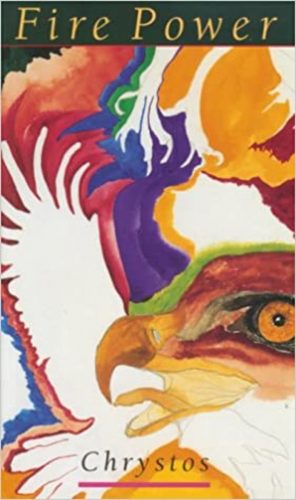
Amid this reading of new work by lesbian and queer women poets, I returned to the work of Chrystos and spent weeks marveling at the corpus of her work. If I had more time and could really stretch out to tell you everything, I would write a detailed, sustained meditation on the poetry of Chrystos. Maybe it will come. Right now, I want to note that echoes of Chrystos’s work are in all of these collections. Chrystos’s work is filled with gorgeous, vexing, challenging, inspiring images of bodies and nature. She breaks conventions of contemporary poetry just because she can, because she has so much control over language, images, and the line, that she wants to flaunt her power. It is heady. It is exciting. It is worth your consideration as a reader, as a human, longing, hungering for some meaning, for connections in our troubled world. Chrystos knows about community and connection, and she wants them. She wants us to have them.
VI.
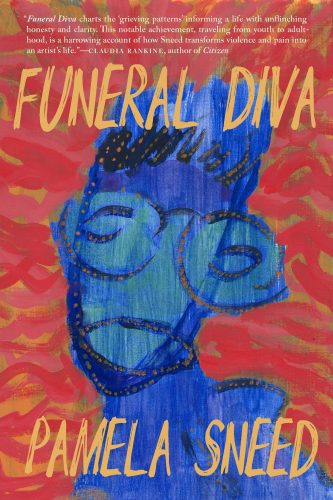
Funeral Diva, the new collection by Pamela Sneed, joins this gathering of new poetry that powerfully calls readers into community. While Sneed fashions herself as a diva in the title, in fact, these poems demonstrate rich community engagements that belie the temperament diva implies. The work in this collection—a hybrid of poetry and prose—calls a range of people, living and dead, into a community invoking a history of queer Black writers and insisting on a powerful present and future for Black queer writing.
Like the hybrid work that characterized lesbian-feminist writing in the 1980s and 1990s, Funeral Diva is a mix of poetry and essay braided together to illuminate how the two genres intersect, co-exist, merge, hybridize. Reading Funeral Diva amid COVID-19 as it harkens back to another, different epidemic, AIDS, is a powerful reminder of the responses of queer communities during the 1980s and 1990s. Sneed writes,
when I saw the poster silence equals death in the windows of the Leslie Lohman Museum That pink triangle on black paper from blocks away It called to me like a beacon Amidst societal madness/personal struggles and the Trump presidency to never give up It reminded me too of a generation of gay and lesbian warriors who are no longer here with us felled to AIDS and cancer But on their deathbeds used the mantra to inspire Silence=Death I think about when Black gay and Latinx poets Essex Hemphill Donald Woods Don Reid Roy Gonsalves Rory Buchanan David Frechette Craig Harris Alan Williams and Assotto Saint and so many more were still here How their black hair began to sprout twists and knots go wild and kinky to signify early Black gay consciousness I think about when I first met Donald Woods outside of a bookstore in the West Village called A Different Light and we fell in love We were all so young Black awkward and gangly but fierce and determined.
Funeral Diva fueled my desire to return not only to the poems of Chrystos, but also the poems of Dorothy Allison, Minnie Bruce Pratt, and many other writers that I read thirty, thirty-five years ago when I was coming out. Sneed is an inheritor to the vibrant poetic traditions of lesbian-feminism and the Black gay and lesbian renaissance of the 1980s. Funeral Diva is her love letter to the people and work who created her. Sneed, like the other poets here, calls us into community with all of its challenges, its foibles its uncertainties. As she tells us in her conclusion to Funeral Diva,
And then I understand what it all means If we can survive have equipment means money support conditions There are also other possibilities We can heal.
Indigo
by Ellen Bass
Copper Canyon Press
Paperback, 9781556595752, 64 pp.
April 2020

The Hammer of Witches
by Kelly Rose Pflug-Back
Caitlin Press
Paperback, 9781773860299, 72 pp.
March 2021

Wound From the Mouth of a Wound
by torrin a. greathouse
Milkweed Editions
Paperback, 9781571315274, 88 pp.
December 2020

Theorem
by Elizabeth Bradfield
Potry Northwest Editions
Paperback, 9781949166026, 96 pp.
November 2020

Fire Power
by Chrystos
Press Gang Publishers
Paperback, 9780889740471, 131 pp.
October 1995

Funeral Diva
by Pamela Sneed
City Lights Books
Paperback, 9780872868113, 160 pp.
October 2020
With The Sense of Brown, José Esteban Muñoz left a love-letter to brownness that acts as a dream for its desire. Extending to the minerals of the soil, to the animals, and to the people who bare its shade, it is an ode to a brown of rapturous multiplicity. A testament to those things that thrive under duress and thirst for excessive contact, the book fosters a Marxist militancy that he translates into Latina/o radical study. It acknowledges the incommensurability of brown itself, as a plural, dynamic site, wielding many names, and provokes a range of feelings. The text tells the story of an “identity-in-difference”, a phrase borrowed from Norma Alarcón, that sketches the details of an iridescent brown and cracks open standard definitions of brownness to include a myriad of “ethnic” backdrops.
The book begins with the notion of the brown commons, which is wild insofar as it describes a boundlessness that is not situated in individual identity, but something more expansive. Illustrative of an interconnectedness with all beings who suffer the strange fate of coming into the world as “brown”, it tells the story of a sacred solidarity between them. The theory practices a politics that is rooted in a Platonic proto-communism that tends towards alternative notions of kinship, imagined through a thriving undercommons. The work engages in a materialism that is influenced by the politics of race, resources, and the commonalities between them. The dominance of the template of the normative Human fades away, and the brown thing comes forth out of the shadows as something emotive, raw, and finally, at last, written.
Muñoz’s readings span a homosexual/social continuum that ties ethnicity to emotion, as it is an affectivity brought on by a shared sense of alterity. Queerness is felt as being in excess, a belonging and a failure to belong, which carves a space for those who are both brown and out at the same time. Consisting of equal parts ecstasy and melancholia, the brown outlaw is spoken and lived through artists like Nao Bustamante, Wu Tsang, Isaac Julien, Carmelita Tropicana, Tania Bruguera, Ana Mendieta, and José Feliciano, just to name a few. He colors them into the world of theory, and grants access to signatures and structures of feeling specific to being minoritarian within a complex web of interdependency.
The chapter “Chico, What Does It Feel Like to Be a Problem?” stands out as an urgent message for our current political landscape. It works to coalition build between the “black radical tradition” and brown liberation movements. With grace, Muñoz acknowledges these movements are not the same but have a shared sense of political aspiration. Invoking Brown Power’s modeling after Black Power, he braids the two together through shared dissident sentiments. These notions are essential for today’s movement concerning Black lives, as they model a continued practice of these groups supporting each other. Thinking through W.E.B. Du Bois, with agility and tact he addresses the communality of racial recognition and belonging in difference. For Du Bois, this feeling like a problem is in itself a mode of belonging, and for Muñoz, this feeling procures an opening, another way of relating in the alt-space of minoritarian becoming, with a built-in quasi-militant utopianism that lives and breathes otherwise.
This book enters the contemporary discourse of latinidad not without its complications. As of late, the area of study has never been more divided–between dark and light, brown and white, with a sharp focus on colorism and individual identity, which is a line of thinking that seems to move in opposition to what Muñoz seeks to drive forward with this book. As someone who is not the whitest brown person and not the brownest either, questions about these divisions continue to ruin my sleep. Not to invalidate contemporary discussions around the topic, I find Muñoz’s approach to be the more generative discourse regarding collective movement-building for achieving equity across race relations. Utilizing the work of theoreticians like Vijay Prashad and Wilfred Bion, Muñoz engages a global brownness that encompasses latinidad, but also reaches beyond it. I will admit, some of the language does have a dated tinge to it but keep in mind this posthumously published text has been in the works for the past decade and without his contemporary editorial eye for revision. There are so many questions I wish I could ask Muñoz, like about language choice when using the terms “African American” and “black” interchangeably throughout the text, especially when theories around these terms have been differentiated to mean different things and have also fused with latinidad by way of Afro-Latin scholarship. There is also the tense difference between the terms “Latina/o”, and the more recent (and also contentious) “Latinx” which he doesn’t employ in the text. Perhaps we can attribute this to the failure of the written to keep up with the spoken? Predictive of this problem, Muñoz addresses the issue of the unsatisfactory group identificatory term, saying that these terms themselves contribute to feeling brown, which he marks as inseparable from naming it. Given his mentioning of this, the text performs a discomfort with its own language, disidentifying with itself, as it strives to make known these difficulties and how they manifest in brown performance, how the words we have are still not enough. Despite the text’s time being somewhat out of joint, this book and Muñoz’s thoughts remain an arsenal full for any minoritarian subject who desires to understand and even love themselves, and their sense of being, more–a radical proposition.
The Sense of Brown
by José Esteban Muñoz
Duke University Press
Paperback, 978147801103, 185 pp.
October 2020