A cisgender teenage girl from Minnesota has filed a gender discrimination case against a Buffalo Wild Wings location after a server reportedly followed her into the bathroom and made her prove she is not transgender.
Gerika Mudra, an 18-year-old high school student who is biracial and a lesbian, was out to dinner with a friend at the restaurant chain’s Owatonna branch in April when the incident occurred. She recounted how the two sensed hostility from the staff from the moment they arrived, saying in a video posted by local advocacy organization Gender Justice that their server was “rude” and “giving us dirty looks.”
Their server largely ignored them, Mudra said, until she left the table to use the bathroom. That’s when the employee followed her in, pounded on her stall door, and proclaimed, “This is a women’s restroom. The man needs to get out of here.” Mudra said that she told the server “I am a lady,” but the worker still insisted “You have to get out now.”
Cornered and alone, Mudra said that she was forced to unzip her sweatshirt and show the server her clothed breasts to prove her gender. The server didn’t say anything else, then left the restroom.
“This wasn’t the first time something like this happened, but this is the worst time,” Mudra said. “Because other people — they just say, like, ‘This is a girl’s restroom’ and they just go on about their day. But this one kept it going. She was mad screaming. She made me feel very uncomfortable. Now after that I just don’t like going in public bathrooms. I just hold it in. And now I just think, like, ‘Oh I’m going to get harassed. I’m going to keep getting harassed like this.'”
Gender Justice has filed a charge of discrimination on behalf of Mudra with the Minnesota Department of Human Rights (MDHR), the body that enforces the state’s Human Rights Act. Though Mudra is not trans, she would still have a gender discrimination case if she was — Minnesota is one of 21 states that legally protect trans people’s right to use the facilities that correspond with their gender identity.
While no criminal charges have been filed, and it is unclear if any will be, the events as described by Mudra could fall under the legal definitions of sexual harassment, sexual assault, and false imprisonment. Megan Peterson, executive director at Gender Justice, said that the confrontation could have also led to further violence.
“This kind of gender policing is, unfortunately, nothing new. And yet, in our current climate we have to ask: What if Gerika had been a trans person?” Peterson said in a statement. “Would this story have ended differently? That’s the terrifying reality too many trans people live with every day.”
“Gerika’s story sits at the intersection of anti-LGBTQ+ panic, racism, and rigid gender norms and stereotypes,” Peterson continued. “A growing culture of suspicion and control is targeting trans, gender-nonconforming, and Black girls and women—anyone who doesn’t match narrow ideas of how women should look or behave. When people are harassed just for existing, none of us are truly safe.”
Nearly one-third of LGBTQ+ people reported experiencing harassment for using a bathroom in a 2017 survey by the Harvard Opinion Research Program (HORP), as noted by Gender Justice. About 60 percent of trans people said in a separate study from Trans Equality that they avoid using public restrooms out of fear for their safety.
“I just want like people to know they’re not alone,” Mudra said. “Like they’re not the only people this happens to. It’s okay to stick up for themselves and be okay with who they are.”
President Donald Trump’s federal takeover of Washington, D.C. policing, billed as a crackdown on violent crime, has quickly turned into an economic and cultural crisis for the capital’s LGBTQ+ nightlife. In the most LGBTQ+ city in America, bar owners say sales have collapsed, patrons are staying home, and workers are carrying passports and legal documents just to walk the streets.
“This whole thing is being billed as a violent crime crackdown, but it’s just an immigration sweep,” Mark Rutstein, co-owner of Crush Dance Bar, told The Advocate on Saturday.
A deserted corridor
Rutstein said that on Wednesday evening, federal and local agencies staged checkpoints on 14th Street that led to 45 arrests, 29 of them immigration-related. He said that Homeland Security agents in vests were seen pulling a Latino man into an unmarked vehicle.
Rutstein said the visible presence of law enforcement for blocks sparked protests and “customer flight.” Thursday sales at Crush, which is at 14th and U Northwest, dropped 75 percent, and Friday, typically one of their busiest nights, was down by more than half. “Washingtonians leaving the city to avoid the chaos on top of a reduction of tourism is crippling small businesses,” he said.
Dave Perruzza, who owns Pitchers and A League of Her Own in Adams Morgan, said Friday night felt “like a desert.” “Thursdays are all local, but Fridays and Saturdays we get people from out of town, and we just had none of them. It was awful,” he said. He estimated a loss of $7,000 in a single night. “That’s not sustainable.”
Safe inside, fear outside
A viral video of a man later identified as Sean Charles Dunn throwing a Subway sandwich at federal agents circulated widely after the crackdown began. The incident happened on Sunday above Bunker, a popular LGBTQ+ underground nightclub on 14th Street, after bystanders said Dunn, who is gay, was denied entry.
Bunker co-owner Q Edwin said the real impact has come not from that single incident but from the heavy federal presence in the days since. “We’re seeing around the block a lot of federal agents, asking people for IDs, randomly stopping cars and checking,” he said. “We wanted to make sure people were aware that while they’re inside Bunker, it is a safe space. But outside, that’s another story.”
Edwin, a naturalized U.S. citizen who served six years in the Army, including tours in Iraq and Afghanistan, said he now carries his passport and veteran ID when driving in the city. “Even the ones that have green cards or work permits are scared to come to work,” he said. “It’s bad for business, bad for tourism. Everybody is afraid. And when the workforce is afraid, when the community is afraid, the economy suffers.”
Policies in place
All three owners stated that they have consulted with lawyers and trained their staff on how to respond if federal agents attempt to enter their premises.
Rutstein said Crush’s rule is straightforward: “Show us a warrant. We have nothing to hide, but you aren’t disturbing what is a safe place for the community.”
Edwin said Bunker has documentation proving its employees are verified and a plan for what to do if officers show up. “If ICE wants to come, we can show them proof that we have gone through the entire process,” he said. “If they are at our doors trying to come in, we will let the community know. We will let people know on the dance floor. The last thing we want is some of them trying to enter and force themselves into the club.”
Perruzza said his managers and security have also been briefed. “They’re not allowed in the establishment unless we call them and have an issue,” he said. “If ICE or somebody comes to your establishment, they have to have a warrant that’s daytime and date-stamped. They can’t just come in. In D.C., all businesses are private. Our thing is: sorry, you’re not coming in.”
He added that even the Metropolitan Police Department’s LGBTQ+ Liaison Unit, once a welcome presence in his bars, is no longer allowed inside. “We normally let the D.C. cops come in, the gay and lesbian liaison unit come in, but I can’t even do that,” Perruzza said. “I don’t want to freak out my customers.”
Trump’s “worst crime ever” lie
Trump has defended his actions by citing 2023 data and claiming D.C. faces “the worst violent crime ever.” But city records show violent crime is at historic lows.
Rutstein, who has lived in the city for 25 years, dismissed the president’s claims as “unequivocally false.” “The early ’90s had over 500 homicides, and it soon decreased to 300, and we aren’t even close to those numbers,” he said. “I don’t feel unsafe in D.C. Is there crime? Yes, just like all cities. But quoting that we are the worst crime ever is just not true.”
Business owners acknowledge that juvenile crime has been a challenge, but argue that deploying federal agents and immigration sweeps in nightlife corridors is not the solution. Perruzza, who has lived in D.C. for decades, said he feels safe walking across the city, even late at night, and rejects the White House’s framing of the city as lawless. “Adams Morgan has zero issues. I walk through Meridian Hill Park from the bars home, it’s dark. I feel safe. I just don’t feel unsafe, and everybody I talk to does not feel unsafe,” he said. “What we don’t like is, and it’s a constant with all my friends, the kids. I do think the kids are out of control, but I don’t think they need to call the National Guard to deal with the kids.”
For Perruzza, the problem lies less with policing and more with accountability at home. “I think it’s time to start holding the parents accountable. If your kids are out and they do something wrong, you should go to jail for the night,” he said. While stressing that he doesn’t support corporal punishment, he argued parents need to set limits. “Take away the phone, take away the iPad, take away the gaming system. Kids can’t live without a phone. You want to be a shithead, no phone. Plain and simple.”
He views today’s youth culture as a post-pandemic phenomenon that has gone unaddressed for too long. “There is something different about the teenagers and young people these days, and just the way that they are willing to behave. They have no sense of consequences since COVID. They let them get away with it for too long,” Perruzza said. However, he added, the presence of the National Guard is unlikely to have a lasting impact. “The kids aren’t going to come out now because the National Guard’s here. The minute they leave, the kids will come out again.”
A plea to locals
For LGBTQ+ business owners, the federal presence is not only reshaping nightlife but also threatening the fragile ecosystems that sustain D.C.’s queer communities. “Local people should go out. Local people should do things,” Perruzza said. “If we’re not getting the people from out of town, we really need local people to show up.”
Rutstein agreed, noting the hesitation some feel in this climate but urging solidarity: “I understand Black and brown people’s pause on going out right now, but we do need the community to patronize as they feel comfortable. We’ve received several messages on Instagram asking how they can help, and I say, come have a drink and a laugh or two with us to forget what’s happening, even if it’s temporary.”
Still, the prevailing mood is unmistakable. As Rutstein put it: “Panicked.”
The Advocate has contacted Japer Bowles, director of D.C. Mayor Muriel Bowser’s Office of Lesbian, Gay, Bisexual, Transgender, and Questioning Affairs, for comment.
A South Dakota community has rallied to help a transgender couple buy the town’s only bookstore now that the state’s anti-trans bathroom ban has forced its original owner to move east to protect his 10-year-old daughter.
As The Washington Post reports, the people of Vermillion, South Dakota have so far donated over $27,000 via a GoFundMe campaign for Nova and Elias Donstad to make a down payment on Outside of a Dog, a beloved family-owned bookstore. The shop’s owner, Mike Phelan, opened the store shortly after moving to Vermillion with his family five years ago and discovering that the town did not have a bookstore. He named it after comedian Groucho Marx’s quip, “Outside of a dog, a book is man’s best friend.”
Now, though, the Phelans are moving to New England because of South Dakota’s recently passed law banning trans people from using bathrooms that align with their gender identity.
Mike and his wife Jen’s trans daughter has identified as a girl from an early age. In 2021, the couple successfully lobbied the Vermillion School Board to adopt a policy allowing their daughter to use the girls’ restroom — making it the only district in all of South Dakota with such a policy.
The following year, Republican state Rep. Fred Deutsch introduced a bill to ban transgender students from using the restroom that corresponds to their gender. Mike spoke out against the bill at the time, sharing his daughter’s story, and it ultimately failed to pass. But this year, a similar bill succeeded.
In recent years, however, the state has also passed laws banning trans girls from participating in school sports that align with their gender, and on gender-affirming care for minors. As the Post notes, the Phelans’ daughter is too young for medical intervention and is not interested in sports. The state’s bathroom ban, however, would force her to use the boys’ restroom at school or potentially go back to faking injuries so that she could use the school nurse’s bathroom. The Phelans, like many other families of trans kids, have opted to move to a state with explicit legal protections for their daughter.
As the Post notes, South Dakota’s anti-trans laws have ripple effects beyond trans people and their families. In the case of Vermillion, the town stood to lose not only beloved community members when the Phelans left, but its only bookstore as well.
That’s where the Donstads came in. Elias, a trans grad student, and Nova, a nonbinary nurse’s assistant, offered to buy Outside of a Dog from the Phelans. Unsure how they would manage the down payment, the Donstads started their GoFundMe campaign at the suggestion of another Vermillion local, and the town helped them raise the money they needed. With the sale finalized, Mike Phelan recently handed the bookshop over to its new owners.
Both on Mike’s last day at the store and at a farewell party that evening, Vermillion residents turned out in droves to express their sadness at losing the Phelans, their frustration with Republican attacks on their daughter’s rights, and their relief that the bookstore would live on.
One couple introduced themselves to the new owners. “We will support you,” they told Elias and Nova. “We want you here.”
LinkedIn, the popular professional networking platform, has quietly stripped explicit protections for transgender and nonwhite users from its English-language hate speech rules, repeating a playbook now familiar to LGBTQ+ advocates tracking the rollback of content safeguards across major social mediaplatforms.
The changes, first flagged by the nonprofit Open Terms Archive and independently confirmed by The Advocate, involve edits to LinkedIn’s Professional Community Policies, specifically the “Hateful and Derogatory Content” and “Harassment and Abusive Content” sections. In both, references to protections for transgender people and people of color were either weakened or removed entirely.
Before Monday, the site’s “Hateful and Derogatory Content” page included a line explicitly prohibiting the “misgendering or deadnaming of transgender individuals” as an example of hate speech. That language has now been deleted. The same page still states that LinkedIn prohibits content that “attacks, denigrates, intimidates, dehumanizes, incites or threatens hatred” against individuals based on characteristics including gender identity and race. But misgendering and deadnaming, terms that refer to deliberately using the wrong name or pronouns for a transgender person, are no longer explicitly prohibited.
The company also edited its “Harassment and Abusive Content” section. In the previous version, LinkedIn made clear that “content that negatively targets others on the basis of inherent traits, like race or gender identity,” would be enforced under its hate speech rules. That language has now been changed to exclude those specific attributes, referencing only “inherent traits” without further definition. The page still prohibits behaviors such as doxxing, trolling, and comparing people to hate groups, and includes a new reference to “perceived gender” in the context of disparaging appearance, but makes no mention of transgender identity or expression.
Archived versions show the deleted language was still live on the site as recently as Monday, and had been in place since at least April 2023. No announcement accompanied the edits, which are not reflected in LinkedIn’s Trust and Safety blog or other transparency channels.
After an inquiry from The Advocate, a LinkedIn spokesperson initially defended the platform’s stance against identity-based abuse, asserting that “We regularly update our policies. Personal attacks, intimidation or hate speech toward anyone based on their identity, including misgendering, violates our harassment policy and is not allowed on our platform.”
Less than an hour later, the company asked to revise that statement, removing the phrase “hate speech” and instead mirroring the new policy language: “Personal attacks or intimidation toward anyone based on their identity, including misgendering, violates our harassment policy and is not allowed on our platform.”
When asked to clarify whether LinkedIn’s new wording allows certain forms of dehumanizing or hateful language to go unaddressed, a second company spokesperson said “neither” and pointed to LinkedIn’s “Hateful and Derogatory Content” page.
LinkedIn’s changes come at a time when the Trump administration continues its full-scale rollback of LGBTQ+ rights. Within hours of his second inauguration in January, President Donald Trump signed an executive order instructing all federal agencies to define sex and gender based on birth assignment. Since then, federal departments have removed protections for trans people across health care, education, the military, and immigration services.
The LGBTQ+ media nonprofit GLAAD condemned the move as “an overt anti-LGBTQ+ shift” that mirrors troubling developments at Meta and YouTube under the influence of regulatory and political pressure of the second Trump administration. The revision removes key clarity at a time when targeted abuse against transgender people is surging.
“It’s the latest in a disturbing trend,” a GLAAD spokesperson told The Advocate. “Following Meta and YouTube earlier this year, yet another social media company is choosing to adopt cowardly business practices to try to appease anti-LGBTQ political ideologues at the expense of user safety.”
According to GLAAD’s 2025 Social Media Safety Index, released in May, major tech platforms are failing LGBTQ+ users, and in some cases, actively endangering them. The report, which didn’t include LinkedIn, shows protections for LGBTQ+ people online have eroded dramatically over the past year, especially on platforms owned by Meta and Google. Every company surveyed received a failing grade, with TikTok scoring highest at just 56 out of 100 and X (formerly Twitter) lowest at 30.
“Targeted misgendering and deadnaming are among the most frequent and insidious forms of anti-trans hate online,” the GLAAD spokesperson said.
The policy rollback at LinkedIn closely echoes the arc of changes at Meta, the parent company of Instagram, Facebook, and Threads. In January, The Advocatereported that Meta had rewritten its “Hateful Conduct” policies to allow posts that previously would have been banned, so long as they are framed as “political or religious” discourse. The company’s new rules explicitly permit content excluding trans and gay people from restrooms, sports, and employment, and even allow for content portraying LGBTQ+ identities as “abnormal” or mentally ill.
In April, The Advocatereported that YouTube removed “gender identity and expression” from its hate speech policy. The company called the deletion a “copy edit” but never restored the language or explained the rationale.
“As transgender and nonbinary people face escalating attacks and extreme dehumanizing rhetoric from the right, including from political leaders and government agencies, social media platforms have a clear responsibility to uphold basic protections,” the GLAAD spokesperson said. “Instead, LinkedIn is aligning with the far-right Project 2025, which calls for targeting ‘woke culture warriors … start[ing] with deleting the terms sexual orientation and gender identity…’”
Microsoft, which owns LinkedIn, prominently touts its commitment to diversity, equity, and inclusion in annual reports and public campaigns. Its 2024 Global Diversity & Inclusion Report declares, “Empower every person and every organization on the planet to achieve more.” The company’s Chief Diversity Officer emphasizes the importance of creating a “thriving organization” rooted in “differing perspectives” and inclusive behavior.
When The Advocate initially asked Microsoft to comment on LinkedIn’s removal of the transgender protections, the company did not answer questions. A spokesperson confirmed that they were “looking into this.” Later, the spokesperson pointed to LinkedIn’s response and said, “Microsoft doesn’t have anything further to share.”
“Hate speech policies are a reflection of a company’s values,” the GLAAD spokesperson told The Advocate. “If LinkedIn believes that transgender and nonbinary people should be protected from hate and harassment, they should clearly state this without resorting to confusing doublespeak.”
Earlier this month, a set of payment processors, including Visa and Mastercard, forced video game marketplaces to remove thousands of adult video games from their storefronts.
The financial companies forced gaming marketplaces Steam and Itch.io to remove their library of Not Safe For Work (NSFW) video games, or else customers would be prevented from using their credit cards to make purchases on the platforms.
Itch.io was forced to “deindex” its entire NSFW library, saying it was vital to “ensure we can continue to operate and provide a marketplace for all developers.”
Visa and Mastercard forced Steam and Itch.io to ban adult content from their platforms. (Screenshot/Cyberpunk 2077)
“This is a time critical moment for itch.io. The situation developed rapidly, and we had to act urgently to protect the platform’s core payment infrastructure,” a spokesperson for the gaming platform said. “Unfortunately, this meant it was not realistic to provide creators with advance notice before making this change. We know this is not ideal, and we apologise for the abruptness of this change.”
Steam, meanwhile, reportedly removed hundreds of titles from its storefront and has since enacted policy changes
Visa and Mastercard’s ultimatum against Steam and Itch.io was met with heavy backlash from those arguing that the move is a slippery slope towards payment processors “controlling what we watch, read, or play.”
Why are Visa and Mastercard forcing NSFW game bans?
Both Visa and Mastercard made the demand towards Steam and Itch.io after facing pressure from the anti-pornography group Collective Shout.
The right-wing Australian lobby group issued an open letter on 11 July demanding that the payment processors take action against the gaming platforms after highlighting a video game featuring themes of rape and sexual assault. It called for all NSFW games to be banned as a result.
A spokesperson for the organisation wrote that it believed adult content on both platforms to be too “distressing” to be left open for the public, demanding the credit card companies take action immediately.
“We request that you demonstrate corporate social responsibility and immediately cease processing payments on Steam and Itch.io and any other platforms hosting similar games,” they continued.
In response, both organisations demanded that the marketplaces remove their NSFW library or they would rescind the right for customers to buy products using their credit cards.
In a statement on the situation, Itch.io creator, Leaf Corcoran, wrote that its hand had been forced while apologising for the “sudden and disruptive change.
He added that a “comprehensive audit” would take place and that all NSFW-labelled titles would be deindexed – made unavailable to locate on the website’s storefront – until the review was complete.
Visa and Mastercard face overwhelming backlash
The decision prompted major worldwide backlash from the site’s users, as well as other groups arguing that the decision amounts to “moral policing.”
One petition, which has nearly 200,000 signatures at the time of reporting, argues that the move amounts not just to “overreach,” but “blatant hypocrisy.”
“Adults are capable of choosing what they want to watch, read, or play,” the petition continues. “If someone doesn’t like a certain type of entertainment, the solution is simple: walk away.
“Nobody is forced to engage with content they find offensive, but they have no right to dictate what others are allowed to enjoy, especially when it’s within the bounds of the law.”
The American Civil Liberties Union (ACLU) similarly blasted the move by Visa and Mastercard, writing in a petition with over 155,000 signatures that the policy “only applies to websites that host adult content – when all available evidence indicates that these problems proliferate across all kinds of sites.”
The petition continues: “In reality, all Mastercard’s policy actually does is make it harder for platforms to host adult content – destabilizing the websites that sex workers use to make a living … Sex workers’ livelihoods shouldn’t depend on the whims of corporations.”
In the wake of the controversy, both payment companies are reportedly receiving an overwhelming number of complaints via email and phone calls, according to Polygon.
One user in a now-deleted post on Reddit reportedly said they called customer service teams for both payment processors and was told they were already aware of the problem.
There are more LGBTQ+ new business owners than ever recorded — and they’re treating their employees better than others.
Ten percent of all new business owners in 2024 identified as LGBTQ+, according to a new report from Gusto, marking a 50 percent increase from 2023. This is in line with demographic shifts, the study notes, as about 9.3 percent of U.S. adultssaid in a Gallup survey last year that they identify as something other than heterosexual, up from 7.6 percent from the previous year.
This suggests that “more LGBTQ people are seeing fewer barriers to entrepreneurship and are choosing it as an accessible and viable path to make a living,” the Gusto study states.
The new business owners were also more likely to be younger, as Gen Z and Millennials accounted for 70 percent of all new LGBTQ+ entrepreneurs in 2024. This is also in line with data that shows younger generations are much more likely to be LGBTQ+ than the generations before them — 28 percent of Gen Z adults identify as LGBTQ+, compared to 16 percent of millennials, seven percent of Gen X, and four percent of baby boomers, according to the Public Religion Research Institute.
New LGBTQ+ entrepreneurs were 56 percent more likely than their non-LGBTQ+ peers to start a business in order to make a positive impact on their community. Over one-third of businesses started by LGBTQ+ people in 2024 were in the professional services industry, and more than half were in community or personal services, including health care, accommodation, and retail.
New LGBTQ employers were also 30 percent more likely to offer benefits than their non-LGBTQ+ peers, with 95 percent offering benefits compared to 74 percent. Among those that offer benefits, new LGBTQ+ business owners were 79 percent more likely to offer health insurance and 30 percent more likely to offer retirement benefits.
“LGBTQ entrepreneurs are starting businesses with a clear sense of purpose,” the report concludes. “Their decisions around industry, motivation, and employee support reflect commitments to autonomy, equity, and community. Their growing presence in entrepreneurship is a sign that more people see business ownership as a viable and inclusive path.”
The Booksmith recently posted a notice letting customers know that they would not be selling the series anymore in light of Rowling founding “an organization dedicated to removing transgender rights ‘in the workplace, in public life, and in protected female spaces.'”
“With this announcement, we’ve decided to stop carrying her books,” the store wrote. “We don’t know exactly what her her ‘women’s fund’ will entail, but we know that we aren’t going to be a part of it.”
Rowling said in May that she would be starting the “J.K. Rowling Women’s Fund” using her personal fortune. The website for the group states that it “offers legal funding support to individuals and organisations fighting to retain women’s sex-based rights in the workplace, in public life, and in protected female spaces.”
It is not the first time Rowling has used her over $1 billion net worth to influence legal cases involving so-called women’s sex-based rights — a dog whistle used by herself and other anti-trans activists to exclude trans people from public spaces and reduce women to their genitals.
Rowling donated £70,000 (roughly $88,200) to the anti-trans group For Women Scotland in 2024 after it lost its challenge to a 2018 Scottish law that legally recognized trans women as women. The group appealed its case to the U.K. Supreme Court, which ruled last month that trans women aren’t considered women under the nation’s Equality Act.
Rowling responded to the decision by posting a picture of her having a drink and smoking a cigar, with the text “I love it when a plan comes together.” The post was widely criticized, including by The Mandalorian and The Last of Us star Pedro Pascal, who called it serious “Voldemort villain s—” and referred to Rowling as a “heinous loser.”
The Booksmith included in its announcement a list of fantasy and young adult books to read instead of Harry Potter. It wrote, “As a group of queer booksellers, we also had our adolescents shaped by wizards and elves. Look at us, it’s obvious. If you or someone you love wants to dive into the world of Harry Potter, we suggest doing so by buying used copies of these books. Or, even better, please find below a list of bookseller-curated suggestions for books we genuinely love that also might fit the HP brief for you and yours.”
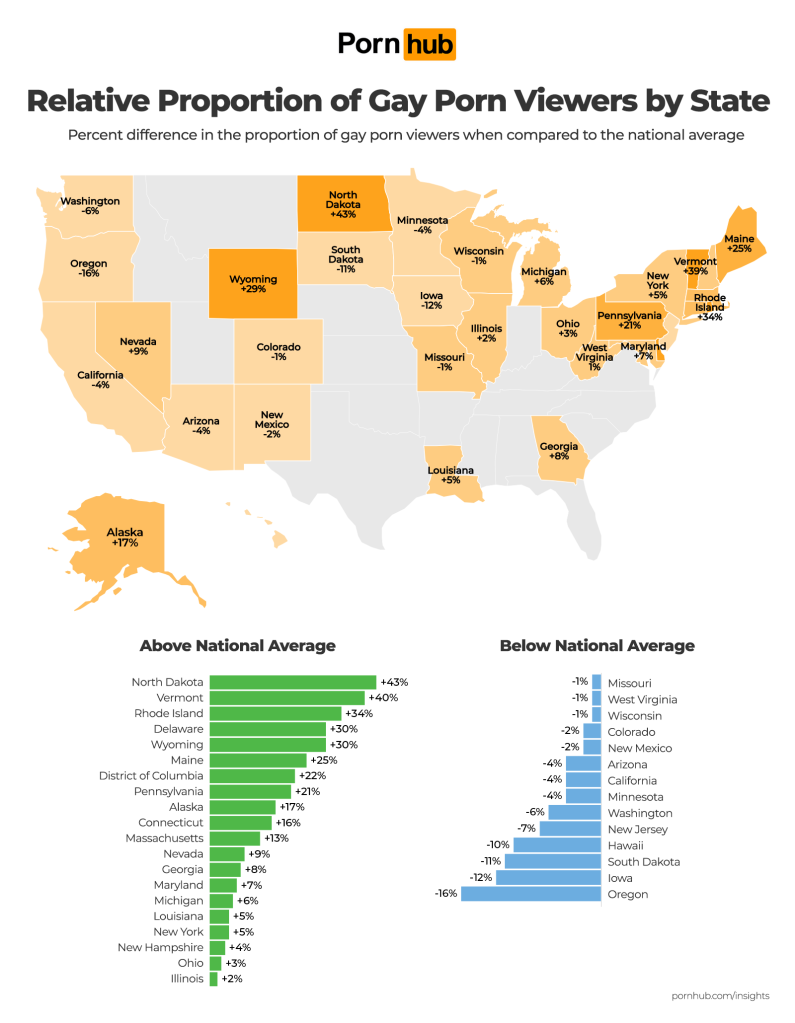
Voters in two states won by Donald Trump in last year’s presidential election have been revealed to watch gay porn much more often than the national average, according a study by Pornhub.
The porn site’s latest Pride Insights research revealed that North Dakota topped the charts in terms of hours of gay porn watched in the past year, with Wyoming not far behind. Both are notorious for implementing anti-LGBTQ+ legislation and both have Republican governors.
North Dakota’s proportion of gay porn fans seemingly exceeded the national average by 43 per cent, and Wyoming by 29 per cent. Other states with a higher-than-average interest included Vermont, Rhode Island and Pennsylvania.
The research gave an insight into the top states for gay porn viewership. (PornHub)
When it comes to top categories, Wyoming viewers were big fans of men with big…. well, you know! California, South Dakota, Alaska and Iowa residents had the same tastes. North Dakotans, meanwhile, much preferred twink porn as did people in Arizona, New Mexico and Oregon.
North Dakota, The Roughrider State, can crown itself king of the daddies, because more people there watched daddy porn than in any other state. Wyoming was the top state for military-related adult videos.
By way of comparison, Democratic strongholds Oregon and California had lower-than-average viewership figures, with -16 per cent and -4 per cent respectively. However, Delaware – also a “blue” state – was well above the average (+30 per cent), the figures showed.
JD Vance has become the most blocked account on Bluesky just two days after joining the social media platform.
The vice president signed up for the site, a competitor of X/Twitter, on Wednesday. Vance used his first post to mock transgender people by sharing part of Supreme Court Justice Clarence Thomas’ opinion in U.S. v. Skrmetti, in which he incorrectly said that gender-affirming care relies on “questionable evidence.”
“Hello Bluesky, I’ve been told this app has become the place to go for common sense political discussion and analysis,” Vance wrote. “So I’m thrilled to be here to engage with all of you.”
Within just one day, Vance became the most blocked account on Bluesky, according to Clearsky, the platform’s unofficial data tracker. As of publishing, Vance has been blocked by over 117,500 accounts, more than 29,000 of which blocked him in the past 24 hours. He has only gained 10,000 followers since joining the site.
The title formerly belonged to anti-trans journalist Jesse Singal, whom GLAAD has criticized for spreading misinformation harmful to LGBTQ+ people. It took 12 days for Singal to become the most blocked account, with users even starting a petition asking the site to remove his account. He is currently blocked by over 81,000 people.
“The only thing I’ve ever accomplished in my life, gone, all because being vice president wasn’t enough for JD Vance — he needed more,” Singal recently posted on X/Twitter in response to the news. “We are in hell.”
The U.S. Supreme Court ruled 6-3 Wednesday that Tennessee‘s law banning gender-affirming care for trans youth – while allowing the same treatments for youth who aren’t trans – does not constitute sex-based discrimination, and therefore does not violate the Equal Protection Clause of the 14th Amendment.
In the snippet of his opinion shared by Vance, Thomas asserted that the Court should not listen to “so-called experts,” accusing medical professionals of allowing “ideology to influence their medical guidance.” He then falsely claimed that “there is no medical consensus on how best to treat gender dysphoria in children.”
Justice Sonia Sotomayor argued in her dissenting opinion that the law explicitly discriminates on the basis of both sex and gender, as it “expressly classifies on the basis of sex and transgender status,” since “male (but not female) adolescents can receive medicines that help them look like boys, and female (but not male) adolescents can receive medicines that help them look like girls.”
The decision “does irrevocable damage to the Equal Protection Clause and invites legislatures to engage in discrimination by hiding blatant sex classifications in plain sight,” Sotomayor wrote. “It also authorizes, without second thought, untold harm to transgender children and the parents and families who love them. Because there is no constitutional justification for that result, I dissent.”
Back on Bluesky, Vance was met with , with one person asking, “Why pick such a polarizing issue if you want to have a real discussion, and why not something relevant to more Americans?”
To which another replied, “It’s only a polarizing issue because ignorant bigoted child abusing superstitious sadists like Vance want to pretend that they know more than doctors.”
Over the past five years, corporate America has abandoned diversity, equity and inclusion (DEI) practices en masse, with the crusade to roll back these efforts only ramping up since Trump’s reelection.
While it may seem like there are many forces behind these proposals, they were all submitted by the National Center for Public Policy Research, a conservative think tank commonly referred to as the National Center.
Although not very well known, they are effective: Since receiving their proposals, half of the companies listed above have watered down or abandoned their DEI practices, with Apple, JPMorganChase, Costco, Kroger and Coca-Cola standing firm.
And although the National Center has been trying to dismantle DEI for nearly two decades, they’re experiencing enormous success today due to the rise of the conservative crusade against “woke capitalism” and so-called “viewpoint discrimination.”
Jason Stahl, a historian and researcher specializing in right-wing think tanks and populism in the U.S., says the National Center’s newfound success reflects a renewed desire for socially conservative populist movements. “Think tanks prime themselves to respond to the American political culture in a populist way and to present themselves as for the people.”
“We’ve got Flint, Michigan without clean drinking water, we’ve got the flooding that occurred in Appalachia and North Carolina, we’ve got the fires in California and in Hawaii. Why aren’t we talking about all this?” he says. “Politics should be about the improvement of people’s lives,” but dominant powers in the U.S., including the National Center, want people to be fighting over DEI—a debate that detracts “from the material reality of people’s lives.”
How the National Center Is so Effective
Through shareholder proposals, the National Center—along with anyone who owns a high enough stake in a publicly traded company—can attempt to influence its governance.
In their proposal to Apple, the National Center submitted a “Request to Cease DEI Efforts,” writing, “Apple likely has over 50,000 [employees] who are potentially victims of this type of discrimination.” In their proposal to Alphabet, Google’s parent company, they came after the Human Rights Campaign’s (HRC) Corporate Equality Index (CEI), calling it “hyper-partisan, divisive and increasingly radical.” Their supporting statement included disinformation about transgender people, claiming the HRC uses the CEI “to force [corporations] to do the political bidding of radical activists, which seek to sow gender confusion in youth, encourage permanent surgical procedures on confused and vulnerable teens, and effectively eliminate girls’ and women’s sports and bathrooms.”
And in their proposal to Goldman Sachs, they requested a “Racial Discrimination Audit,” citing a Supreme Court case that alleged Harvard University’s affirmative action policies discriminated against white students.
While the Goldman proposal failed, with just 2% of shares voting in its favor, the company still dropped their diversity and inclusion policies. But even these losses are often considered wins by the National Center, who have said that “the true aim of these proposals is to negotiate with companies and convince them to amend their equal employment opportunity policies to add protections against viewpoint discrimination.”
R.G. Cravens, a senior research analyst at the Southern Poverty Law Center, says the anti-DEI movement is part of a bigger campaign to maintain the status quo in corporate America. “A lot of the rhetoric the hard right uses to describe DEI is based on racist and white supremacist narratives about people of color. For example, saying that DEI means unqualified people get jobs, they mean people of color who aren’t qualified to hold positions,” he says. “DEI policies are designed to interrupt systemic inequalities, and they do a lot beyond just what the hard right tends to caricature them as doing.”
In principle, DEI is meant to close wage and opportunity gaps in the workforce. LGBTQ workers earn 90 cents to every dollar earned by the average American worker, and women make 85 cents to every dollar earned by men. Meanwhile, Black and Latino workers make 24% and 28% less than white workers, respectively. Trans women, who are the most demonized in the crusade against DEI, earn just 60 cents on the dollar compared to the typical American worker.
Mary Wrenn, a professor of economics specializing in capitalism and neoliberalism at the University of Cambridge, says the crusade against DEI uses a similar strategy to that used against the civil rights movement of the 1960s. “There were a lot of economists and politicians who said that we should not force desegregation because the free market will take care of it. Of course that’s not true: We had to have legislation in order for the cultural and social spheres to catch up.”
The National Center’s Free Enterprise Project and the Rise of Stefan Padfield
While the anti-DEI movement has only gained momentum in the last few years, the National Center has been around since 1982, when Amy Moritz Ridenour, a former campaign coordinator for Ronald Reagan, founded it.
In the 1990s, they successfully campaigned against the Clinton healthcare plan that would have provided universal healthcare to all Americans. Throughout the early 2000s, they campaigned to limit the amount that businesses which knowingly sold deadly asbestos products must pay in compensation to victims.
One of the National Center’s major initiatives is the Free Enterprise Project (FEP). Launched in 2007, they claim the FEP is “the original and premier opponent of the woke takeover of American corporate life and defender of true capitalism.”
Through the years, the FEP has campaigned against attacks on conservatives, pharmaceutical company support for the Affordable Care Act, and government initiatives to cap corporate carbon dioxide emissions.
But in recent years, the FEP’s focus has been to use shareholder activism to force a shift in corporate America. In 2021, they launched the Stop Corporate Tyranny coalition, which aims to “[expose] the Left’s nearly completed takeover of corporate America” and provide “resources and tools for everyday Americans to fight back against the Left’s woke and censoring mob in the corporate [world].”
The National Center’s funders include anti-LGBTQ hate groups like the Alliance Defending Freedom; religious donor-advised funds like National Christian Foundation; mainstream charitable funds like Fidelity, Schwab and Vanguard Charitable; and corporations such as ExxonMobil.
“Free enterprise is just a mask for social conservatism because they want small government, but only with respect to business—they don’t want it with respect to people’s lives,” Wrenn told Uncloseted Media. “It’s about controlling the cultural conversation and our social norms, and that’s very tied up with white supremacy, patriarchy and capitalism as an economic means by which to forward their personal agendas,” says Wrenn.
Stahl says President Trump’s positioning as a right-wing populist plays well into the National Center’s strategy. “They’re populist projects that say the liberals are out of touch and against your values. Over the decades, the messaging is the same but different issues get plugged in and we’re seeing this really come to its full flowering because [of] Trump,” he told Uncloseted Media.
In 2023,Stefan Padfield joined the FEP, quickly becoming the deputy director. The following year, the project convinced the U.S. Court of Appeals to overturn a Nasdaq board diversity rule that had required any Nasdaq-listed companies have—or explain why they don’t have—at least two “diverse” directors, including at least one woman and at least one other person who identifies as an underrepresented minority.
Padfield has also penned articles for RealClearMarkets, such as “A Question for Goldman Sachs: What Is a Woman?” in which he claims, “Transgenderism is one of the most divisive issues today,” reducing trans women to men who “become [women] simply by saying so.”
In an email to Uncloseted Media, Padfield says he has “no disdain for trans people or the wider LGBTQ community.” He says he wants to see all people have equal opportunities for maximum flourishing. “Having said that, if someone claims, for example, that they need to be permitted to surgically mutilate minors behind the backs of their parents in order to feel affirmed in their belief that children can be born in the wrong body, then I will be on the side of those defending those children.¹”
The Belief That America Should Be Governed as a Christian Theocracy
The National Center’s mission is reflective of a larger network of conservatives who claim to be protecting so-called viewpoint diversity. Last year, they launched an app to help shareholders identify conservative proposals that would help “hold woke corporations accountable.” The app also provided users with “neutrality v. wokeness” ratings of certain companies.
Cravens says that “viewpoint discrimination” has replaced “political correctness” as conservative buzzwords. “It’s this innocuous-sounding phrase like ‘We need to protect First Amendment speech and maintain pluralism’ … [this false notion] that conservatives and people who oppose anti-racist policies and LGBTQ-inclusive policies are discriminated against. But that is so reductionist because it ignores how white people have claimed and maintained power against communities of color through wealth inequality, racist corporate policies and banking practices,” he says.
He says there’s a rhetorical connection shared across these groups that Christian supremacists have been using for decades. “You say you’re concerned about children and trying to strengthen the family—that’s a totally different kind of marketing than ‘We are evangelicals and we’re here to take over.’ It’s been described as a stealth communication strategy to articulate the same message in secular terms in an effort to reach all Americans.”
What This Means for LGBTQ People
The National Center’s successes have a very real impact on LGBTQ communities. “I think they risk losing their jobs ultimately,” says Cravens. “One of the goals is to drive queer people back into a closet and dismantle any notion that it’s okay to be [openly] queer. They want to turn a group of people toxic so they won’t get service, they won’t get jobs and they won’t be part of society anymore.”
While powerful institutions try to sow division, advocates say it’s critical the LGBTQ community works together to push back against organizations like the National Center.
“It’s always been a minefield,” says Ben Greene, a transgender inclusion consultant and author of Good Queer News.
Greene urges LGBTQ people to stick together. “[We] are going to be our best antidote to [DEI setbacks]. ‘You had a bad experience?’ That needs to go on Glassdoor or your local LGBTQ social media page.” It is going to be an increasingly hard time but there is incredible solidarity between the LGBTQ community and other marginalized groups. “We can’t write off those little moments because that is what will get us out of this,” he says.
Cravens underscores the need for corporate America to have a backbone to push back against organizations like the National Center in an effort to create fair and inclusive workplaces. “A lot of companies advise against anti-DEI shareholder proposals already because they know it’s irresponsible and unprofitable to try to turn back the clock on civil rights. … They should recognize that there is value in diversity and vote down these policies inspired by hateful ideologies.”