JD Vance has become the most blocked account on Bluesky just two days after joining the social media platform.
The vice president signed up for the site, a competitor of X/Twitter, on Wednesday. Vance used his first post to mock transgender people by sharing part of Supreme Court Justice Clarence Thomas’ opinion in U.S. v. Skrmetti, in which he incorrectly said that gender-affirming care relies on “questionable evidence.”
“Hello Bluesky, I’ve been told this app has become the place to go for common sense political discussion and analysis,” Vance wrote. “So I’m thrilled to be here to engage with all of you.”
Within just one day, Vance became the most blocked account on Bluesky, according to Clearsky, the platform’s unofficial data tracker. As of publishing, Vance has been blocked by over 117,500 accounts, more than 29,000 of which blocked him in the past 24 hours. He has only gained 10,000 followers since joining the site.
The title formerly belonged to anti-trans journalist Jesse Singal, whom GLAAD has criticized for spreading misinformation harmful to LGBTQ+ people. It took 12 days for Singal to become the most blocked account, with users even starting a petition asking the site to remove his account. He is currently blocked by over 81,000 people.
“The only thing I’ve ever accomplished in my life, gone, all because being vice president wasn’t enough for JD Vance — he needed more,” Singal recently posted on X/Twitter in response to the news. “We are in hell.”
The U.S. Supreme Court ruled 6-3 Wednesday that Tennessee‘s law banning gender-affirming care for trans youth – while allowing the same treatments for youth who aren’t trans – does not constitute sex-based discrimination, and therefore does not violate the Equal Protection Clause of the 14th Amendment.
In the snippet of his opinion shared by Vance, Thomas asserted that the Court should not listen to “so-called experts,” accusing medical professionals of allowing “ideology to influence their medical guidance.” He then falsely claimed that “there is no medical consensus on how best to treat gender dysphoria in children.”
Justice Sonia Sotomayor argued in her dissenting opinion that the law explicitly discriminates on the basis of both sex and gender, as it “expressly classifies on the basis of sex and transgender status,” since “male (but not female) adolescents can receive medicines that help them look like boys, and female (but not male) adolescents can receive medicines that help them look like girls.”
The decision “does irrevocable damage to the Equal Protection Clause and invites legislatures to engage in discrimination by hiding blatant sex classifications in plain sight,” Sotomayor wrote. “It also authorizes, without second thought, untold harm to transgender children and the parents and families who love them. Because there is no constitutional justification for that result, I dissent.”
Back on Bluesky, Vance was met with , with one person asking, “Why pick such a polarizing issue if you want to have a real discussion, and why not something relevant to more Americans?”
To which another replied, “It’s only a polarizing issue because ignorant bigoted child abusing superstitious sadists like Vance want to pretend that they know more than doctors.”
Over the past five years, corporate America has abandoned diversity, equity and inclusion (DEI) practices en masse, with the crusade to roll back these efforts only ramping up since Trump’s reelection.
While it may seem like there are many forces behind these proposals, they were all submitted by the National Center for Public Policy Research, a conservative think tank commonly referred to as the National Center.
Although not very well known, they are effective: Since receiving their proposals, half of the companies listed above have watered down or abandoned their DEI practices, with Apple, JPMorganChase, Costco, Kroger and Coca-Cola standing firm.
And although the National Center has been trying to dismantle DEI for nearly two decades, they’re experiencing enormous success today due to the rise of the conservative crusade against “woke capitalism” and so-called “viewpoint discrimination.”
Jason Stahl, a historian and researcher specializing in right-wing think tanks and populism in the U.S., says the National Center’s newfound success reflects a renewed desire for socially conservative populist movements. “Think tanks prime themselves to respond to the American political culture in a populist way and to present themselves as for the people.”
“We’ve got Flint, Michigan without clean drinking water, we’ve got the flooding that occurred in Appalachia and North Carolina, we’ve got the fires in California and in Hawaii. Why aren’t we talking about all this?” he says. “Politics should be about the improvement of people’s lives,” but dominant powers in the U.S., including the National Center, want people to be fighting over DEI—a debate that detracts “from the material reality of people’s lives.”
How the National Center Is so Effective
Through shareholder proposals, the National Center—along with anyone who owns a high enough stake in a publicly traded company—can attempt to influence its governance.
In their proposal to Apple, the National Center submitted a “Request to Cease DEI Efforts,” writing, “Apple likely has over 50,000 [employees] who are potentially victims of this type of discrimination.” In their proposal to Alphabet, Google’s parent company, they came after the Human Rights Campaign’s (HRC) Corporate Equality Index (CEI), calling it “hyper-partisan, divisive and increasingly radical.” Their supporting statement included disinformation about transgender people, claiming the HRC uses the CEI “to force [corporations] to do the political bidding of radical activists, which seek to sow gender confusion in youth, encourage permanent surgical procedures on confused and vulnerable teens, and effectively eliminate girls’ and women’s sports and bathrooms.”
And in their proposal to Goldman Sachs, they requested a “Racial Discrimination Audit,” citing a Supreme Court case that alleged Harvard University’s affirmative action policies discriminated against white students.
While the Goldman proposal failed, with just 2% of shares voting in its favor, the company still dropped their diversity and inclusion policies. But even these losses are often considered wins by the National Center, who have said that “the true aim of these proposals is to negotiate with companies and convince them to amend their equal employment opportunity policies to add protections against viewpoint discrimination.”
R.G. Cravens, a senior research analyst at the Southern Poverty Law Center, says the anti-DEI movement is part of a bigger campaign to maintain the status quo in corporate America. “A lot of the rhetoric the hard right uses to describe DEI is based on racist and white supremacist narratives about people of color. For example, saying that DEI means unqualified people get jobs, they mean people of color who aren’t qualified to hold positions,” he says. “DEI policies are designed to interrupt systemic inequalities, and they do a lot beyond just what the hard right tends to caricature them as doing.”
In principle, DEI is meant to close wage and opportunity gaps in the workforce. LGBTQ workers earn 90 cents to every dollar earned by the average American worker, and women make 85 cents to every dollar earned by men. Meanwhile, Black and Latino workers make 24% and 28% less than white workers, respectively. Trans women, who are the most demonized in the crusade against DEI, earn just 60 cents on the dollar compared to the typical American worker.
Mary Wrenn, a professor of economics specializing in capitalism and neoliberalism at the University of Cambridge, says the crusade against DEI uses a similar strategy to that used against the civil rights movement of the 1960s. “There were a lot of economists and politicians who said that we should not force desegregation because the free market will take care of it. Of course that’s not true: We had to have legislation in order for the cultural and social spheres to catch up.”
The National Center’s Free Enterprise Project and the Rise of Stefan Padfield
While the anti-DEI movement has only gained momentum in the last few years, the National Center has been around since 1982, when Amy Moritz Ridenour, a former campaign coordinator for Ronald Reagan, founded it.
In the 1990s, they successfully campaigned against the Clinton healthcare plan that would have provided universal healthcare to all Americans. Throughout the early 2000s, they campaigned to limit the amount that businesses which knowingly sold deadly asbestos products must pay in compensation to victims.
One of the National Center’s major initiatives is the Free Enterprise Project (FEP). Launched in 2007, they claim the FEP is “the original and premier opponent of the woke takeover of American corporate life and defender of true capitalism.”
Through the years, the FEP has campaigned against attacks on conservatives, pharmaceutical company support for the Affordable Care Act, and government initiatives to cap corporate carbon dioxide emissions.
But in recent years, the FEP’s focus has been to use shareholder activism to force a shift in corporate America. In 2021, they launched the Stop Corporate Tyranny coalition, which aims to “[expose] the Left’s nearly completed takeover of corporate America” and provide “resources and tools for everyday Americans to fight back against the Left’s woke and censoring mob in the corporate [world].”
The National Center’s funders include anti-LGBTQ hate groups like the Alliance Defending Freedom; religious donor-advised funds like National Christian Foundation; mainstream charitable funds like Fidelity, Schwab and Vanguard Charitable; and corporations such as ExxonMobil.
“Free enterprise is just a mask for social conservatism because they want small government, but only with respect to business—they don’t want it with respect to people’s lives,” Wrenn told Uncloseted Media. “It’s about controlling the cultural conversation and our social norms, and that’s very tied up with white supremacy, patriarchy and capitalism as an economic means by which to forward their personal agendas,” says Wrenn.
Stahl says President Trump’s positioning as a right-wing populist plays well into the National Center’s strategy. “They’re populist projects that say the liberals are out of touch and against your values. Over the decades, the messaging is the same but different issues get plugged in and we’re seeing this really come to its full flowering because [of] Trump,” he told Uncloseted Media.
In 2023,Stefan Padfield joined the FEP, quickly becoming the deputy director. The following year, the project convinced the U.S. Court of Appeals to overturn a Nasdaq board diversity rule that had required any Nasdaq-listed companies have—or explain why they don’t have—at least two “diverse” directors, including at least one woman and at least one other person who identifies as an underrepresented minority.
Padfield has also penned articles for RealClearMarkets, such as “A Question for Goldman Sachs: What Is a Woman?” in which he claims, “Transgenderism is one of the most divisive issues today,” reducing trans women to men who “become [women] simply by saying so.”
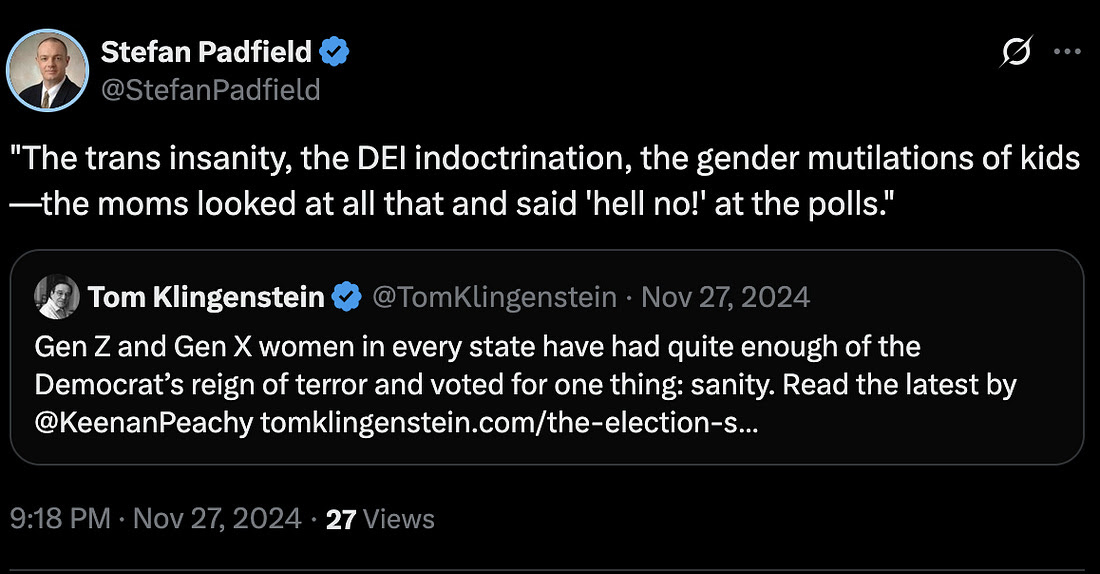
In an email to Uncloseted Media, Padfield says he has “no disdain for trans people or the wider LGBTQ community.” He says he wants to see all people have equal opportunities for maximum flourishing. “Having said that, if someone claims, for example, that they need to be permitted to surgically mutilate minors behind the backs of their parents in order to feel affirmed in their belief that children can be born in the wrong body, then I will be on the side of those defending those children.¹”
The Belief That America Should Be Governed as a Christian Theocracy
The National Center’s mission is reflective of a larger network of conservatives who claim to be protecting so-called viewpoint diversity. Last year, they launched an app to help shareholders identify conservative proposals that would help “hold woke corporations accountable.” The app also provided users with “neutrality v. wokeness” ratings of certain companies.
Cravens says that “viewpoint discrimination” has replaced “political correctness” as conservative buzzwords. “It’s this innocuous-sounding phrase like ‘We need to protect First Amendment speech and maintain pluralism’ … [this false notion] that conservatives and people who oppose anti-racist policies and LGBTQ-inclusive policies are discriminated against. But that is so reductionist because it ignores how white people have claimed and maintained power against communities of color through wealth inequality, racist corporate policies and banking practices,” he says.
He says there’s a rhetorical connection shared across these groups that Christian supremacists have been using for decades. “You say you’re concerned about children and trying to strengthen the family—that’s a totally different kind of marketing than ‘We are evangelicals and we’re here to take over.’ It’s been described as a stealth communication strategy to articulate the same message in secular terms in an effort to reach all Americans.”
What This Means for LGBTQ People
The National Center’s successes have a very real impact on LGBTQ communities. “I think they risk losing their jobs ultimately,” says Cravens. “One of the goals is to drive queer people back into a closet and dismantle any notion that it’s okay to be [openly] queer. They want to turn a group of people toxic so they won’t get service, they won’t get jobs and they won’t be part of society anymore.”
While powerful institutions try to sow division, advocates say it’s critical the LGBTQ community works together to push back against organizations like the National Center.
“It’s always been a minefield,” says Ben Greene, a transgender inclusion consultant and author of Good Queer News.
Greene urges LGBTQ people to stick together. “[We] are going to be our best antidote to [DEI setbacks]. ‘You had a bad experience?’ That needs to go on Glassdoor or your local LGBTQ social media page.” It is going to be an increasingly hard time but there is incredible solidarity between the LGBTQ community and other marginalized groups. “We can’t write off those little moments because that is what will get us out of this,” he says.
Cravens underscores the need for corporate America to have a backbone to push back against organizations like the National Center in an effort to create fair and inclusive workplaces. “A lot of companies advise against anti-DEI shareholder proposals already because they know it’s irresponsible and unprofitable to try to turn back the clock on civil rights. … They should recognize that there is value in diversity and vote down these policies inspired by hateful ideologies.”
Wedding spending by same-sex couples and their out-of-state guests has boosted state and local economies by approximately $5.9 billion over the past 10 years, a new study has found.
There are an estimated 823,000 same-sex couples in the U.S., according to a recent report from the Williams Institute at UCLA School of Law, and more than 591,000 have married since the Supreme Court’s 2015 decision Obergefell v. Hodges, which legalized marriage equality nationwide. About 80 percent of married couples (473,000 couples) celebrated with a wedding or other events.
At the average $8,546 spent per wedding, these couples have spent approximately $4.9 billion on their celebrations, with an estimated 22.2 million guests in attendance. Among them, 7.6 million guests traveled from out-of-state, generating an additional economic boost of nearly $1 billion over the past 10 years.
Same-sex couples’ weddings have also generated an estimated $432.2 million in state and local sales tax revenue — enough to support an estimated 41,300 jobs for one year.
The boost from Obergefell has been felt across U.S., with the biggest boost surprisingly seen in the regions with the least out LGBTQ+ residents. Approximately $2.3 billion of the wedding spending occurred in the South, $1.7 billion in the West, $1 billion in the Midwest, and $900 million in the Northeast.
“Marriage equality has had a significant impact on the lives and well-being of same-sex couples in the U.S.,” said lead author Christy Mallory, Interim Executive Director and Legal Director at the Williams Institute. “Additionally, it has offered a substantial financial benefit to businesses as well as state and local governments.”
Nine states have recently introduced resolutions asking the Supreme Court to reconsider Obergefell, citing state constitutional amendments banning marriage between same-sex couples that were nullified. None have yet passed, and even if they were to, the resolutions are nonbinding — meaning they carry no legal weight, and the court is not obligated to hear them.
While the Supreme Court has made no official move to reconsider marriage equality, some justices have voiced opposition to Obergefell even after the ruling. When the court overturned the national right to an abortion in Roe v. Wade, Clarence Thomas wrote in his concurring opinion at the time that the court should also revisit and overrule decisions that prevent state restrictions on contraception, marriage equality, sodomy, and other private consensual sex acts, calling the rulings “demonstrably erroneous.”
If the Supreme Court reverses Obergefell , marriages between same-sex couples will still be recognized federally under the Respect for Marriage Act. Signed into law by President Joe Biden in 2022, the act mandates that the federal government recognizes same-sex and interracial marriages, and that all states recognize those performed in other states. However, the act does not require states to allow marriages between same-sex couples.
Converse has long been known for its fantastic Pride collections. The iconic shoe brand has celebrated Pride Month with rainbow footwear every year since 2015.
This year, the company is celebrating its 10-year anniversary of showing its Pride. “Converse has always stood with the bold, the daring, and the unapologetic,” the website says. “For our 2025 ‘Proud to Be’ celebration, we’re not looking back, we’re lighting the way forward towards a future of love and joy for everyone.”
The brand also invited members of past Pride campaigns to write love letters to their future selves.
2025 Converse Pride Collection
“I know that you are somewhere creating the life you’ve always dreamed of,” writes Xavier.
“I hope to look back and see a world where I no longer need to justify my existence,” says Allié.
Ayo writes, “I hope that you never forget the magic of black queer and trans existence.”
The letters are also highlighted in a powerful ad.
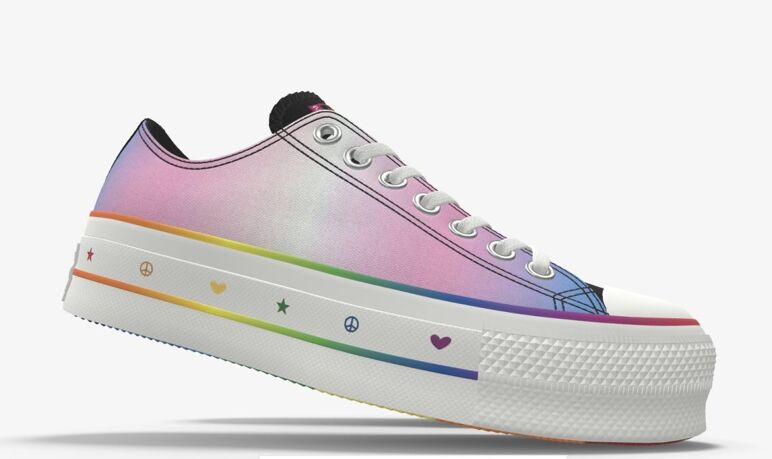
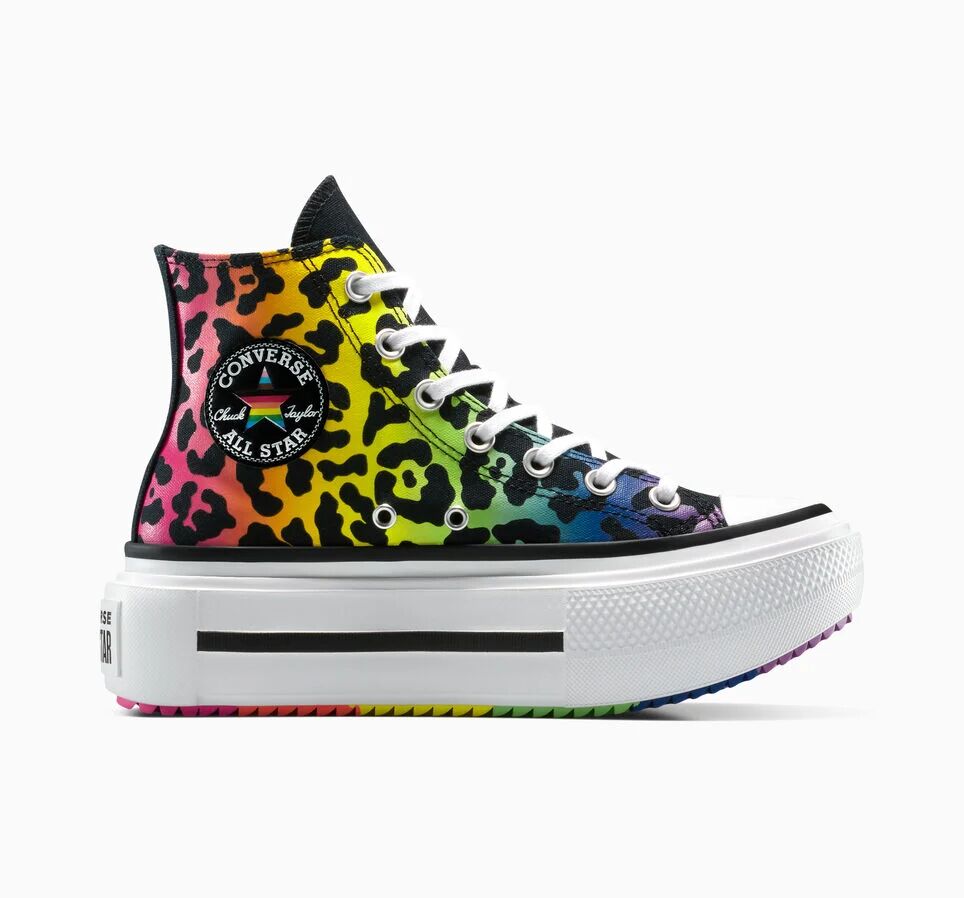
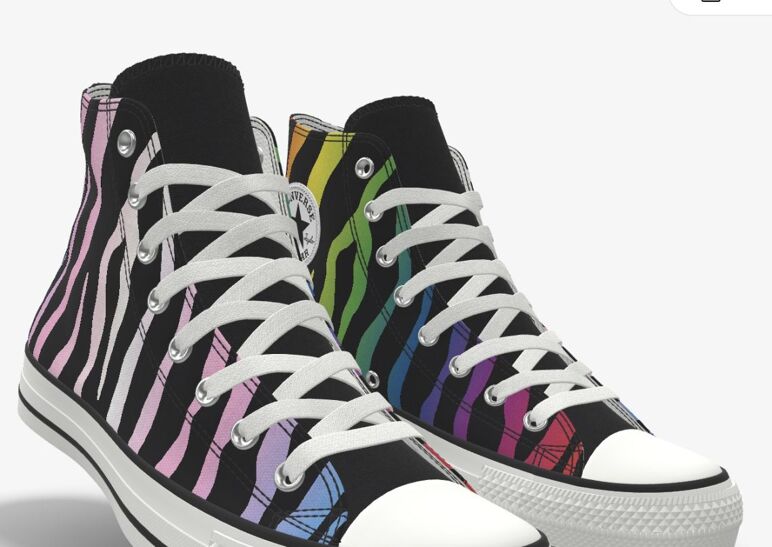
The 2025 Converse Pride shop includes two t-shirts and 15 unique sneaker designs – including rainbow flames, zebra stripes, and rainbow soles. There is also an option to create your own custom pride shoes, with gradients available depicting colors of the trans, lesbian, bisexual, pansexual, and nonbinary flags.
2025 Converse Pride Collection
The company also puts its money where its mouth is, partnering with organizations like It Gets Better, the Ali Forney Center, and the Boston Alliance of LGBTQ+ Youth to provide annual grants. Since 2015, the website says, Converse has pledged and donated almost $3.4 million to LGBTQ+ organizations around the world.
On January 7, 2025, Meta announced sweeping rollbacks to its content moderation policies across Facebook, Instagram, and Threads — ending third-party fact-checking in the U.S. and weakening its hate-speech policies worldwide. Additionally, the company announced that it would halt “proactive” enforcement of some policies on harmful content, notably hate speech. As noted in GLAAD’s 2025 Social Media Safety Index, the rollbacks include new exceptions expressly allowing anti-LGBTQ hate speech, such as stating that LGBTQ people are “abnormal” and “mentally ill,” as well as Meta’s own use of anti-LGBTQ language (referring to LGBTQ people using the terms “homosexuality” and “transgenderism” in its updated hate speech policy).
In the absence of data from Meta itself, GLAAD partnered with UltraViolet and All Out to survey more than 7,000 active users from 86 countries — focusing on people who Meta defines as belonging to protected characteristic groups — to understand how these policy shifts have affected their experience online. The findings are both stark and deeply concerning: since the rollbacks, users report a sharp rise in hateful content, increased self-censorship, and a pervasive sense of vulnerability. The survey is part of a larger campaign, called Make Meta Safe.
Survey Methodology We conducted a mixed-methods survey in English and in Portuguese, Spanish, German, Italian, and French, reaching individuals targeted by hate on the basis of protected characteristics (i.e. race, gender, sexual orientation, gender identity, disability, religion, national origin, and serious disease). Recruitment was done organically — via email and social-media outreach through co-sponsoring organizations — to ensure that our sample reflected communities most at risk. After cleaning for duplicates, respondents shared quantitative ratings and qualitative testimony about their experiences since January 2025.
Key Findings at a Glance
1 in 6 respondents report being the victim of some type of gender-based or sexual violence on Meta platforms.
92% are concerned about harmful content increasing since the rollbacks.
72% see more hate targeting protected groups.
92% feel less protected from being exposed to or targeted by harmful content.
Over 25% say they have been targeted directly with hate or harassment.
66% have witnessed harmful content in their feeds.
77% feel less safe expressing themselves freely on Meta platforms.
Hate on the Rise When asked if harmful content had increased, 75% of LGBTQ respondents, 76% of women, and 78% of people of color said “yes.” One user, who is trans and nonbinary, reported, “Violence against me has skyrocketed since January. I live in daily fear.” Another shared:
“I rarely see friends’ posts now — my feed is filled with obscene manipulated images, commercial ads, and transphobic, sexist, violent comments, even under kitten videos. Death threats are not removed, even when reported.”
Erosion of Safety and Free Expression Ninety-two percent of all respondents say they feel less protected from being exposed to or targeted by harmful content. Among LGBTQ people, notably transgender people, there are stories of targeted harassment:
“I recently saw someone state they wished all transgender people would die by suicide — 41% to become 100%. When I told them how awful that was, they called me a transphobic slur.”
“One night I reported at least 10 comments directly inciting violence towards the LGBT community. Facebook responded within less than a minute saying that the comments were investigated and they didn’t see anything wrong, and [they] kept the comments up.”
“I recently posted information about my transition and someone responded with a picture of a noose.”
A full 77% say they now feel less safe expressing themselves following the policy changes. One respondent noted:
“There are times when I am afraid to comment on a post because of the violence expressed by others in their [comments].”
Gender-Based and Sexual Violence Online Alarmingly, 27% of LGBTQ respondents and 35% of people of color report that they have been the direct targets of gender-based or sexual violence online. Examples include doxxing, stalking, threats of physical harm, and rape threats. As one survivor of digital stalking put it:
“Weaponizing technology to threaten, harass, and silence me has transformed my online existence into a battleground of fear.”
Global Impact, Local Harms While the majority of respondents are from the U.S., U.K., and Canada, voices from the Global South underscore that unchecked hate online can — and does — translate to violence offline. In Colombia, users spoke of renewed attacks on trans people in the wake of Sara Millerey González’s murder, whose brutal killing was filmed and circulated on social media. Where LGBTQ lives are already marginalized or criminalized, these policy rollbacks risk endangering us even more.
Why This Matters Meta produces quarterly reports on the prevalence of harmful content and content labeled as false by fact-checkers. In its most recent report published last month, the company stated that, from January – April 2025, “violating content largely remained unchanged for most problem areas.”
But it’s important to note: those numbers are based solely on internal data and remain opaque to outside scrutiny. Our survey centers the lived experiences of users themselves, revealing that weakened policies have not led to, as Meta claims, “more speech and fewer mistakes” — but rather to a more hostile environment for those already most vulnerable.
A Call to Action Everyone deserves online spaces where they can connect, communicate, and organize without fear of harassment, threats, or dehumanization. GLAAD, UltraViolet, and All Out therefore urge Meta to:
Commission an independent third-party review of the impact of the January 2025 policy changes, centering user experiences.
Reinstate robust hate-speech protections for all historically marginalized groups, including LGBTQ people.
Restore third-party fact-checking and proactive enforcement mechanisms globally.
Engage civil-society stakeholders in future policy deliberations, ensuring that human-rights perspectives shape content-moderation standards.
The data is clear: since Meta’s draconian rollbacks, harmful content has surged, user safety has plummeted, and freedom of expression for marginalized communities hangs in the balance. We call on Mark Zuckerberg and Meta’s leadership to reverse course — restoring the guardrails that make social media a place for community and expression, not only for the broad range of marginalized communities who are so directly experiencing these harms, but for everyone.
Read the full survey report and detailed findings at makemetasafe.org.
Levi’s has released its annual Pride Collection along with a promotional video entitled “Meet You in the Park.”
“We’re taught to not take up space, we’re taught to be quiet,” a voiceover says in the ad, which doesn’t explicitly mention LGBTQ+ identities. “But there’s something about being in your body that makes you want to just like be proud and take up that space.”
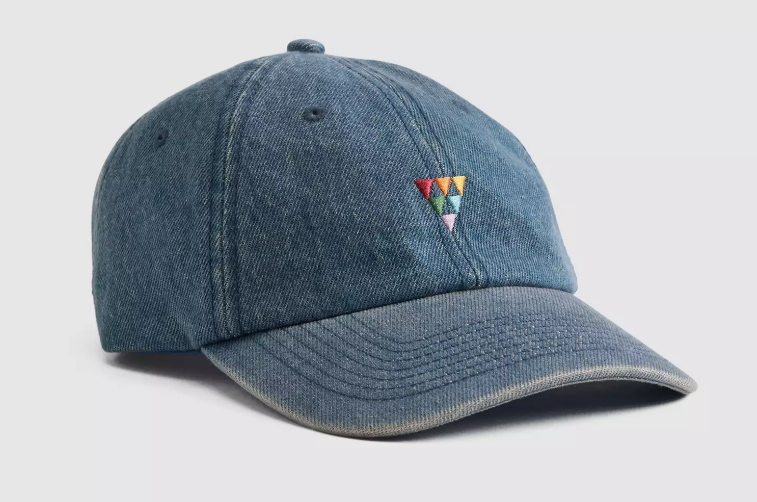
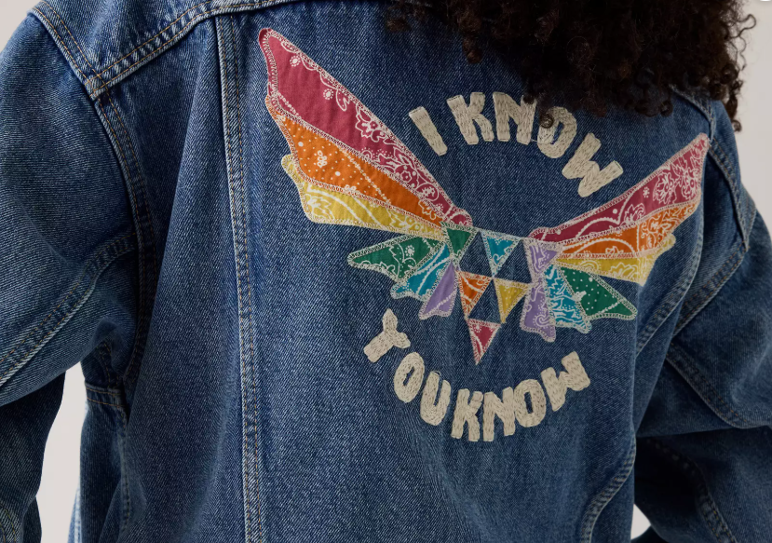
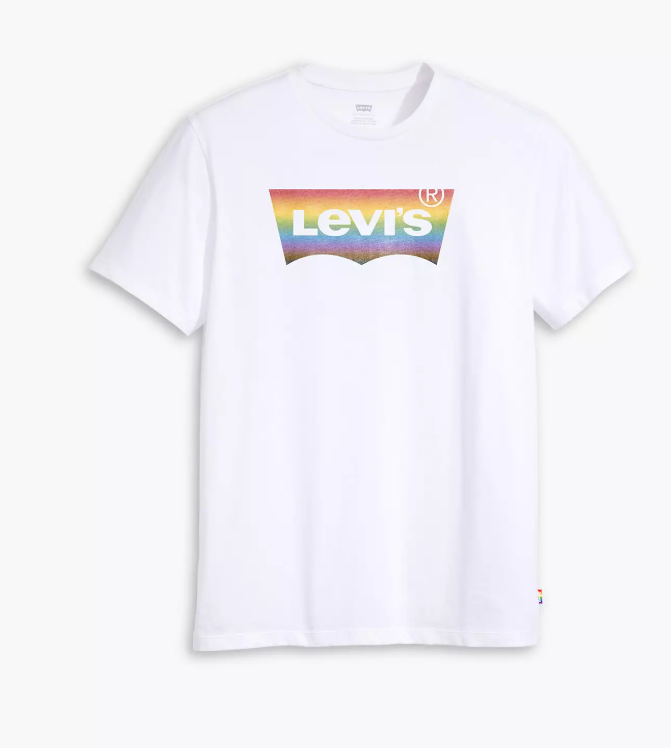
The collection itself is designed by LGBTQ+ people and includes rainbow colors and triangles, symbols associated with the LGBTQ+ community.
A Levi’s Pride cap | Levi’sA Levi’s Pride jacket | Levi’sA Levi’s Pride T-shirt | Levi’s
“This year, our Pride collection shines a light on togetherness and the importance of safe spaces for all LGBTQIA+ folks,” Levi’s said in a statement, adding that the pieces in the collection “honor efforts by the LGBTQ+ community to reclaim and define for themselves symbols that have had different and, at times, fraught meanings throughout history but that continue to carry profound significance in modern LGBTQ+ communities and advocacy.”
BarkBox’s CEO is “deeply sorry” for a leaked message that revealed the company’s plans to forgo advertising for its LGBTQ+ Pride collection — but they appear to have followed through on those plans.
The dog product subscription service came under fire earlier this week after a message from an employee was shared on social media, exposing the company’s intentions to “pause all paid ads and lifestyle marketing pushes for the Pride kit effective immediately.” The author referred to LGBTQ+ existence as “another politically charged symbol,” comparing it to being a supporter of Donald Trump.
“While celebrating Pride is something we may value, we need to acknowledge that the current climate makes this promotion feel more like a political statement than a universally joyful moment for all dog people,” the message reads. “If we wouldn’t feel comfortable running a promotion centered around another politically charged symbol (like a MAGA-themed product), it’s worth asking whether this is the right moment to run this particular campaign.”
“Right now, pushing this promo risks unintentionally sending the message that ‘we’re not for you’ to a large portion of our audience,” the author concluded.
After backlash online — including users unsubscribing and threatening boycotts — CEO Matt Meeker posted a statement on BarkBox’s Instagram apologizing for the message. He insisted that “the Pride Collection is still available” and that the company has “no plans to remove them,” but did not address the advertising roll back.
“I apologize. A few days go, an internal message from a BARK team member was released on social media,” Meeker wrote. “The message was disrespectful and hurtful to the LGBTQIA+ community, and as the CEO of BARK, I’m responsible for that. I do not agree with the content of the message. It wasn’t good, it doesn’t reflect our values, and I’m deeply sorry that it happened.”
Meeker added that instead of donating a portion of the profits from the Pride Collection to a “worthy organization,” BarkBox would donate “100 percent of the revenue” this year.
As of publishing, the Pride Collection does not appear on BarkBox’s home page, nor is it listed under the website’s “Monthly Themes” tab. There are no posts advertising the collection on the same company Instagram page that Meeker issued his apology on.
A spokesperson for BarkBox told The Advocate that the Pride Collection has been advertised on the website “in the yellow banner at the top of the page.” An Internet Archive snapshot of the website from yesterday shows no banner, suggesting it was added in the past 24 hours.
Collections BarkBox seemingly considers not “politically charged” include cannabis leaf merchandise for the 420 holiday, a “fleshlight” pig in a blanket toy, and a Harry Potter collection — when writer J.K. Rowling has been using her personal profits to fund legal cases tat restricted the rights of transgender people.
A trans software engineer fired by Wikipedia is speaking out after she filed a lawsuit against the nonprofit website claiming wrongful termination.
Kayla Mae said that the “bigotry” described in her suit is “organization wide” and that most of her former colleagues “are as against the problems in leadership as I was.”
“Unfortunately, I became the squeaky wheel for management to retaliate against by reporting the discrimination,” Mae wrote on Reddit, “instead of quietly leaving like others did.”
Mae was hired in 2022 by the Wikimedia Foundation, the website’s parent organization, as a software engineer in a remote role based in Texas, The Deskreported in May. Her direct supervisor was based in Kenya.
The lawsuit states that from the moment the neurodivergent, transgender woman was hired, she faced abuse and harassment by her supervisor, leading her to file complaints with Wikimedia Foundation’s human resources department.
Among other things, her supervisor asked her inappropriate questions about her sexual identity and inquired about her medical history. In emails to HR, Mae characterized other behavior by the supervisor as “transphobic microaggressions” and “ableism”. She wrote that the situation made her “dread work.”
An initial internal investigation ultimately determined that her supervisor’s actions were “inappropriate” and a violation of the organization’s policy, Mae said, but it was unclear what actions were taken against him.
After repeatedly being denied transfer to another team, Mae was asked to meet with managers so that Wikimedia could “learn more about your recent experiences.”
A week later, Mae affirmed in that meeting that her supervisor’s behavior hadn’t improved. Shortly after, she was fired, the lawsuit states.
After her dismissal, Mae filed a complaint with the Equal Opportunity Commission, alleging her firing was based on her gender identity and disability. Earlier this year, the agency granted her a Notice of Right to Sue, which paved the way for her lawsuit filed in federal court last month.
Mae said working at Wikimedia Foundation was “my dream job… and I felt unbelievably betrayed.”
“When I was fired, I received several emails from former co-workers expressing concern at WMF’s leadership, and similar stories of people terminated in suspicious ways,” she said, referring to the Wikimedia Foundation.
Mae was warned that one of her managers was “a ‘fixer’ who goes after employees that were seen as stirring the pot.”
Her lawsuit states that the Wikimedia Foundation responded to her Equal Employment Opportunity Commission complaint by saying that the organization intended to fire Mae before the meeting where she was informed of her termination over Zoom.
“In some ways, I think it was an extra f*ck you, so my health insurance would expire immediately,” Mae said in her Reddit post.
“I am very grateful that I was able to compartmentalize this process, with a splash of righteous anger keeping me going,” Mae wrote on Tuesday. “It has been exhausting for me, too, and will continue to be exhausting for however long it’s in court.”
In 2020, Wikipedia instituted a new code of conduct to battle what the organization called “toxic behavior” by some volunteers, in particular against women and members of the LGBTQ+ community.
“We must work together to create a safe, inclusive culture, where everyone feels welcome, that their contributions are valued, and that their perspective matters,” said Katherine Maher, the chief executive officer at Wikimedia.
“Our goal is all the world’s knowledge, and this is an essential step on our journey.”
A check of comments on the Glassdoor employment site reveals continued reports of dysfunction at the nonprofit.
One employee wrote that there was “no support staff” to address “leadership’s bad behavior and toxic culture.” The post was dated just months before Mae was hired.
J.K. Rowling is using her wealth attained from the Harry Potter series to create an organization dedicated to removing transgender people’s rights “in the workplace, in public life, and in protected female spaces.”
The author announced in a Saturday post to X, formerly Twitter, that she would be founding the J.K. Rowling Women’s Fund, using her personal fortune. The website for the group states that it “offers legal funding support to individuals and organisations fighting to retain women’s sex-based rights in the workplace, in public life, and in protected female spaces.”
“I looked into all options and a private fund is the most efficient, streamlined way for me to do this,” she said. “Lots of people are offering to contribute, which I truly appreciate, but there are many other women’s rights orgs that could do with the money, so donate away, just not to me!”
It is not the first time Rowling has used her over $1 billion net worth to influence legal cases involving so-called women’s sex-based rights — a dog whistle used by herself and other anti-trans activists to exclude trans people from public spaces and reduce women to their genitals.
Rowling donated £70,000 (roughly $88,200) to the anti-trans group For Women Scotland in 2024 after it lost its challenge to a 2018 Scottish law that legally recognized trans women as women. The group appealed its case to the U.K. Supreme Court, which ruled last month that trans women aren’t considered women under the nation’s Equality Act.
Rowling responded to the decision by posting a picture of her having a drink and smoking a cigar, with the text “I love it when a plan comes together.” The post was widely criticized, including by The Mandalorian and The Last of Us star Pedro Pascal, who called it serious “Voldemort villain s—” and referred to Rowling as a “heinous loser.”
Pascal, whose younger sister Lux is trans, urged his followers to not “buy a single Harry Potter thing ever,” including by boycotting the upcoming HBO series and attractions at Universal Studios theme parks.
“It’s time to tell these corporations that transphobia loses money,” he said.
Even before Donald Trump’s executive orders terminating all DEI positions in the federal government, dozens of major companies had already abandoned their practices. Many made their decisions after conservatives online specifically targeted them for their policies and threatened boycotts, with failed filmmaker turned failed congressional candidate Robby Starbuck taking credit for spearheading the movement.
This withdrawal didn’t just encompass inclusive work environments and hiring practices, or participation in the Human Rights Campaign’s Corporate Equality Index — in abandoning DEI, companies also ceased many of their community partnerships. This included small businesses, minority- and women-owned businesses, and organizations supporting underserved groups: veterans, people of color, and LGBTQ+ people.
As a result, many of the companies abandoning DEI have stopped sponsoring Pride Month events. Here are the companies that have walked back their support, some of them after decades of allyship.
Anheuser-Busch
The brewer behind brands such as Bud Light, Budweiser, Corona, and Stella Artois declined to sponsor Pride in its home city of St. Louis after a partnership of over 30 years. DEI and outreach director, Jordan Braxton, told NBC News that St. Louis Pride was left $150,000 short of its goal, until donations from the community made up the difference within days.
The company also withdrew from San Francisco Pride and Columbus Pride. Anheuser-Busch, which was the target of a conservative boycott after simply sending a free beer to a transgender influencer, has not yet commented publicly on its backing out of Pride events.
Booz Allen Hamilton
U.S. government defense contractor Booz Allen Hamilton Holding Corp. dropped its sponsorship of WorldPride, which is being hosted in Washington, D.C. from May 17 to June 8., shortly after it ended its DEI programs.
Chief People Officer Aimee George Leary said during a virtual company town hall first viewed by Bloomberg : “While our existing people programs comply with law, it is clear from [Trump’s] executive orders and other public statements, that the definition of what’s allowed is changing, so we must make changes. If we don’t, we could be ineligible for contracts with the federal government. This would put our ability to operate and our company at risk.”
Citi
Banking giant Citi was one of the low-level donors that withdrew or scaled back its sponsorship of NYC Pride. Spokesperson Kevin Kilbride told The New York Times that “the vast majority of what we have heard is that folks are treading carefully from an economic perspective.”
Comcast
Comcast was another major company that withdrew from San Francisco Pride, according to Ford. A spokesperson for the corporation would not comment on why it backed out, but noted to NBC that it is sponsoring other Pride celebrations in its home state of California, including Silicon Valley Pride, Oakland Pride, and some events at San Francisco Pride that are hosted by other nonprofits.
Diageo
Diageo, the company behind alcohol brands such as Baileys, Captain Morgan, Crown Royal, and Smirnoff among others also withdrew from San Francisco Pride. A spokesperson told NBC that the company backed out due to some changes in the sponsorships budget for California, but that it would still be active in the city during June, and would be involved in Pride events around the country through its Smirnoff vodka brand.
Garnier
Heritage of Pride, the organization that produces New York City’s annual Pride events, previously had five “Platinum” donors — those who had donated $175,000. This year, it has just one. Hair care company Garnier was one of the four “Platinum” donors that has withdrawn its support in 2025 after several years of sponsorship.
Lowe’s
Lowe’s Home Improvement withdrew its support for Pride Month events this year in Columbus, Ohio. Stonewall Columbus Executive Director Densil Porteous told The Columbus Dispatch that the $125,000 in lost donations was made up for by the community and their other partners.
“Those [companies] who probably only saw this opportunity as a marketing moment have backed down, and we are sorry to see them go,” Porteous said. “But we are thankful for those partners who continue to support us.”
Mastercard
Mastercard was another one of NYC Pride’s four “Platinum” donors that withdrew support after several years of sponsoring the celebration. However, the company will still be participating in the march and other events.
“Mastercard is a longstanding supporter of the many communities of which our employees are members, including the LGBTQIA+ community globally,” a spokesperson told The Wall Street Journal.
Nissan
Automaker Nissan was another one of the low-level donors that withdrew or scaled back its sponsorship of NYC Pride, while also withdrawing from San Francisco Pride and Columbus Pride.
A spokesperson told NBC that the company is “currently reviewing all marketing and sales spending, including auto shows, sports properties and other entertainment activations, to maximize both efficiency and breakthrough effectiveness,” adding, “Nissan remains committed to promoting an inclusive culture for employees, consumers, dealers and other key stakeholders.”
PepsiCo
PepsiCo — which makes Aquafina, Cap’n Crunch, Cheetos, Doritos, Frito’s, Gatorade, Lay’s, Life, cereal, Lipton, Mountain Dew, Tostitos, and Quaker Oats among other snacks and drinks — was another one of the low-level donors that withdrew or scaled back its sponsorship of NYC Pride.
PricewaterhouseCoopers
Consulting firm PricewaterhouseCoopers was another one of the low-level donors that withdrew or scaled back its sponsorship of NYC Pride, as first reported by WSJ.
Skyy Vodka
Skyy Vodka was another one of the four “Platinum” donors that either stopped or scaled back support, or asked for their involvement to go unpublicized, as first reported by The Times.
Target
Target is the fourth “Platinum” donor to alter its commitment to Heritage of Pride. While the company is still “sponsoring NYC Pride at a level consistent with last year,” according to spokesperson Joe Unger, Kilbride told The Times that it is contributing as a “silent partner” and requested not to be listed as a Platinum donor to avoid “the publicity.”
Conversely, after Target made the decision to drop DEI initiatives, the largest Pride festival in the company’s home state of Minnesota decided to drop them as a sponsor. Twin Cities Pride raised over twice the amount pledged by Target in less than 24 hours.
Walmart withdrew its sponsorship from Stonewall Columbus’ Pride Month Events. The company said that store employees in the Columbus area will still be volunteering with community organizations, including LGBTQ+ organizations.
Spokesperson Jimmy Carter told The Dispatch that the company is focused on “creating an environment where our associates and customers feel they belong.”