Quakers in Britain have been commended for rejecting claims that a UK Supreme Court ruling prevents trans people from using single-sex spaces.
The Christian group, which represents Quakers, or members of the Society of Friends faith group, argued that a ruling handed down in April, which aims to clarify the 2010 Equality Act’s definitions of women and sex, has not affected the rights of trans people to use gendered facilities consistent with their birth sex.
In a unanimous ruling, Supreme Court judge Lord Patrick Hodge argued that the terms women and sex in the legislation refer to “biological women” and “biological sex.”
Lord Hodge further noted that the judgement should not be viewed as a “triumph” of one group over another in society.
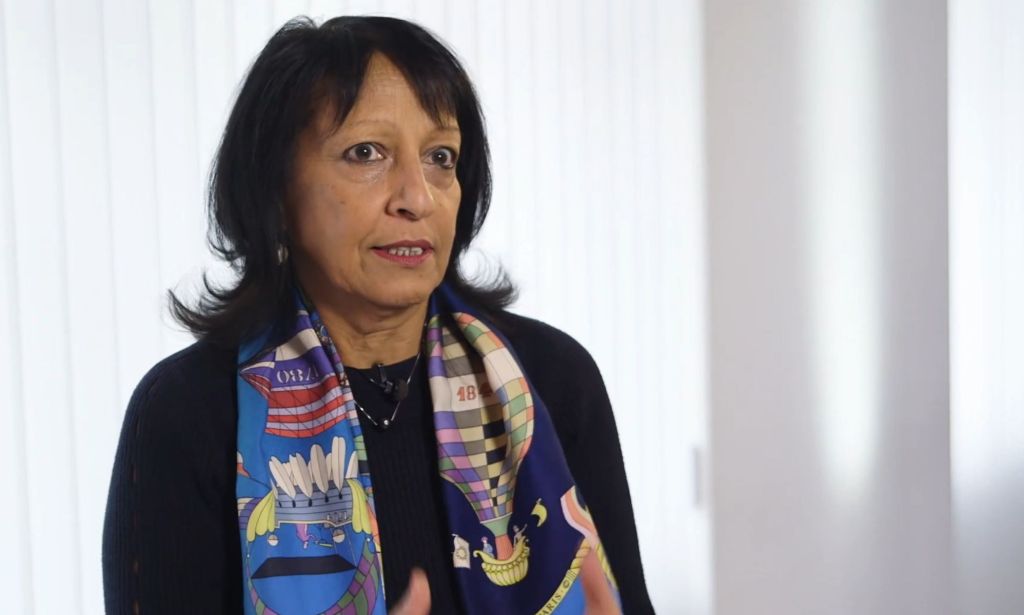
Kishwer Falkner, chair of the EHRC, has been criticised on a number of occasions for her stance on trans issues. (Youtube/UBS Center)
During the Quakers’ British Yearly Meeting on Sunday (25 May), officials criticised interim guidance brought by the Equality and Human Rights Commission (EHRC), which argued that trans people should be banned from all gendered facilities, including those associated with their birth sex.
The faith group argued the guidance “goes beyond the scope” of the ruling and refused to abide by it, adding: “It is non-statutory and therefore does not have the force of law. We see the Equality Act itself as our primary legal guide when making decisions.”
It further argued that the EHRC’s interim guidance misinterprets a ruling which is “already contested and subject to legal challenge.”
“Nevertheless, the Supreme Court judgment prompts Quakers in Britain to clarify our expectations of how toilet and changing facilities across our state can be used,” a statement continued.
Quakers to keep ‘trans-inclusive’ facilities, officials agree
Officials agreed that the faith group would continue to make its spaces “trans-inclusive”, arguing that it refuses to label something as a single-sex space if it is not “possible or desirable” to monitor facilities to check if they are “truthfully” single-sex.
You may like to watch
It will continue to provide “sufficient accessible facilities,” which it says will only be available for “those who need accessible facilities” and will “not normally be made available for general use to resolve issues around sex and gender, as this would further disadvantage people with disabilities.”
“The rights and inclusion of people belonging to our communities and using our buildings are not, and should not be, just about toilets,” a Trustee said during the meeting. “We will continue to work to make our corner of the Commonwealth of Heaven on Earth a more welcoming and accessible place. This is what Love requires of us.”
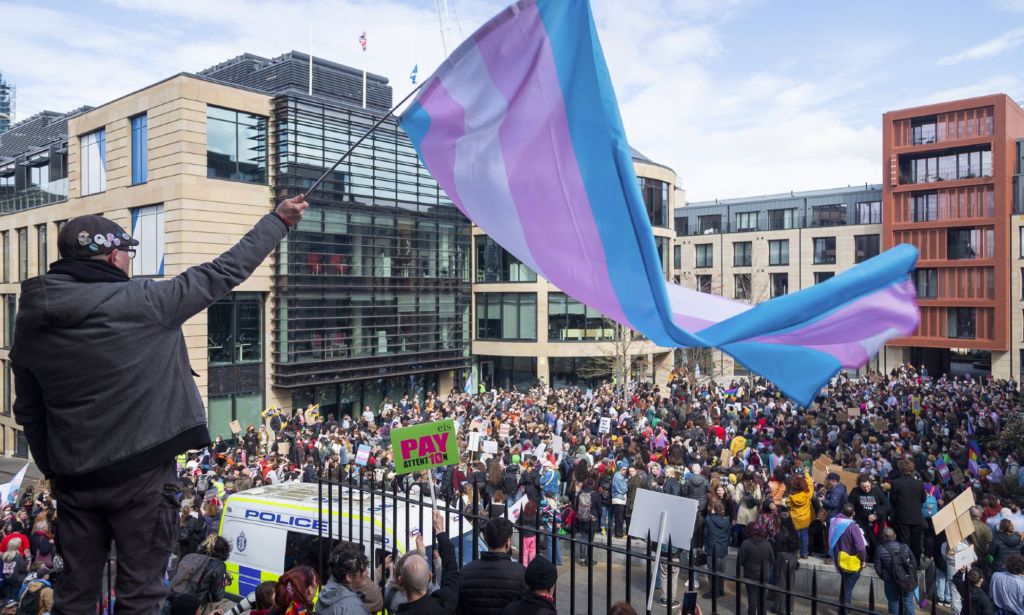
Protests took place in cities across the UK following the supreme court’s ruling. (Supplied/RTiE/Dave Morris)
The decision to maintain its trans-inclusive policies is consistent with the historical beliefs of the Quakers, who emphasise that a relationship with God can be achieved for everyone, regardless of their background.
“Belonging is being accepted as one’s true self”
In 2023, Quakers in Britain senior staff member, Paul Parker, joined more than 215 charities in signing a pledge to stand with trans people amid the rise of transphobia across the globe.
He told PinkNews at the time that it is a fundamental Quaker belief that “Belonging is being accepted as one’s true self.”
“Who are we to resist what God has created and continues to create in all their glory?” he said. “I want our Quaker communities and workplaces to reflect this fully.”
Despite this, Sex Matters founder and “gender-critical” pundit, Helen Joyce, attempted to lecture Quakers on their own beliefs, arguing to The Telegraph that 17th-century Quakers would be “shocked and ashamed” at the group’s commitment to inclusion.
More than a tax bill, the legislation, passed 215-214 in the early morning hours Thursday, couples tax cuts for corporations and the wealthy with profound structural changes to Medicaid and the Affordable Care Act, including provisions that would strip transgender people of access to transition-related care — even when privately insured. It’s a vision of health policy that experts told The Advocate weaponizes bureaucracy and budgetary authority to target one of the most marginalized groups in the country.
What Trump’s budget bill does to trans health
At the heart of the bill are two key provisions targeting transgenderhealth care. The first prohibits Medicaid and the Children’s Health Insurance Program from covering any gender-affirming services — puberty blockers, hormone therapy, surgeries — for people of any age. The second redefines what counts as an “essential health benefit” under the ACA, explicitly excluding transition-related care from private insurance plans regulated by federal standards.
Katie Keith, a scholar and director of the Center for Health Policy and the Law at the O’Neill Institute for National and Global Health Law at Georgetown University Law Center, told The Advocate the bill would “certainly increase health care costs for transgender people, both on those who have Medicaid coverage, but also those who have marketplace coverage as well.”
“By stripping federal funding for treatment for gender dysphoria, you’re imposing a whole set of barriers,” she said. “A primary one is cost. But I think it will also have the unintended — or maybe intended — consequence of deterring providers from offering this care at all.”
Keith, who previously served as deputy assistant to the president and deputy director of the White House Gender Policy Council under President Joe Biden, added that the essential health benefits provision could destabilize health coverage even for those outside ACA marketplaces.
“By proposing to exclude treatment for gender dysphoria from essential health benefits, this care would not be subject to cost-sharing limitations that apply to essential health benefits under the Affordable Care Act,” she explained. “If treatment for gender dysphoria is not considered an essential health benefit, transgender people — including those in job-based private health insurance — could face higher out-of-pocket costs for care that would otherwise be covered.”
Medicaid cuts and their fallout
The bill’s language goes beyond cost containment; it reengineers Medicaid to eliminate federal support for gender-affirming care, even in states that affirmatively cover it. As Adrian Shanker, a former Biden administration LGBTQ+ health adviser in the Department of Health and Human Services, told The Advocate, this would deliver a disproportionate blow to low-income trans people who rely on Medicaid
“Medicaid is the payer for low-income Americans, and it’s an essential safety net program,” Shanker said. “We know that trans people are disproportionately lower income and benefit from Medicaid in a higher percentage than the majority population. We know that’s even more pronounced among trans people of color and trans people who are from rural communities.”
A new study from the Williams Institute at UCLA underscores the scale of what’s at stake. Drawing on federal health data, the May report finds that approximately 1.8 million LGBTQ+ adults — nearly twice the rate of non-LGBTQ+ adults — rely on Medicaid as their primary source of health insurance. The burden is especially acute among transgender people, more than 185,000 of whom depend on Medicaid. These disparities, the authors note, are driven by intersecting inequalities — including disability, parenting responsibilities, and systemic economic disadvantage — that make Medicaid a lifeline for some of the most vulnerable in the LGBTQ+ community.
The legislation’s ripple effects would be especially catastrophic in states like Colorado, where budget constraints enshrined in the state constitution limit how leaders can respond to sudden federal funding shortfalls. Mardi Moore, executive director of Rocky Mountain Equality, told The Advocate that Colorado’s unique combination of a balanced budget requirement and the Taxpayer’s Bill of Rights (TABOR) would make it nearly impossible for the state to backfill the $10 billion the state receives annually in federal Medicaid funding.
TABOR, adopted by voters in 1992, is one of the most restrictive fiscal policies in the country. It caps state spending increases to a formula based on population growth and inflation — but inflation as experienced by government services, not consumers, Moore explained. TABOR also requires voter approval for any new taxes or tax increases, which means Colorado’s legislature cannot simply raise revenue or allocate extra funds to offset lost federal support without a ballot measure.
“The service gaps are going to widen, especially for LGBT communities, people of color, rural communities, low-income folks, and young people,” Moore said.
Why the bill targets trans health
The bill’s framing — slashing Medicaid to “pay” for tax cuts while targeting trans care — represents what critics have called a cruel calculus: appealing to a political base through culture war flashpoints. “This administration seems obsessed with the idea that their political goals are more important than the health and wellbeing of the American people,” Shanker said.
Moore, a longtime LGBTQ+ advocate, echoed that sentiment. “They know this is a winning issue for their base,” she said of the bill’s anti-trans provisions. “Our movement has not done a great job of getting information out about trans folks. The narrative that gender-affirming care is a choice and not medically necessary has taken hold. ‘Why should my tax dollars pay for your choice?’” she said. “That’s what we’re fighting.”
Even if the bill dies in the Senate, Moore argued that the damage has already been done. “The national narrative is starting to take hold in Colorado,” she warned. “There’s just not enough of us who care about others to make the community well.”
A broader strategy of erasure
Advocates for Trans Equality, the largest trans-led policy organization in the U.S., called the bill a calculated political attack. “This budget proposal is a direct, calculated attack on the lives and dignity of people across the country,” Sinead Murano-Kinney, the group’s health policy analyst, said in a statement. “These cuts clearly aim to make trans people and their healthcare into political scapegoats.”
Murano-Kinney pointed to a 2022 Williams Institute report showing that 21 percent of trans adults rely on Medicaid, likely due to high rates of employment discrimination and economic instability. “Denying access to this care would not only worsen physical and mental health outcomes but would deepen housing insecurity, exacerbate mental health crises, and increase rates of depression and suicidality among trans people.
“This is no accident — it is part of a broader political agenda driven by anti-trans extremists determined to force trans, nonbinary, and intersex people out of public life,” she added.
Insurance industry raises alarm
Notably, even the health insurance industry has balked at the logistical and financial burdens of carving out gender dysphoria care from essential health benefits. In public comments reviewed by the Center on Health Insurance Reforms at Georgetown, insurers such as the Blue Cross Blue Shield Association warned that banning care for gender dysphoria would create “significant operational burdens” and could inadvertently disrupt access to services used for other conditions, including cancer treatment, menopause care, and birth control procedures like vasectomies.
“This is just health care,” said Keith. “Many of these procedures are medically necessary for cisgender people, too. The only difference is who’s receiving the care.”
What comes next?
Keith said legal challenges are inevitable, but the immediate policy impact is clear: health care for most transgender Americans is at risk.
The Congressional Equality Caucus has condemned the bill, with Chair Rep. Mark Takano of California warning that 13.7 million Americans will lose their health insurance if it becomes law. “Attacks on the trans community are just the cherry on top,” Takano said. “Congress should be working to make healthcare more affordable — not banning medically necessary care or pulling the rug out from underneath millions who rely on Medicaid.”
The stakes are no longer hypothetical as the bill heads to the Senate.
“The word I just use over and over is cruel,” Moore said. “How much more cruel can you be, and what’s the point of this? Is the point really cruelty?”
In 2022, Utah Gov. Spencer Cox was the rare Republican governor who seemed to truly care about the well-being of transgender kids. “I don’t understand what they are going through or why they feel the way they do. But I want them to live,” he wrote in a letter that year, explaining why he was vetoing a bill that would have banned four trans middle- and high schoolers in Utah from playing on sports teams with classmates who shared their gender identity. “All the research shows that even a little acceptance and connection can reduce suicidality significantly.”
Meanwhile, nationally, Republican politicians were making opposition to trans rights a core tenet of their platforms, filing hundreds of bills attacking trans kids at the doctor’s office, at school, and on the field. Early in the 2023 legislative session, Cox capitulated, signing a bill that placed an indefinite “moratorium” on doctors providing puberty blockers and hormone therapy to trans kids with gender dysphoria. The bill ordered the Utah health department to commission a systematic review of medical evidence around the treatments, with the goal of producing recommendations for the legislature on whether to lift the moratorium. “We sincerely hope that we can treat our transgender families with more love and respect as we work to better understand the science and consequences behind these procedures,” Cox said at the time.
Now, more than two years later, that review is here, and its conclusions unambiguously support gender-affirming medical care for trans youth. “The conventional wisdom among non-experts has long been that there are limited data” on gender-affirming pediatric care, the authors wrote. “However, results from our exhaustive literature searches have lead us to the opposite conclusion.”
The medical evidence review, published on Wednesday, was compiled over a two-year period by the Drug Regimen Review Center at the University of Utah. Unlike the federal government’s recent report on the same subject, which was produced in three months and criticized gender-affirming pediatric treatments, the names of the Utah report’s contributors are actually disclosed on the more than thousand-page document.
The authors write:
The consensus of the evidence supports that the treatments are effective in terms of mental health, psychosocial outcomes, and the induction of body changes consistent with the affirmed gender in pediatric [gender dysphoria] patients. The evidence also supports that the treatments are safe in terms of changes to bone density, cardiovascular risk factors, metabolic changes, and cancer…
It is our expert opinion that policies to prevent access to and use of [gender-affirming hormone therapy] for treatment of [gender dysphoria] in pediatric patients cannot be justified based on the quantity or quality of medical science findings or concerns about potential regret in the future, and that high-quality guidelines are available to guide qualified providers in treating pediatric patients who meet diagnostic criteria.
In a second part of their review, the authors looked specifically at long-term outcomes of patients who started treatment for gender dysphoria as minors:
Overall, there were positive mental health and psychosocial functioning outcomes. While gender affirming treatment showed a possibly protective effect in prostate cancer in transgender men and breast cancer in transgender women, there was an increase in some specific types of benign brain tumors. There were increased mortality risks in both transgender men and women treated with hormonal therapy, but more so in transgender women. Increase risk of mortality was consistently due to increase in suicide, non-natural causes, and HIV/AIDS. Patients that were seen at the gender clinic before the age of 18 had a lower risk of suicide compared to those referred as an adult.
Submitted with the review was a set of recommendations—compiled by advisers from the state’s medical and professional licensing boards, the University of Utah, and a Utah non-profit hospital system—on steps the state legislature could take to ensure proper training among gender-affirming care providers, in the event it decides to lift the moratorium.
But according to the Salt Lake Tribune, legislators behind the ban are already dismissing the findings they asked for. In response to questions from the Tribune, Rep. Katy Hall, who co-sponsored the 2023 ban, issued a joint statement with fellow Republican state Rep. Bridger Bolinder, the chair of the legislature’s Health and Human Services Interim Committee, that dismissed the study’s findings. “We intend to keep the moratorium in place,” they told the Tribune. “Young kids and teenagers should not be making life-altering medical decisions based on weak evidence.”
Why ignore their own review? Polling, the legislators’ statement suggests. “Utah was right to lead on this issue, and the public agrees—polls show clear majority support both statewide and nationally,” Hall and Bolinder added in their statement. “Simply put, the science isn’t there, the risks are real, and the public is with us.”
Others, like former state Rep. Mike Kennedy, a co-sponsor of the 2023 ban who now represents Utah’s 3rd district in Congress, have so far been silent on the state review’s findings—as has Gov. Cox, who did not respond to the Salt Lake Tribune‘s request for comment.
In Trump’s new America, bathrooms have become politicized battlegrounds.
What may have seemed like an issue resolved in 2017 following the repeal of North Carolina’s infamous HB 2, bathroom bans targeting the trans community have once again made national headlines alongside a spate of new bills.
Nineteen states already have active laws that restrict transgender people from using restrooms that match their gender identity. Many of these bills are more extreme than those in previous years, with Florida and Utah—two states that have banned trans folks from using all government building restrooms that match their gender identity—threatening criminal penalties against violators. Florida’s law classifies the offense of using the bathroom and not leaving when asked as a first-degree misdemeanor, punishable by up to a year in prison and a $1,000 fine.
Photo on left by Whitney Brewer for Uncloseted Media.
To understand what these bans look like in practice, Uncloseted Media documented Briden Schueren, a trans man, legally using the women’s bathroom at the University of Cincinnati and Ashley Brundage, a trans woman, legally using the men’s bathroom at Tampa International Airport.
Whitney Brewer for Uncloseted Media.
Schueren, a 37-year-old art studio owner from Columbus, Ohio, walks across the University of Cincinnati’s campus, uncertain of where he can and can’t use the men’s restroom in his home state.
“What are the bills, what is getting passed in the House,” he told Uncloseted Media. “[Keeping up] is just exhausting.”
Ohio is one of seven states that ban transgender people from using bathrooms and facilities consistent with their gender identity in K-12 schools and specific government-owned buildings, including the University of Cincinnati.
Provided by a University of Cincinnati student.
The public research university made headlines and sparked outrage from LGBTQ advocates when it implemented restroom signs labeled “biological men” and “biological women” to enforce Ohio’s Senate Bill 104. They took the signs down after just one month of protests, with college administrators apologizing to students in an email, saying that the “biological” bathroom signs will be replaced and that they made an “error.”
But even with the removal of the signs, it’s still illegal for Schueren to use the men’s bathroom anywhere on the school’s campus, meaning if he wants to follow the law, he has to use the women’s bathroom or a gender neutral option that is “out of the way,” according to students.
Schueren says he felt uncomfortable entering a space where he knows he doesn’t belong. “I now have to be in this bathroom [even though] that’s not how I identify anymore socially and mentally,” he says. “I don’t belong there. As a masculine person with a very obvious beard, I feel like my bathroom is the men’s restroom.”
Brundage, a 44-year-old transgender woman from Tampa, Florida, has not used men’s restrooms for 16 years since she came out.
“It felt weird,” says Brundage, describing the moments before being forced by law to use the men’s restroom at the airport. “It was a little awkward, right? We wanted to make sure that we weren’t making anybody feel uncomfortable.”
Schueren says that being back in a bathroom that doesn’t align with his identity was painful.
Research from the International Journal of Transgender Health shows that 49% of transgender youth reported sometimes avoiding public bathrooms and 22% always avoided them. Youth who avoided bathrooms were nearly twice as likely to attempt suicide in the past year compared to those who never avoided public bathrooms. And a 2020 survey found that 85% of transgender youth who faced bathroom restrictions reported a persistent depressive mood.
“We already know that the suicide rates for trans individuals are highest amongst everybody, so it just could cause more,” says Schueren.
Whitney Brewer for Uncloseted Media.
Bathroom bans are not only emotionally taxing; they can be dangerous.
A 2025 report by the Williams Institute found that transgender people face increased risks when they are required to use bathrooms according to their sex assigned at birth. Transgender men were more likely to experience harassment when using the women’s restroom.
Schueren has faced harassment in both the men’s and women’s restrooms. In the early stages of his transition, he remembers entering a bathroom on his college campus and being followed by a man who knew he was trans. “He was making aggressive movements,” says Schueren.
The man stood outside the stall, punching his hand against the wall. “He was just so angry. … [H]e was much bigger than I was. He was making threats, saying I would ‘be injured.’”
For nearly 45 minutes, Schueren sat on the toilet and watched through the crack in the stall door as the man paced back and forth before finally departing. “I was just sitting in the bathroom shaking hysterically, waiting patiently for him to leave.”
Brundage, who ran for office for the Florida House of Representatives in 2024, sees a massive irony when far-right lawmakers claim these bans will keep women and girls safer.
“I also want to make sure that my kids are safe in bathrooms,” Brundage says. “The people who actually do harm in spaces … are typically cisgender men. And it’s like, ‘Who is the actual villain?’ We should be doing something to address the issue, not scapegoating transgender people.”
Congresswoman Nancy Mace, who has been vocal and accusatory on this issue, has used transgender slurs in press conferences and has framed her stance as a defense of “biological reality” against what she calls “radical gender-bending experimentation.”
In November 2024, she introduced a resolution to ban transgender women from using female facilities on federal property. When asked if the resolution was targeted toward Sarah McBride, the first openly transgender member of Congress, Mace said, “Absolutely.”
Even though McBride said she would follow House rules by using a private bathroom on Capitol Hill, Republican Congresswoman Lauren Boebert mistakenly confronted a cisgender woman in a Capitol bathroom, believing she was Rep. McBride.
Boebert reportedly said, “You shouldn’t be here,” before realizing her error and later apologizing.
In addition, earlier this month, two cisgender women were ordered to leave a Boston hotel after a security officer demanded one of them show identification to “prove” her sex while using the women’s restroom.
“We have to do a better job in the world linking bathroom hypocrisy to [discrimination],” Brundage says, drawing a line from today’s debates to Jim Crow laws from the 1960s, where Black Americans were banned from white-only bathrooms—part of a racist system that falsely promised “separate but equal.”
Whitney Brewer for Uncloseted Media.
Far-right media has created a narrative that allowing trans folks to use the bathroom that matches their gender identity is dangerous and unsafe, especially for young girls.
In 2021, Fox News aired 88 segments over a three-week period about a sexual assault at a Virginia high school, repeatedly suggesting that the incident was related to trans-inclusive bathroom policies. Fox host Will Cain claimed that the school’s “transgender policies led to [a father’s] teenage daughter being allegedly raped in the school bathroom by a man in a skirt.” These claims were false, as the school’s policy was implemented months after the assault.
In addition, transgender men are frequently indistinguishable from cisgender men. This means a male predator wouldn’t need to disguise himself to enter a women’s restroom in a state with a bathroom ban; he could simply claim to be trans.
“A law’s not gonna stop a gross, deranged perpetrator,” says Schueren. “They’re already breaking the law by being a person that wants to be a predator. So it’s not trans people that are doing this, it’s people that just break the law in general, and those tend to be cis [men].”
There is no empirical evidence that allowing trans individuals to use a bathroom of their choosing increases the risk of sexual assault.
Brundage says that beyond the misinformed narratives surrounding anti-trans legislation lies something far more practical and frustrating: a massive amount of wasted taxpayer dollars.
“We’re talking about this wasteful spending issue of trans people,” she says. “Meanwhile, do I have a realistic way to make a living? Am I paying too much for insurance? Do the roads have potholes where I live? All of these things that could actually really affect you on a day-to-day basis aren’t being discussed and aren’t being solved.”
Brundage notes the more than $215 million the Trump campaign and the GOP spent on anti-trans ads during the last election cycle.
She says the constant political targeting of trans people has psychological and social consequences.
“Could you imagine if someone was going to be the president … and every time they got on the microphone, they talked about all the people named Steve in the world, how awful they are, how crappy they are?” she says. “If your name is Steve, you’re going to feel really crappy eventually. You’re going to feel like the whole weight of the largest economy in the world is against you.”
Whitney Brewer for Uncloseted Media.
While using a bathroom isn’t something cis people have to think about, Schueren says it’s often on his mind, especially when crossing state lines. “I recently went on a road trip with a trans person and we both are at different stages of our transition,” he says.
Beyond the emotional toll and stress of planning where to use the bathroom, holding in urine can increase the risk of urinary tract infections, cause bladder discomfort, and—in the long-run—contribute to bladder dysfunction from overstretching.
With many states and the federal government adopting anti-transgenderpolicies, nearly half of the trans people in a Williams Institute survey have moved to a more welcoming state or are considering such a move.
The institute, located at the School of Law at the University of California, Los Angeles, surveyed 302 trans, nonbinary, and other gender-diverse American adults in December to gauge the effect of Donald Trump’s election on them. They are referred to under the umbrella term “transgender” in the report. Respondents could remain anonymous. More than a third were people of color, and more than 40 percent had an annual income under $50,000.
Forty-eight percent had either moved to a more trans-friendly state or were thinking about doing so. Twenty-three percent had already made such a move.
“Respondents who lived in less supportive local communities, those in states with laws and policies that were less supportive of transgender people, and those with concerns about the impact of Trump’s presidency on their access to health care, exposure to discrimination, and vulnerability to hate crimes, were more likely to want to move to a state they viewed as more trans-affirming,” says an executive summary of the findings, released this week. “Those with lower incomes were also more likely to want to relocate, even though they may lack the resources to do so.” (The full report is here.)
“When asked more specifically what cities or states they want to move to, most respondents mentioned progressive cities or politically liberal states, with California, Massachusetts, Minnesota, New York, and Washington Statefrequently named,” the summary continues. But many reported barriers to moving, particularly cost-related ones.
Among those working full-time or part-time in an unfriendly state, 14 percent were applying for jobs in more welcoming states, and 26 percent were considering this action.
Some respondents were considering international moves. Twenty percent said they very much wanted to move to another country, and 25 percent somewhat wanted to do so. There were barriers to this as well, including concerns about visas or other immigration regulations, health care, and language issues.
The anti-trans climate is affecting travel plans too. Thirty percent of respondents said they were traveling less frequently as a result of the 2024 election, and 70 percent said they would be much (48 percent) or somewhat (22 percent) less likely to go on vacation to states they view as less trans-friendly. About one-sixth said they had canceled travel plans to states they consider hostile or were considering cancellation.
“For those transgender people who do pursue relocating, service providers, businesses, and state and local governments should both consider the costs of losing members of their communities and support and welcome those who are making new homes,” the summary concludes. “Many transgender people will need resources to be able to move, and all will need to stay as informed as possible about what a move will and will not accomplish, given the rapidly changing policy landscape. Ultimately, whether or not most transgender people who want to move will be able to do so, the expression of a desire to move is a measure of the extreme pressure that transgender people are feeling about their and their families’ safety and health. Such pressure has mental health, physical health, and economic impacts on those who move and those who remain.”
“This survey was conducted in December 2024, so the desire to move and fears regarding travel for transgender people may be even more pronounced today,” lead author Abbie E. Goldberg, affiliated scholar at the Williams Institute and professor of psychology at Clark University, said in a press release. “Conversely, recent anti-transgender federal policies, which can affect even states with supportive laws, may have lessened the belief among transgender people that relocating will lead to significant improvement.”
“Whether or not the transgender people who want to move will ultimately be able to relocate, the desire to move is a measure of the extreme pressure that transgender people are feeling about the safety and health of themselves and their families,” added author Brad Sears, distinguished senior scholar of law and policy at the Williams Institute. “That pressure has mental health, physical health, and economic impacts on those who move and those who stay.”
An earlier release of the survey findings, which came out in March, noted that many trans people were worried about their access to gender-affirming careunder the Trump administration, were planning to downplay their trans identity, and were taking steps to protect themselves and their families.
A school in the Escambia County Public Schools of Pensacola, Florida, is refusing to call out the chosen name of a transgender student during an upcoming high school graduation ceremony or to print his name on his diploma.
The student’s supportive parents are now asking their son’s school to change their decision, saying it’s based on a vague and “unwritten” school policy that contradicts years of educators respectfully using their son’s chosen name in school.
The student’s mother, Charline Barger, said that her son will graduate from Escambia Virtual Academy on May 27. However, when she reached out to the academy’s director, Lisa Morgan, she told Barger that honoring her son’s request to be called by his chosen name would violate school district practice and “be a big hassle” since some students may use inappropriate nicknames, Barger told The Pensacola News Journal.
“It has been our practice to announce full legal names, as they appear on birth certificates and diplomas, at commencement ceremonies,” Escambia County Public Schools Superintendent Keith Leonard told the aforementioned publication. Barger noted that while her son has not legally changed his name to his chosen name, Morgan did agree to address him at the ceremony by calling out the first initial of his legal birth name, followed by his legal middle and last names, but his diploma will list his full legal name.
Barger has said that she wants to raise awareness about the district’s “harmful practice,” saying, “This is not just for him, but for any student whose identity isn’t being honored at this once-in-a-lifetime moment.” She said that many LGBTQ+ students experience supportive environments in the district’s schools and classrooms and that the support should continue throughout graduation.
“It’s about a student standing tall, hearing their real name called, and walking proudly across that stage. To deny that moment is to deny their identity,” she added. “It may seem like a small moment to those calling the names, but for the students on that stage, it’s everything.”
Florida has recently passed several anti-trans laws, including one that restricts instruction on LGBTQ+ issues in public schools; one banning trans students from playing on school sports teams matching their gender identity; one restricting trans access to bathrooms in any state school, state university, or government building; one preventing gender marker changes on birth certificates, state IDs, and drivers lisences; and another preventing state Medicaid funds from covering gender-affirming medical care for all trans people.
The restrictive laws have resulted in trans people and their families fleeing the state for “sanctuary states” with more supportive trans policies. An August 2023 survey from the Human Rights Campaign found that 36% of other LGBTQ+ adults want to or plan to move out of Florida because of gender-affirming care bans, and almost 80% of other LGBTQ+ adults feel less safe in the community as a result of bans on gender-affirming care.
GLAAD has announced the findings of its fifth annual Social Media Safety Index (SMSI), an annual report on LGBTQ safety, privacy, and expression online.
The in-depth report analyzes six major social media platforms — TikTok, YouTube, X, and Meta’s Facebook, Instagram, and Threads — across 14 indicators that address a range of issues affecting LGBTQ people online including data privacy, content moderation, workforce diversity, and more. All companies are failing to meet basic standards across most safety metrics on the SMSI scorecard.
Offering a quantitative ranking and also highlighting LGBTQ safety policy rollbacks from major platforms, the report is a wake-up call for tech leaders and employees at major platforms and for all of Silicon Valley.
As the report shows, rollbacks from some companies eerily mirror recent changes to federal websites and communications that were implemented by the Trump administration from Project 2025 (notably, Project 2025 calls for “deleting the terms sexual orientation and gender identity.”)
In January, YouTube quietly removed “gender identity” from the list of protected characteristics in its hate speech policy, and Meta removed major components of its hate speech policy protections for LGBTQ people, including adding language expressly stating it is now allowed to refer to LGBTQ people as “abnormal” and “mentally ill.” In its policy revision, Meta also uses the terms “homosexuality” and “transgenderism” — a well-known, right-wing anti-trans trope — in reference to LGBTQ people.
Although YouTube claims that “our hate speech policies haven’t changed,” it is an objective fact that, sometime between January 29th and February 6th, the company removed “gender identity and expression” from its list of protected characteristics (the change is visible here in the current and archived policy page). The SMSI report calls out this unprecedented break from best practices in the field of trust and safety, stating that: “YouTube should reverse this dangerous policy change and update its Hate Speech policy to expressly include gender identity and expression as a protected characteristic.”
These shifts — among others — undermine the safety of LGBTQ people and other historically marginalized groups, who are uniquely vulnerable to hate, harassment, and discrimination online and off.
All companies are failing to meet basic standards across most safety metrics on the SMSI scorecard. Out of a possible 100, the platforms received the following scores:
“At a time when real-world violence and harassment against LGBTQ people is on the rise, social media companies are profiting from the flames of anti-LGBTQ hate instead of ensuring the basic safety of LGBTQ users,” said GLAAD President and CEO Sarah Kate Ellis. “These low scores should terrify anyone who cares about creating safer, more inclusive online spaces.”
The quantitative methodology of GLAAD’s Platform Scorecard was created in partnership with Ranking Digital Rights (RDR) and research consultant Andrea Hackl. This year, GLAAD introduced a new scoring methodology that generated numeric ratings for each platform with regard to LGBTQ safety, privacy, and expression. The Platform Scorecard focuses on the existence of policies, and does not measure the enforcement of those policies. The 2025 scores are not directly comparable to the 2024 scores due to extensive revising of the Scorecard methodology.
The Social Media Safety Index includes specific findings and recommendations for each company, and calls on companies to urgently and tangibly prioritize LGBTQ safety. The report also highlights the volume of online anti-trans hate, harassment, and disinformation that has skyrocketed in the past year, a trend that GLAAD has qualitatively examined in the SMSI report.
Alongside these rollbacks in LGBTQ protections online, GLAAD’s Anti-LGBTQ Extremism Reporting Tracker has shown a distinct upwards trend in offline anti-LGBTQ incidents in recent years. These include both criminal and non-criminal instances of harassment, vandalism, and assault motivated by anti-LGBTQ hate.
Social media platforms are vitally important for LGBTQ people, as spaces where we connect, learn, and find community. Although today’s social media landscape does indeed look dire, it is heartening that some platforms have implemented positive initiatives in the past year. For Pride month in 2024, TikTok created their LGBTQIA+ TikTok Visionary Voices List and YouTube offered the Celebrate Pride on YouTube LGBTQ creators spotlight. In this current moment, as LGBTQ people face unprecedented attacks on our civil and human rights, now is the time for all companies to stand up for inclusive values and provide LGBTQ communities with the safety protections we need, and the celebratory and affirming messages we deserve.
Key Findings of the 2025 SMSI include:
Recent hate speech policy rollbacks from Meta and YouTube present grave threats to safety and are harmful to LGBTQ people on these platforms.
Platforms are largely failing to mitigate harmful anti-LGBTQ hate and disinformation that violates their own policies.
Platforms disproportionately suppress LGBTQ content, via removal, demonetization, and forms of shadowbanning.
Anti-LGBTQ rhetoric and disinformation on social media has been shown to lead to offline harms.
Social media companies continue to withhold meaningful transparency about content moderation, algorithms, data protection, and data privacy practices.
GLAAD’s Key Recommendations:
Strengthen and enforce (or restore) existing policies and mitigationsthat protect LGBTQ people and others from hate, harassment, and misinformation; while also reducing suppression of legitimate LGBTQ expression.
Improve moderation by providing mandatory training for all content moderators (including those employed by contractors) focused on LGBTQ safety, privacy, and expression; and moderate across all languages, cultural contexts, and regions. AI systems should be used to flag for human review, not for automated removals.
Work with independent researchers to provide meaningful transparency about content moderation, community guidelines, development and use of AI and algorithms, and enforcement reports.
Respect data privacy. Platforms should reduce the amount of data they collect, infer, and retain, and cease the practice of targeted surveillance advertising, including the use of algorithmic content recommender systems, and other incursions on user privacy.
Promote and incentivize civil discourse including working with creators and proactively messaging expectations for user behavior, such as respecting platform hate and harassment policies.
GLAAD’s SMSI Platform Scorecard draws on RDR’s standard methodology to produce numeric ratings for each platform with regard to LGBTQ safety. This year, GLAAD added elements addressing emerging threats to LGBTQ people online as well as an indicator regarding content that promotes so-called “conversion therapy,” a practice that has been banned in 23 states and condemned by all major medical, psychiatric, and psychological organizations.
GLAAD and other monitoring organizations repeatedly encounter failures in enforcement of a company’s own guidelines for content moderation, including hate speech and harassment policies.
Specific LGBTQ safety, privacy, and expression issues identified in the SMSI include: Inadequate content moderation and problems with policy development and enforcement (including failure to mitigate anti-LGBTQ content and over-moderation of LGBTQ users); harmful algorithms and lack of algorithmic transparency; inadequate transparency and user controls around data privacy; an overall lack of transparency and accountability across the industry, among many other issues — all of which disproportionately impact LGBTQ people and other marginalized communities.
“We need to hold the line — as tech companies are taking unprecedented leaps backwards, we remain firm in advocating for basic best practices that protect the safety of LGBTQ people on these platforms,” said GLAAD’s Senior Director of Social Media Safety Jenni Olson. “This is not normal. Our communities deserve to live in a world that does not generate or profit off of hate.”
About the GLAAD Social Media Safety Program As the leading national LGBTQ media advocacy organization, GLAAD is working every day to hold tech companies and social media platforms accountable and to secure safe online spaces for LGBTQ people. The GLAAD Social Media Safety Program produces the highly-respected annual Social Media Safety Index (SMSI)and researches, monitors, and reports on a variety of issues facing LGBTQ social media users — with a focus on safety, privacy, and expression.
The average American spends over three hours on their phone every day, and nearly half of U.S. teens say they’re on the Internet almost “constantly.”
While most of us understand that not all of our data is private, the scope of how much U.S. government agencies can access is overwhelming: Internet history, private messages, health information, political affiliation and phone location data are all up for grabs.
“We are constantly shedding data as we go about our daily lives,” says Lisa Femia, staff attorney at Electronic Frontier Foundation (EFF), a digital rights advocacy group. She says with no comprehensive Federal data privacy law, there’s little legal protection surrounding our digital rights.
This lack of regulation has unique implications for LGBTQ people, especially under the current Trump administration. In March 2025, the Department of Homeland Security’s Office of Intelligence and Analysis removed protections for LGBTQ identities from its restrictions on gathering intelligence. That means queer people are no longer a protected class when it comes to surveillance efforts.
This occurred off the back of Trump’s January Executive Order, “Protecting Children From Chemical and Surgical Mutilation,” that attempts to ban trans kids’ access to healthcare. In addition, laws banning gender-affirming care have passed in at least 24 states across the country, creating a perfect storm for the government to use digital surveillance to capture folks trying to access what advocates describe as “lifesaving” treatment.
“When our identities are being criminalized or stigmatized, record keeping, if it’s not done well, can be a massive, massive tool for oppression,” says Shae Gardner, policy director at the LGBT Technology Institute.
So what capabilities do law enforcement agencies and the government have when it comes to monitoring LGBTQ folks looking for resources like gender-affirming care? What are the implications for trans youth who are seeking this care out of state? And what can you do to protect yourself?
Data Brokers
One alarming way third parties—including marketers, scammers, private investigators, tech companies, retailers and law enforcement—can access your digital footprint is through data brokers. These businesses exist solely to collect individuals’ online data to sell for profit. They have access to highly sensitive data from companies, apps and websites that collect information on people. They also indirectly gather data from public records such as voting registries. In the U.S., their work is virtually unregulated.
“Data brokers can access our home addresses, telephone numbers, political preferences, location data, online purchases and much more,” says Gardner. “Users don’t even know that their data is available to be sold.”
There may be up to 5,000 data brokers globally, and out of the top 23 data brokerage companies in the world, 17 are in the U.S. These brokers have profiles on millions of Americans.
Through third-party apps, they can even access our health data, putting our sensitive medical information at risk. For example, after the overturning of Roe v. Wade in 2022, privacy experts were concerned that data collected by Flo, the period tracking app, could be misused, given its history of passing the health details of its users to third parties.
Because of this, Femia says it’s becoming “harder and harder for people to get the care they need, the support they need, or be who they are, without leaving a trail that a hostile law enforcement agency or state government or federal government could use to target them.”
In some cases, the government has used the “Data Broker Loophole”—a gap in the Electronics Communications Privacy Act—to bypass legal requirements of obtaining warrants and subpoenas for data and instead purchasing it directly from private brokers. In Trump’s first term, it was discovered that his Department of Homeland Security (DHS) bought cellphone location data to detect possible illegal border crossings.
One data broker, Babel Street, created a tool named Locate X—used by the Secret Service and DHS—which gathers smartphone location data to monitor people worldwide without a warrant. In practice, this is meant to help the government track serious criminal activities. But with increasing animus towards the trans community, it could potentially be used to track the movements of doctors working at gender-affirming care clinics or trans people seeking care.
“It’s not a federal agent following you home anymore. It’s someone tracking your location on your phone,” says Gardner.
While there are no documented instances of the government using this data surveillance to track folks looking for trans healthcare, that’s not the case when it comes to reproductive healthcare. In 2023, an Idaho woman and her son were charged with taking the son’s girlfriend to Oregon to get an abortion, using her cellphone location data as evidence.
And in 2024, one company used location data broker Near Intelligence to track people’s visits to nearly 600 Planned Parenthood locations across 48 states and sold the data to feed a massive anti-abortion ad campaign funded by Veritas Society, a pro-life activist group.
On a now-deleted page on the organization’s website, they proudly cite that they use Near Intelligence’s advanced digital technology known as “Polygonning” to “identify and capture the cell phone ID’s of women that are coming and going from Planned Parenthood and similar locations. We then reach these women on apps, social feeds and websites like Facebook, Instagram, Snapchat with pro-life content and messaging.”
Education
In addition to data brokers, American kids are being monitored when they use computers provided by their schools. The Center for Democracy and Technology (CDT) reported an increase in surveillance software to monitor online activity on school-owned devices. In fact, 81% of teachers reported that their schools use some form of monitoring software and 71% reported it being used on school-issued devices, allowing schools to survey children outside of teaching hours.
“These tools provide teachers and schools with the ability to … view students’ email, messaging, and social media content, view the contents of their screens in real time, and other monitoring functionality,” CDT reports.
While companies like GoGuardian claim to use their surveillance tools to mitigate potential security threats and monitor students’ mental health, privacy experts warn that these tools put children in homo/transphobic states at risk of their data being weaponized by their educators and law enforcement.
Subscribe for LGBTQ-focused investigative journalism.
“Schools can specifically ask these programs to flag any LGBTQ content,” says Eleni Manis, research director at the Surveillance Technology Oversight Project. “So school surveillance software is already in place to provide a dragnet for flagging kids who are LGBTQ, or just exploring their sexuality.”
In 2023, EFF found that GoGuardian software in the Lake Travis Independent School District in Texas flagged over 75 websites with the terms “transgender,” “LGBT,” “gay,” “homosexual,” “non-binary” or “queer” in the URL. Websites that were flagged included the Wikipedia pages for the Transgender Rights Movement and for the portrayal of transgender people in film; an article from The Guardian about transgender history; and a page about the Gay Men’s Chorus of Washington, D.C.
In addition to blocking kids from visiting LGBTQ-themed websites, states like Alabama have passed bills that require school personnel to inform parents if a minor expresses a gender identity that is inconsistent with their biological sex. School personnel can enforce these bills through the surveillance of school-owned devices.
“It’s going to disproportionately affect kids who are middle or low-income, kids who don’t have the resources to have their own private iPad or laptop,” says Manis. In states where gender-affirming care for kids is illegal, questions also arise surrounding what will be done with the data—will it be used to discipline the child or even shared with law enforcement?
Manis says this software turns schools into another branch of America’s invasive surveillance apparatus. “It’s very difficult for those programs to stop flagging LGBTQ students even if they want to. It’s the first place conservative, anti-trans or anti-LGBTQ districts can go to [for evidence],” she says.
Medical Records
Photo by Fotofrog.
Beyond the classroom, the medical information of child and adult patients is at risk of being compromised.
“Medical records give you a patient’s name, prescriptions, doctor’s name, practice name, everything that you need to launch an investigation or prosecution. Same thing for prescription records. Pharmacy’s prescription records will tell you who wrote a prescription, when it was filled, who filled it,” says Manis.
While patients speak frankly with their doctors based on confidentiality, there have been instances where local governments—and even doctors—have violated patients’ right to medical privacy in the name of criminal prosecutions.
In 2023, Dr. Eithan Haim, a Dallas surgeon, leaked sensitive data about children receiving transition-related care at Texas Children’s Hospital to a conservative activist who published the documents in a magazine.
Although what Dr. Haim did was illegal, the Department of Justice dropped their charges against him in January, the same week Trump passed the EO banning gender-affirming care for trans kids.
Additionally, in 2023, Vanderbilt University Medical Center handed over records for more than 100 current and former patients seeking transgender health care to Attorney General Jonathan Skrmetti as part of an investigationinto possible violations of the Tennessee Medicaid False Claims Act.
“It’s a terrifying precedent because it works, even though it shouldn’t,” says Manis.
HIPAA laws permit disclosures of protected health information if they are made to prevent a serious and imminent threat to health or safety, creating a loophole for local governments to work around. “The loophole is large enough that when a law enforcement agency comes knocking at a hospital’s door and asks for medical records in connection with an ongoing investigation, states typically cooperate.”
In other words, if the Trump administration wanted to come for patients, there’s a model to follow, and HIPAA laws may not protect you.
Camera Surveillance
On top of all of this, automated license plate readers (ALPRs) are “commonplace” in policing. ALPRs are camera systems that capture the license plate data of passing vehicles. Nearly 90% of sheriff’s offices with more than 500 sworn deputies use ALPRs, as well as every single police department that serves over 1 million people.
“No specific federal legislative framework exists that governs federal law enforcement use of ALPRs,” according to a 2024 report by the Library of Congress. That means law enforcement agencies can access the data, store it for as long as they need, and officers are not required to demonstrate probable cause before accessing it.
A 2013 report by the American Civil Liberties Union found that license plate readers check plate numbers against “hot lists”—plates that have been uploaded to the system—to alert a law enforcement agency if a match appears. According to EFF, the data is often managed by private companies and data brokers.
In 2024, it was revealed that Sacramento authorities were collecting license plate data and sharing it with law enforcement agencies in other states. In their investigation, the Sacramento County Grand Jury expressed concern that the “data could be used to track individuals based on immigration status, place of worship, employment locations, or visits to places such as gun stores or hospitals. Particularly troubling was the potential sharing of ALPR data with other states whose citizens travel to California to seek an abortion, which has been banned or severely restricted in their home states.”
“By using camera footage surveillance, you can track where people are going and you might see a person going to a clinic, or to an LGBTQ center and use that to aid an out-of-state prosecution saying a parent let their kid get gender-affirming care,” Femia says.
How Can You Maintain Your Privacy?
Despite the various ways you can be monitored, experts say individuals can protect themselves from digital surveillance by using encrypted messaging apps like Signal and more secure search engines like DuckDuckGo. They also recommend using Virtual Private Networks to encrypt your Internet traffic. Finally, they recommend turning your phone off when going to protests or other LGBTQ-themed events so data brokers can’t track your location.
But there’s only so much individuals can do. “It’s really important that we don’t fall into the trap of thinking that this is our fault and our problem to solve, or that you can protect your privacy just by changing some settings on your phone,” says Evan Greer, director of digital advocacy group Fight for the Future. “We need to fight for policies that protect people. … The reality is, this is a collective societal problem, and it should be addressed at a broad scale by enacting policies that protect people’s basic human rights.”
States like California and New York are passing shield laws to protect individuals and cement themselves as data sanctuary states. These laws give consumers more control over the personal information that businesses collect about them and limit the disclosure of their personal data to out-of-state entities.
But “the way data travels doesn’t respect state lines. So the idea that there are differing protections once you hit a state border is kind of silly,” Gardner says. “Any time the states, no matter how well-intentioned, are attempting to build data protections, they’re doing it on a wobbly table that really doesn’t have a base because there are [no comprehensive federal protections].”
Greer cites the European Union’s General Data Protection Regulation as an aspirational framework for the U.S. It’s a law enforced in 2018 that grants individuals the right to their personal data.
“What we really, really need is federal privacy protections. We need to enshrine rights to gender-affirming care in federal law. That’s the only thing that would truly protect trans and non-binary Americans. It doesn’t look like we’re gonna get that in the short run,” says Manis.
**For more information on how to control your data, the Digital Defense Fund has a presentation here.
If objective, nonpartisan, rigorous, LGBTQ-focused journalism is important to you, please consider making a tax-deductible donation through our fiscal sponsor, Resource Impact, by clicking this button:
Military commanders will be told to identify troops in their units who are transgender or have gender dysphoria, then send them to get medical checks in order to force them out of the service, officials said Thursday.
A senior defense official laid out what could be a complicated and lengthy new process aimed at fulfilling President Donald Trump’s directive to remove transgender service members from the U.S. military.
The new order to commanders relies on routine annual health checks that service members are required to undergo. Another defense official said the Defense Department has scrapped — for now — plans to go through troops’ health records to identify those with gender dysphoria.
Instead, transgender troops who do not voluntarily come forward could be outed by commanders or others aware of their medical status. Gender dysphoria occurs when a person’s biological sex does not match up with their gender identity.
The defense officials spoke on condition of anonymity to provide details of the new policy. The process raises comparisons to the early “don’t ask, don’t tell” policy, which at times had commanders or other troops outing gay members of the military who — at the time — were not allowed to serve openly.
Active-duty troops will have until June 6 to voluntarily identify themselves to the Defense Department, and troops in the National Guard and Reserve have until July 7.
The department is offering a financial incentive to those who volunteer to leave. They will receive roughly double the amount of separation pay than those who don’t come forward.
Initially, officials said the Defense Department would begin going through medical records to identify anyone who did not come forward voluntarily. That detail was not included in the new guidance released Thursday.
While the department believes it has the authority to review medical records, it would rather go through a more routine health assessment process, the defense official said. Traditionally, all service members go through a health assessment once a year to determine if they are still medically able to serve.
A new question about gender dysphoria is being added to that assessment. Active-duty troops who do not voluntarily come forward would have to acknowledge their gender dysphoria during that medical check, which could be scheduled months from now.
A unit commander could expedite the health assessment.
Under the new policy, “commanders who are aware of service members in their units with gender dysphoria, a history of gender dysphoria, or symptoms consistent with gender dysphoria will direct individualized medical record reviews of such service members to confirm compliance with medical standards.”
The defense official said it is the duty of the service member and the commander to comply with the new process. The department is confident and comfortable with commanders implementing the policy, and it does not believe they would use the process to take retribution against a service member, the senior defense official said.
It comes after the Supreme Court recently ruled that the Trump administration could enforce the ban on transgender people in the military while other legal challenges proceed. The court’s three liberal justices said they would have kept the policy on hold.
Officials have said that as of Dec. 9, 2024, there were 4,240 troops diagnosed with gender dysphoria in the active duty, National Guard and Reserve. But they acknowledge the number may be higher.
There are about 2.1 million total troops serving.
In a statement, Pentagon spokesman Sean Parnell said earlier this month that about 1,000 troops already have identified themselves and “will begin the voluntary separation process” from the military. That can often take weeks.
Trump tried to ban transgender troops during his first term, while allowing those currently serving to stay on. Then-President Joe Biden overturned the ban.
The new policy does not grandfather in those currently serving and only allows for limited waivers or exceptions.
Trump and Defense Secretary Pete Hegseth allege that troops with gender dysphoria don’t meet military standards. Hegseth has tied his opposition to a campaign to rid the department of “wokeness.”
“No More Trans @ DoD,” Hegseth wrote in a post on X. In a recent speech to a special operations conference, he said: “No more dudes in dresses. We’re done with that s—.”
As President Donald Trump intensifies his second-term campaign to roll back LGBTQ+ rights, new polling suggests that his relentless attacks on transgenderpeople are gaining traction with the public, despite broad disapproval of his presidency overall. LGBTQ+ advocates say this slide requires accurate media representation of trans lives
Public opinion is shifting to restriction
According to a national survey released Saturday by the Associated Press-NORC Center for Public Affairs Research, a majority of Americans—68 percent—now say gender is determined by sex assigned at birth. Two-thirds oppose public insurance programs like Medicare or Medicaid covering gender-affirming carefor minors. And nearly half of the respondents support banning such care for trans youth altogether, regardless of who pays for it.
Among Republicans, opposition to both youth and adult access to gender-affirming care is overwhelming. Independents are more likely to oppose than support, and even among Democrats, 44 percent oppose public coverage of care for minors, while only 30 percent support it. Resistance also extends to transgender adults, with nearly one-third of Democrats and most independents and Republicans expressing disapproval of publicly-funded care.
Yet, in one area, public sentiment is more complex. When asked whether transgender men and women should be allowed to serve in the military, 37 percent of adults said yes, while 26 percent opposed it. Thirty-six percent remained neutral. That split, which shows greater openness than on other trans-related issues, may reflect years of advocacy and public storytelling from transgender service members, especially amid ongoing legal challenges to Trump’s renewed military ban.
A misinformation strategy that’s working
Despite widespread disapproval of his leadership—Trump’s overall job approval stands at 41 percent—his approval rating on handling transgender issues is nearly 10 points higher. That disparity has alarmed LGBTQ+ advocates, who say it reflects the success of targeted disinformation and a coordinated right-wing strategy to scapegoat trans people for political gain.
Caleb Smith, LGBTQI+ Policy Director at the Center for American Progress, said the findings reveal the results of years of manufactured outrage and misinformation. “The poll released by AP-NORC shows much of what we expect to see after years of the right’s relentless, unscientific, partisan attacks on transgender people,” Smith told The Advocate. “While Trump’s approval rating is historically, alarmingly low, it’s easy to look at these numbers and think anti-trans messages are a winning issue for him. In reality, he’s far underwater on most topics, and the slight approval bump Trump may get from targeting transgender people seems to be more of a pool noodle rather than the life raft his presidency needs to get back towards national approval.”
Visibility gap fuels misunderstanding
Smith added that the poll underscores the urgent need for solidarity and continued visibility. “It’s concerning to see any part of the country agree with anti-trans rhetoric, and it’s crucial for us to continue to show strong and vocal support for the transgender community—particularly transgender young people. No poll detracts from the reality that transgender people—just like the rest of us—deserve to be treated with dignity and respect, deserve access to health care, and deserve not to be obsessively targeted by an administration looking for cheap political wins.”
Part of the challenge, LGBTQ+ advocates say, is visibility. According toGLAAD’sAccelerating Acceptance 2023 study, less than 30 percent of non-LGBTQ+ Americans say they know a transgender person.
The ongoing shift in public attitudes is occurring alongside an unprecedented nationwide assault on LGBTQ+ rights. According to the American Civil Liberties Union, at least 575 anti-LGBTQ+ bills have been introduced in state legislatures across the country in 2025 alone. These bills target everything from accurate IDs and school bathroom access to gender-affirming health care and free speech in classrooms. The ACLU warns that even proposals that fail to pass into law still fuel a climate of fear, spread harmful misinformation, and deepen stigma against LGBTQ+ people.
Executive orders and legal battles
Although he began with transphobic ads during the 2024 election, Trump’s renewed attacks on transgender rights started the moment he returned to power. On Inauguration Day, he signed Executive Order 14183, declaring that the federal government would no longer recognize transgender or nonbinary people. The directive redefined sex in federal policy strictly as male or female based on birth characteristics, and ordered agencies to strip references to gender identity from all guidance, services, and legal protections. Passports, Social Security records, school policies, and shelter access are among the areas now being rewritten to exclude transgender Americans.
At the same time, his administration has revoked federal funding for gender-affirming health care, moved to bar transgender students from using bathrooms aligned with their gender identity, and resumed enforcement of a military ban targeting trans service members.
In March, U.S. District Judge Ana Reyes blocked enforcement of Trump’s military ban, ruling in Talbott v. United States that the policy likely violates constitutional protections. Reyes called the ban “soaked in animus and dripping with pretext,” and cited the Department of Defense’s data showing that the military spends far more on Viagra than it does on trans-related care. Last week, while considering a stay on a preliminary injunction in a similar case, Shilling v. USA, the U.S. Supreme Court allowed the ban to go into effect while appeals continued, handing Trump a temporary legal victory.
“We can beat back the bullshit”
At a recent EMILY’s List gala in Washington, D.C., U.S. Rep. Sarah McBride—the first out transgender member of Congress—confronted the political strategy behind these attacks. “Every single time they say the word ‘trans,’ look at what they’re doing with their grubby hands,” she said. “They’re trying to pick the pocket of American workers.”
McBride vowed she would not be used as a distraction for the GOP’s broader economic agenda. “I’m not going to let them bait me into a fight that simply rewards their attempt at 15 minutes of fame,” she said. “We can beat back the bullshit. We can win back power.”
GLAAD warns against interpreting public opinion as a legitimate gauge of civil rights. “There are going to be a few problems with a poll that asks people about the human rights of other people,” a spokesperson told The Advocate. “In this country, we are guaranteed the right to be treated equally and not be discriminated against, and that is not up to public opinion.”
The GLAAD spokesperson highlighted that of the few Americans who say they know a trans person, fewer still understand the medical, legal, or familial realities of their lives, especially as right-wing politicians and donors pour resources into misinformation campaigns.
“The poll shows it remains urgent that media include transgender voices in stories about trans people. The poll shows support for transgender people in the military after months and years of GLAAD and others in the community helping trans troops bravely tell their own stories while they show up every day to capably and honorably serve,” the spokesperson said. “When you meet and get to know people in person or through inclusive and accurate stories, understanding and acceptance grow.”