Stephanie Vigil, a queer Colorado state legislator, flipped her district from Republican to Democrat. Now, she’s ready to make some other changes.
While the GOP has launched repeated attacks on transgender students nationwide, a local effort to prevent teachers from asking a teenager about their preferred pronouns has spawned a response from Vigil.
She’s introduced a bill requiring teachers to use a student’s preferred name in the classroom. Deadnaming a trans student would be considered discrimination.
“Making sure that we can create space for them to be seen and heard as their true self is very important,” said Nadine Bridges, the executive director of One Colorado, told the local news after the bill was introduced. “It’s a great opportunity to kind of create equity and inclusion in schools.”
A controversial effort by a school board that would have prevented school staff from accommodating trans students was ultimately defeated after students, parents, and activists objected.
“I’m kind of old-fashioned,” one school board member said at the time. “I know a boy when I see one, and I know a girl when I see one.”
The board has reservations about the proposed law too, insisting that “parents are responsible for determining the upbringing, education, care, and moral development of their child.”
“Parents do have the right, for their specific child, to make whatever decisions they deem best for that young person,” Bridges said. “They do not have the right to make decisions for every student that attends a charter school or a public school.”
“We’re talking about pronouns and names and making sure that a young person can be seen as their authentic selves. Why wouldn’t anybody want to create space for that?”
The bill would also create a task force to “examine existing school policies and provide recommendations to schools on how to best implement student non-legal name change policies.”
In an article published in the opinion section of The New York Times, opinion columnist Pamela Paul wrote a 4,500-word article filled with factual errors and unfounded assumptions about transgender care and the lived experiences of transgender people. Although the article is presented as a piece on detransitioners, the interviews serve as vehicles through which Paul packages inaccuracies and disinformation with faulty citations and claims that are not supported by the evidence she presents. The article is the latest in a seriespublished by The New York Times to do so, and a simple fact check of the claims presented easily debunks the article’s central premises as highly misleading.
It is notable that this is not the first time Paul has waded into LGBTQ+ issues with the seeming goal of covering for anti-LGBTQ+ policies. Previously, she wrote an article criticizing LGBTQ+ organizations for the use of the word “queer,” a word that many LGBTQ+ people use to describe themselves. She has written articles accusing transgender people of “erasing women.” However, this article is certainly her longest and most in depth attempt to tackle transgender issues; in doing so, she misses the mark.
Claim: Rapid onset gender dysphoria and transgender social contagion is making people trans.
Fact: Rapid onset gender dysphoria and transgender social contagion is not a validated theory, has been widely debunked as pseudoscience by major medical organizations.
“Most of her patients now, she said, have no history of childhood gender dysphoria. Others refer to this phenomenon, with some controversy, as rapid onset gender dysphoria, in which adolescents, particularly tween and teenage girls, express gender dysphoria despite never having done so when they were younger. Frequently, they have mental health issues unrelated to gender. While professional associations say there is a lack of quality research on rapid onset gender dysphoria, severalresearchershave documented the phenomenon, and many health care providers have seen evidence of it in their practices.”
At the beginning of the article, Paul discusses “Rapid Onset Gender Dysphoria” and “social contagion” as potential reasons for the apparent increase in transgender individuals in recent years, raising concerns that these individuals will detransition. However, her sources clearly contradict her premise. Her first source, used to support “Rapid Onset Gender Dysphoria,” is an article by Lisa Littman that has been retracted. Littman is notably one of the only researchers to argue for the theory, which has been repeatedlydismissed for lacking factual support and for recruiting subjects from anti-trans websites. Recently, unable to validate the theory, she collaborated with Leor Sapir, who lacks a background in transgender mental health care and works at the anti-trans Manhattan Institute, to broaden the definition of “Rapid” so that even a period of two to four years could be considered rapid. She then published it in a journal run by Ken Zucker, an anti-trans “expert” whose clinic was closed following accusations of conversion therapy.
The second set of links, claiming to show “several researchers” documenting the phenomenon, actually refers to only three researchers, not “several.” These “researchers” include Lisa Littman’s personal website, a retracted article by Michael Bailey (Lisa Littman’s treasurer), and another article by Lisa Littman herself. The sources cited for the “documented phenomenon” are the anti-trans website Transgender Trend and a SurveyMonkey poll distributed on Reddit and Twitter.
The only source that correctly represents the consensus is the source showing that professional organizations oppose ROGD as pseudoscientific. In a letter from over 60 psychological organizations, the coalition for the Advancement & Application of Psychological Science calls for the elimination of the term, stating, “There are no sound empirical studies of ROGD” and “there is no evidence that ROGD aligns with the lived experiences of transgender children and adolescents.” Paul, however, simply and misleadingly presents this letter as the organization stating “there is not enough quality research.”
A study in the prestigious journal Pediatrics entirely debunked the concept of ROGD, determining that most transgender people know their gender identity for years before they come out and seek treatment for gender dysphoria. When transgender people finally do come out, many are overjoyed to finally reveal their true self to the world around them – to others, however, the process may seem “rapid.” To ascertain whether transgender identification occurs “rapidly,” researchers directly asked transgender teenagers: “How long have you known you were transgender?” They discovered that on average, transgender people know their gender identity for four years before first coming out and presenting for treatment.
Claim: Stephanie Winn, a “licensed marriage and family therapist,” spoke out in favor of “approach gender dysphoria in a more considered way” but then was “investigated” for conversion therapy.
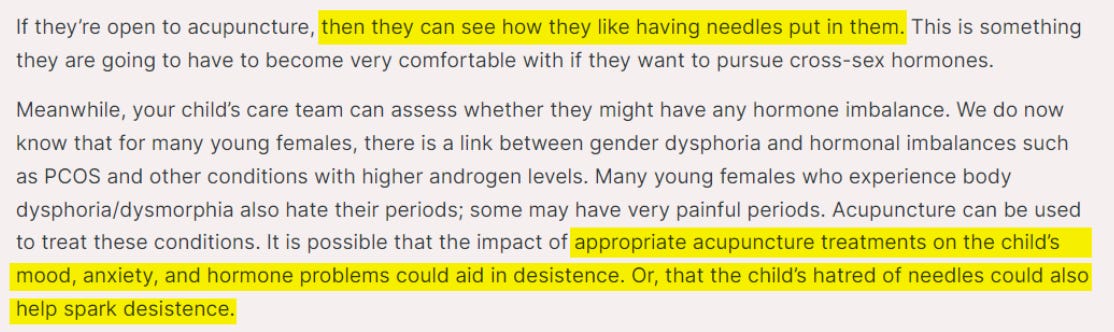
Fact: Stephanie Winn suggested the treatment of transgender youth with acupuncture to “see if they like having needles put in them” and stating it could “help spark desistance.” She also pushed the idea that transgender men should be estrogen to make them feel more feminine.
“They have good reasons to be wary. Stephanie Winn, a licensed marriage and family therapist in Oregon, was trained in gender-affirming care and treated multiple transgender patients. But in 2020, after coming across detransition videos online, she began to doubt the gender-affirming model. In 2021 she spoke out in favor of approaching gender dysphoria in a more considered way, urging others in the field to pay attention to detransitioners, people who no longer consider themselves transgender after undergoing medical or surgical interventions. She has since been attacked by transgender activists. Some threatened to send complaints to her licensing board saying that she was trying to make trans kids change their minds through conversion therapy. In April 2022, the Oregon Board of Licensed Professional Counselors and Therapists told Winn that she was under investigation. Her case was ultimately dismissed, but Winn no longer treats minors and practices only online, where many of her patients are worried parents of trans-identifying children.”
Paul then attempts to take readers through to other researchers who are, presumably, being “unfairly treated” for their “unorthodox” views on transgender people. One of those people is Stephanie Winn, who she presents as a “licensed marriage and family therapist” in Oregon. She claims that Winn simply spoke out “in favor of approaching gender dysphoria in a more considered way” and was attacked for this. A simple click on Paul’s link, however, shows how this is a highly misleading claim and misrepresents the brutality of what Winn was proposing.
In the thread linked by Paul, Winn muses that transgender men have a “sense of being less feminine” and could be made to feel more feminine by giving them estrogen. There is absolutely no research behind this claim, and in fact, giving transgender people the hormone of their assigned sex at birth has been tried in the past with disastrous effects. In a paper published in 1967 by Harry Benjamin, one of the first major researchers into transgender care, he stated: “I have heard rather frequently in the patient’s history that androgen had been used in the past in an attempt to cure the transsexualism by masculinization. It is the wrong treatment. It aggravates the condition by increasing libido without changing its character or direction. Androgen is contraindicated.”
Winn has also advocated for the treatment of transgender youth with acupuncture, stating, “they can see how they like having needles put in them.”
“So Your Kid Wants To Live As The Opposite Sex” by Stephanie WinnStephanie Winn has not been investigated or attacked simply for “approaching gender dysphoria in a more considered way.” Rather, attacks on Winn are linked to extremely cruel suggestions and musings around how transgender youth should be dealt using cruel, coercive, and painful conversion therapy techniques.
Claim: Transgender people may actually just be gay, and transitioning is a form of “conversion therapy.”
Fact: Gender and sexuality are different, many transgender people identify as gay or bisexual after transition, and gay acceptance is higher than trans acceptance.
Gay men and women often told me they fear that same-sex-attracted kids, especially effeminate boys and tomboy girls who are gender nonconforming, will be transitioned during a normal phase of childhood and before sexual maturation — and that gender ideology can mask and even abet homophobia. … “I transitioned because I didn’t want to be gay,” Kasey Emerick, a 23-year-old woman and detransitioner from Pennsylvania, told me. Raised in a conservative Christian church, she said, “I believed homosexuality was a sin.”
The claim that transgender people are “actually just gay” is one that has been made repeatedly by those opposed to gender affirming care, and one that has been repeatedlydebunked. Paul wades into this claim by featuring Kasey Emerick, who claims that “believing homosexuality was a sin” played into her transition.
Factually, though, attitudes towards transgender people tend to be “significantly more negative” according to an article in the International Journal of Environmental Research and Public Health. This contributes to a much higher rate of violence and discrimination. Many transgender people, such as celebrity Laverne Cox, report that the most common response to coming out is, “couldn’t you have just been gay?”
According to the 2012 National Transgender Discrimination Survey, most transgender people identify as lesbian, gay, bisexual, or queer after transition. If transition was being used to “cure” being gay, it is a startlingly ineffective cure.
Claim: 80% of transgender individuals desist from being transgender if they go through puberty without intervention, and another study suggests that 30% of individuals stop taking hormone therapy medication.
Fact: Detransition rates are estimated to be between 1-4%. The study citing an 80% detransition rate is based on faulty outdated data, using criteria no longer in use. Furthermore, the study indicating a 30% discontinuation rate is based on military families not refilling their prescriptions through Tricare, rather than actual discontinuation of hormone therapy.
The claim that 80% of transgender youth detransition has been widely debunkedand is contradicted by modern research, which indicates regret and detransition rates of 1-4%, according to a review of newer peer-reviewed studies by Cornell University. Recent studies reveal that 97.5% of transgender youth maintain a stable gender identity after five years. The older article Paul references is a journal article in a publication with a very low impact factor; this article does not provide new data, and instead discusses the same two outdated sources commonly associated with the exaggerated “80% detransition rate” claim: Kenneth Zucker’s research from the 1990s on detransition, which uses outdated diagnostic criteria for “gender identity disorder” that misclassified feminine gay men as “disordered,” and Steensma’s studies from 2011/2013, known for similar methodological shortcomings.
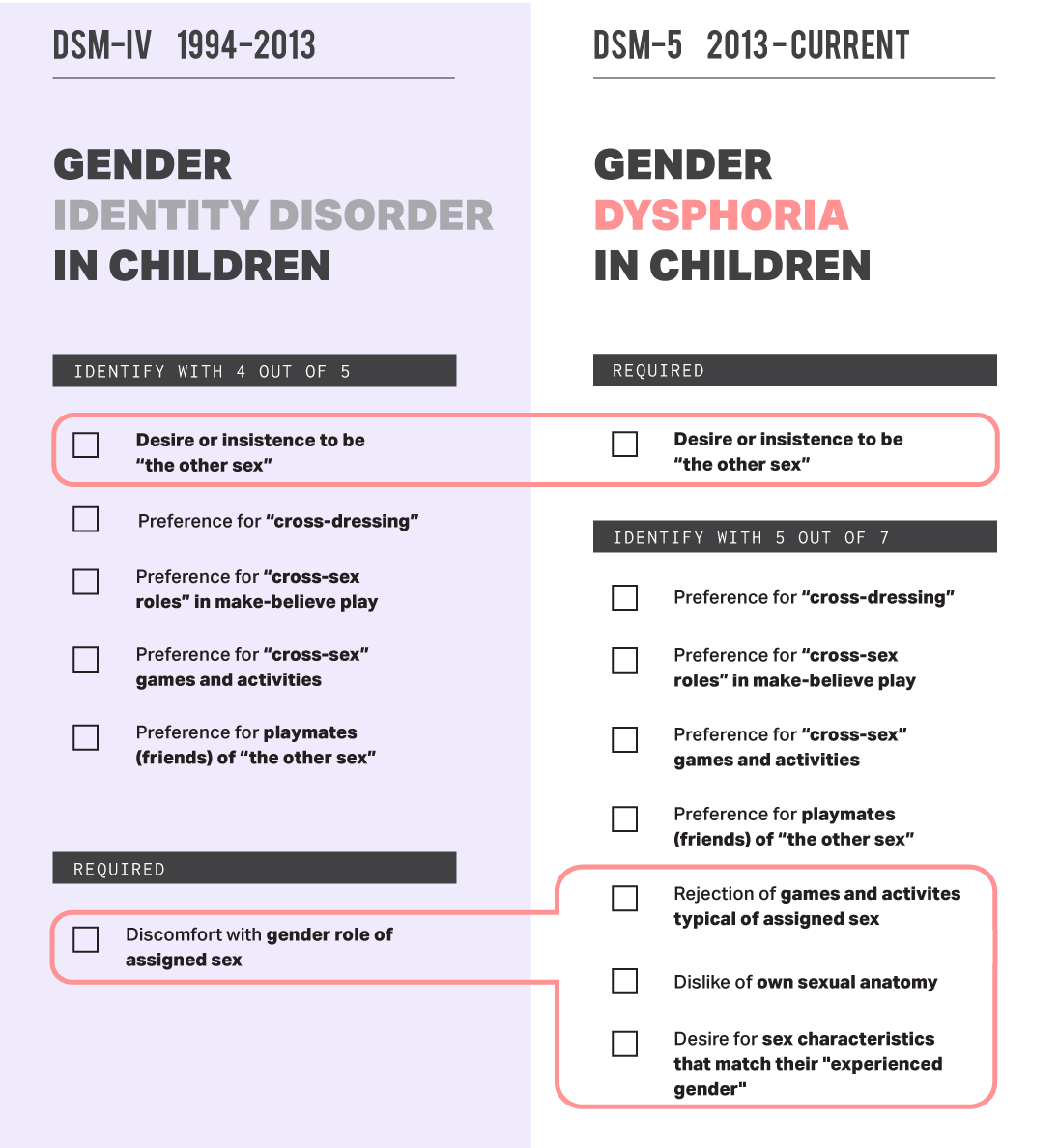
Both of these studies share a similar problem that explains why the numbers are so different when compared to modern studies around transgender care: they utilize outdated criteria for “gender identity disorder,” which misclassified tomboys, masculine lesbians, and effeminate gay men as “disordered.” Notably, Zucker advocated for conversion therapy, arguing that “a homosexual lifestyle in a fundamentally unaccepting culture simply creates unnecessary social difficulties.” He also employed techniques aimed at coercing trans kids to conform to their assigned sex at birth, such as withholding cross-gender toys and advising parents “not to give in” to their trans youth’s desires to wear clothing that aligns with their gender identity.
The old criteria noted that to be diagnosed with “gender identity disorder,” you did not need to desire to be “the other sex.” Instead, the disorder was about gendered behavior that was deemed “too masculine” or “too feminine” by society, and purposefully included gay people who didn’t “act man or woman enough.” The new criteria, however, require the transgender youth to desire or insist to be the other sex.
Steensma’s2011 and 2013 studies had similar issues in his research, which in some ways had even worse methodological flaws. Steensma used the old criteria, which is not the way that gender dysphoria is diagnosed today. Worse, the two studies classified every youth who did not return to the clinic as having “desisted” or “detransitioned” with no long term follow-up. Half of the participants in the studies did not return and all were classified as having “desisted.” The sample sizes were tiny at the getgo – only 53 people were in the first study and 127 in the second study. Given the fact that a large portion if not the majority of Steensma’s patients were classified under decades old criteria and assumed permanently detransitioned simply for refusing to follow up, these studies cannot be used to make any reasonable claim of high desistance rates.
The last study that Paul refers to is a study released two years ago on military continuance of care. That study looked at all hormone therapy distributed under the military Tricare health insurance plan and determined that 30% of people stopped receiving their hormones through Tricare. What the study does not do, as Paul claims, is support the idea that “30% of people discontinued hormone therapy.” In fact, there are many reasons why people would no longer fill their hormone therapy through a military Tricare plan, especially towards the end of the study in 2017-2018:
The Trump administration began targeting transgender servicemembers, and many transgender servicemembers likely stopped filling their hormone prescriptions through Tricare for themselves or their family members, fearing being targeted.
Tricare has notoriously poor transgender care coverage, as evidenced by many military members responding to a thread discussing the results of this study, and many transgender servicemembers may opt to get their medication through a low cost alternative such as Planned Parenthood
Hormone therapy can be discontinued for surgery, fertility and pregnancy planning, and many other purposes.
Some nonbinary patients may obtain all the results they wish from hormone therapy before discontinuing, desiring no future results.
Transgender people may simply have not filled the medication through insurance and instead utilized online pharmacies, which have grown increasingly popular.
Transgender patients can easily fill prescriptions through GoodRX plans, which would allow them more privacy.
Transgender people may have been forced off care by military decisions
Even the authors of the article themselves state that they likely overestimate discontinuation:
“We only collected information on medication refills obtained using a single insurance plan. If patients elected to pay out of pocket for hormones, accessed hormones through nonmedical channels, or used a different insurance plan to pay for treatment before and/or after obtaining gender-affirming hormones using TRICARE insurance, we did not capture this information. This means that our findings are likely an underestimate continuation rates among transgender patients.”
There are many more factual errors contained within Paul’s article; it is 4,500 words long and covers virtually every anti-trans claim made in legislative hearings across the United States. Many advocates for transgender people, medical experts, and journalists have weighed in to cover other aspects of Paul’s piece. You can find those here:
The National LGBTQ Task Force announced on Tuesday that long-time transgender rights activist and community leader Kris Hayashi has joined the organization as its director of advocacy and action.
Hayashi most recently served as the executive director of the Transgender Law Center and previously led the Audre Lorde Project as its executive director/co-director.
“We could not be more excited or honored to welcome Kris Hayashi to our team and the Task Force family. Kris will bring immeasurable expertise to our advocacy and policy work as our community, especially our trans and non-binary siblings, are under unrelenting and unprecedented attacks,” said Kierra Johnson, executive director of the National LGBTQ Task Force, in a statement.
Hayashi told The Advocate that he was “honored” and thrilled to be joining Johnson and the Task Force. But he understands there is a real danger to LGBTQ+ rights, specifically to the rights of transgender people.
“I will say that particularly at this moment, particularly at this time when trans communities, when nonbinary communities, when we are facing an escalation in attacks on our rights and our lives, I am excited to be joining the Task Force to be able to support and continue the organization’s work to really build an LGBTQ progressive movement that centers trans power, resistance, and joy,” he said.
The work he has before him isn’t anything new, Hayashi explained.
“As a trans person, as a person of color, as a queer person here in the U.S., from a pretty young age, I understood that the world was not set up for me to survive and thrive,” he said.
That experience led him to a professional career in advocacy and activism from California to New York.
“I was really fortunate and privileged to have mentors — from Black power movements, from migrant justice movements, from environmental justice movements — who really took me under their wing, and I really learned from them the ways that our communities have in the past and continue to speak truth to power, to fight for justice, and to build strong movements,” Hayashi said.
As he sets out to lead the Task Force’s advocacy and action arm, Hayashi said it’s important to understand the violence LGBTQ+ people already face. Attacks on transgender and nonbinary people were already endemic. Now, there’s a more legislative turn that’s amplifying the attacks.
“In this moment, trans and nonbinary people are facing just an extreme escalation in attacks on our rights and lives across the globe, but specifically here in the U.S.,” Hayashi said. “Over 20 states have passed laws that ban and in some cases criminalize our health care. Similarly, states have banned trans you from playing sports. We’re seeing attacks on our ability to get identity documents, [go to] bathrooms, even [our names].”
He continued: “It’s very clear that the conservative right is using attacking trans and non-binary people to advance their anti-democratic agenda, which ultimately impacts everyone.”
Hayashi said that local LGBTQ+ leaders are still trying to combat such measures, but they need support. They need more help.
That’s where, he said, the Task Force and his work comes in.
“[Local leaders] cannot do it alone,” he said. “This is a time when we need to bring all of our resources and all our capacities into this fight because there is just so much at stake, not just for trans people, but really for all of us.”
Findings from the National Center for Transgender Equality’s 2022 U.S. Transgender Survey counter the right-wing narrative about “transition regret” by showing how gender-affirming care improves trans people’s lives, while the survey also documents the continued discrimination and marginalization trans Americans face.
The NCTE released its “Early Insights” report of survey findings Wednesday. The survey includes data from 92,329 binary and nonbinary trans people across the U.S., the largest number of participants ever. “Early Insights” is the first in a series of reports to be released from the survey.
Ninety-four percent of respondents who lived at least some of the time in a gender other than the one they were assigned at birth reported that they were either “a lot more satisfied” (79 percent) or “a little more satisfied” (15 percent) with their life than before their transition. Nearly all of those who were undergoing hormone treatment or had received at least one form of gender-affirming surgery said this health care had improved their lives.
Respondents also reported substantial family support, with more than two-thirds of trans adults saying that their families were either supportive or highly supportive of their identity and gender expression.
“It’s impactful to see so many trans people report life satisfaction when they live according to their gender identity and get the health care they need, but we also see that trans people face substantial barriers to living full, healthy, and authentic lives,” Dr. Sandy E. James, co-principal investigator and lead researcher for the survey, said in a press release. “As the most comprehensive source of data about trans people in the U.S., these findings fill an important gap in our knowledge and serve as a critical resource for understanding and addressing the needs of trans people.”
Trans people still face discrimination and mistreatment at work, at school and elsewhere, according to the survey.
Eleven percent of respondents who had ever held a job said they had lost a job because of their gender identity or expression.
Eighty percent of adult respondents and 60 percent of 16- and 17-year-old respondents who were out or perceived as trans in elementary or secondary school said they went through one or more forms of mistreatment or negative experience.
Of those who had seen a health care provider within the previous 12 months, 48 percent reported having at least one negative experience because they were transgender, such as being refused health care, being misgendered, or being verbally or physically abused.
Most respondents reported being denied equal treatment due to their gender identity or being verbally harassed, physically harassed, or harassed online.
Respondents also faced economic challenges. Thirty-four percent were experiencing poverty. The unemployment rate among respondents was 18 percent. Nearly one-third had experienced homelessness in at some point.
Regarding the impact of discriminatory laws, 47 percent of respondents had thought about moving to another state because their state government considered or passed anti-trans laws and 5 percent had moved out of state because of this. The top 10 states from which respondents moved for this reason were Alabama, Arizona, Florida, Georgia, Missouri, North Carolina, Ohio, Tennessee, Texas, and Virginia.
“Trans people deserve equal access to the same societal benefits as everyone else — access to good jobs, affordable health care, stable housing and to feel safe in their communities,” said Josie Caballero, director of the survey. “The ‘Early Insights’ report highlights how much further the U.S. still needs to go to achieve trans equality.”
NCTE developed the survey in partnership with the National Black Trans Advocacy Coalition, the TransLatin@ Coalition, and the National Queer Asian Pacific Islander Alliance.
“Everyone deserves to be treated with dignity and fairness,” added Rodrigo Heng-Lehtinen, executive director of NCTE. “We need laws at the federal and state level that make sure all people — including trans people — are treated fairly. No one should ever face discrimination in employment, housing, health care, education, and other areas of life just because of who they are. Transgender people are here to stay, and we are proud of who we are.”
In the past century, there have been three waves of opposition to transgenderhealth care.
In 1933, when the Nazis rose to power, they cracked down on transgender medical research and clinical practice in Europe. In 1979, a research report critical of transgender medicine led to the closure of the most well-respected clinics in the United States. And since 2021, when Arkansas became the first U.S. state among now at least 21 other states banning gender-affirming care for minors, we have been living in a third wave.
On the other hand, the archives of transgender medicine demonstrate that backlash against these practices has historically been rooted in pseudoscience. And today, an anti-science movement that aims to discredit science altogether is fueling the fire of the current wave of anti-trans panic.
The 1930s − eugenics and sexology collide
In the 1920s, the new science of hormones was just reaching maturation and entering mainstream consciousness. In the field of sexology – the study of human sexuality, founded in 19th century Europe – scientists were excited about research on animals demonstrating that removing or transplanting gonads could effectively change an organism’s sex.
In 1919, the German sexologist Magnus Hirschfeld founded the Institut für Sexualwissenschaft in Berlin, which became the world’s leading center for queer and transgender research and clinical practice. Hirschfeld worked closely with trans women as co-researchers throughout the 1920s. Several trans women also received care at the institute, including orchiectomies that halted the production of testosterone in their bodies.
Within months of Hitler’s rise to power in early 1933, a mob of far-right studentsbroke into and shuttered the institute for being “un-German.” Some of the most famous images of Nazi book burning show the institute’s library set ablaze in an outdoor plaza.
Nazi ideology was based on another prominent field of science of that time: eugenics, the belief that certain superior populations should survive while inferior populations must be exterminated. In fact, Hirschfeld’s sexology and Nazi race science had common roots in the Enlightenment-era effort to classify and categorize the world’s life forms.
But in the late 19th century, many scientists went a step further and developed a hierarchy of human types based on race, gender and sexuality. They were inspired by social Darwinism, a set of pseudoscientific beliefs applying the theory of survival of the fittest to human differences. As race scientists imagined a fixed number of human races of varying intelligence, sexologists simultaneously sought to classify sexual behaviors as innate, inherited states of being: the “homosexual” in the 1860s and the “transvestite,” a term coined by Hirschfeld himself, in 1910.
But where Hirschfeld and other sexologists saw the classification of queer and trans people as justifications for legal emancipation, eugenicists of the early 20th century in the U.S. and Europe believed sexually transgressive people should be sterilized and ultimately eradicated.
By the 1970s, trans medicine went mainstream. Nearly two dozen university hospitals were operating gender identity clinics and treating thousands of transgender Americans. Several trans women and men wrote popular autobiographical accounts of their transitions. Trans people were even on television, talking about their bodies and fighting for their rights.
Yet trouble was brewing behind the scenes. Jon Meyer, a psychiatrist at Johns Hopkins, was skeptical of whether medical interventions really helped transgender people. In 1979, Meyer, along with his secretary Donna Reter, published a short academic paper that ushered in the second wave of historic backlash to trans medicine.
In their study, Meyer and Reter contacted previous patients of the Johns Hopkins Gender Identity Clinic. To understand whether surgery had improved patients’ lives, the authors developed an “adjustment scoring system.” They assigned points to patients who were in heterosexual marriages and had achieved economic security since their operations, while deducting points from those who continued to engage in gender nonconformity, homosexuality, criminality, or sought mental health care.
Meyer and Reter believed that gender-affirming surgeries were successful only if they made model citizens out of transgender people: straight, married and law-abiding.
In their results, the authors found no negative effects from surgery, and no patients expressed regret. They concluded that “sex reassignment surgery confers no objective advantage in terms of social rehabilitation,” but it is “subjectively satisfying” to the patients themselves. This was not a damning conclusion.
Yet, within two months, Johns Hopkins had shuttered its clinic. The New York Times reported that universities would feel pressure to similarly “curtail their operations and discourage others from starting to do them.” Indeed, only a handful of clinics remained by the 1990s. Transgender medicine did not return to Johns Hopkins until 2017.
In requiring trans patients to enter straight marriages and hold gender-appropriate jobs to be considered successful, Meyer and Reter’s study was homophobic and classist in design. The study exemplified the pseudoscientific beliefs at the heart of transgender medicine in the 1960s through the 1980s, that patients had to conform to societal norms – including heterosexuality, gender conformity, domesticity and marriage – in order to receive care. This was not an ideology rooted in science but in bigotry.
The 2020s − distrust in science
As in the 1930s, opposition to trans medicine today is part of a broad reactionary movement against what some far-right groups consider the “toxic normalization” of LGBTQ people.
But widespread distrust in science and medicine in the wake of the COVID-19 pandemic has affected how Americans perceive trans health care. Prohibitions on gender-affirming care have occurred simultaneously with the relaxing of pandemic restrictions, and some scholars argue that the movement against trans health care is part of a broader movement aimed at discrediting scientific consensus.
Yet the adage “believe in science” is not an effective rejoinder to these anti-trans policies. Instead, many trans activists today call for diminishing the role of medical authority altogether in gatekeeping access to trans health care. Medical gatekeeping occurs through stringent guidelines that govern access to trans health care, including mandated psychiatric evaluations and extended waiting periods that limit and control patient choice.
It is not clear how the current third wave of backlash to transgender medicine will end. For now, trans health care remains a question dominated by medical experts on one hand and people who question science on the other.
Even as Catholic dogma continues to repudiate same-sex marriage and gender transition, one of the most prominent religious orders in the United States — the Jesuits — is strengthening a unique outreach program for LGBTQ Catholics.
The initiative — fittingly called Outreach — was founded two years ago by the Rev. James Martin, a Jesuit who is one of the country’s most prominent advocates for greater LGBTQ inclusion in the Catholic Church.
Outreach, a ministry of the Jesuit magazine America, sponsored conferences in New York City in 2022 and 2023, and last year launched a multifaceted website with news, essays and information about Catholic LGBTQ resources and events.
On Tuesday, there was another milestone for Outreach — the appointment of journalist and author Michael O’Loughlin as its first executive director.
O’Loughlin, a former staff writer at online newspaper Crux, has been the national correspondent at America. He is the author of a book recounting the varied ways that Catholics in the U.S. responded to the AIDS crisis of the 1980s and ‘90s — “Hidden Mercy: AIDS, Catholics, and the Untold Stories of Compassion in the Face of Fear.”
O’Loughlin told The Associated Press he’s excited by his new job, viewing it as a chance to expand the range of Outreach’s programs and the national scope of its community.
“It’s an opportunity to highlight the ways LGBT people can be Catholic and active in parishes, ministries and charities,” he said. “There’s a lot of fear about to being too public about it. … I want them to realize they’re not alone.”
O’Loughlin says his current outlook evolved as he traveled to scores of places around the U.S. to promote his book, talking to groups of LGBTQ+ Catholics, and their families and friends, about how to make the church more welcoming to them.
Those conversations made O’Loughlin increasingly comfortable publicly identifying as a gay Catholic after years of wondering whether he should remain in the church. Its doctrine still condemns any sexual relations between gay or lesbian partners as “intrinsically disordered.”
The latest expansion of Outreach occurs amid a time of division within the global Catholic Church as it grapples with LGBTQ issues.
Pope Francis, a Jesuit who has met with Martin and sent letters of support to Outreach, has made clear he favors a more welcoming approach to LGBTQ people. At his direction, the Vatican recently gave priests greater leeway to bless same-sex couples and asserted that transgender people, in some circumstances, can be baptized.
However, there has been some resistance to the pope’s approach. Many conservative bishops in Africa, Europe and elsewhere said they would not implement the new policy regarding blessings. In the U.S., some bishops have issued directives effectively ordering diocesan personnel not to recognize transgender people’s gender identity.
Amid those conflicting developments, Martin and other Jesuit leaders are proud of Outreach’s accomplishments and optimistic about its future.
“There seems to be deep hunger for the kind of ministry that we’re doing, not only among LGBTQ Catholics, but also their families and friends,” Martin said by email from Ireland, where he was meeting last week with the the country’s Catholic bishops.
“Pope Francis has been very encouraging, allowing himself to be interviewed by Outreach and sending personal greetings to our conference last year,” Martin added. “Perhaps the most surprising support has been from several bishops who have written for our website, as well as some top-notch Catholic theologians who see the need for serious theological reflection on LGBTQ topics.”
Martin will remain engaged in Outreach’s oversight, holding the title of founder.
The Rev. Brian Paulson, president of the Jesuit Conference of Canada and the United States, evoked both Jesus and the pope when asked why his order had embraced the mission of Outreach.
“Pope Francis has repeatedly called leaders in the Catholic church to emulate the way Jesus spent his ministry on the peripheries, accompanying those who had experienced exclusion,” Paulson said email. “I think the work of Outreach is a response to this invitation.”
Paulson also said he was impressed by Martin’s “grace and patience” in responding to the often harsh criticism directed at him by some conservative Catholics.
There was ample evidence of Outreach’s stature at its conference last June at a branch of Fordham University in New York City. The event was preceded by a handwritten letter of support sent to Martin by Pope Francis, extending “prayers and good wishes” to the participants.
“It’s a special grace for LGBTQ Catholics to know that the pope is praying for them,” Martin said.
Another welcoming letter came from Cardinal Timothy Dolan, the archbishop of New York.
“It is the sacred duty of the Church and Her ministers to reach out to those on the periphery,” he wrote to the conference attendees.
The keynote speakers included Fordham’s president, Tania Tetlow, and the closing Mass was celebrated by Archbishop John Wester of Santa Fe, New Mexico.
Ohio Gov. Mike DeWine’s administration on Wednesday backed off its plans to impose rules that advocates feared would have restricted gender-affirming medical treatment for adults in a way no other state has.
The rules proposed by two state departments would have required the psychiatrists, endocrinologists and medial ethicists to have roles in creating gender-affirming care plans for clinics and hospitals. And patients under 21 would have been required to receive at least six months of counseling before starting hormone treatment or receiving gender-affirming surgery.
The Department of Health and Department of Mental Health and Addiction Services both issued revised proposals Wednesday after gathering public comment. Both said in memos that they were swayed by what they had learned as transgender people and care providers weighed in. The Health Department said it received 3,900 comments. In the new versions, the rules would apply only to the care of minors, not adults.
Over the last few years, 21 states have adopted laws banning at least some aspects of gender-affirming care for minors. Some are so new they haven’t taken effect yet, and a ban in Arkansas was struck down in court. But so far, only Florida has restricted care for adults.
The departments said the rules will now advance to the next step of review before being implemented.
The draft rules would still require that patients under 18 receive at least six months of mental health counseling before they can receive gender-affirming medications or surgeries. The revisions made Wednesday also expand the list of mental health professionals qualified to provide the required counseling, adding clinical nurses, social workers, school psychologists and some physicians.
Further, a medical ethicist would no longer be required to have a role in developing facility-wide treatment plans for the care. In a memo, the Health Department said that change was made partly because institutions already use medical ethics professionals to develop policies.
Some parts of the rules regarding care for minors could have a muted effect. Last month, the Legislature banned gender-affirming surgeries and hormone therapies for minors by overriding DeWine’s December veto of that measure, which would allow children already receiving treatment to continue.
South Dakota has apologized and will pay $300,000 under a settlement with a transgender advocacy group that sued Gov. Kristi Noem and her health secretary last year after the state terminated a contract with it.
Attorneys for the Transformation Project announced the settlement Monday. The nonprofit sued last year after the state canceled the contract for a community health worker in December 2022. The contract included a roughly $136,000 state-administered federal grant, about $39,000 of which the group received, according to its attorneys.
The organization alleged the state’s decision “was based purely on national politics,” citing Noem’s statement to conservative media outlet The Daily Signal that the state government shouldn’t participate in the group’s efforts. The outlet had asked Noem about the group and one of its events.
“This settlement marks a significant milestone in our ongoing commitment to civil rights advocacy,” lead attorney Brendan Johnson said. “We commend the resiliency of the LGBTQ community and remain committed to vigorously upholding their rights.”
The apology, in a letter dated Jan. 18 and signed by South Dakota Secretary of Health Melissa Magstadt, reads: “On behalf of the State of South Dakota, I apologize that the Transformation Project’s contract was terminated and for treating the Transformation Project differently than other organizations awarded Community Health Worker contracts.
“I want to emphasize that all South Dakotans are entitled to equal treatment under the law — regardless of their race, color, national origin, religion, disability, age, or sex. South Dakota is committed to ensuring that no person is excluded from participation in, denied the benefits of, or subject to discrimination under any program, activity, or service that it provides,” she wrote.
Transformation Project Executive Director Susan Williams said she is glad the lawsuit is over and “it feels good to know that we won.”
“I would say that we settled with the apology. It would have been nice to have the apology come from our governor,” she said.
Magstadt was not health secretary at the time the contract was terminated. Her predecessor announced her retirement days after the state terminated the contract. The Transformation Project had hired a community health worker before the state ended the contract.
The state alleged contract violations in a letter from the deputy secretary noticing the termination. The group said it had complied.
Spokespersons for Noem and the state Department of Health did not immediately respond to email requests for comment on the settlement.
Transformation Project Community Health Worker/Project Coordinator Jack Fonder said in a statement: “I assumed the role of CHW with the intention of providing trans people in our community with the resources they require to succeed in this state, little realizing that doing so would result in my own outing as a trans man for standing up for what is right. We promise to keep up the battle for transgender rights and to make sure they have access to the resources they require.”
Fundraising helped continue Fonder’s position, Williams said. Fonder helps transgender people find shelter, housing and employment, as well as support with legal paperwork and driving people to appointments, among other needs.
Williams said the organization would apply for future grants from the state, and she hopes similar groups “will feel more confident” to apply, too.
The nonprofit offers help for LGBTQ people and their families, such as suicide prevention and guiding people through health care and social services, and educates about gender identity.
South Dakota and other Republican-led states have passed laws in recent years that have raised complaints about discrimination against transgender people, such as restricting school sports participation and banning gender-affirming care for kids.
Alongside bans on gender-affirming care for minors and bans on teaching LGBTQ+ topics in public schools, the state enacted a law that also requires school districts to “at a minimum” prohibit trans students from using restrooms that align with their gender identity, and mandates that schools staff out LGBTQ+ students to their guardians.
But something else significant happened in Kentucky in 2023: The state swore in its first-ever transgender elected official. Even more significant, she was sworn in to her local school board.
Rebecca Blankenship has been a member of the Berea Independent School District’s board of education for one year now and is still the only out transgender person who’s ever been elected to any office in Kentucky. Moreover, during her time in the position, the state legislature has “forced us to implement policies that turn our stomachs,” she says.
While this may seem like a cause for despair, Blankenship isn’t losing focus. Despite the anti-LGBTQ+ legislation being pumped out by state lawmakers, there are pro-LGBTQ+ measures she believes are capable of passing in the state. More importantly, there is no law the Kentucky Legislature can pass that bans basic kindness.
“Our Berea board would have loved to stand up for LGBT kids. Our state legislature, though, which is completely power mad, completely out of control, wants to come into small communities and dictate how we are going to treat each other,” Blankenship tells The Advocate. “They have forced us to implement policies that turn our stomachs, but what they cannot do is force teachers, and school staff, and bus drivers, and everybody who does their job because of the kids, to start treating those kids with cruelty or disrespect.”
“The legislature cannot ban their kindness,” she adds.
While a spate of anti-LGBTQ+ laws has gone through in the state – the majority of which target transgender minors – there’s one policy Blankenship is pushing for that could protect trans kids, and its approval is showing “early promise.” The initiative? Ban conversion therapy within the state of Kentucky. The strategy? Highlight anti-transgender hypocrisy.
Three local governments in the state have passed ordinances banning the draconian practice, but none have enforced them, Blankenship claims. This has helped “increase the pressure on the state legislature [to say] that they need to take action, so that they can’t just leave this to somebody else.”
“Another thing that has helped us increase interest in doing this bill is that the legislature banned gender-affirming care for minors last year,” Blankenship notes. “They spent the whole year talking about how they wanted to ban unethical experimental medical treatments for LGBT youth. Well, here’s one. … I think that we’re really turning some heads with the idea that we need to be consistent.”
The Kentucky Legislature’s attacks on LGBTQ+ people have significant consequences, but they have also fostered a greater sense of community among queer people in the state. Blankenship says that lately more and more people have been inspired to get involved in local politics and even to run for office – particularly transgender people. In fact, the state may soon have its second transgender elected official and first trans representative if Emma Curtis wins her bid for the 93rd House District in Lexington.
Those are two of the biggest steps Blankenship believes people can take to support the trans community in a time where they’re under attack: run for office, and donate to those running for office who are LGBTQ+, or at least supportive of queer people. The third step is to “push their local party establishments and democratic powerhouses to do the same things: to endorse these candidates, to put money behind these candidates, to put effort behind these candidates.”
“The City Council and the school board are more important than the president,” Blankenship says. “Our local governments affect our lives so, so profoundly, and LGBT people have the same basic needs as everybody else. We pay rent, we drive on roads, we send our kids to school. … If we can all uplift each other, we can achieve a new kind of power. We can achieve a new kind of community and a new kind of politics that works for everybody.”
Enfranchising such candidates won’t just change policy nationally, she explains, but it will also “change hearts and minds locally,” as it “demonstrates that we have so much more in common with regular people, working people, than we have differences.”
“It’s not regular people who want to hurt us, it’s national organizations that try to co-opt religion to build power through hate,” Blankenship continues. “The fact that Kentucky’s first openly trans elected official didn’t come from a city, but from a little bitty mountain town, proves that the stereotype of queerphobic rural conservatives is just not the reality.”
She adds: “My election showed that this is something that can happen. … If a trans person can win here in Appalachian State hills, they can win anywhere.”
The CEOs of Facebook, Instagram, TikTok, X, Snap, and Discord testified in the Senate on Wednesday to discuss the online exploitation of children. The discussion brought up the Kids Online Safety Act (KOSA), a bipartisan bill that seeks to protect minors from online harm. But KOSA has come under fire from some LGBTQ+ activists and groups who fear that the bill will enable Republicans to block queer youth from seeing age-appropriate LGBTQ+ content online.
Laura Marquez-Garrett, an attorney with the Social Media Victims Law Center, says revisions to the bill have helped ensure that its current version will protect all kids and safeguard against potential misuse by anti-LGBTQ+ politicians. But Evan Greer, director of Fight for the Future, a nonprofit that protects people’s human rights in the digital age, says KOSA unconstitutionally violates free speech rights and will result in social media companies broadly censoring LGBTQ+ content rather than risking lawsuits from attorneys general.
It’s undeniable that social media can negatively impact mental health. Last year, the U.S. Surgeon General issued an advisory noting how the frequency and kinds of information shown to young people on social media can cause a “profound risk of harm” to their mental health.
“Children and adolescents on social media are commonly exposed to extreme, inappropriate, and harmful content, and those who spend more than three hours a day on social media face double the risk of poor mental health including experiencing symptoms of depression and anxiety,” the Surgeon General’s report on Social Media and Youth Mental Health said. Social media’s content and design can also make some young people feel addicted to it, increasing body dysmorphia, low self-esteem, and even self-harming behaviors, the report added.
KOSA tries to remedy this by requiring online platforms to take measures to prevent recommending content that promotes mental health disorders (like eating disorders, drug use, self-harm, sexual abuse, and bullying) unless minors specifically search for such content. KOSA also requires platforms to limit features that result in compulsive usage — like autoplay and infinite scroll — or allow adults to contact or track young users’ location. The bill says platforms must provide parents with easy-to-use tools to safeguard their child’s social media settings and notify parents if their kids are exposed to potentially hazardous materials or interactions.
Furthermore, KOSA requires platforms to submit annual reports to the federal government containing details about their non-adult users, the internal steps they’ve taken to protect minors from online harms, the “concern reports” – or reports platforms issue parents when their child encounters any harmful content – they’ve issued to parents, and descriptions of interventions they’ve taken to mitigate harms to minors. These reports will be overseen by an independent third-party auditor who consults with parents, researchers, and youth experts on additional methods and best practices for safeguarding minors’ well-being online.
KOSA has bipartisan support, including that of President Joe Biden as well as 46 senatorial co-sponsors, 21 of whom are Democrats, including lesbian Sen. Tammy Baldwin (WI) and LGBTQ+ allies like Sen. Amy Klobuchar (MN) and Sen. Elizabeth Warren (MA). LGBTQ Nation reached out to Baldwin and Warren’s offices for additional comment but didn’t receive a response by the time of publication. KOSA is also supported by groups like Common Sense Media, Fairplay, Design It For Us, Accountable Tech, Eating Disorders Coalition, American Psychological Association, and the American Academy of Pediatrics.
But while parents of transgender youth and numerous pro-LGBTQ+ organizations agree that social media can negatively impact young people’s mental health, many other groups have nonetheless opposed the bill, including the American Civil Liberties Union (ACLU), the Woodhull Freedom Foundation, the LGBT Technology Partnership, as well as LGBTQ+ advocacy organizations in six states.
“KOSA is, at its heart, a censorship bill,” Mandy Salley, Chief Operating Officer of the Woodhull Freedom Foundation, a group that advocates for sexual freedom as a fundamental human right, told LGBTQ Nation. “If passed in its current form, we believe that KOSA will hinder the ability of everyone to access information online and negatively harm many communities that are already censored online, including sex therapists, sex workers, sex educators, and the broader LGBTQ+ community. Our human right to free expression cannot be ignored in favor of supposed ‘safety’ on the Internet.”
Shutterstock
The big sticking point: KOSA’s Duty of Care provision
Specifically, Woodhull and the other aforementioned organizations are worried about the bill’s Duty of Care provision that allows attorneys general to conduct investigations, issue subpoenas, require documentation from, and file civil lawsuits against any platforms that have “threatened or adversely affected” minors’ well-being. LGBTQ+ advocates fear that Republican attorneys general who consider LGBTQ+ identities as harmful forms of mental illness will use KOSA to censor such web content and prosecute platforms that provide access to such content.
In a July 2023 Teen Vogue op-ed, digital rights organizer Sarah Philips wrote that the bill “authorizes state attorneys general to be the ultimate arbiters of what is good or bad for kids. If a state attorney general asserts that information about gender-affirming care or abortion care could cause a child depression or anxiety, they could sue an app or website for not removing that content.”
It didn’t help that KOSA was introduced by anti-LGBTQ+ Sen. Marsha Blackburn (R-TN), who has said that one of the bill’s top priorities is to protect children from “the transgender in this culture.”
“[Social media] is where children are being indoctrinated,” Blackburn told the Family Policy Alliance, a conservative Christian organization, in a September 2023 speech. “They’re hearing things at school and then they’re getting onto YouTube to watch a video and all of a sudden this comes to them… They click on something and, the next thing you know, they’re being inundated with it.”
Blackburn’s office told LGBTQ Nation that her comment had been “taken out of context” and wasn’t related to KOSA, stating, “KOSA will not — nor was it designed to — target or censor any individual or community.” But the anti-LGBTQ+ conservative think tank Heritage Foundation has also said it wishes to use the law to “guard” kids against the “harms of… transgender content.”
But Marquez-Garrett told LGBTQ Nation that these concerns are based on an old version of the bill that has since been revised after consultation with concerned LGBTQ+ activists.
“If [the possibility of an attorney general misusing a law is] the standard by which we judge all laws, we’re never going to have new laws because the reality is an unscrupulous attorney general can try,” she said. “But it doesn’t mean they’re going to succeed.”
First, she points out that Philips’s concern about attorney generals suing platforms for not removing pro-LGBTQ+ content doesn’t necessarily apply for two reasons: KOSA doesn’t regulate what LGBTQ+ or allegedly harmful content a site can host — it regulates what content that websites automatically suggest to young users. Users of all ages can still access any material that they deliberately search for.
Moreover, attorneys general have to prove to a judge and the Federal Trade Commission (FTC) that, by KOSA’s definitions, LGBTQ+ content harms young users’ mental health. Such arguments won’t pass muster with every judge or FTC commissioner.
Marquez-Garret noted that after Sen. Blackburn made her concerning comments, the bill was revised with input from queer advocates and reintroduced with amendments meant to account for those concerns. For example, while the original bill broadly required web platforms to prevent all “harms” to minors, the revised bill specifically mentions the harms companies must work against (including suicidal behaviors, eating disorders, substance use, sexual exploitation, and ads for tobacco and alcohol).
She also notes that KOSA says an attorney general who begins civil actions under KOSA will be required to issue a report of any action to the FTC. The FTC will then have the right to intervene.
“The FTC is only as good as the people running it,” Marquez-Garrett told LGBTQ Nation. “And we don’t know what’s going to happen in the future.” But, assuming that the FTC is “not nefarious and is reasonable,” she continued, if the FTC begins an investigation into the actions, the attorney general’s home state is forbidden from taking any additional actions.
Marquez-Garrett also points out that the revised version of KOSA contains a carveout that says that if a minor searches for any sort of content, including LGBTQ+ content, then they’re allowed to see it even if an attorney general considers it harmful. Additionally, KOSA also explicitly excludes many websites from its control, including government platforms, libraries, and non-profits. That means if a minor finds pro-LGBTQ+ content on the websites of the ACLU, The Trevor Project, or the Human Rights Campaign, an attorney general can’t prosecute.
Furthermore, under the revised KOSA, websites aren’t required to install age verification or parental consent functionality that might prevent young people from accessing different platforms. Though Greer questioned how social media platforms can comply with the bill without conducting age verification, Marquez-Garrett says Greer’s question ignores KOSA’s plain language and echoes “another Big Tech narrative about Big Tech’s ability or inability to comply with KOSA.”
Regardless, under KOSA, platforms are also expressly forbidden from being required to disclose a minor’s browsing behavior, search history, messages, contact list, or other content or metadata of their communications that could potentially out them to their parents.
“We totally agree that big tech platforms and the surveillance capitalist business model that they employ are doing real harm, and that they’re specifically harming LGBTQ people and communities,” Greer, director of Fight for the Future (FFF), told LGBTQ Nation. “But as long as KOSA attempts to dictate what content platforms can recommend, it will be unconstitutional.”
FFF and the ACLU have said that the government cannot force platforms to suppress entire categories of content or to suppress all content that might lead to a minor becoming depressed or anxious without violating the First Amendment.
Greer said that legislators behind KOSA should have consulted more with civil liberties and human rights advocates, like her organization and the ACLU, to consider a bill’s potential constitutional and human rights pitfalls.
Marquez-Garrett disagrees with Greer’s characterization, telling LGBTQ Nation, “KOSA does not prohibit content of any sort, nor does it prohibit posting of any content by third parties, so does not run afoul of the First Amendment.”
Apart from the constitutionality issue, Greer most worries that if social companies are subjected to liability for content, they will over-remove content to avoid getting sued. “This is exactly what happened with SESTA,” she said, referencing two bipartisan laws passed in 2018 that sought to reduce sex trafficking online.
Because the law held online companies liable for any user content that could be seen as facilitating sex work, many online businesses just opted to shut down any forums for sex or dating. Others banned any potential “adult content” (including discussion boards), deleted content about avoiding sexually transmitted infections, and created rules forbidding sexual comments. The law made sex workers much more vulnerable to traffickers and made actual sex trafficking much more difficult to track, its critics say. Even Sen. Warren, who supported the law, expressed regret for its unintended consequences.
“Do I think that Mark Zuckerberg is going to go to bat in court to protect my kid’s ability to continue engaging in the online communities that she finds supportive and loving and caring? Absolutely not,” Greer said. “He’s gonna roll over and do whatever he thinks he needs to do to avoid his company getting sued,” she added, especially if they’re threatened by “rogue” attorneys general, conservative judges, or an FTC run by the administration of Donald Trump.
“Do people really want to gamble with trans kids’ lives hoping that we’ll never have a bigot in the White House ever again? I sure don’t,” Greer added.
In an informational white paper, FFF said that if a user searches for “Why do I feel different from other boys,” and a platform returns search results about gender identity, an attorney general can argue that that’s not what the user was searching for, and thus the platform is liable for “algorithmically recommending” that content.
Shutterstock
Is there a way to fix KOSA’s potential problems?
If KOSA becomes law, social media companies won’t risk attracting these attorneys’ attention, Greer and other groups worry. Instead, the companies will react by omitting, algorithmically suppressing, or blocking large swaths of LGBTQ+ content — not just “recommended” served by platform algorithms.
This would affect not only content related to LGBTQ+ issues and other controversial but important topics for users they believe could be minors (including content from The Trevor Project or the Human Rights Campaign, Greer says), but also any users’ or resources’ posts sharing information about queer health resources, life experiences, and social events, Greer predicted, since all social media content is regulated by algorithms.
“I truly believe that legislation [like KOSA] that enables this type of government censorship makes kids less safe, and not more safe,” Greer says. “It feels to me like it’s driven by the same bad thinking behind abstinence-only sex education: the idea that we protect kids by cutting them off from information rather than by allowing them to access it.”
Marquez-Garrett disagrees. “KOSA is plain on its face, and efforts to misinterpret KOSA will not succeed. If a conservative attorney general could simply attack a type of content it doesn’t like, then liberal attorneys general could do the same, such as with guns, or political content, or any number of potentially objectionable topics. And KOSA’s own limitations would provide complying platforms with viable defenses.”
But instead of supporting KOSA in its current form, FFF has encouraged legislators to ditch its Duty of Care provision and replace it with a strict privacy regime that bans any use of minors’ personal data to power algorithmic recommendation systems. The FFF also suggested explicitly prohibiting specific manipulative business practices, like autoplay, infinite scroll, intrusive notifications, and surveillance advertising.
Lawmakers should also drop the provision in KOSA allowing enforcement by attorneys general, the FFF suggests. Instead, its provisions could be enforced by the FTC as “unfair or deceptive business practices,” which the FTC already has a mandate to crack down on. This would aid the law’s constitutionality and bring the law into the realm of regulating these businesses the same way that the federal government already regulates many other businesses.
Some social media platforms and influencers are opposed to any government oversight, Marquez-Garrett says, because policies that limit what their algorithms can recommend also reduce their overall content engagement and, thus, their profits.
Currently, social media platforms aren’t protecting LGBTQ+ kids, she adds. A minor who searches for “gay pride” may be served videos telling them that being gay is bad and that gay people are going to hell and should kill themselves. Platforms also regularly remove LGBTQ+ content for allegedly violating platform policies or potentially offending users in other countries.
She believes that KOSA could help open the playing field for platforms that don’t harmfully target kids because any such actions will become a matter of public record and scrutiny. This will allow ethical web designers to create better systems that protect children’s needs. That’s especially important, she said, since numerous studies have shown that access to positive online LGBTQ+ media and communities can improve young queers’ mental health.
Ultimately, she believes that everyone should support protecting children, especially as more studies show how negative online experiences can increase mental distress and suicidality among kids.
“We cannot give big tech a free pass and assume they have our kids’ best interests at heart,” she said.