US Christians gathered at the Wisconsin State Capitol to protest the “religious condemnation” of the trans community.
On Sunday (28 December), a group of trans-affirming Christians gathered to take part in the event titled “Not In Jesus’ name”.
The event, which took place from 2pm for two hours, included a march around Capitol Square and a sung prayer service inside the Capitol Rotunda.
As per 15 WMTV, organisers of the event said the gathering took place in response to the national debate over gender-affirming care and concern about religious condemnation directed at the trans community.
In June, a US Supreme Court decision to uphold Tennessee’s ban on healthcare for transgender youngsters was described as devastating for trans rights in the US. The ban is among thousands of anti-LGBTQ+ bills US states have tried to pass over the past few years.
This year’s Trans Day of Remembrance report remembered honoured 58 known trans people who have died since November 2024. Of those deaths, 27 were due to violence, while 21 were linked to suicide.
‘Faith demands courage’
Reverend Liz Edman, an Episcopal priest and co-founder of the Stone Catcher Project, which helped organise the event, said of the anti-trans rhetoric in the US: “Transgender people are under violent assault, both physical and spiritual. For too long, such violence has been justified by appeals to religion. But we aim to follow Jesus, who taught us to catch stones thrown at vulnerable people, not throw them ourselves.”
Edman continued: “So many people in the name of God are pointing at others and saying, you are a problem. You are a problem. Therefore, you are condemned. We’re coming to get you.
“We believe that faith is something that we’re responsible to live well. And anytime you point fingers at somebody else and go after them, you have violated the terms of our covenant with God.”
U.S. Catholic bishops voted Wednesday to make official a ban on gender-affirming care for transgender patients at Catholic hospitals. The step formalizes a yearslong process for the U.S. church to address transgender health care.
From a Baltimore hotel ballroom, the bishops overwhelmingly approved revisions to their ethical and religious directives that guide the nation’s thousands of Catholic health care institutions and providers.
More than one in seven patients in the U.S. are treated each day at Catholic hospitals, according to the Catholic Health Association. Catholic hospitals are the only medical center in some communities.
Major medical groups and health organizations support gender-affirming care for transgender patients.
Most Catholic health care institutions have taken a conservative approach and not offered gender-affirming care, which may involve hormonal, psychological and surgical treatments. The new directives will formalize that mandate. Bishops will have autonomy in making the directives into law for their dioceses.
“With regard to the gender ideology, I think it’s very important the church makes a strong statement here,” said Bishop Robert Barron of Minnesota’s Winona-Rochester diocese during the public discussion of the revised directives.
The new guidelines incorporate earlier documents on gender identity from the Vatican in 2024 and the U.S. bishops in 2023.
In the 2023 doctrinal note, titled “Moral Limits to the Technological Manipulation of the Human Body,” the bishops specified: “Catholic health care services must not perform interventions, whether surgical or chemical, that aim to transform the sexual characteristics of a human body into those of the opposite sex, or take part in the development of such procedures.”
Progressive religious voices respond
The Catholic Church is not monolithic when it comes to transgender rights. Some parishes and priests welcome trans Catholics into the fold, while others are not as accepting.
“Catholic teaching upholds the invaluable dignity of every human life, and for many trans people, gender-affirming care is what makes life livable,” said Michael Sennett, a trans man who is active in his Massachusetts parish.
Sennett serves on the board of New Ways Ministry, which advocates for LGBTQ+ inclusion in the Catholic Church. In 2024, the group arranged a meeting with Pope Francis to discuss the need for gender-affirming care.
New Ways Ministry’s executive director, Francis DeBernardo, said that for many transgender Catholics he knows, “the transition process was not just a biological necessity, but a spiritual imperative. That if they were going to be living as authentic people in the way that they believe God made them, then transition becomes a necessary thing.”
On the same day that U.S. Catholic bishops were discussing gender identity, the heads of several major progressive religious denominations issued a statement in support of transgender, intersex and nonbinary people, at a time when many state legislatures and the Trump administration are curtailing their rights.
The 10 signers included the heads of the Unitarian Universalist Association, the Episcopal Church, the Union for Reform Judaism and the Presbyterian Church (U.S.A.).
“During a time when our country is placing their lives under increasingly serious threat, there is a disgraceful misconception that all people of faith do not affirm the full spectrum of gender – a great many of us do. Let it be known instead that our beloveds are created in the image of God – Holy and whole,” the religious leaders said in a statement.
U.S. bishops united in their concern for immigrants
The Catholic bishops, wrapping up their conference in Baltimore, overwhelmingly approved a “special message” on immigration Wednesday. Such pastoral statements are rare; the last was in 2013 in response to the Obama administration’s mandate for insurers to provide contraception coverage.
Catholic leaders individually have criticized the Trump administration’s immigration crackdown. Fear of immigration enforcement has suppressed Mass attendance at some parishes. Local clerics are fighting to administer sacraments to detained immigrants.
“We are disturbed when we see among our people a climate of fear and anxiety around questions of profiling and immigration enforcement,” the bishops’ statement reads. “We are saddened by the state of contemporary debate and the vilification of immigrants. We are concerned about the conditions in detention centers and the lack of access to pastoral care.”
In a show of unity, multiple bishops stood up to speak in favor of the statement during the final afternoon discussion, including Oklahoma City Archbishop Paul Coakley, the newly elected president of the conference.
“I’m strongly in support of it for the good of our immigrant brothers and sisters, but also to find a nice balance,” Coakley said, noting that they call “upon our lawmakers and our administration to offer us a meaningful path of reform of our immigration system.”
Chicago Cardinal Blase Cupich walked to the microphone to recommend stronger language around mass deportation. “That seems to be the central issue we are facing with our people at this time,” he said.
His brother bishops agreed. The updated text now states that U.S. Catholic bishops “oppose the indiscriminate mass deportation of people.”
As Christian nationalism seeks to fuse church and state, we’re here to celebrate queer clergy who are proving that faith and freedom don’t have to be opposites. They embody a radically inclusive Christianity, one that loves beyond borders, votes beyond pulpits, and worships without fear.
Rev. Paul Brandeis Raushenbush
When a gay Baptist minister becomes one of the nation’s loudest voices against Christian nationalism, it’s worth listening. In one penned essay, Brandeis Raushenbush opined that the current administration is weaponizing religion and urged people not to “allow Trump and his Christian nationalist backers to claim the mantle of ‘religious liberty’ or define the role of belief in public life.” He’s living proof that the faithful can be fierce defenders of democracy.
Rev. Brandan Robertson
Part theologian, part influencer, Robertson uses social media to spread a radical message: God’s love isn’t a limited-edition export of the American right. The 2025 Out100 honoree dismantles Christian nationalism one post at a time, all while reminding his followers that queerness and holiness coexist beautifully.
Rev. Dr. Carter Heyward
In her book, The Seven Deadly Sins of White Christian Nationalism, this pioneering lesbian Episcopal priest doesn’t mince words. She calls it what it is and calls on Christians to embrace love rather than hate. Heyward has spent decades teaching that loving one’s neighbor doesn’t stop at the nation’s border or the church door.
Bishop Yvette A. Flunder
From the Black church to the Bay Area, Bishop Flunder preaches liberation. As founder of The Fellowship of Affirming Ministries, she joined several other faith leaders in 2024 to issue a call to reject Christian nationalism. Her gospel centers the margins and reclaims the church as a house of radical love.
Bishop Deon K. Johnson
When the Episcopal bishop of Missouri says faith belongs to everyone, it echoes like scripture. A gay, Black immigrant, Johnson has spoken openly against symbols of Christian nationalism in his diocese, calling it “a distortion of the Gospel that fosters division, exclusion, and systemic oppression.” Preach it!
Bishop Bonnie A. Perry
Serving Michigan’s Episcopal Diocese, Perry issued guidance warning clergy about Christian nationalism’s creeping presence in sanctuaries. Her message is clear: Jesus was not and will never be a Christian nationalist.
Bishop Gene Robinson
Nearly two decades after making history as the first openly gay Episcopal bishop, Robinson is still challenging the faithful to confront bigotry. “God has a dream for us, I believe, as a people,” he said during a 2022 sermon. “And I’m pretty sure it doesn’t include white Christian nationalism.”
Rev. Winnie Varghese
Recently appointed Dean of New York City’s Cathedral Church of St. John the Divine, the Episcopal cleric is an out-and-proud queer woman of Indian descent. She doesn’t shy away from calling out Christian nationalism as “weaponizing of the name of a religion.”
Rev. Broderick Greer
This gay Episcopal theologian calls out “white Christian identity” as the idol it is. His writings and sermons expose how faith turned imperial serves neither God nor justice, and does it with the eloquence of a modern prophet. In one piece, he began it quite simply by saying white communities and groups must “conjure the courage to show up and dismantle their various scaffoldings of dominance” to make “a more just world to begin to be realized.” Can we get an amen?!
Rev. Alba Onofrio
Earlier this year, Rev. Onofrio joined trans and queer faith leaders & activists in a bid to empower LGBTQ+ Christians to use faith for social justice, including in the ongoing fight for trans rights. Onofrio calls out “white Christian supremacy” in sermons that sound like exorcisms for empire. Their mission: sabotage systems of spiritual abuse before they sabotage democracy.
Rev. Benjamin Perry
Rev. Benjamin Perry fuses activism with liturgy, calling for compassion amid rising Christian nationalism.
Rev. Jes Kast
A queer United Church of Christ pastor, Kast warns that white Christian nationalism endangers both faith and freedom. After a recent trip to Germany where she met with pastors on how to counteract the threat of the growing movement, she reflected on how “Jesus loves all of us very much” on Instagram, with a famed photo of Marsha P. Johnson captioned with “Explaining to people I love Jesus in a Marsha P. Johnson way and not a MAGA Christian Nationalist Way.”
Rev. Joseph W. Tolton
As a gay bishop in The Fellowship of Affirming Ministries, Tolton connects the dots between conservative Christians and attacks on the marginalized. His sermons and writings link liberation in America to liberation abroad, reminding us that empire has never been God’s plan.
Rev. Micah Bucey
At Judson Memorial Church in Greenwich Village, Rev. Bucey’s sermons blend scripture, satire, and social justice. A queer minister in a legendary activist congregation, they’ve turned art and protest vigils into liturgy against Christian nationalism’s joyless gospel.
Honorable Mention: Bishop Mariann Budde
Many of the above queer clerics denounced Christian nationalism through sermons, words, or speaking at protests. For queer ally Rev. Budde, she did something even greater: talked with compassion against Christian nationalism in front of the conservative movement’s presumed champion, President Donald Trump. In a sermon at the Washington National Cathedral’s inauguration worship service, Budde reminded Trump to show compassion to the marginalized, regardless of political affiliation.
“Our God teaches us that we are to be merciful to the stranger,” Budde expressed, “for we all once were strangers in this land.” Trump and other conservative pundits disparaged her in the hours, days, and weeks following. But Budde remained calm and resolute, continuing to shepherd her flock in teaching tolerance and respect.
Christian nationalism preaches fear disguised as faith. These clergy preach the opposite: that the gospel is an open door, not a border wall. If the movement to save democracy needs a choir, these 20 queer clerics are already singing in the key of liberation.
Standing at the corner of Cedar Springs and Oak Lawn Blvd in Dallas for over 150 years, Oak Lawn United Methodist Church has served Texans of faith, including members of the LGBTQ community. Through its inclusive efforts, the church is a leader in providing resources for all Texans. And through a sign of symbolic strength, the church continues to commit to standing up for equality.
On Oct. 9, Texas Governor Greg Abbott ordered all decorated crosswalks across the state to be removed within 30 days or risk losing essential funding from the state’s transportation department. The rainbow crosswalks are a major pillar of the community across Houston, Dallas, Austin and more, and have been in place as early as 2017 as a visible and popular show of support for LGBTQ Texans in their hometowns.
In Dallas, the rainbow crosswalk was privately funded by the North Texas LGBTQ Chamber of Commerce through private donations and fundraising efforts in 2020. The crosswalks, which underwent a recent redesign that was also privately funded, are maintained by small business owners across Dallas’ LGBTQ neighborhood in Cedar Springs.
Though City of Dallas officials and local advocates continue to explore options to keep the crosswalks in place, members of the community have already begun to mobilize in response to Abbott’s efforts. Last Saturday, local community leaders, including Cece Cox from Dallas’ Resource Center and out State Representative Venton Jones, organized a rally at the city’s historic intersection of Cedar Springs and Oak Lawn to speak out against the removal. On Tuesday morning, Oak Lawn United Methodist Church coordinated its own response.
Robert Garcia Sr. and Robert Garcia Jr., father and son and heads of security at Oak Lawn United Methodist Church, are leading the project to paint the stairs leading up to the church in LGBTQ pride colors. This project, Garcia Jr. said, is an opportunity for the church to show its solidarity and commitment to all Texans of faith, including members of the LGBTQ community.
“We’re trying to show them you can take away the colors here, but you can’t take it away from our church,” Garcia Jr. said.
Garcia Sr., who has family members who attend Sunday services, said the church community welcomes him and his family with open arms. Literally.
“You come in here and you’re family. Gay, straight, trans, Black, white,” Garcia Sr. said. “There are hugs everywhere. We’re not shaking hands here. Just hugs here and open doors.”
Earlier this week, Houston staged a sit-in protest as officials removed the rainbow crosswalk in Houston’s Montrose District. Less than a day later, the crosswalk colors returned, chalked in by residents. In Austin, drag artist and activist Brigitte Bandit and other organizers held a photoshoot on their crosswalk, and with help from Austin’s Fire Department, removed red paint thrown onto the crosswalk by protesters.
Though the crossroads on Cedar Springs may face an uncertain future, for Oak Lawn United Methodist Church, pride will not be erased. No matter what.
“If you like it, great! If you don’t, turn around. Look away,” Garcia Sr. said. “It’s as simple as that.”
Pope Leo is continuing his predecessor’s decision to bless same-sex couples — so long as they don’t look too much like a wedding.
The new pontiff recently said in an interview with Christian newspaper Crux that “the church’s teaching will continue as it is” in regards to marriage equality, while criticizing some ceremonies in which priests have blessed couples as they legally marry.
“I’ve already spoken about marriage, as did Pope Francis when he was pope, about a family being a man and a woman in solemn commitment, blessed in the sacrament of marriage,” Leo said. “But even to say that, I understand some people will take that badly.”
“In Northern Europe they are already publishing rituals of blessing ‘people who love one another,’ is the way they express it, which goes specifically against the document that Pope Francis approved, Fiducia Supplicans, which basically says, of course we can bless all people, but it doesn’t look for a way of ritualizing some kind of blessing because that’s not what the Church teaches,” he continued.
Pope Francis released the document in December, 2023 formally approving priests to bless same-sex couples, so long as the blessing does not resemble a wedding. The church still holds the official position that marriage is between a man and woman, but the ordinance allowed “the possibility of blessings for couples in irregular situations and for couples of the same sex.”
“That doesn’t mean those people are bad people, but I think it’s very important, again, to understand how to accept others who are different than we are, how to accept people who make choices in their life and to respect them,” Leo added.
Pope Leo’s views on the LGBTQ+ community have not been widely reported, though he has so far taken Pope Francis’ approach of preaching compassion without changing church teaching on marriage equality or the ordination of women.
Leo lamented at a meeting of bishops in 2012 that Western news media and popular culture fostered “sympathy for beliefs and practices that are at odds with the gospel,” according to The New York Times . He specifically mentioned the so-called “homosexual lifestyle” and “alternative families comprised of same-sex partners and their adopted children.”
Leo also said in a private meeting with the Vatican diplomatic corps in May that the family is “founded upon the stable union between a man and a woman,” the Associated Press reported.
Pope Leo XIV met Monday with one of the most prominent advocates for greater LGBTQ inclusion in the Catholic Church and encouraged his ministry, just days before a planned Holy Year pilgrimage of LGBTQ Catholics to the Vatican.
The Rev. James Martin, a New York-based Jesuit author and editor, said Leo told him he intended to continue Pope Francis’ policy of LGBTQ acceptance in the church and encouraged him to keep up his advocacy.
“I heard the same message from Pope Leo that I heard from Pope Francis, which is the desire to welcome all people, including LGBTQ people,” Martin told The Associated Press after the audience. “It was wonderful. It was very consoling and very encouraging and frankly a lot of fun.”
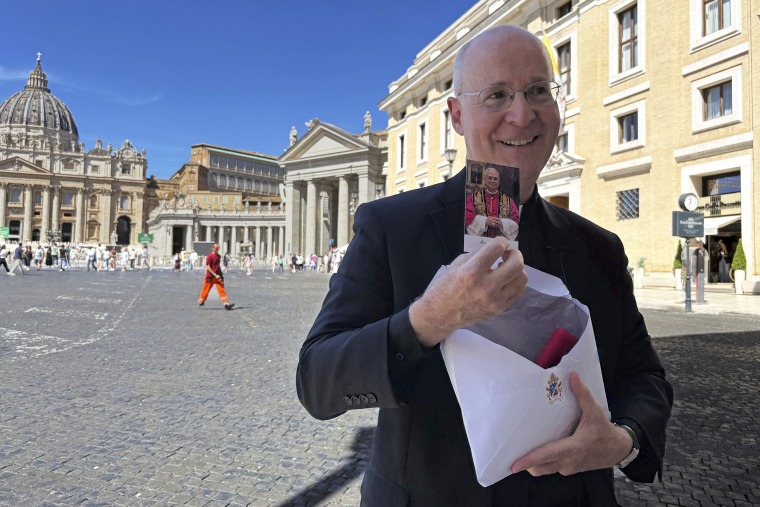
Rev. James Martin shows a commemorative photograph of Pope Leo XIV, outside St. Peter’s Square in Rome, on Monday.Maria Selene Clemente / AP
The meeting, which lasted about a half-hour, was officially announced by the Vatican in a sign that Leo wanted it made public.
The audience was significant because it showed a strong sign of continuity with Francis, who more than any of Leo’s predecessors worked to make the Catholic Church a more welcoming place for LGBTQ Catholics. From his 2013 quip, “Who am I to judge?” about a purportedly gay priest, to his decision to allow priests to bless same-sex couples, Francis distinguished himself with his message of welcome.
During his 12-year papacy from 2013 to 2025, Francis met on several occasions with Martin and named him an adviser in the Vatican’s communications department and a member of his big multi-year meeting on the future of the church. Still, Francis never changed church teaching saying homosexual acts are “intrinsically disordered.”
Leo’s position on LGBTQ Catholics had been something of a question. Soon after he was elected in May, remarks surfaced from 2012 in which the future pope, then known as the Rev. Robert Prevost, criticized the “homosexual lifestyle” and the role of mass media in promoting acceptance of same-sex relationships that conflicted with Catholic doctrine.
When he became a cardinal in 2023, Catholic News Service asked Prevost if his views had changed. He acknowledged Francis’ call for a more inclusive church, saying Francis “made it very clear that he doesn’t want people to be excluded simply on the basis of choices that they make, whether it be lifestyle, work, way to dress, or whatever.”
Prevost then underlined that doctrine had not changed.
“But we are looking to be more welcoming and more open and to say all people are welcome in the church,” he said.
Martin, who knew Prevost from their time working together in the synod on the church’s future, said he wasn’t worried about Leo’s views given Martin always had found him to be “a very open, welcoming, inclusive person.”
“But it’s wonderful to hear this continuation,” Martin said, adding that Leo told him his priorities are to work for peace and unity, citing in particular the conflicts in Ukraine, Gaza and Myanmar.
“But he also wanted to remind people that this is a church for ‘todos, todos, totos,”‘ Martin said, quoting Francis’ famous line in Spanish about how the church is open to everyone, todos.
Martin helped found Outreach, a ministry promoting LGBTQ acceptance, which will participate in a big Holy Year pilgrimage Friday and Saturday sponsored by Italian LGBTQ Catholic group “Jonathan’s Tent.” Significantly, the pilgrimage of about 1,200 people includes a Mass at the Jesuit church in Rome celebrated by the second-highest member of the Italian bishop’s conference.
The pilgrimage is not officially sponsored by the Vatican, but is listed on the Vatican’s calendar of Holy Year events. Vatican officials say such a listing doesn’t signify endorsement, but is merely a logistical help to those groups that wish to organize pilgrimages and walk through the Holy Door of St. Peter’s Basilica.
But the pilgrimage and Martin’s audience nevertheless send a signal that is consistent with church teaching “that Jesus reaches out to people on the margins,” Martin said.
The message he received from Leo was “that if people were happy with Pope Francis’ approach to LGBTQ Catholics, they’re going to be happy with Pope Leo’s approach. And he asked me to continue what I’m doing, which was very encouraging,” Martin said.
LGBTQ+ Americans are significantly less likely to be religious than their straight and cisgender peers — but they’re still more spiritual.
Less than half of U.S. adults who are LGBTQ+ (48 percent) say they identify with a religion, according to a new poll from the Pew Research Center, compared to 73 percent of non-LGBTQ+ Americans. The majority of queer adults (52 percent) identify as atheist, agnostic, or “nothing in particular,” compared to just 26 percent of their non-LGBTQ+ peers.
LGBTQ+ adults were also far less likely to say that religion is very important to them personally (17 percent vs. 42 percent), that they attend religious services at least monthly (16 percent vs. 31 percent), or pray daily (23 percent vs. 46 percent).
The majority of LGB adults (46 percent) also said that they believe religion does more harm than good in American society, the Center’s separate 2023-24 Religious Landscape Study (RLS) found. Another 17 percent said religion does more good than harm, and 37 percent said it does equal amounts of good and harm.
Despite the lack of religious affiliation, LGBTQ+ adults still higher rates of spirituality. Around 80 percent of LGB adults said they believe “people have a soul or spirit in addition to their physical body,” and 69 percent believe “there is something spiritual beyond the natural world, even if we cannot see it.”
LGBTQ+ adults are also more likely to believe in astrology or horoscopes. Over half of LGBTQ+ Americans (54 percent) consult them at least yearly, according to a separate May survey from the Center — nearly twice the percentage of the general U.S. adult population (28 percent). Another 33 percent of LGBTQ+ adults said they consult tarot cards, three times as much as U.S. adults overall (11 percent).
The newest PRC report suggests that LGBTQ+ Americans may be less religious due to their age demographics, as young Americans are both more likely to be LGBTQ+ and less likely to be religious. Another factor is the treatment of LGBTQ+ people by religious institutions — specifically Abrahamic religions — whose doctrines are either not accepting of queer people or weaponized to reject them.
Growing up, Kenzie remembers dragging her feet as her mom sent her to American Heritage Girls (AHG) programs.
“I describe it as Girl Scouts but indoctrination,” says Kenzie, a 20-year-old dance major from Oklahoma.
“Ever since I was little, I always knew I was queer; different from the people around me. … [In the eyes of AHG staff] it felt wrong to be feminine, but also wrong to be masculine.”
AHG and Trail Life USA—a similar organization for boys—havetroops in all 50 states and more than 110,000 members. They teach kids that homosexuality is sinful and that anything outside the gender binary is wrong. The messaging is often provided by anti-LGBTQ hate groups, like Focus on the Family, which still promotes so-called conversion therapy.
“AHG and Trail Life’s fixation on ‘sexual immorality’ reinforces a theology that punishes non-heterosexual, non-monogamous, non-cis lives,” says Fernando Salinas-Quiroz, an assistant professor at Tufts University who specializes in child study and human development.
“LGBTQ-exclusive policies don’t just harm the kids they shut out—they send a loud, damaging message to the kids inside, too,” they say. “It’s awful. But more than that, it’s strategic. These policies are not accidents—they are deliberate projects to maintain a binary, heteronormative, Christian nationalist order.”
These changes were too much for Patti Garibay, a devout conservative Christian who, in 1995, founded AHG as a Christian alternative.
Almost 20 years later, in 2013, AHG leadership helped launch Trail Life USA, the conservative Christian alternative to the Boy Scouts which was created after the organization announced that they would allow openly gay members.
John Stemberger, who was chairman of the board at Trail Life when it was founded, said in a 2024 interview of the Boy Scouts’ decision to allow gay members that “they’re going to allow an openly gay boy to decide who he’s gonna unilaterally sleep with. … This absolutely creates a radical increase of boy-on-boy contact.”
John Stemberger discusses the Boy Scouts’ inclusion of gay youth.
Salinas-Quiroz thinks the Christian hypersexualization of kids is concerning. “Suggesting that a gay boy choosing a tentmate is a threat isn’t just homophobic: It sexualizes queer presence, equates intimacy with danger, and teaches all kids to see desire, affection, and identity through a lens of fear.”
Exclusionary Membership Policies
This fear is baked into all of AHG’s and Trail Life’s policies. AHG’s membership policy says, “All biological girls of any color, race, national origin and socioeconomic status … are invited to be members of [AHG].” The term “biological girls” is a transphobic dog whistle which implies a person’s “real” sex can only be either male or female—denying the reality of transgender and intersex people.
“They’re ignoring both the scientific evidence and the lived experiences of so many of us,” says Salinas-Quiroz.
American Heritage Girls logo.
Trail Life’s handbook states, “[A]ny sexual activity outside the context of the covenant of marriage between one man and one woman is sinful. … We grant membership to adults and youth who do not engage in or promote sexual immorality of any kind.”
Homophobia and Transphobia in the Form of Strict Gender Roles
Kenzie remembers AHG “prepping us to be good mothers one day, like learning how to sew. … Activities that would make us good and pure Christian girls.” She says they didn’t do much outdoors. “You don’t need to be playing a ton outside, that’s what boys do,” they would tell her.
“I remember from a young age hearing, ‘This will make you a good housewife, a good mom.’ Who’s to say I want to get married? Who’s to say I want to have children?” says Kenzie, who only felt comfortable using her first name because she isn’t out to her family. “It felt like [AHG was] putting us in a very gendered box.”
Being forced to conform to the gender binary is also true over at Trail Life. “No matter what our culture says, boys and girls are different,” reads one blog post by Trail Life entitled “Letting Boys be Boys in a ‘Toxic’ Culture.”
“Discussions about ‘toxic masculinity,’ a blurring of gender lines, fewer and fewer fathers in the home, and the watering down or extinction of programs that train and equip boys to become men have left too many boys frustrated, fearful, and floundering in their struggle to understand what it means to be a man.”
At Trail Life, even though women are allowed to assist a troop, only men can become leaders “so that they can show the boys what it is like to be a man,” according to another blog post. “You need men to instill masculinity into boys, helping show them how to become a man.”
What Do They Teach?
Both AHG and Trail Life provide resources for parents and carers of young people that serve to bolster their anti-LGBTQ teachings.
In 2020, Trail Life—which operates as a ministry—partnered with two Southern Poverty Law Center-designated anti-LGBTQ hate groups: the Alliance Defending Freedom and Focus on the Family. The groups presented a webinar for troop leaders and connected officials that explored “religious freedom, child safety and gender confusion.”
“We need to know there is not an LGBT community. … So don’t think that any of us have to be respectful of the LGBT community,” Glenn Stanton, director of Family Formation Studies at Focus on the Family, said during the webinar.
Stanton also used the discussion to promote conversion therapy resources from Focus on the Family’s partner organizations for those who “struggle with unwanted same-sex attractions.”
“Same-sex feelings and all that is rooted in just pure political ideology, [and] those things have to be resisted,” he told pastors and ministry leaders on the webinar.
Screenshot from Focus on the Family’s presentation at the Trail Life Protect Your Ministry Summit.
In 2022, AHG self-published an e-book called “A Raising Godly Girls Guide to Gender and Identity,” aimed at supporting parents whose children are questioning their gender or experiencing gender dysphoria. The book—written by an unnamed author—undermines and denies the reality of transgender and gender-diverse identities.
The cover of AHG’s book, A Raising Godly Girls Guide to Gender & Identity.
In the founder’s note, Garibay writes, “For centuries, the beauty of God-given femininity has been under attack, its definition debated, [and] its behavior contested. … Today, it has gone one step further to claim an embrace of non-binary sexual identity.”
The anonymous authors define so-called “Biblical femininity” as “the core essence of every woman … relational, nurturing, and vulnerable beings.” They suggest that readers who know someone “struggling with confusion” should encourage them to go through conversion therapy by “[seeking] the professional clinical and spiritual care of a Christian counselor and … find[ing] healing.”
“This narrative may be cloaked in spiritual language, but its function is deeply political: It teaches girls that their value lies in submission, emotional labor and supporting others—particularly men—rather than in discovering who they are on their own terms,” says Salinas-Quiroz. “These [gender] roles aren’t natural—they’re socially constructed and often steeped in colonial, white-supremacist and Christian nationalist ideals.”
Rgg Gender And Identity E Book For Media4.19MB ∙ PDF file
Trail Life’s counterpart book, Raising Godly Boys, teaches a patriarchal view of masculinity—one that requires men to view care as feminine and positions women as less capable. “Women, for the most part, may not be the strong, action-oriented, stoic risk-takers men are. There is beauty and intention in these differences.”
“What [Trail Life] really means is that boys must perform a very specific kind of masculinity—one tied to dominance, emotional suppression and patriarchal authority. … These messages don’t just harm [queer] youth,” says Salinas-Quiroz. “They also limit cis children, especially those who don’t see themselves reflected in these rigid templates.”
It’s unlikely AHG’s or Trail Life’s LGBTQ-exclusive membership policies will face a legal challenge anytime soon. Both groups have some protection because of a 2000 Supreme Court ruling which upheld the Boy Scouts’ First Amendment right to exclude an assistant scoutmaster after learning he was “an avowed homosexual and gay rights activist.”
There is, however, a new, more inclusive option that’s gaining momentum. Founded in 2014 after Michael Brown and Eric Garner were killed by police officers, the Radical Monarchs is an alternative scouting organization for girls and gender-expansive youth, rooted in social justice and aimed specifically at girls of color to provide kids with a place where difference is celebrated, not disciplined.
Radical Monarchs badge.
“Rather than asking how to raise boys into men and girls into women, we should be asking how to raise young people into whole compassionate human beings. This requires spaces rooted in trust, exploration and self-determination—not segregation and control,” says Salinas-Quiroz.
“Children know who they are. Our job is to listen, affirm and make space for that knowing to grow.”
Kenzie says she’s done “a lot of unpacking” after her years at AHG and her Christian upbringing and says she’s now at peace. “If I could just be a straight cis woman and the ideal Christian girl it would make my life a hell of a lot easier, but I can’t push that into myself.”
The American Heritage Girls and Trail Life USA did not respond to Uncloseted Media’s request for comment.
After an LGBTQ+-inclusive church in Austin, Texas, was vandalized on Thursday, the community came together to transform the act of hate into something beautiful.
The vandals tore down the Pride flag at Life in the City UMC and graffitied “Pride was the 1st sin” on the front of the building. Afterward, volunteers joined the church for a “creative restoration project” to transform the graffiti into a mural featuring two Progress Pride flags flanking the church doorway.
“At Life in the City, we strive to welcome those on the outside to the inside of the circle because Jesus’ greatest commandment was for us to love our neighbor as ourselves,” the church wrote on Instagram in response to the graffiti. “And we will continue to do that, even to those who chose to deface our church building… as we know, the church is not the walls, it is the people and the community.”
The mural also includes broken stained glass “because we believe that we are each broken pieces of stained glass that all come together to make a beautiful picture,” one person involved with the project toldKVUE.
A post on Saturday celebrated that the mural had been completed only 12 hours after the hateful incident. “At Life in the City, we make beautiful things out of the dust,” the church said, adding, “Now, this is one flag you can’t tear down.”
In a separate statement, Pastor Glenn Luhrs reaffirmed the church’s mission of radical inclusivity.
“Let us be clear. Life in the City stands firm in our call to love our neighbor, without exception or condition,” Luhrs said. “Our faith compels us to protect, uplift, and advocate for the dignity of all people, especially those who are targeted, silenced, or pushed aside. That includes our LGBTQIA+ family, women, and anyone whose identity is used as justification for harm.”
“The outside of our building may have been damaged, but our spirit has not. Our commitment to love, justice, and inclusion only grows stronger. And our doors will remain open to everyone always, all ways.”
On its website, the church describes itself as a place “where outsiders are insiders.” It says it’s a place that believes in both “God and science,” declares that “reason is a gift,” and says “every human is of sacred worth, which is why we affirm all gender identities and sexualities, and why we are committed to the work of anti-racism.”
Bishop Cherry Vann has been elected as archbishop of the Church in Wales, becoming the first woman and LGBTQ cleric appointed to lead any of Britain’s Anglican churches.
While the broader, international Anglican Communion has had openly gay bishops before, most notably Gene Robinson in the United States, Vann will be the first lesbian to serve as archbishop globally.
The Church in Wales, which broke away from the Church of England in 1920, elected Vann to the post on Wednesday.
Vann was among the first women ordained as priests in the Church of England in 1994 and later served as Archdeacon of Rochdale, in northern England, before moving to Wales.
She is affiliated with the Open Table Network, a Christian initiative that offers worship and support for LGBTQ people.
According to her official biography, Vann lives with her civil partner, Wendy, and the couple’s two dogs. While the Church in Wales does not conduct same-sex marriages, it permits clergy to enter into civil partnerships.
Vann will replace Andrew John, who resigned in June following the publication of two internal church reports in May which raised concerns about governance and safeguarding. There was no suggestion of any wrongdoing by John.
“The first thing I shall need to do is to ensure that the issues which have been raised in the last six months are properly addressed,” Vann, 66, said in her first statement after her appointment.