LGBTQ+ Victory Fund, the only national organization dedicated to electing LGBTQ+ people to all levels of government, proudly congratulates Antwon Womack on his historic Birmingham School Board election victory. Womack is the first out Black LGBTQ+ person elected in Alabama and will become the second out LGBTQ+ person currently serving in elected office in the state.
LGBTQ+ Victory Fund President & CEO, Evan Low, remarks on the win: “We are thrilled to gain more LGBTQ+ representation in Alabama with Antwon Womack’s historic win to serve on the Birmingham School Board. School boards are an important place to stand up for student equality and progress. Alabama has one of the lowest rates of LGBTQ+ representation in the country, and this win literally doubles our total of known out LGBTQ+ elected officials in the state. We congratulate Antwon and know he will make a big difference for the youth and families of Birmingham.”
Antwon Womack, Birmingham School Board Member-elect, says: “Tonight’s election is historic — a victory for equality and progress in the City of Birmingham, State of Alabama. LGBTQIA+ representation matters because it ensures every student feels seen, safe, and supported. Together, we will continue building schools that protect all students, promote inclusion, and create policies rooted in fairness, dignity, and opportunity for every child in Birmingham City Schools!”
LGBTQ+ Victory Fund Vice President of Political Programs, Daniel Hernandez, continues: “Electing local LGBTQ+ leaders is a central part of LGBTQ+ Victory Fund’s mission, and as a former school board member, I know just how impactful school boards are in local communities,” says Hernandez. “Antwon has worked hard to achieve his seat at the table, and we celebrate not just his historic win but the important voice he will bring to his work in office.”
Royce Collins, LGBTQ+ Victory Fund Black Leaders Caucus Co-Chair, added: “Antwon Womack’s win is a powerful reminder that local elections shape our communities. As co-chair of the Victory Fund’s Black Leaders Caucus, I’m proud we’re helping elect endorsed, pro-equality leaders nationwide, especially in the South, so more voices like his can lead and deliver.”
LGBTQ+ Victory Fund endorsed Womack for his run, one of over 250 endorsed LGBTQ+ candidates in local, state and federal races. When Womack takes office, he will join more than 1,300 out LGBTQ+ elected officials serving across the United States.
Two years after state lawmakers passed a sweeping law aimed at preventing Texas cities from adopting progressive policies, that law may finally get its first major test.
Three Dallas residents sued the city in Denton County District Court Wednesday to strike down dozens of local ordinances they allege violate the law, dubbed the “Death Star” law by opponents. The law made it illegal for cities and counties to enact local laws that go further than certain broad areas of state law.
Some 83 ordinances could be wiped out if a judge sides with the plaintiffs. Among them are a slew of local protections for LGBTQ+ people, rules that city contractors pay employees a living wage and noise regulations for public parks and recreational facilities.
Read the full article. Texas Gov. Greg Abbott signed the bill in a ceremony attended by Christian and anti-LGBTQ activists. The Dallas residents are represented by the anti-LGBTQ hate group, the Texas Public Policy Foundation.
Texas judges who decline to perform a wedding ceremony based on a “sincerely held religious belief” do not violate the state’s rules on judicial impartiality, according to a comment the Texas Supreme Court added to the state’s judicial conduct code Friday.
The high court’s comment on Oct. 24, effective immediately, could have statewide implications for gay marriage and potentially play a role in a federal lawsuit attempting to overturn the U.S. Supreme Court decision that legalized gay marriage.
The rule change appears to answer a question of state law that the U.S. Fifth Circuit Court of Appeals posed to the Texas Supreme Court in April, which was prompted by a lawsuit challenging the State Commission on Judicial Conduct’s now-withdrawn sanction of a Waco judge who refused to marry gay couples while continuing to marry straight couples. The plaintiff in that suit, a North Texas county judge, sued saying he was afraid he could face the same punishment.
A Florida teacher has been put on leave after requesting to use the gender-neutral title Mx at work.
The teacher at Alachua County Public Schools has been placed on administrative leave after requesting that students and staff address them with the title Mx.
Mx is a gender-neutral title pronounced as ‘mix’ which some trans, non-binary, gender non-confirming and cis people use as an alternative to gendered honourifics like Miss, Ms, Mrs or Mr. Mx does not indicate a person’s gender.
The state’s attorney general James Uthmeier accused the teacher of violating Florida House Bill 1069, which was signed into law by governor Ron DeSantis in July 2023.
The bill enshrines “sex as an immutable biological trait” and prohibits K-12 employees from using preferred personal titles or pronouns that don’t alight with birth-assigned sex. Florida officials said the teacher’s use of “Mx” violated state law.
The district confirmed that the educator has been placed on leave pending review, but did not released further details.
@pinknews A Florida teacher at Alachua County Public Schools has been placed on administrative leave after requesting students and staff address them with the gender-neutral title “Mx.”The state’s Attorney General James Uthmeier accused the teacher of violating Florida House Bill 1069, which was signed into law by Governor Ron DeSantis in July 2023, which enshrines “sex as an immutable biological trait”. This law prohibits K-12 employees from using preferred personal titles or pronouns that don’t align with birth-assigned sex.Florida officials said the teacher’s use of “Mx.” violated state law. The district confirmed that the educator has been placed on leave pending review, but did not release further details. Florida Attorney General James Uthmeier took to X writing “A female teacher at Talbot Elementary in Gainesville is forcing students and faculty to address her with the prefix ‘Mx.’ instead of ‘Ms.’ or ‘Mrs.’ This violates Florida law and Alachua County School District policy and must stop immediately.” #Florida#USPolitics#Mx#education#lgbtqia♬ Minimal for news / news suspense(1169746) – Hiraoka Kotaro
Uthmeier took to X writing of the case: “A female teacher at Talbot Elementary in Gainesville is forcing students and faculty to address her with the prefix ‘Mx.’ Instead of ‘Ms.’ Or ‘Mrs’. This violates Florida law and Alachua County School District policy and must stop immediately.”
In August, a Florida judge struck down parts of House Bill 1069. Part of the law sets out a process for parents to complain about books and material with which they disagreed, forcing educators to remove them from their libraries “within five school days… until the objection is resolved”.
The wording of the legislation broadly singled out books with “pornographic” content or those which “describe sexual conduct”. Titles pulled from shelves included The Color Purple, On the Road, Looking for Alaska, The Handmaid’s Tale and Slaughterhouse-Five, also known as The Children’s Crusade: A Duty-Dance with Death.
Following legal action by publishers, the Authors Guild, and parents from Escambia County against the removal of dozens of books from school libraries, District Court Judge Carlos Mendoza struck down large parts of the legislation.
“None of these books are obscene,” he said in his ruling. “The restrictions placed on these books are thus unreasonable.”
The prohibition of material that “describes sexual conduct” was “over-broad and unconstitutional”, he added, because the law “mandates the removal of books that contain even a single reference to the prohibited subject matter, regardless of the holistic value of the book individually or as part of a larger collection”. In addition, the law gave “parents licence to object to materials under a I-know-it-when-I-see-it approach”.
As the internet becomes an increasingly powerful incubator for extremist ideas, young men are finding themselves drawn into online ecosystems that blur the lines between memes, masculinity and hate.
Since 1990, far-right extremists have committed far more ideologically motivated homicides than left-wing or Islamist extremists, and studiesindicate that right-wing extremist violence has been responsible for approximately 75% to 80% of U.S. domestic terrorism fatalities since 2001. In 2025, online radicalization has become more hidden and widespread, with extremists using encrypted apps, gaming communities and private chatrooms to recruit and groom young people. These platforms make it increasingly difficult to detect or intervene, allowing hate-filled and violent ideologies to spread unchecked.
Anthony Siteman, a senior at Quinnipiac University studying political science and public relations, has spent his undergrad researching how radicalization spreads through digital spaces—and even went undercover in extremist chat rooms to understand it firsthand.
As a white cis straight man, the rhetoric of hate he uncovered made him realize the urgency of developing communication strategies that can deradicalize his peers at a time when ideologies in extremist circles that promote violence against LGBTQ people are penetrating deeper into the minds of young American men.
Watch the video or read the transcript below.
Spencer Macnaughton: Hi everyone, today I am speaking with Anthony Siteman a senior political science and public relations student at Quinnipiac University, whose work specializes in online radicalization, and he even went undercover inside some of these groups as part of that work. Anthony, thank you so much for speaking with me and Uncloseted Media today.
Anthony Siteman: Thank you, Spencer, for having me here.
SM: So you specialize in online radicalization. What got you interested in that? Because I think it’s a big problem in the United States right now. And a lot of the time it’s actually young white men around your age, likely, who are the perpetrators of this.
AS: Yeah, well, you said it right there. Since I’m a young white male and I’m from a suburban Massachusetts town that is mainly white people. So I’ve been around it my whole life and I’ve always wondered why are these people having the views that they have?
SM: Tell me some of the things you saw in your friend groups that was concerning for you in terms of social media.
AS: Yeah, so my concern is that anytime they open up social media, they’re believing anything that they see. And it’s mainly just, you know, “Oh my god, look at what President Biden’s doing. Oh my god. Look at what the Democrats are doing.” For example, when I first moved to campus, I lived with eight guys, all white guys. And you know just getting to know them and seeing what their views are. It just seems like… One is that they’re not even politically active. They don’t understand what’s going on around the world. So they will just believe whatever they’re seeing without doing any research into it.
SM:Did you notice that when they start seeing a certain kind of content, it just keeps going more and more and more of that down a rabbit hole?
AS: 100%. For example, Nick Fuentes. He’s really been blowing up on people’s algorithms. And one time, just a couple of weeks ago, one of my friends was screen sharing his TikTok to the TV and every single post was just Nick Fuentes’.
SM: What do you think of that?
AS: It’s not good. We use these social media platforms every day and we expect them to be so good and great, but they’re really shaping the way we view things, the way that we see things, by pushing these algorithms. When I was doing the research into this—I obviously don’t support any of this stuff—trying to search about radicalization, it would damage my algorithm so much because everything I started getting was pro-Trump, pro-Trump or pro-Republican or just anti-Democrats.
SM: So interesting. And why do you think, especially for like young bros, really, you know, like something about the Nick Fuenteses, about the Andrew Tates, about these people does resonate with your demographic. Why do you think that is in 2025?
AS: I just think that it’s because those conversations, what Andrew Tate or Nick Fuentes are saying, is sometimes what kids my age just talk about. And for them to hear it from someone that has some sort of status, some sort of fame, money? That it just really resonates with them because usually you only hear [those] conversations just with a group of teenagers and them talking amongst themselves. So when they hear that someone with some influence is saying the same things as them, it really pushes them to really believe what they’re saying.
SM: I’m gonna sound like a geriatric millennial here, but meme culture and the idea of the cool effect, like there’s something cool and edgy about these guys, I think, to a lot of young men in America. What do you think is up there?
AS: Yeah, yeah, that’s a good question. For example, Andrew Tate, he says like, “This is how to be a man. If you wanna be a man, this is how you gotta treat people, this is how you gotta view things. You gotta look at life this way.” Same thing with Nick Fuentes. [He’s] saying like, “If you really care about the white race, if you care about America, then you should be protecting it through these beliefs,” which is just white nationalism.
SM: Growing up in the last 20 years, if I look at what’s happened, there’s been a lot of progress for LGBTQ rights, women’s rights. So I would think that Gen Z guys would be way more sympathetic to women and LGBTQ people, but that’s not necessarily the case. For a lot of guys, it’s gone the opposite direction. What do you think’s behind that?
AS: Despite what progress this country has made or progress around the world, they put this lifestyle out to people and it’s like, “If you follow what I’m doing, what I’m saying, what I’m believing in, then you will get this lifestyle.” People are so influenced by them because no one else [is] saying these things. If you’re saying the stuff that Nick Fuentes or Andrew Tate are saying online you’re going to get “canceled” or you’re just not going to get a following. But since they already have that following, they’re allowed to say that stuff, and then people will fall for it.
SM: Right. Wow. Really interesting. And then there’s obviously the Nick Fuentes, Andrew Tates, but then there is a lot deeper radicalization as well that can happen. So tell me about your research project. What was it and what did you set out to do?
AS: Yeah, so my research was just focusing on radicalization on social media platforms. I originally started with just Instagram, Facebook, X and TikTok. But the most I could really find is just the people we were just talking about: Tate, Fuentes. So I realized that, yes, they’re monitored to a degree. They still have these hateful people on it, but there isn’t so much radicalization. That’s when I started to go to other platforms like Telegram. I went on Discord. When I was on those apps, then that’s when I was able to find like these more secret groups of people who have all the same opinions and views. But since Discord and Telegram, for example, those are channel-only apps. So you can’t just like, you don’t have profiles. And that’s when I started finding the real radicalization.
SM: And tell me what you mean by that. What do you mean by real radicalization?
AS: So yeah, when I view radicalization, I view it as when people are believing in extremist beliefs and then start using violence or support violence to achieve them. So in those apps, they’re always blaming someone. It’s never their fault. It’s always “us versus them.” And what makes Telegram so useful for these people is that all the messages are encrypted so that it’s hard for them to get leaked or for them to get out there. It’s all basically anonymous.
SM: What were some of the messages or the consistent themes you noticed in these message boards on Telegram?
AS: Yeah, so when I was looking at them mainly, it was before the 2024 election and a lot of the messaging was like, “Democrats, they’re fraud. They’re all illegal. They support all of these bad causes.”
SM: You said that your definition of radicalization is when it gets to a level where there’s violence involved, right? Did you see some of that in Telegram?
AS: Yes, obviously it wasn’t like physical violence, but there’s a lot of people saying, you know, very hateful things, like “Burn all Jews” or “We should send them to the gas chambers.” What they did utilize a lot are memes of these violent events. So, for example, if they have a murder video… because you can access LiveLeak videos online and some of these channels, they would meme them.
SM: What does that mean? To meme a video that’s live of somebody getting murdered?
AS: So for example, there’s a game called Call of Duty and they release trailers for it, obviously. And they took a shooting video at a mosque in New Zealand where over like 50 people died. And they took the clips from that shooting and put it in like a trailer format.
SM: What is the impetus for people doing that with that shooting? Is it Islamophobia? Is it just people being idiots?
AS: I thinkthey just have too much time on their hands. I think that they do wanna instill fear in people and they wanna just take bad events and turn it into something that is “cool.” So I think they wanna do it to just create some more fear and be like, “Look at what we can do.”
SM: And you referenced something that actually just came out of the news today, that there was a big, I think, Telegram leak where young Republican leaders were using hundreds of racist and anti-LGBTQ slurs in a group chat, as well as jokes about slavery and rape. Why do you think it’s just so pervasive, that level of hate? Among, you know, groups that are seemingly just part of the GOP Young People’s Club. And how do you think American politics has played into that? Because obviously, President Trump’s rhetoric is pretty rough sometimes, too. Do you think because it comes from the top, that green lights it for young men in America at large?
AS: Yeah, I think since Trump has [come] into office, he has kind of sent politics down to a very low level where you can kind of say whatever you want, do whatever you want. Since his rhetoric is so bad, it just stoops everyone to such a low level.
SM: What do you think are the groups that we should be most concerned about right now? Because I know you did some research on the Ku Klux Klan and other extremist groups. What should people be worried about based on what you found in your research?
AS: It can be anyone, it really can. Anyone can be an extremist, anyone could be radicalized. But if I had to say one group, it would just have to be white nationalists. It would have to be white nationalists who believe that America is losing its white identity, that they need to fight to come back, to fight to get their place back in this country.
SM: And why do you think that?
AS: Because just from my research of what I’ve done, they contribute to 75% of extremist-related killings. In the past, about 10 years, there’s been around 440 killings, and yeah, they account for 75% of them. So they are the majority of people who are committing these extremist acts in this country.
SM: Which groups right now are you most concerned about, if any?
AS: I would say the Proud Boys, despite what they say now that they’re not racist and that they’re accepting of all people, yes they are still [an] issue. When I was in their Telegrams, they have chapters all over this country and all over the world, frankly. They have chapters in New Zealand, Australia, all the European countries. So they’re pretty prevalent everywhere. One concern I’m thinking, too, is the rise of Nazis again. I’ve seen that with a lot of Jewish hate and with the rhetoric towards Jewish people now, especially with the war.
SM: And you see that being played out, that kind of anti-Semitic hate in these channels on Telegram.
AS: It’s a mix. I feel like that’s a place where it has split these extremists because there’s the extremists who side with Israel and then there’s extremists who side with Palestine. So I feel like that issue really split them in a way.
SM: When I was doing my work in far-right extremism, there were those groups, there were groups like the Michigan Militia and the Boogaloo Boys, et cetera. But a lot of it was, to your point, decentralized groups. And one of those white supremacists said it was fragmented into a million little pieces as lone wolves. Are you concerned about individuals specifically and the idea of lone wolf acts of radicalization or terrorism?
AS: Yes, because they can be anonymous in that way if they’re not tied to any group and if they are just logging on to their computer sending out hate messages, sending out fake disinformation and all this other stuff? Then yes, it is an issue with these decentralized groups. It’s hard to stop decentralized groups because you don’t know where they’re coming from. You don’t know what platform they’re going to move to next. You don’t know if they’re not even meeting on these social media platforms and they have a secret society where they meet in person somewhere. So it’s hard to really track them. No one uses a real name. No one’s using pictures of themselves. It’s all just them hiding behind a username or hiding behind just a profile.
SM: And they’re probably using things like VPNs and like you said, encrypted messaging. So it’s very hard to track where they are.
AS: Yeah, and one thing I’ve noticed too is that some of these extremists, they’re not even from America. They utilize bots a lot. They utilize taking people’s information and making profiles for them. Especially older people, because as you know, 60-, 70-, 80-year-olds aren’t going to be on apps like X. Sure, there are some. But they’re going to get their information stolen and used on those apps and they won’t even know about it. And so when you see Twitter threads of this elderly woman just arguing why Democrats are so bad, a lot of the time it’s not an elderly woman. It’s someone behind the screen or it’s just a bot running the account.
SM:That’s really interesting. So you think that’s pretty prevalent? These fake kind of older Americans are just patriots, if you will, being run by other types of people.
AS: Yeah, a hundred percent, and I like that you said the word “patriots” because that’s always the word that they have in the bio, like, “American Patriot, U.S. veteran for 20 years,” and you can really tell too because they start like responding to all the same posts with the same message, or they start reposting the same image in all these other threads. So there’s ways to tell, but a normal person isn’t going to go through this person’s profile and figure it out.
SM: What are the main, kind of, rhetorical devices, things you have noticed as it relates to the LGBTQ community and how people are coming after that demographic group in these channels of radicalization?
AS: Yeah, like you said with the pedophilia a lot of like I saw was that “oh LGBTQ people are grooming these kids.” That they want these kids to be in drag shows and just the normal rhetoric that has been being said for the past eight years that we obviously know isn’t true. Mainly about LGBTQ individuals grooming the younger generation to try to pull them into their sickness. And that’s another word too is that they use the word illness, sickness, that they’re not right.
SM: And how prevalent is that? There’s a lot of that, I would guess.
AS:Yeah, so some of the things I saw since it was June, it was a pride month, and they would post on June 1st “Happy groomer awareness month.”
Meme of LGBTQ groomers found online. Courtesy of Siteman.
SM:That’s interesting. What else are you concerned about with artificial intelligence and radicalization? I mean, you’ve mentioned that a few times and that does sound a little scary when you put it like that.
AS: With artificial intelligence, you can get it to say whatever you want and you can get it to post whatever you want. So for example, they could have accounts that are just literally run by AI and spread just such nasty, nasty rhetoric and it’s not gonna get tied back to anyone because it’s AI running the account. They could have someone, just a fake persona on it. But there’s not going to be many repercussions for the account saying it since it’s run by AI.
SM: Super interesting and you know, we’re talking a lot about rhetoric here, right? Why is that still concerning though when it comes to something more violent and actually committing acts of violence and, God forbid, a mass shooting or a terrorist attack or something like that?
AS: Yeah, that rhetoric itself, it’s damaging. Because even though people may not act on it, [they] hear that and internalize it. And if people are in a bad spot, maybe they will act on that type of stuff.
SM: Will you ever see, do you ever see people actually threatening violence in Telegram and saying, “Let’s do event X?”
AS: I would say yes, but they were obviously empty threats, to me at least. I could tell that they would say stuff like, “Let’s go to the streets. Let’s go to a pride parade and go blow it up.”
SM:What about the rhetoric around women specifically and queer women?
AS: They treat women as just [an] extension to the man. That women [are] good only if they listen to you and do everything that you say. The only good thing I heard them say about women is that they give birth to children.
SM: The trans community, specifically, has really been under attack by the politicians in this country, and after Charlie Kirk’s assassination, the rhetoric about who the murderer was, even though there was no evidence that the perpetrator was trans, was grossly tied to transgender people. Even though, again, no evidence. What do you make of all of that?
AS:I think that that whole rhetoric came out just because they just wanted someone to blame that wasn’t themselves.
AS: These people are obviously not hearing trans voices. They don’t know any trans voices. They don’t know trans people. They just totally deny their existence. So they just want someone to blame. And it’s probably the easiest for them to blame because that’s what they’ve been using for the past like six years. That “trans are grooming people in libraries, trans are going to the bathrooms” and insane people all that stuff. So it’s just kind of their scapegoat.
SM: I think a lot of it does come down to conceptions of masculinity and bro culture. You talk a lot about communicative devices to kind of push back against this. What else can be done among men in this country to tamp down on that rhetoric, to make it not as cool?
AS: If you hear friends who talk like this, you have to have a conversation with them. And I know that’s what everyone says, but seriously. From what I’ve seen with my friends who have been somewhat radicalized, the best way to get to them is to just sit down and talk to them and just go through everything that they’re saying. Like, you know this isn’t true. You know this isn’t right.
SM:I think a lot of guys might be listening to this being like, “That sounds so hard.” So do you have an example of a conversation you’ve had that you felt has actually worked?
AS: Don’t make them ever feel stupid like, “Oh like why the hell would you believe that?” So you don’t want to be like, “You can’t look at this, you can’t view this.” You just have to be like, “I understand what you’re trying to say. I understand how you got to this view. But you have to understand that this isn’t the full story.” If you find a common ground between the issue that both of you can actually agree on, that’s a good start because it gives you that ability to be like, “You know what, maybe we aren’t that different after all.” And that’s something I’ve really found out like talking with people that claim they’re on the right is that when they start talking and they start saying what they actually believe and how they view things, they sound a lot more left than actual right; they just want to be right because of what you’re saying, that bro culture. Like, “Oh men are on the right and girls are on the left.”
SM: Do you think there is a stereotype that being liberal in America right now is feminine?
AS:Yeah, a hundred percent. 100%. I mean, obviously, I disagree with that. Like I go to a private school and it’s like 90% white. And I remember like when Trump won, it was like, like no liberal wussies allowed. There’s a connotation that if you’re liberal, you’re a loser.
SM: That’s so interesting.
AS: Which obviously isn’t true, and I think that the only reason why they really connect with the Republican Party right now is one, that they fall for a lot of the manipulation and tactics they’re using. But also that the right uses the American flag and the symbols of [patriotism] in America much more than the left does, so for someone who actually fought for the country, they’re more likely to go on the right because they’re more like American flags and country music. Whereas the left, you don’t really see that.
SM: So interesting. What else can we do? Because I think it’s such a big problem in this country getting, honestly, your demographic, 21-year-old white straight men, to be less radical. You can be whatever political party you want, but like, can you leave the radicalization at the door? How do you get people to do that?
AS: Yeah, it is hard. And that’s what I’m still trying to figure out right now. I just did some work looking at counter-radicalization, which is like, for example, there’s a program called ExitUSA where they do private mentoring one-on-one. And that really helps someone. But the issue with that is that people who are radicalized, it’s not easy for them to admit that they’re radicalized. So those are great resources for people that are willing to make that change. But as of right now, it’s hard and that’s why I think talking is just the best thing, just talking to people and just really, like, understand what their views are.
SM:You’re in a group of bros, let’s say a frat party, let’s make it super stereotypical, and everyone else is just spitting transphobia. I would be nervous to interject. How do you intervene in a way that doesn’t make you literally wanna disintegrate?
AS: For me I’d just be like, “Yo, think before you talk. One of these people among us could be transgender. You don’t know what you’re saying and how it affects people, and I know you’re trying to be cool, but you know let’s be respectful.” Because if they’re willing to stoop that low to talk all this hate about one group, then I can stoop that low, and I know that’s maybe not the best tactic but I mean it has worked for me. It really puts them in perspective. It puts them in their place.
SM: I do think the word “cool” is like a big word that I keep thinking about in this conversation, that people think it’s cool to be transphobic or it’s cool to be misogynistic, right? How do we change what young American guys think is cool?
AS: I think it has to come from up top from our leaders allowing this rhetoric to begin with, because it’s like they allow these people to just think that these things are okay to say because their own people are saying it. Yeah, once we have two parties that can just really understand that what these people are saying is not okay, and if they hear these acts of violence or [this] bad language that they go to take action and be like, “This is not okay” to all of their supporters. A good way to help my generation understand it is put on the debate between Obama and Mitt Romney, they’re just so cordial. It’s like, it hasn’t always been like this. You can be on two opposite sides and you can still love each other and still be friends.
SM: And you really haven’t grown up at all with that type of political discourse because when Trump came down that escalator in 2016, you were 12.
AS: Yeah, yeah.
SM: Which is wild to think about. Anthony Siteman, thank you so much for your research in this important space of online radicalization and for speaking with me and Uncloseted Media today. I really appreciate it.
AS: Of course. Thank you, Spencer. It has been great being on here. Thank you so much.
The online three-day class, “Advancing Excellence in Transgender Health: A Core Course for the Whole Care Team,” had originally been scheduled from Oct. 31 through Nov. 2, but The Harvard Crimsonreported the Fenway Institute-developed course had been postponed.
That came after the National Review contacted the university and questioned how it could legally waive $650 fees for transgender and gender-diverse participants. The outlet said rather than providing an answer to the query, the school said the course had been postponed.
The Crimson said the school’s website afterward stopped listing any cost for the course and eliminated any mention of the fee waivers.
The website now states: “Upcoming dates to be announced soon.” Under pricing, the site mentions a $10 non-refundable processing fee on registrations, but lists no price for the course in question.
A course description remains viewable. That states the curriculum was developed “in response to the high volume of queries from clinicians and health care staff seeking to learn about providing high-quality care for adults, adolescents, and children who are transgender or gender diverse.”
Identifying the class as a conference, it says participants would discuss best clinical practices grounded in research evidence.
“Sessions are led by expert faculty specialized in transgender health-focused research and patient care. The conference is appropriate for all members of health care teams, including physicians, behavioral health care providers, physician assistants, nurses, and other staff,” the website states.
“In addition to didactic presentations, attendees will learn from lived experience panels and have the opportunity to engage in interactive discussions that highlight medical and behavioral health approaches to gender-affirming care, led by experienced clinicians specialized in transgender health.”
The medical has not signaled when the class may be rescheduled. A spokesperson for the institution told The Crimson the course “will be rescheduled for later this academic year.”
“HMS remains committed to ensuring that the courses we accredit comply with applicable laws,” the statement reads.
The Fenway Institute told the outlet it remains committed to the course and ensuring the “vital training reaches as many people as possible.”
During a 1971 Cinco De Mayo event at the Los Angeles gay bar The Closet, Richard Adams (a Filipino-American citizen) met Tony Sullivan (an Australian immigrant). The two began dating and fell in love. But because Sullivan entered the U.S. under a tourist visa, he wasn’t legally allowed to stay long-term.
So, in 1975, in Boulder, Colorado, the two men married. At the time, Boulder County Clerk Clela Rorex issued six same-sex marriage licenses with the local state attorney’s understanding that, because the state’s marriage law only specified “any two persons,” it didn’t explicitly forbid same-sex unions.
State Attorney General J.D. MacFarlane soon ordered the practice to stop, saying the licenses were void because they lacked legal standing. However, no Colorado court at the time ruled that the marriages had violated state law. In fact, the couple’s attorney, Lavi Soloway, pointed out that Colorado state law held that the formal opinion of a state attorney general does not carry the same force of law as the state’s pre-existing statutes and would have no impact in a judicial proceeding.
Sullivan petitioned the U.S. Immigration and Naturalization Service (INS) for permanent residency, a privilege afforded to the legally married spouses of U.S. citizens. However, INS refused to recognize his marriage license and denied his petition.
You have failed to establish that a bona fide marital relationship can exist between two fa**ots.U.S. Immigration and Naturalization Services’ November 24, 1975 letter to married gay couple Richard Adams and Tony Sullivan
As part of its reasoning, the INS cited the 1967 U.S. Supreme Court decision of Boutilier v. INS in which the INS rejected the visa application of Canadian native Clive Michael Boutilier because his homosexual orientation was proof of a “psychopathic personality.”
At the time, the 1952 Immigration and Nationality Act listed “sexual deviation” as a legal criterion for denying immigrants entry. In its ruling, the Supreme Court upheld INS’ decision, even though the 1952 law didn’t clearly define what a “psychopathic personality” is. The American Psychiatric Association would later declassify homosexuality as a mental illness in 1973.
A section of the 1952 Immigration and Nationality Act that lists homosexuality as a criterion for refusing immigrants into the United States.
“You have failed to establish that a bona fide marital relationship can exist between two fa**ots,” the INS’s reply to the couple stated. “[A] marriage between two males is invalid for immigration purposes and cannot be considered a bona fide marital relationship since neither party to the marriage can perform the female functions in marriage.”
The couple then filed a lawsuit in the United States District Court for the Central District of California. Their lawsuit said INS had violated the U.S. Constitution’s Equal Protection Clause, which guarantees equal treatment under the law to all Americans.
In a 1979 press conference, Soloway noted that many married women, for various reasons, cannot fulfill marital “female functions.” As such, INS’ reasoning would deny federal marriage recognition and legal residence status to all sorts of opposite-sex couples.
“We’re asking the court either to say that this was a lawful marriage under Colorado law and therefore has to be the proper basis for changing immigration status or, if they’re not willing to say that, then we have to get to the question of, is there a violation of the federal guarantee of equal protection of the laws involved in this situation?” Soloway said in the 1979 press conference. “Obviously, that issue has tremendous ramifications, way beyond just the field of immigration.”
A Los Angeles federal judge eventually upheld INS’s decision in a 1985 ruling against Sullivan. He filed an appeal to stop the impending deportation proceedings, stating it would cause “extreme hardship,” but a court denied that petition, too, Esquire reported.
“My belief was if the press knew what we were doing — if we got in the press and stayed in the press —that gave us a measure of safety from the government,” Sullivan told The Washington Post in 2015. “And I think one of the reasons the press decided to be nice to us was because we were so honest.”
In 1985, the couple traveled around Europe for a year and re-entered the U.S. via Mexico in 1986. Afterward, they began speaking publicly as marriage equality advocates. When Massachusetts became the first state to legalize same-sex marriage in 2004, Soloway asked if they wanted to wed there, but the couple refused, still convinced of the legitimacy of their Colorado union.
A flyer from the March Committee for Lesbian Gay Rights/Los Angeles, “Your Presence Counts: Demonstrate for the Revision of Immigration Laws Affecting Lesbians and Gays,” February 1980. | Sullivan (Anthony Corbett) v. Immigration and Naturalization Service legal records, ONE Archives at the USC Libraries.*
Adams eventually became afflicted with cancer, and by 2012, the couple planned to wed in Washington state. However, before they could do so, Adams died on December 17, 2012, at the age of 65.
In 2015, the U.S. Supreme Court eventually legalized marriage equality nationwide. In an interview that year with Los Angeles’ LGBTQ+ publication The Pride, Sullivan said, “I desperately wish Richard was here with me for this.”
In 2016, U.S. Citizenship and Immigration Services (USCIS) – one of the agencies that replaced INS in 2003 – granted Sullivan permanent residency status. In 2020, USCIS issued him a work permit and a green card, finally recognizing the legitimacy of his marriage.
Then-USCIS Director Leon Rodriguez also responded to Sullivan’s letter requesting a formal apology for the INS’s insulting letter.
“This agency should never treat any individual with the disrespect shown toward you and Mr. Adams,” Rodriguez wrote. “You have my sincerest apology for the years of hurt caused by the deeply offensive and hateful language used in the November 24, 1975, decision and my deepest condolences on your loss.”
Sullivan died in November 2020, but the couple’s decades-long legal struggle was immortalized in the 2015 documentary Limited Partnership, which is currently available to stream online.
In December 2024, U.S. Secretary of the Interior Deb Haaland announced that the Boulder County Courthouse had been designated a National Historic Landmark for being the first U.S. site to issue a same-sex marriage license.
It may come as a surprise to people living outside of the U.S. South that the majority of LGBTQ Americans reside in this region. Ask any LGBTQ person living in the coastal U.S. their thoughts about the experiences of queer people living in deep red states like Alabama, Georgia, and Mississippi, and their reaction is likely to be a combination of fear and sympathy. Sure, some queer people flee the South for more politically and socially progressive states. Then some remain and commit themselves to creating a future that is welcoming and affirming of all people, especially Black queer folks who still choose to call the South home.
Kamilah Kenyatta, Gender/LGBTQ+ Justice Organizer, ACLU Alabama, and TC Caldwell, Executive Director, The Knights Orchid Society (TKO Society), are two of those people. Both Kenyatta and Caldwell served as co-organizers of the inaugural Black Queer Visionaries Summit (BQVS), an offshoot of Black Trans Futures, a five-month, paid organizing and storytelling collaboration between the ACLU of Alabama and TKO Society that provided Black transgender Alabamians with community organizing and storytelling skills to combat anti-trans rhetoric and legislation. BQVS was held in Birmingham over three days in early October.
“The creation of BQVS was our declaration that we have always been here, and we are here to stay,” Kenyatta said. “When our communities are forced to defend our very existence, such as fighting legislative attacks on trans healthcare, book bans that erase our stories, and being confronted with the effects of systemic violence, we are not meant to have time to dream.”
For organizers, BQVS was a tangible, community-first manifestation of each organization’s direct investment in Black LGBTQ communities.
“This [BQVS] was not about reacting to struggle, but rather a proactive and intentional gathering that poured directly into the attendees and their lived realities,” Kenyatta said. “We held space for all of it: the hard conversations, building around and mapping out practices for community care and organizing, the collective processing of grief, the sacred act of archiving our own stories, and most importantly, for radical unapologetic joy.”
ACLU Alabama and TKO Society selected over 60 Black LGBTQ people from across the South for the all-expenses-paid inaugural BQVS cohort. Redefining home as Black queer and transgender Southerners was one of the first visionary assignments facilitators gave to attendees and speakers on day one.
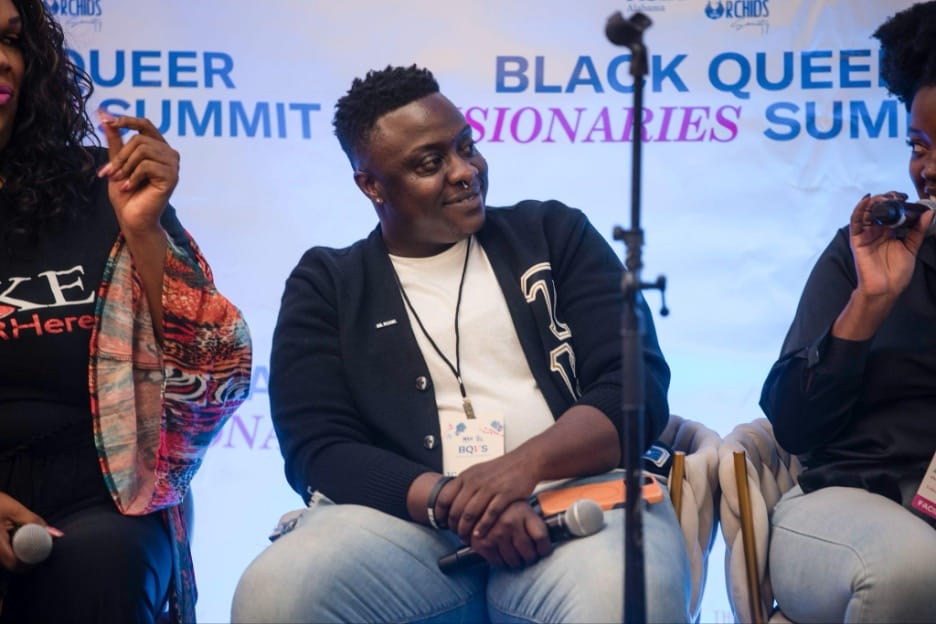
TC Caldwell, Executive Director, The Knights Orchid Society (TKO Society), speaks during the opening session fireside chat of the inaugural Black Queer Visionaries Summit on October 3, 2025, at the Embassy Suites in Birmingham, AL. (Photo: Tosha Gaines Photography)
During the opening fireside chat, Caldwell, a Black transgender man and Montgomery resident, described home as a place “where my nervous system is calm, where I don’t have to pick what bathroom I go to. Where people witness me but don’t perceive me.”
The use of bathrooms that align with one’s gender identity remains a baseless but relentless priority for conservative Alabama politicians at the expense of the dignity and humanity of transgender Alabamians. It was also an issue organizers had to navigate on-site in real time after being forced to designate an additional hotel room for transgender attendees to use the bathroom without fear of questions or confrontation from other hotel guests who might object to their entry into a bathroom they feel safest in.
“Why are we still navigating bathroom use? It was a sharp reminder that we still have a long way to go in the South,” Caldwell said. “Being called to the front desk like children to discuss “the bathroom problem” really showed me that bodily autonomy is a right many of us may never have if we continue to let things like this happen.”
“The worst part is that we anticipated this,” Kenyatta said. “Given the current climate, we thought about safety extensively beforehand and had already secured private suites to ensure a comfortable, judgment-free option was available. We fundamentally believe in letting people use the bathroom that aligns best with their identity and needs, and we never wanted to police that. We are so grateful that folks still resonated with the space, but it certainly undermined the sense of belonging we were working so hard to ensure for our attendees.”
In the last five years, the Alabama Legislature has passed several laws targeting LGBTQ people, including the original “Don’t Say Gay” law passed in 2021 and a ban on gender-affirming medical care for transgender youth the following year, according to reporting from AL.com.
“We get to create what home looks like,” said Jenice Fountain, executive director of The Yellowhammer Fund. “We get to create what healing looks like, and it’s always gonna look different from any mainstream ideal,” she said.
“Home consists of showing up whole,” said Daroneshia Duncan-Boyd, founder and executive director of the Birmingham-based TAKE Resource Center (Transgender Advocates Knowledgeable Empowering).
“People don’t understand our courageous identity. We show up with so much courage,” Duncan-Boyd told GLAAD in a previous interview. “We’re gonna do it, no matter how somebody views us or what anyone says about us. We are who we are and will stand true to what we believe in.”
“Nobody has ever loved me or cared for me the way Black queer and trans people have, but nobody has ever hurt me the way Black queer and trans people have, and that tells me that we understand principle struggle and conflict,” Caldwell said. “We haven’t healed our shit yet because we’re still healing what our parents couldn’t do. We’re still healing what their parents couldn’t do. And now that we have language and access to these things, it’s gonna take us a little more time, but my God, we’re getting there,” they said.
Facilitators centered strategy discussions on how to dismantle various forms of oppression throughout the Summit, but with a lineup of fierce Black drag performers, including Alabama drag legend Bronzie De’Marco, who recently celebrated her 56th year as a drag performer, organizers also made sure to center Black queer joy, and above all else, rest.
“Burnout is a real thing,” Caldwell said. “And these movements can’t move when dead bodies are pushing them.”
For Duncan-Boyd, one of Birmingham’s most respected and effective Black transgender leaders, creating work/life balance, while necessary, isn’t necessarily at the top of the list when the work is personal and Black LGBTQ organizations consistently lack vital resources.
“If you don’t get emotional by doing this work, baby, you’re in the wrong field,” Duncan-Boyd told the BQVS cohort. “You’re not gonna tell me to detach myself from the people that I’m serving that look like me, identify like me, and have been where I’ve been. You’re gonna tell me to detach from them because it’s personal? Hell yeah, it’s personal because I see myself in them.”
With its inaugural success, Kenyatta says BQVS is “proof and a model for what is possible when we stop waiting for permission and start building the futures we deserve, right here in the South.”
And like every Black and queer person who is an ancestor or walking among us, the co-hort, Black LGBTQ people everywhere, including Caldwell, remain resilient in the face of increasing attacks on the community.
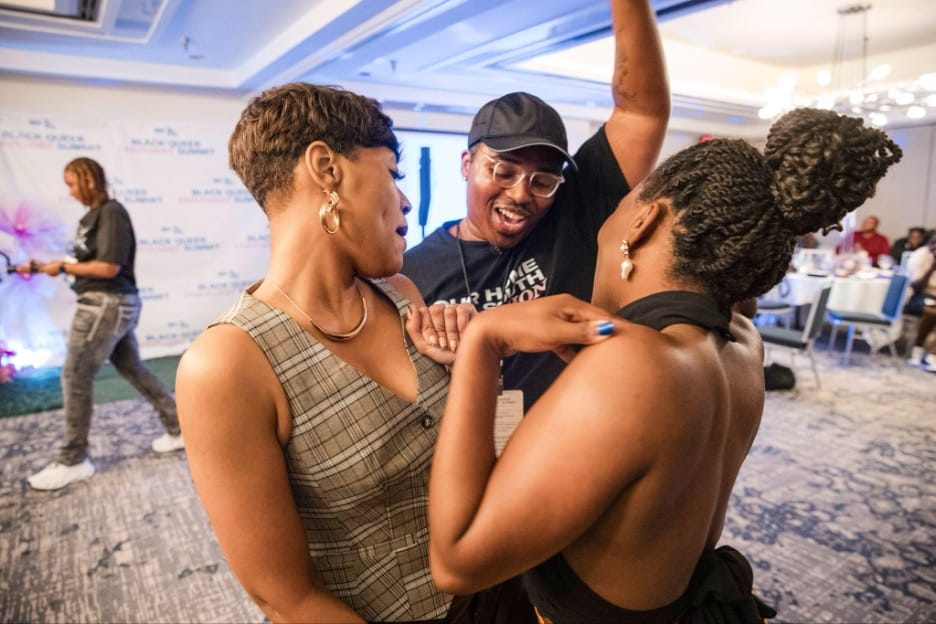
Dr. Joshua Baker (center), Youth Program Coordinator for TKO Society and an organizer of the Black Queer Visionaries Summit, revels in Black queer joy with attendees during day two of the inaugural event at the Embassy Suites in Birmingham, AL. (Photo: Tosha Gaines Photography)
“We keep saying the world is on fire, but Lord have mercy, they will not stop us from dancing,” Caldwell said. “They will not stop us from celebrating or from loving one another. Joy is a part of our lineage and we deserve to be fu**ing happy.”
An asylum-seeker who fled anti-LGBTQ+ persecution in Ecuador is now in ICE custody after being arrested as part of a controversial undercover operation targeting men who were allegedly cruising at New York City’s Penn Station.
The man, identified only as Isrrael, told Gothamist this week that he believes federal Amtrak police targeted him because of his appearance and mannerisms.
According to the outlet, which, along with nonprofit news website The City, first reported on the Amtrak Police Department’s sting operation last month, Isrrael was on his way to meet a real estate broker in July when he entered a Penn Station men’s room. In a criminal complaint, police allege that Isrrael exposed himself in “plain view.” But Isrreal told Gothamist that he was merely using a urinal when an undercover cop pinned him against the wall, handcuffed, and arrested him.
Isrrael said he was wearing a t-shirt and shorts at the time, had bleach-blonde hair, and described himself as “very feminine in the way that I walk, that I talk, that I sit.”
“I thought that the U.S. would give me a different opportunity,” he said. “And so I felt very free when I got here. I felt like I could wear my hair the way I wanted to and that no one was judging me and that people were kind to me, and that they treated me well without knowing me.”
According to Gothamist, records show that Isrrael entered the U.S. at a border checkpoint in Hidalgo, Texas, where he applied for asylum. His application reportedly states that in Ecuador, he was harassed and assaulted for being gay and fears getting killed in his home country. He had been in New York City less than a month before he was arrested. Despite being allowed to remain in the U.S. until November 2026 as his asylum claim is processed, Isrrael now faces deportation.
As Gothamist reported last month, among the 200 people arrested in the Amtrak Police Department (APD) cruising crackdown, 20 have been turned over to Immigration and Customs Enforcement (ICE). That’s because while state and city laws ban New York police from handing detainees over to ICE, as a federal police department, the APD is obligated to check whether detainees have been flagged for deportation proceedings and, if so, alert ICE.
Isrrael’s attorney told Gothamist that charges against him were dropped on October 1, but he remains in custody at the Moshannon Valley Processing Center in Pennsylvania.
“We’re seeing the intersection of both ICE raids and anti-LGBTQ policing in which they can do both at the same time,” Kevin Nadal, a professor at John Jay College who studies the intersection of LGBTQ+ issues and the criminal justice system, told the outlet.
Nadal also noted that he hasn’t seen this type of enforcement of anti-cruising laws in recent years. As Gothamist reported last month, NYPD data indicates only 12 people were arrested for public lewdness in and around Penn Station during the first five months of 2025. Since June, those arrests have skyrocketed thanks to the APD operation.
Amtrak Deputy Police Chief Martin Conway insisted that ADP officers are “not targeting anybody on the way they look.”
“We’re taking action on behaviors, committing criminal acts,” he told Gothamist. “What they look like has no bearing on that.”
New York Democrats, including Rep. Jerry Nadler, state Sen. Brad Hoylman-Segal, and New York City Council member Erik Bottcher, have reacted to reporting on the ADP arrests with outrage, demanding explanations from Amtrak President Roger Harris and an end to its alleged targeting of gay men.
Gothamist reports that others who were arrested during ADP’s Penn Station bathroom sting, including one NYPD sergeant, have also had their charges dropped in recent weeks. As Jennvine Wong, a supervising attorney at the Cop Accountability Project for the Legal Aid Society One, told the outlet, the sudden rise in arrests and lack of prosecutions suggest that “the enforcement and cause for arrests may be flawed.”
As for Isrrael, he said that “being detained because of my sexuality” has revived past trauma. “I just feel like a crushed insect that cannot defend itself,” he told Gothamist.
Donald Trump‘s Department of Education has unveiled a new policy that will make workers of LGBTQ+ nonprofits ineligible for student loan forgiveness.
The department will publish a rule tomorrow in the Federal Register that would allow the Secretary of Education, Linda McMahon, to disqualify government and nonprofit employers that do not align the Trump administration’s agenda from participating in the Public Service Loan Forgiveness (PSLF) program.
While no specific organizations have yet been named publicly as ineligible for PSLF under the rule, LGBTQ+ organizations operating as 501(c)(3) nonprofits are likely to be targeted. Even large legal groups like the American Civil Liberties Union or Lambda Legal working to legally protect gender-affirming care could be misconstrued as the “subsidization of illegal activities.”
“This is a direct and unlawful attack on nurses, teachers, first responders, and public service workers across the country,” Democracy Forward and Protect Borrowers said in a joint statement. “Congress created the Public Service Loan Forgiveness (PSLF) program because it is important for our democracy that we support the people who do the hard work to serve our communities.”
“This new rule is a craven attempt to usurp the legislature’s authority in an unconstitutional power grab aimed at punishing people with political views different than the administration’s,” it continued. “In our democracy, the president does not have the authority to overrule Congress. That’s why we will soon see the Trump-Vance administration in court.”
The Public Service Loan Forgiveness (PSLF) program forgives the student loans of those who work for federal, state, tribal, or local government, or for non-profit organizations, after they’ve made payments for ten years (120 payments). The program was created as part of the 2007 College Cost Reduction and Access Act and signed into law by President George W. Bush as a way to encourage students to pursue careers in public service.
Trump signed an executive order in March that drastically limits who qualifies for PSLF, preventing forgiveness for people who work at organizations that engage in the supposed “subsidization of illegal activities, including illegal immigration, human smuggling, child trafficking, pervasive damage to public property, and disruption of the public order.”
The order directly singled out organizations that assist trans people, including with gender-affirming care, which it falsely refers to as “child abuse, including the chemical and surgical castration or mutilation of children.”
More than one-third (35 percent) of LGBTQ+ adults ages 18 to 40 — an estimated 2.9 million — held more than $93.2 billion in federal student loans at the beginning of the Biden Administration, according to a March report from the Williams Institute and the Point Foundation, including over half (51 percent) of trans adults, 36 percent of cisgender LBQ women, and 28 percent of cisgender GBQ men.
Luis Vasquez, Senior Legal Writer for the Human Rights Campaign, told The Advocate that “this rule is simply about bullying LGBTQ+ people and nonprofits and other progressive groups and making life more difficult for those who Donald Trump dislikes.”
“The result is that it would keep talented people from pursuing careers in public service, fearing that they may suddenly lose eligibility for this program on a whim,” Vasquez said. “The administration is once again going beyond what Congress has authorized, pursuing a discriminatory policy without legal basis. This hurts innocent people and should be rescinded immediately.”