When an LGBTQ person is subjected to so-called “conversion therapy,” society pays a steep price. All told, the impacts of the widely discredited practice are estimated to cost the United States $9.23 billion annually.
According to a first-of-its-kind study published in JAMA Pediatrics, efforts to change a person’s sexual orientation and gender identity create direct costs and, as well, indirect costs associated with anxiety, severe psychological distress, depression, alcohol or substance abuse, suicide attempts, and fatalities.
“Conversion therapy causes the kind of lingering lifelong harm that we wind up spending billions of dollars in order to address and health,” Casey Pick, senior fellow for advocacy and government affairs at The Trevor Project, told Bloomberg. “While we’re trying to put a financial cost on conversion therapy, there is so much that is incalculable that can only be understood by listening to the stories of survivors, to see the true human cost in addition to the additional financial cost.”
The review of 28 published studies showed that LGBTQ people who participated in sexual orientation or gender identity change efforts were more likely to experience negative impacts than those who did not, including serious psychological distress (47% vs 34%), depression (65% vs 27%), substance abuse (67% vs 50%), and attempted suicide (58% vs 39%).
Conversion therapy is banned in some form in 25 U.S. states as well as the District of Columbia and Puerto Rico. But these bans apply only to licensed professionals, as religious practitioners are unregulated.
According to the report, about 10 percent of LGBTQ people will undergo some form of sexual orientation or gender identity change effort, typically as a youth.
Researchers noted that there is already a clear consensus from medical organizations and human rights groups that these practices cause harm to patients. Their analysis was intended to add an economic dimension to the discussion, strengthening the argument against providing any public or private funding for these damaging practices.
“There is a growing body of research that shows that transgender or nonbinary gender identities are normal variations in human expression of gender,” said American Psychological Association President Jennifer F. Kelly said in a statement opposing the practice. “Attempts to force people to conform with rigid gender identities can be harmful to their mental health and well-being.”
A Michigan lawmaker has slammed a Republican colleague’s ‘groomer’ accusations because of her diehard support for the LGBT+ community.
State senator Mallory McMorrow delivered a passionate speech on the Capitol floor, defending herself from baseless claims by Republican Lana Theis. McMorrow told her fellow legislators that Theis “accused me by name of grooming and sexualising children” in a fundraising email because the Democrat stood up against Theis’ attempts to marginalise the LGBT+ community.
McMorrow, who shared a clip of her fiery speech on Twitter, told those gathered at the state Capitol building that she “didn’t expect to wake up” to the message and “sat on it” for a while as she wondered why Theis would lob such accusations against her. But then she realised that she is the “biggest threat to your hollow, hateful scheme”.
“You can’t claim that you are targeting marginalised kids in the name of ‘parental rights’ if another parent is standing up to say ‘no’,” McMorrow said. “So then what – you dehumanise and marginalise me.”
“These are the people we are up against,” Theis’ fundraising email read. “Progressive social media trolls like senator Mallory McMorrow (D-Snowflake) who are outraged they can’t teach can’t groom [sic] and sexualise kindergarteners or that eight-year olds are responsible for slavery.”
PinkNews has contacted Theis’ office for comment.
McMorrow argued that Theis’ email tried to other her by saying “she’s a groomer”, “she supports pedophilia”, “she wants children to believe they were responsible for slavery and to feel bad about themselves because they’re white”.
McMorrow explained in her speech that Theis’ accusations are rooted in a broader conservative campaign to use concepts like critical race theory to attack the LGBT+ community, civil rights activists and allies.
“I am a straight, white, Christian, married, suburban mom who knows that the very notion that learning about slavery or redlining or systemic racism somehow means that children are being taught to feel bad or hate themselves because they are white is absolute nonsense,” McMorrow said.
She continued: “No child alive today is responsible for slavery. No one in this room is responsible for slavery.
“But each and every single one of us bears responsibility for writing the next chapter of history… we are not responsible for the past.
“We also cannot change the past. We can’t pretend that it didn’t happen, or deny people their very right to exist.”
She added that people who are “different” are not the reason why “roads are in bad shape”, “healthcare costs are too high” or “teachers are leaving the profession”.
“We cannot let hateful people tell you otherwise to scapegoat and deflect from the fact that they’re not doing anything to fix the real issues that impact peoples’ lives,” McMorrow said. “I know that hate will only win if people like me stand by and let it happen.”
She continued: “And I want to be very clear right now: Call me whatever you want. I know who I am.
“I know what faith and service mean, and what it calls for in this moment. We will not let hate win.”
Senator McMorrow was among a group of Democrats who walked out while Theis was speaking during a legislative session last week. During the speech, Theis claimed that “children are under attack” because of “forces that desire things for them other than what their parents would have them see and hear and know”, Detroit Free Pressreported.
Right-wing figures and conservative Republicans have increasingly labelled the LGBT+ community and advocates as “groomers” following the advancement of anti-LGBT+ bills including Florida’s reviled and hateful ‘Don’t Say Gay’ law.
Casey Pick, senior fellow for advocacy and government affairs at the Trevor Project, told NBC Newsthat the organisation has seen an “uptick in the use of these slurs” and “gross terms like ‘grooming’”, especially in “dark corners of the internet”.
“It’s important to note that we’ve been fighting against these stereotypes for decades, if not longer,” Pick said.
Pick referenced Anita Bryant’s fierce anti-gay crusade in the 1970s and broader fearmongering during the campaign for marriage equality as precedent for the modern rise in ‘groomer’ allegations against the LGBT+ community and allies.
“We’re starting to see politicians and political staff using this term, not in the way that is beneficial to discuss things like the real concerns about sexual abuse, but as a way to demean and silence debate about LGBTQ people and their needs,” Pick added.
Transgender community activist Deja Alvarez and LGBTQ rights and economic development advocate Jonathan Lovitz, both of whom have been involved in LGBTQ rights issues for many years, are running against each other and against two LGBTQ supportive straight men for a seat in the Pennsylvania House of Representatives in Philadelphia’s center city area.
Alvarez, Lovitz, public affairs consultant Ben Waxman, and café owner and community activist Will Gross are running in the May 17 Democratic primary in the 182nd District, which includes Philadelphia’s “Gayborhood” and is believed to have more LGBTQ residents than any other legislative district in the state.
The seat has been held since 2013 by out gay Rep. Brian Sims, who is giving up the seat this year to run for Pennsylvania lieutenant governor. Sims, a close friend and current housemate of Alvarez, has endorsed her to succeed him as representative of the 182nd District.
Lovitz supporters have expressed concern that Sims may have orchestrated a lobbying campaign that persuaded and possibly pressured the LGBTQ Victory Fund, the national group that raises money to help elect out LGBTQ candidates for public office, to endorse Alvarez. Lovitz backers have argued that the Victory Fund should have endorsed him, remained neutral, or made a dual endorsement of Alvarez and Lovitz as it has in other races where LGBTQ candidates have run against each other.
Lovitz backers also point out that Lovitz has raised far more campaign funds than Alvarez and the other two candidates, making him a more viable candidate than Alvarez and the one with the best chance of being elected as another LGBTQ person to the 182nd District seat.
Elliot Imse, the Victory Fund’s vice president for communications who was just named executive director of the sister organization Victory Institute, told the Washington Blade about 11 LGBTQ elected officials from across the country sent the Victory Fund a letter encouraging the group to endorse Alvarez. He said it was a “polite and respectful” letter.”
He said the Victory Fund welcomes input from the community and from supporters of all LGBTQ candidates on which candidates to endorse. According to Imse, it was the group’s 150-member Campaign Board, which consists of politically engaged activists from throughout the country, that voted to endorse Alvarez after analyzing a wide range of factors in the race. But some critics familiar with the Victory Fund, who spoke on the condition of anonymity, said the lobbying by Sims’s supporters of board members was irregular and drew the ire of Victory Fund leadership.
Although it decided to endorse Alvarez, the Victory Fund considers Lovitz to be a highly qualified candidate who would be an excellent state legislator representing the interests of LGBTQ people in Pennsylvania, Imse said. But he said the group determined that Alvarez’s background and status as a Latina trans candidate make her the right candidate for the job at this time.
“Deja is a candidate with extremely strong name recognition in her district,” Imse said. “She’s worked in the district for decades,” he said, “from founding organizations to help LGBTQ people who are homeless to help trans people through recovery programs, to providing COVID relief to immigrants and undocumented people,” he said.
“Deja is a Latinx trans woman and would be the first in the entire nation elected to a state legislature,” he said, as well as the first trans person elected to the Pennsylvania Legislature.
Alvarez currently serves as director of community engagement for World Healthcare Infrastructures, a Philadelphia-based group that provides HIV/AIDS related services and other community healthcare and social services. She also serves as the LGBTQ Care Coordinator for the Philadelphia Department of Public Health and, among other posts, was appointed to a task force to create an LGBTQ Advisory Board for the Philadelphia District Attorney’s Office.
Lovitz supporters point to what they call his long, highly distinguished record as an advocate for LGBTQ rights and public policy and economic development related issues that have resulted in endorsements from both organized labor and groups representing small community-based businesses.
Lovitz has served as senior vice president of the National LGBT Chamber of Commerce from 2016 until he announced his candidacy for the state house seat last year. He joined the LGBT Chamber in 2015 as vice president for external affairs and as director of the group’s New York subsidiary.
He has been credited with helping to write and pass more than 25 state and local laws, including in Pennsylvania, extending economic opportunity to LGBTQ-owned businesses around the country, including millions of dollars in small business grants to local and minority-owned businesses. In 2020, Lovitz co-founded PhillyVoting.org, an initiative to register and turn out the vote in the Black and LGBTQ communities, which, among other things, resulted in the registration of more than 300 new voters in the program’s first month.
The most recent campaign finance reports filed with the state’s campaign finance office show that as of January of this year the Lovitz campaign had raised $252,355. The reports show that Waxman had raised $45,276, Alvarez raised $35,941, and Gross raised $22,134 as of the January filing period. The next round of finance reports was scheduled to be released on May 6.
Some critics of Alvarez have pointed out that she had not been living in the 182nd District for a number of years and only recently moved back to run for the state house seat. Imse called such claims unfair and misleading, saying Alvarez at some point in the recent past was forced to find an apartment in another area outside the district because of the excessively high cost of living in the Center City area due to gentrification.
Imse said Alvarez continued to work in the district and retained her “decades long” ties to the district before she moved back to the district and became housemates with Sims to enable her and Sims to share the living costs in a high-priced neighborhood.
Alvarez told the Blade she and her supporters believe rumors circulating that she was unqualified for the state house seat because she had not been living in the district and just moved back were being orchestrated by Lovitz and his campaign to discredit her.
She said she has been living in Philadelphia since the late 1990s and has been living and working in the district most of the time for more than 20 years.
“The fact of the matter is my opponent has been in Philadelphia for like three years,” she said. “As a woman of color, as a trans person and, yes, like many Philadelphians, there was a time I had to move out of this district because I could not afford to live here any longer,” Alvarez said.
“But there’s not a single person out there and in this race that has both worked in this district, socialized in this district and then come back and done all the work that I’ve done in this district, which I have been part of for more than half of my life,” she said.
When asked to respond to Alvarez’s remarks, Lovitz said in an email that he has had a “lifelong connection to Philadelphia that no one can dispute” and that he moved to the 182nd District in 2017.
“What matters to me, and to voters, isn’t how long you live somewhere, but how much you’ve done to make their lives better in the time you’ve been there,” he said. “Since the day I returned home to Philly I’ve helped register over 1,000 voters through the PhillyVoting project; protected women’s rights by volunteering as a Planned Parenthood escort in my neighborhood; raised millions for charity through the boards I serve on and the events I’ve had the honor of emceeing; and so much more because I love my city.”
Additional information about each of the four candidates running in the Democratic primary can be accessed on their campaign websites, which show that each received endorsements from various advocacy or political organizations, with Alvarez, Lovitz, and Waxman receiving endorsements by local and state elected officials: lovitzforpa.com, dejaforpa.com, votewaxman.com, WillforPA.com.
An increasing number of child welfare workers in Texas are quitting because of a directive from Gov. Greg Abbott that requires them to investigate child abuse claims against parents suspected of providing gender-affirming care to their transgender children.
Morgan Davis, a transgender man, put in his two-week notice with the Child Protective Services office in Travis County this month because he “couldn’t morally continue” his job after investigating the family of a trans teen, he told KXAN-TV, an NBC affiliate in Austin.
Davis is reportedly not alone. More than a half dozen Child Protective Services employees in the state told The Texas Tribunethis month that they have either resigned or were looking for new jobs as a result of Abbott’s directive.
Last year, the Texas Legislature failed to pass a bill that would’ve changed the state’s definition of child abuse to include providing gender-affirming medical care, such as puberty blockers and hormones, to minors.
As a result, Attorney General Ken Paxton issued a legal opinion in February that said providing gender-affirming medical care to minors, including puberty blockers and hormones, constitutes child abuse under state law. Abbott issued his directive to the Texas Department of Family and Protective Services, the state agency that investigates child abuse reports, shortly after.
One of the first cases under Abbott’s order landed on Davis’ desk. He said he could have recused himself, but he wanted the family being investigated to see a friendly face.
“In my case, it was an exemplary family. Exemplary. The kind of family you wish and pray that every case we had would have,” Davis said.
He didn’t find any abuse or neglect, but said the agency didn’t drop the case.
“All we do is protect children. That’s all we’re supposed to do,” he told KXAN. “And then we’re genuinely in a path to hurt and, or terrify families. To tell them anything else other than to walk into that home and applaud them is unthinkable.”
Davis told The Texas Tribune that he decided to resign after speaking with the lawyer of the family he had investigated.
“She said, ‘I know your intentions are good. But by walking in that door, as a representative for the state, you are saying in a sense that you condone this, that you agree with it,’” Davis told the paper.
The lawyer’s comment “hit me like a thunderbolt,” he said. “It’s true. By me being there, for even a split second, a child could think they’ve done something wrong.”
The Department of Family and Protective Services declined to comment on the resignations. In regards to the investigations, Marissa Gonzales, the agency’s director of media relations, said “DFPS has and continues to comply with Texas law.”
Davis told KXAN that turnover at the agency is already high, adding that caseworkers, who usually manage about 15 cases at one time, have recently been overseeing about 35 to 45.
“You have caseworkers calling in sick just because they need a break,” he explained.
In May 2021, the Human Rights Campaign (HRC) officially announced the worst year for anti-LGBTQ+ legislation in recent history. At the time, state lawmakers introduced over 250 bills – from anti-Trans sports legislation to religious refusal measures – in statehouses across the country, 17 of which were enacted into law.
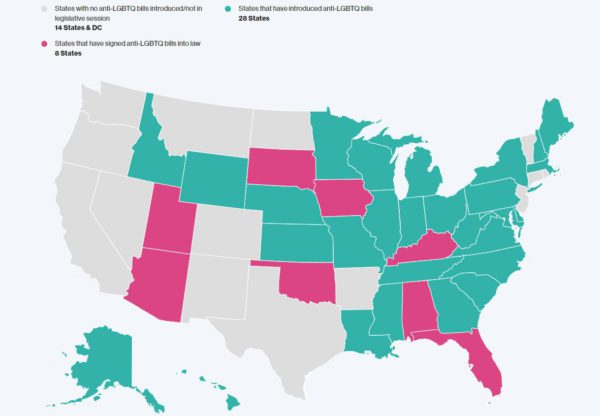
Now, LGBTQ+ rights in states seem to be taking even more of a hit. According to HRC, over 300 anti-LGBTQ+ bills have surfaced in 36 Legislatures. As the legislation increases – 41 such measures were introduced in 2018 – so does the number of bills passed and enshrined into state law, though LGBTQ+ advocates often challenge the laws in court.
The legislation overwhelmingly targets Trans youth, according to the organization, from blocking participation in sports to baring access to gender-affirming care. Lawmakers have also attempted, and in some cases passed, legislation limiting how LGBTQ+ issues can be taught in schools and keeping Trans kids from using restrooms that correspond with their gender identity.
“2022 is on track to surpass last year’s record number of anti-transgender bills,” Cathryn Oakley, state legislative director and senior counsel at the HRC, told the Blade, calling the “legislative attacks” on Trans youth “craven, baseless, and an effort to create more division, fearmonger, and rile up radical right-wing voters at the expense of innocent kids.”
Proponents of the bills say they are to “protect” parental rights, children and religious freedom. However, LGBTQ+ advocates and people continue to denounce the legislation as discriminatory and harmful.
This year, one of the most talked-about anti-LGBTQ+ measures was Florida’s so-called “Don’t Say Gay” bill, which Republican Gov. Ron DeSantis signed into law last month. The legislation will ban classroom instruction about sexual orientation and gender identity in grades K-3 if it survives legal challenges.
Days after DeSantis signed the bill, the first lawsuit against the measure emerged, arguing the statute “would deny to an entire generation that LGBTQ people exist and have equal dignity.”
“This effort to control young minds through state censorship —and to demean LGBTQ lives by denying their reality — is a grave abuse of power,” the lawsuit says.
Since Republican sponsors successfully pushed the bill through, other states have followed in Florida’s footsteps. Ohio, for example, introduced its version of the legislation roughly a week after DeSantis’ signature.
Like Florida, LGBTQ+ advocates were quick to announce legal challenges to the legislation. Some of the most prominent LGBTQ+ and civil rights organizations – including the HRC, GLAD and Southern Poverty Law Center (SPLC) – announced a legal challenge in federal court against Alabama’s gender-affirming care ban.
In terms of legislation introduced, Tennessee has far outpaced other states, according to LGBTQ+ rights organization Freedom for All Americans. The group’s legislative tracker found over 30 bills limiting LGBTQ+ rights in the state – including a “Don’t Say Gay” bill and a ban on LGBTQ-themed literature in schools. But, unlike other Republican-controlled states, none have made it out of the statehouse.
Arizona has also been a hotspot for anti-LGBTQ+ legislation, with at least 17 bills, according to Freedom for All Americans. In March, Republican Gov. Doug Ducey signed two billslimiting the rights of Trans people in the state – one banning some types of medical care for Trans youth, and the other preventing Trans students from participating in school sports consistent with their gender identity.
“Across the country, moderate Republicans are struggling—and too often failing—to stop the takeover of their party by dangerous extremists,” Shannon Minter, legal director for the National Center for Lesbian Rights (NCLR), told the Blade at the time, adding: “We are in danger of watching large segments of our nation give way to authoritarian extremism.”
In other states, anti-LGBTQ+ legislation became law without support from its governor – Democratic or Republican. In fact, two Republican governors vetoed anti-Trans sports bills in late March.
Utah Gov. Spencer Cox and Indiana Gov. Eric Holcomb, both Republicans, vetoed legislation that barred Trans youth from participating in sports. Cox said the bill had “several fundamental flaws and should be reconsidered,” while Holcomb said the measure was in search of a problem.
“This [Utah] bill focuses on a problem of ‘fairness’ in school sports that simply does not exist — but its negative impacts on the mental health and well-being of trans and nonbinary youth are very real,” said Sam Ames, director of advocacy and government affairs at The Trevor Project. “These youth already face disproportionate rates of bullying, depression, and suicide risk, and bills like this one will only make matters worse.”
In recent weeks, two Democratic governors vetoed anti-LGBTQ+ legislation from their Republican-controlled legislatures.
“Shame on the Kentucky General Assembly for attacking trans kids today,” said Chris Hartman, executive director for the Fairness Campaign. Shame on our commonwealth’s lawmakers for passing the first explicitly anti-LGBTQ law in Kentucky in almost a decade.”
Kansas Democratic Gov. Laura Kelly vetoed last weekend two anti-LGBTQ+ measures, the “Parents’ Bill of Rights” and the “Fairness in Women’s Sports” Acts.
GOP lawmakers in Idaho decided last month to effectively kill a bill criminalizing gender-affirming care, one of the most extreme proposals in the country. It would have made it a felony — punishable by up to life in prison — to provide minors with hormones, puberty blockers or gender-affirming surgery.
In a statement, Idaho Senate Republicans said they “stongly” oppose “any and all gender reassignment and surgical manipulation of the natural sex” on minors. But they also wrote that the controversial legislation “undermines” a parent’s right to make medical decisions for their children.
“We believe in parents’ rights and that the best decisions regarding medical treatment options for children are made by parents, with the benefit of their physician’s advice and expertise,” the senators wrote.
Texas is one of the 14 states with no anti-LGBTQ+ legislation, as the state only holds legislative sessions in odd years. However, the Lone Star State has made headlines for anti-Trans orders from Republican Gov. Greg Abbott.
But even as Republican politicians continue to push for limits to LGBTQ+ rights, many LGBTQ+ advocates, people and allies promise to continue fighting against the discriminatory efforts – whether in court or on the streets.
“The Human Rights Campaign strongly condemns these harmful, potentially life-threatening bills and will continue to use every tool at our disposal to fight for the rights of transgender youth and all LGBTQ+ people,” Oakley said.
In a January 2022 poll by The Trevor Project, an organization that provides crisis intervention and suicide prevention services to LGBTQ youth under 25, and Morning Consult, over two-thirds of LGBTQ youth said recent debates over state laws that target transgender people have negatively impacted their mental health.
“These results underscore how recent politics and ongoing crises facing the globe can have a real, negative impact on LGBTQ young people, a group consistently found to be at significantly increased risk for depression, anxiety and attempting suicide because of how they are mistreated and stigmatized in society,” Amit Paley, CEO of The Trevor Project, said in a statement.
The majority of US voters oppose using the slur “groomer” to describe LGBT-inclusive teachers and parents, a new poll has revealed.
The Data for Progress poll surveyed 1,155 likely voters and asked them about the spread of anti-LGBT+ legislation across the US.
While the dangerous and ignorant conflation of homosexuality and LGBT+ identities with paedophilia goes back decades, there has been a recent surge in Republicans and religious conservatives using “grooming” language to describe LGBT-inclusive education, or just queer folk in general.
The Data for Progress poll noted: “Some groups have been describing teachers and parents who oppose banning discussion about sexual orientation or gender identity in schools as ‘groomers’ – a term used to describe someone who gets close to and builds trust with a child or young person with the intent of sexually abusing them.”
Respondents were asked whether they agreed that “teachers and parents that support discussions about sexual orientation and gender identity in school” were “groomers”, and a majority of 55 per cent said they did not.
However, there was a stark political divide.
While just 15 per cent of likely Democrat voters supported anti-LGBT+ “groomer” language, this figure jumped to 45 per cent for likely Republican voters.
The poll also revealed some serious cognitive dissonance among likely Republican voters.
Asked whether the US government should “have a say in personal matters like a person’s sexual preference or gender identity”, the overwhelming opinion across the political spectrum was that it should not (88 per cent of Democrats and 86 per cent of Republicans).
However, when asked about the hundreds of bills across the country which aim to limit the discussion of LGBT+ topics in classrooms, as well as “limit transgender people’s ability to play sports, use bathrooms that correspond with their gender identity, and receive gender-affirming health care”, 63 per cent of Republicans said they supported such legislation, compared with just 15 per cent of Democrats.
The same trend appeared in a question about gender-affirming healthcare for transgender children, with 59 per cent of Republicans saying the government should deny them this care, compared to 15 per cent of Democrats.
As state lawmakers moved to ban transgender kids from girls’ sports, Kansas’ most visible LGBTQ-rights lobbyist recently said during an interview in a Statehouse corridor that conservatives don’t mind if kindergartners “have their genitals inspected.”
The politically needling comment was bold enough to make Tom Witt’s point, and loud enough for a lobbyist supporter of the ban to hear as she walked by. It was also classic Witt: Boisterous. Engaged. And well-targeted.
Witt is a key reason Kansas is unlikely to join a growing number of states this year with a ban, despite Republican supermajorities in its Legislature. With lawmakers returning Monday from a spring break, supporters don’t yet have the two-thirds majorities to override Democratic Gov. Laura Kelly’s veto of their bill. They didn’t last year, either.
Witt, 60, is executive director of Equality Kansas and a Democratic consultant. During 18 years at the Statehouse, he’s spotlighted conservatives’ bills so that unwanted publicity prompts Republican leaders to disavow them or discourages GOP-led committees from even holding hearings. Others describe him as relentless in pursuing just enough “no” votes when it counts, and was influential enough in the state Democratic Party to help push it to the left.
He’s even let his health slide. In 2017, he ignored growing fatigue to successfully lobby against requiring transgender students to use facilities associated with their genders assigned at birth — then had a heart attack and bypass surgery.
As for this year’s bill, he said unnamed Republicans told him they “really hate” it before voting for it anyway. He said he’s bitter that they might have considered the political cost of voting no.
“This is life and death for some kids,” he said. “This is not trivial. This is not politics.”
Witt plans to retire from activism, lobbying and consulting by year’s end, having mentored younger, self-described progressive lobbyists.
Democratic state Rep. Stephanie Byers, the state’s first elected transgender lawmaker and a retired Wichita band director, credits Witt with connecting her to national groups and making media interviews easier to navigate during her 2020 campaign. Kari Rinker, a friend and American Heart Association lobbyist, said he taught her how to fundraise and work with a nonprofit board.
But Witt is sometimes profane and often pugnacious, even with friends. As for lawmakers, he said, party doesn’t matter: “If they vote against LGBT rights, I’m going to go after them.”
Brittany Jones, the conservative lobbyist who was walking by Witt’s recent hallway interview, begins her recollection of their Statehouse introduction in 2019 with, “I believe he’s made in the image of God just like I am.”
“As soon as he found out who I worked for, he dropped my hand, walked away and wouldn’t speak to me,” said Jones, policy director for the conservative group Kansas Family Voice. Witt doesn’t dispute that.
As Witt fights to keep Kansas from following at least 15 other states in banning transgender athletes from female school and college sports, some Kansas lawmakers are conflicted.
State Sen. David Haley, a Kansas City Democrat, voted no earlier this month but said “reasonable” constituents see the bill as common sense. He was the deciding vote last year against a veto override, giving a speech weighing both sides before voting no — as Witt sat in the main visitors’ gallery, visibly on edge.
“You know, it’s kind of like he’s a Marine Corps drill sergeant when he is committed to the advocacy for his ideology,” Haley said. “It’s like, ‘Everybody line up. This is the way it’s going to go.’”
The Kansas measures have applied to K-12 students, and a few lawmakers cite that as a problem.Witt said elementary schools would be forced to physically inspect children as young as 5 to settle disputes over transgender kids competing against other girls.
The bill’s text doesn’t says exactly how disputes would be resolved, and Haley called Witt’s argument “a little bit beyond belief.” State Rep. Barbara Wasinger, a Republican from western Kansas, said Witt’s argument is diverting attention from what she sees as the real issues, fair competition and scholarship opportunities for young women.
But Witt sees this year’s proposals triggering bullying and suicides. He pointed out a scar on his left cheek and said it’s from being attacked and cut with a knife in a high school bathroom in the 1970s.
“In some respects, not a damn thing has changed,” he said. “In the 70s, the things that trans people are being called today are what gays and lesbians were called then. The panic about bathrooms? We had the bathroom panic in the 70s.”
He also recalled how his activism began ahead of a 2005 statewide vote in favor of banning same-sex marriage in Kansas. A computer software writer and IT troubleshooter, he was living in Wichita with his future husband and their daughter.
“All I ever wanted in my life was a family,” Witt said. “And it felt like those people were coming after it.”
A transgender journalist is filing for wrongful termination after being fired from South Dakota Public Broadcasting, alleging the state-run media outlet treated them with bias.
Stel Kline shared on Twitter April 18 that they had been let go from their position with SDPB News on the grounds they are “not objective” and “have a problem with authority.” But the reporter said their most recent job review didn’t include any areas for improvement.
Kline suggested that the concerns about “objectivity” are directed at their efforts to defend against anti-transgender attacks lobbed against them on Twitter.
“I was encouraged by the comms team to create a twitter and share my experiences in [South Dakota],” Kline wrote in a Twitter thread. But when they shared that they were experiencing verbal harassment because they are trans, Kline explained, “the director of journalism content tells me I have lost credibility. That I am not objective.”
Kline noted that they discussed objectivity in their interview for the position.
“In my interview I was very clear that as a trans person I am unable to be impartial about attacks on my humanity. Objectivity is not a static identity, but when wielded as such becomes the language of those with the most power,” they said. “Declaring someone not objective is a selective practice used effectively to exclude POC / queer journos.”
Kline referenced fellow trans radio journalist Lewis Raven Wallace, who was fired from Marketplace after publishing a personal blog post about the ethics of objectivity as a transgender journalist. Wallace has since written a book about his experiences.
But it wasn’t just the disagreement about objectivity, Kline said. Bias related to their gender allegedly started on the first day of the job, when they learned an article announcing their hire would run without using their pronouns.
“A half hour before beginning my first day of work I received a call informing me the head of communications directed the editor of the membership magazine to remove all instances of my pronouns from an article set to run announcing my hiring,” Kline wrote. “Instead of using ‘they’ to refer to me in the third person she was told to use my last name, Kline.”
According to Kline, the director claimed the decision was made to prevent listeners from pre-judging them based on their transgender identity.
“When confronted, the director said he wanted me to make the best impression with listeners – so they would judge my stories and voice without being clouded by the fact that I am trans,” Kline said. “The director of journalism content added that it would be a grammar issue for the older readers.”
Kline noted that SDPB is owned by the state of South Dakota, and that they are drawing inspiration from trans trailblazers as they move forward with their appeal.
“[A]s I begin my wrongful termination appeal I am guided by the resistance and courage of other trans state employees – especially Teri Bruce,” they wrote. “Teri was an archeologist at the South Dakota State Historical Society Archaeological Research Center. He began a lawsuit to get state health insurance to cover gender affirming care. The lawsuit closed when Teri died by suicide in 2019.”
South Dakota state statutes do not address discrimination based on gender identity or sexual orientation. Neither Kline nor SDPB responded to a request for comment by press time.
The bans have largely come from Republican politicians, conservative school boards and so-called “parents’ rights” groups that have opposed such content as “woke” “indoctrination” that’s “inappropriate” for school children.
For their report, PEN America examined publicly noted book bans occurring from the start of July 2021 to the end of March 2022. During that time, school districts banned 379 LGBTQ titles, including 84 that deal with transgender topics and characters.
Four of the most frequently banned books all had LGBTQ characters or themes including the nonbinary and asexual graphic novel Gender Queer: A Memoir by Maia Kobabe (banned in 30 districts), the autobiographic YA memoir All Boys Aren’t Blue by George M. Johnson (banned in 21 states), a coming-of-age novel Lawn Boy by Jonathan Evison (banned in 16 districts), and the non-fiction trans/nonbinary book Beyond Magenta: Transgender Teens Speak Out by Susan Kuklin (banned in 11 districts).
In addition to LGBTQ books, 283 of the banned titles deal with sexual or health-related content, 142 deal explicitly with sex, 21 cover abortion, 32 cover teen pregnancy, and 14 cover puberty. Of those, 95 deal with sexual assault. Nearly 61 percent of the banned books dealt with racism or non-white characters. Many of these titles will now be unavailable to the students that need them most.
Overall, the report found that the bans affected 1,145 unique book titles by 874 different authors, 198 illustrators, and nine translators, “impacting the literary, scholarly, and creative work of 1,081 people altogether.” The bans occurred in 86 school districts in 26 states representing 2,899 schools educating over two million students.
The report showed a “disproportionate targeting of books by or about people whose identities and stories have traditionally been underrepresented in children’s and young adult literature, such as people of color, LGBTQ+ individuals, or persons with disabilities,” PEN America wrote.
Unsurprisingly, southern states — like Texas, Florida, Oklahoma, Kansas, Tennessee, Georgia and Missouri — were among the states that banned books most often, but midwestern and northern states like Indiana, Virginia, Pennsylvania and New York were also among the most censorious nationwide.
Approximately 96 percent of all the bans were initiated by school administrators or board members, “in a wide range of ways… and rarely with the requisite written forms that most district policies officially require,” PEN America noted. None of the books meet the legal definitions for “obscenity” and “pornography” despite claims to the contrary.
More worrying, in 98 percent of all instances, the schools involved didn’t follow best practice guidelines outlined by the American Library Association (ALA) and the National Coalition Against Censorship (NCAC) to ensure that the bans didn’t violate First Amendment protections against free speech which prohibit government officials from banning or punishing free expression.
“Today, state legislators are introducing — and in some cases passing — educational gag orders to censor teachers, proposals to track and monitor teachers, and mechanisms to facilitate book banning in school districts,” PEN America added. “At the same time, the scale and force of book banning in local communities is escalating dramatically.”
“While the Supreme Court has recognized the ‘broad discretion’ granted to local school boards in the ‘management of school affairs,’” PEN America wrote, “that discretion does not negate the responsibility of engaging in proper, considered processes concerning selections or removals.”
Even when school districts don’t outright ban books, the political campaigns of hostility against queer- and race-inclusive education can discourage teachers from discussing any potentially taboo topics.
Legal threats, such as lawsuits filed by the ACLU, and community pressure have resulted in some of the banned books being returned to the shelves. But PEN America believes that librarians or teachers in numerous states are likely preemptively removing books or not recommending them in order to skirt controversy.
The Carroll County Public Schools district has banned rainbow flags, saying they could be a “gateway for other flags” and that teachers were bullied into displaying them.
A local chapter of PFLAG had donated small Pride flags to the district and staff members were told they could put them on their desks as a sign of support for LGBTQ students.
But board members accused the administrators of “bullying” teachers into displaying the flags. Teachers were not required to display the flag.
“Many teachers have reached out to me saying that they’ve been pressured or bullied to put flags in their classroom, and that’s a problem that needs to be addressed,” board member Donna Sivigny claimed. She was unable to cite a specific example.
“These flags were shoved down teachers’ throats to put on their desk – that’s not inclusive,” school board President Kenneth Kiler said. “That’s not the way it ought to be.”
“What this does is open up a gateway for other flags to come into our schools that other people will not like,” board member Tara Battaglia added before comparing the Pride flag to the Confederate battle flag.
“We’ve already banned the Confederate flag, and that was done a couple of years ago,” she said as she tried to skirt the reason why she thought the Pride flag could be offensive. “The premise behind the Pride flag was social advocacy… which is political.”
But another parent got to the heart of the issue by saying that the flags “do not solely represent the gay community. They also represent gender identity and transgender ideology.”
Republicans and the religious right have turned schools into the latest front in the culture wars. From laws that ban transgender children from playing school sports to restrictions on history class instruction on slavery and the Holocaust, conservatives have pushed dangerous claims using racist and homophobic stereotypes and slurs.
Just days after Florida’s governor signed the state’s “Don’t Say Gay” bill into law and several other states – including Arizona, Oklahoma, and Utah – passed anti-transgender laws, the Department of Justice issued a warning to states that said targeting trans people for discrimination could violate federal law.
The DOJ “is committed to ensuring that transgender youth, like all youth, are treated fairly and with dignity in accordance with federal law,” the letter opens. “This includes ensuring that such youth are not subjected to unlawful discrimination based on their gender identity, including when seeking gender-affirming care.”
Over the past two years, states have been attacking transgender youth with bills to take away their ability to participate in school sports, to ban doctors from providing gender affirming care, and to keep schools from treating trans students equally. Florida’s Don’t Say Gay law even requires schools to out transgender students to their parents in some cases.