Alabama governor Kay Ivey signs sweeping legislation banning gender-affirming healthcare for trans youth and prohibiting discussions of LGBT+ topics in schools.
The Republican governor signed into law two controversial bills, House Bill 322(HB 322) and Senate Bill 184 (SB 184), just a day after the state legislature approved both measures.
SB 184 makes it a felony for anyone to provide gender-affirming care – including puberty blockers, hormone therapy or gender-affirming surgeries – to trans youth. Anyone convicted under the proposed legislation face a 10-year prison sentence and a steep $15,000 fine, ABC Newsreported.
The bill also means that Alabama is now the first state in the US to impose felony criminal penalties on medical professionals who offer gender-affirming treatment to trans youth, according to the Human Rights Campaign (HRC). The HRC also warned the bill would also require school personnel to out trans youth to their parents.
HB 322 – which has been dubbed by LGBT+ advocates as a ‘Don’t Say Gay or Trans’ bill – originally started as legislation that would ban trans K-12 students from using multi-person bathrooms, changing rooms and locker rooms that correspond with their gender identity.
But then Republican lawmakers amended the bill to also ban classroom discussions on gender identity or sexual orientation from kindergarten through fifth grade or in a “manner that is not age-appropriate”.
The Alabama bill goes further than Florida’s ‘Don’t Say Gay’ law, which prevents discussions on LGBT+ issues between kindergarten and third grade. Any discussion on LGBT+ topics in older grades in Florida classrooms must be “age appropriate”.
“I believe very strongly that if the good Lord made you a boy, you are a boy and if he made you a girl, you are a girl,” she said. “We should especially protect our children from these radical, life-altering drugs and surgeries when they are at such a vulnerable stage in life.”
She also went on to declare that “men use the men’s room” and “ladies use the ladies’ room” in Alabama. Ivey added that HB 322 would “ensure our elementary school classrooms remain free from any kind of sex talk”.
She then claimed that it is “misleading” to call it a ‘Don’t Say Gay or Trans’ bill because she said it is ensuring that young children are not being taught about sex.
“We are talking about five-year-olds for crying out loud,” she said. “We need to focus on what matters – core instruction like reading and math.”
Carmarion D Anderson-Harvey, Alabama state director for the HRC, condemned Ivey for choosing to “score political points with radical, far-right voters over the welfare” of trans youth and their families in Alabama.
“The governor and her fellow anti-equality legislators in the state capitol have recklessly passed a bill that goes directly against the best advice of the medical community and intrudes on the rights of parents and families to make their own medical decisions,” Anderson-Harvey said.
She added that Republican lawmakers have also “successfully criminalised” life-saving care that trans youth “need desperately” as well as the “incredible” medical professions who help these young people “each and every day”.
“In doing so they have jeopardised the future of these doctors, families and transgender youth who are all considering what their livelihoods will be in Alabama,” Anderson-Harvey said.
She continued: “The legislative package passed yesterday and signed today is the most anti-transgender legislative package ever passed, combining elements of infamous laws like HB 2 in North Carolina, Florida’s ‘Don’t Say Gay or Trans’ law and even Texas’s cruel executive action from earlier this year.
“Shame on Governor Ivey for being such a political coward that she puts children in harm’s way just to serve her own career.”
A bar serving LGBTQ New Yorkers has closed after an arson attack over the weekend, the New York City Police Department confirmed Wednesday.
At approximately 9 p.m. on Sunday, a man walked into the Rash Bar in Brooklyn’s Bushwick neighborhood with a bottle of flammable liquid, poured it on the bar’s floor, lit a match and set the venue ablaze, according to the NYPD. Police said the suspect fled as the bar became engulfed in flames.
Jake Sillen, one of the bar’s owners, told NBC News on Wednesday that they are still in shock.
“It’s so hard to believe and process,” said Sillen, 26, who is nonbinary and uses they/them pronouns. “It’s more confusing than anything.”
The Rash Bar in Brooklyn’s Bushwick neighborhood.Rash Bar / via NBC New York
Three people — a bartender, DJ and security guard — were inside when the venue was set on fire. A 25-year-old female was transported to nearby Wyckoff Heights Medical Center with minor burns, while another victim was evaluated on the scene for minor burns to the shoulders, the NYPD said.
Claire Bendiner, a co-owner of Rash, had just stepped outside when the fire broke out.
“Everyone rushed out,” Bendiner told NBC New York. “The side door has a glass front, and I looked over and saw flames to the top of ceiling. It was crazy, it happened so fast.”
The bar was left unrecognizable and torched, NBC New York reported.
Bendiner, who uses they/them pronouns, said the suspect boldly left behind evidence.
“He left the gas canister inside. Kind of calmly placed it on the bar counter. Wasn’t knocked over or anything,” they told NBC New York.
Police are reviewing surveillance footage that shows someone filling up a gas can minutes before the fire.
‘Easy target’
Police are still investigating a motive for the incident, and no arrests have been made. The bar’s owner declined to comment on the suspect’s intentions but noted that serving a large LGBTQ clientele makes the space vulnerable.
“I don’t want to jump to any conclusions, because we don’t know anything about the person that did this,” Sillen said. “It could easily turn out to be a motive that we aren’t expecting.”
“It’s easy to see why our space would be an easy target for someone looking to do harm to the queer community,” they said, adding that in Rash Bar, “people feel safe to be themselves, and it’s a shame that anybody would do anything to threaten this.”
Since the bar opened nearly five months ago, it has become a staple in LGBTQ nightlife and a refuge for queer young adults and performers. It is also known for being packed late into the night, according to NBC New York.
This is not the only reported incidenttargeting bars in or near the Bushwick neighborhood that are popular with the city’s LGBTQ community: In February, someone threw a pepper-bomb spray on the dance floor at a party for the Black queer community at Nowadays, and last summer there was a wave of attacks at Happyfun Hideaway.
“We, definitely in the last year, have seen a rise in anti-LGBT violence,” Sillen said, noting that more people are taking cars to and from parties. “The streets haven’t been as safe as they were three or four years ago.”
As of Wednesday afternoon, the bar owners had raised $52,000 of their $200,000 goal on GoFundMe to help reconstruct the damaged building and care for the injured employees. Sillen said they are thankful for the outpouring of support.
“What we’re doing is important, and no matter what, we will be reopening,” Sillen said. “We’ve never once thought about that not being a possibility.”
Sillen, who is still on edge after the fire, said they have a message for the arsonist.
“Turn yourself in,” Sillen said. “You’ve harmed so many people. Not just physically, but the waves that this is going to create — between the loss of income, wages and just the space for as long as it’s going to be gone. … It’s a lot of loss.”
Student organizer and activist Will Larkins decided that since LGBTQ American history is not taught in Florida’s public schools, he took it upon himself to explain the events of the Stonewall Uprising to his 4th period U.S. history class at Winter Park High School.
Although Larkins’ lesson was only, in his words, a 5 minute PowerPoint presentation for the history class of which he posted an excerpt on Twitter, there was a resulting torrent of hateful comments some of which took aim at the fact that Larkins gave his PowerPoint presentation in a rather fetching red dress.
The actions that the 17-year-old junior and president of the WPHS Queer Student Union took to educate his fellow students was lauded by several notable LGBTQ+ activists and allies including Marjory Stoneman Douglas High School shooting survivor and co-founder of the “March For Our Lives” movement David Hogg; Brandon J. Wolf, Press Secretary for Equality Florida; Janessa Goldbeck, the CEO of the Vet Voice Foundation; and countless hundreds of others.
Former US vice president Mike Pence has launched a list of policy suggestions ahead of the midterms and of course, plenty of them are anti-LGBT+.
Pence recently published his “Freedom Agenda” – his blueprint for Republicans to win future elections, which reads like a prelude to a 2024 run.
It’s essentially a Republican bingo card, with everything from pulling taxpayer funding for abortions to banning “anti-American, racist ideologies like Critical Race Theory” in schools.
Tightening border controls was also top of the list. And guns. A lot on guns, as well as stopping the government from “interfering with our First Amendment right to free exercise of religion”.
On women’s sports, Pence said that athletes should compete for their “God-given gender” to “preserve and protect female athletic competition”.
He also believes that doctors should be free to refuse to provide gender-affirming healthcare.
Pence wants Republican candidates to fight for faith-based adoption and foster agencies to have the right to discriminate LGBT+ couples.
“End the assault on faith-based adoption and foster care agencies that will only place children into families with one male father and one female mother,” the plan states.
A number of anti-LGBT+ former White House staffers from the Trump administration helped draft the plan, which included adviser Kellyanne Conway and former education secretary, Betsy DeVos.
Appearing on Fox News Digital, Pence said: “Elections are about the future, and frankly the opposition would love nothing more for conservatives to talk about the past or to talk of the mess they’ve made in the present.”
“I think it’s of equal importance we focus on conservatives at every level.”
Pence’s plan comes as conservative state legislators in dozens of states are proposing or passing laws targeting the trans community, many prohibiting trans youth from participating in girls’ sports.
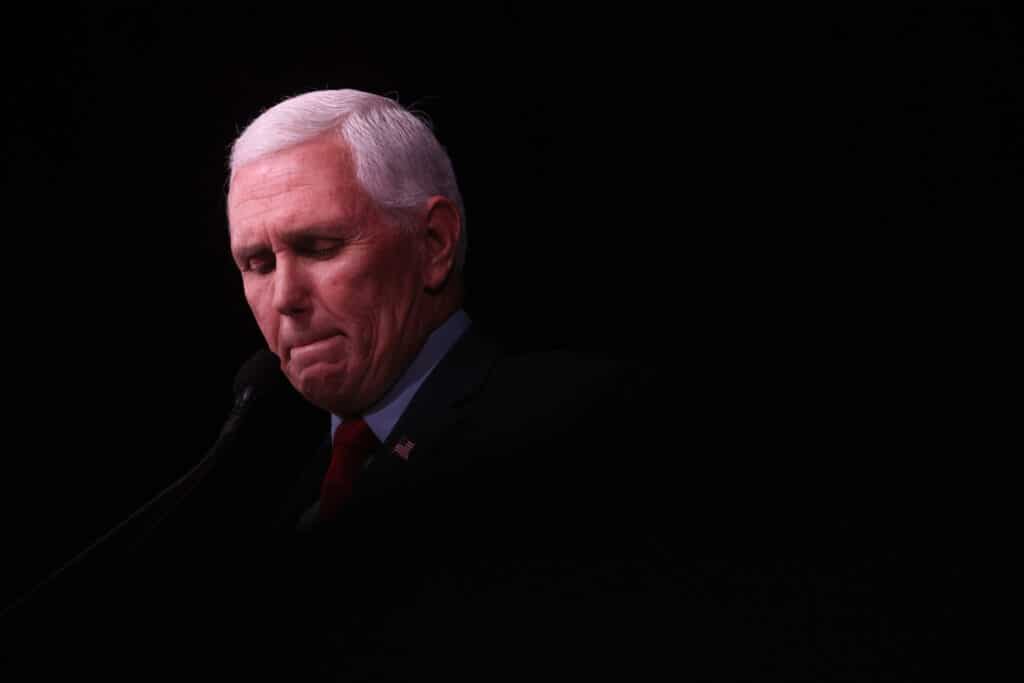
Mike Pence speaks during the Advancing Freedom Lecture Series at Stanford University with a speech on ‘How to Save America From the Woke Left’. (Justin Sullivan/Getty Images)
Just four months into 2022, more than half of US states have already sought to introduce anti-trans sports bills, according to legislative trackers.
Speaking of problems that don’t exist, Pence also urged Republican candidates to campaign to “make in-person voting the primary method of voting”, following Trump’s baseless and debunked claims of mail-in voter fraud in 2020.
Forcing voters to bring identification with them to vote is another one of Pence’s bright policy ideas. Voter identification laws, voting rights advocates say, deprive countless Americans of the chance to vote.
Researchers have found that more disadvantaged groups are less likely to have ID, while one in 10 US citizens have no ID at all.
A 2018 report revealed that Pence played a pivotal role in dismantling civil rights protections for LGBT+ people during the Trump years, alleging that Pence was behind an executive order that aimed to legalise forms of religious discrimination against queer people.
The order bore a startling similarity to a bill Pence signed as Indiana governor in 2015 that allowed faith-based businesses to discriminate against LGBT+ customers.
Last month, a group of parents in Orlando, Florida, demanded “consequences” against sixth grade science teacher Robert Thollander. His crime? Thollander acknowledged his marriage at school.
“He married a man. This alone is not an issue. Sharing the details … with all his 6th grade students is the issue,” the parents wrote in a letter sent to their children’s school board, which was shared with NBC News. “It was not appropriate. Many of these students felt very uncomfortable with the conversations and shared this with their families.”
Had Thollander just “said he will be out for a few days because he was getting married, no problem,” the letter continued, “but to discuss the details and create an uncomfortable situation for the students with no benefit to teaching his subject matter is inappropriate.”
Sixth grade science teacher Robert Thollander.Courtesy Robert Thollander
Thollander denied having discussed his marriage since he and his husband tied the knot in March of last year, aside from acknowledging it when he was asked. No action was taken against him by school leaders, who defended him several days later with a letter of their own, he said.
Nevertheless, the incident prompted Thollander to make this school year his last after 11 years of working in Florida as a teacher.
“A lot of trust is given to teachers, and it made it seem like I wasn’t trusted because there’s something wrong with me for being gay,” he said. “It makes it seem like being gay is something vile or disturbing or disgusting when it’s described as making children uncomfortable knowing that I’m married to a man. It hurt.”
While the Orlando parents did not succeed in having Thollander disciplined or ousted, he and other LGBTQ teachers in the state worry that newly signed state law — titled Parental Rights in Education but dubbed by critics as the “Don’t Say Gay” law — will galvanize parents to take similar action against them. In fact, Thollander said he believes the parents who complained about him were emboldened by the bill even before it was signed into law.
With the new law in place, teachers fear that in talking about their families or LGBTQ issues more broadly, pointed letters will be the least of their worries.
The law, HB 1557, bans “instruction” about sexual orientation or gender identity “in kindergarten through grade 3 or in a manner that is not age appropriate or developmentally appropriate for students in accordance with state standards.” Florida Gov. Ron DeSantis signed it into law Monday. Parents will be able to sue school districts for alleged violations, damages or attorney’s fees when the law goes into effect July 1.
Lawmakers who support the law have repeatedly stressed that it would not prohibit teachers and students from talking about their LGBTQ families or bar classroom discussions about LGBTQ history, including events like the 2016 attack at the Pulse nightclub, a gay club in Orlando. Instead, they argue, it is about giving parents more jurisdiction over their children’s education.
But legal experts have said the broad language of the law could open districts and teachers to lawsuits from parents who believe any conversation about LGBTQ people or issues is “inappropriate.”
Nicolette Solomon said Florida’s new education bill was “the straw that broke the camel’s back.Courtesy Nicolette Solomon
Nicolette Solomon, 28, taught fourth grade in Miami-Dade County for more than four years. As HB 1557 passed through the Legislature, she quit. Solomon, a lesbian, said that after months of having taught virtually through the coronavirus pandemic, the law was “the straw that broke the camel’s back.”
“The law would erase me as an LGBTQ teacher,” she said. “Nobody would be able to know, which then puts me in the closet, and I’m there seven hours a day, if not more, five days a week. I wouldn’t be able to be who I am.”
“And I don’t think I can bear to see the students struggle and want to ask me about these things and then have to deny them that knowledge,” she added. “That’s not who I am as a teacher.”
Some Florida teachers also worry that the law will worsen the disproportionate rates of bullying, harassment and mental health issues plaguing their LGBTQ students.
A survey last year by The Trevor Project, an LGBTQ youth suicide prevention and crisis intervention organization, found that 42 percent of the nearly 35,000 LGBTQ youths who were surveyed seriously considered suicide within the previous year. More than half of transgender and nonbinary youths who were surveyed seriously considered suicide, it also found.
“Will other students interpret that as ‘Hey, now I have a pass to bully or mistreat certain students?’” asked Brian Kerekes, who teaches math at a high school in Osceola County, referring to the law. “It’s not out of the realm of imagination that that could now be an issue.”
A separate survey conducted by The Trevor Project last year found that LGBTQ youths who reported having at least one LGBTQ-affirming space reported lower rates of attempting suicide.
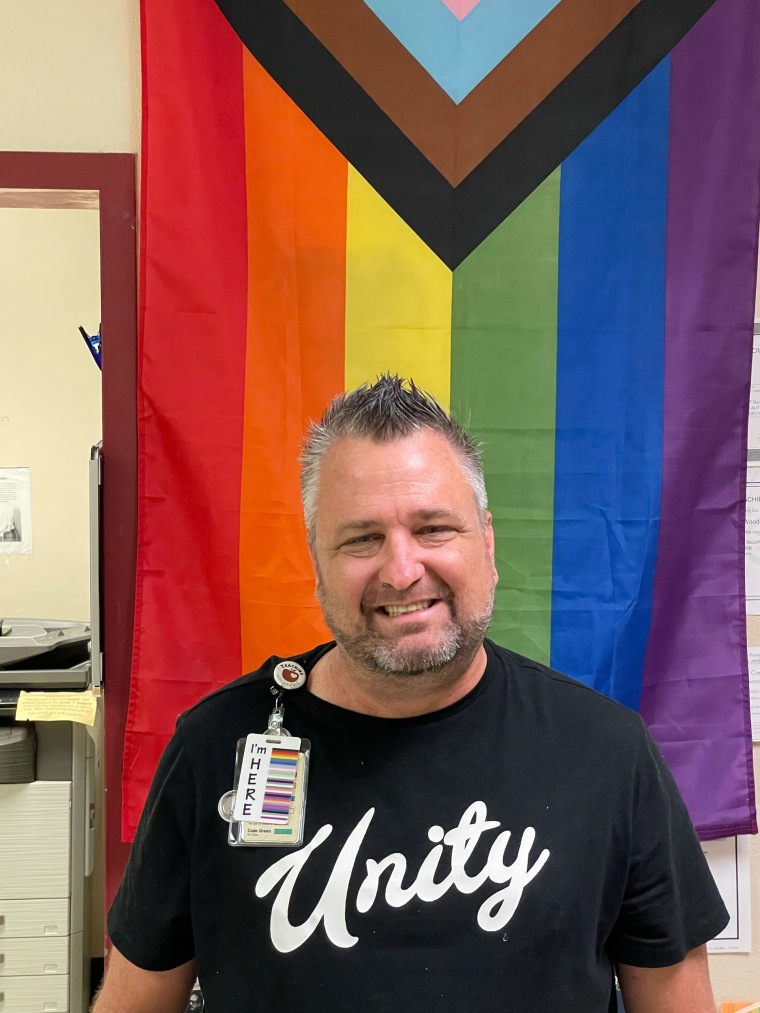
With that in mind, he said, Kerekes asks his students for their preferred pronouns at the beginning of every school year. He also places other LGBTQ-affirming symbols in his classroom, including a rainbow Pride flag and a sign that says “safe space.”
“Our students need to see that the educators in their community are as diverse as the rest of that community. They need educators that look and resemble them,” said Kerekes, who is gay. “We want them to know that we see them and respect them so that they can focus on what it is that they’re learning in class and not have to worry about how they’re going to be treated because of who they are.”
Get the Morning Rundown
Get a head start on the morning’s top stories.SIGN UPTHIS SITE IS PROTECTED BY RECAPTCHA PRIVACY POLICY | TERMS OF SERVICE
Building successful teacher-to-student relationships has become increasingly important in recent years, Kerekes said, in light of remote learning during coronavirus lockdowns and the rise in school shootings nationally.
With the passage of the new Florida law, Kerekes worries that most teachers will now “hesitate to be the advocates and the mentors” for LGBTQ kids who may confide in them.
Supporters of the measure say exposing kids to LGBTQ symbols and identities is part of the problem.
DeSantis, who is widely seen as considering a run for the 2024 GOP presidential nomination, said Monday that the law will ensure “that parents can send their kids to school to get an education, not an indoctrination.”
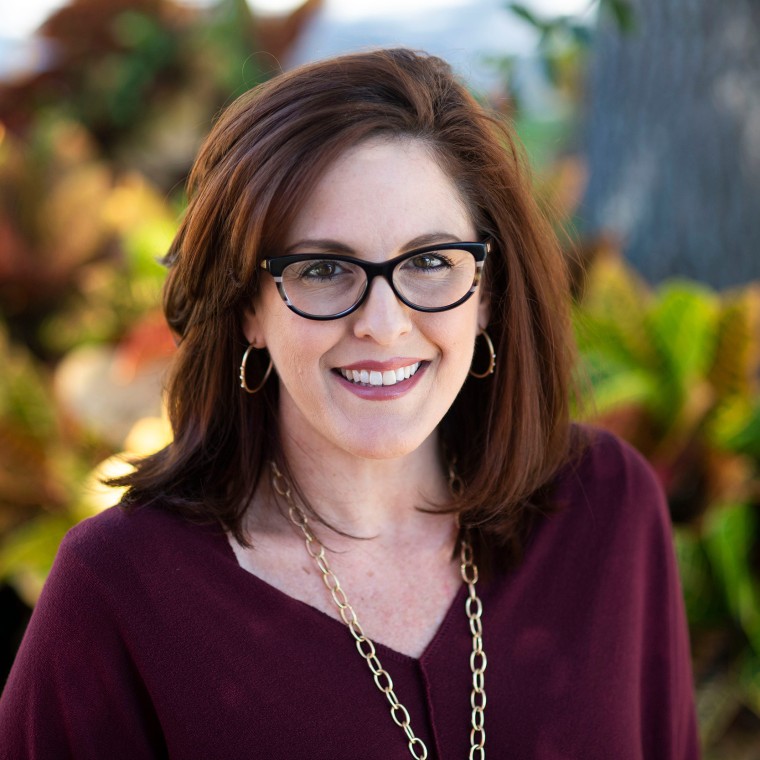
Tiffany Justice.Leah Voss / TCPALM / USA Today Network file
Tiffany Justice, who served on a Florida school board for four years and co-founded a national network of about 80,000 parents, Moms for Liberty, agreed, saying the law is needed to fight a “transgender contagion” sweeping the country.
“This is parents pushing back,” Justice, a mom of four school-aged children, said. “They’ve had enough. We’ve seen enough nonsense. The kids are not learning to read in schools, and what I have said before is ‘Before you activate our children into social justice warriors, could you just teach them how to read?’”
She added, “Teachers really need to get back and focus on what they’re supposed to be teaching in schools.”
Michael Woods, a special education teacher in Palm Beach County, said legislators and parents are looking for a “solution to a problem that doesn’t exist.”
“Teachers do not go out of their way to create these moments where we’re ‘indoctrinating’ students,” said Woods, who is gay. “If I could indoctrinate a student, it would be to bring a pencil and a piece of paper, and if I was really good at ‘indoctrinating,’ I would be able to get them to do their homework.”
Some educators are also concerned about a section in the law that will require them to notify parents of a child’s “mental, emotional, or physical health or well-being … unless a reasonably prudent person would believe that such disclosure would result in abuse, abandonment, or neglect.”
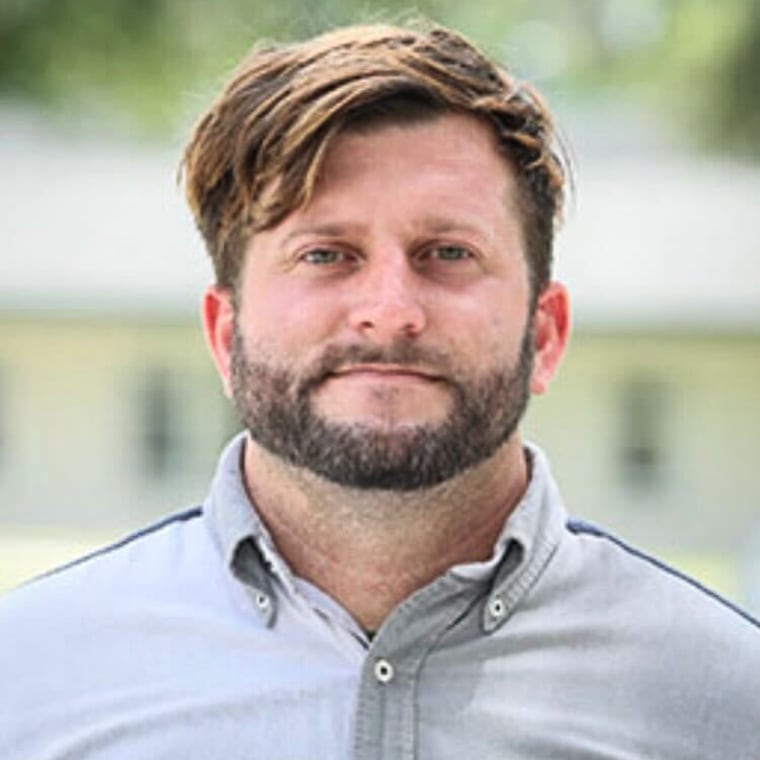
Michael Woods is a special education teacher in Palm Beach County, Florida.Courtesy Michael Woods
Critics have said the provision will force teachers to “out” their LGBTQ students to their parents, potentially leaving them vulnerable to rejection at home.
From her first week on the job, Solomon said, “so many kids” throughout her elementary school — even those she did not teach directly — came out to her.
“They want to go to someone like a teacher who they might not know for the rest of their lives or someone who they know won’t judge them or won’t tell anybody,” she said. “They’re kids. They can’t just call a therapist and make an appointment.
“I don’t want to be in that situation where, instead of helping the students, I’m going to be hurting them,” she added.
On Monday, the American Federation of Teachers, the country’s second largest teachers labor union, slammed the measure, calling it an “assault” on students and teachers.
“Make no mistake, this bill will have devastating real-world consequences—especially for LGBTQIA+ youth who already experience higher rates of bullying and suicide,” Randi Weingarten, the group’s president, said in a statement. “And for teachers and school staff who work tirelessly to support and care for their students, this bill is just another gross political attack on their professionalism.”
U.S. Education Secretary Miguel Cardona met in private with LGBTQ students and their family members Thursday to discuss the impacts of the law.
Earlier in the week, Cardona issued a statement saying the Education Department would “monitor” the law upon its implementation and “evaluate whether it violates federal civil rights law.”
In the meantime, Thollander will be putting his new real estate license to work, and Solomon will be working on her newly launched LGBTQ family-focused podcast, “Flying the Coop.”
“I would teach in another state, but I cannot teach in Florida,” Solomon said. “It’s just so horrible.”
Beyond Florida, legislators in several other states — including Georgia, Tennessee, Kansas and Indiana — are weighing measures similar to the Florida law, which Justice said was “just the beginning.”
“We’re not stopping here,” Justice said. “If they think they have a problem with HB 1557 in Florida, wait until it’s in all 50 states. And we won’t stop until it is.”
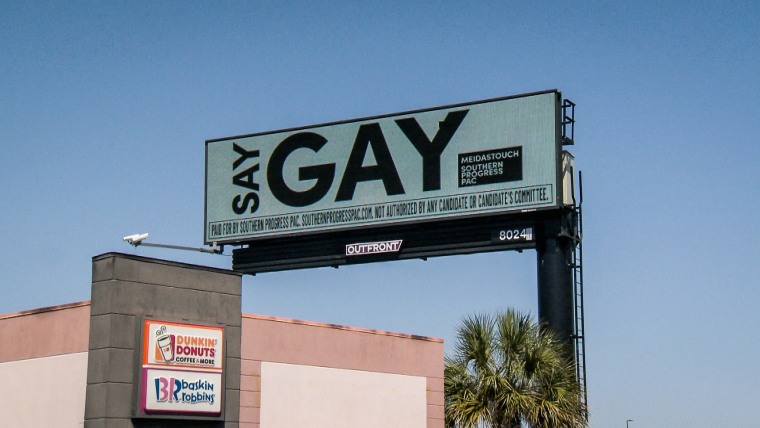
Billboards popping up in some of Florida’s largest cities are encouraging passersby to “say gay.”
The massive roadside messages are a response to the state’s controversial Parental Rights in Education bill, dubbed by critics the “Don’t Say Gay” bill, which Republican Gov. Ron DeSantis signed into law Monday. The measure prohibits “classroom instruction … on sexual orientation or gender identity” in “kindergarten through grade 3 or in a manner that is not age-appropriate or developmentally appropriate.”
The billboards — now on display in Orlando, Tallahassee and Jacksonville — were spearheaded by the Southern Progress Political Action Committee, which, according to its website, seeks to “expose the extremist agenda of Republican politicians.”
‘Say Gay’ billboard in Orlando, Fla. WESH
“It’s OK to say gay. It’s more than OK. It’s encouraged,” Ally Sammarco, a volunteer for the PAC, told NBC affiliate WESH of Winter Park. “We want to make it very clear that it’s OK to talk about who you are and where you come from, and no one can stop you from doing that.”
A gay teacher in Ohio, United States, has spoken out after being fired for giving Pride bracelets to students, saying: “There is room at the table for everyone”.
According to NBC15 News, Jay Bowman, who has worked as a teacher for 30 years, was wearing a rainbow-coloured Pride bracelet when several students asked about it.
Speaking in an interview, Bowman said: “If a kid has questions, if a kid wants honesty, I don’t think I should be forbidden from providing that.
“I don’t try to recruit anyone. The parents are responsible for the kids. The parents are the ones who need to teach their kids right and wrong.
“I think the reaction to my violation when compared to other instances in the school where certain things are tolerated was unfair.”
He added: “My catchphrase has become, ‘There is room at the table for everyone,’ and there is.”
The school district argued that Bowman broke school policies by discussing “political” and “personal” beliefs with students, as well as giving a student a Pride bracelet.
“Our board policies restrict staff from discussing with students certain subjects, including political, religious and personal beliefs,” the school district said in a statement.
“This past week, we received reports with specific concerns about possible violations of those policies by a substitute teacher in the district.
“As a result of his violation of board policies, the district decided his services as a substitute would no longer be utilised. While we recognise there are diverse points of view on this matter, this policy exists for the purpose of ensuring all students feel comfortable in the classroom.”
NBC15 News reported that some community members will ask the “school board to reconsider its policies” at a board meeting on 11 April.
The bill, which has faced fierce criticism not only from LGBT+ activists, but from US president Joe Biden, also mandates that school staff must out students to their potentially unsupportive families. The only exception is “if a reasonably prudent person would believe that disclosure would result in abuse, abandonment, or neglect”.
Now that it has been signed, the bill will come into effect on 1 July 2022.
Following the signing of the bill, Amit Paley, CEO of LGBT+ charity The Trevor Project, said in a statement: “LGBTQ youth in Florida deserve better. They deserve to see their history, their families, and themselves reflected in the classroom.
“While I am saddened to see this harmful bill signed into law, I am inspired by the outpouring of support for LGBTQ students we have seen from parents, teachers, celebrities, and their peers.
“Social support is vital for suicide prevention, and I want to remind LGBTQ youth in Florida and across the country that you are not alone.”
A group of determined New Jersey students defiantly staged a walkout in protest against a new policy that stops them from flying an LGBT+ Pride flag.
About 40 students, some wearing kaleidoscopic coloured items, in Passaic, New Jersey, took to the streets on Monday (28 March) for the right to fly the Pride flag, NJ.comreported.
The Passaic board of education recently enacted a policy that bans flag displays on school grounds with exceptions for the American flag, New Jersey state flag and school flags.
But students want to be able to raise the LGBT+ Pride flag. Several stood in front of the city’s three high schools and chanted “walk out” to encourage others to join in the protest against the new policy.
The brave students also called on school officials to allow them to “raise our flag”. The protest eventually moved from the schools to City Hall and then the board of education building.
Amari Gawthney led the group down to City Hall and declared “we’re not going to stop until we get what we want”.
“We put up the flag last year with no problem,” Gawthney said. “Then this new policy came from out of the blue, and they pushed it under the rug, actually.”
Last June, students in Passaic were allowed to raise the LGBT+ flag on school grounds for the first time to celebrate Pride Month. Flag displays were permitted until November when a group of community members questioned the school board on why the Pride flag was allowed to fly.
The board’s vice chairman L Daniel Rodriguez said it was easier to enact a blanket ban because it was “one of those issues [where] we want to make sure we were fair to everyone”, NJ.comreported.
Camila Perez, a freshman in Passaic, wore a rainbow flag as she spoke before trustees at a school board meeting last week. Perez argued the blanket ban is “unfair” and “discriminates” against the queer community.
“It bothers me, and it bothers the whole community,” Perez said.
The students at the protest called on the school board to rescind the policy and allow them to fly the LGBT+ flag in time for Pride Month, just two months from now.
Jaylie Barrett, a senior at Passaic PREP, argued the board “disrespected us as a community” and “won’t tell us why” they changed the policy.
Students across America have staged mass walkouts in protest of LGBT+ hate in the education system, discrimination against queer students and increasing restrictions on displays in support of the LGBT+ community.
Students across America are staging mass walkouts to protest LGBT+ hate in the education system, and schools are finding them harder and harder to ignore.
A short while later, hundreds of students in Texas marched out after a lesbian teacher was allegedly escorted off campus amid a row over stickers used by educators to show their classrooms were a ‘safe space’ for LGBT+ students.
Recently, the student organiser of massive school walkouts across Florida was suspended for distributing Pride flags during protests against the state’s ‘Don’t Say Gay’ bill.
Jack Petocz, a junior at Flagler Palm Coast High School in Florida, said he was “proud of who I am” and proud of all those who are “protesting these regressive bills”.
He called on students to “let our politicians know that no matter how hard they try, they cannot suppress our identities or silence our voices”.
“Gen Z will not stand idly by as our rights are stripped from us,” Petocz said. “It is now up to you to decide which side of history you will be on, the side that empowers us or the side that seeks to erase us.”
A food distribution program run by an Iowa LGBTQ couple was almost sabotaged by a fake volunteer – but the community rallied to save the day.
Every month, Together We Achieve holds a food box giveaway event in which it passes out over 1000 boxes of food to those in need.
One person, however, decided to sign up for 10 volunteer slots with a “hateful email” that was reportedly intended to hurt the leaders of the organization. At the organization’s helm is couple Raymond Siddell and Matthew Salger.
Fortunately, volunteers stepped in and filled the slots.
“It’s just amazing when you put a call out like this or show the community that there’s a need and you’re doing something about it, there are so many members that will show up from the community to help out in any way that they can,” Siddell told KCRG.
Siddell and Salger founded Together We Achieve after they first began providing relief to Iowa families who were effected by a destructive 2020 weather event called a derecho.
After the derecho hit Iowa, Siddell started a Facebook group where people could seek and offer resources. That initiative grew into the Iowa Storm Derecho Resource Center, which offered both information and crucial supplies.
Siddell said he and Salger launched the center out of frustration for the lack of centralized location for people to get help.
“I like to give back,” Salger said at the time. “I’ve always tried to give back either through time, talent, whatever you have.”
And after the effects of the storm had died down, the couple didn’t want to stop giving back. So, Together We Achieve was born.
“Our biggest need that we saw in the community was those families that fall between the cracks,” Salger explained. “To see that relief on their face. We don’t ask any questions. They’re not going to get turned away. There’s no qualifiers. If you need help, you just come here.”
In addition to food distribution, the organization provides cold weather gear in winter. Its equipment program also offers residents fans and space heaters.
According to the Together We Achieve website, it has served over 10,000 individuals and over 3000 households, and has distributed over 700,000 pounds of food and served almost 6000 hot meals.
Arizona’s Republican governor signed a series of bills Wednesday targeting abortion and transgender rights, joining a growing list of GOP-led states pursuing a conservative social agenda.
The measures signed by Gov. Doug Ducey will outlaw abortion after 15 weeks if the U.S. Supreme Court allows it, prohibit gender confirmation surgery for minors and ban transgender girls from playing on girls sports teams.
Bills targeting abortion and transgender rights have been popular with the conservative base in states where Republicans dominate but could be politically risky in a battleground state where Democrats have made significant inroads.
The Arizona abortion legislation mirrors a Mississippi law now being considered by the nation’s high court. The bill explicitly says it does not overrule a state law in place for more than 100 years that would ban abortion outright if the Supreme Court overrules Roe v. Wade, the 1973 case that enshrined the right to abortion in law.
“In Arizona, we know there is immeasurable value in every life — including preborn life,” Ducey said in a signing letter. “I believe it is each state’s responsibility to protect them.”
Ducey is an abortion opponent who has signed every piece of anti-abortion legislation that has reached his desk since he took office in 2015. He said late last year that he hoped the Supreme Court overturns the Roe decision.
Florida lawmakers passed a similar 15-week abortion ban early this month that Republican Gov. Ron DeSantis is expected to sign.
Other states are considering similar bans or passing versions of a ban enacted in Texas last year that bans abortions after about six weeks of pregnancy that the Supreme Court has refused to block.
The president of Planned Parenthood Advocates of Arizona called the 15-week ban just the latest in a series of “unrelenting attacks” on a woman’s right to choose by Arizona Republicans.
Get the Evening Rundown
A rundown of the day’s top stories and headlines.SIGN UPTHIS SITE IS PROTECTED BY RECAPTCHA PRIVACY POLICY | TERMS OF SERVICE
Meanwhile, Arizona joins at least a dozen other states with limits on sports participation for trans girls and becomes the third state to try and limit health care options for transgender teens.
Until two years ago, no state had passed a law regulating gender-designated youth sports. But the issue has become front and center in Republican-led statehouses since Idaho lawmakers passed the nation’s first sports participation law in 2020. That law is now blocked in court, along with another in West Virginia.
Republicans have said blocking transgender athletes from girls sports teams would protect the integrity of women’s sports, claiming that trans athletes would have an advantage. Ducey echoed that sentiment in his signing statement.
“Every young Arizona athlete should have the opportunity to participate in extracurricular activities that give them a sense of belonging and allow them to grow and thrive,” Ducey said.
Many point to the transgender collegiate swimmer Lia Thomas, who won an individual title at the NCAA Women’s Division I Swimming and Diving Championship last week.
But there are few trans athletes in Arizona schools. Since 2017, about 16 trans athletes have received waivers to play on teams that align with their gender identities out of about 170,000 high school athletes in the state, according to the Arizona Interscholastic Association.
Critics said the legislation dehumanizes trans youth to address an issue that hasn’t been a problem. They said decisions about health care should be left to trans children, their parents and their health care providers.
“We’re talking about legislating bullying against children who are already struggling just to get by,” Democratic Rep. Kelli Butler said during the House debate on the sports bill last week.