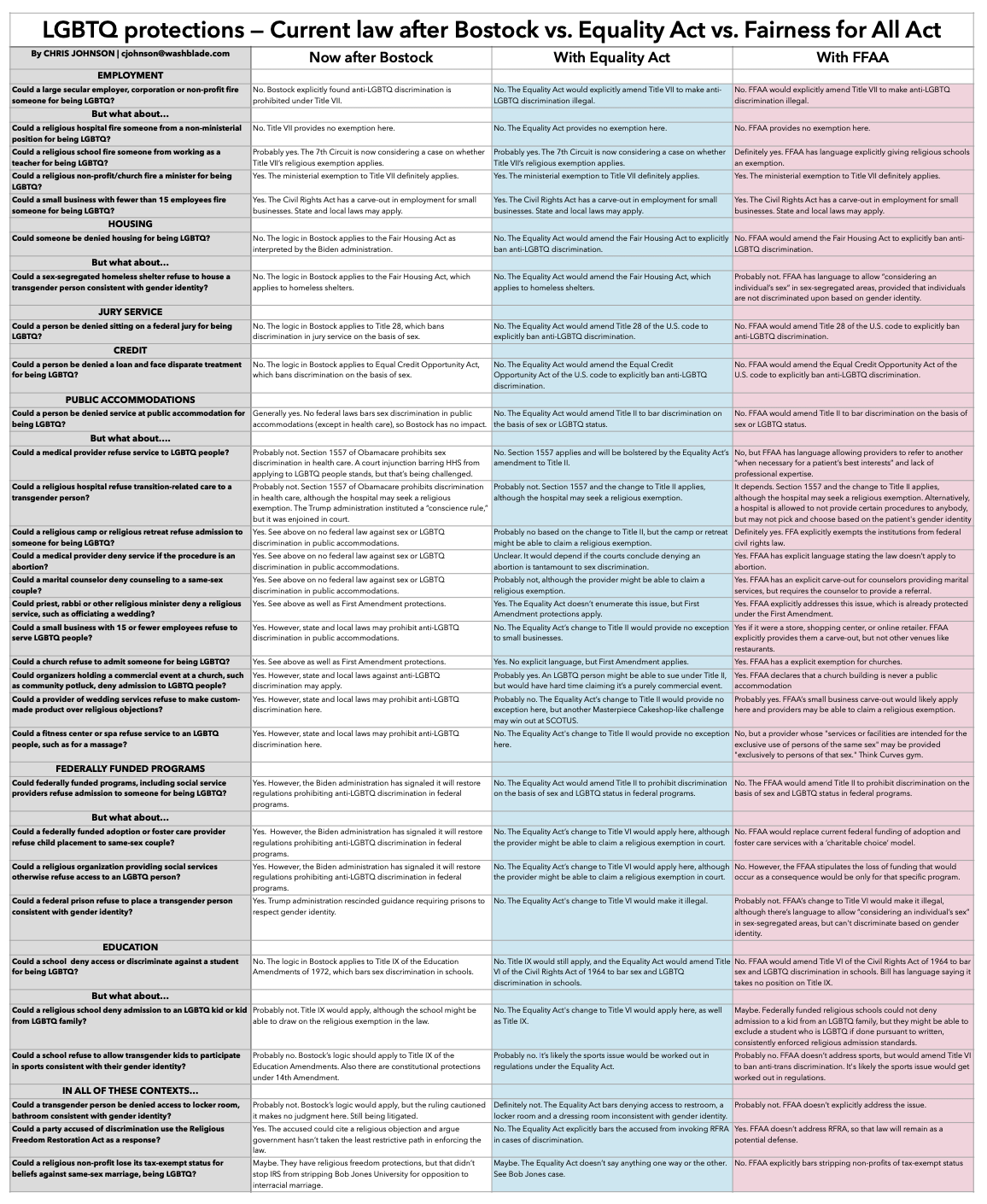
Current law vs. Equality Act vs. Fairness for All Act — What’s the differences?

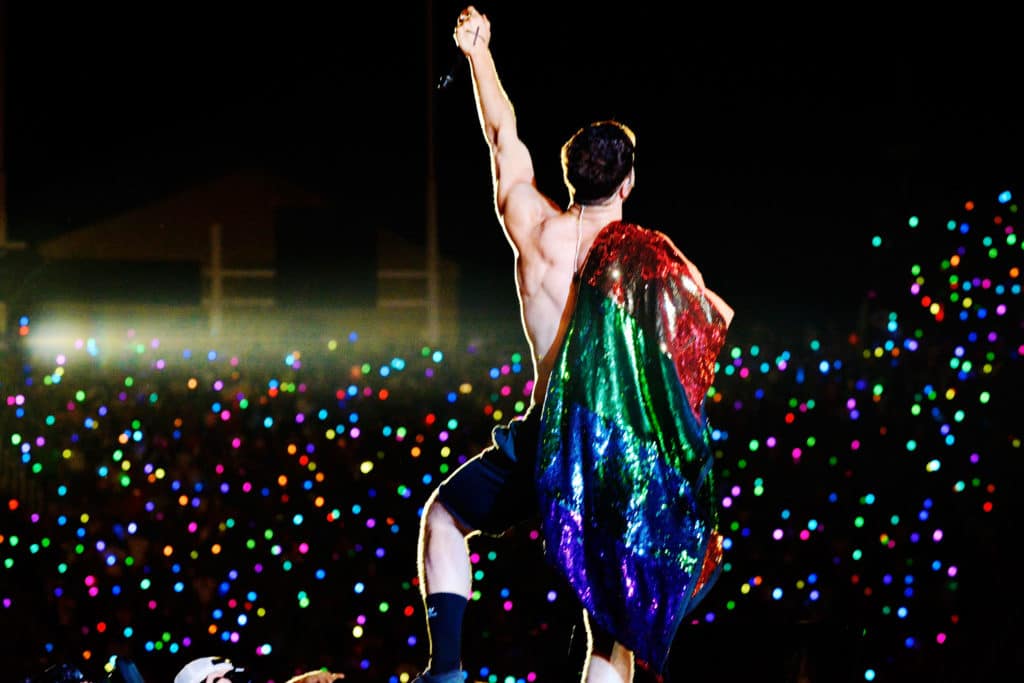
Dan Reynolds, professional tall man and Imagine Dragons singer, has donated his childhood home worth $1 million for it to become an LGBT+ youth centre.
As part of LGBT+ advocacy group Encircle’s ‘$8 Million, Eight Houses’ campaign, the 34-year-old reflected on the difficulties queer youth face.×ADVERTISING
Reynolds, an outspoken LGBT+ ally, and his wife Aja Volkman are to donate the Las Vegas, Nevada, property to be converted into one of Encircle’s new facilities, which will offer vulnerable queer youth a crucial lifeline.
Both Reynolds and Volkman will serve as honorary co-chairs of Encircle’s new campaign, according to NME.
“Encircle is about bringing young LGBTQ+ people and their families together, by including the community and strengthening the bonds that connect us,” Reynolds and Volkman said in a joint statement.
“Being a part of this organization means so much to both of us and we know the house Dan grew up in will be a loving and supportive home to every young LGBTQ+ person who crosses the threshold.”
Appearing on daytime talk show Good Morning America Thursday (25 February), Reynolds, alongside fellow donators Apple CEO Tim Cook and Utah Jazz basketball team owner Ryan Smith, discussed the campaign.
Stars you didn’t know are LGBT+Celebs you didn’t know have an LGBT sibling
“I’ve watched throughout my life the difficult path that LGBT+ youth have, especially coming from homes of faith,” he said.
“Now to know, with my mum and dad’s blessing, I was able to purchase the home for them and it’s going to be the first Encircle home in Las Vegas – that’s powerful for me.”
Encircle operate various safe houses in Utah in Salt Lake City, Provo and St George, and a fourth in Heber on the way. The campaign being part of an effort to expand to Arizona, Idaho and Nevada.
Even if you consider yourself to be in good health, it’s important to keep up with…
“Studies repeatedly have shown that LGBT+ youth across the country struggle with depression and suicidality far more than their heterosexual peers, and the pandemic has made that sense of isolation so many feel harder than ever before,” Encircle CEO Stephanie Larsen said in a statement to the press.
“We strive to give these kids a positive and loving environment that builds support within their communities where they can realize their full potential, and it works — we have not lost a single youth to suicide.”
Republicans are launching a rival to the Equality Act which will allow them to discriminate against LGBT+ people on the basis of religious freedom.
The “Fairness for All” Act was reintroduced by Utah Congressman Chris Stewart on Sunday (28 February), days after the Equality Act was passed by the House of Representatives, as a way to “harmonise religious freedom and LGBT+ rights”.
Like the Equality Act it would outlaw LGBT+ discrimination in employment, housing, jury selection, credit and federally assisted programs – except, of course, when that discrimination is based on religious beliefs.
“It is hard to really love our neighbours when we are fighting with them over whose rights are more important,” Stewart complained. “This country can accommodate both civil liberties for LGBT individuals and religious freedom.
“We have wasted enough time, energy, and money fighting over who deserves which legal protections. It is time to define the federal protections for our LGBT and religious friends and neighbours.”
The Fairness for All Act promises to build on LGBT+ protections in federal, state and local law while simultaneously preserving the Religious Freedom Restoration Act, which enshrines the First Amendment right of religious freedom.
This means small business owners and faith-based charities, such as shelters and foster care agencies, would be free to refuse LGBT+ people if they feel their existence runs “contrary to their conscience and beliefs”.
The bill also protects the tax-exempt status of religious organisations, colleges and universities, allowing them to “uphold their religious standards” without losing funding.
According to a press release it is “the largest expansion of religious freedom and LGBT civil rights under federal law in a generation” – and Stewart somehow insists this is not a contradiction.
“There’s room to do both,” he told 2News. “Some people say, ‘You’ve got to do one, or you can do the other, but you can’t do both,’ and that’s just not true.”
The Fairness for All Act already has 20 Republican co-sponsors and the support of the Mormon Church, the Seventh-day Adventist Church and multiple other faith advocacy groups.
But the Human Rights Campaign called the legislation “deeply dangerous”, warning that it would create “substandard protections” for LGBT+ people.
“The ‘Fairness for All’ Act is anything but fair, and it certainly does not serve all of us,” the advocacy group said when the bill was first tabled in 2019.
“It is an affront to existing civil rights protections that protect people on the basis of race, sex, and religion and creates new, substandard protections for LGBTQ people with massive loopholes and carve-outs, and upends critical federal programs that serve children in need.
“This legislation is deeply dangerous for many reasons,” it continued, “mainly because it would erode protections that already exist for people based on race, sex and religion, rolling back protections that have been on the books for decades.
“It would expand the number of places and situations in which lawful discrimination could occur.”
Even if it doesn’t pass, the bill could influence revisions of the Equality Act, which needs to gain Republican support in order to overcome a potential Senate filibuster.
Donald Trump mocked trans athletes in a sinister first speech since leaving the White House in January.
The disgraced former president gave his first public address since leaving office at the Conservative Political Action Conference (CPAC) in Orlando, Florida, on Sunday (28 February).
n a speech that dragged on for an hour and a half, Trump repeatedly hit out at Joe Biden, pushed the false idea that the election was stolen, and characterised immigrants as “predators”, “rapists” and “drug smugglers”.
Around 42 minutes into his speech, Donald Trump turned his attention to trans athletes, lambasting Joe Biden for advancing protections for LGBT+ people.
“Joe Biden and the Democrats are even pushing policies that would destroy women’s sports,” Trump said to cheers from a mostly maskless crowd.
Trump incorrectly claimed that “a lot of new records are being broken in women’s sports”. Directly addressing women in the audience, he added: “Hate to say that ladies, but you got a lot of new records that are being shattered.
“For years the weightlifting, every ounce is like a big deal for many years,” Trump said, imitating a person struggling to lift weights.
“All of a sudden somebody comes along and beats it by a hundred pounds. Nah. Young girls and women are incensed that they are now being forced to compete against those who are biological males,” he said, adopting wording commonly used by anti-trans pressure groups.https://www.youtube.com/embed/g9ITyMTesmo?feature=oembed&enablejsapi=1
“It’s not good for women, it’s not good for women’s sports, which worked so long and so hard to get to where they are. The records that stood for years, even decades, are now being smashed with ease,” Trump lied.
The former president claimed that women’s sports will “die” if trans women are allowed to compete.
He went on to claim that cisgender women’s records will “easily be broken by somebody who was born a man”. Needless to say, Trump provided no evidence to back up his claims.
“I think it’s crazy, I think it’s just crazy what’s happening,” he said.
“I don’t even know, is that controversial?” he asked the audience, who responded with cheers.
“Somebody said, ‘Well that’s going to be very controversial.’ I said, ‘That’s OK, you haven’t heard anything yet.’”
Trump has been slammed by LGBT+ rights organisations for his harmful and baseless claims about trans athletes.
Alphonso David, president of the Human Rights Campaign, lambasted Trump’s comments as “offensive and dangerous” – but added that they were “unsurprising”.
“His historic anti-LGBTQ agenda is part of the reason he’s no longer president and we’ll never get tired of reminding him of that,” he said.
The HRC tweeted: “Trans men are men, trans women are women, and Trump is a transphobic liar.”
Meanwhile, GLAAD tweeted: “He’s getting cheers from the CPAC crowd for attacking trans Americans. His administration deployed multiple departments to target trans people looking for a job, going to school, trying to see a doctor, or to access a safe shelter.”:
This is not the first time Trump has used his platform to attack trans athletes. During his presidency, he backed legal attempts, led by anti-LGBT+ evangelical law firm Alliance Defending Freedom, to ban trans girls from playing school sports.
In March 2020, the Trump administration officially declared that it believes trans girls should be treated as “biological males” when playing sports at school.
Trump repeatedly targeted LGBT+ people throughout his four years in office, leading to celebrations from advocacy organisations when Joe Biden won the election in November.
The former president has now been relegated to pushing his hateful views at conservative conferences after he was permanently banned from Twitter – his favourite platform – in January after he incited a riot at the United States Capitol in Washington DC.
Once known for singer Anita Bryant’s anti-gay rights campaign and a ban on gay and lesbian adoptions, Florida is now home to two metro areas with among the highest concentrations of gay and lesbian coupled households in the U.S., according to a new report released by the U.S. Census Bureau.
Orlando and Miami had the fourth and sixth highest percentages respectively of same sex coupled households in the U.S., according to the report released this week using data from the bureau’s 2019 American Community Survey.
San Francisco, Portland and Seattle topped the list. Austin was No. 5 and Boston came in at No. 7. But they were joined in the top 10 by some unexpected metro areas like Baltimore, Denver and Phoenix. Noticeably absent were three of the nation’s largest metros: New York, Los Angeles and Chicago. Though they have some of the nation’s most visible LGBTQ communities, the vastness of their metro areas dilutes the concentration.ADVERTISEMENT
The appearance of these metros on the list shows that tolerance isn’t limited to large coastal cities, gay rights advocates said.
“You often think of LGBTQ people in large cities like San Francisco, but we’re everywhere,” said Jeremy LaMaster executive director of FreeState Justice, a Baltimore-based LGBTQ advocacy organization for Maryland.
The report focused on same sex couples, both married and unmarried, and not gay and lesbians who are single. About 1.5% of all coupled households nationwide were same sex. The cities on the top 10 list ranged in concentration from San Francisco’s 2.8% to Baltimore’s 2%.
In the District of Columbia, which was categorized along with states in the report, 7.1% of coupled households were same sex.
In Florida, acceptance of LGBTQ communities has been driven at the local level, with passage of human rights ordinances, fast-growing populations from all over the world and gay-friendly companies from the hospitality and entertainment industries, said Nadine Smith, executive director of Equality Florida, an LGBTQ advocacy group.
While Orlando already had a visible gay community with out elected officials and workforces like Disney World with large numbers of gays and lesbians, the collective grief from the massacre at the gay Pulse nightclub in 2016 helped push that acceptance into more conservative corners of civic life such as local churches.
“Miami is a port city and Orlando is the epicenter of amusement parks and hospitality, so it makes perfect sense,” Smith said of the high concentrations of same sex households. “The cities have led the way for sure, rebuilding Florida’s image from a really hateful history.”ADVERTISEMENT
That history stretches back to the 1970s. That’s when Bryant, an early-1960s pop singer and brand ambassador for the Florida Citrus Commission, headed a campaign that led to the repeal of an ordinance in Miami-Dade County prohibiting discrimination based on sexual orientation in one of the earliest organized fights against gay rights. Florida also was the last state in the U.S. to end its ban on gay and lesbian adoption when a court ruled it violated equal protection rights in 2010.
Austin, Orlando and Phoenix have been among the metropolitan areas with the largest population growth in recent years.
Phoenix’s general meritocracy, which comes from being a relatively young community with a constant influx of new arrivals, has made it welcoming to gay and lesbians, said Angela Hughey, president of ONE Community, a business coalition that advocates for inclusion and equality.
“It’s a very broad city and we are in every neighborhood,” Hughey said Thursday.
In Baltimore, residents have had an appreciation for a camp aesthetic that now would overlap with queer culture. A favorite son, after all, is filmmaker John Waters, and the city celebrates the unconventional, as evidenced by the annual HONFest where celebrants sport beehive hairdos and cat-eye sunglasses. The city also has a vibrant vogue ball scene.
“Part of me feels like I need to give a shout-out to John Waters,” said LaMaster, referring to the filmmaker behind cult movies made in Baltimore, such as “Pink Flamingos” and “Hairspray.” “But it’s not just John Waters. There is a rich heritage and history that can be found here.”
LaMaster, who lived in New York City before moving to Baltimore, said the Maryland city lacked the visible gay scene found in a neighborhood like Chelsea in New York City. But Baltimore made sense for same sex couples wanting to set up households in a state that has been a leader in laws prohibiting discrimination based on sexual orientation and gender identity, as well as allowing second-parent adoptions, he said.
“The work isn’t done. That’s my takeaway,” La Master said. “Even though there has been tremendous progress, I think there’s always room for improvement.”
___
A new initiative backed by a coalition of right-wing organizations is courting lawmakers and parents in an effort to stop the passage of the Equality Act — a federal LGBTQ rights bill — and promote policies targeting transgender Americans at the federal and state levels.
Backed by the Alliance Defending Freedom, Family Policy Alliance, Heritage Foundation and other national and local groups, the Promise to America’s Children coalition says it is fighting “a culture – and sadly, a government – around us seek to sexualize our children for the sake of a political agenda.”
“It’s no surprise that the ugly wave of state attacks on trans kids traces back to a few, very familiar national anti-LGBTQ groups.”
SARAH KATE ELLIS, GLAAD PRESIDENT AND CEO
As part of this effort, policymakers and parentsare asked to sign pledges protecting children’s “minds,” “bodies” and “relationships with their parents.” Elected officials can even sign up on the coalition website to receive model legislation on the policies it promotes.
“Every child deserves an education that is suited for their specific needs and development as guided by their parents, and one that is free from graphic sexual curriculum or content, the promotion of abortion, and politicized ideas about sexual orientation and gender identity,” the policymaker pledge reads.
On its website, the Promise to America’s Children coalition says anyone who signs the pledge is not signaling support or opposition to legislation, “with the exception of the federal Equality Act, which clearly violates all principles of this Promise.”
The Equality Act is federal legislation that seeks to prohibit discrimination based on sexual orientation and gender identity in employment, housing, credit, education, public spaces, public funding and jury service. The House passed the recently reintroduced legislation Thursday, but it will likely face an uphill battle in the Senate, where a 60-vote threshold is required to bypass a filibuster.
Civil rights groups say this new conservative coalition is an attempt to roll back the rights of LGBTQ Americans, particularly the transgender community, and stall passage of comprehensive nondiscrimination laws on the federal and state levels.
“The same few sources have been responsible for peddling anti-LGBTQ legislation for many years, and this legislation is simply the latest iteration of their losing political fight against equality,” Cathryn Oakley, state legislative director and senior counsel for the Human Rights Campaign, said of state bills associated with the organizations in the coalition.
“While extremist groups push copycat bills down to states, these state legislators should understand that their constituents — including a large majority of Republicans — believe transgender people should be allowed to live freely and openly,” Oakley added. “The only thing these bills do is harm kids who are simply trying to navigate their adolescence.”
Emilie Kao, an attorney at the Heritage Foundation, said the coalition’s efforts were accelerated by the reintroduction of the Equality Act.
“Regardless of whether one agrees with the idea that people can have gender identities at odds with their biological sex, bills that treat Americans as criminals if they don’t agree with a government-imposed ideology about the treatment of gender dysphoria is a gross violation of our most basic freedoms of speech and conscience,” Kao told NBC News. “The Equality Act will turn disagreements over marriage and sexuality into discrimination by misusing civil rights law as a sword to coerce conformity rather than as a shield to prevent unjust discrimination.”
Kao declined to disclose what model legislation the coalition is offering on its website. Prior to the coalition’s official launch this week, LGBTQ advocates said anti-transgender bills were introduced in 20 states in a coordinated assault by conservative groups. At least one of those conservative groups, the Alliance Defending Freedom, is part of this newly formed coalition.
Bethany Moreton, a history professor at Dartmouth College, said the guise of protecting children when promoting conservative ideology is not uncommon. She cited Anita Bryant’s “Save Our Children” campaign in the late 1970s that worked to overturn gay nondiscrimination ordinances in Miami by referencing how such measures would harm local children. Over the past 20 years, the religious right has repeatedly lost political battles when it comes LGBTQ issues, so this new pledge is continuing in the “Save Our Children” vein in an effort to appeal to a broad base, according to Moreton.
“Their sort of arsenal of acceptable arguments have shrunk, and one of them is doubling down on child vulnerability,” Moreton said.
While the Promise to America’s Children coalition is new, groups within the coalition have already had success in assisting lawmakers with legislation intended to curtail transgender rights. One such example is Idaho’s HB 500, a bill that bars trans women from participating in high school sports that was passed in 2020, which was written with the help of the Alliance Defending Freedom, according to Barbara Ehardt, the legislator who drafted it. A similar bill in Montana was drafted directly from HB 500, Laura Sankey Keip, a staff attorney in the Montana Legislature, confirmed.
The coalition, which launched Tuesday, already has 24 state representatives as signatories to the group’s pledge, three of whom have introduced legislation targeting transgender individuals. Ohio state Rep. Jena Powell and North Dakota state Rep. Ben Koppelman, both Republicans, have introduced bills that would restrict trans women from participating in high school sports, mirroring HB 500, and Kansas state Sen. Mike Thompson, also a Republican, has introduced a bill that would criminalize doctors providing gender-affirming health care to teenagers.
There are more than 45 pieces of anti-transgender legislation making their way through statehouses this year, according to a legislation tracker from Freedom for All Americans. That is more than the legislative session of 2016, which produced the largest volume of anti-trans bills in statehouses, according to civil rights groups.
“It’s no surprise that the ugly wave of state attacks on trans kids traces back to a few, very familiar national anti-LGBTQ groups,” Sarah Kate Ellis, president and CEO of GLAAD, said. “They have opposed LGBTQ equality for decades, fighting marriage equality and now targeting trans youth. Bills claiming to protect children or women’s rights do neither and put trans kids in further danger.”
The US House of Representatives has voted to pass the Equality Act, a landmark civil rights bill prohibiting discrimination against LGBT+ people in all 50 states.
The House voted 224-206 on Thursday (25 February) to pass the sweeping legislation, which substantially expands the existing 1964 Civil Rights Act to include specific protections for sexual orientation and gender identity.ADVERTISING
Its passage represents an enormous step forward for LGBT+ rights in America as it finally addresses the “patchwork” state coverage that leaves countless queer people vulnerable to discrimination.
Representative Ritchie Torres, the first LGBT+ Black and Afro Latino member of congress, said he felt “the weight of history” on his shoulders as he voted to claim what discrimination denies: equal protection under law.
“My younger self could’ve never imagined standing on the floor of the house as a member of congress voting for legislation that, if enacted, will make me equal in the eyes of the law,” he said.
“We are here to uphold the abiding truth of the American experiment – that we are all created equal, and that none of us should be evicted, fired or denied accommodations and services simply because of who we are and whom we love.
“We are equal by nature, and we ought to be equal by law.”
The Equality Act builds on the Supreme Court’s historic ruling in Bostock v Clayton County, which included LGBT+ people under sex-based employment protections.
The difference is that the Equality Act cements this by explicitly enshrining sexual orientation and gender identity protections in law, rather than looping them under the umbrella of “sex”.
It also goes far beyond employment: it would cover housing, public accommodations, public education, federal funding, credit, and the jury system, among other areas.
“The Equality Act is vital to ensuring the promise of a level playing field for all Americans,” said Jason Wu, executive director of GLBTQ Legal Advocates & Defenders.
‘Saturday Night Live’ is home to America’s greatest comedic minds. But when you put…
“[It] is a critical step toward ensuring that LGBTQ people – and all people – can protect their families and contribute to their communities and workplaces. It also ensures the fairness and dignity all Americans need and deserve.”
This has unfortunately brought it into conflict with religious conservatives, who fear it could spell an end to businesses refusing to serve LGBT+ customers on the basis of “religious freedom”.
“Just as [a business] would not be able to turn away somebody for any other prohibited reason in the law, they would not be able to do that for LGBT+ people either. And we think that’s a really important principle to maintain,” said Ian Thompson, a senior legislative representative at the ACLU.
Because of this the legislation has long lingered in congress, with Republicans standing in the way of the measure and its predecessor bills for more than two decades.
The most recent hurdle came in 2019 when it was stalled by the senate after the Trump administration labelled it a “poison pill” that would “undermine parental and conscience rights”.
But Joe Biden championed the Equality Act throughout his presidential campaign, saying it was “essential” to reducing economic barriers and ensuring consistent protection for the LGBT+ community.
The legislation remains highly controversial and its fate in the senate is still unclear, as Democrats and Republicans are evenly divided.
Even if all 50 Democratic and Democratic-caucusing Independents in the Senate voted in favour of the Equality Act, it would still need the backing of at least 10 Republicans to clear the upper chamber’s traditional 60-vote threshold for final passage.
From the Log Cabin Republicans:
Gay, lesbian, and bisexual members of society would effectively become an ‘extinct species’ under this bill. That’s because it would enshrine the gender identity agenda that is counter to gay rights.
For decades, we gays preached to the world that we were ‘born this way,’ and that being gay, lesbian, or bisexual ‘is not a choice.’
We did not challenge nature or the science of our biology, nor millennia of human history’s distinctions and separations of the two sexes.
Now, that’s turned on its head. For the gender-identity and trans-obsessed crowd, how you were born can now be ‘changed,’ and everything regarding sex and gender is simply a ‘choice.’
If being gay means being a man who has same-sex attraction to another man, the Equality Act would make this definition completely defunct. What is now a ‘man’? Whoever claims to be.
The Star Observer reports:
After a gay man in Houston, Texas was found murdered, police investigators have tracked down and charged the alleged perpetrator Benjamin Davis with capital murder. The victim, the police have said, was targeted for robbery through gay hook up app Grindr.
The victim, identified as Victor Najera Betanzos had arranged to meet with Davis at his apartment with the intent of having sex. But once inside his apartment, the victim was first knocked unconscious, before Davis used a scarf to strangle him.
In his statement to detectives, Davis said he then poured bleach over Betanzos body in an attempt to destroy evidence, before driving off in the victim’s vehicle and also stealing an iPhone and iPad.
Click2Houston reports:
Davis, 29, has a history of violence. He served two years in prison for choking a family member in 2018. Police said he opened an account on an app called Grindr to find people to rob.
“He learned from other individuals, people we don’t know, that it’s pretty easy to get into people’s homes on this app and rob them,” said Assistant Harris County District Attorney Chandler Raine.
Prosecutors said social media apps are making it easier for criminals to target victims and urged caution. “Really look at people before you allow them to come into your home,” Raine said. Davis is charged with capital murder. He’s being held on a $500,000 bond.
Gallup’s latest update on lesbian, gay, bisexual or transgender identification finds 5.6% of U.S. adults identifying as LGBT. The current estimate is up from 4.5% in Gallup’s previous update based on 2017 data.
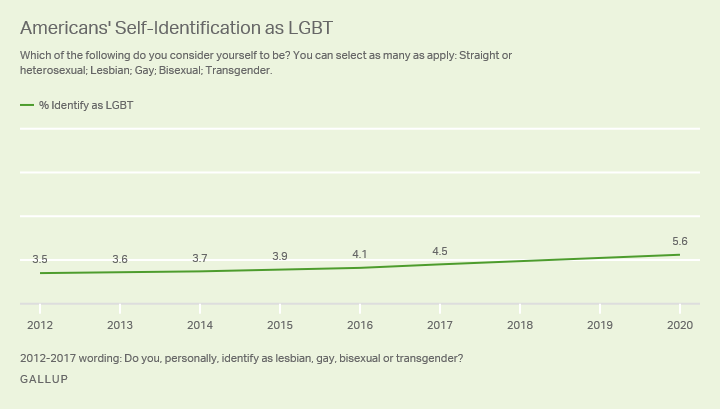
Line graph. Gallup trend in self-identification as lesbian, gay, bisexual or transgender. In 2020, 5.6% of U.S. adults identified as LGBT. That is up from 4.5% in 2017, the last year it was asked, and 4.1% in 2016. Between 2012 and 2015, 3.5% to 3.9% of U.S. adults identified as LGBT.
Currently, 86.7% of Americans say they are heterosexual or straight, and 7.6% do not answer the question about their sexual orientation. Gallup’s 2012-2017 data had roughly 5% “no opinion” responses.
The latest results are based on more than 15,000 interviews conducted throughout 2020 with Americans aged 18 and older. Gallup had previously reported annual updates from its 2012-2017 daily tracking survey data, but did not routinely measure LGBT identification in 2018 or 2019.
The identity question asked in 2020 offers a greater level of detail than the question asked in previous years. Now, respondents indicate their precise sexual orientation, rather than simply answering “yes” or “no” to whether they identify as lesbian, gay, bisexual or transgender.
Different approaches to measuring LGBT status can produce varying estimates of its incidence in the U.S. population. Results from Gallup’s new question do appear comparable to those from its prior question. The 1.1-percentage-point increase in the 2020 estimate (using the new question) compared with the 2017 estimate (using the old question) is about what would have been predicted from the recent trends. The LGBT percentage rose an average of 0.3 points per year in 2016 and 2017. Assuming that trend continued the past three years, the total increase would have been about one percentage point.
More than half of LGBT adults (54.6%) identify as bisexual. About a quarter (24.5%) say they are gay, with 11.7% identifying as lesbian and 11.3% as transgender. An additional 3.3% volunteer another non-heterosexual preference or term to describe their sexual orientation, such as queer or same-gender-loving. Respondents can give multiple responses when describing their sexual identification; thus, the totals exceed 100%.
Rebasing these percentages to represent their share of the U.S. adult population finds 3.1% of Americans identifying as bisexual, 1.4% as gay, 0.7% as lesbian and 0.6% as transgender.Americans’ Self-Identified Sexual OrientationWhich of the following do you consider yourself to be? You can select as many as apply: Straight or heterosexual; Lesbian; Gay; Bisexual; Transgender.
| Among LGBT U.S. adults | Among all U.S. adults | |
|---|---|---|
| % | % | |
| Lesbian | 11.7 | 0.7 |
| Gay | 24.5 | 1.4 |
| Bisexual | 54.6 | 3.1 |
| Transgender | 11.3 | 0.6 |
| Other (e.g., queer, same-gender-loving) | 3.3 | 0.2 |
| Percentages total more than 100% because respondents may choose more than one category. | ||
| GALLUP, 2020 |
One of the main reasons LGBT identification has been increasing over time is that younger generations are far more likely to consider themselves to be something other than heterosexual. This includes about one in six adult members of Generation Z (those aged 18 to 23 in 2020).
LGBT identification is lower in each older generation, including 2% or less of Americans born before 1965 (aged 56 and older in 2020).Americans’ Self-Identification as LGBT, by Generation
| LGBT | Straight/Heterosexual | No opinion | |
|---|---|---|---|
| % | % | % | |
| Generation Z (born 1997-2002) | 15.9 | 78.9 | 5.2 |
| Millennials (born 1981-1996) | 9.1 | 82.7 | 8.1 |
| Generation X (born 1965-1980) | 3.8 | 88.6 | 7.6 |
| Baby boomers (born 1946-1964) | 2.0 | 91.1 | 6.9 |
| Traditionalists (born before 1946) | 1.3 | 89.9 | 8.9 |
| GALLUP, 2020 |
The vast majority of Generation Z adults who identify as LGBT — 72% — say they are bisexual. Thus, 11.5% of all Gen Z adults in the U.S. say they are bisexual, with about 2% each identifying as gay, lesbian or transgender.
About half of millennials (those aged 24 to 39 in 2020) who identify as LGBT say they are bisexual. In older age groups, expressed bisexual preference is not significantly more common than expressed gay or lesbian preference.Americans’ Self-Identified Sexual Orientation, by Generation
| Bisexual | Gay | Lesbian | Transgender | Other | |
|---|---|---|---|---|---|
| % | % | % | % | % | |
| Generation Z (born 1997-2002) | 11.5 | 2.1 | 1.4 | 1.8 | 0.4 |
| Millennials (born 1981-1996) | 5.1 | 2.0 | 0.8 | 1.2 | 0.4 |
| Generation X (born 1965-1980) | 1.8 | 1.2 | 0.7 | 0.2 | 0.1 |
| Baby boomers (born 1946-1964) | 0.3 | 1.2 | 0.4 | 0.2 | 0.0 |
| Traditionalists (born before 1946) | 0.3 | 0.3 | 0.2 | 0.3 | 0.1 |
| Figures represent the percentage of all adult members of each generation who have that sexual orientation | |||||
| GALLUP, 2020 |
In addition to the pronounced generational differences, significant gender differences are seen in sexual identity, as well as differences by people’s political ideology:
At a time when Americans are increasingly supportive of equal rights for gay, lesbian and transgender people, a growing percentage of Americans identify themselves as LGBT. With younger generations far more likely than older generations to consider themselves LGBT, that growth should continue.
The pronounced generational differences raise questions about whether higher LGBT identification in younger than older Americans reflects a true shift in sexual orientation, or if it merely reflects a greater willingness of younger people to identify as LGBT. To the extent it reflects older Americans not wanting to acknowledge an LGBT orientation, the Gallup estimates may underestimate the actual population prevalence of it.
One of the biggest recent advances in LGBT rights was the legalization of same-sex marriage nationwide. Gallup’s new estimates on same-sex marriages and domestic partnerships in the U.S. can be found here.
Learn more about how the Gallup Poll Social Series works.