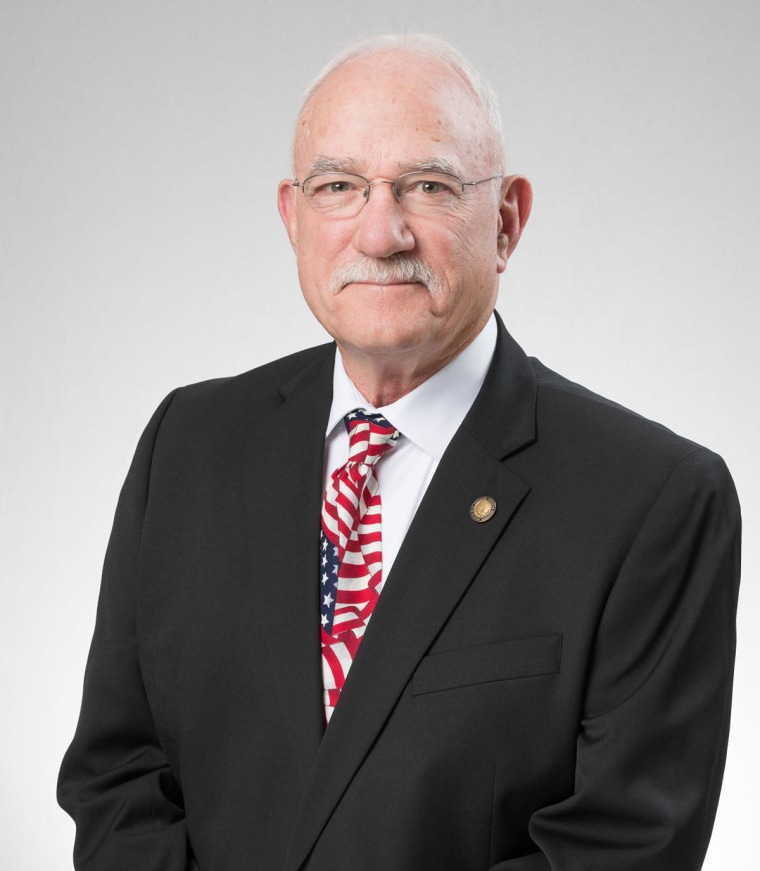
South Dakota Republican lawmakers on Tuesday revived a proposed law that would ban people from changing the sex designation on their birth certificates, even after a House committee rejected the bill that LGBTQ advocates decried as an attack on transgender people.
Republicans in the House forced the bill to be brought to a vote by the full House through a rarely used legislative procedure known as a “smoke out.” At least one-third of the House supported the procedure.
A committee of lawmakers had earlier Tuesday dismissed the bill on a seven-to-six vote after five Republicans joined two Democrats to oppose the bill, which would stop people from changing the sex listed on birth certificates after one year from birth. The proposal will be delivered to the full chamber for consideration by Wednesday.
Law changes that affect transgender people have become a perennial topic in the South Dakota legislature, although transgender advocates say they are making progress in getting their voices heard and issues understood. A handful of advocates gathered in the pre-dawn cold outside the statehouse on Tuesday, waving rainbow and transgender flags.
“I want transgender people to know they have a home here, a family here,” said Seymour Otterman, a nonbinary transgender person who testified to lawmakers on their experience living in the state.
The legislative efforts to address transgender issues were spearheaded by Rep. Fred Deutsch, a Watertown Republican who introduced this year’s proposal. After the bill was rejected in committee, he said he had heard from fellow Republicans that they would like to debate and vote on the bill in a meeting of the full House.
Deutsch pushed a bill last year that would have banned puberty blockers and gender confirmation surgery for transgender children under 16. And in 2016, he introduced a bill that would have limited the bathrooms and locker rooms that transgender students can use.
But Deutsch’s efforts have increasingly struggled to gain traction: His 2016 bill cleared the House and Senate before being vetoed by former Gov. Dennis Daugaard, a Republican; his bill last year passed the House before being halted by a Senate committee; this year’s bill failed to clear its first hurdle in the House and had to be revived by the “smoke out” procedure.
Deutsch defended his efforts, saying he was not motivated by hate but by social importance.
He argued that the state’s judges have struggled with how to handle requests from people who want to change the sex on their birth certificates and that keeping vital records on sex is an important aspect of government business.
South Dakota courts have received 11 requests for updates to the sex listed on birth certificates since 2017, according to the court system.
Rep. Kevin Jensen, a Canton Republican who supported the bill, said he doesn’t feel it discriminates against transgender people, and that a birth certificate serves as an objective record of someone’s sex at birth.
But LGBTQ people see Deutch’s efforts as an attack intended to send a message that they are not welcome in a state dominated by conservative politics. They warned that barring people from updating their birth certificates was dangerous, exposing them to violence, hate and discrimination. They could be unwillingly exposed as transgender when they apply for jobs, housing or health care.
“It’s incredibly disrespectful that we have to address this every year. It’s infuriating,” said Rep. Erin Healy, a Democrat from Sioux Falls. “We are disrupting the lives of a vulnerable population, and I think what we are missing today is empathy and compassion.”
Opponents to the bill pointed out that similar bans, such as a 2018 law passed in Idaho, have been struck down by federal courts as unconstitutional. LGBTQ advocates have also pointed to President Joe Biden’s order reversing a Trump-era Pentagon policy largely barring transgender people from military service as a sign that the federal government is taking a stronger approach to protections for transgender people.
Otterman said Deutsch’s proposed ban did not come as a surprise, even though they are struck by increasing waves of anger and sadness each January when the bills come.
“In most places in South Dakota, it is a very lonely, isolating experience because of this sentiment,” they said.
Healy said bills that delve into transgender issues can be harmful, even if they often fail.
“It’s an emotional roller coaster,” Healy said. “To be so happy and relieved that it died, only to see it resurrected and have that threat all over again.”
The Washington Blade has learned Judy Shepard will testify in support of a bill that would ban the so-called LGBTQ panic defense in Virginia.
The measure — House Bill 2132 that state Del. Danica Roem (D-Manassas) introduced — will go before a House of Delegates subcommittee on Wednesday.
Shepard’s son, Matthew, died on Oct. 12, 1998, after two men brutally beat him and left him tied to a fence outside of Laramie, Wyo. One of the men convicted of murdering Matthew Shepard claimed he became after he made a sexual advance towards him.
Eleven states and D.C. currently ban the so-called LGBTQ panic defense. Lawmakers in Maryland are considering a measure that would prohibit the use of the legal strategy in the state.
Legislators in Montana advanced two bills Monday focused on transgender youth: House Bill 112 would prohibit transgender student athletes from participating on teams that correspond to their gender identities, and House Bill 113 would prohibit health care professionals from providing gender-affirming care to trans minors.
“If passed into law, HB 112 and HB 113 will cause irrevocable harm to trans youth,” Caitlin Borgmann, executive director of the American Civil Liberties Union of Montana, said in a statement. “If these discriminatory bills pass — we will sue, and we will win. Trying to defend laws in court that stigmatize and target trans youth doesn’t seem like a good use of taxpayer dollars to us.”
University of Montana cross country runner Juniper Eastwood, center, warming up with her teammates at Campbell Park in Missoula, Mont., on Aug. 15, 2019. The proposed ban is personal for people like Eastwood, a transgender woman and former member of the University of Montana’s track and field and cross-country running teams. She said the legislation “would make it impossible for other young Montanans like me to participate in sports as who they are.”Rachel Leathe / Bozeman Daily Chronicle via AP file
The bills working through Montana’s Legislature are among an estimated 21 anti-LGBTQ measures that have been filed or pre-filed for 2021 state legislative sessions, according to Freedom for All Americans, an organization advocating for LGBTQ nondiscrimination protections. Many of the bills, like those in Montana, focus on transgender youths.
“I think the volume of bills is going to dramatically increase, particularly because of what is happening at the federal level,” said Kasey Suffredini, CEO of Freedom for All Americans. “For the opposition, this is the only avenue for their narrative that treating LGBT people with dignity and respect is a problem for the country.”
Chase Strangio, deputy director of transgender justice for the American Civil Liberties Union, agreed.
“We often see backlash” after advancements in LGBTQ rights, he said, citing the flurry of measures targeting LGBTQ people after the Supreme Court’s landmark decision in Bostock v. Clayton County, Georgia, which expanded the scope of federal nondiscrimination law to include sexual orientation and gender identity.
Strangio said that with fewer opportunities to roll back LGBTQ rights at the federal level under President Joe Biden — who has signed multiple pro-LGBTQ executive orders — he’s not surprised that opponents are zeroing in on the states.
Anti-LGBTQ bills
Republican legislators in over a dozen states have proposed legislation that targets LGBTQ people. The bills touch on athletics, health care and a grab bag of other issues related to queer rights and recognition.
Legislators have also introduced bills to restrict transgender participation in student athletics in Oklahoma, South Carolina, Tennessee, Kentucky, North Dakota, New Hampshire and Florida. The trend carried over from last year, when lawmakers took up the issue in several states. Idaho is the only state to have adopted such a law, and it did so just last year.
Proponents of such bills say it’s about fairness, while opponents say the measures are discriminatory.
Bills that would penalize or criminalize medical professionals for providing trans youths with gender-affirming care have been introduced in Utah, Missouri, Indiana, Alabama, Mississippi and Texas.
“Criminal health care bans are unlike anything we have ever seen before,” Strangio said. “To cut someone off from their health care and make it a crime is pretty much unparalleled.”
In Kentucky, SB 83 would prohibit “discrimination” against any health care provider who refuses to administer care because of a religious objection.
In New Hampshire, HB 68 would expand the definition of “child abuse” to encompass parents’ provision of gender-affirming care, while bills in Alabama, Missouri and Indiana would make it a crime for physicians to give any gender-affirming care to a minor.
Research released in September in the journal Pediatrics found that transgender children who receive gender-affirming medical care earlier in their lives are less likely to experience mental health issues like depression and anxiety.
Strangio said he is alarmed by “how far-reaching these bills are becoming.” For example, a bill introduced by Mississippi state Sen. Angela Burkes Hill would criminalize access to care for young adults up to age 21.
Hill defended the bill on social media as necessary in the face of Biden’s pro-LGBTQ policies: “It should have been passed last year. Who is going to fight for your daughters not to be cheated by biological males deciding to identify as a girl?? Women shouldn’t have to change clothes in front of men either. That federal money will be the carrot. Get ready.”
Other bills that have alarmed LGBTQ advocates include Indiana’s HB 1456, which aims to prohibit transgender people’s access to bathrooms that match their gender identities; South Dakota’s HB 1076, which would require birth certificates to reflect biological sex; North Dakota’s HB 1476, which would codify discrimination against LGBTQ people; and Iowa’s Senate File 80, which would require schools to alert parents if their children are asked by school employees about their “preferred” pronouns.
Pro-LGBTQ legislation
For LGBTQ advocates, the news from legislatures isn’t all bad.
Suffredini expects several states to advance nondiscrimination protections, including Ohio, Pennsylvania, Arizona and Michigan. In Michigan, advocates collected over 400,000 signatures to put a measure on the ballot to extend such protections, and the Legislature has 40 days to amend existing nondiscrimination legislation or the issue will appear on the November 2022 ballot for voters to decide.
Advocates in Arkansas — one of only three states that have no hate crimes law, along with South Carolina and Wyoming — hope an LGBTQ-inclusive hate crimes bill makes it to the governor’s desk this session. Conservatives tried to derail the bill this month because it includes protections based on sexual orientation and gender identity.
In Indiana, the state’s first openly gay legislator, Sen. J.D. Ford, has proposed legislation that would outlaw conversion therapy for minors by licensed counselors. If the bill becomes law, Indiana would join 20 other states and 80 cities in banning the widely discredited practice.
North Carolina cities and municipalities have begun to pass nondiscrimination measures after the end of a moratorium on such local ordinances as a result of a 2017 compromise bill that repealed HB 2, the controversial “bathroom bill.”
New York Senate Democrats are advancing a bill that would strike down an anti-loitering statute, also known as the “walking while trans” law, which allows police to arrest and detain sex workers merely for being on the street. LGBTQ advocates say that the statute is used to harass transgender women of color and that its repeal is necessary to end targeted discrimination. The legislation is on track to pass next week.
Maryland legislators introduced a measure that would make it easier for transgender people to legally change their names.
State Sen. Scott Wiener, an openly gay lawmaker from California, has introduced a bill that would prohibit medically unnecessary surgical procedures on intersex children before age 6. If it passes, the law would be the first of its kind in the U.S.
An ally in the White House
Since he took office last week, Biden has taken several actions applauded by LGBTQ advocates, including issuing an executive order that prohibits discrimination on the basis of sexual orientation and gender identity across federal agencies and another that rescinds former President Donald Trump’s ban on transgender people’s serving openly in the military.
“The Biden administration is by far the most supportive of LGBT people in U.S. history,” Suffredini said. “He took action on day one to extend protections on day one. No other president has done that. That is a first.”
With Biden in the White House and Democrats in control of Congress, Suffredini and other advocates are optimistic about passage of pro-LGBTQ federal legislation, including the Equality Act, which would grant LGBTQ people federal protections from discrimination in employment, housing, credit, education, use of public space, public funding and jury service.
“We are in the best position we have ever been to update federal civil rights law,” Suffredini said. “Our dedicated opposition knows this, and they know this moment could be coming. This is a last gasp.”
Devyn Box, 36, a social worker in Dallas, avoids going places in Texas where IDs have to be shown, because Box’s lists their sex assigned at birth rather than their nonbinary gender.
Nineteen states across the U.S. allow nonbinary residents to use an “X” mark for gender on state IDs, like driver’s licenses, though Texas is not one of them. Box, who uses gender-neutral pronouns, said a federal policy that would allow them and other individuals who identify as neither exclusively male nor female to receive an accurate ID would make a huge difference in their daily quality of life.
“On my mortgage, I had to put the wrong gender, because they wouldn’t let me select my actual gender,” Box told NBC News. “I’ve had situations where people are going on what’s on my ID, and so then I have to basically out myself to them if I want for them to speak to me respectfully, which can be unsafe, and it’s also just uncomfortable and exhausting having to continuously educate and advocate for myself.”
Devyn Box.Courtesy Devyn Box
In Joe Biden’s plan to “advance LGBTQ+ equality in America and around the world,” which is on his campaign website, the president-elect said he “believes every transgender or non-binary person should have the option of changing their gender marker to ‘M,’ ‘F,’ or ‘X’ on government identifications, passports, and other documentation.” As a result, he vowed to support state and federal efforts that permit trans people to have IDs that accurately reflect their gender identity.
Box said they hope the Biden administration will push for a federal rule in its first 100 days, because they don’t plan to move out of Texas anytime soon, and they don’t expect the state to pass its own legislation. Until then, Box said they will continue to feel unsafe and experience hostility from people while explaining their identity.
“I don’t want to make it a big deal, like I just want to exist and not have to give this any thought,” Box said. “I just feel like if I had an ID that matched who I am, that I could possibly cut down on the number of times that I have to experience that. But it’s just kind of unavoidable everywhere I go.”
Last March, during the Democratic presidential primary race, Biden released an ambitious plan to advance LGBTQ rights, but at the time it was unclear what he would realistically be able to accomplish if elected with a Republican-controlled Senate. But now that Democrats will narrowly control Congress and the White House for the first time since 2011, many of Biden’s LGBTQ proposals appear much more achievable.
LGBTQ people and advocates are gearing up to hold Biden to his promises in the first 100 days of his presidency. Some, like Box, want to see federal ID legislation, which the American Civil Liberties Union is pushing for Biden to institute via an executive order. Others want him to immediately undo the ban on transgender people serving in the military and a variety of other Trump administration policies that rolled back protections for LGBTQ people. Advocates would also like to see Biden pass federal discrimination protections, among other legislation.
The Equality Act
In May 2019, the Democrat-controlled House passed the Equality Act, a sweeping bill that would grant LGBTQ people federal protections from discrimination in employment, housing, credit, education, public space, public funding and jury service. The legislation, however, was never given a vote in the Republican-led Senate.
“With Mitch McConnell in charge of the Senate, there was no chance we would ever get a vote on any of our stuff,” Mara Keisling, executive director of the National Center for Trans Equality, said of pro-LGBTQ legislation.
With McConnell, R-Ky., in a minority leader role, the bill faces fewer barriers.
“The opportunity that we have to pass the Equality Act is better now than it’s ever been before,” said Alphonso David, president of the Human Rights Campaign, the country’s largest LGBTQ advocacy group. “This should be a part of our civil rights laws.”
Addressing a four-year ‘onslaught of attacks’
Advocates also expect Biden to deliver on his promises of immediately undoing Trump policies that targeted LGBTQ people with executive orders or new guidelines.
Neither of those policies are currently in effect. The Department of Housing and Urban Development is scheduled to issue the final version of the policy for homeless shelters in April. Last August, a federal judge blocked the Department of Health and Human Services from removing nondiscrimination protections for LGBTQ people in health care. The administration finalized another rule on Jan. 12 that would allow social service providers to discriminate against LGBTQ people, and it’s scheduled to take effect Feb. 11.
“I think we will see a reversal of the illegal and incompetent and dangerous trans military ban,” Keisling said. “I bet you that turns out to be one of the first things we see.”
Just a week before Biden’s inauguration, the Department of Health and Human Services issued a rule allowing taxpayer-funded social services organizations, like adoption agencies, to discriminate based on LGBTQ status.
Heather McNama-Nyman, left, and Nancy Nyman.Courtesy Nancy Nyman
Nancy Nyman, who is a foster parent with her wife in Los Angeles, said she hopes Biden will act immediately to “recognize the importance of same-sex couples and families in the foster care system.”
“There is definitely always a need for more families in foster care, and to enable organizations to discriminate against same sex couples or LGBTQ couples in the foster care system just seems outrageous to us,” she said. “This kind of discrimination, it cuts deep, because it cuts parents who are very well equipped to help, and to help solve a really big problem in our country.”
Some of the “attacks” on LGBTQ people over the last four years have been more subtle, according to David. For instance, the Trump administration removed references to LGBTQ people from federal agency websites.
“All of these steps that have been taken by the Trump administration were really focused on effectively erasing LGBTQ people, trying to suggest that LGBTQ people don’t exist,” David said.
The administration has also rolled out policies that disproportionately affect LGBTQ people of color, like the travel restriction focused on Muslim-majority countries, among other immigration policies, according to Kamal Fizazi, 47, a lawyer who lives in New York City. Fizazi said immigration and criminal justice are two issues that matter most to them as a queer Muslim.
Kamal Fizazi.Thomas Johnson
“There are some people who live in Muslim-majority countries that need to get out of those societies because they’re facing some persecution, and the U.S. used to be a safe harbor,” Fizazi said. “At the same time, the idea that the U.S. is a safe harbor is increasingly open to question. It feels increasingly unsafe here for some people.”
There are currently around 70 countries around the world that criminalize homosexuality and at least nine that have laws criminalizing certain types of gender expression, which are aimed at transgender and gender-nonconforming people, according to Human Rights Watch. Most of them are in Africa, the Middle East and Southeast Asia.
Fizazi also said they would like to see Biden enforce and expand Deferred Action for Childhood Arrivals, a program for undocumented young people who came to the United States as children, and expand access to affordable health care.
“Health care is an LGBTQ issue, given that we have higher rates of mental health illness and addiction,” Fizazi said.
Many of the Trump administration policies that LGBTQ advocates would like to see reversed by the incoming Biden administration could be undone without congressional action in the first 100 days, although rules issued by the Department of Health and Human Services will take longer to address as they have to follow a longer administrative process that includes a public comment period.
Sending a new message
While LGBTQ advocates want Biden to move swiftly to reverse a number of Trump-era policies, they would want his administration to implement proactive, pro-LGBTQ policy. In addition to federal ID legislation, a number of advocates would like to see the Biden team issue guidance to federal agencies regarding implementation of the Supreme Court’s 2020 decision in Bostock v. Clayton County, Georgia, which granted LGBTQ people protections from employment discrimination.
While the Bostock ruling specifically addressed Title VII of the Civil Rights Act of 1964, which deals with workplace discrimination, David advocated for the decision’s central finding — that sex discrimination includes discrimination on the basis of sexual orientation and gender identity — to be applied to other federal discrimination protections.
“We have many federal statutes not only in the area of employment, where LGBTQ people could be protected but have not been because the administration has not implemented the Bostock decision,” David said.
Much of what the administration can do immediately, Keisling said, is send LGBTQ people a different message than the one they’ve received over the last four years. She said that after the Trump administration rescinded Obama-era guidance meant to protect trans students in schools, calls to the Trans Lifeline, a crisis hotline run by and for trans people, increased.
“What it does to trans kids to know that the president of the United States is coming after them over and over again, what it does to our service members, who one month they’re told, ‘We welcome you if you’re qualified, you can serve,’ and in the next month, the commander in chief is just whimsically tweeting that they can’t serve anymore — there’s big psychic damage to that,” Keisling said. “People are going to feel better not being attacked.”
New York City now recognizes LGBTQ-owned companies as minority-owned businesses, making them eligible for billions in city contracts, as well as access to consulting, mentorship, educational programs and other resources.
The new designation, announced Tuesday by New York City’s Department of Small Business Services in partnership with the National LGBT Chamber of Commerce, will fast-track LGBTQ-owned businesses into city certification programs, including the Minority and Women-owned Business Enterprise, or MWBE, Program.
“New York City has a legacy of leadership in promoting inclusivity at every level of public life,” Justin Nelson, the chamber’s president, said in a statement. “LGBT entrepreneurs in New York City will now have the opportunity to create jobs and develop innovations that benefit all who live there.”
New York is the largest city to incorporate LGBTQ businesses in minority contracting and procurement opportunities, but it follows similar efforts by numerous other cities — including Chicago; Baltimore; Los Angeles; Nashville, Tennessee; and Philadelphia — and several states, including California, Massachusetts and Pennsylvania.
The estimated 1.4 million LGBTQ-run companies in the United States generate $1.7 trillion a year in revenue, according to the chamber, larger than the economy of many European countries. The National LGBT Chamber of Commerce, commonly referred to as NGLCC, said its members alone contributed more than $1.15 billion to the economy in 2015.
“These small-business owners drive economic development, create jobs, and build stronger communities, all despite the latent, and often outright hostile discrimination they continue to endure on account of their sexual orientation or gender identity,” according to a statement on the NGLCC website.
In 2015, New York City Mayor Bill de Blasio set a 10-year goal to award $25 billion in city contracts to minority-owned businesses by 2025. LGBTQ-run businesses now have access to those opportunities, but NGLCC Senior Vice President Jonathan Lovitz told NBC News, “This is as much about equality as it is about contracts.”
“Getting certified is about telling our story to America — we have everything from mom-and-mom and pop-and-pop businesses all the way up to multinational corporations,” he said.
In 2019, then-City Councilmember Ritchie Torres introduced a billrequiring the city’s Small Business Services agency to certify queer-owned businesses.
“The LGBT business community is a stimulus to the American economy,” Torres, now a U.S. senator, told reporters at the time. “But even though New York City is reputed to be a bastion of diversity and equality, LGBT businesses are invisible to our government.”
Opponents feared the bill would undermine existing programs aimed at minority- and women-owned business enterprises, available to female, Black, Hispanic, Indian, Asian Pacific and Native American entrepreneurs. Openly gay City Council Speaker Corey Johnson raised concerns that, under New York state law, the city didn’t have the authority to give preferential treatment to LGBTQ contractors.
Torres’ measure failed to advance, but the chamber moved forward in its discussions with the city’s Small Business Services agency leading to the policy change.
Openly gay Councilmember Daniel Dromm said the agreement will “impact the lives of thousands of New Yorkers in a meaningful and lasting way.”
“When it comes to establishing and growing businesses, LGBTQ entrepreneurs face many significant and manifold challenges,” Dromm said in a statement Tuesday. “I am pleased that these business owners who were once excluded from sorely needed contracting and procurement opportunities will be able to participate.”
Lovitz said New York City will have a snowball effect, with other cities and states following suit. The chamber worked with the Obama administration on achieving federal recognition for LGBTQ-owned businesses, he said, but “time ran out” before an executive order could be issued.
“We’re excited about working with the Biden administration to make it happen,” he added. “If we want a seat at the table, we have to have our names printed on the place cards.” The policy announcement comes as New York City is still reeling from the economic devastation wrought by the pandemic, including a $9 billion revenue shortfall and an unemployment rate that reached twice the national level in the summer.
LGBTQ Americans are more likely to face job loss as a result of the pandemic, according to a May 2020 poll by the national LGBTQ advocacy group Human Rights Campaign and PSB Research.
“We work in industries, like the service industry, that are more likely to be impacted,” HRC spokesperson Elizabeth Bibi said previously.
Within the queer community, people of color were disproportionately affected, with 22 percent of LGBTQ people of color losing their jobs because of the pandemic, compared to 14 percent of white LGBTQ workers and 13 percent of the general population.
Joe Biden’s new secretary of state has made several promises to the LGBT+ community, including “urgently” appointing an LGBT+ envoy.
Antony Blinken, who will lead the Biden-Harris administration’s Department of State, made the comments at his confirmation hearing with the Senate Foreign Relations Committee on Tuesday (19 January), according to CNN.
He outlined changes he would make to ensure that the US government was “standing up for and defending” the LGBT+ community once Biden is in office.
The position of LGBT+ envoy, which was created to oversee US government efforts to support LGBT+ human rights, was left vacant during Trump’s presidency.
But Blinken said that filling the role was “a matter, I think, of some real urgency”.
He added: “We’ve seen violence directed against LGBTQI people around the world increase.
“We’ve seen, I believe, the highest number of murders of transgender people, particularly women of colour, that we’ve seen ever.
“And so I think the United States playing the role that it should be playing in standing up for and defending the rights of LGBTQI people is something that the department is going to take on and take on immediately.”
The new secretary of state also said that while working for the Biden administration, he would officially repudiate the findings of Trump’s anti-LGBT+ “Commission on Unalienable Rights”.
The commission, which was supposedly based on “natural law”, was formed by the Trump administration in July, 2019, to undercut the US government’s existing human rights laws.
Lastly, Blinken said he would allow all US embassies to fly Pride flags, after Trump banned US embassies from flying it for the entirety of June, 2020.
The Presidential Inaugural Committee for President-elect Joe Biden and Vice President-elect Kamala Harris is calling on the LGBTQ community to participate in several planned virtual inaugural events that reflect the theme of “America United,” an inaugural official told LGBTQ representatives at a Jan. 12 online briefing.
“We are looking forward to the inaugural ceremonies in which the American people and the world will witness the peaceful transition of power,” said Rina Patel, the inaugural committee’s Associate Director of Coalitions before a Zoom gathering of close to 50 representatives of LGBTQ organizations from across the country.
“This will mark a new day for the American people focused on healing our nation, bringing our country together, and building back together,” she said.
Patel noted that the inaugural swearing-in ceremony for Biden and Harris, which will take place outside the U.S. Capitol, will not be open for in-person viewing and will be restricted mainly to members of Congress.
“In order to be mindful of COVID-19 guidelines there are no public tickets available for the inauguration,” she said. “I know some folks are excited about being in D.C., but we are really encouraging everyone to stay home and not to travel to D.C.”
At least three national LGBTQ organizations, meanwhile, were scheduled to hold their own inaugural celebrations in honor of the incoming Biden-Harris administration.
The Human Rights Campaign, the nation’s largest LGBTQ advocacy organization, announced it is joining “community partners” in holding a virtual LGBTQ Inaugural Ball on Jan. 20 called the Power of Unity.
“This not-to-be-missed virtual event will feature musical performances and special appearances from equality leaders across the LGBTQ movement,” a statement promoting the event says. Among the performers scheduled to appear, the statement says, is Billy Porter, the Grammy, Tony and Emmy Award-winning actor, singer and activist who stars in the FX hit series “Pose.”
HRC is billing the event as a fundraiser with suggested levels of donations of $400, $250, $175, $100, and $35, with financial supporters having access to an online reception and having their name posted as an official sponsor. But HRC says people can also attend the online Inaugural Ball free of charge by registering in advance of the event.
The Center for Black Equity, the D.C.-based national LGBTQ advocacy organization that organizes the nation’s Black Pride events, is holding its own virtual inaugural ball on Jan. 20, according to Executive Director Earl Fowlkes. Fowlkes said some LGBTQ elected officials were expected to speak at the event along with Reggie Greer, who served as the LGBTQ liaison for the Biden presidential campaign.
The LGBTQ Victory Fund, which raises money and provides logistical support for openly LGBTQ candidates running for public office, was scheduled to hold a virtual Inauguration 2021 fundraising event on Jan. 14.
In a statement on its website, the group said the event would celebrate “the queerest U.S. Congress in history!” a reference to the record number of LGBTQ candidates elected or re-elected to Congress in the 2020 election. Nine U.S. House members and U.S. Sen. Tammy Baldwin (D-Wisc.), were expected to appear at the Victory Fund event.
The Biden inauguration was scheduled to take place two weeks after the Jan. 6 Capitol riots in which hundreds of supporters of President Donald Trump stormed the U.S. Capitol building in a siege that took the lives of five people, including a U.S. Capitol Police officer.
The Biden-Harris inaugural committee has said it was working closely with the U.S. Secret Service, D.C. police, and a Capitol Police force with new leadership to ensure the security and safety of all those participating in the few in-person inaugural events.
Patel and Carrie Gay, another inaugural committee official, told the LGBTQ representatives at the Jan. 12 online briefing about at least three virtual inaugural events that community-based organizations, including LGBTQ groups, could participate in.
The two said one of the events scheduled for Jan. 18 was being organized in conjunction with the annual Martin Luther King Jr. National Day of Service. Community organizations throughout the country, including LGBTQ organizations, were being invited to organize events assisting those in need that would be publicized on the inaugural committee’s website, Gay told the briefing. Most of the events were to be virtual.
“Events will focus on COVID-19 relief and address challenges that have been exacerbated by the pandemic, such as poverty, hunger, racial injustice, homelessness, mental health, and educational disparities,” a statement released by the inaugural committee says.
“The Presidential Inaugural Committee is asking Americans everywhere to participate in community service and urging them to sign up to volunteer at bideninaugural.org/day-of-service and encourage their friends, family, and neighbors to join,” the statement says.
Three North Carolina municipalities passed discrimination protections for LGBTQ people this past week, shortly after the expiration of a yearslong moratorium on such measures.
Hillsborough, Carrboro and Chapel Hill passed ordinances protecting lesbian, gay, bisexual, transgender and queer people from discrimination in public accommodations and employment on Monday, Tuesday and Wednesday, respectively.
They’re the first measures of their kind passed since the 2017 repeal of North Carolina’s infamous HB2 “bathroom bill.” That controversial legislation, which passed in 2016 and restricted which public facilities transgender people could use, spawned national outrage and boycotts that were expected to cost the state billions in lost business. The repeal of HB2, however, was part of a “compromise bill” that placed a statewide moratorium on municipalities passing nondiscrimination ordinances. That bill, HB142, expired on Dec. 1, and advocates were ready and waiting.
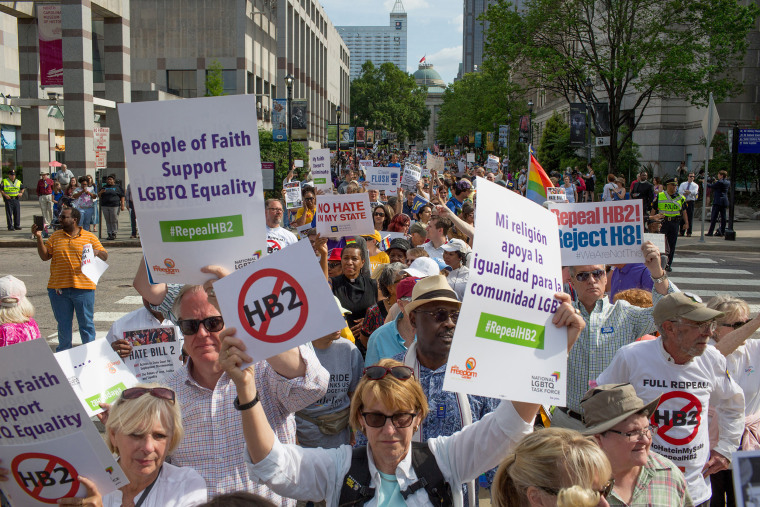
Demonstrators call for the repeal of HB2 in Raleigh, North Carolina on April 25, 2016.Jill Knight / Raleigh News and Observer/TNS via Getty Images
The three bills that passed so far are similar, though the Carrboro and Hillsborough ordinances carry a $500 penalty for violation and, according to their text, “Each and every day during which such discrimination continues shall be deemed a separate offense.” Officials in Orange County and the city of Durham are expected to vote on nondiscrimination measures Tuesday, and the Greensboro City Council is expected to discuss a similar ordinance in the coming weeks.
Advocates say it’s been a long time coming.
“We’ve been talking with elected officials since well before HB2 and trying to get these kinds of progressive policies passed,” Allison Scott, director of policy and programs at the Campaign for Southern Equality, told NBC News. “So to see these actually coming up to a vote feels amazing.”
People who live in the municipalities that pass these ordinances will not only be protected on the local level from discrimination based on sexual orientation and gender identity — but also based on race, national origin, marital or familial status, pregnancy, veteran status, religious belief, age and disability. That’s because North Carolina is one of five states that only have statewide discrimination protections for people with disabilities, leaving LGBTQ people and other groups open to discrimination in areas where they aren’t currently protected by federal law.
Even in areas where LGBTQ individuals are protected by federal law, there may be loopholes that leave some people out. Scott cited the Supreme Court’s decision in Bostock v. Clayton County, Georgia, as an example: The landmark 2020 decision ruled that LGBTQ people are protected under federal civil rights law from employment discrimination, but this doesn’t include individuals who work at small businesses with fewer than 15 employees. Those individuals, however, will now be protected from discrimination under these new local ordinances.
“It just shows the importance of why these laws are needed and why cities and counties need to step up,” Scott said.
HB2’s lasting impact
In early 2016, the Charlotte City Council passed North Carolina’s first public accommodations law protecting LGBTQ people from discrimination. The ordinance, however, drew criticism due to a clause that said transgender people would be allowed to use the bathroom that aligns with their gender identity rather than their sex assigned at birth.
Shortly after, the North Carolina General Assembly called a special session to debate the ordinance. Lee Storrow, executive director of the North Carolina AIDS Action Network, said the ordeal was disheartening to many LGBTQ people in the state.
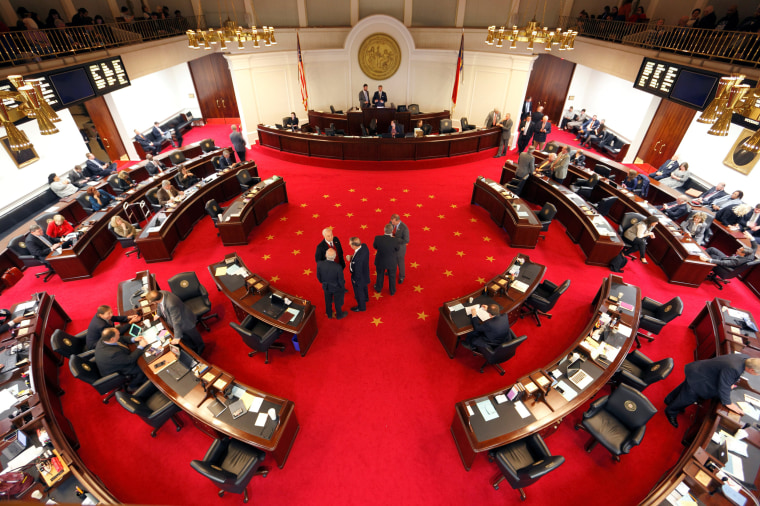
Lawmakers confer during a negotiations on the floor of North Carolina’s State Senate chamber as they meet to consider repealing the controversial HB 2 law, Dec. 21, 2016.JONATHAN DRAKE / Reuters
“That whole debate was just really hard to be a part of,” said Storrow, who has lived in Chapel Hill since 2007. “Because of the debate in 2016, people are so aware that they’re not protected, and it may not be that they have a specific moment where they’ve directly been discriminated against, but just the threat and knowing that they have no legal protections, that really has an impact on folks.”
In March 2016, just a few weeks after Charlotte passed its nondiscrimination ordinance, then-Gov. Pat McCrory, a Republican, signed into law HB2, or the Public Facilities Privacy and Security Act.
When the General Assembly did finally repeal HB2 the following year, municipalities still weren’t allowed to pass their own nondiscrimination measures. While advocates have waited for the moratorium to expire, LGBTQ North Carolinians have continued to face discrimination, they say.
“Just this month, someone in our network reached out about a person who was denied gender-affirming care who works for the state,” Kendra Johnson, executive director of Equality North Carolina, said.
The statewide LGBTQ advocacy group also received calls during the election about people being “policed around their identity, because their name does not match what the particular poll worker thought they should look like if they had a certain gender marker on their ID,” according to Johnson.
“It’s every single month we hear cases of discrimination,” Johnson added. “I know that these measures are necessary because we don’t have comprehensive nondiscrimination in the state, and we do not have it on the federal level, so we have to start where people live and work, and that’s cities and towns.”
The end of the moratorium means municipalities can start passing their own nondiscrimination ordinances, but there are limits. Scott said there’s a clause in HB142 that gives only the General Assemblythe power to legislate bathrooms and public changing facilities.
“That’s why we still need a full repeal of 142,” she said. “We know fully 67 percent of North Carolinians, a supermajority, believe that LGBTQ people should be protected from discrimination.”
‘A sense of relief’
After Carrboro passed its ordinance Tuesday, Mayor Lydia Lavelle said it reminded her of how she felt when same-sex marriage became legal.
“It’s kind of like, ‘About time,’” she said. “I’m feeling like it was long overdue.”
North Carolina will join 47 other states that either have statewide protections for LGBTQ people or allow cities and counties to create their own protections, according to Lavelle, who is a law professor at North Carolina Central University.
“We were an outlier before,” she said. “We’re joining the strong, strong majority of states that allow communities to do this.”
Tiz Giordano, who works in Carrboro, said they’re “elated” that the town passed discrimination protections for LGBTQ people.
“I’ve been able to build queer community, have chosen family and live in safety as my true self due to living in Carrboro and working in an affirming workplace,” they said. “I just want other queer and trans people to be able to feel this way and feel protected, especially in medical settings.”
Though Carrboro is a relatively progressive community, Giordano said their spouse has faced medical discrimination in the past. Under the new ordinance, hospitals and physicians’ offices will be considered public accommodations and LGBTQ people will be protected.
“Knowing that people will be able to have a case in court if they are being discriminated against definitely gives me a sense of relief,” Giordano said.
Vanity Reid Deterville, program director of the LGBTQ Center of Durham, said nondiscrimination laws at any level of government are especially important after the Trump administration rolled back certain federal protections for LGBTQ people over the last four years.
“Protections of any sort when it comes to the LGBT community — and, more specifically, queer and trans Black women, people of color — is critical,” she said, pointing to their level of marginalization in society.
Johnson said she’s confident the newly passed ordinances will help better protect LGBTQ people in the state, but she said she’s also happy to see elected officials coming together to do something for their constituents.
“I think we’re in a moment where there’s been a real ‘us versus them’ mentality coming from the White House down,” she said. “It’s nice to see elected officials recognizing that yes, there is discrimination, people should have the right to pursue their livelihood, to have housing, to not be discriminated [against] in health care and to be treated as equal and valuable citizens of towns, and acting to actually start to make that a reality.”
The Lincoln Project co-founder John Weaver has resigned from the group after admitting to sending sexually inappropriate messages to several men online.
The veteran strategist, who has a wife and children, is accused by at least 30 young men of dangling his political connections and access to high-profile job opportunities “in an attempt to receive sexual favours,” according to aForensic News report.
Weaver later issued a statement apologising in full for his actions while coming out as gay.
“To the men I made uncomfortable through my messages that I viewed as consensual mutual conversations at the time: I am truly sorry,” he told Axios. “They were inappropriate and it was because of my failings that this discomfort was brought on you.”
“The truth is that I’m gay,” Weaver added. “And that I have a wife and two kids who I love. My inability to reconcile those two truths has led to this agonising place.
“I have the most beautiful, loving and courageous family who I deceived all these years. I don’t deserve you. But I love you with all my heart and I’m sorry that you have to suffer for my mistakes.”
The Lincoln Project started in 2019 as a coalition of Republican operatives, including Kellyanne Conway’s husband, George Conway, who united to help prevent Donald Trump’s re-election.
The group gained a reputation for its viral memes bashing Trump and his administration, including billboards in New York City mocking Ivanka Trump and Jared Kushner.
Weaver, 61, became one of the most prominent members of the group – until earlier this week, when allegations of his inappropriate behaviour began to surface.
Forensic News claimed that at least 30 individuals had come forward, accusing Weaver of sending them unsolicited pictures, flying “politically-ambitious men to his location for massages,” and offering jobs in exchange for sexual relations.
The men were reportedly aged between 19 and 28, and most indicated that they were in college or had recently graduated and were looking for jobs in politics. The crux of the complaints levied by the men is that Weaver used his position of power to exploit them as they were beginning their careers.
While Weaver said he took “full responsibility” for the inappropriate messages and conversations, he attributed the emergence of the allegations to critics’ animosity for the Lincoln Project.
“I want to state clearly that the other smears being levelled at me by Donald Trump’s enablers as a way to get back at the Lincoln Project for our principled stand for democracy are categorically false and outrageous,” he asserted.
A spokesperson for The Lincoln Project said simply: “John’s statement speaks for itself.”
A Republican lawmaker in Montana has introduced a pair of bills targeting transgender youth.
House Bill 112, authored by state Rep. John Fuller, requires athletic teams at all public educational institutions — from elementary schools to colleges — to be designated based on “biological sex.” The measure, also known as the Save Women’s Sports Act, would prohibit transgender students from joining teams that match their gender identity, no matter how long ago they transitioned.
“Athletic teams or sports designated for females, women, or girls may not be open to students of the male sex,” it reads in part.
Montana Rep. John Fuller of Whitefish (R-HD8).Montana State Legislature
Fuller told Montana Public Radio that, as a former women’s soccer coach, he believes allowing transgender girls to play on women’s teams is unfair. His bill would allow students to sue if they feel they’ve been deprived or harmed in some way by a trans athlete participating in school sports.
“I want to protect and defend women’s sports,” he told the Helena Independent Record. “I believe this continued practice of allowing males to compete as females … is egregious and wrong.”
Another bill, also penned by Fuller, would bar health care professionals from providing transgender minors certain transition-related care.
Under House Bill 113, also known as An Act Providing for Youth Health Protection, physicians and other medical professionals are prohibited from treating gender dysphoria in minors by prescribing, providing or administering puberty-suppressing drugs or cross-sex hormones (including estrogen and testosterone); performing gender-reassignment surgery; or removing “any otherwise healthy or nondiseased body part or tissue.” Penalties for providers who violate the law would include fines of up to $50,000.
Fuller said it was “deeply wrong” for young people to undergo such procedures, according to Montana Public Radio. “We don’t let children do all kinds of things,” he told the Helena Independent Record. “Why should we allow this to happen? The state has a vested interest to protect children from such barbaric behavior.”
Fuller did not respond to a request for comment from NBC News.
Chase Strangio, deputy director for transgender justice at the American Civil Liberties Union, said that after the fallout from North Carolina’s House Bill 2, conservatives pivoted away from so-called “bathroom bills” toward legislation targeting trans youth.
“After the marriage decision, there was an immediate backlash on trans people using the bathroom — you saw dozens of these bills,” Strangio told NBC News. “Then you see the extremely affirming response — from companies, from the NCAA — and between 2017 and 2019 they lose the bathroom fight. There’s no more laws, they lose their court fights and they lose ballot initiatives.”
In 2018, Montana’s own bathroom bill garnered less than half of the 25,000 signatures needed to qualify for a state referendum.
Then, in 2019, Juniper Eastwood, a student at the University of Montana, became the first transgender runner to compete at the Division I level. That, according to Strangio, is “when conservatives start shifting to sports.”
“They start forming this narrative about trans student athletes that appears on Fox News, Breitbart, the Daily Caller. It attracts some cis women groups who were worried about female athletes,” he said, using a shortened term for the word cisgender, which means nontransgender.
That same year, Strangio said, a highly publicized custody battleinvolving a 7-year-old transgender girl in Texas became “another right-wing media moment.”
“By summer 2020, you have the Alliance Defending Freedom and the Heritage Foundation drafting these model trans-youth bills,” he added. “They’re not constituent-led. They’re put together by well-funded right- wing groups and shipped out to state legislatures. And they play on people’s fears and misconceptions.”
In 2020, the Michigan-based American Principles Project spent $4 million on political ads denouncing transgender athletes and access to gender-affirming health care for people under 18.
In addition to Montana, at least six other states — including Alabama, Indiana, New Hampshire, Mississippi, Missouri and Utah — are currently considering bills levying criminal or civil penalties for offering transition care to minors, according to the ACLU.
Lawmakers have sponsored legislation restricting transgender students from sports participation in at least 12 states, including Alabama, Georgia, Idaho, Indiana, Kentucky, Missouri, Montana, New Hampshire, North Dakota, Oklahoma, Tennessee and Washington. Only Idaho’s bill has passed so far.
Idaho’s House Bill 500, the Fairness in Women’s Sports Act, was signed by Republican Gov. Brad Little last March. A month later, Lindsay Hecox, a transgender student athlete at Boise State University, filed a lawsuit challenging the law. After a lower court issued an injunction against enforcement, HB 500 is now before the 9th U.S. Circuit Court of Appeals.
In a friend-of-the-court brief, nearly 200 elite female athletes — including Billie Jean King, Megan Rapinoe and Candace Parker — argued HB 500 “flies in the face of bedrock principles of equality and diversity in sports.”
“The global athletic community grows stronger when we welcome and champion all athletes — including LGBTQI+ athletes.” King said in a statement.
Strangio said Montana’s HB 112 is practically “a carbon copy” of Idaho’s law.
Readings for both Montana bills were rescheduled from Wednesday to Jan. 20 to allow for public comment. Republicans, who currently control both chambers of the Montana state Legislature, will have until April to pass the measure this legislative session.
On Thursday, more than 150 state nonprofits, businesses and professional groups joined the organization in opposing Fuller.
“Make no mistake: these bills target and attack trans youth and will cause them serious and lasting harm,” ACLU of Montana Executive Director Caitlin Borgmann said in a statement. “We cannot let fear mongering and lies about what it means to be transgender result in laws that would stigmatize trans youth, harm families and communities, and drive businesses away from Montana.”
Bozeman restaurateur Pete Strom pointed to the economic toll HB 112 and 113 could take by recalling the fallout from North Carolina’s HB2 “bathroom bill.” In 2016, North Carolina lost an estimated $630 million in economic activity related to HB2, according to Forbes.
“Montana doesn’t need that,” he said in a statement. “It’s simply common sense to oppose these out-of-touch and harmful anti-trans bills.”