In a first-of-its-kind poll, a new survey from YouGov and Out magazine found that LGBTQ+ voters favor the Massachusetts Senator by a nearly 2-to-1 margin over her Democratic rivals in the 2020 primary race.
In an online survey of 816 likely voters conducted between November 11 and November 18, 31 percent claimed that Warren is their preferred candidate, followed by Vermont Senator Bernie Sanders (18 percent), former Vice President Joe Biden (16 percent), and South Bend, Indiana Mayor Pete Buttigieg (14 percent).
Further down the list, California Senator Kamala Harris came in at six percent, while New Jersey Senator Cory Booker (three percent), entrepreneur Andrew Yang (two percent), Minnesota Senator Amy Klobuchar (two percent), and former HUD Secretary Julián Castro (two percent) also polled in the single digits.
The US Social Security Administration is facing legal action, after refusing to approve survivor’s benefits for a woman whose same-sex partner died before they could legally marry.
Helen Thornton, of Washington, was with her partner Marge Brown for 27 years. The couple raised a son together, and Thornton served as Brown’s carer for three years before her death from cancer in 2006.
However, as Brown died before same-sex marriage became legal in the state, the US Social Security Administration refuses to recognise their relationship – denying Thornton, who is now 64, access to survivor’s benefits that a heterosexual spouse would be entitled to from age 60.
On Thursday, LGBT+ law firm Lambda Legal asked a federal court to override the decision to deny benefits to Thornton and to end discrimination against other same-sex surviving partners who were barred from marriage.
‘We cared for each other in sickness and in health’
Thornton said: “Margie and I were fortunate to share 27 years of love and commitment together on this earth.
“Like other committed couples, we built a life together, formed a family, and cared for each other in sickness and in health.
“Although we wanted to express our love for each other through marriage, discriminatory laws barred us from doing so before Margie’s death.
“Now, in my retirement years, I’m barred from receiving the same benefits – essential to my financial security – as other widows, even though Margie and I both worked hard and paid into the social security system with every paycheck.”
Social Security Administration ‘systemically discriminates’ against same-sex couples
Social Security rules stipulate that couples must have been married for at least nine months to qualify for survivor’s benefits – which excludes people who were in committed same-sex relationships before it was legal for them to marry.
Thornton’s lawyers told the US District Court for the Western District of Washington that the policies result in unconstitutional discrimination.
Helen Thornton and her late partner Marge (Courtesy Lambda Legal)
Lambda Legal counsel Peter Renn said: “By requiring same-sex couples to have been married at a time when that was impossible for them under state law in order to access survivor’s benefits, the Social Security Administration is now doubling down on unlawful discrimination that continues to harm surviving same-sex seniors every single month they are deprived of the benefits for which they paid.
“Helen and Marge were together for 27 years. They built a home, raised a child, and paid into Social Security like any committed couple. But because they couldn’t marry, Social Security is denying Helen the essential survivor’s benefits that she and Marge paid for.
“Heterosexual surviving spouses are able to count on the critical financial protection of survivor’s benefits after the death of their loved ones, but SSA casts surviving same-sex partners like Helen aside, even though they paid the same lifetime of contributions from their paychecks.”
Max Richtman of the National Committee to Preserve Social Security and Medicare said: “Same sex partners should not be denied Social Security survivor’s benefits when discriminatory laws prevented them from getting married in the first place.
“Basic fairness demands that they receive the same benefits as married couples. It’s long past time to right this wrong.”
While large cities in blue states — like New York and San Francisco — are well known for their LGBTQ inclusivity, accepting environments can now be found across the country, even in some unexpected places.
The Human Rights Campaign’s annual Municipal Equality Indexrated more than 500 cities and towns based on how inclusive their municipal laws, policies and services are of the LGBTQ people who live and work there. Each municipality was rated on a scale of 0 to 100 based on 49 different criteria including nondiscrimination laws and “city leadership’s public position on equality.”
This year’s report heralded 88 cities with a perfect score of 100, and many of the index’s high-scoring municipalities can be found in states not typically thought of as being inclusive to lesbian, gay, bisexual, transgender and queer people.
Here are 11 small cities (less than 200,000 residents) in red states (those that haven’t voted for a Democrat for president in the 21st Century) that scored at least an 80 on HRC’s Municipal Equality Index.
The Midwestern town is home to the University of Missouri and has a bustling nightlife scene with a multitude of gay-friendly spots. The city’s MEI score has risen sharply since 2015 when it received a 74, in large part due to city initiatives like the hiring of a LGBTQ liaison to its police department.
–
Missoula, Montana
MEI score: 100, Population: 73,000
Autumn in Missoula, Mt.akpakp / Getty Images
For six years, representatives in the mountain state of Montana fought to decriminalize consensual same-sex relations, which was formerly classified as a felony. The law was ruled unconstitutional in 1997, and Missoula has continued to advocate for the equal rights of its LGBTQ citizens since. Last year, the town unveiled a rainbow crosswalk that was planned by Empower Montana’s youth program, Youth Forward.
–
Brookings, South Dakota
MEI score: 100, Population: 24,000
Main Street in Brookings, S.D.Jon Platek
After Brookings received a score of 12 out of 100 in 2013, local leaders embarked on a multiyear mission to bump their rating to 100. It wasn’t until 2018, when the town adopted a nondiscrimination ordinance, that it finally achieved the coveted score. Brookings is an outlier in South Dakota, where the average MEI score is 31, well below the national average of 58.
–
Huntington, West Virginia
MEI score: 100, Population 47,000
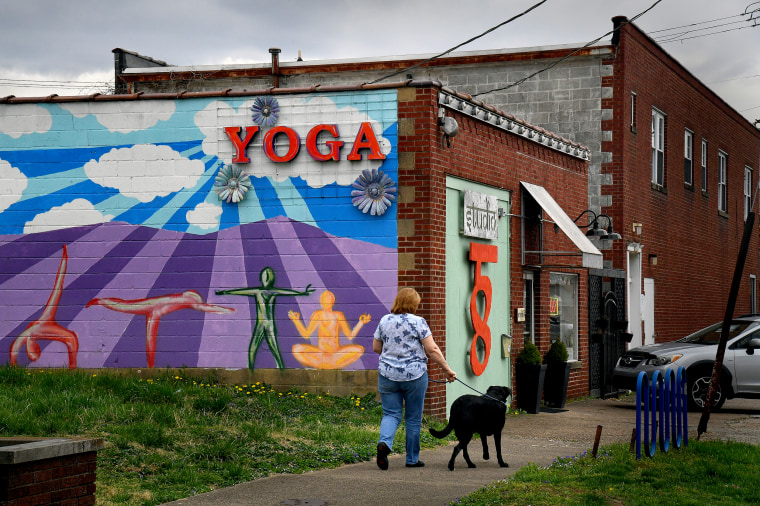
A yoga studio in Huntington, W.V., on April 5, 2019.Michael S. Williamson / The Washington Post via Getty Images file
Since Huntington was first placed on the index in 2012, the small town has more than doubled its MEI score. Aside from anti-discrimination ordinances, the city also launched the Open for All campaign, which encourages businesses to post a sticker that signifies their support of the LGBTQ community. The Human Rights Campaign called the town a “shining beacon of hope” in a part of the country not known for LGBTQ inclusivity.
–
Covington, Kentucky
MEI score: 94, Population: 40,000
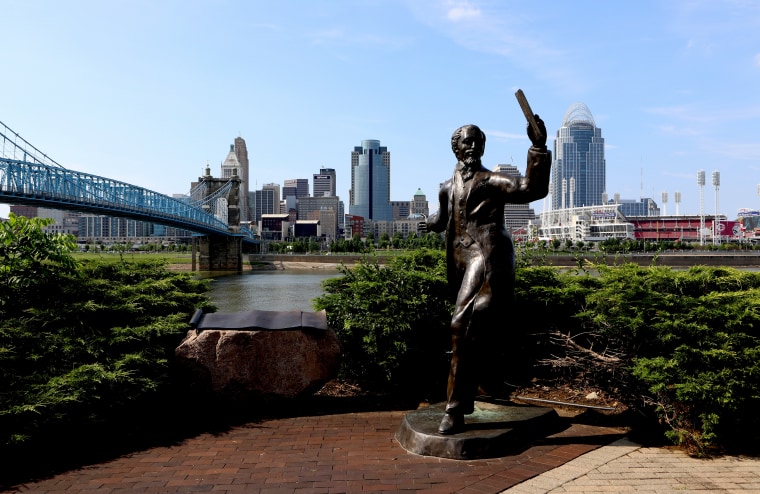
The riverfront in Covington, Ky., in 2017.Raymond Boyd / Getty Images file
In 2003, Covington passed one of the state’s first fairness ordinances, which prohibited LGBTQ discrimination in employment, housing and public accommodations. This year, the city celebrated Northern Kentucky Pride’s 10-year anniversary with a vibrant rainbow crosswalk. The annual pride event’s slogan reads “Y’all Means All.”
–
Norman, Oklahoma
MEI score: 92, Population: 123,000
The Gaylord Family Oklahoma Memorial Stadium in Norman on Nov. 9, 2019.Brian Bahr / Getty Images file
Norman, home of the University of Oklahoma, became the first city in the conservative state to pass a nondiscrimination ordinance for LGBTQ people. Norman’s progressive policies toward gay residents is evident in it’s index score, which is 30 points above the second-highest ranked Oklahoma city in the index.
–
Charleston, West Virginia
MEI score 91, Population 45,000
The Elk City historic district in Charleston, W.V.Michael S. Williamson / The Washington Post via Getty Images file
The capital and most populous city in West Virginia has moved to improve the lives and rights of its local LGBTQ community. In May, Mayor Amy Shuler Goodwin announced the creation of the city’s first LGBTQ working group, which will develop anti-bullying policies and LGBTQ-awareness training within the city.
–
Flagstaff, Arizona
MEI score: 88, Population: 72,000
The desert near Flagstaff, Arizona.Steve Smith / Getty Images
Nestled next to ponderosa pine forests and mountain ranges, Flagstaff is particularly inclusive to the LGBTQ community. The city is home to Pride in the Pines, an annual LGBTQ celebration that has featured neon dance parties and performers from “RuPaul’s Drag Race.”
–
Juneau, Alaska
MEI score: 86, Population 32,000
Coastal mountains and houses in Juneau, Alaska.Sergi Reboredo / Universal Images Group via Getty Images file
Juneau is home to the Southeast Alaska LGBTQ+ Alliance, also known as SEAGLA. The group began meeting in 1980 and offered a safe space to same-sex couples, with events that included dance parties, solstice celebrations and potlucks. In 2014, SEAGLA planned Juneau’s first pride event, and the organization has continued to meet and advocate for the LGBTQ community since it’s inception.
–
Manhattan, Kansas
MEI score: 83, Population: 54,000
The Kansas State Wildcats marching band during a game at the Bill Snyder Family Stadium in Manhattan on Oct. 26, 2019.Icon Sportswire / Icon Sportswire via Getty Images file
Kansas made strides toward equal protections this year, with the state’s MEI score increasing by 12 points. Manhattan is the second-highest rated city behind Overland Park, a much larger suburb of Kansas City. Kansas State University is in Manhattan and was recently ranked as one of the 25 most LGBTQ friendly universities in the U.S. by Campus Pride.
An Indiana University professor blasted by his employer for “sexist, racist, and homophobic” views penned a lengthy response to detractors, reiterating his notions that gay men should not be K-12 teachers and that women could indeed be “sluts.”
Eric Rasmusen, a 60-year-old business and economics professor at Indiana University’s Kelley School of Business, created a web page to respond to what he called “the 2019 kerfuffle in which the Woke crowd discovered” his social media posts and other comments.
He also responds directly to the university’s executive vice president and provost, Lauren Robel, who earlier this week slammed his views while also saying they constitute free speech protected by the First Amendment.
“Professor Eric Rasmusen has, for many years, used his private social media accounts to disseminate his racist, sexist, and homophobic views,” Robel said in her statement. “I condemn, in the strongest terms, Professor Rasmusen’s views on race, gender, and sexuality, and I think others should condemn them.”
But she said that “is not a reason for Indiana University to violate the Constitution of the United States.”
Kelley School of Business Dean Idie Kesner also posted an open letter to students and staff, criticizing Rasmusen but defending the school’s stance: “While many have called for the professor’s dismissal, there are legal reasons why the University cannot dismiss him over his postings. Like all of us, Professor Rasmusen has First Amendment rights.”
“I open doors for ladies; I say that sodomy is a sin. I am sure that is enough to qualify me for those insults under the Provost’s personal definitions,” the professor said.
He also touched upon some of his views that have drawn criticism.
On alleged sexist slurs: “Is ‘slut’ a slur against women? Not at all. It is a slur against certain women, against a minority of women, and for them it is a justified slur, a descriptive one. A women who sleeps with 100 men in a year is a slut.”
On whether gay men should be teachers: “Homosexuals should not teach grade and high school,” Rasmusen said. But he says he’s OK with them teaching college. “Professors prey on students too, so there is a danger, but the students are older and better able to protect themselves, and there is more reason to accept the risk of a brilliant but immoral teacher.”
On affirmative action: The professor said affirmative action may be right or wrong. “What is clear is that *some* students are admitted because of their race — which means that other students are denied because of their race, since we have a fixed number of spots.”
Rasmusen also said he strives for views that stand the test of time. “What I aim for is a view that stands up to both the 18th century and 21st century critiques, not to mention 1st-century, and to critiques from ancient China as well as ancient Greece. The Provost is taking the opposite tack here, saying that we should not care about what other cultures and times think of our views, only what people in 2019 think.”
The recent attention to Rasmusen was sparked by his Nov. 7 retweetof an article, “Are Women Destroying Academia? Probably.” Rasmusen prefaced the tweet by saying, “Geniuses are overwhelmingly male because they combine outlier high IQ with moderately low Agreeableness and moderately low Conscientiousness.”
Robel said in her statement that while the university will not try to fire Rasmusen, it will take steps to ensure that “students not add the baggage of bigotry to their learning experience.”
No student will be required to take any of his classes, Robel said. In addition, she said he will have to use double-blind grading on assignments to “ensure that the grades are not subject to Professor Rasmusen’s prejudices.”
In a rule change announced on Friday, November 1, the Trump administration said that health programmes receiving grants from government Department of Health and Human Services (HSS) would no longer have to abide by nondiscrimination guidelines protecting LGBT+ people.
The Trump administration changed the regulations in the name of “religious freedom”, and it would also apply to abortions, contraception, gender confirmation surgery, or any other services or people healthcare providers might disagree with “on moral or religious grounds”.
This week, US district judge William Alsup of the Northern District of California joined two other judges in writing off Trump’s new rule.
Alsup wrote in his decision: “Under the new rule, to preview just one example, an ambulance driver would be free, on religious or moral grounds, to eject a patient en route to a hospital upon learning that the patient needed an emergency abortion. Such harsh treatment would be blessed by the new rule.”
He added: “When a rule is so saturated with error, as here, there is no point in trying to sever the problematic provisions. The whole rule must go.”
According to Instinct, Jamie Gliksberg of Lambda Legal which represented the plaintiffs said in a statement: “That is now three judges in two weeks who have recognised the Denial of Care Rule for what it is, an egregious and unconstitutional attack on women, LGBT people and other vulnerable populations.”
Two federal judges have already blocked Trump’s rule allowing discrimination against LGBT+ people in healthcare.
Donald Trump and the White House had claimed the religious protections were introduced following a “significant increase” in complaints from hospital workers who were being forced to violate their faith by treating LGBT+ patients – but Engelmayer ruled that this was “factually untrue”.
According to Advocate, the next day judge Stanley Bastian of Washington announced that he would also rule against the Trump administration in a lawsuit brought by Washington state.
Washington state attorney general Bob Ferguson added in a press release: “This rule would have disproportionately harmed rural and working poor Washington families, who have no alternatives to their local health care providers, as well as LGBTQ individuals, who already face discrimination when they seek medical care.”
The American Medical Association on Tuesday voted to support state and federal efforts to ban gay conversion therapy, throwing the weight of America’s medical establishment behind ending the scientifically discredited practice of attempting to change a person’s sexual orientation or gender identity.
“It is clear to the AMA that the conversion therapy needs to end in the United States given the risk of deliberate harm to LGBTQ people,” AMA board mMember Dr. William E. Kobler said in a statement shared with NBC News. “Conversion therapy has no foundation as scientifically valid medical care and lacks credible evidence to support its efficacy or safety.”
Speaking on background, an AMA official said Tuesday’s directive means that AMA will produce model legislation banning conversion therapy that can be distributed to state-level organizations, since medical licensing happens at the state level, while simultaneously working on a federal effort.
In August, a study found that 200,000 transgender people in the United States have been exposed to conversion therapy at some point in their lives. A September study of 27,000 transgender peoplefound that those who were exposed to these efforts before the age of 10 were four times more likely to report a suicide attempt in their lifetime versus trans people who were never subjected to efforts to change their gender identity.
Currently, 18 states and the District of Columbia ban conversion therapy for minors, according to the Movement Advancement Project, a think tank focused on LGBTQ issues. And recently, New York City hurried to repeal its conversion therapy ban because it prohibited the practice for minors and adults — who, as discredited as the practice is, may be entitled under free speech protections to pursue the therapy for themselves.
“Historically, medical professionals have contributed to the stigmatization of LGBTQ individuals, so the AMA’s active involvement in LGBTQ health advocacy is incredibly important,” Dr. Alexis Chavez, medical director for the nonprofit Trevor Project, said in a statement. “The AMA’s support for ending conversion therapy furthers the work that The Trevor Project is doing across the country with our 50 Bills 50 States campaign to protect LGBTQ youth from this dangerous and discredited practice.”
The AMA also endorsed the creation of electronic health records that are inclusive of LGBTQ people.
“The newly amended policy now supports the voluntary inclusion of a transgender patient’s preferred name and clinically relevant sex specific anatomy in medical documentation,” the AMA said in Tuesday’s statement.
“Without this information, transgender patients and their specific health care needs cannot be identified or documented, the health disparities they experience cannot be addressed, and the provision of important health care services may not be delivered,” Kobler stated.
Chavez said the electronic health record change “can help reduce the 50 percent of transgender individuals who delay seeking necessary health care because of legitimate fears of discrimination.”
The AMA also endorsed a policy that encourages medical accreditation bodies “to both continue to encourage and periodically reassess education on health issues related to sexual orientation and gender identity in the basic science, clinical care and cultural competency curricula in medical school and residency programs.”
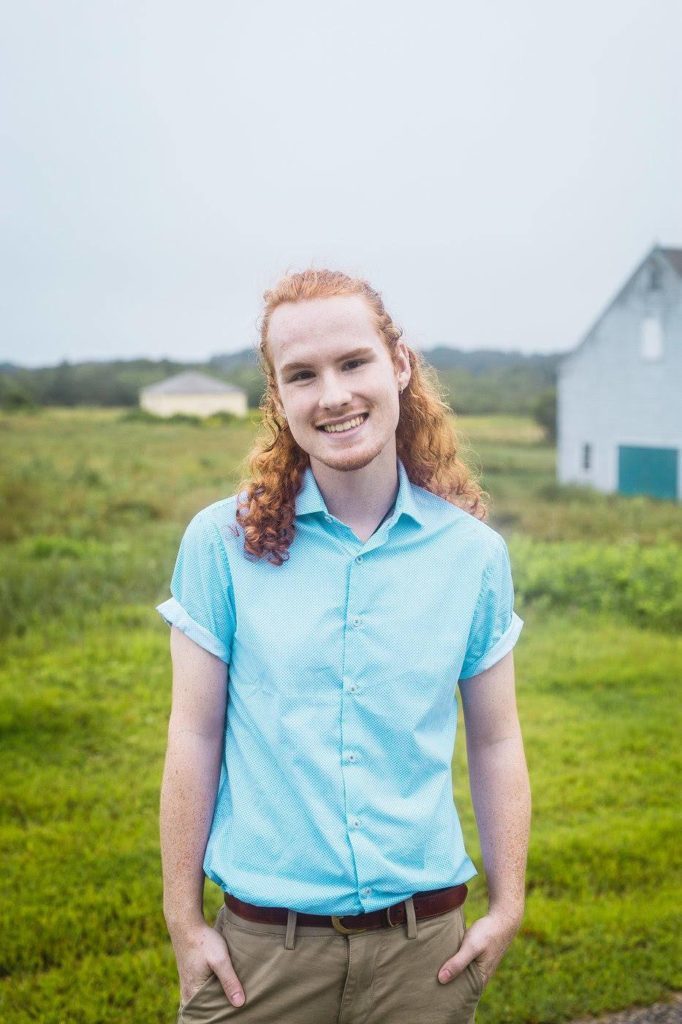
A gay 19-year-old from a small town in Maine has become one of the youngest elected officials in the US, after winning a spot on the city council.
Keagan Roberts took home the second-largest share of the votes for a seat on the South Berwick Town Council, which serves a town with a population just shy of 7,500 people.
Roberts, whose twin brother is also gay, toldOut magazine that South Berwick is the kind of small town where “everyone knows everyone” and that it had been “such a great place to grow up” as a young gay person, after coming out in middle school.
“My school was super understanding,” he said. “I really didn’t face too much bullying, at least to my face, which was nice. I also have a twin brother who’s gay, so that kind of made high school a little bit easier. It’s amazing. I wouldn’t trade it for the world.”
The teenager said he was speechless when the results of the vote came in.
“I didn’t realise my message had touched so many people,” he said. “I was just really proud of what I was able to do and just what I was able to accomplish.”
After he is sworn in, Roberts will be the youngest-ever city council member in South Berwick’s history.
He will also be one of the youngest elected officials in the US.
Roberts’ mum is Tiffany Roberts-Lovell, the local representative in the MaineHouse of Representatives, where she has served since 2018.
He said that she taught him how to inspire people and how to run a grassroots campaign.
“My mom definitely had to coach me through, and some days were better than others,” he said. “I also work, so it’d be like, ‘Let’s go knock on 100 doors and then you can go work your shift.’ Some days I’d ask, ‘Mom, do we have to do this?’ And she said, ‘Yep, you have to do this. This is how we get votes.’”
He added that he hopes his win will inspire other young LGBT+ people to run for public office.
“I hope that it doesn’t matter how young you are, it doesn’t matter how you identify, you can do whatever you put your mind to,” he said.
New York City Comptroller Scott Stringer on Wednesday submitted a letter to HIV drugmaker Gilead Science’s board of directors demanding a shareholder “clawback” policy. The shareholder proposal, if approved by the board, would empower the board to “recoup” some of the money paid to top Gilead executives, like CEO Daniel O’Day.
Stringer, as comptroller of America’s largest city, is responsible for administering New York City’s vast pension funds, estimated in June to comprise $208 billion in investments. Acting as a fiduciary for the funds’ exposure to stocks like Gilead’s, Stringer also represents a large number of the pharma giant’s shareholders. New York City’s pension funds pay the city’s retired teachers, firefighters, police officers and other municipal workers.
The clawback, Stringer said, is in response to allegations — including those made in a class action lawsuit filed in May — that the company engaged in anti-competitive practices in order to charge “exorbitant prices” for its lifesaving HIV drugs. In particular, Gilead is accused of withholding a safer version of tenofovir from the market. Tenofovir is a family of drugs that comprises the backbone of Gilead’s multibillion-dollar suite of HIV treatment and prevention medicines, such as Stribild, Biktarvy and Truvada, which is commonly known as PrEP — or HIV pre-exposure prophylaxis.
“Ethics matter — and companies should hold their employees accountable when they commit misconduct,” Stringer said in a statement. “There is strong evidence that suggests Gilead purposefully raised drug prices to exorbitant levels — and that people living with HIV were denied the medicine they need to survive. It’s outrageous and now the company is facing long-term consequences.”
New York City’s comptroller’s office has proposed 18 clawbacks since 2014, and 11 were enacted. Stringer pointed to his office’s successful effort to recoup Wells Fargo executive pay after it was shown that the company defrauded customers by opening accounts without their knowledge.
In a statement emailed to NBC News, Gilead spokesman Ryan McKeel said the company has “received the proposal and will evaluate it.”
Part of the proposed resolution sent to Gilead’s board notes that the company “is the subject of U.S. congressional and other federal investigations alleging anti-competitive practices to prevent the entry of Human Immunodeficiency Virus (HIV) drugs into the market, and the U.S. government has sued Gilead alleging patent infringement relating to its HIV drugs.”
The proposal also alleges that Gilead worked with other companies to “unlawfully extend patent protection” and slow the entry of competitively priced generic HIV drugs to market.
“Such circumstances cause financial and reputational harm,” the proposal reads. “As long-term shareholders, we believe compensation policies should promote sustainable value creation.”
Activists with the PrEP4All Collaboration have for over a year argued that Gilead improperly claimed patent protection — and the right to set a high list price for Truvada tablets exclusively sold by Gilead — since PrEP was approved in 2012. A lawsuit filed this month against Gilead shows that the Department of Health and Human Services agrees with the PrEP4All position, and if Gilead’s patent protections are invalidated by a judge, the HIV-prevention treatment could potentially be made more widely available, a key goal of the Trump administration’s plan to end the HIV epidemic.
Peter Staley, a longtime HIV activist and a plaintiff named in the lawsuit Stringer cited in his letter to Gilead’s board, predicted the clawback resolution would fail but said he “wholeheartedly” endorses the sentiment.
“O’Day lied multiple times to Congress, and his arrogance towards the American taxpayers’ contributions to ending AIDS will cost his company dearly,” Staley said in a statement to NBC News. “Institutional stockholders of Gilead are in for a shock as Staley v Gilead and United States v Gilead play out.”
In May, Rep. Alexandria Ocasio-Cortez, D-N.Y., grilled O’Day over the high price of Truvada.
“The list price is almost $2,000 in the United States. Why is it $8 in Australia?” Ocasio-Cortez asked, after noting the company made $3 billion in revenue off the once-a-day pill in 2018.
O’Day responded that “Truvada still has patent protection in the United States, and in the rest of the world it is generic.” He noted that the drug is set to be generically available in the U.S. in September 2020.
“There’s no reason this should be $2,000 a month,” said Ocasio-Cortez, who had pushed for the hearing before the House Committee on Oversight and Reform. “People are dying because of it, and there’s no enforceable reason for it.”
A ‘Christian’ printing company in Alabama, US, has refused to print an issue of a college magazine because it contains content about LGBT+ people.
Interstate Printing representatives cite their “First Amendment Right” to refuse to print images of drag queens, queer folk, disabled students and people of various religious beliefs on the grounds of religion.
University of South Alabama magazine Due South was denied printing by the Mobile company because their latest issue, which discusses diversity, does not align with their values.
Sydney McDonald, managing editor of the student-ran publication, first broke the story on Due South on Thursday.
Defiant editors have not let themselves be detracted, however, and have sought printing from a different company instead.
Ahead of their Fall 2019 issue, Due South editors were busy approving copy and editing images. With the finished version completed, it was sent to the printers on Wednesday.
“They emailed me back and said they would be exercising their right to decline printing this issue because it does not adhere to their Christian values and they hope to print with us in the future,” said editor-in-chief Sara Boone to AL.com.
The 21-year-old added: “It’s very ironic for me because this particular issue of Due South is a special topics issue on diversity and inclusion.
“And it’s the very first special topics issue that we have ever produced.
“For them to decline printing it because it’s so diverse and the content is incredibly ironic.”
Printing company goes cold over magazine expressing ‘freedom of lifestyles’.
Rupturing the magazine’s seven year-long relationship with the printing company, Boone explained that the company had quoted $5,000 for 3,500 copies of the magazine.
“As the magazine expresses freedom of lifestyles, we must express our freedom by declining to print on the principle that we are a Christian company that does not adhere to the content,” Tracy Smith of Interstate Printing wrote in the email.
“We value the 40-plus years relationship we have with the University of South Alabama, and look forward to continuing our work with USA on other print and mail service projects.”
Interstate Printing’s front-page has a Bible verse on it. It reads: “We are a Christian company that will serve the Lord God Almighty in any way we can.”
The company aims to achieve this by printing bridal magazines or flyers for a local high-school football game, sponsored by Reece’s Pieces.
This isn’t the first time a religion printers has rejected printing material containing LGBT+ content.
In Illinois earlier this year, a print shop denied printing a queer charity’s brochure claiming it “promoted” the gay lifestyle.
A former Kentucky school principal has been indicted on child pornography charges, a decade after he first made headlines for banning books with LGBTQ storylines.
Phillip Todd Wilson, the former principal of the Clark County Area Technology Center in Winchester, Kentucky, was charged with 17 child pornography and distribution charges in August, according to Kentucky state police.
A spokesperson for the Kentucky Department of Education told NBC News that Wilson was no longer employed at the school.
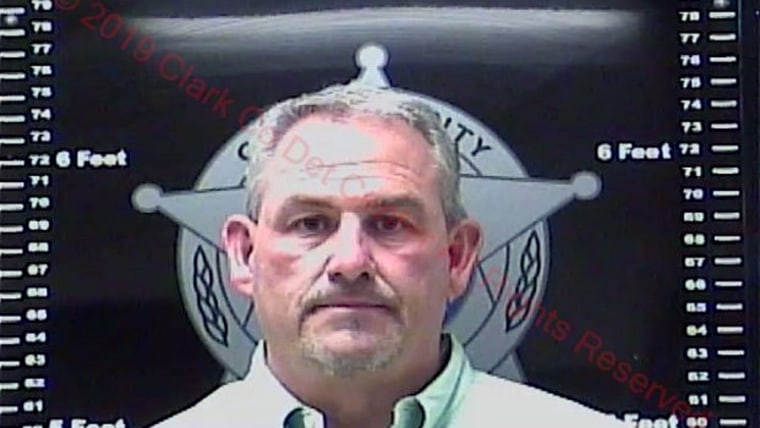
Phillip Todd Wilson.Clark County Detention Center
Wilson, 54, was the principal of the Montgomery County High School, another institution in Kentucky, 10 years ago when he banded together with other administrators to remove several young-adult novels that had been listed as optional reading in English classes. Wilson fought to ban books with “homosexual content,” as well as those that mentioned drugs, sex, child abuse and suicide, because he deemed these topics “inappropriate” for students, according to a 2009 article from The Lexington Herald-Leader.
More than half of the top 11 most frequently challenged and banned books of 2018 include LGBTQ content, according to a report by the American Library Association.
The four books that were reportedly challenged by Wilson and his associates and eventually pulled from the curriculum were “Twisted” by Laurie Halse Anderson, “Deadline” by Chris Crutcher, “Lessons from a Dead Girl” by Jo Knowles and “Unwind” by Neal Shusterman.
Though Knowles’ book is about a girl who endures sexual and emotional abuse from a female friend, Knowles said her book was banned for “homosexual content.”
“I was a very new author at the time all this happened and the press coverage was overwhelming,” Knowles, author of “Lessons from a Dead Girl,” wrote in a recent post on Facebook. “I was horrified by the accusations he and the superintendent made. And heartbroken for the brave teacher, Risha Allen Mullins, who stood up for our books and faced so much unfair criticism.”
In response to news of Wilson’s indictment, Knowles added, “As I said to some friends last night when I got the news, ‘You can’t make this sh– up.’”
Laurie Halse Anderson — whose book “Twisted” examines toxic masculinity and includes a character accused of being gay after he turns down sex with a girl who is too intoxicated to consent — also took to Twitter after learning about the charges against Wilson.
“Books that help kids examine the violence, abuse and shame they’ve endured are very threatening to the people who commit those acts of violence, abuse, and shaming,” she wrote.