Dan Bishop, the North Carolina legislator and lead sponsor of the notorious ‘bathroom bill’, has won a congressional seat in a narrow victory over his Democratic opponent.
A special district election was held as the 2018 election was nullified due to allegations of voter fraud on behalf of the Republican candidate Mark Harris, an anti-LGBT+ minister.
Harris stepped down and Bishop ran in his place with a campaign supporting Trump’s border wall, gun ownership, Christian values and a ban on late-term abortions.
Bishop won the Republican stronghold by just under two points – 50.6 percent to 48.8 percent – having gained supporters in the staunchly Conservative state over his backing of the ‘bathroom bill’.
Also known as HB2, the bathroom bill was signed into law in North Carolina in 2016, forcing trans people to use toilets in accordance with the gender marked on their birth certificate.
The legislation was widely denounced as discriminatory and prompted a huge backlash from businesses and celebrities, including Ringo Starrand Bruce Springsteen.
A federal lawsuit was launched by civil rights groups,and the law was struck down in July this year with a judge ruling that trans and non-binary people in North Carolina must be allowed to use the public bathrooms of their choice.
The Human Rights Campaign and CNN will host Power of Pride, a Democratic presidential town hall focused on LGBTQ issues in October.
The town hall will take place on Thursday, October 10, the night before the 21st annual National Coming Out Day, at The Novo in Los Angeles. It will air live on CNN. Confirmed participants will include former Vice President Joe Biden, Mayor Pete Buttigieg, former Secretary Julian Castro, Senator Kamala Harris, Senator Amy Klobuchar and Senator Elizabeth Warren.
This marks the first time a Democratic presidential town hall will be devoted solely to LGBTQ issues and will be the first time a major cable news network will air a presidential event focused on LGBTQ issues.
HRC President Alphonso David said in a statement: “For nearly 40 years, the Human Rights Campaign has fought to realize a world in which LGBTQ people are safe, equal and free in every aspect of our lives. Today, at a time when our most basic civil rights and democratic values are under attack, our work has never been more urgent. We are eager to hear from this field of Democratic presidential candidates about how they plan to win full federal equality, defend the fundamental equality of LGBTQ people, and protect the most vulnerable among us — both here in the United States and around the globe — from stigma, institutional inequality, discrimination, and violence.”
The audience will include HRC members, supporters and community leaders. Tickets are invitation only.
A woman accused of hacking Capital One and at least 30 other organizations is a flight risk, a threat and should be kept locked up until her trial, U.S. prosecutors said in court documents filed ahead of a Friday detention hearing in Seattle.
Paige Thompson, a former Amazon software engineer who goes by the online alias “erratic,” has a history of stalking and threatening to kill people and to get herself killed by police, prosecutors said in the documents.
Police in Mountain View, California, said she also threatened to shoot up an undisclosed company in May, while she was living with a convicted felon who had a stockpile of pistols, rifles and ammunition.
Lawyers for Thompson, a 33-year-old transgender woman, denied that she is violent and said she should be released to a halfway house where she would have better access to mental health care. Citing a doctor, they say her safety is at risk in the male facility.
“The risk of being continuously misgendered and becoming a target for intimidation by other inmates is likely increased in a male facility,” Dr. Matt Goldenberg wrote.
Authorities say Thompson previously has been the subject of an extreme risk protection order due to mental illness issues. State red flag laws permit police or family to petition a court to remove firearms from a person deemed to be a danger to themself or others.
“In today’s America, it is easy enough to obtain firearms, and there is every reason to be concerned that Thompson, who repeatedly has threatened to kill, would obtain the means to carry out … her threats – particularly when confronted with the alternative of near-certain conviction and imprisonment,” prosecutors said in their motion.
Thompson was charged in July with accessing personal information on 106 million Capital One credit card holders earlier this year.
The financial corporation said among the information obtained by the hacker was 140,000 Social Security numbers and 80,000 bank account numbers. It said no credit card account numbers or log-in credentials were compromised.
The breach was among the largest on record involving a major U.S. financial institution. Thompson had talked about the hack online in chat groups, authorities say.
At least 40 lawsuits have been filed in the U.S. against Capital One following the breach, saying it failed to protect consumers. Eight other suits were filed in Canada.
Seattle police were granted the risk order against Thompson in May 2018. Four months later, two of Thompson’s former friends secured a protection order against her, saying she had stalked and harassed them.
Sarah Stensberg told police that Thompson left voice messages and several text messages, including one that listed Stensberg’s address and read, “rest in peace.” Stensberg said Thompson also stalked her on social media.
In May, Thompson focused on a California social media business and sent a series of Twitter messages to a former Amazon co-worker, according to police.
“I feel bad, when my cat dies, I’m going to California to shoot up (REDACTED) office I hope you are not there,” the message said. “Sorry. But it has to be done.”
The message continued: “I like you but I can’t let you stand in the way of what has to be done.”
The person responded, police said, and Thompson wrote back: “maybe spd could do something kind and come over and shoot me.”
Mountain View police sought help from Seattle police and they informed Thompson’s case manager and made a referral to a designated crisis responder.
Thompson’s lawyers said the Seattle police officer wrote in a report, “I am familiar with Paige Thompson and my unit has a response plan for her,” and found she had no means or money to travel to California.
A Kentucky print shop owner who refused to make a gay pride T-shirt argued before the Kentucky Supreme Court that he shouldn’t be compelled to promote messages that go against his religious beliefs.
Blaine Adamson is owner of Hands-On Originals in Lexington and declined to print a shirt promoting an LGBT pride festival in 2012. The city’s Human Rights Commission said that refusal violated its gay-rights fairness ordinance.
On Friday, the high court heard an attorney for the T-shirt maker argue that the First Amendment protects him from having to print that message. An attorney for the Human Rights Commission says the T-shirt maker cannot pick and choose who it wants to serve in the Lexington community.
The Supreme Court heard oral arguments from attorneys and will issue a ruling at a later date.
At least four Democratic presidential hopefuls — Joe Biden, Julián Castro, Joe Sestak and Marianne Williamson — are expected to attend an LGBTQ forum in Iowa on Sept. 20.
The event at Coe College in Cedar Rapids will be hosted by One Iowa, a statewide LGBTQ advocacy group; The Gazette, a daily in Eastern Iowa; and The Advocate, an LGBTQ magazine. The candidates will address the audience before a question-and-answer session with the three moderators, one from each of the host organizations.
Courtney Reyes, the interim director of One Iowa, said the event will “focus on LGBTQ people in the heartland and their needs.”
“The overarching narrative that LGBTQ people in the U.S. live in urban coastal areas ignores the millions of LGBTQ individuals living and working in the middle of the country,” Reyes wrote in a statement. “We look forward to hearing what the presidential candidates have to say to this often overlooked, but politically powerful community.”
Advocate Editor-in-Chief Zach Stafford said the forum will be an event where LGBTQ issues “are front and center” and will allow the community to “make clear and informed decisions about the candidates seeking our valuable votes.”
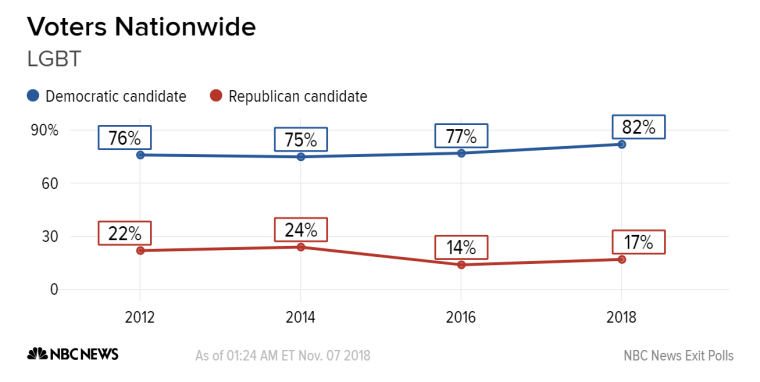
LGBTQ voters are a reliable part of the Democratic base, according to exit polls. In the 2018 midterm elections, over 80 percent of LGBTQ people said they voted for the Democrat in their local federal election, while just 17 percent voted for the Republican. And in 2016, 78 percent of LGBTQ voters said they voted for Hillary Clinton, the Democratic presidential nominee, while just 14 percent reported supporting Donald Trump.
NBC News
In addition to former Vice President Joe Biden, former Housing and Urban Development Secretary Julián Castro, former Pennsylvania Rep. Joe Sestak and author Marianne Williamson, other 2020 candidates “are expected to confirm in the coming weeks,” according to The Advocate.
The lesbian, gay, bisexual, transgender and queer community has been largely ignored in the initial Democratic presidential debates. While the campaign of Mayor Pete Buttigeig of South Bend, Indiana, the first major gay presidential candidate, has elevated the issue of LGBTQ rights more broadly, the community was only mentioned in the first debate in the context of Rep. Tulsi Gabbard of Hawaii’s prior opposition to same-sex marriage. In the second debate, Sen. Kirsten Gillibrand of New York was the only candidate to devote speaking time to LGBTQ issues.
Democratic presidential candidates have also been invited to a town-hall-style meeting at UCLA on Oct. 10, the eve of National Coming Out Day. That forum will be hosted by UCLA and the Human Rights Campaign. Additional details have not yet been released.
Lesbian political activists in the US are divided over whether they want Pete Buttigieg for president or whether they want a woman, according to Politico.
But interviews with prominent LGBT+ Democrats have shown that there is a “collision of goals and ideals in the community of lesbian political activists this year”, Politico reports.
“Mayor Pete, he’s a trailblazer,” said Campbell Spencer, a lesbian and political consultant who worked in the Obama White House and sits on the board of the LGBTQ Victory Fund – which this year endorsed Buttigieg to be president, it’s first-ever endorsement of a presidential candidate.
“But I’m one of these women who thinks we are way overdue for having a woman in the White House. That’s a lens through which I’m going to filter my decision,” Spencer added.
“It feels like a slap in the face to just go directly to the white gay guy, when for decades you’ve been trying to elect a woman and it didn’t happen last time,” said one lesbian Democrat who works in national politics. “If Pete Buttigieg is elected it won’t feel like a vindication of Hillary Clinton. If a woman is elected, it will.”
“As a woman, as a lesbian, as someone who was all in for Hillary Clinton and as someone who was a historic first myself, I would love to see a woman at the top of the ticket,” said Annise Parker, the former Houston mayor who is now president and CEO of the LGBTQ Victory Fund.
“And talking with other women inside the community and not, we understand the importance of Pete’s candidacy — but dammit, we’re half the population. It’s time” for a woman president, Parker added.
LGBT+ voters make up around six per cent of the US electorate, according to 2018 midterm election exit polls.
Buttigieg previously addressed his sexuality in a speech to LGBT+ campaigners at a Human Rights Campaign dinner in Las Vegas on May 11.
“I may be part of the LGBTQ community, but being a gay man doesn’t tell me what it’s like to be a trans woman of colour in that same community, let alone an undocumented mother of four, or a disabled veteran, or a displaced auto worker. But being gay, just like every other fact about me, means I have a story,” he said.
“And if I look to that story, I can find the building blocks not only for empathy, but for the impetus for action. The more you know about exclusion, the more you think about belonging, and we have a crisis of belonging in this country.”
Gonzalez said: “This defendant allegedly violated the sanctity and safety of this couple’s home when he showed up at their door spewing hate, then escalated it to a violent assault.”
According to the investigation, in the early morning of June 22, a man and his gender non-conforming partner were allegedly harassed by Dash outside their apartment, where he said: “I’m glad I know where you live, because I don’t like gay people.”
A 32-year-old man has been indicted on attempted murder and hate crime charges for allegedly stabbing a transgender Individual’s partner after harassing the couple outside their apartment in Bedford-Stuyvesant.
There is no place for such ignorance and intolerance in Brooklyn, where we celebrate our diversity. We will now seek to hold this defendant accountable for this very serious attack.
The stab wound in ‘hate crime’ resulted in a partial severing of the victim’s vertebral artery.
The defendant is then accused of knocking on doors until he found the apartment where the couple live, and when they answered the door he threatened them with a knife.
They said they closed the door on Dash, but later went to look for him, as they recognised him from the local area and wanted to speak with him.
As they returned to their building, Dash allegedly ran at them and began attacking them with the knife. The man was stabbed in the back of the neck, resulting in a six-inch would which partially severed the vertebral artery.
His gender non-conforming partner called 911 and he was taken to hospital. The defendant was arrested at his home on June 24.
The district attorney added: “There is no place for such ignorance and intolerance in Brooklyn, where we celebrate our diversity. We will now seek to hold this defendant accountable for this very serious attack.”
Brief falsely suggests LGBTQ people do not exist, but rather are choosing “actions, behaviors, or inclinations.”
53 members of the U.S. Senate and the House of Representatives are urging the nation’s highest court to rule against LGBTQ people when it hears three landmark cases October 8. The lawmakers, all Republicans (list below), say the Civil Rights Act of 1964 does not – and should not be interpreted to – protect gay, lesbian, bisexual, and transgender people, including their own constituents.
In a grotesque and ignorant reading of a key portion of the 55-year old legislation the Republican lawmakers suggest LGBTQ people do not exist, but rather are choosing “actions, behaviors, or inclinations,” which is false.
“Title VII’s sex discrimination provision prohibits discrimination because of an individual’s sex; it does not prohibit discrimination because of an individual’s actions, behaviors, or inclinations,” the lawmakers say in the amicus brief filed with the Supreme Court.
“What the statute actually prohibits is discrimination ‘because of [an] individual’s race, color, religion, sex, or national origin,’” the Republicans insist.
The Advocate notes the brief “demeans the plaintiffs bringing actions forward to the court,” including claiming one of the plaintiffs only claimed he was gay so he could sue for wrongful termination. It also repeatedly misgenders a funeral director who is a woman and transgender, referring to her as “he.”00:0000:44
The brief also wrongly claims a correct interpretation of the Civil Rights Act to include LGBTQ people would “adversely” affect “the protection of women’s rights.”
And in a nod to the Hobby Lobby case, the brief proclaims that the “funeral home is a closely held corporation whose principal is a Christian,” strongly suggesting it is his First Amendment right to fire someone because they are LGBT.
The friend of the court brief was co-authored by Ken Starr, the former head of Baylor University who resigned in disgrace. Starr is also known for having defended Jeffrey Epstein, for being an attorney representing supporters of California’s anti-gay Prop 8, and the infamous special prosecutor whose work led to President Bill Clinton’s impeachment.
It is unknown if taxpayer funds were used to pay for the brief.
Republican Senators who have signed the amicus brief include Marsha Blackburn, Roy Blunt, Mike Braun, John Cornyn, Kevin Cramer, James Inhofe, James Lankford, and Mike Lee.
Republican Representatives include: Robert B. Aderholt (AL-04), Rick W. Allen (GA-12), Brian Babin (TX-36), Jim Banks (IN-03), Andy Biggs (AZ-05), Ted Budd (NC-13), Michael C. Burgess (TX-26), Doug Collins (GA-09), Warren Davidson (OH-08), Jeff Duncan (SC-03), Bill Flores (TX-17), Russ Fulcher (ID-01), Louie Gohmert (TX-01), Paul A. Gosar, (AZ-04), Glenn Grothman (WI-06), Michael Guest (MS-03), Andy Harris (MD-01), Vicky Hartzler (MO-04), Jody Hice (GA-10), George Holding (NC-02), Richard Hudson (NC-08), Jim Jordan (OH-04), Steve King (IA-04), Doug LaMalfa (CA-01), Doug Lamborn (CO-05), Debbie Lesko (AZ-08), Thomas Massie (KY-04), Mark Meadows (NC-11), Alex X. Mooney (WV-02), Ralph Norman (SC-05), Pete Olson (TX-22), Gary Palmer (AL-06), John Ratcliffe (TX-04), David Rouzer (NC-07), Van Taylor (TX-03), Tim Walberg (MI-07), Mark Walker (NC-06), Randy K. Weber (TX-14), Ron Wright (TX-06), and Ted S. Yoho (FL-03).
Republican lawmakers and attorneys general on Monday submitted amicus briefs to the U.S. Supreme Court arguing that LGBTQ workers are not protected by federal civil rights law.
In two separate briefs, 48 members of Congress and 15 attorneys general argue that Title VII of the Civil Rights Act of 1964 — which bans employment discrimination on the basis of “race, color, religion, sex, or national origin” — does not protect against workplace discrimination due to a person’s sexual orientation or gender identity.
“[A]t the time Congress enacted Title VII, ‘sex,’ ‘sexual orientation,’ and ‘gender identity’ had different meanings,” the brief by the attorneys general states. “As a result, the word ‘sex’ in Title VII cannot be fairly construed to mean or include ‘sexual orientation’ or ‘gender identity.’ The Second Circuit and the Sixth Circuit erroneously conflated these terms to redefine and broaden Title VII beyond its congressionally intended scope.”
Both briefs also argue that the power to ban discrimination against LGBTQ people rests solely with Congress.
The issue of whether “sex” discrimination in Title VII is inclusive of anti-LGBTQ discrimination has caused a split in lower courts over the past several years, with some backing gay and trans workers and others the employers who have fired them.
The briefs submitted by the lawmakers and the attorneys general Monday concern three cases that the Supreme Court will hear in October. Two of the cases involve discrimination based on sexual orientation: a suit from Gerald Bostock, a gay man fired from his job as a child welfare services worker by Clayton County, Georgia, and a suit on behalf of the late Donald Zarda, a gay man fired from his job as a skydiving instructor by New York company Altitude Express. The third case involves Aimee Stephens, a transgender woman who was fired from a Detroit funeral home after she informed her employer that she was beginning her gender transition.
The Department of Justice submitted two briefs in the cases earlier this month: One argued that Title VII does not prohibit employment discrimination based on sexual orientation, while the other arguedthat it doesn’t prohibit employment discrimination based on gender identity.
In a brief submitted earlier this year by 153 congressional Democrats, the lawmakers argued if “a man is discriminated against in the workplace because he dates men, but his female co-workers who also date men are not discriminated against for the same conduct, sex is clearly both a ‘but for’ cause and a motivating factor in that discrimination.”
The argument by the attorneys general against such an interpretation relies on Judge Diane Sykes’ dissent in a ruling issued by the 7th U.S. Circuit Court of Appeals that expanded Title VII to cover discrimination on the basis of sexual orientation: “An employer ‘who hires only heterosexual employees’ is simply ‘insisting that his employees match the dominant sexual orientation regardless of their sex,’” the brief states.
That same brief argues that a court ruling against the 1960s interpretation of “sex” discrimination would deprive “the States of the opportunity to weigh in on that question through the political process,” and noted that Congress has repeatedly failed to pass a bill adding these categories to the bill.
The executive director of the Log Cabin Republicans is the latest official to resign from the conservative LGBTQ group after it recently endorsed President Donald Trump for re-election.
Less than a year after after she became the first woman to lead the group, Jerri Ann Henry, a lesbian activist who fought for the legalization of same-sex marriage within the Republican Party, told NBC News that she would not be issuing a statement regarding her resignation.
But former Log Cabin members say her departure further exemplifies factions within the group. Jennifer Horn, a former board member, and Robert Turner, the former president of the group’s Washington, D.C., chapter, also denounced the Trump endorsement and left the group last week.