Instantly recognisable with his pink hair and nose ring, Christopher Wylie claims to have helped create data analysis company Cambridge Analytica before turning whistleblower and becoming “the face” of the crisis engulfing Facebook.
Carole Cadwalladr, the Guardian journalist who worked with Wylie for a year on the story, described him as “clever, funny, bitchy, profound, intellectually ravenous, compelling. A master storyteller. A politicker. A data science nerd.”
The bespectacled 28-year-old describes himself as “the gay Canadian vegan who somehow ended up creating Steve Bannon’s psychological warfare tool,” referring to Trump’s former adviser, whom the report said had deep links with Cambridge Analytica (CA).
With Wylie’s help, Cadwalladr revealed how CA scooped up data from millions of Facebook users in the US.
They then used the information to build political and psychological profiles, in order to create targeted messages for voters.
Facebook insists it did not know the data taken from its site were being used, but the revelations have raised urgent questions over how data of 50 million users ended up in CA’s hands.
Shares of the tech giant have since tumbled, with $70 billion (56 billion euros) wiped off in 10 days.
Wylie studied law and then fashion, before entering the British political sphere when he landed a job working for the Liberal Democrats.
Former Lib Dem colleague Ben Rathe had a less complementary description of Wylie, tweeting that he “thinks he’s Edward Snowden, when he’s actually Walter Mitty” — a reference to a fictional character with a vivid fantasy life.
Wylie became a research director for Strategic Communication Laboratories (SCL), the parent company of CA, in 2014.
“I helped create that company,” he said of CA in an interview with several European newspapers.
“I got caught up in my own curiosity, in the work I was doing. It’s not an excuse, but I found myself doing the research work I wanted to do, with a budget of several million, it was really very tempting,” he told French daily Liberation.
Initially, he enjoyed the globetrotting lifestyle, meeting with ministers from around the world.
But the job took a dark turn when he discovered that his predecessor had died in a Kenyan hotel. He believes the victim paid the price when a “deal went sour”.
“People suspected poisoning,” he told a British parliamentary committee investigating “fake news” on Tuesday.
– ‘Repair Facebook!’ –
His appearance before MPs saw him swap his usual loud T-shirts for a sober suit and tie, producing hours of testimony against the firm that he left in 2014.
He said he eventually decided to speak out after US President Donald Trump’s shock election victory, which he partly attributed to the misuse of personal data for political purposes.
Cambridge Analytica vigorously denies the charges levelled against it, saying that Wylie was merely “a part-time employee who left his position in July 2014” and had no direct knowledge of how the firm had operated since.
Wylie urged British MPs to dig deeper into the story, insisting that his concern was not political and was focussed on abuses in the democratic process — including during the Brexit referendum campaign.
“I supported Leave, despite having pink hair and my nose ring,” he said.
He claimed that various pro-Brexit organisations worked together to get around campaign finance rules, using the services of Aggregate IQ, a Canadian company linked to the SCL group.
Wylie believes that it is “very reasonable” to say that CA’s activities may have swung the Brexit vote, although he stressed he was not anti-Facebook, anti-social media or anti-data.
“I don’t say ‘delete Facebook’, but ‘repair Facebook’,” he told the European newspapers.
However, he admitted to MPs that he had “become the face” of the scandal.
The Milwaukee Common Council Tuesday voted to ban a controversial therapy that aims to change someone’s sexual orientation or gender identity, a practice known as “conversion therapy.”
Aldermen vote 12-2 in favor of the ban, with one abstention.
Supporters and opponents of the ban packed Tuesday’s meeting at City Hall, with opponents occasionally shouting “Amen!”
“This is real,” said Ald. Cavalier Johnson, the measure’s lead sponsor. “This affects real people.”
A Milwaukee council committee approved the measure earlier this month.
Opponents said Tuesday they didn’t have advance notice to gather opposition to the measure.
Johnson introduced the ordinance to ban the practice for anyone under 18. He called it a “proactive piece of legislation” to address the practice that is commonly tied to religious values.
He stressed Tuesday that it did not affect free therapy or counseling.
But Ald. Bob Donovan, who opposes the measure, said it was government overreach. He said supporters “did not make the case that this problem even exists in Milwaukee.”
Last year, state lawmakers proposed a bill to penalize mental health providers or counselors who performed conversion therapy, but it did not get a hearing or committee vote. Several other states and cities have passed similar bans.
Major medical and mental health organizations have condemned conversion therapy, said Tony Snell, a member of the city’s Equal Rights Commission.
A 2009 American Psychological Association report concluded such practices can pose critical health risks to lesbian, gay, bisexual and transgender youths, including depression, substance abuse, stress and suicidal thoughts.
A 2015 federal report found no existing research that such practices can change a person’s gender identity or sexual orientation and instead found those practices often are “coercive, can be harmful and should not be part of behavioral health treatment.”
The city proposal went before the council’s Public Safety and Health Committee where aldermen heard support for the ban from LGBTQ advocates and mental health experts from Alverno College and Mount Mary University.
Natalie Zanoni, director of client and program services at the Milwaukee LGBT Community Center, read a statement from a 29-year-old graduate student in Milwaukee who experienced conversation therapy.
The student came out as gay to his parents at age 16 and a youth pastor suggested Exodus International, a national conversion therapy nonprofit that has since been shut down.
“But what is worst of all is the emotional and spiritual damage it caused, the deep-rooted shame that came along with attempting to change my orientation,” he wrote.
Several council members asked about the prevalence of conversion therapy practices in Milwaukee.
Snell said they are present in the metro area but said it’s difficult to quantify.
“A lot of these folks who have gone through this are living in the shadows,” he said, later adding, “I think we need to send the message proactively and say this won’t be tolerated here in the city of Milwaukee.”
The committee previously voted 2 to 0 to approve the measure. Ald. Chantia Lewis and Ald. Jose Perez offered strong support, each signing on as co-sponsors and voting in favor of it. Ald. Mark Borkowski and Ald. Bob Donovan abstained from voting at the committee level.
The proposed ban carries a fine between $500 to $1,000 for each violation. The Milwaukee Police Department would have the power to enforce the ordinance, if it’s approved.
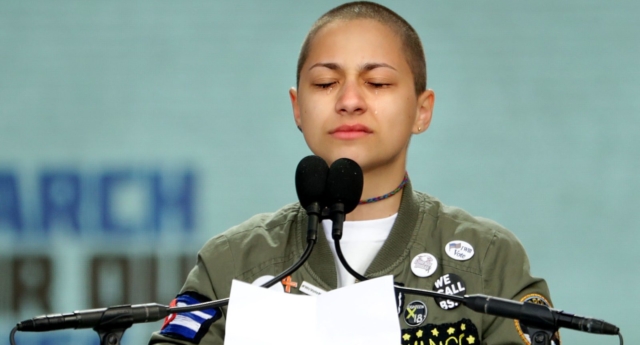
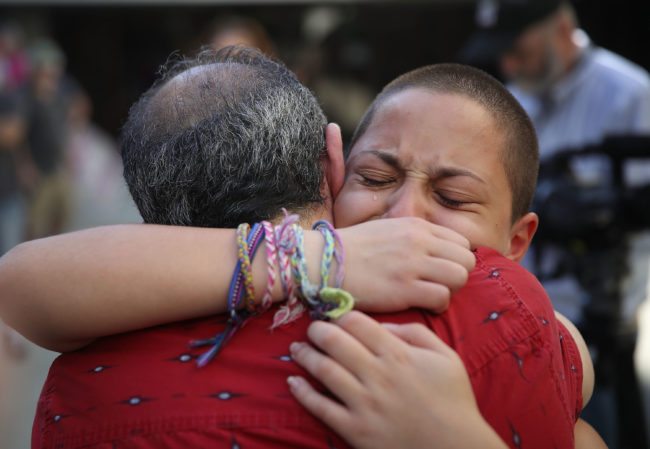
Parkland survivor Emma Gonzalez, the bisexual president of Stoneman Douglas High School’s Gay-Straight Alliance, has spoken out about the way her sexuality fuels her activism.
Together with fellow students like David Hogg and Cameron Kasky, the 18-year-old has prompted a tidal wave of public sentiment in favour of better gun regulation following the shooting in Florida.
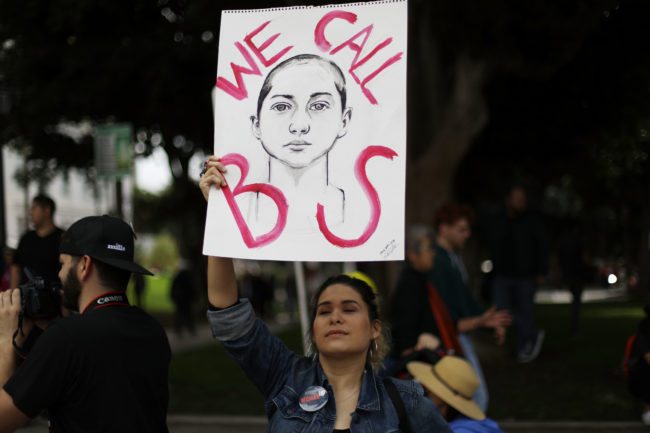
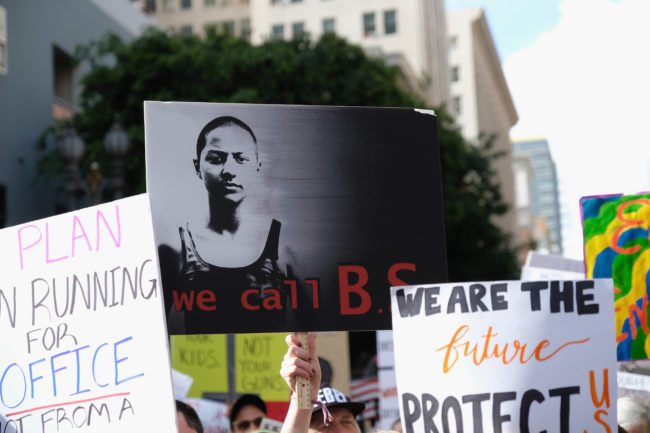
She has been at the forefront of the #NeverAgain movement since her impassioned speech at a rally last month in Fort Lauderdale, Florida, when she emotively repeated the phrase “We call BS” about NRA-funded politicians, gun advocates and those who don’t believe the Parkland teenagers know enough to speak up.
(Getty)
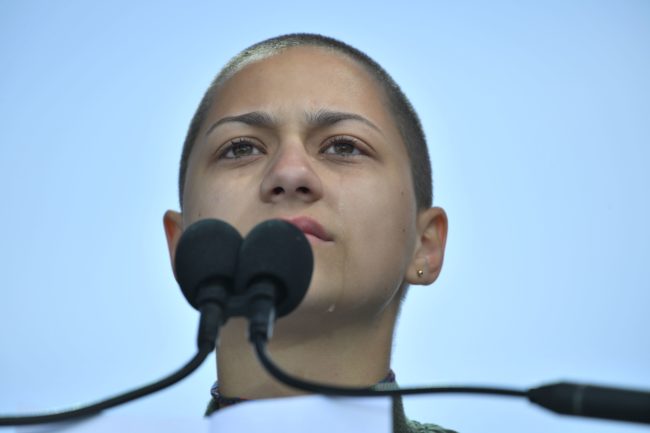
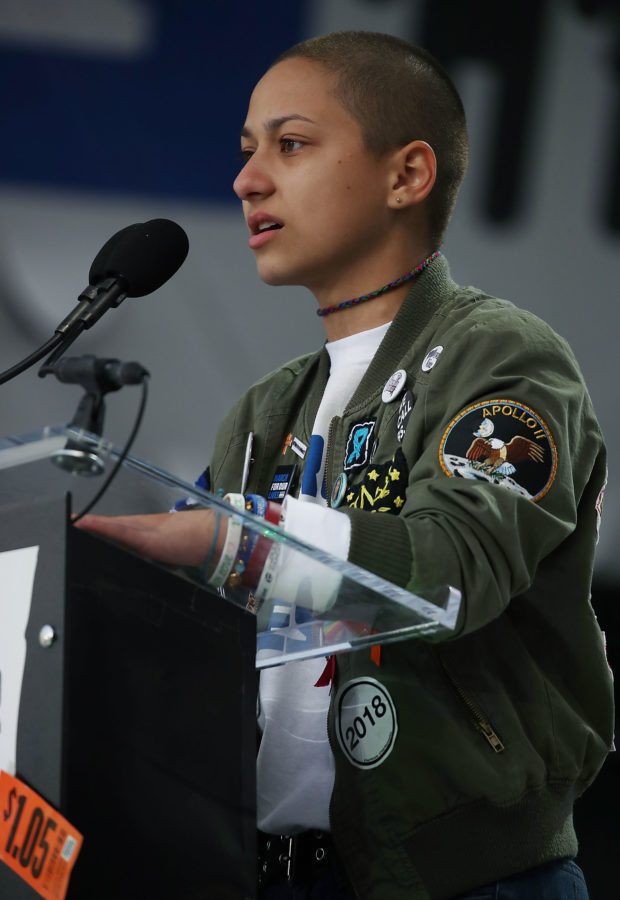
At the March For Our Lives rally in Washington DC, she made an emotional speech which left her and many of the hundreds of thousands of protesters in tears.
And speaking to Yahoo, she said that being open with her bisexuality meant she was able to speak out in this powerful way as one of the leaders of the Never Again MSD movement.
“They’re definitely linked for me personally,” she said. “If I wasn’t so open about who I was I never would’ve been able to do this.
“In ninth grade,” she recalled, “I was in a creative writing class where I could actually really effectively communicate what I was feeling, and it especially helped me come to terms with who I was.
“That definitely was when I really understood who I am, and when I came to terms with it, and when I told most people.”
This experience, she explained, “helped me understand that everybody, no matter who they are and what they look like, is going through a lot of different things.”
She has become an icon (Getty)
Gonzalez’s position as head of her school’s Gay-Straight Alliance has also been a crucial part of making her the activist she is today, she said.
“It’s really helped me get used to shifting plans very quickly, planning in advance, and also being flexible… understanding that maybe you organise a club meeting with this one person in mind and they just don’t come because they aren’t coming to school, and you can’t get upset,” she said.
“Because most of the kids in GSA either have depression or they’re dealing with a lot of stuff at home, and it’s like, I can understand that.
(Getty)
“And there are so many people in the country who are dealing with that, in relation to gun violence. You have no idea.
“You don’t know how many people you talk to on a daily basis that have actually been shot before, or have lost someone through gun violence.
“With GSA it’s the same. Everything’s incredibly far-reaching and widespread,” added the teenager.
(Getty)
During her speech at yesterday’s rally, Gonzalez showed exactly how inspiring she could be.
“Six minutes and about 20 seconds,” she told the crowd. “In a little over six minutes, 17 of our friends were taken from us, 15 were injured and everyone in the Douglas community was forever altered.
“Everyone who was there understands. Everyone who has been touched by the cold grip of gun violence understands. For us, long, tearful, chaotic hours in the scorching afternoon sun were spent not knowing.
“No one understood the extent of what had happened.”
Gonzalez listed off the names of those who died in the mass shooting last month with actions – like joking, smiling and playing basketball – that the young victims “would never” do again.
Apart from sporadic shouting and chanting, the immense number of protesters did the same, staying quiet.
When she broke the silence, Gonzalez told the crowd: “Since the time that I came out here, it has been six minutes and 20 seconds. The shooter has ceased shooting, and will soon abandon his rifle”.
She ended the speech with the message: “Fight for your lives, before it’s someone else’s job.”
The trial of the wife of Pulse shooter Omar Mateen has taken a dramatic twist – after it emerged that Mateen’s father was an FBI informant.
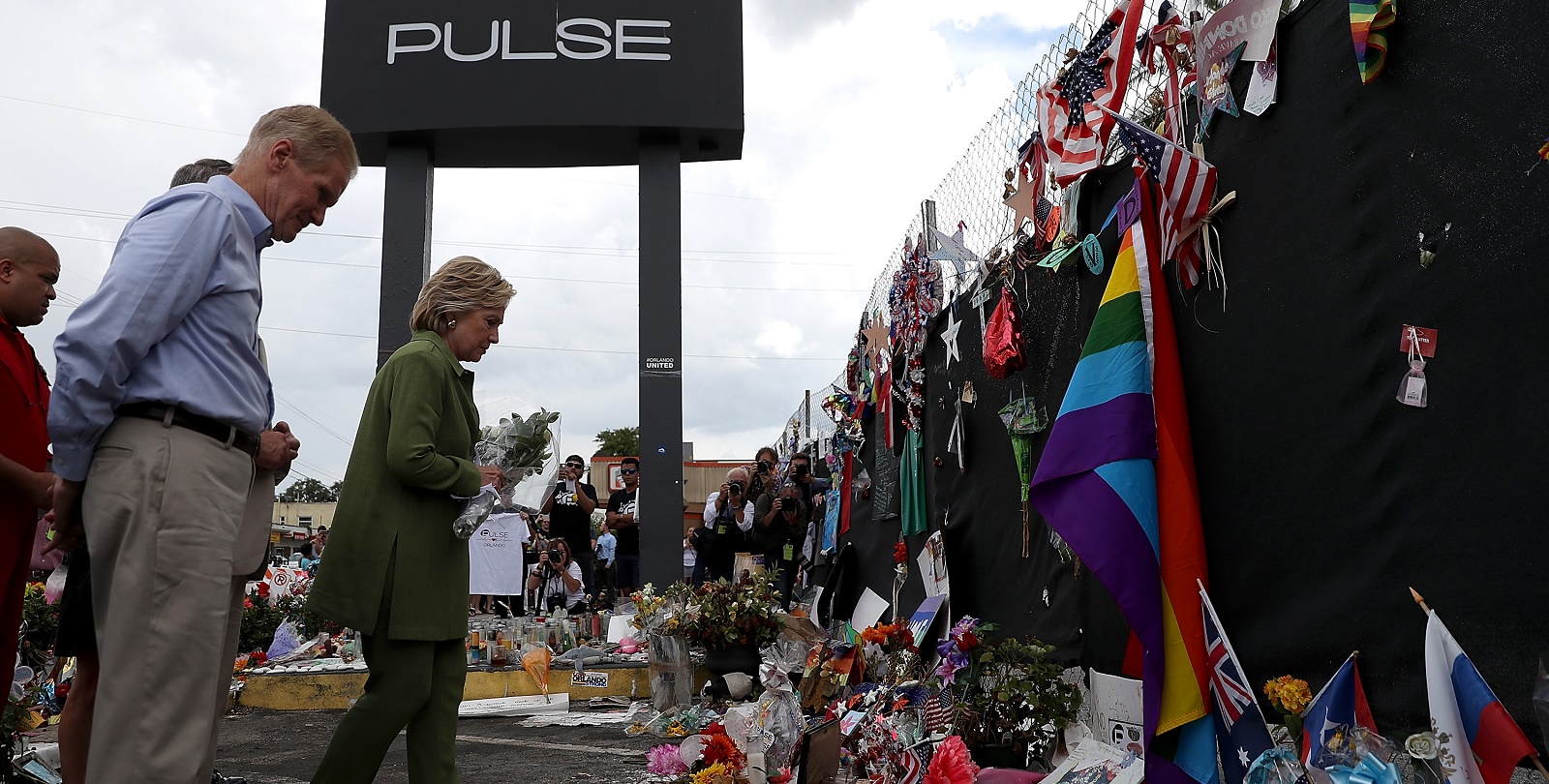
Forty-nine people died at Orlando’s Pulse gay club during a horrific mass shooting in June 2016, when Omar Mateen, who had pledged support for ISIS, opened fire at the crowd.
At the time it was the most deadly mass shooting in recent US history, though it has since been surpassed.
Mateen was killed in a shootout with the local police during the attack, but his wife Noor Salman is currently standing trial over allegations that she knew about the attack in advance.
But there was a dramatic development in the case this week, as Salman’s lawyers pushed for a mistrial – alleging that prosecutors failed to provide information to their client.
The defence alleges that Omar Mateen’s father Seddique Mateen was an FBI informant between January 2005 and June 2016 – details they claims were concealed ahead of the trial.
The FBI had previously confirmed it investigated Omar Mateen twice ahead of the attack but concluded he was not a potential terrorist.
The Intercept reports claims that FBI agents consulted Mateen’s father, who was already an FBI informant at the time of the investigation into his son.
Salman’s lawyers claimed: “Because the government violated Ms Salman’s Fifth Amendment right to due process and Sixth Amendment right to a fair trial, this Court must dismiss the Government’s case.
“In the alternative, if this Court does not dismiss this action, it should order a mistrial in order to safeguard these fundamental constitutional rights. Indeed, an analysis of the government’s conduct in this case establishes a consistent pattern of withholding evidence that directly impacted presentation of Ms Salman’s defense.”
(Getty)
However, the motion was dismissed.
Judge Paul Byron denied the motion, saying: “It doesn’t change the dynamic about this case involving Noor Salman.”
Salman, 31, stands accused of obstruction of justice and of aiding and abetting Mateen over the attack.
She stands accused of knowing about the plans for the attack in advance, but her attorneys and family insist she did not know what her husband was planning.
Prosecutors believe that while planning the shooting, Mateen asked Salman whether attacking a Disney site would have a bigger impact than attacking a nightclub.
It was also previously alleged she had “driven him to the gay nightclub, Pulse, because he wanted to scope it out” and “was with him when he bought ammunition and a holster”.
But Salman’s uncle Al Salman insists that the 30-year-old was “simple and innocent”, and that she had been abused by Mateen.
The study, which tracked more than 500 couples in Vermont over the course of 12 years, also revealed that women in same-sex marriages were the most likely to break up.
Lesbian unions are twice as likely as gay marriages and 1.5 times as likely as straight marriages to end, according to the research.
Professor Esther Rothblum, the study’s author and a visiting scholar at the Williams Institute who also teaches women’s studies at San Diego State University, said that one explanation was the results was that women expected more than men.
“Other studies on heterosexual couples have found that women have higher standards for relationship quality than men,” she said.
“We suspect that similar dynamics may be at play with the lesbian couples in our study, leading to the higher dissolution rate.”
The Williams Institute research also revealed the reasons why same-sex unions last.
For lesbian couples, with every extra year that the relationship lasts, the odds of a breakup are reduced by a huge 13 percent.
If you’re a learned pair of female lovers, you’re also better-suited to the world of relationships, with each year of education causing the odds of a split to plummet by 16 percent.
Older couples are also less likely to break up.
If you’re wondering whether having children will help or damage your marriage’s chances of lasting, the study found that having a baby has no effect.
Another author of the study, Kimberly Balsam from Palo Alto University, said the study was “crucial in combating stereotypes about same-sex couples,” adding that she hoped it would “inform policy and program development to support healthy relationships for all couples.”
The author of the research, Ritch C. Savin-Williams, explained that the study proved sexuality was a “continuum,” adding that he wants it to help clear up misconceptions and stigma about bisexual people – in particular, bisexual men.
“Men have gotten so much cultural crap put on them that even if a man does have some sexual attraction to guys, they would never say it,” Savin-Williams said.
The hometown of anti-gay Vice President Mike Pence will host its first ever Pride festival in an effort to distance themselves from the former governor.
Erin Bailey, a high school student, has organised the Columbus Pride Festival in an effort to prove that Mike Pence does not represent all of his hometown.
“I feel it is important for members of the LGBTQ community to know that Columbus is a welcoming and diverse community,” Bailey said to Huff Post.
“Even though Mike Pence is openly anti-gay, that doesn’t mean that all of us in his hometown are.”
The controversial vice president has one of the worst records on LGBT rights of any US leader in history.
The event is planned for April 14 and will be the first of its kind to be hosted Columbus, a small city with under 50,000 people.
Organiser Erin Bailey, a student of Columbus Signature Academy-New Tech, also said that as well as welcoming LGBT people to Columbus, the event could help distance the liberal-leaning town from the ultra-conservative Veep.
The 18-year-old said: “We are so much more than just a small town that he grew up in.”
“It is important for this event to be happening now so that others know that even in this time of hatred, we don’t all agree with it. This is an opportunity to show support for an all-inclusive community.
“This is something incredibly important to me, and I want to make a difference in not only our small Indiana community but in the world as well. Gay rights are human rights.”
Other LGBT+ groups in Columbus have welcomed the plans as the first of their kind, though they are by far the first pro-LGBT movement in Columbus, according to Pride Alliance Columbus.
“As an ally, it’s very important to me that Erin’s event, as wonderful as it is, is not seen in a vacuum. PAC has been in existence for almost 20 years, and our mission is inclusion for all,” said Pride Alliance Columbus’ president Jill Tasker.
This isn’t the first bit of potentially bad news for the anti-LGBT Vice President this month.
In response to the Senate passing H.R.1865, an anti-online sex trafficking bill that has the potential to seriously harm consenting, adult sex workers, Craigslist has shuttered its all of its personals sections. Even the platonic ones.
Early Friday morning, Craigslist made a public post regarding the bill commonly known as FOSTA (Fight Online Sex Trafficking Act) that explained the logic behind their decision to shut down one of the most widely-used subsections of the platform. The message was straight and to the point:
“US Congress just passed HR 1865, “FOSTA”, seeking to subject websites to criminal and civil liability when third parties (users) misuse online personals unlawfully.
Any tool or service can be misused. We can’t take such risk without jeopardizing all our other services, so we are regretfully taking craigslist personals offline. Hopefully we can bring them back some day.
To the millions of spouses, partners, and couples who met through craigslist, we wish you every happiness!”
In a post-FOSTA world, websites like Craigslist where sex workers commonly posted ads for their services would be legally responsible for the whatever kinds of illegal interactions users ultimately took part in.
In the most ideal of situations, a bill like FOSTA could play a role in fighting off sex trafficking. In reality though, the bill (as is the case here) is causing a chilling effect that gooses sites like Craigslist to close up at least part of their shop and actively hurts consenting sex workers who rely on the website. As drastic as it may seem, it’s easy to understand the why of Craigslist’s decision to avoid the consequences of FOSTA, but the question now is whether other sites frequently used by sex workers will follow suit.
The LGBT Fund supports both deep engagement in select countries as well as rapid response grants, which are distributed to grassroots organizations to respond to emergencies facing LGBT people across the continent. To date, the Fund has already helped nearly 23,000 people in 20 countries, most of which criminalize same-sex relations. Through these grants, 6,500 LGBT people have received an HIV test, and 100 grassroots organizations have been able to continue providing HIV treatment, human rights protection, emergency shelter, and legal services to LGBT people facing barriers to treatment and care.
“The donation by Phil to EJAF is in keeping with the special connection and consistently supportive, collaborative relationship I have developed with AEG for more than a decade. We will put his donation to work to ensure that vulnerable groups are not left behind in the fight against HIV/AIDS,” said Elton John. “This funding will help our programs provide life-saving work for LGBT communities around the world, starting with the LGBT Fund in Sub-Saharan Africa.”
“My gift to the Elton John Foundation is intended to emphasize that we support freedom of all people to live their lives peacefully, without interference from others,” Anschutz said in a statement. “Sexuality is among the most personal of issues, and it has never been my intent to weigh in on people’s private lives. I support the rights of all people and oppose discrimination and intolerance against the LGBTQ community. I see this as a matter of basic human rights. Our Foundation supports a broad range of philanthropic causes. I regret if any money given to a charity for other purposes may have indirectly worked against these values. That was not my intention, it does not reflect my beliefs, and I am committed to making sure our internal processes are strengthened so that it does not happen again.”
According to Freedom for All Americans and Snopes.com, the Anschutz Foundation donated nearly $200,000 to the Alliance Defending Freedom, the National Christian Foundation, and the Family Research Council between 2010 and 2015. The Alliance Defending Freedom has advocated for anti-sodomy laws; the Family Research Council describes LGBT “lifestyles” as “unhealthy and destructive;” the National Christian Foundation has been accused of funding anti-LGBT groups around the world. Anschutz has long maintained that he supports the rights of all people regardless of sexual orientation, and one of his attorneys told Pitchfork that the executive had stopped donating to such organizations after 2015.
The release states that Anschutz’s donation “celebrates Sir Elton John’s legacy and the impact he has had bringing people together, as well as over 25 years of work by the Elton John AIDS Foundation to create a global, AIDS-free generation.”
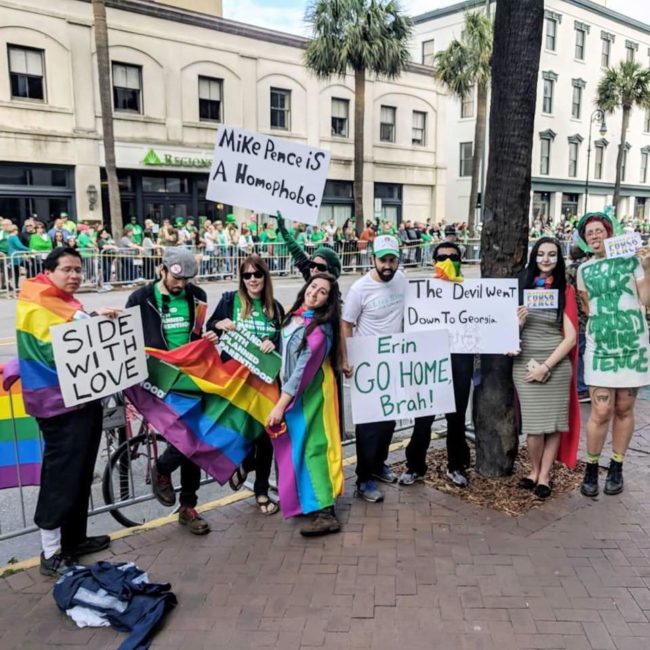
LGBT activists made sure to give Vice President a nice hospitable Southern welcome on his trip to Savannah, Georgia this week – with a sea of rainbow flags.
The Veep, who has the worst record on LGBT rights of any US leader in US history, was in town for a visit and to take part in the annual St Patrick’s Day parade.
However, the local community banded together to make sure that everywhere he went, a rainbow flag went with him.
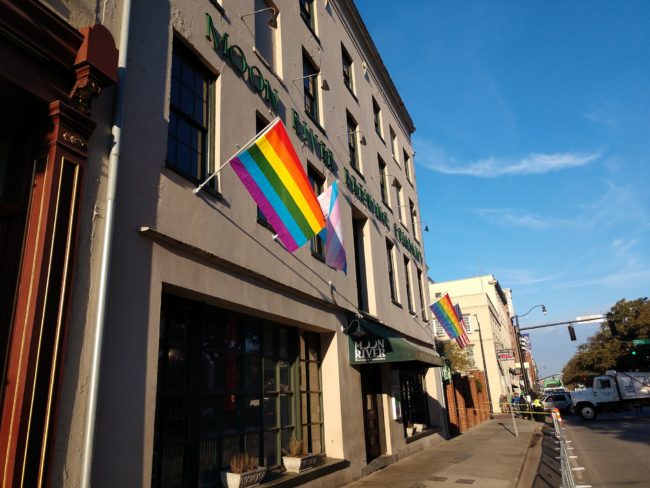
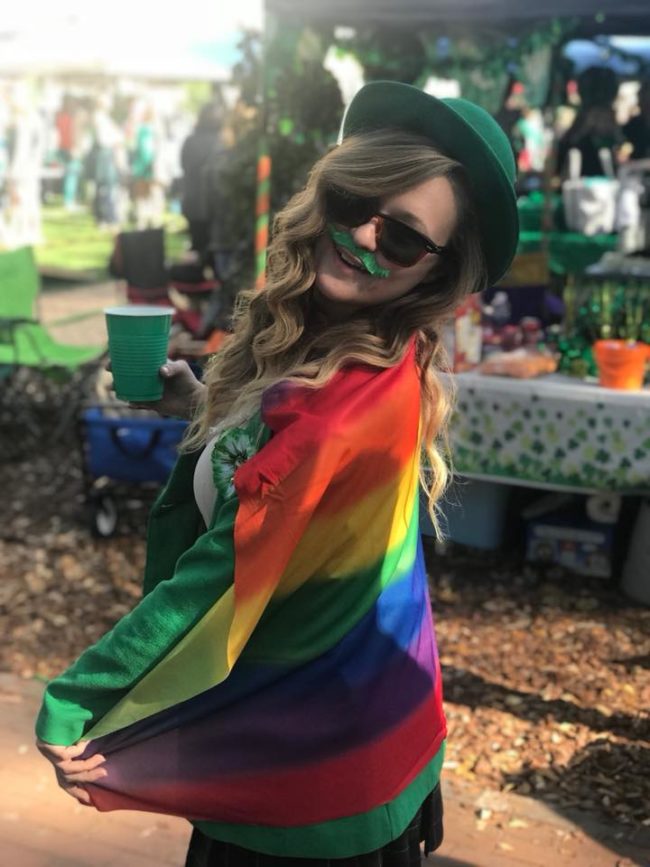
A group of protesters attended the St Pat’s parade route with rainbow flags, while even some local businesses decided to put up flags for the occasion.
Moon River Brewing Company, based in the centre of Savannah, was one of the companies that put up flags.
Owner John Pinkerton wrote: “Moon River Brewing Company is all dressed up for the unwelcome visit of the Prince of Darkness himself, Vice President Mike Pence. Please join me letting our leaders know that spending millions of our tax dollars on security for these kind of frivolous appearances.”
Addressing local leaders, he said: “Mayor Eddie DeLoach, despite my best efforts to reach you, or anybody else in your office, through numerous channels, you have failed to respond.
“How do you reconcile Pence’s long history of hateful policy and rhetoric toward African Americans, LGBT and women? Did you stop to consider the demographic of your own City?
“Let me remind you: Savannah is 55% African American. Women make up over 50% of the population, pretty much everywhere you go. And Savannah is probably (and thankfully) the gayist city in the southeast!”
According to LGBT activists, Pence spent less than an hour at the St Patrick’s Day festivities, pursued along the way by LGBT rights campaigners who “made sure there were rainbows in every photo op”.
Ahead of the event, Savannah Pride, First City Network, and Savannah LGBT Center issued a joint statement noting Pence’s record.
A group of protesters (Photo: Savannah Pride)
They wrote: “As members of Savannah’s LGBTQ community, we are troubled by our public officials’ welcoming of Vice President Mike Pence.
“Mr Pence has proved himself to be one of the most anti-LGBTQ political crusaders to serve in government. As governor of Indiana, he led a concerted effort to deny equality to LGBTQ people, opposing gay marriage and signing into law a bill that made it legal for businesses to turn away gay and lesbian customers.
“As a member of Congress, he voted against the Employment Non-Discrimination Act, the repeal of Don’t Ask Don’t Tell, co-sponsored a bill to define marriage between a man and woman, and sought to cut off HIV funding to organizations that did not encourage the reprehensible practice of gay ‘conversion therapy’.
(Photo: Savannah Pride)
“These attacks have continued with at least two dozen actions by the current administration against LGBT people, including those serving in our armed forces.
“Ordinarily, there is no place for his brand of discrimination in Savannah. However, this weekend, he will feel right at home at the largest St Patrick’s Day Parade in America that discriminates against LGBTQ organizations.
“We Savannahians are proud of our diversity, so we welcome Vice President Pence to join our interracial gay families raising adopted children, trans service members proudly defending their country, queer artists inspiring creativity, immigrant students dreaming of a bright future with a same-sex spouse, and the many other faces of the Hostess City that will be proudly lining the streets this weekend.”
The Vice President banned media from the meeting with Mr Varadkar, after the leader said he would be raising LGBT rights.
Ever the diplomat, Mr Varadkar did not detail exactly what was said afterwards – but did reveal that Pence had offered to host him and his partner in future.
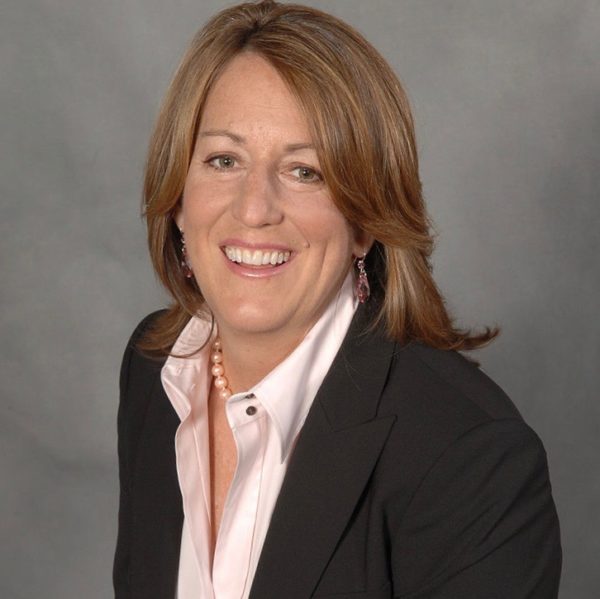
NCLR Executive Director Kate Kendell (courtesy NCLR)
LGBT politicos nationwide were struck by the March 15 announcement that National Center for Lesbian Rights executive director Kate Kendell was stepping down after more than 22 years of service advancing social and economic justice through the lens of LGBT civil rights.
“Kate literally changed the world. Her leadership in advancing the rights of LGBT people from being criminals to being able to marry has transformed the lives of millions of people. She always pushed the envelope and was a constant voice for our movement to embrace our communities’ diversity, partner with others and embrace a progressive agenda,” says Geoff Kors, Palm Springs City Councilmember, former Equality California Executive Director, and Kendell’s “brother from another mother.” “She has an ability to connect with people on our shared humanity and move them to do the right thing even when it is politically challenging.”
“We are so grateful for Kate’s decades of leadership in the fight for full LGBTQ equality and social justice,” says Equality California Executive Director Rick Zbur, noting that NCLR is currently co-representing Equality California in Stockman v. Trump, a lawsuit challenging the Trump administration’s transgender military ban. “They broke the mold when they made Kate Kendell. And while her leadership at NCLR will be missed, her legacy will live on in the work of generations of LGBTQ civil rights advocates who will stand on her shoulders.”
It is that passionate commitment to justice and human dignity that helped Kendell grow the small San Francisco-based national non-profit into a powerhouse legal advocacy legal organization.
“Kate Kendell’s charisma, passion and vision have resulted in NCLR becoming one of the most creative and effective advocacy organizations in this country. Every LGBTQ person has benefitted because of her incredible leadership,” said Donna Hitchens, the retired San Francisco Superior Court judge who founded NCLR in 1977.
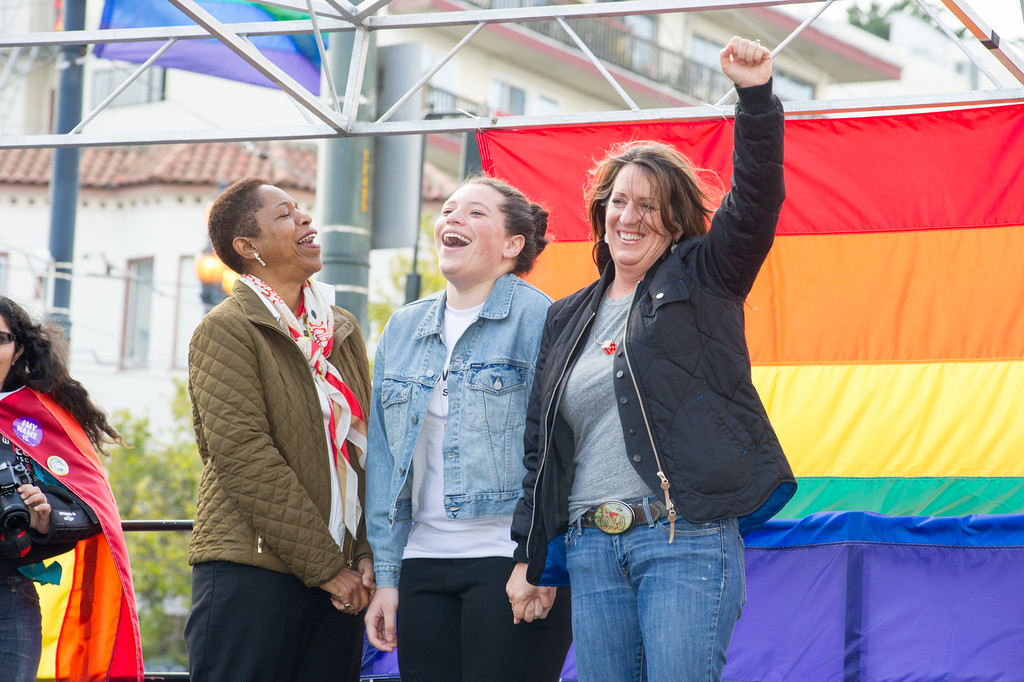
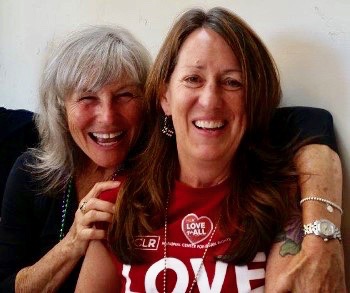
Kate Kendell, wife Sandy before Rainbow Flag (Courtesy NCLR)
“Kate Kendall is one of the most fearless and tireless advocates the LGBTQ equality movement has ever known,” says Human Rights Campaign President Chad Griffin. “Kate’s profound work is woven into the fabric of our movement and millions of Americans have felt the impact of her unwavering leadership. I am proud to call Kate a friend, colleague, and a true champion for equality.”
Even journalists pay Kendell respect. “Authentic, empathetic, fully present, flawless mix of PC and un-PC, openminded, Mormon good-girl ethics, rebellious lesbian side, a hard worker not a brander, and a fully spin-free zone. It don’t get much better,” tweeted San Diego-based semi-retired reporter Rex Wockner.
Kendell started thinking about her career trajectory a few years ago. “I’ve engaged in a fair amount of self-interrogation and reflection about when might be the right time” to leave, Kendell says in an extensive March 15 phone interview.
“It just really felt like this was the right time for me—I hit 58 next month—to pursue whatever my next chapter is,” Kendell adds. “And it’s the right time for NCLR to have a new, obviously younger leader.”
The NCLR board and management team is working on a succession plan. The search for the new executive director will officially launch on April 1.
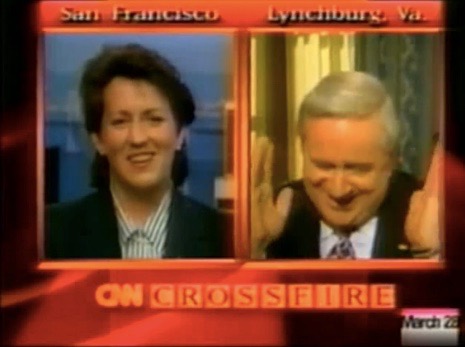
Kate Kendell debating Rev. Jerry Falwell on CNN’s “Crossfire” (Courtesy NCLR)
“I had no idea when I took the job as legal director in 1994 or even as executive director in 1996 that I would be in the role this long, that I would be a part of some of the most powerful resonant and culture-changing moments in the LGBTQ movement, or that I would be able to look back on a 22-year run with such a profound sense of gratitude and humility,” she says.
“I was lucky enough to meet Kate back in 1994, when she started as NCLR’s Legal Director after working at the Utah ACLU and we clicked right away,” Mary L. Bonauto, longtime attorney with GLAD (GLBTQ Legal Advocates & Defenders), tells the LA Blade. “For one, there were few women working in the legal organizations at that time, and we were both eager to use our legal skills to stick up for our community—for liberty, freedom and equality, even as others tried to stuff us back into the closet. And we were able to collaborate across the miles on cases and policy issues sometimes, too, including parenting cases.” NCLR’s “docket of protecting all families and children…is foundational to many of our other successes.”
Parenting issues were NCLR’s first priority as lesbian parents in heterosexual marriages came out and lost custody of their children. For generations, invisibility “protected us from the worst of this nation’s bigotry and assaultive approach to LGBTQ people. But it also rendered us unable to be our own advocates because we couldn’t be open and fight for what we wanted,” Kendell says.
”And then AIDS—which galvanized our community like nothing else could have,” Kendell continues. “And while it was never worth the death count, it still put in stark relief that being hidden, being silent, being invisible was a matter of life and death. Our visibility, our coming out, our being adamant about our own humanity and demanding that this nation recognize and honor that humanity is how we got to where we are now—in very short order by civil rights-time measurement.”
But while “the rapidity with which we’ve seen landmark change is breath-taking,” Kendell says, family issues such as adoption and child custody issues are “still a huge problem in many states.”
Some of the most heart-wrenching cases in the 1990s involved lesbian couples separating with the biological parent treating the non-biological parent as a “legal stranger” with no right to even see the child.
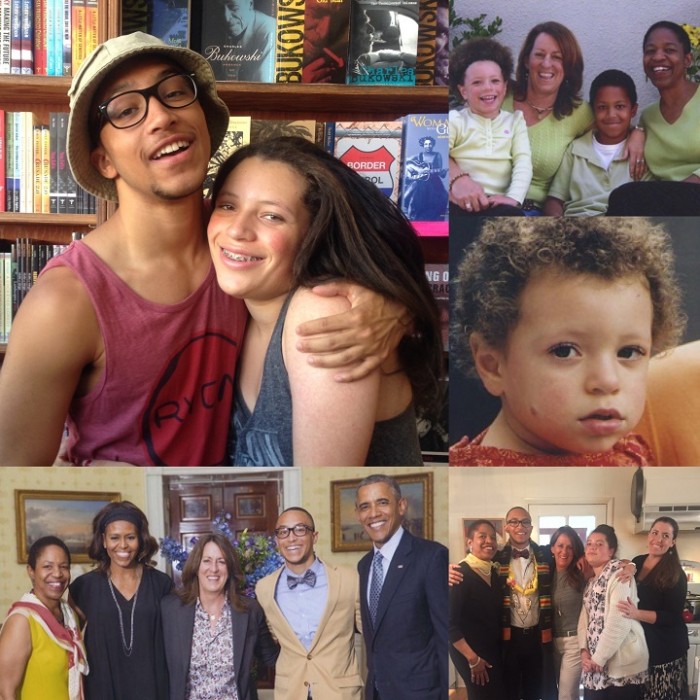
Collage of Kate Kendell and family— wife Sandy, son Julian, 20 and daughter Ariana 14. (Courtesy NCLR)
“To this day, I find it abhorrent in the extreme that there are lesbians who would use heterosexist homophobic legal arguments against not just their former partner but our entire community. It still haunts me the cases that we lost with children four, five, six-year olds being denied any ongoing relationship with their parent! Forget how traumatic and hard this is for the lesbian co-parent—as a parent myself, my kids were about the same age when we were in the thick of these cases—imagine the trauma to this child!” Kendell says. “The venality and the self-loathing and the selfishness embedded in such an action still makes my blood boil.”
Lorri L. Jean, CEO of the LA LGBT Center, says she is sad Kendell is stepping down. “Personally, she has been a valued colleague and friend and I’m going to sorely miss her indomitable presence, her support, her insight and her sense of humor,” says Jean, who also took a stand against the “legal stranger” arguments. “She has done her work with a rare and admirable combination of selflessness, courage and integrity. LGBTQ people everywhere have better lives thanks to her leadership.”
NCLR made history arguing for Sharon Smith’s right to file a wrongful death civil lawsuit after the 2001 murder of her beloved domestic partner of seven years, Diane Alexis Whipple.
Whipple, a lacrosse coach, was coming home with groceries when she was viciously attacked by two large dogs and mauled to death in her apartment hallway. Neighbors Marjorie Knoller and her husband, Robert Noel were eventually convicted of second-degree murder and manslaughter, respectively.
Smith, a vice president at a brokerage firm, filed a wrongful death suit—but California only allowed surviving spouses, children and parents to file such claims. NCLR argued to San Francisco Superior Court Judge James Robertson II that the committed couple was essentially married. Robertson agreed that limiting the right to sue to straight spouses violated the Equal Protection Clause of the state constitution.
“Up until Sharon’s case, it was virtually unheard of for a same-sex partner to be permitted to sue for wrongful death. In every prior case, the surviving partner was deemed a ‘legal stranger,’ regardless of the length or depth of the relationship,” Kendell wrote on her NCLR blog in 2011. “But that measure of vindication, while enormously important, could never bridge Sharon’s terrible loss.”
Kendell and Smith remain very close friends. “Sharon’s case really made history and changed the way people viewed our relationships,” Kendell says.
In 2004, Kendell witnessed history again. The week before Valentine’s Day when Kendell got a call from Mayor Gavin Newsom’s chief of staff saying Newsom was going to begin issuing marriage licenses to same sex couples on Monday, Feb. 9.
“At the time, I thought it was not a good idea,” Kendell says, since the marriage victory in Massachusetts prompted calls for a federal constitution ban on same sex marriage, endorsed by President George W. Bush. “It’s like a little bit of a powder keg right now,” she told him before he made it clear the action would happen “no matter what.”
Kendell talked to NCLR Legal Director Shannon Minter and Bonato, who won the Massachusetts marriage equality case. By Sunday, Kendell concluded: “You know what—game on. Let’s just do it.”
However, Monday morning it became clear that more time was needed, including for Newsom to do some homework on the movement. “He was humble enough to understand that he needed a few more days,” Kendell says.
They prepared the new proper forms then Joyce Newstadt, Newsom’s policy director, and Kendell decided the first couple to marry had to be lesbian icons Del Martin and Phyllis Lyon.
“I called Del and Phyllis’ home and Phyllis answered and I said, ‘Phyllis, I know you and Del have already done so much for the movement, but I have one more request. Would you be willing to be the first couple that would be issued a marriage license by the City and County of San Francisco because Mayor Newsom wants to begin issuing marriage licenses to same sex couples. And she said, ‘Well, just a minute. Let me ask Del.’ I heard her put the phone down and then I heard her say, her voice a little bit muffled, ‘Kate wants to know if we want to get married.’ I didn’t hear what Del said but Phyllis came back and said, ‘Del said we’ll do it,’”Kendell recalls.
The clandestine team included Kors, Newsom’s office, the City Attorney’s office—and on Thursday morning, Feb. 12, history happened.
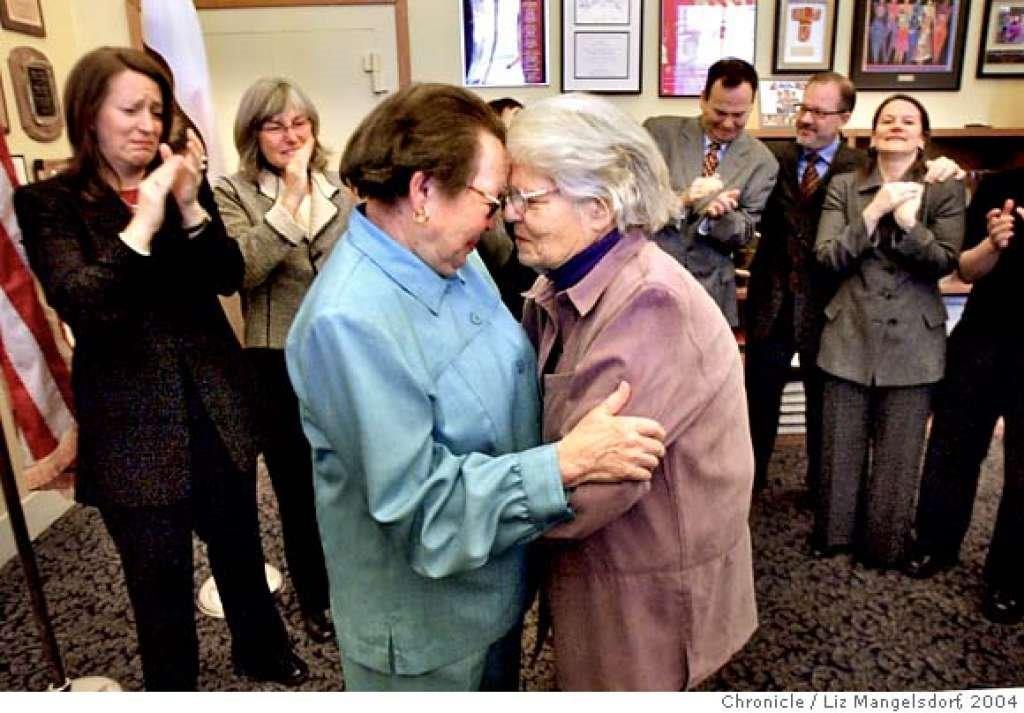
Phyllis Lyon and Del Martin marry in 2004 (Photo by Liz Mangelsdorf, courtesy NCLR)
Kendell drove the couple to City Hall in her 1972 Mercedes sedan, escorting them through the basement to avoid being seen. They waited outside Treasurer Mable Tang’s office until—“one of the greatest privileges of my life—I was there when Mable Tang did the wedding vows for Del and Phyllis and witnessed Del and Phyllis’ wedding—Feb. 12, 2004, the 51th anniversary of the day they first met.”
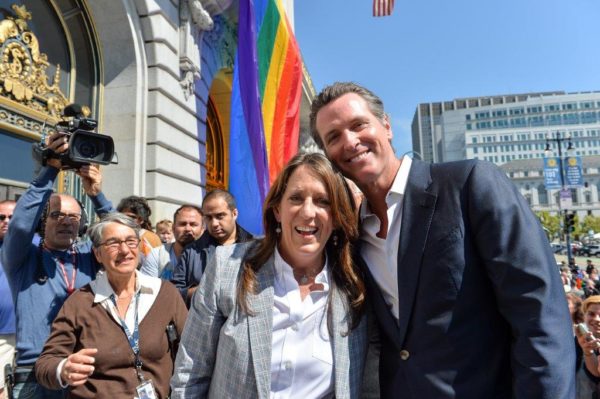
Kate Kendell and Gavin Newsom (Photo courtesy NCLR)
“In 2004—at a time when many in the Democratic Party were not ready to support marriage equality—Kate was a force whose advocacy and leadership gave us the courage to marry over 4,000 same-sex couples,” California Lt. Gov Newsom tells the LA Blade. “That’s just one in a long list of fights Kate and NCLR have taken on, and won, to benefit LGBTQ folks across the country. I am grateful for her counsel and friendship, and for her decades of bold leadership at the forefront of the movement for equality.”
“I always knew when Kate was at the table that we would be on solid ground to do the right thing,” says Newstat, now CEO of Rocket Science Associates.
Roberta Achtenberg and Kate Kendell (Photo courtesy NCLR)
“Kate is a force of nature, and her leadership of NCLR has been nothing short of brilliant! I will remember always the day we stood shoulder to shoulder with tears in our eyes and love in our hearts as Phyllis and Del said their vows and ignited the marriage revolutions! That, and so much more, our Kate has helped make possible,” says Roberta Achtenberg, former San Francisco Supervisor and historic high-ranking official in the Clinton administration.
Kendell is proud of NCLR’s role in winning the consolidated 2004 case that resulted from that event. Minter argued, In Re Marriages before the California Supreme Court, which treated the transgender NCLR attorney with dignity and respect during oral arguments. The Court ruled marriage equality was a fundamental constitutional right in May 2008.
“Shannon was an employee of NCLR before I even got to NCLR. In fact, he and I had met a couple of years prior when I was at the ACLU and he came to Utah because we were trying to get a young lesbian girl released from a psychiatric facility where she had been institutionalized by her parents when she came out,” Kendell recalls.
“Shannon and I had been through so much together and to see him standing before the California Supreme Court as our Legal Director and my partner in so much of what had been great about NCLR and my job and to be someone I had so much respect and love and affection for was just a spectacular moment. I was proud, I was moved, I was emotional. I was inspired. It was fantastic. And he was brilliant,” Kendell gushes warmly.
NCLR Legal Director Shannon Minter and Kate Kendell (Photo by Trish Tunney, courtesy NCLR)
Minter became the first individual to transition at an LGBT organization and the first full time transgender employee at a national LGBT organization.
Minter remembers Kendell’s reaction when he announced he was going to transitioning at work.
“I first talked to her about it in 1995, a time when transgender issues were not yet much on the radar of any national LGB group,” Minter tells the LA Blade. “Like most other LGB people at the time, Kate knew very little about transgender issues, but her response was always completely spot-on. She didn’t pretend to know more than she did, but she was enthusiastically supportive on both a personal and professional level from day one.
“When I actually transitioned in 1996, she sheltered me from any negative responses and offered unflagging acceptance and support,” Minter continues. “She set such a positive example for the whole movement in that regard. At the same time, she was always real, including telling me when I complained about having a hard time finding men’s shirts that fit that my arms, which were too short! I have loved teasing her about that over the years.”
He adds, “Kate has never flinched from a fight. She has empowered our staff to launch innovative new projects and then trusted them to take risks. As a result, she has nurtured some of the most impressive leaders in our community.”
One of the hardest issues was Proposition 8, the anti-gay marriage ballot initiative that passed in November 2008.
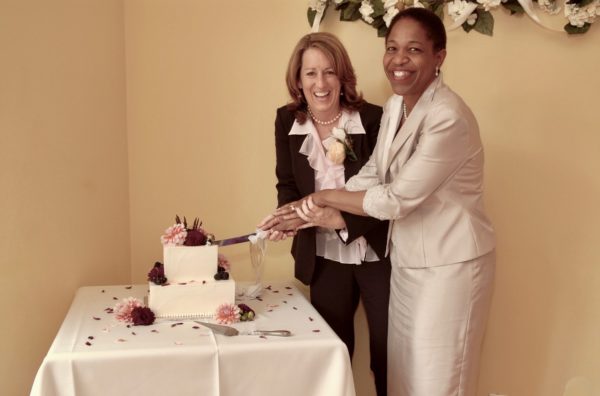
Kate and Sandy get married (Photo courtesy NCLR)
“What happened in Prop 8 was the lowest point of my career and it just followed on the heels of one of the highest points of my career,” Kendell says. “When we won marriage in California, I was ecstatic….I knew that the resonance of ending discrimination in marriage was going to be a huge lift to every other facet of the lives of queer people. And I believe that has been borne out to be true,” she says.
“I knew Prop 8 was an existential threat and I knew it had a very good chance of passage. But it was impossible to get people to focus on it because everybody was still elated that we’d won marriage and they couldn’t believe that California voters would vote to take away marriage!” Kendell says, her voice rising as if reliving the fall of 2008. “So when Prop 8 passed—I remember the entire night. I remember the growing feeling of dread and nausea. And I remember a sleepless night absolutely devastated and then having to face the next morning. It was a brutal, brutal experience” that left her seriously depressed for six months.
But there was an upside. “I believe that had it not been for Prop 8, we wouldn’t have won marriage as quickly as we did in this country. It shocked the shit out of people that we could see marriage taken away at the ballot box and it galvanized and energized a huge new generation of LGBTQ folks to engage in the fight. And that moment really changed everything, in terms of our momentum,” Kendell says.
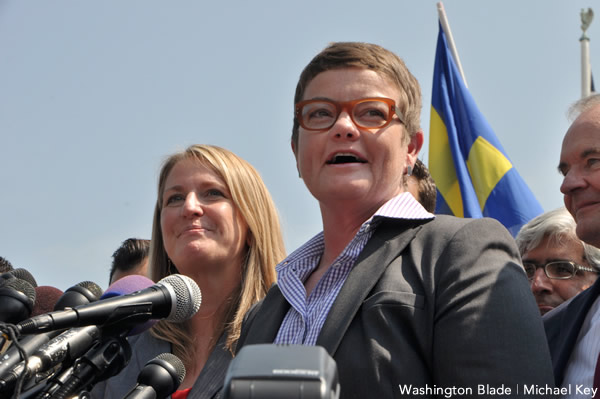
Federal Prop 8 plaintiffs Kris Perry and Sandy Stier at the Supreme Court (Photo by Washington Blade photographer Michael Key)
“We have admired her courageous leadership and ability to build support for NCLR for many years but we will be forever grateful to Kate for her unequivocal support during our challenge to Proposition 8 and subsequent friendship,” successful federal Prop 8 plaintiffs Kris Perry and Sandy Stier tell The LA Blade.
Kendell and NCLR have also worked hard on intersectional issues that “deeply impact LGBTQ people,” such as immigration, policing, criminal justice, asylum and poverty issues. “If those issues are not an essential part of every LGBTQ organization, we are doing a disservice and we are leaving people behind,” she says. “There can be no more important work for us to do than actually saving lives.”
“Kate has a clear vision of the intersections in our communities. Whether as an advocate for LGBT immigrants, same sex parents, or transgender youth, she has the best interests of all of us impacted by the range of prejudice and bigotry when she bravely steps forward time after time,” says longtime Democratic Latina politico, Gloria Nieto. “She is the definition of fierce and our communities are more fierce thanks to Kate Kendell.”
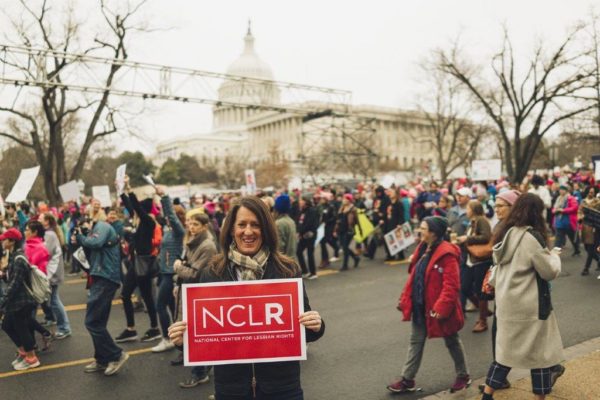
Kate Kendell at the Women’s March 2017 (Photo courtesy NCLR)
“Having worked side-by-side with Kate Kendell—including as co-counsel in a number of path-breaking cases—for three decades,” says Jon Davidson, former Legal Director of Lambda Legal, “I often have had the pleasure of seeing Kate’s inspired leadership, passion, smarts, and tenacity up close. She fought tirelessly for the full breadth of our communities, ensured that the LGBTQ rights movement incorporated essential feminist perspectives, and successfully built alliances that have been key to our success. We collectively owe her a huge debt of gratitude, as we certainly would not have made the progress we have but for her many years of hard work.”
Kendell feels that the fight for social justice and intersectionality is “baked into DNA” at NCLR. And while the Right “is still going to fight us at every turn,” her 22 years have taught her that “people are generally good and want to be good but are stopped by being scared.” So, she says, “it’s important to meet people where they are, even when that’s difficult.”
The stakes now are high. “We are in a fight about who we are as a nation,” Kate Kendell says. “But I do have hope. Like Harvey Milk said, we have to give them hope. Because if we lose hope, we concede ground to our enemy. And I do not concede!”