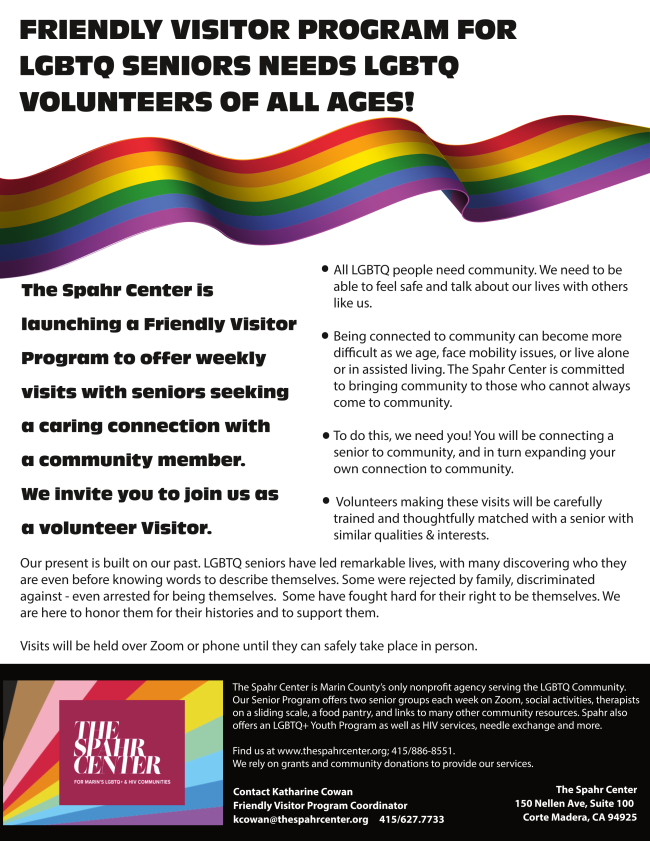
Marin’s Spahr Center Looking for Volunteers of all Ages for Senior Program

A high school in Indiana has ordered teachers to remove Pride flags from their classrooms to “maintain viewpoint neutrality”, and students have slammed the decision.
The principal of Pendleton Heights High School, Connie Rickert, ordered three teachers to remove Pride flags from their classrooms, local newspaper The Herald Bulletin reported.
“Teachers are legally obligated to maintain viewpoint neutrality during their official duties to ensure all students can focus on learning and we can maintain educational activities and school operations,” she stated. “Our counselors are trained to respond to any student who desires support.”
Despite outrage from students, other senior staff also issued statements about the ban, with one comparing the Pride flag to a white supremacy flag. One student slammed the comparison, telling The Indianapolis Star: “One is about inclusiveness and the other is about hate.”
The president of the board of trustees for the local district wrote in an email to parents: “The issue with displaying the flag in a school is a double-edged sword.
“If an LGBTQ+ flag is allowed to be displayed, then any other group would have the same ability. That could include such flags as supporting white supremacy, which is in direct conflict with LGBTQ+. I hope we can model equality and support through our actions.”
Student Bryce Axel-Adams started an online petition, calling for the school board to officially allow Pride flags in classrooms. At the time of writing, it has more than 3,500 signatures.
Bryce wrote: “Having a pride flag is one of the clearest ways to say, ‘I support you, and I’m here for you. You are loved.’
“That is so important for LGBTQ+ youth, we have always been told that teachers will always be there for us, and being able to easily identify teachers we can safely go to is extremely important to our mental health.”
Bryce later added that they had received an update from the school administrators saying they had changed their stance, and weren’t banning the flags because they are “political speech”, but to
“avoid a discrimination lawsuit”.
The petition received a number of heart-warming responses from teachers in other districts, Pendleton alumni and other students.
The number of young people who are gender-diverse — including transgender, nonbinary and genderqueer — may be significantly higher than previously thought, according to a new study.
Researchers in Pittsburgh found that nearly 1 in 10 students in over a dozen public high schools identified as gender-diverse — five times the current national estimates. Gender diversity refers to people whose gender identities or gender expressions differ from the sexes they were assigned at birth, according to the American Psychological Association.
In a report published this week in the journal Pediatrics, researchers from the University of Pittsburgh Graduate School of Public Health, Children’s Hospital of Pittsburgh, Seattle Children’s Hospital, the Harvard T.H. Chan School of Public Health and the UCLA School of Medicine analyzed 3,168 student surveys culled from 13 Pittsburgh high schools.
In all, 291 participants, or 9.2 percent, reported incongruities between their sexes assigned at birth and their experienced gender identities. Of those gender-diverse youths, about 30 percent expressed transmasculine identities and about 39 percent expressed transfeminine identities. People with nonbinary identities were about 31 percent of the total.
The overall figure is vastly higher than the roughly 2 percent cited in most national estimates.
The lead author, Dr. Kacie Kidd, a pediatrician and adolescent medicine fellow at Children’s Hospital of Pittsburgh, said that’s because earlier researchers — including those behind the Youth Risk Behavior Survey of the Centers for Disease Control and Prevention — didn’t use the right terminology or methodology.
The risk behavior survey is a biennial assessment providing vital insights into the sexual behavior, substance use, mental health and violence victimization of young Americans. The 2017 edition, given to 118,803 students ages 14 to 18 from 10 states and nine large urban school districts, was the first and only one to date to include a question about gender identity, but it simply asked, “Do you identify as transgender?” and gave respondents the option to reply “yes,” “no” or “I’m not sure.”
“Of course, not everyone who is gender-diverse identifies as transgender,” Kidd said. “We worried that that language didn’t encompass the breadth of gender-diverse identities we see, particularly in young people.”
So Kidd and her colleagues added a two-part gender identity question in their survey: (1) “What is your sex (the sex you were assigned at birth, on your birth certificate)?” with options for “female” and “male,” and (2) “Which of the following best describes you (select all that apply)?” with the options “girl,” “boy,” “trans girl,” “trans boy,” “genderqueer,” “nonbinary” and “another identity.”
Although the data come from a single school district, the authors write, “the findings may approximate a less biased estimate of the prevalence of youth with gender-diverse identities.”
Kidd said the findings also underscore racial and ethnic disparities in access to gender-affirmative care: The population Kidd and her colleagues see at their clinic are mostly “masc-identified and white,” she said. “And that is just not the data that we’re seeing in our study.”
According to the survey, just 7.1 percent of gender-diverse youths identified as white, compared to 9.9 percent who identified as Black, 14.4 percent as Hispanic, 8.7 percent as multiracial and 13.4 percent as another race.
But, Kidd said, the vast majority of young people who walk through the door of the university’s gender and sexual development clinic are “white, upper-middle-class, masc-identified youth.”
“That’s reflective of gender centers and clinics across the country,” she said. “It makes us question why we’re not seeing more gender-diverse young people of color or who are nonbinary or femme-identified.”
Of course, not all gender-diverse youths want or need services, she added, “but we know that gender-diverse young people face health disparities as a whole and that young people of color also face more health disparities.”
“The intersection of those two communities is one of concern for us,” she said. “We need to make sure that we are serving all of the young people who would benefit from the care we provide.”
The study was published as lawmakers across the U.S. are introducing a raft of measures to ban or limit gender-affirming care for minors and restrict transgender students’ participation in school sports.
“These kinds of policies further limit our ability to provide care to young people and increase the discriminatory rhetoric and health disparities, frankly, that these young people face,” Kidd said.
Numerous leading medical organizations, including the American Medical Association and the American Academy of Pediatrics, recommend access to comprehensive, gender-affirming and developmentally appropriate care for trans and gender-diverse young people.
“We know it’s beneficial for young people — it’s lifesaving,” Kidd said. “But our political climate is not one that is supportive of these young people.”
Even if the 2 percent figure is more accurate, she added, “we still need to support that population.”
“But the fact that that prevalence, at least in our data, is much higher is important, because it suggests there are many, many more young people who will be harmed by the legislative efforts of folks who truly don’t understand them,” she said.
Kidd also hopes her findings encourage pediatric care providers to ask patients about their gender identities and discuss gender diversity in an affirming way.
“We need to support young people who have questions or who may experience things like gender dysphoria,” she said. “More importantly, we need to be advocates, asking questions and sharing information without waiting to be asked about it.”
Reuters reports:
German lawmakers voted for legislation on Thursday to rehabilitate soldiers who for decades faced discrimination, discharge or convictions on the basis of their sexual orientation.
Until the year 2000, Germany’s military considered that homosexuals posed a threat to the discipline of the troops and were not suitable as superior officers. Gay soldiers could be denied promotions, discharged from military service or even criminally convicted.
Under the new law, soldiers can ask for such convictions to be expunged, and they are entitled to some financial compensation.
Read the full article.
Research has shown that lesbian, gay, bisexual, and queer (LGBQ) youth and adults are disproportionately incarcerated. The root cause of LGBQ overrepresentation in the criminalization system is unclear, but scholars and advocates have pointed to police surveillance as one important factor.12 Reviews of LGBQ people’s experiences with police indicate a history of targeted surveillance—much of this documented in public spaces, like parks, and sex work domains.3 Here we present findings of a study of frequency and types of police interactions in a national probability sample of LGBQ people (Generations study). We compare these findings to results from the Police-Public Contact Survey (PPCS)—a survey of the U.S. general population conducted by the Bureau of Justice Statistics (see the Methods Note below for additional methodological details).
Results
Prevalence of contacts with the police
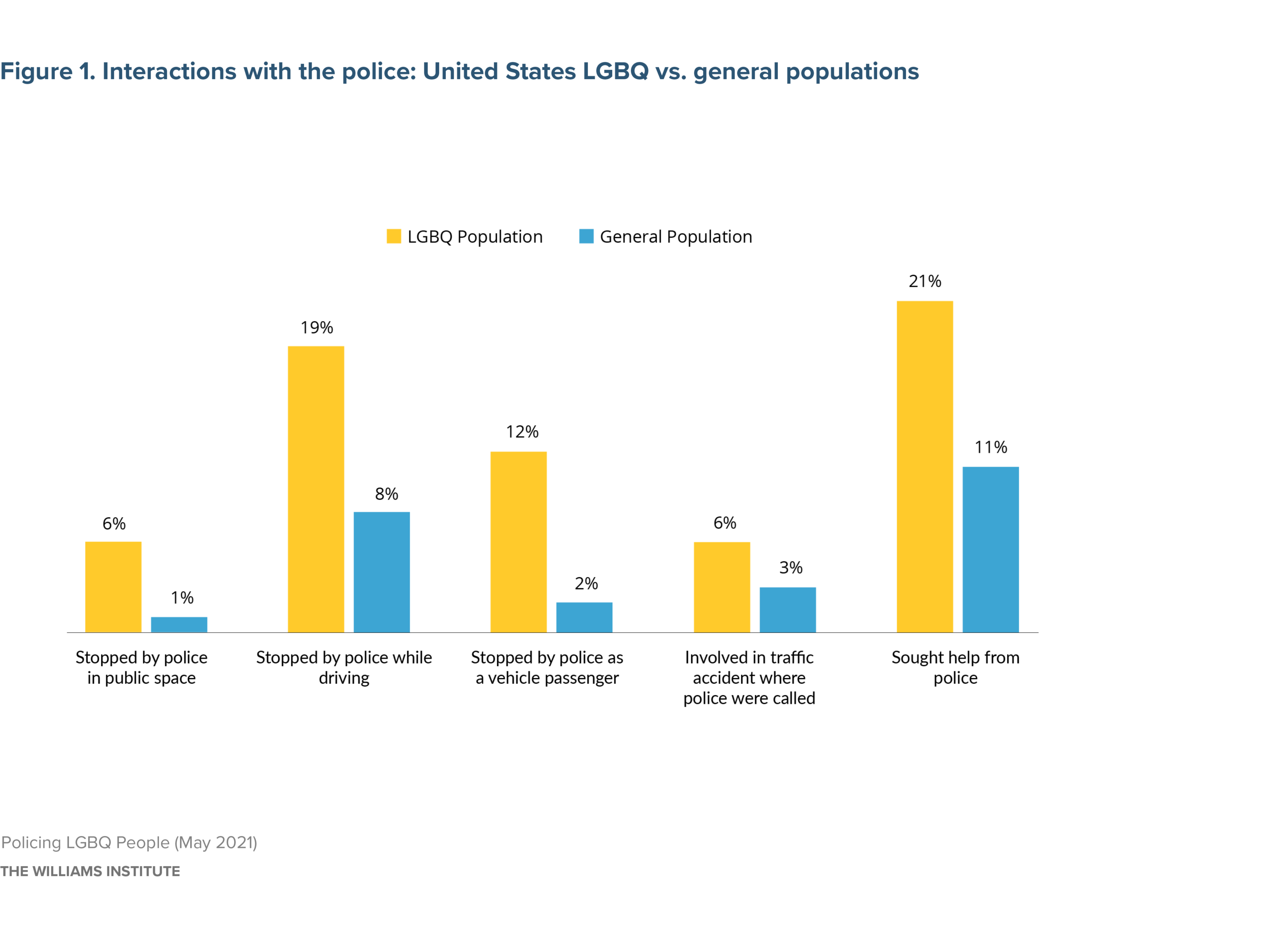
A larger proportion of LGBQ adults compared with the general population reported contacts with the police over a one-year period. This included being approached by the police, being involved in an incident that involved the police, and self-initiated contact with the police (Table 1). Compared with the general population, almost six times as many LGBQ people were stopped by the police in a public space (6% vs. 1%), and nearly seven times as many LGBQ people were stopped by the police for reasons other than involving a vehicle (driving or being a passenger). Additionally, twice as many LGBQ people approached or sought help from the police (22% vs. 11%) as compared to those in the general population.
Other findings include more common experiences of police stops while driving among LGBQ (19%) than non-LGBQ (8%) people, being a passenger (12% vs. 2%), or being involved in an accident to which the police were called (6% vs. 3%). The findings were similar across sex and race. In general, more LGBQ adults, both White and people of color, as well as female and male adults, reported contacts with the policy as compared with the general population. The groups did not differ in the average amount of contact with the police. Both adult LGBQ and people in the general population reported an average of 1.8 police contacts in one year, and this did not differ by sex and race. Among LGBQ people, 13% said they did not call the police even when they needed help (this was not measured in the general population so we cannot compare this figure). There were some statistically significant differences between Black and White respondents in the PPCS, but they are similar to the differences reported here for the general category of non-White. There were no statistically significant differences between Black and White respondents in the Generations sample (not shown).
Satisfaction with police interactions
The surveys then asked people to reflect on the most recent contact they have had with the police. Most people reported satisfaction with the police response in their most recent contact (Table 2). But compared with the general population, fewer LGBQ adults agreed that police behaved properly during their contact (81% vs. 91%). Additionally, more LGBQ people were unlikely to contact the police again (22%) as compared with the general population (6%). Fewer female LGBQ adults report satisfaction with the police (69%) compared to females in the general population (85%). Fewer female and White LGBQ people reported agreement that the police behaved properly (73% and 80%, respectively) compared to their peers in the general population (91% and 91%, respectively). Lastly, fewer female LBQ (33%), and both White and non-White LGBQ people (22% and 21%, respectively), reported that they were less likely to contact the police in the future compared to their general population peers (6%, 6%, and 7%, respectively).
*Bolded numbers indicate that the LGBQ group proportion is statistically significantly different than the general population proportion.
#The general population survey asks about participants’ “sex” with response options “male” and “female.” The data on LGBQ people come from the Generations study, which differentiated between assigned sex at birth and current gender identity. The LGBQ categories for female and male refer to sex assigned at birth. We use the term sex for consistency with the general population data. Transgender people were not surveyed in the Generations study and were not identifiable in the general population survey.
*Bolded numbers indicate that the LGBQ group proportion is statistically significantly different than the general population proportion.
#The general population survey asks about participants’ “sex” with response options “male” and “female.” The data on LGBQ people come from the Generations study, which differentiated between assigned sex at birth and current gender identity. The LGBQ categories for female and male refer to sex assigned at birth. We use the term sex for consistency with the general population data. Transgender people were not surveyed in the Generations study and were not identifiable in the general population survey.
Summary
More LGBQ adults than people in the general population have had interactions with the police, including when they were approached by the police and when they contacted the police. When we make these comparisons to the general population, we use this as a proxy for comparison to heterosexual cisgender adults, who make up 95.5% of the general population. The much higher rates of LGBQ adults reporting being approached by the police is consistent with the idea that LGBQ people are over-policed and raises the issue of bias-based profiling of LGBT communities in general.4 LGBQ adults are also less likely than people in the general population to report that the police “behaved properly” or that they would contact the police in the future. This may reflect the lower levels of trust the LGBTQ community has with the police, perhaps as a consequence of both over or under-policing, such as being stopped by the police for no cause, or when the police do not adequately respond to crimes against LGBT individuals. Notably, while LGBQ adults do not differ from the general population regarding satisfaction with the police, LGBQ women were less satisfied compared to women in the general population, which is perhaps a function of criminalization of non-heteronormativity of LGBQ women. Although data about transgender people were not available in the datasets analyzed for this brief, research indicates that transgender people, particularly women of color, are at heightened risk of negative police interactions, including harassment and assault.56 As police reform is being discussed nationally, it is important that reforms include attention to policing of LGBTQ populations across race and gender.
Methods Note
Dataset
To obtain comparisons between the general population and LGBQ adults in the United States, we utilized the Bureau of Justice Statistics Police-Public Contact Survey (PPCS) 20157 for the general adult population prevalence estimate and the Generations study,0 a national probability sample of LGBQ adults, for the LGBQ prevalence estimate. Weighted proportions and 95% confidence intervals were obtained using the recommended sampling weights. Analyses were performed using Stata 14. Statistically significant differences were determined by non-overlapping 95% confidence intervals (assuming an alpha of 0.05).
Sonoma County Library is moving to the next stage of our Express Services model. Library doors are now open at 50 percent capacity, with a variety of service hours to meet your needs. There is no time limit for your library visit, and you don’t need to make a reservation (except for the Sonoma County History & Genealogy Library). See our new in-person hours at sonomalibrary.org/express.
Curbside service is still available by request during in-person open hours, with additional curbside hours at regional libraries.
Join us in reopening gradually and safely!Learn More
Thank you for being a member of the Sonoma County Library community. Visit our online library for thousands of films, TV shows, eBooks, databases, magazines, classes, videogames, and more. Be sure to check out open jobs at Sonoma County Library here.
Questions? Please call your local library branch or click here to send us a message.
¡Más Acceso a la Biblioteca!
La Biblioteca del Condado de Sonoma está avanzando a la siguiente etapa de nuestro modelo de Servicios Express. Las puertas de las bibliotecas ahora están abiertas para hasta 50 por ciento de capacidad, con varios horarios de servicio para todas sus necesidades. No hay un límite de tiempo para su visita a la biblioteca y no es necesario hacer una reservación (salvo para la Biblioteca de Historia y Genealogía del Condado de Sonoma). Consulte nuestros nuevos horarios de servicio en persona en sonomalibrary.org/servicios-express.
El servicio desde la acera todavía está disponible por solicitud durante las horas de operación, con horas adicionales de este servicio en las bibliotecas regionales.
¡Únase a nuestra reapertura gradual y segura!Más información
Gracias por ser miembro de la comunidad de la Biblioteca del Condado de Sonoma. Visite nuestra biblioteca en línea para ver miles de películas, programas de televisión, libros electrónicos, bases de datos, revistas, clases, videojuegos y mucho más. Revise aquí los puestos disponibles en la Biblioteca del Condado de Sonoma.
¿Preguntas? Por favor llame a su biblioteca local o haga clic para mandar un mensaje.
Oregon became the 14th US state to finally ban the so-called “gay and trans panic defence” on Sunday (23 May), leaving just 36 more states to go.
Governor Kate Brown has signed Senate Bill 704 which brings to an end defendants being able to use a victim’s sexuality or gender identity to defend their actions.
“The passage of this bill will send a strong and proactive message that the perpetrator of a second-degree murder will not be able to excuse the crime simply based on who their victim is,” said the bill’s chief sponsor, Democratic lawmaker Karin Power, the Washington Blade reported.
The decades-old legal strategy, which has historically been used to lessen charges or shorten a sentence, argues that the defendant acted in a state of temporary insanity because of unwanted sexual advances from LGBT+ people.
Both legal experts and queer advocates alike have argued that such a defence places blame onto the victim – effectively codifying homophobia into law.
ut, as SB704 reads: “The discovery of a victim’s actual or perceived gender, gender identity, gender expression or sexual orientation does not constitute reasonable explanation for extreme emotional disturbance or purposes of affirmative defense to murder in the second degree”.
Brown signing the ban into the books comes after the law glided through both houses this year, drawing unanimous approval in the state’s House of Representatives and a 29-1 victory in the Senate.
Oregon now joins 13 other states legislatures, alongside the District of Colombia, which have approved bans on the discriminatory panic defence.
Vermont and Virginia both banned the strategy this year, while similar measures are inching closer across a dozen state legislators, including Florida and Texas, according to the LGBT Bar, which is monitoring the passage of LGBT+ panic defence bans.
The panic defence itself stems from the outdated attitude that to be LGBT+ was to have a mental illness, according to a 2016 study by the Williams Institute. Such reviled notions have been widely discredited by leading healthcare organisations.
The lesbian singer and feminist activist who appeared in an iconic and recently resurgent 1975 photo wearing a t-shirt that read “The Future is Female,” has died. Alix Dobkin of Woodstock, New York, was 80.
An early leader in the music scene for lesbians and women, she passed away at her home from a brain aneurysm and stroke, according to Liza Cowen, her friend and former partner.
“Everything that she did was about being a public lesbian in the world,” said Cowen, who also took the striking photo.
In 1973, Dobkin formed the group Lavender Jane with musician Kay Gardner. With an all-women team of musicians, engineers and even vinyl pressers, they recorded the album “Lavender Jane Loves Women” — the first ever to be entirely produced by women, Cowen said.
Dobkin had been performing in the folk music scene in Philadelphia and New York in the 1960s, where she mingled with future superstars like Bob Dylan, according to her 2009 memoir “My Red Blood.” The title references her parents’ and her own membership in the Communist party.
When she came out as a lesbian, she forged ahead musically as an early leader and then mainstay of Women’s Music, a genre made by, for and about women. The genre fostered a whole network of publications, recording labels, venues and festivals starting in the 1970s.
“She became an iconic, kind of bigger-than-life figure for women who identified as lesbians,” said Eileen M. Hayes, author of the book “Songs in Black and Lavender,” a history of Black women’s involvement in the movement.
Dobkin sang songs like “Lesbian Code,” that playfully lists the many ways women interested in women identify each other. She also had a version of the alphabet song that begins, “A, you’re an Amazon.” Dobkin, who was Jewish, often played Yiddish songs during her performances and told stories she had heard growing up in Philadelphia.
She often performed for all-women audiences. An undated flyer advertising one of Dobkin’s shows explained all-women concerts offered women the opportunity “to come together to develop our culture as part of the process of taking control of our lives.” It asked men who supported the struggle against sexism not to attend.
A friend and collaborator, Kathy Munzer, produced shows for lesbians in Chicago for more than 30 years and called Dobkin “The Head Lesbian,” saying in a Facebook post that she inspired others to take pride in who they were.
Before the AIDS epidemic, lesbian and gay organizations operated separately, Hayes said. A prominent women’s festival where Dobkin played for years, the Michigan Womyn’s Music Festival, excluded transwomen from attending. In 2000, Dobkin wrote in defense of cis-women-only spaces while also seeking out conversations with transwomen and defending the right of everyone to love and be themselves.
“I especially worry about the narrowing of women’s identity and the erasure of women’s history. For voicing these considerations we have been attacked as ‘bigoted,’ ‘transphobic’ and worse, but are these not credible concerns?” she wrote in a column in the Windy City Times.
Reflecting on the fight about cis-women-only spaces, Hayes said at the beginning of the women’s movement, “it was a statement about, who is this movement supposed to benefit the most?”
The choice to create a parallel media ecosystem also reflected how difficult it was for women to break into the mainstream music industry, Hayes said.
“It didn’t support women as performers, and singers, and engineers and advertising people,” Hayes said. “It’s still very hard for women to break into the industry.”
Hayes called the newfound fame of the slogan “The Future is Female” and the reemergence of the photo of Dobkin “fabulous.”
The slogan originated from a woman’s bookstore in New York, Labyris Books, that had screenprinted a small run of the shirts, Cowen said. She photographed Dobkin wearing one for an article she was writing about lesbian fashion. An Instagram post in 2015 by @h_e_r_s_t_o_r_y, an account that chronicles lesbian history, featured the image. That inspired an unaffiliated company to print the T-shirts again and eventually introduced the slogan to a new generation, according to the New York Times.
“What we’ve learned through the women’s movement is that, yeah, the future is female, but it’s not a uni-dimensional female,” Hayes said. “It’s a female identity that is constructed with various threads, various backgrounds, and that is the corrective our new generation makes to the failings of earlier generations.”
In the weeks before her death, Dobkin’s family kept a public diary about her health that drew hundreds of comments from friends and fans. They wrote of how Dobkin’s music provided them comfort, guidance and community.
“And still you bring us together again, wonderous woman you are!!!” read one comment.
Before coming out as a lesbian, Dobkin married Sam Hood, whose father owned a folk music venue in New York where she had played. Dobkin is survived by him, their daughter, Adrian, and three grandchildren, among other family members, former partners and fans.
As a historian and witness to the women’s movement, Hayes said she was grateful to have had Dobkin’s musical and political leadership.
“I think that the death of Alix Dobkin just reminds us of how far we’ve come in terms of LGBTQ right to life,” she said. “And right to life as in the right to be.”
Daniel Hernandez Jr., the intern hailed as a hero for helping save the life of then-U.S. Rep. Gabrielle Giffords following an attempted assassination a decade ago, announced Thursday he’s running to represent her former district in Congress.
Hernandez was a 20-year-old college student in his first week interning for Giffords when he went to her “Congress on your corner” constituent event where a gunman opened fire killing six and injuring 13, including Giffords, in 2011. He kept the congresswoman conscious and applied pressure to her head wound until paramedics arrived.
His actions were widely praised during a period of shock and unity that gripped the nation. Then-President Barack Obama called Hernandez a hero at a memorial for the victims and also while he a guest at the State of the Union address weeks later.
A Democrat, Hernandez currently represents parts of Tucson in the state House of Representatives. He’s developed a moderate profile as one of a handful of Democrats who occasionally cross the aisle to work with Republicans, sometimes to the frustration of more progressive members of his party.
“Gabby Giffords continues to inspire me and I strive to follow her example of service for our community,” Hernandez said in a statement announcing his candidacy.
A trauma surgeon who operated on Giffords that day, Dr. Randy Friese, is also running for the former Giffords seat. He now serves with Hernandez in the House. State Sen. Kirsten Engel is also seeking the Democratic nomination.
Arizona’s 2nd Congressional District has historically been one of the most competitive in the state. It currently covers parts of Tucson, stretching to the state’s borders with Mexico and New Mexico, but the boundaries will change before next year’s election due to the every-decade redistricting.
Spain’s Congress of Deputies on May 18, 2021, rejected a landmark legislative proposal that would have allowed legal gender recognition based on self-determination, Human Rights Watch said today. The existing process for modifying gender markers on official documents is pathologizing for transgender people and does not recognize non-binary people.
Transgender people in Spain currently can only have the gender with which they identify legally recognized if they provide evidence of a gender dysphoria diagnosis. They must also undergo two years of medical treatment to “adjust” their physical characteristics to those “corresponding” to the gender marker they seek. The only categories available are “female” and “male,” meaning non-binary people must carry documents designating them as a gender with which they do not identify.
“Congress voted to hold Spain back when it comes to the rights and dignity of trans and non-binary people,” said Cristian González Cabrera, LGBT rights researcher at Human Rights Watch. “Spain’s current procedure for legal gender recognition is onerous, inadequate, and out of tune with advances on gender identity in Europe and beyond.”
The proposed reform, Legislative Proposal for the Real and Effective Equality of Trans People (122/000133), would have eliminated the requirement for medical or psychological evidence to modify one’s legal gender identity. It would also have allowed non-binary and blank gender markers on identity documents, acknowledging the rights and dignity of people who do not identify with a rigid gender binary. The change, as proposed, would have upheld children’s self-determination by allowing children and adolescents access to legal gender recognition.
The final vote on the legislative proposal was 78 in favor, 143 against, and 120 abstentions. To advance in the legislative process, the proposal needed support from the Spanish Socialist Workers’ Party (Partido Socialista Obrero Español, PSOE), the largest party in Spain’s governing coalition, whose deputies all abstained.
On May 3, Human Rights Watch wrote to Prime Minister Pedro Sánchez Pérez-Castejón, urging his government to back legal gender recognition based on self-determination and highlighting how the status quo on official documents can infringe on human rights. These include the right to privacy, the right to freedom of expression, and rights related to employment, education, health, security, access to justice, and the ability to move freely.
The World Professional Association for Transgender Health, an interdisciplinary professional association with over 700 members worldwide, has found that medical and other barriers to gender recognition for transgender people, including diagnostic requirements, “may harm physical and mental health.”
The proposed reform, as well as another similar bill put forth by the Equality Ministry, have been the subject of increased political conflict and even transphobic vandalism in recent months in Spain. Both, however, were in line with international and regional human rights standards, which support individual autonomy when it comes to one’s gender identity.
Principle three of the Yogyakarta Principles on the Application of International Human Rights Law in relation to Sexual Orientation and Gender Identity affirms that each person’s self-defined gender identity “is integral to their personality and is one of the most basic aspects of self-determination, dignity, and freedom.”
The International Covenant on Civil and Political Rights (ICCPR) provides for equal civil and political rights for all (article 3), everyone’s right to recognition before the law (article 16), and the right to privacy (article 17). Spain is obligated under the ICCPR to ensure equality before the law and the equal protection of the law for everyone without discrimination on any ground, including sex (article 26). The United Nations Human Rights Committee has recommended that governments guarantee the rights of transgender people, including the right to legal recognition of their gender, and that countries should repeal abusive and disproportionate requirements for legal recognition of gender identity.
The European Court of Human Rights ruled in Goodwin v. United Kingdom (2002) that the “conflict between social reality and law” that arises when the government does not recognize a person’s gender identity constitutes “serious interference with private life.” The Committee of Ministers of the Council of Europe called on member states in 2010 to take “appropriate measures to guarantee the full legal recognition of a person’s gender reassignment in all areas of life, in particular by making possible the change of name and gender in official documents in a quick, transparent, and accessible way.”
In the Americas, the Inter-American Court of Human Rights in a 2017 advisory opinion held that to comply with the American Convention on Human Rights, gender recognition procedures must be “prompt and, insofar as possible, cost-free” and “based solely on the free and informed consent of the applicant” without medical or psychological requirements.
A growing number of countries around the world have removed burdensome requirements to legal gender recognition, including medical or psychological evaluation, sterilization, and divorce. Countries like Argentina, Belgium, Denmark, Ireland, Luxembourg, Malta, Norway, Portugal, and Uruguay are at the forefront of individual autonomy over gender identity, providing for simple administrative processes based on self-declaration. Costa Rica and the Netherlands have taken steps toward the removal of gender markers on identity documents altogether.
“Congress’ decision to scrap the legislative proposal and maintain the status quo means that trans and non-binary people will still have to carry identification cards that do not correspond with their identities,” González said. “Spanish legislators should seize the next opportunity to ensure that Spain’s transgender and non-binary residents have their rights fully respected in law.”
$50$100$250$500$1000OtherDONATE NOW