An out lesbian has been picked to serve as the acting mayor of Anchorage, Alaska after her straight male predecessor resigned over a sex scandal.
Austin Quinn-Davidson made history with her appointment as the city’s new acting mayor, after a vote by the city assembly on Friday (October 16) picked her for the role.
The politician, who has served on the Anchorage assembly since 2018, will take over after the resignation of Ethan Berkowitz, who quit after admitting to an a “consensual, inappropriate messaging relationship” with a local TV anchor.
Her appointment as the city’s first woman and first gay mayor was backed by assembly chair Felix Rivera, who is also gay and had been tipped to take over the role himself beforehand.
Rivera, who is Latino and would have been the first person of colour to serve in the role, praised Quinn-Davidson as a “compassionate and dedicated public servant”, and assured those disappointed by the city’s record of all-white office holders: “Don’t you worry. It will happen sooner or later. If I were a betting person, I’d bet on sooner.”
He lauded the incoming acting mayor as an “an excellent communicator who sincerely cares about what you have to say, and will listen to all parts of our community”.
Quinn-Davidson will have a lot of work in her in-tray, with COVID-19 cases rising in the city and its economy faltering.
“I think the most important role of a mayor right now is to inspire trust in government, and to make people feel at ease during a time that is pretty tumultuous.
“I think revitalizing the economy and ensuring that small businesses can survive and that people can get back to work is key. Of course, that interplays with public health and safety, and those two are so aligned, we need to work together on both.”
The hard-won progress on LGBT+ rights in schools could be at stake as a new report finds homophobic and transphobic language is ubiquitous in educational establishments.
The new study by GLSEN, a national LGBT+ education advocacy group, found that just under 99 per cent of LGBT+ students in the US have heard offensive remarks about their sexuality or gender identity.×
Comments such as “that’s so gay” are still regularly thrown around playgrounds and campus cafeterias, which almost 92 per cent of queer students said made them feel “distressed”.
Almost 97 per cent of respondents stated that they had heard the phrase “no homo” at school, while more than 95 per cent reported hearing homophobic terms such as “dyke” and “faggot”.
About 69 per cent said they had experienced verbal harassment because of their sexual orientation, while just under 57 per cent said they had also been called names or threatened because of their gender expression.
A further eleven per cent said they had been physically assaulted, or “punched, kicked (or) injured with a weapon” because of their sexuality, the report noted.
The troubling results came from a survey of 16,700 LGBT+ students aged 13 to 21 in all 50 US states as well as the District of Columbia, Puerto Rico, American Samoa and Guam.
“This is a very significant wake-up call about how the progress we’ve won is directly under attack,” said Eliza Byard, the executive director of GLSEN, formerly the Gay, Lesbian & Straight Education Network.
“Where we are now is so different from where we were 20, 25 years ago in terms of how better things are. On the other hand, where we are is clearly still unacceptable,” she told Reuters.
Unfortunately the high prevalence of LGBT+ abuse isn’t isolated to schools: a recent Kantar survey across 14 countries and 24 industries showed that a quarter of LGBT+ people experience bullying in the workplace, and more than half suffer from “consistent high stress, anxiety and mental health problems” at work.
Mike Pompeo has defended his decision to address an overtly anti-LGBT+ group which reportedly led to an internal protest among “appalled” state department employees.
On October 3, the secretary of state delivered a keynote speech at a fundraising gala for the Florida Family Policy Council, an extreme anti-LGBT+ Christian organisation that advocates for conversion therapy and the repeal of same-sex marriage.×
Concerns were first raised by members of Pompeo’s advance team, who flagged the group to their supervisors after they discovered anti-gay flyers when scoping out the site of the event, the Miami Herald reported.
Several other state department employees also raised complaints after learning that the group’s website offers LGBT+ people “help leaving the gay lifestyle”.
Lisa Kenna, executive secretary at the state department, was alerted to the concerns and attempted to mitigate fallout from the event.
Pompeo ultimately gave a virtual address for the fundraising gala, which filled a ballroom with roughly 700 guests, but one source described several aides as “appalled” it still took place despite their concerns.
They add that afterward, Mike Pompeo highlighted his appearance in his latest “Miles with Mike” message to department employees.
A state department spokesperson downplayed internal dissension overthe secretary’s appearance at the event, but did not address the group’s views or answer questions on whether the secretary supports conversion therapy.
GLAAD launched “Drive the Vote,” a 4-part video series featuring interviews with LGBTQ voters across four battleground states: Pennsylvania, Ohio, Michigan, and Wisconsin. The series, created in partnership with leading global digital media company BuzzFeed, will launch on GLAAD’s YouTube and social media accounts, as well as on BuzzFeed’s Facebook, IGTV, and Twitter.
The series follows Mathew Lasky, GLAAD’s Director of Communications, as he drives across the country to talk with LGBTQ voters about the upcoming election, why they’re voting, and what issues matter most to them. The interviews were conducted according to COVID-19 safety guidelines, socially distanced, and with appropriate mask use. The series features interviews with Connie Ticho in Allentown, Pennsylvania; Letha Pugh in Columbus, Ohio; Jon Hoadley in Kalamazoo, Michigan; and Camden Hargrove in Menomonie, Wisconsin.
The first video in the series, released today, features GLAAD’s Mathew Lasky speaking with a young, non-binary voter, Connie Ticho, in their hometown of Allentown, Pennsylvania. The first episode was produced in partnership with Bradbury-Sullivan LGBT Community Center in Allentown. Check it on BuzzFeed’s Facebook below:
“Drive the Vote” is part of GLAAD’s get out the vote campaign. Viewers are invited to visit glaad.org/action to register to vote, request an absentee ballot, check their voter registration status, and more.
Each day, GLAAD will release state-specific voting information on each state profiled in the series. The series was created in partnership with Bradbury-Sullivan LGBT Community Center in Allentown, Pennsylvania; Stonewall Columbus, and Black, Out & Proud in Columbus, Ohio; Equality Michigan and OutFront Kalamazoo in Michigan; and the OutReach LGBT Community Center in Madison, Wisconsin.
“With LGBTQ issues largely left out of the political discourse around the upcoming elections, and completely absent from any of the presidential or vice presidential debates, it was important to GLAAD to speak with LGBTQ voters personally to hear what issues are most important to them this election season,” said Mathew Lasky, GLAAD’s Director of Communications and the host of Drive the Vote. “Together with BuzzFeed, we will amplify these stories from real LGBTQ people across America to remind the nation that LGBTQ issues simply can’t be ignored in 2020.”
“At BuzzFeed, we’re committed to representing our massive and diverse audience, celebrating their identities, and covering the issues that matter to them,” said Wyatt Harms, BuzzFeed LGBTQ’s Lead. “Through this partnership, we can help bring an LGBTQ lens to the upcoming election and deliver on our mission to make inclusive Queer media. We’re proud to use our platform to distribute GLAAD’s important work and amplify the voices of LGBTQ voters across the country.”
LGBTQ issues have been largely absent from the 2020 election cycle, with no mention in any nationally televised election events since the presidential candidates were nominated in August. The Trump administration has targeted LGBTQ Americans at least 180 times in policy and rhetoric since taking office in 2017. GLAAD continues to add pressure on news media to include LGBTQ issues as a part of their election coverage.
GLAAD is currently engaged in a 100 Days of Action campaign to educate LGBTQ people about what’s at stake during the 2020 election and to increase LGBTQ turnout at the polls in November. GLAAD’s recently released ‘State of LGBTQ Voters’ poll found that LGBTQ voters are highly motivated and prepared to vote. The poll also found overwhelming support from LGBTQ voters for Vice President Joe Biden (76%) in a head-to-head matchup against President Trump (17%).
GLAAD has also been activating supporters and followers, including the GLAAD Campus Ambassadors and alumni of the GLAAD Media Institute. As part of the campaign, GLAAD last month launched its Digital Doorknocking initiative, which is a grassroots effort to get GLAAD’s followers the tools to reach out to family and friends. By signing up, GLAAD’s followers gain access to exclusive graphics, videos, research and resources to share with friends, family, and fellow advocates between now and the election. Continue to invite your contacts to participate by signing up at glaad.org/knock.
For over three decades, Stephanie Byers taught music and band at the largest public high school in Kansas. After seeing how decisions made by state lawmakers affected her students, she decided to trade retirement for politics.
“They saw a bottom line, a number that needs to be worked with, and didn’t think about what that means when a student is staring at a textbook that is being held together by duct tape because it outlived its usefulness and the district didn’t have the money to replace textbooks,” said Byers, who is running to be the next representative of Kansas House District 86, which includes much of Wichita.
A Democrat who ran unopposed in the primaries, Byers will face off against Republican Cyndi Howerton, a businesswoman, in the November election. While Kansas is largely a conservative state, Byers is a strong contender in Wichita, a progressive enclave that has historically swung left.
If elected, Byers has vowed to fight for increased funding for education and Medicaid expansion in Kansas, one of at least 12 states that have not expanded the program under the Affordable Care Act. She has also made civil rights protections a pillar of her campaign in a state where, according to advocacy group Freedom for All Americans, “there are currently no explicit, comprehensive statewide non-discrimination protections” for LGBTQ people.
When Byers came out as transgender six years ago, she was largely embraced by her students and colleagues, an experience that pushed her to become a trailblazer for trans educators in her school district.
“I realized that when I came out as a teacher that I was blazing the pathway,” she said. “A lot of public educators that are trans may not necessarily come forward and come out during their careers, because the fact that there’s the fear of prejudice is going to be there.”
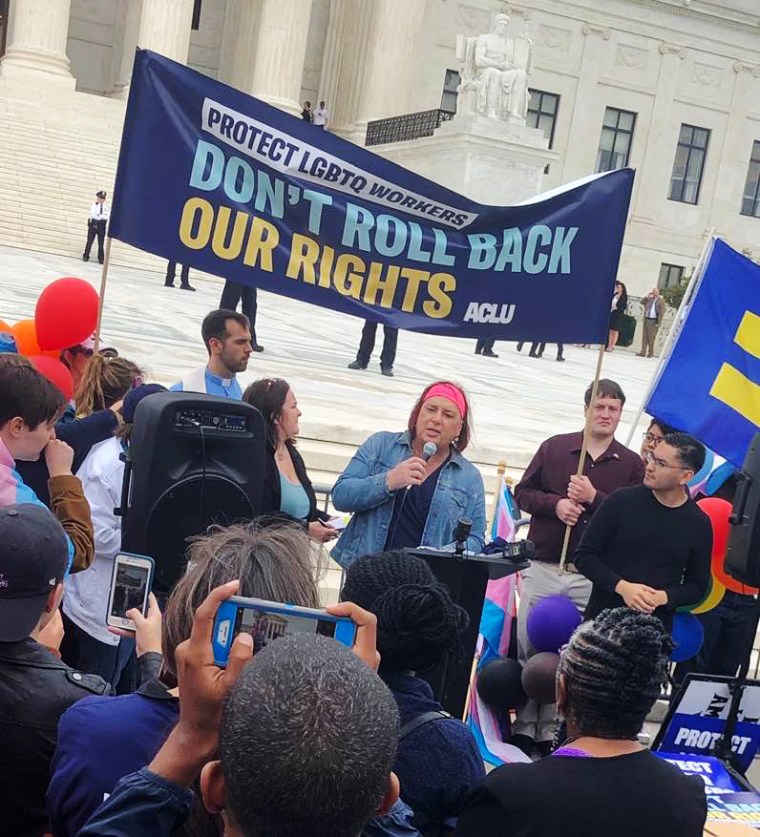
Stephanie Byers speaks on behalf of transgender educators and students at an ACLU rally outside of the Supreme Court in October 2019.Courtesy of Byers for Kansas
As Republican-backed anti-transgender legislation — including much designed to keep trans students out of public restrooms and off sports teams — proliferated in statehouses across the country, including in Kansas, Byers met with school officials and spoke at community events to educate the public about gender identity.
Last October, she spoke out on behalf of trans educators and students at an American Civil Liberties Union rally outside of the Supreme Court, which at the time was hearing arguments in cases that would determine whether employers had a right to terminate workers because of their sexual orientation and gender identity. In 2018, a year before she retired, Byers was named both state Educator of the Year by GLSEN Kansas and national Educator of the Year by GLSEN, the national LGBTQ youth advocacy organization with chapters across the country.
If Byers wins her election on Nov. 3, she will be the first out transgender lawmaker from Kansas. She is one in a “rainbow wave” of at least 574 LGBTQ candidates who will be on the ballot next month, according to a new report by Victory Fund, a group that trains, supports and advocates for LGBTQ candidates. Byers said politicians who are transgender are seen as novelties, and that’s something she hopes to change.
“It’s a part of who we are. It’s part of our identity, but it’s not the only thing. There’s so many other things we are passionate about as well,” she said. “It’s just a matter of normalizing that enough that it’s no longer a thing, and … it’s just a matter of what can we do to serve the communities that elected us?”
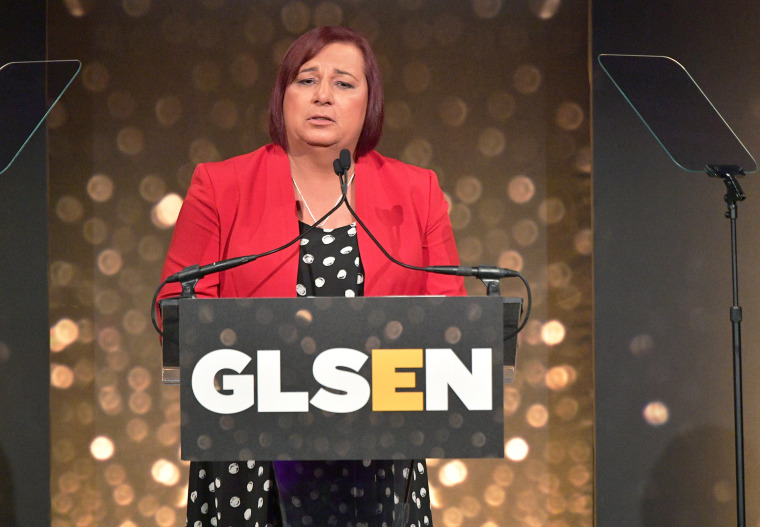
Educator of the Year honoree Stephanie Byers accepts her award at the GLSEN 2018 Respect Awards at Cipriani 42nd Street in New York on May 21, 2018.Dia Dipasupil / Getty Images for GLSEN file
The candidate, who grew up in neighboring Oklahoma, is a wife, parent of two adult sons and a grandparent of nine children. She’s a member of the Native American Chickasaw Nation and has deep roots in the working class. She said her father, a longtime U.S. Postal Service worker, and her mother, who served as national vice president to the American Postal Workers Union Auxiliary, showed her the struggles that working-class families face.
“I’m a parent, I’m the grandparent, and I know the challenges that families face at this time,” Byers said, “and that’s who I want to be a voice for — for those families that need somebody who stands up for them.”
Equality California and LGBTQ Victory Fund condemned San Diego mayoral candidate Barbara Bry for repeatedly refusing to denounce homophobic and false attacks on her openly gay opponent California Assemblymember Todd Gloria. The Assemblymember is now receiving threats of physical violence — including death threats — on social media. The threats are being investigated by the San Diego Police Department.
The threats come after a campaign by right-wing media and activists to spread lies about Senate Bill 145, which changes California law to give judges the same level of discretion when determining legal penalties for LGBTQ+ people as it does for straight people in certain crimes (USA Today fact checks the bill here). SB 145 was strongly supported by the California District Attorneys’ Association, the California Police Chiefs’ Association and the California Coalition Against Sexual Assault. The misinformation campaign has provoked a barrage of homophobic attacks against Gloria – including the death threats (seen here: 1, 2, 3). Bry repeatedlyrefuses to condemn the homophobic nature of the misinformation campaign or the threats of violence against Gloria.
Among the most prominent right-wing media outlets promoting the falsehoods is KUSI. On Wednesday, the president of KUSI Michael Dean McKinnon, Sr., along with Martha McKinnon, each maxed out to Bry’s campaign.
“Just like Donald Trump refuses to condemn white supremacy, Barbara Bry is refusing to condemn homophobia,” said Equality California Executive Director Rick Chavez Zbur. “Barbara Bry’s willingness to lie about civil rights legislation supported by law enforcement and survivors’ advocates and to pander to far-right, anti-LGBTQ+ extremists says a lot about her character. San Diegans deserve a mayor who will unite the city and stand up to violent extremists. Barbara Bry has shown us repeatedly that she’s unwilling to be that mayor and unfit to lead America’s Finest City.”
“Barbara Bry is putting politics and self-interest before morality and leadership, emboldening the ugliest segments of our society by refusing to condemn homophobia and falsehoods,” said Mayor Annise Parker, President & CEO of LGBTQ Victory Fund. “Barbara is thriving on the mischaracterizations of Senate Bill 145 – which does nothing but equalize the legal implications between LGBTQ people and straight people – because she believes it will benefit her campaign. Her early condemnation of these lies from right-wing extremists would have defused the internet trolls now threatening Todd’s life.”
After Bry attempted to shift blame for her refusal to condemn anti-LGBTQ+ hate onto Assemblymembers Lorena Gonzalez and Tasha Boerner Horvath, the San Diego legislators pushed back:
“Please don’t try to justify your inability to distance yourself and denounce the support of hate-filled extremists like DeMaio & Gastelum & Trump’s SD Republican Party by in any way aligning yourself with my vote,” tweeted Gonzalez.“I fully support @ToddGloria & am disgusted by these alliances.”
“Homophobia doesn’t have a place in our politics, Barbara Bry,”tweeted Boerner Horvath.“These attacks on @ToddGloria are despicable. You should denounce them unequivocally, not make excuses for them.”
Todd Gloria will be the first openly LGBTQ+ person and first person of color elected mayor of San Diego if he wins in November.
###
Equality California is the nation’s largest statewide LGBTQ civil rights organization. We bring the voices of LGBTQ people and allies to institutions of power in California and across the United States, striving to create a world that is healthy, just, and fully equal for all LGBTQ people. We advance civil rights and social justice by inspiring, advocating and mobilizing through an inclusive movement that works tirelessly on behalf of those we serve. www.eqca.org
LGBTQ Victory Fund works to change the face and voice of America’s politics and achieve equality for LGBTQ Americans by increasing the number of openly LGBTQ elected officials at all levels of government. victoryfund.org
It is with a heavy heart that after 20 years in business supporting our work here at Face to Face that we have made the difficult decision that our 3 Monkeys Thrift store will be closing its doors byDecember 15th. These challenging times have made us look closer at our operations and know that this is the best decision for us in being fiscally responsible to the organization.
A huge debt of gratitude is owed to our Store Manager Richard Chole along with Roger Lloyd, Monica Hostnick and a team of amazing volunteers who have been truly dedicated to the store and the mission of ending HIV in our county. To our patrons who passed through our doors all these years we thank you for your support. We will miss seeing you.
Please note that we will no longer be accepting donations at this time but will be offering some amazing deals on a daily basis until we close our doors!
In the meantime, please do stop on by and give us a “simizal” from behind your masks!
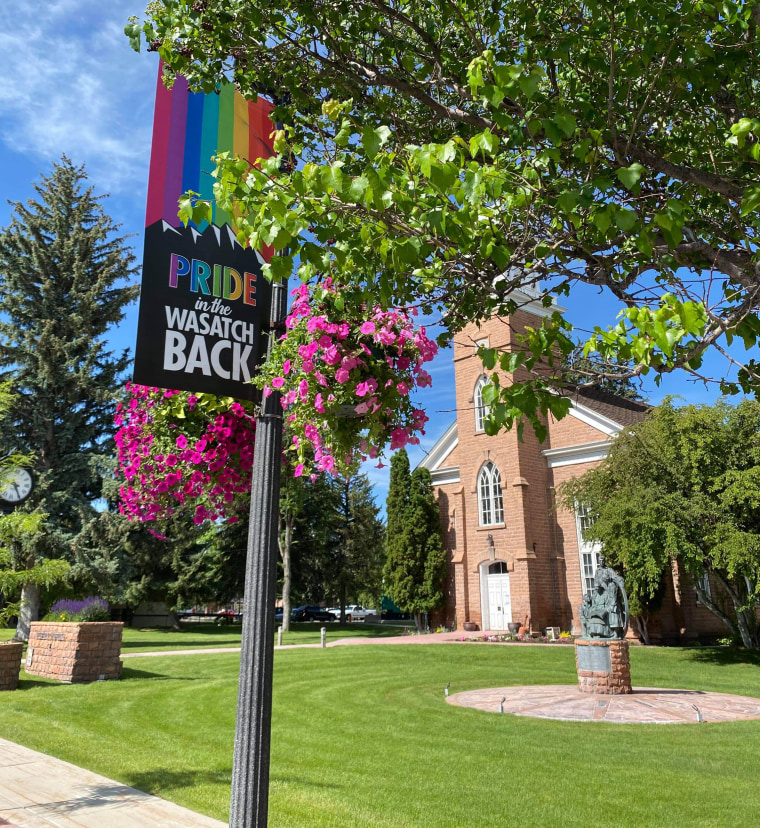
For the past two years, residents in the small Rocky Mountain town of Heber City, Utah, have seen their main street bedecked with rainbow banners in celebration of Pride Month in June.
However, after the City Council voted for a controversial ordinance regulating banners, LGBTQ advocates said they fear the colorful displays will be a thing of the past.
“It feels like a slap in the face,” said Allison Phillips Belnap, 47, a local real estate attorney who raised $3,553 through a GoFundMe campaign to purchase and install the banners on city lampposts.
The new ordinance, passed in August, requires banner applications be reviewed by the city manager, with appeals submitted to the council for review. Any event or message promoted on the signage must be sponsored by Heber City, Wasatch County or the Heber Valley Chamber of Commerce, and events must be both nonpolitical and nonprofit. Due to the ongoing debate within the community over whether Pride banners are “political” speech, and since the new ordinance bans political banners, it’s unclear whether city officials will approve them next June.
Heber City Mayor Kelleen Potter, the mother of two LGBTQ teens, opposed the ordinance.
“It has pretty much eliminated the option of private citizens funding banners and requesting them to be hung on Main Street, unless they are able to get sponsorship from the city, the county or the chamber, and that sponsorship means some financial sponsorship,” she said.
Prior to the ordinance, residents could apply to display banners on city lampposts for a fee of a few hundred dollars, so long as banners were noncommercial, according to Potter. Banners were approved by the public works department, and if public works had concerns about an application, they sent it to Potter for approval. Typically, banners advertise holidays and local events, such as Veterans Days and Heber Valley’s sheepdog competition, Potter said. No one questioned the process until June 2019, when residents saw their downtown adorned in rainbow banners for the first time.
A day after they appeared along Main Street, residents filled a city council meeting to voice divided opinions over them. While many were thrilled, others saw the rainbow banners as government-sanctioned “political speech,” according to Potter. She said city officials began receiving phone calls and emails from people who wanted to know if they could hypothetically apply to install flags with anti-abortion or anti-pornography messages, or with Ku Klux Klan or Nazi symbols, though no one actually applied to install such banners. Still, the inquiries sparked debate among city officials over whether an ordinance was needed to regulate them.
“No one ever gave me a specific example besides those that we could dismiss easily as hate speech,” said Potter, who had approved the Pride banners the past two years.
‘Are we the silent majority?’
Home to about 16,000 people, Heber City is a microcosm of how small towns across America are adjusting to evolving attitudes around gender and sexuality.
Last year, Mayor Wally Scott of Reading, Pennsylvania, canceled a Pride flag ceremony, calling the flag a political symbol. After criticism, he reversed his decision, and the rainbow flag flew over the city last June.
This past June, debate swarmed in Woonsocket, Rhode Island, a town of about 42,000, after the town’s first Pride flag was relocated to what many residents considered a less visible location. That same month, officials in Foster City, California, a town of about 34,000, refused a request to raise a Pride flag outside the city’s municipal building in celebration of Pride Month. Councilman Sam Hindi told the Bay Area Reporter that doing so would open the door for hate groups to fly banners in the city.
Just last month, after some residents in Minot, North Dakota, voiced anger over a rainbow flag that was temporarily hoisted outside city hall, a lesbian council member came out publicly in fierce defense of the flag. Her speech was captured in a now-viral video posted online. Minot has since banned flags other than the American flag until it decides on an official policy.
Throughout Utah, rainbow flags are becoming common and increasingly controversial. Last year, Project Rainbow, a small Salt Lake City-based nonprofit, rented out rainbow flags for $14 that Utahans could stake in their lawns for the duration of their city’s Pride festivities. The group staked about 1,400 flags, and raised about $20,000, which it donated to local LGBTQ centers. The flags were not all well-received: The group received backlash on social media from people accusing it of “forcing their beliefs” on local communities, according to the group’s founder, Lucas Horns. Horns estimated that about 10 percent of last year’s flags were stolen or vandalized.
This month, for National Coming Out Day on Oct. 11, the group staked 3,000 Pride flags.
“It does seem like there was an uptick in stolen flags and particularly vandalized flags,” Horns said in an email to NBC News. “A number of people found their flags torn or written on or even lit on fire, which I think speaks to a more emboldened hatred. But with that said, more people signed up for flags than ever before and were more excited about showing love and support to the LGBTQ community than ever.”
Heber City, Utah.Jeff Mclean
When Pride banners were installed along Main Street in Heber City this past June, there was less controversy than there had been the year prior, according to Mayor Potter. Still, residents took to the town’s local “Ask (Heber, Utah)” Facebook group to debate them. One mother expressed frustration over having to explain the meaning of the rainbows to her young children.
“As a Christian, our family believes that marriage is between a man and a woman. I’d like to think that there are other people in this valley who feel the same way. Are we the silent majority? If you still believe in Christian values, please speak up,” the woman wrote.
In August, after the second wave of backlash, the City Council voted to pass the banner ordinance. City Council Member Ryan Stack took to the “Ask (Heber, Utah)” Facebook group to explain why he voted in favor of the measure.
“By playing favorites and choosing only those banners it wants to see, a governing body engages in illegal viewpoint discrimination,” he wrote. “I supported removing the element of discretion by allowing only government speech on the banners. Yes — this prohibits private banners on Main Street. But it also protects the City in the stronger way to insulate it from potential legal claims when it comes to decisions regarding banner display.”
Heber City Council Member Mike Johnston, who also voted for the ordinance, told NBC News that it does not ban Pride banners, but is rather a way to keep out potentially hateful and divisive messages.
“If we decide — and I hope we will — that Pride is something we want to support, then we will do that as a city council, as elected officials, who are elected to make the decisions and take the heat,” Johnston said. “I think we’re big girls and big boys, and we can make those decisions, but it’s tough when you let anybody in the public submit banners to put up, and basically, they’re making a free speech statement that, ‘You have to let me do that, because that’s what you do, you let everybody do it, so you have to let me do it.’”
Political speech or symbol of inclusion?
Phillips Belnap claimed Heber City council members passed the ordinance to appease a religious minority who opposed the banners. She said the ordinance will likely prevent her from installing them next year, since it will require her to organize an event, such as a Pride festival, with financial sponsorship from the city, county or chamber of commerce.
“We’re not going to be able to get this council to sponsor a Pride festival or to get the county to sponsor a pride festival,” she said, referring to the ongoing debate over whether the banners are “political.”
She rejected criticism that her banners are political symbols. A lesbian who left the Church of Jesus Christ of Latter-day Saints (commonly referred to as the Mormon Church) after multiple suicide attempts, Phillips Belnap said the banners were intended to reduce suicide among local LGBTQ youth.
“We have a large number of people who are closeted and at high risk of suicide, because they feel like coming out is the equivalent of ruining their lives and ruining their family’s lives,” she said.
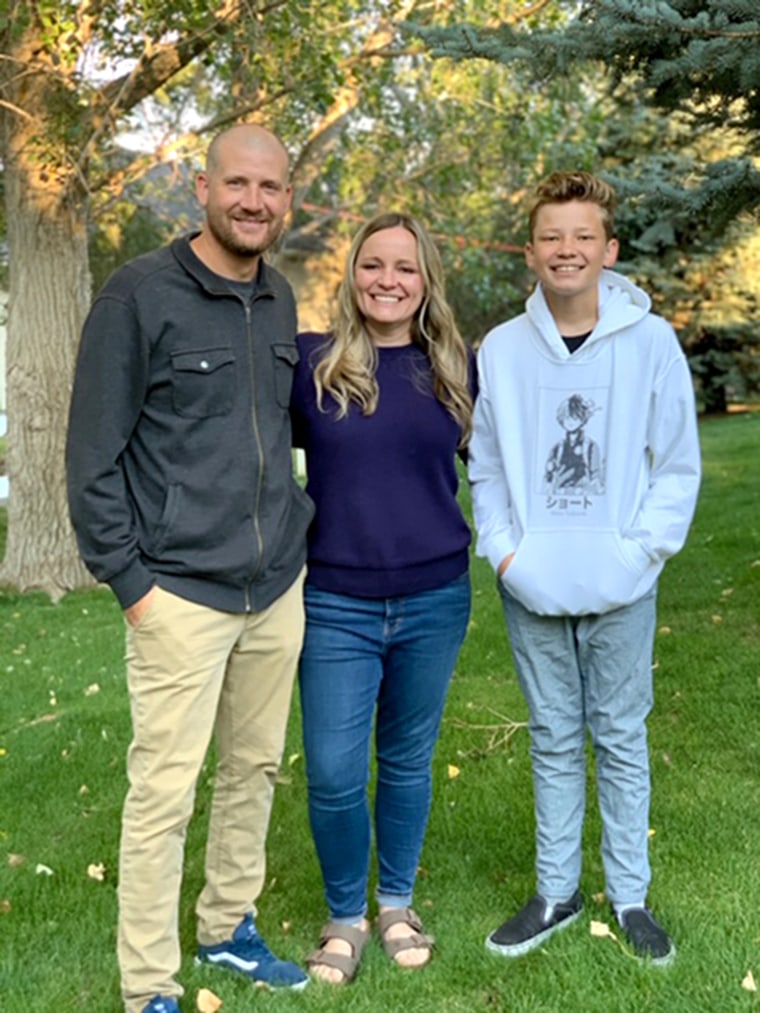
Ben and Jamie Belnap with their son, Luke,Courtesy Jamie Belnap
Heber City resident Jamie Belnap, 41 (no relation to Phillips Belnap), whose 14-year-old son, Luke, is openly gay, said the banners “made us feel great” in a town where few LGBTQ people feel visible.
“Kids who don’t feel comfortable coming out yet, at least they know that our community is working towards being a welcoming place for them and that they’re seen and valued, so I know my son felt that way,” Belnap said.
Deeply conservative Utah has begun to warm on LGBTQ issues. In 2015, the state’s Republican-dominated Legislature passed “the Utah compromise,” a law that made Utah the only solidly conservative state to pass some protections in housing and employment for LGBTQ people. Two years later, Utah became the first of eight conservative states to repeal a “No Promo Homo” law that prohibited discussing LGBTQ issues in schools. And this past January, it became the 19th state to ban conversion therapy for minors, a controversial practice that aims to change a person’s sexual orientation or gender identity. It was the most politically conservative state to do so.
One reason for this shift could be a growing tendency among Mormon parents to embrace their LGBTQ children. In recent years, the Mama Dragons, an online support group for Mormon moms of LGBTQ kids, has grown to thousands of members. The group, which Mayor Potter joined after one of her own children came out, has pushed acceptance for LGBTQ youth among families in Utah.
Despite progress, Potter said many LGBTQ teens still feel isolated in Heber City.
“In a self-reported survey, 12 percent of our students at our high school report that they are somewhere in the LGBTQ community — that’s a lot of kids. And one of the top three issues they’ve identified are mental health issues, and so as we all bang our heads against the wall about how to help these kids, this was something that really was helping, because it created a more inclusive and accepting feeling,” she said of the Pride banners.
Three hundred miles southwest of Heber City, a similar controversy flared in the small desert town of St. George, Utah, where rainbow banners fluttered on lampposts along the town’s main thoroughfare last September.
Pride of Southern Utah, a local LGBTQ advocacy group, raised $6,100 to install the banners in St. George, as well as the towns of Cedar City and Hurricane. The banners promoted the group’s annual Pride Week festival, which is typically held in mid-September. After raising the money, the group obtained a permit to have the banners installed.
After they appeared, city officials received at least two informal inquiries from a white supremacist group and another group that wanted to display banners with President Donald Trump’s slogan “Make America Great Again,” according to St. George Mayor John Pike. In an email circulated on social media that year, a St. George councilwoman referred to the rainbow Pride banners as “political statements,” unleashing a debate over whether a current ordinance surrounding public signage should be reevaluated. In response to the backlash, St. George put a moratorium on applications for lamppost banners until officials could revisit the city’s existing ordinance.
Because the Covid-19 pandemic forced the annual Pride festival to be canceled, the group has not applied to resurrect the banners this year, according to Pride of Southern Utah Director Stephen Lambert. But Lambert said he is confident that St. George officials will approve the banners in 2021.
On the topic of Heber City, Lambert said he understands the desire for an ordinance but also expressed concern.
“The real damage, I think will be if Heber [City] says, ‘Well, we’re just not going to do it, because we made a law that prevents you from doing this,’” Lambert said. “They need to figure out a way to keep out the riff raff and the negative and the hate, and keep in the people that need it.”
Despite the backlash against Pride banners, Phillips Belnap said the awareness they’ve created has helped encourage many in Heber City’s small LGBTQ community to come together. A local LGBTQ Facebook group that she started now has about 150 people, she said, and the local middle and high school have formed Gay-Straight Alliances clubs.
Jamie Belnap said her son was “very disappointed” by the ordinance but was also not surprised that it passed.
“I think it’s almost worse when the flags go up, and everybody feels seen and everybody feels like, ‘Oh, this is such a movement in the right direction’ … and then you see the backlash,” she said. And then to see the city give in to that backlash, she added, “That’s a pretty strong message — almost more so than if the flags had not been up.”
Texas social workers are criticizing a state regulatory board’s decision this week to remove protections for LGBTQ clients and clients with disabilities who seek social work services.
The Texas State Board of Social Work Examiners voted unanimously Monday to change a section of its code of conduct that establishes when a social worker may refuse to serve someone. The code will no longer prohibit social workers from turning away clients on the basis of disability, sexual orientation or gender identity.
Gov. Greg Abbott’s office recommended the change, board members said, because the code’s nondiscrimination protections went beyond protections laid out in the state law that governs how and when the state may discipline social workers.
“It’s not surprising that a board would align its rules with statutes passed by the Legislature,” said Abbott spokesperson Renae Eze. A state law passed last year gave the governor’s office more control over rules governing state-licensed professions.
“There’s now a gray area between what’s legally allowed and ethically responsible,” he said. “The law should never allow a social worker to legally do unethical things.”
The Republican-led Texas Legislature has long opposed expanding nondiscrimination protections to LGBTQ Texans in employment, housing and other areas of state law.
Alice Bradford, the board’s executive director, said she received an email from the governor’s staff recommending the change Friday, three days before the board’s Monday vote.
Francis pushed back against that idea. “Rules can always cover more ground as long they don’t contradict the law, which these protections did not,” he said.
U.S. health officials have identified more than 100 Texas counties, particularly in rural areas, with a shortage of social workers and other mental health professionals. Parks, the Houston social worker, said the policy change could impact LGBTQ clients’ access to mental health services in those areas.
“There’s research to show that members of the queer community … are at higher risk for trauma, higher risk for all sorts of mental health conditions,” he said.
Recently, some of our people have been asking that we create a roster of contact information – email &/or phone number – so people can get in touch with each other outside the groups. We’re happy to do so and to distribute it among those who want to participate. Let us know if you would like to be part of it and what information you would like shared. And in the meantime, we can always forward your contact information to someone else you would like to connect with to allow them to get in touch with you.
To join the Spahr Senior Groupon Monday, 7 to 8 pm,click the purple button below the Butterfly Heart. New participants are warmly welcomed!
Topical Thursdays12:30 to 2 pm October 15:What are you looking forward to?We are unquestionably living in difficult times. However, hopefully, we still can look forward to some things in our lives. What do you look forward to when you get up every morning? What do you look forward to in two years? Let’s talk about what keeps us going. And if you’re not sure what that might be for you, join the group to hear others’ sharing their inspirations – and perhaps being inspired yourself! (Thanks to Jerry Schmitz for the topic suggestion.) October 22: Solving Practical Issues If Living SingleMany of us live alone and, especially during sheltering in place, the aloneness builds upon itself. How can we help ourselves and each other through these challenges? Even without the pandemic, various practical issues exist such as what would we do if we have difficulty getting out of bed in the morning or just can’t face making our meals one day? Let’s talk about these potential challenges and help each other think & feel our way through them. (Thanks to Worth Miller for this topic suggestion.) Check-in Mondays7 to 8 pm We catch up with each other on how we’re doing and have unstructured conversations focused on listening.
It’s LGBTQ+ History Month & opportunities abound! Gay Mecca. Tina Dungan and Shad Reinstein have been endeavoring to capture the LGBTQ+ history of Sonoma County. On Oct. 14, 1:30 to 3 pm, Shad will be presenting the latest in-depth history of our community in the Russian River area, pre-Stonewall to 1985. The presentation will be offered on zoom through the auspices of Santa Rosa Junior College and is free of charge.To check out their informational flyer, click here.For more information or to register: cdungan@santarosa.edu. This is Trans Empowerment Month. The organization Stand with Trans has a month’s worth of events: here. The Spahr Center honors the Transgender Day of Remembrance, Friday November 20th at 5 pm. Watch for more details. The SF Gay Men’s Chorus celebrates its 43rd year with an online concert that features a world premier by Andrew Lippa and presents the Inspiration Award to Chasten Buttegieg for his advocacy for LGBTQ Youth. Oct. 17 @ 6 pm. The event is free but you must RSVP here. OUTwatch Wine Country LGBTQI Virtual Film Festival streams four documentaries this year. It features 1989’sTongues Untied, a powerful account in poetry and prose of black gay identity and the difficulties experienced in the straight Black community and the overall gay community. Tix and more here.
The Social Committee has been creating community for Marin LGBT seniors for the past 5 years. Here is a link to their activities for October:Social Committee October Activities Now they’re asking us to help them help us. They would love to have you fill out a simple survey asking us about what events we want them to offer us. Please write to them to request a copy of their survey at socialcommittee@comcast.netAnd sign up for their emails if you haven’t yet!
Also in this email:Volunteer opportunities to work from home to get people registered and committed to voting in November’s vital election. Spahr has skilled therapists ready to work with seniors on a sliding-scale basis.Rental Assistance available.Nutrition ResourcesBisexual Support zoom group forming at The Spahr Center.
Creating Community in the Midst of Sheltering-in-PlaceSee old friends and make new ones! Join us! The Spahr Center’s LGBT Senior Discussion Groupscontinue every Monday, 7 to 8 pm on Zoom
To Join Group by Video using Computer, Smart Phone or TabletJust click this button at the start time, 7 pm:Join GroupTry it, it’s easy!
To Join Group by Phone CallIf you don’t have internet connections or prefer joining by phone,call the following number at the start time, 7 pm:1-669-900-6833The Meeting id is 820 7368 6606#(no participant id required)The password, if requested, is 135296# If you want the meeting to call you to bring you into the group, notify Bill Blackburn 415/450-5339
Spahr’s skilled therapists are available to work with seniors on a sliding-scale basis. Write toinfo@thespahrcenter.org. A Bisexual Support Group is forming with The Spahr Center, facilitated by a therapist. Let Bill Blackburn know if you are interested. Whistlestop, recently renamed Vivalon, provides access to resources including rides for older adults; there is a 3-week registration process so register now if you think you may need rides in the future. They also offer free classes including zumba, yoga, chair exercises, & ukulele! Click here. Adult and Aging Service’s Information and Assistance Line, providing information and referrals to the full range of services available to older adults, adults with disabilities and their family caregivers, has a new phone number and email address: 415/473-INFO (4636) 8:30 am to 4:30 pm weekdays473INFO@marincounty.org
The Spahr Center is opening its Food Pantryto seniors who need support in meeting their nutrition needs. Items such as fresh meats, eggs and dairy, prepared meals, pasta, sauces, and canned goods are delivered weekly to people who sign up. Contact The Spahr Center for more information: info@thespahrcenter.org or 415/457.2487
Marin Center for Independent Living is offering various kinds of support to people with disabilities as well as older adults to prepare them for possible Public Safety Power Shutoff (PSPS).Click here: MarinCIL Has your employment or business been impacted by COVID-19? Check out these local resources…click here: WorkForce Alliance
Snap Back Assistance, up to $800 for COVID-19 affected workers:Call: 415/473-3300
Questions? Assistance? We have resources and volunteers for:grocery deliveryfood assistancehelp with technology issues such as using zoomproviding weekly comfort calls to check in on youtherapy with Spahr therapists on a sliding scale basisplus more!