Last week, the Centers for Disease Control and Prevention (CDC) released the national Youth Risk Behavior Surveillance results for 2019. It’s clear from the national data that many LGBTQ young people continue to suffer higher health and suicide risks than their peers. This follows the same trends present in an HRC analysis of the 2015 and 2017 data — LGBTQ students are more likely to experience victimization, violence and suicidality. In many areas of the data, transgender students are facing more disparities in 2019 than they were in 2017.
The data show that 43% of transgender youth have been bullied on school property. 29% of transgender youth, 21% of gay and lesbian youth and 22% of bisexual youth have attempted suicide.
Since the YRBS began including data on sexual orientation in 2015 and gender identity in 2017, we’ve seen consistently that LGBTQ youth face greater health disparities than their cisgender straight peers. This data continues to make clear a truth that we’ve long known — that LGBTQ students are not getting the support, affirmation and safety they need and deserve. We must ensure that adults are doing everything possible to support LGBTQ youth, especially those who are living at the intersections of multiple marginalized identities. Complete and robust data collection for our entire community is vital to putting systems and structures in place to support LGBTQ students. The Human Rights Campaign Foundation will continue to provide resources for LGBTQ students and educators across the country and will work with our network of youth-serving professionals to be sure they have the resources and tools they need.
Ellen Kahn, HRC Senior Director, Programs and Partnerships
In 2019, many states collected gender identity data. Data for 14 of these states across more than 107,000 youth are included in publicly available files on the CDC’s website. Below are initial key findings from HRC’s original analysis of these 2019 data:
29% of transgender youth have been threatened or injured with a weapon on school property, compared to 7% of cisgender youth; transgender youth were more likely in 2019 to have been threatened or injured with a weapon on school property than reported in 2017
16% of gay and lesbian youth and 11% of bisexual youth have been threatened or injured with a weapon on school property, compared to 7% of straight youth
43% of transgender youth have been bullied on school property, compared to 18% of cisgender youth; transgender youth were more likely in 2019 to have been bullied on school property than reported in 2017
29% of gay or lesbian youth and 31% of bisexual youth have been bullied on school property, compared to 17% of straight youth
29% of transgender youth have attempted suicide, compared to 7% of cisgender youth
21% of gay and lesbian youth and 22% of bisexual youth have attempted suicide, compared to 7% of straight youth
These data underscore the need and urgency for youth-serving professionals to be well equipped to meet the needs of LGBTQ youth. The HRC Foundation has many resources for LGBTQ students and educators, including our Welcoming Schoolsprogram, resources for LGBTQ youth and resources specific to COVID-19. If you’d be interested in speaking with an HRC expert about this data, I’d be happy to help connect you. After all, youth-serving professionals who have attended the annual HRC Foundation’s Time to THRIVE conference are 64% more likely to say they are prepared to promote physical safety of LGBTQ youth than youth-serving professionals who haven’t attended Time to THRIVE.
President Donald Trump added 20 additional names to his shortlistof potential Supreme Court nominees Wednesday, and the list — which includes sitting judges and U.S. senators — immediately drew criticism from LGBTQ advocacy groups.
“This list is teeming with individuals who have alarming anti-LGBTQ and anti-civil rights records, which should be disqualifying for any judicial nominee, let alone a nominee for the Supreme Court,” Sharon McGowan, legal director for Lambda Legal, said in a statement, characterizing many of the potential nominees as “dangerous, ultraconservative ideologues.”
The Human Rights Campaign, the country’s largest LGBTQ advocacy group, called the 20 names a “wishlist” from conservative groups that have a “record of hostility towards progress, tolerance and equality.”
“If the past is prologue, he may once again nominate people who would deny legal protections for LGBTQ people, take away the health care provided by the Affordable Care Act, undermine the fundamental right to vote, erode core civil rights laws, and fail to value the lives, needs and Constitutional rights of the LGBTQ community,” the group’s president, Alphonso David, said in a statement.
When asked about assertions that the names on the shortlist are anti-LGBTQ, the White House broadly defended the president’s record on judicial appointments.
“President Trump has an unmatched record of appointing judges who believe in applying the Constitution as written, not legislating from the bench,” White House spokesperson Judd Deere told NBC News in an email. “Once again, the President is being transparent with the American people about the qualifications he considers paramount and who he would consider for a seat on the High Court to ensure this exceptional nation built on the rule of law continues for generations to come.”
Those qualifications, which were mentioned along with the president’s additional list of potential high court contenders, include a commitment to “protect life,” “protect religious liberty,” “protect the 2nd Amendment” and “protect our borders.”
Shortlist’s new names
McGowan said the sheer number of people on Trump’s running listof over 40 potential Supreme Court justices “whose records are replete with anti-LGBTQ bias is both staggering and terrifying.”
Among the newly added names is Noel Francisco, who served as U.S. solicitor general from 2017 until earlier this year. McGowan said the Trump-appointee drove an “anti-LGBTQ agenda” in that role which included submitting a Supreme Court brief asserting that gay workers are not protected by federal civil rights law.
Also on the list is Lawrence Van Dyke, who currently sits on the 9th U.S. Circuit Court of Appeals. During a Senate Judiciary Committee hearing last year ahead of his 9th Circuit confirmation, Van Dyke broke down in tears when confronted with a scathing letter from the American Bar Association that deemed him “not qualified” and questioned his ability to treat LGBTQ litigants fairly. As solicitor general of Montana, a role he held from 2013 to 2014, Van Dyke argued against same-sex marriage in two cases and in favor of allowing photographers to deny wedding services to gay couples in another.
Another name causing “deep concerns” for LGBTQ advocacy groups, including Lambda Legal, is Allison Jones Rushing, who currently serves as a judge on the 4th U.S. Circuit Court of Appeals. One reason for the concern is the Trump-appointed judge’s ties to Alliance Defending Freedom, a legal nonprofit that the Southern Poverty Law Center has deemed a “hate group” for its espousal of beliefs such as the criminalization of homosexuality, legislation to restrict transgender people’s access to sex-segregated facilities and support of businesses to deny service to LGBTQ people.
A number of the newly added names to Trump’s shortlist — many of whom Trump previously appointed to lower courts — have already “lived up to the worst expectations” of LGBTQ advocates, according to McGowan.
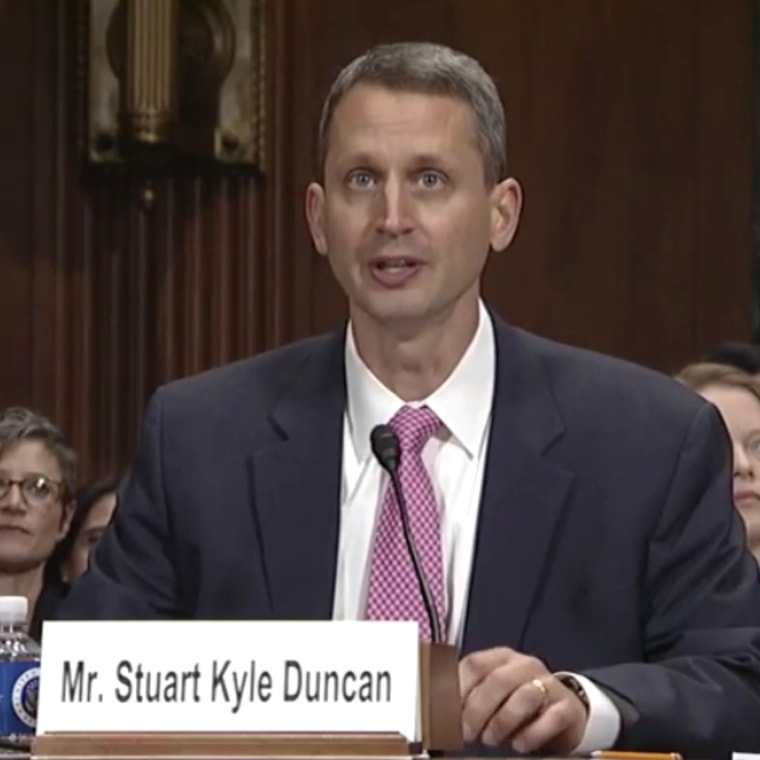
Stuart Kyle Duncan appears before the Senate Judiciary Committee as a U.S. 5th Circuit Court nominee in Washington on Nov 29, 2017.C-Span
“He even went so far as to say it was inappropriate to refer to a transgender person by their [preferred] pronouns,” McGowan said.
Prior to his 5th Circuit confirmation, Duncan was part of the legal team that represented Virginia’s Gloucester County School Board in its case against Gavin Grimm, a transgender high school student who was unable to use the restroom that aligned with his gender identity. And in 2014, he represented Louisiana in its bid to uphold the state’s ban on same-sex marriage.
Another 5th Circuit judge on the shortlist, James Ho, ruled against a transgender inmate seeking to undergo gender reassignment surgery in prison in December. McGowan called Ho “one of the most anti-LGBTQ judges on the court of appeals.”
Some of the most well-known additions to Trump’s shortlist include conservative Republican senators Tom Cotton of Arkansas, Ted Cruz of Texas and Josh Hawley of Missouri, as well as former U.S. Solicitor General Paul Clement, who argued in favor of the Defense of Marriage Act before the Supreme Court in 2013 on behalf of Congressional Republicans.
‘Lasting damage to civil rights’
In less than four years in office, Trump has confirmed over 200 judges — two to the Supreme Court, Neil Gorsuch and Brett Kavanaugh, and 53 to appeals courts. By comparison, President Obama confirmed two Supreme Court justices and 55 appeals court judges during his entire eight years in office.
According to a 2019 report from Lambda Legal, eight of 12 appeals courts — which sit just below the Supreme Court in the judicial hierarchy —are now composed of more than 25 percent of Trump appointees.
Many of Trump’s appointments have provoked criticism from gay and civil rights advocates — a third of the more than 50 circuit court judges nominated by Trump since he took office have a “demonstrated history of anti-LGBTQ bias,” according to the report. This “threatens to do lasting damage to the civil rights of LGBT people,” the report states.
The next appointment to the high court could shape the future of LGBTQ rights for decades. In June, the Court delivered a landmark ruling for LGBTQ workers, finding that Title VII of the 1964 Civil Rights Act protects them against discrimination on the basis of sexual orientation and gender identity. One of Trump’s high court appointees, Gorsuch, sided with the majority, while Kavanaugh voted against the broader interpretation of Title VII.
“The impact that another anti-LGBTQ nominee could have on the Supreme Court would be catastrophic,” McGowan said.
The court, currently divided 5-4 between conservatives and liberals, will hear a key gay rights case in the fall. In Fulton v. The City of Philadelphia, the court will decide whether faith-based child welfare organizations can reject same-sex couples and others whom they consider to be in violation of their religious beliefs.
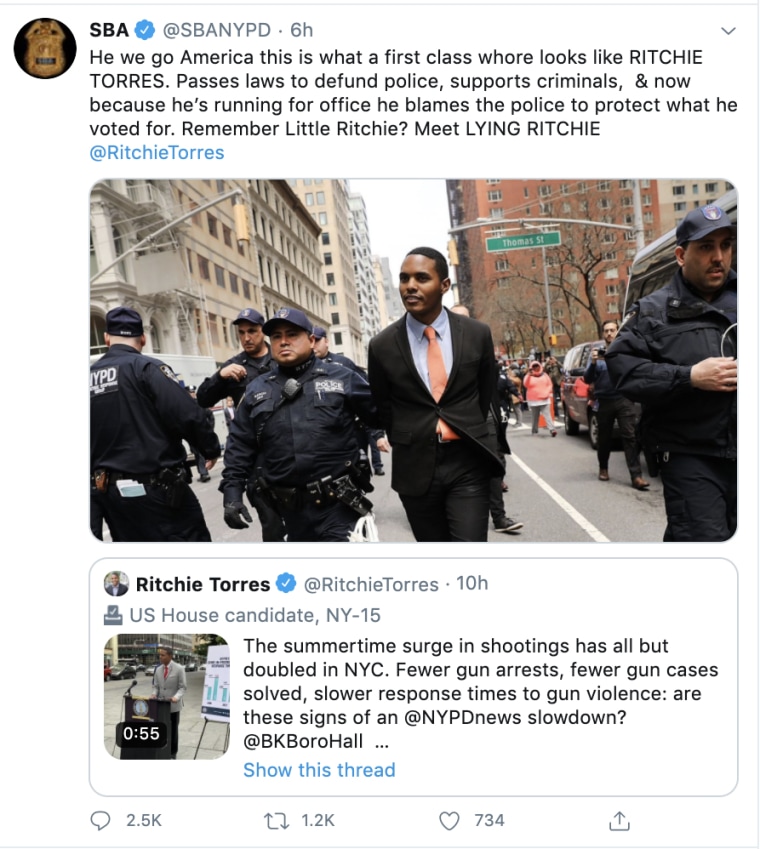
A gay New York City councilman and U.S. congressional candidate is calling on an NYPD union leader to step down after a tweet sent from the union’s official Twitter account called the councilman “a first class whore.”
The now-deleted tweet is credited to Ed Mullins, president of the Sergeants Benevolent Association, a union representing approximately 13,000 active and retired police sergeants, and was directed at Ritchie Torres, a Bronx Democrat running for Congress in November.
“He we go America this is what a first class whore looks like RITCHIE TORRES,” said the tweet, typos untouched, which was originally posted on Sept. 4. “Passes laws to defund police, supports criminals, & now because he’s running for office he blames the police to protect what he voted for. Remember Little Ritchie? Meet LYING RITCHIE.”
In a since-deleted post, the official Twitter account of the NYPD Sergeants Benevolent Association refers to openly gay congressional candidate Ritchie Torres as a “first class whore.”@SBANYPD
That social media message is just part of an ongoing war of words between Torres — who has called the sergeants union “a bona fide hate group masquerading as a union” — and the union, which has accused Torres of supporting anti-police violence.
The deleted tweet included a video of Torres criticizing the NYPD for making fewer gun arrests and solving fewer gun-related cases as the number of summertime shootings doubled in 2020 compared to last year. In the video, Torres calls for an investigation into whether the NYPD initiated a “work slowdown” and, if so, to what extent the slowdown has “driven the growth of violence in New York City.”
“Calling a black NFL player a ‘wild animal.’ Calling a Latina Health Commissioner a ‘bitch.’ Calling an openly LGBTQ Afro-Latino a first-class whore.’ There is NOTHING benevolent about the bigotry of the @SBANYPD. Ed Mullins must resign,” Torres wrote.
Torres’ message referred to a tweet last September by the sergeants’ union calling a Black NFL player a “wild animal” for allegedly punching a police officer, and a tweet from earlier this year calling a female health official a “bitch” after she said she had told a police official, “I don’t give two rats’ asses about your cops” in response to a request for face masks (she since apologized for the remark).
On Tuesday, Mullins issued a response to the call for him to step down, saying that he’d “never resign” and that his comments about Torres “had nothing to do with his race, ethnicity or sexual orientation.”
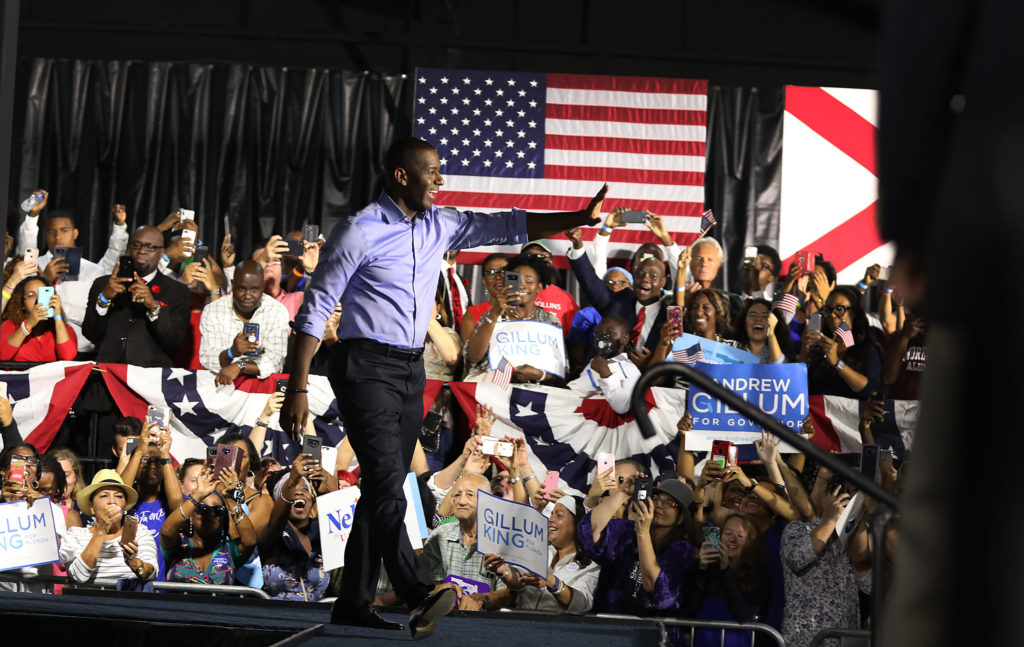
Andrew Gillum, former rising star of the Democratic Party, said he “cried every day” after being found in a Florida hotel room with a gay escort.
A former Tallahassee mayor who ran for Florida governor in 2018, Gillum’s political career plummeted in March when he was found in a Miami Beach hotel room with a sex worker who had reportedly overdosed on crystal meth.Read More
Now, Gillum and his wife are set to appear on chat show Tamron Hall for his first interview since coming out of rehab, one that the eponymous host said is “one of the most difficult” in her 27-year career as a journalist.
“Everybody believes the absolute worst about that day,” Gillum reflected in the pre-recorded interview, due to air Monday (14 September). “At this stage, I don’t have anything else to conceal.
“I literally got broken down to my most bare place, to the place where I wasn’t even sure if I wanted to live, not because of what I had done, but because of everything that was being said about me.”
Andrew Gillum interview was ‘heartbreaking’ says Tamron Hall.
Tamron Hall said her interview with Andrew Gillum interview was “intense, and at moments it was heartbreaking, upsetting and it was disorienting”.
“I’m only there because they’ve agreed, but I still felt like I was prying,” Hall, 49, told PEOPLE magazine.
“They agreed to talk with me, but as a journalist, there’s moments where you wonder: How far are we really supposed to go?”
An outpouring of first responders hit the Mondrian South Beach hotel midnight on March 13, where officers found Gillum “inebriated” and vomiting in the bathroom, according to a police report.
Paramedics treated a man found struggling to breathe, who police suspected had overdosed on crystal meth. He was later identified as Travis Dyson, an escort through the website Rent Men.
Former Florida Democratic gubernatorial candidate Andrew Gillum, a name once floated to be on the 2020 vice-presidential ticket. (Joe Raedle/Getty Images)
Gillium, 41, checked into rehab for alcoholism and depression two days after the incident – a stunning and swift fall for the promising politician once considered a potential kingmaker in the race for the 2020 Democratic presidential nominee, so sought after was his endorsement.
One grins knowingly at a friend over the camera’s shoulder, caught up in the joy of the moment. Another strikes an imposing pose in a pink beard. A third fixes the camera with an inscrutable gaze, daring us to ask a forbidden question. These are three of the iconic photographs of drag queens taken by San Francisco photographer Roz Joseph (1926–2019) that will be on display from September 21, when the GLBT Historical Society unveils an online selection of images drawn from its 2015 exhibition “Reigning Queens: The Lost Photos of Roz Joseph.”
Joseph, who passed away in December of last year, moved to San Francisco in 1970. Her series of remarkable photographs documenting the city’s drag balls of the 1970s was rediscovered when she donated her work to the GLBT Historical Society in 2010. As we put the finishing touches on the online show, board members and drag performers Nick Large and Kyle Levinger share their reflections on the photographs.
Nick Large: Looking at these photographs, many of them depicting drag queens associated with San Francisco’s Imperial Court, causes me to reflect on how much drag has changed in the past 40 years and even in my own lifetime. When I first started doing drag, I had never heard of RuPaul’s Drag Race. There were no makeup tutorials on YouTube, and you could get your entire look locally. My first drag purchase at Forever 21 was a sleeveless fake-leather jacket, which at the time represented $30 of the total sum of $150 I had in my bank account. It’s easy to forget that in the grand scheme of things, the existence of Drag Race is a very recent phenomenon. The “lost” photographs of Roz Joseph are a reminder of earlier times. Joseph’s photos represent a moment when drag was more a form of expression than a competition. As the photographs document, San Francisco’s thriving drag community is decades old. Many people came together and formed their own families through the medium of drag, even though they were sometimes shunned by the larger LGBTQ community. I wonder what these queens of days gone by would think if they witnessed a drag performance today. What would they say we have gained, and lost? What advice and stories would they have for us? In the age of COVID-19 and online streaming shows, I wonder how we can replicate that feeling of family-building in a virtual world.
Kyle Levinger: In 2020, many members of the LGBTQ community are unaware of or uninterested in the Grand Ducal Court and Imperial Court here in San Francisco. Roz Joseph’s photographs transport us back to an era when the Courts were key in helping to shape the LGBTQ community. Drag queens were central in the fight for equality, and the Courts played a vital role in founding and supporting nonprofit organizations to fight AIDS, feed the hungry and meet many other community needs. The Ducal and Imperial Courts also served as families for people when their relatives turned their backs. Today, the Courts do not have the same appeal as they once did. As acceptance of the LGBTQ community continues to broaden and drag becomes an increasingly popular form of entertainment, they have had difficulty attracting and maintaining membership. How can the Ducal Court and Imperial Court adapt to remain relevant in the community?
Groups of men in Cossack military uniforms have been filmed roaming the Russian city of Yekaterinburg during Pride week in “anti-LGBT patrols”.
According to the Russian news outlet E1RU, the men were on the look out for LGBT+ activists, but succeeded in targeting straight people who they thought looked queer.
The group briefly detained at least one “absolutely heterosexual” student, 19-year-old Alexander Zinovyev, because he had dyed hair and wore an earring.
“Why’d you dress up like this? Are you one of them?” Zinovyev recounted one of the men saying to him. “Do you even know that we control the propaganda of gayness among the people?”
He said the men who intimidated him carried certificates declaring themselves to be “Ural Voluntary Cossack Corps”. While most of the group were dressed in military camouflage, others were patrolling in civilian clothes.
The men reportedly intended to detain LGBT+ people whom they deemed to be in violation of Russia’s gay propaganda laws, and turn them in to law enforcement.
“The prosecutor’s office issued a warning to them about the inadmissibility of propaganda. We’ll be checking how the LGBT movement representatives comply with Russian legislation,” Oleg Bogunevich, the deputy head of a local Cossack organisation, told URA News.
He claimed that around fifty people were participating in the patrols, with some Cossacks travelling over 200km from Chelyabinsk to support their Yekaterinburg “brothers”.
Opponents of the LGBT+ activists have also organised a rival “traditional values” week that includes a family parade and an Orthodox Christian fair.
The patrols come after Russia adopted a set of wide-ranging constitutional changes, including a provision that defines marriage solely as a “union between a man and a woman”.
Same-sex marriage is already banned, but the constitutional re-write means marriages registered abroad will no longer be recognised, and makes the prospect of it ever being legalised dimmer than ever for Russian activists.
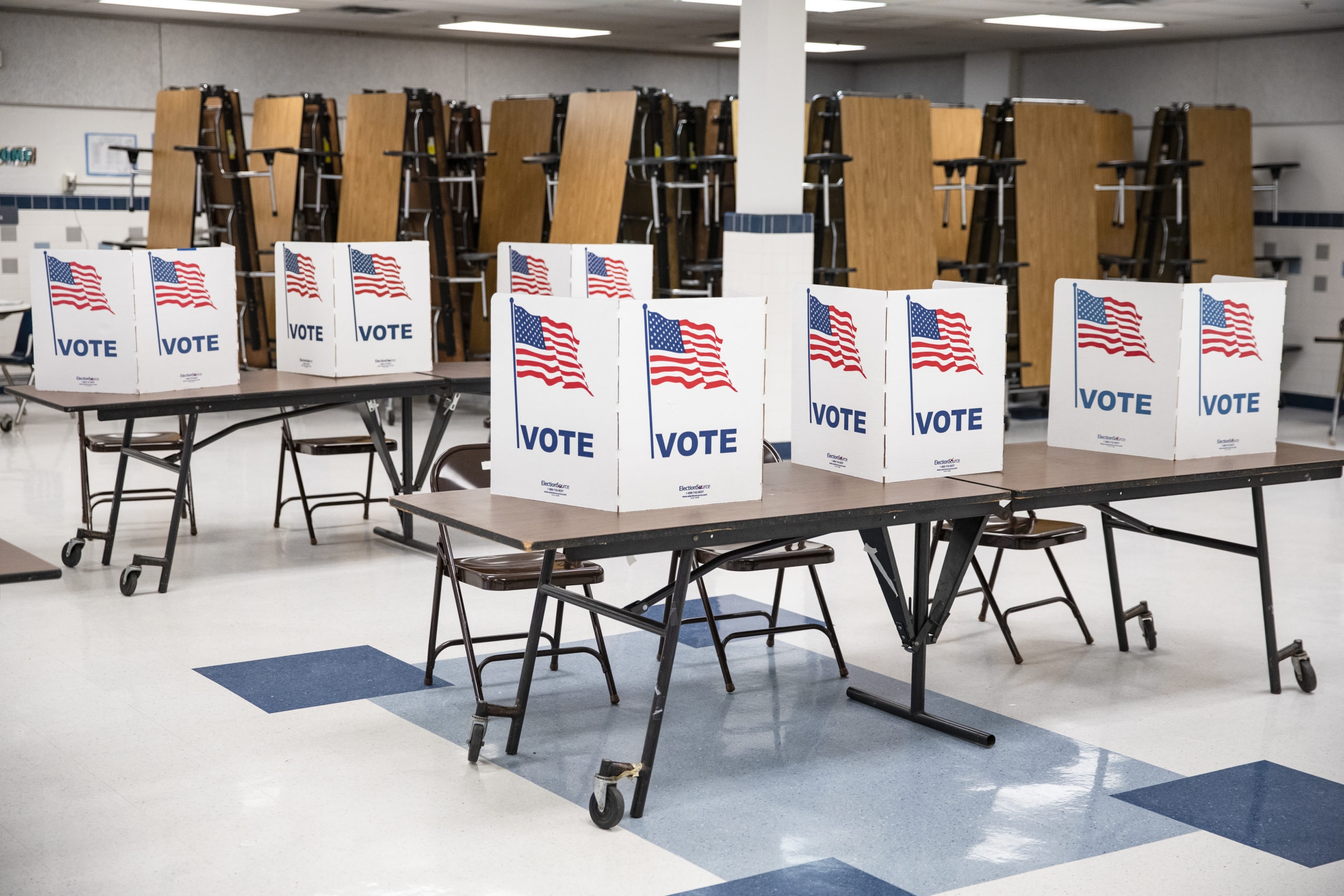
Transgender people are likely to face high barriers to voting in the 2020 election, a report has warned.
An estimated 378,000 transgender people who are eligible to vote do not have ID documents such as a driver’s license reflecting their name, appearance or gender identity, according to the study from the Williams Institute at the UCLA School of Law.
Some 35 US states have a form of voter ID law, which require voters to provide identification when voting. The strictest forms, in operation in 12 states, require a government-issued photo ID at the polls, with no alternative for voters who do not have one.
As well as disenfranchising minority groups who are less likely to have any form of government-issued photo ID, such laws present a barrier to trans people because they can “be challenged by poll workers or election officials who find that their voter registration information, ID, and appearance do not match”.
While many states would allow a person whose identity is disputed to cast a provisional ballot, the report’s co-author Jody Herman told Voice of America: “If those poll workers decide that those IDs don’t adequately or accurately reflect the person who is standing in front of them, they wouldn’t be able vote.”
Transgender people are likely to face high barriers to voting in the 2020 election (Samuel Corum/Getty Images)
The report notes: “There is no way to predict precisely how election officials and poll workers will treat transgender voters at the polls if their registered name and/or ID do not accurately reflect their gender.
“However, 32 per cent of respondents reported having negative experiences after presenting identification documents that did not match their gender presentation [while accessing services].”
Some 57 per cent of trans people in states with strict photo ID laws do not have an ID that reflects their correct name, according to the report.
Trans people in states without voter ID laws “may still face challenges related to potential mismatches between their gender presentation and their name as listed on their voter registration”, the report warns — with poll workers able to question “a person’s eligibility to vote if they do not believe that the name matches the voter, such as when a name is traditionally masculine or feminine and the voter appears to not match that gender”.
Trans people are worried they could be denied a vote.
Tori Cooper of Human Rights Campaign’s Transgender Justice Initiative told VOA: “We hear about folks in our community who feel so uncomfortable or who are made to feel so uncomfortable that they simply give up when they are challenged on their own identity.
“I know someone who is listed on a voter registration form as female, which does not accurately reflect their current gender identity, which is male. He’s afraid the way he looks and presents himself could actually keep him from being able to vote in person.
“Voting is not about challenging people on their identities. It is giving people an opportunity to express their constitutional right to vote.”
The gruesome killing on Saturday of a second transgender woman in northern Mexico has unnerved the local transgender community and amplified calls for greater protections in the Latin American nation.
The murder of Leslie Rocha in the border city of Ciudad Juarez came days after a transgender civil society group staged a protest there to demand greater protection.
Those demands were sparked by the murder late of Ciudad Juarez-born transgender activist Mireya Rodriguez Lemus, whose body was found earlier this week in Aquiles Serdan, a town in the northern Chihuahua state.
Last year 117 people from the LGBTQ community were killed in Mexico, up almost a third compared from 2018 and the highest since 2015, according to local advocacy group Letra S.
“They’re torturing them, they’re killing them horribly,” said Rocha’s aunt, Leticia Sanchez.
“Justice must be had because they deserve respect,” she said. “Why are they doing this?”
An LGBT+ rights protest at the Poland-Germany border has shone a light on the growing disparity between the two nations on queer issues.
While Germany has progressed significantly on LGBT+ rights in the past few years, introducing same-sex marriage and banning conversion therapy, the picture is far bleaker in Poland – where nationalist politicians have fuelled a rise in public homophobia and anti-LGBT+ extremism.
Around 2,000 demonstrators stood up to homophobia on Saturday (September 5) with a protest held jointly by activists in the closely-connected border towns of Slubice, Poland, and Frankfurt an der Oder, Germany, which are separated by a symbolic bridge across the River Oder.
German protesters carried signs and banners expressing their love for their LGBT+ Polish neighbours, as the groups marched across the border.
“This is our response to what is happening in other parts of Poland, where LGBT-free zones are being created,” Kacper Kubiak of the Institute of Equality told Gazeta Lubuska.
Mewa Topolska, a teacher from Slubice and one of the organisers of the march, told Reuters: “The only way we can change people’s opinions is through visibility.
“We don’t have full queer rights in Poland — and won’t for a long time so the main [aim of the march] is solidarity with the Polish side.”
Stella, a care worker in Frankfurt an der Oder, told the outlet: “No one should judge people according to their race, religion or [sexuality]. We are all born different and we don’t choose how we are born.”
A handful of counter-protesters turned up on the Polish side of the border, Reuters reports, bringing with them a van daubed with anti-LGBT+ slogans.
Politicians have repeatedly stoked anti-LGBT+ hatred in Poland.
LGBT+ people are a popular punching bag for Poland’s conservative government, with right-wing president Andrzej Duda narrowly winning re-election in July after making homophobia one of the core planks of his campaign.
In a “family charter” published ahead of the election, Duda pledged to “prohibit the propagation of this ideology” in public institutions and “defend the institution of marriage” as defined as a “relationship between a women and a man”.
With days to go until the run-off vote, Duda also proposed an amendment to Poland’s constitution that would ban same-sex couples from adopting children. He said: “I am convinced that, thanks to this, children’s safety and concern for the good of children will be ensured to a much greater extent.”
The European Parliament passed a resolution that strongly condemned the concept of LGBT-free zones in December, noting that they are “part of a broader context of attacks against the LGBT+ community in Poland, which include growing hate speech by public and elected officials and public media, as well as attacks and bans on Pride marches”.
In just a matter of seconds, Firas Naboulsi, a 23-year-old drag queen and bartender living in Beirut, lost everything he had worked for.
“We heard the first explosion, then the second one happened,” Naboulsi said of the Aug. 4 blast that tore through the capital city’s port area.
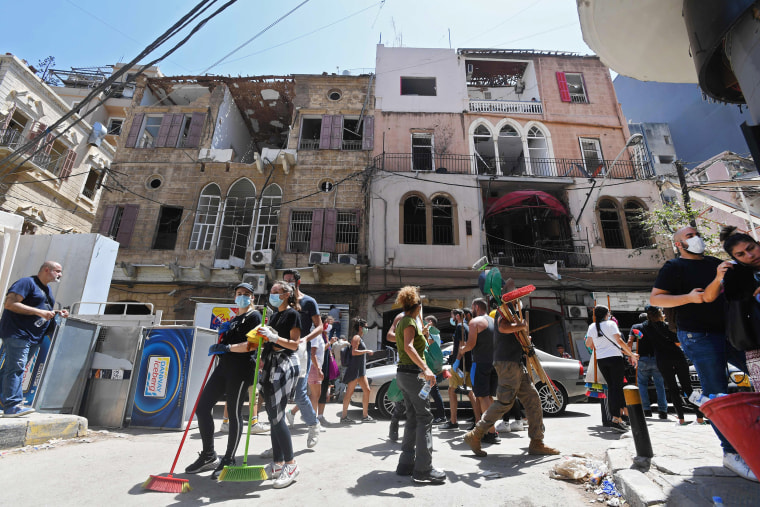
The colossal chemical explosion nearly destroyed his apartment, but Naboulsi and his housemate managed to escape injury and carry a friend with a broken leg to the nearest hospital. The incident, one of the largest non-nuclear explosions in history, killed more than 180 people, injured 6,000 and badly damaged the districts of Mar Mikhael and Gemmayzeh, famous for their centuries-old homes, art galleries, bars, restaurants and clubs.
“Going to this area, it just breaks me … We’ve lost most of the venues where we can be ourselves.”
FIRAS NABOULSI
In those districts, many LGBTQ people, like Naboulsi, also found tolerance and safety in a region not known for queer acceptance.
Naboulsi fled the conservative, Sunni-dominated northern city of Tripoli in 2018 for the relative freedom of Beirut. He said he found what he was looking for: acceptance, friends and a family he chose for himself. But now, following the blast, he said “it was all shattered.”
“Going to this area, it just breaks me,” he said of the torn-apart section of the city he calls home. “We’ve lost most of the venues where we can be ourselves in, and put aside that we’ve lost our jobs, our houses are damaged.”
Following the blast, Naboulsi’s parents, with whom he had not been in contact for two years, came to pick him up and take him back to his hometown. He said relatives had previously threatened him after he had revealed that he worked as a drag performer on social media, but he went anyway. The reunion, however, was short-lived.
“My parents are super religious, so my mom had this conversation with me where she was like, ‘Ah, you can’t stay here because my religion wouldn’t allow me to keep you here, because you’re gay, because you do a lot of things that we can’t accept,’” he said.
Volunteers clear the rubble in the Gemmayzeh neighborhood of Beirut on Aug. 7, 2020.AFP – Getty Images
Just three days after the blast, Naboulsi was back in Beirut. He said the feeling of rejection was more devastating this time than when he first left home.
“It hurt way more knowing with everything that happened in Beirut, you still … have to leave home because you’re gay,” he said. “I was so close to los[ing] my life, and the only thing you had to say was, ‘I can’t accept you, because my religion doesn’t allow me to.’”
The Arab world’s progressive enclave
Lebanon is considered relatively liberal in the Arab world, even though it remains one of the approximately 70 countries around the globe that still criminalizes homosexuality. Vocal advocates in the tiny Mediterranean country defend LGBTQ rights, and gay bars and clubs are allowed to operate. And while cases involving homosexuality still go to trial from time to time in the country, an 80-year old article in the penal code prosecuting homosexual relations has been undermined in recent years by a successful campaign waged by activist lawyers to obtain liberal judicial rulings, which have made it increasingly difficult to criminalize same-sex relationships.
In 2017, a judge in Lebanon ruled for the first time that homosexuality is not a crime, so long as it is not in public, with a minor or under coercion. However, some police officers still use the law as a basis to arrest and harass LGBTQ people, especially transgender people, according to Karim Nammour, an activist and lawyer for Lebanon-based nongovernmental organization Legal Agenda.
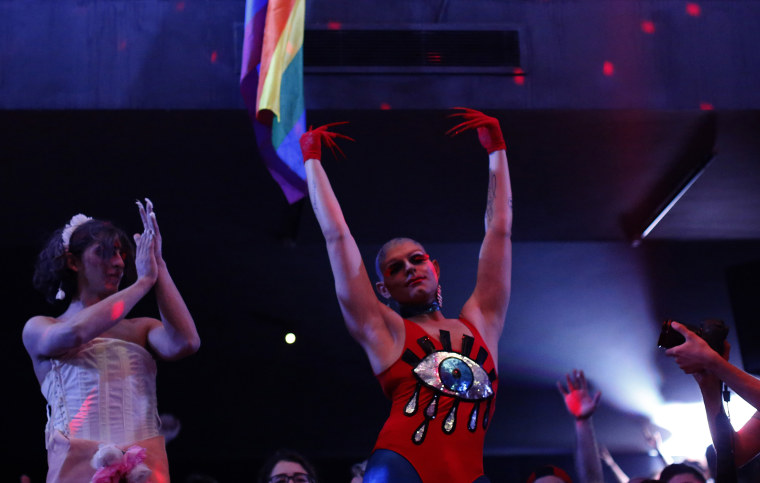
Elias, 24, who goes by the stage name of Melanie Coxxx performs during a Sunday drag queen show, called the drag ball, during Beirut Pride week, north of the capital Beirut on May 13, 2018.Hassan Ammar / AP
And while Lebanon is progressive when compared to its neighbors, Beirut is progressive when compared to the rest of Lebanon.
“When you want to look at Lebanon as a whole, at least from a personal queer perspective, you have to separate Beirut from the rest of it at least in terms of tolerance,” Sandra Melhem, an LGBTQ activist and owner of Beirut gay club Ego, said.
Melhem called the neighborhoods of Mar Mikhael and Gemmayzeh hubs for the city’s queer community and slammed government officials for storing nearly 3,000 tons of highly explosive ammonium nitrate in the heart of the densely populated capital city for years.
“They kind of took away our hope,” she said. “These are the streets we all live in — not all of us, but a lot of people that are young, that are artists, that are invested in changing the country.”
‘A sense of unity’
Melhem is among those who have turned their anger into action. When she saw that her LGBTQ neighbors had lost homes and didn’t have money to eat, she launched a fundraising campaign. She called out on social media to people who needed help and others who could provide it and was surprised by the response. She said the desire to help overcame a former lack of cohesion among different groups within the lesbian, gay, bisexual, transgender and queer community.
“We got a lot of people who were keen on supporting this and started sending food provisions, hot meal donations, detergents, clothes [and] medications,” she said. “We got three registered nurses on board volunteering, two paramedics … we were actually able to go on ground and start working.”
More than 50 volunteers showed up, including some from Beirut’s LGBTQ community whom she had never met.
“For the first time in years, we are all working for one purpose: to get each other out of this mess. Honestly, the past two weeks have shown a sense of unity I have not seen in a very long time,” Melhem said.
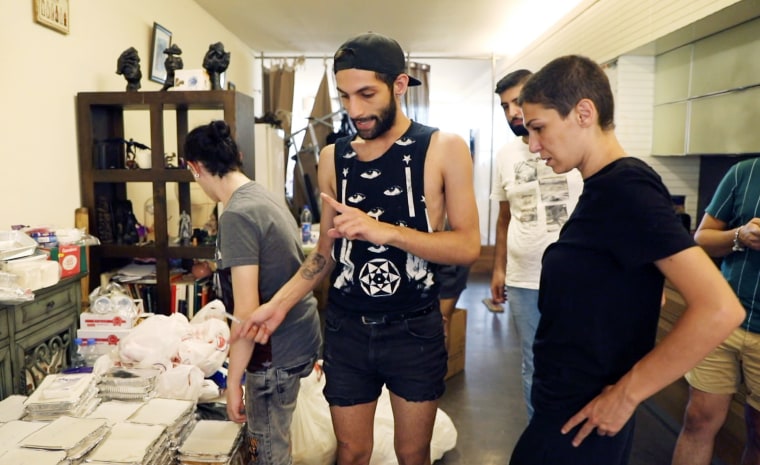
LGBTQ activist and bar owner Sandra Melhem, right, organizes the distribution of food and supplies with volunteer Firas Naboulsi in Melhem’s Beirut home.Mohamed Muslemany
She turned her spacious two-room apartment into a storage space for neatly stacked food trays, cases of bottled water and piles of care packages tailored to specific needs.
Omran Gharib, 26, a registered nurse, was among those who answered Melhem’s appeal on Instagram. He paid home visits to the injured to change dressings and listen to their concerns.
“The most common thing was they were scared of what happened, and they cannot handle the fact that they lost it all,” Gharib said. “They lost the places where they had so much memories, and now there is no place to be like themselves.”
Andrea Nagerian, a 23-year-old drag queen and makeup artist, lost his home in the blast and had to run to a hospital after suffering multiple cuts and internal bleeding. He stayed at Melhem’s home during his recovery and then joined the aid effort.
“The only way we can really use our anger to our benefit is by helping people or helping ourselves to get through the trauma,” Nagerian said. “Right now, we are really focusing on helping … marginalized groups as much as possible … people who are in the depths of poverty.”
Naboulsi has also found solace in helping. After repairing his ruined apartment enough to make it habitable, he spends most of his day at Melhem’s house.
“I’m around my friends and at the same time helping people, so I don’t have this free time to keep thinking about what happened, to keep thinking about what’s going to happen,” he said.
The aid and outreach from the city’s LGBTQ community to other communities following the explosion also helped to change some hearts and minds, according to Melhem.
“We’re entering areas I would never have sent the boys to if they looked very flamboyantly gay. You know, they would be harassed,” she said. “Now when they’re going and they’re lending a helping hand to marginalized communities, people in need … you see that there’s acceptance from the people who previously we would not ever have gone to. So I think it is also lifting the threshold of tolerance.”
While many in Beirut’s queer community are still mourning the loss of homes and popular venues in their neighborhood, Melhem said she’s hopeful that this once-vibrant hub that provided freedom and acceptance can be revived. Her next step is to set up a committee tasked with disbursing donated funds to help people rebuild, and there is also a grassroots movement composed of activists urging desperate residents not to sell to developers seeking damaged but valuable property.
Nagerian said he believes the community can come back even stronger than before.
“I’m someone who lost their home, got severely injured, and I experienced first-hand the explosion, and I’m saying there’s a glimpse of hope — even if it’s bare, and you have to believe in it and push forward and try to use this experience to your advantage and build a new version of what you want to see in the world.”