An intersex woman in Russia said her landlord evicted her after police allegedly harassed her.
Olga Moskvitina lives in Makhachkala a city on the western shore of the Caspian Sea.
She said a plain clothed police officer forced his way into her apartment. This happened after her identity documents which showed she had a male name were published on social media.
People on social media left hateful comments including, ‘people like that should be killed’.
According to a report on news site Lenta, the policeman allegedly made Moskvitina strip naked and examined her genitals. He also interrogated her about her genitals and threatened to out her to locals so the could kill her.
Moskvitina tried to explain that she is in fact intersex, but cannot update her identity documents to reflect her intersex status. As a result she is forced to identify as trans.
After the incident at her apartment, Moskvitina’s landlord then evicted citing ‘such affairs’ as a reason.
While it not illegal to be trans in Russia, the LGBTI community faces high levels of discrimination, intimidation and violence. In 2013, Russian president Vladimir Putin introduced the ‘gay propaganda’ law. It prevented the positive portrayal of the LGBTI community in mass media.
In Equality California’s 20th anniversary year, the nation’s largest statewide LGBTQ civil rights organization has introduced its most aggressive, robust package of pro-equality legislation yet. The organization’s priorities include a number of first-in-the-nation bills and are primarily focused on supporting LGBTQ youth and families, increasing access to HIV prevention medication and protecting the civil rights of transgender and intersex Californians.
Equality California is sponsoring the following 2019 bills and resolutions in the California Legislature and has experts available for comment or background briefings:
Safe and Supportive Schools Act – AB 493 by Assemblymember Todd Gloria and State Superintendent of Public Instruction Tony ThurmondAB 493 will give teachers and school staff the tools and training they need — and want — to support LGBTQ students who may be facing harassment or lack of acceptance at school, rejection at home or discrimination in the broader community. Public school teachers and staff are on the front lines of providing a safety net against the effects of discrimination and lack of acceptance for the LGBTQ community, which can result in higher dropout rates, lower economic success and a number of other disparities in health and well-being that LGBTQ people continue to face. If LGBTQ students have support in school, their likelihood of overcoming these disparities and succeeding in school and life increases significantly. Equality California is cosponsoring AB 493 with State Superintendent of Public Instruction Tony Thurmond.
Status: Passed by the Assembly Education Committee 5-0. Referred to the Assembly Committee on Appropriations.
LGBTQ Young People Nondiscrimination – SB 145 by Senator Scott Wiener and LA County District Attorney Jackie LaceySB 145 will address the state’s discriminatory practice of treating LGBTQ young people differently than their non-LGBTQ peers when engaging in voluntary sexual activity. Currently, for example, if an 18-year-old boy has voluntary sex with his 17-year-old girlfriend, he isn’t required to register as a sex offender. But if an 18-year-old boy has voluntary sex with his 17-year-old boyfriend or an 18-year-old girl has voluntary sex with her 17-year-old girlfriend, they’re automatically required to register as sex offenders, no matter the circumstances and without any opportunity for a judge to provide discretionary relief from the requirement. SB 145 only applies when a teenager age 14 or older has consensual sex with a partner who is within 10 years of age. The bill will simply allow the older partner to request — and a judge to grant — relief from the registration requirement. Equality California is cosponsoring SB 145 along with Los Angeles County District Attorney Jackie Lacey.
Status: Referred to the Senate Public Safety Committee. Scheduled for hearing on Tuesday, April 9.
PrEP and PEP Access Expansion – SB 159 by Senator Scott Wiener and Assemblymember Todd GloriaSB 159 will reduce barriers to accessing HIV preventative medications. This legislation will authorize pharmacists to furnish pre-exposure prophylaxis (PrEP) and post-exposure prophylaxis (PEP) to patients without a prescription. Pharmacists are already authorized to furnish birth control pills without a prescription. The legislation will also prohibit insurance companies from requiring patients to obtain prior authorization before using their insurance benefits to obtain PrEP or PEP. Equality California is cosponsoring SB 159 along with the San Francisco AIDS Foundation, the Los Angeles LGBT Center and California Pharmacists Association.
Status: Referred to the Senate Committee on Business, Professions, and Economic Development.
Intersex Autonomy – SB 201 by Senator Scott WienerSB 201 will protect the rights of intersex Californians — “intersex” being a term used for people born with variations in their sex characteristics — by ensuring they can provide informed consent before medically unnecessary, often irreversible and potentially harmful procedures are performed on them. SB 201, at its core, is about giving people born with variations in their sex characteristics autonomy over their own bodies. The bill does not prohibit treatment or surgery when it is medically necessary; it will simply delay elective surgeries that often performed on babies in an attempt to “normalize” their bodies until they have the ability to make their own informed decision. Equality California is cosponsoring SB 201 along with interACT and the ACLU of California.
Status: Testimony heard by Senate Committee on Business, Professions, and Economic Development on Monday, April 1. Scheduled for vote on Monday, April 8.
Homeless Youth Grant Program – AB 307 by Assemblymember Eloise Gómez Reyes and Senator Scott WienerAB 307 will require the development and administration of a grant program that would, primarily, support nonprofit organizations or continuum of care administrative entities in serving youth experiencing homelessness. Funding will go toward an array of supportive services, including rental assistance, drug abuse prevention, health care and employment assistance. All programs funded under AB 307 will be required to have the cultural competence to serve youth who identify as LGBTQ. Equality California is cosponsoring AB 307 along with the California Coalition for Youth, Tipping Point Community, John Burton Advocates for Youth, Housing CA and Corporation for Supportive Housing.
Status: Passed by the Assembly Human Services Committee 8-0. Referred to the Assembly Committee on Appropriations.
Affirming Records – SB 741 by Senator Cathleen GalgianiSB 741 will update the law to allow transgender Californians to update their marriage certificates and the birth certificates of their children to accurately reflect their legal name and gender, while still protecting their privacy. Current state law allows transgender people to petition courts to change their legal name and gender to conform with their gender identity. The law then allows such a person’s old birth certificate to be sealed and a new one issued as an original to protect the person’s privacy and respect their identity. This legislation would simply align the process for updating transgender people’s marriage certificates and the birth certificates of their children with the process for updating their own birth certificate. This will help to prevent discrimination when a transgender person enrolls their child in school, applies for a loan or seeks to make medical decisions on behalf of an incapacitated spouse.
Status: Referred to Senate Rules Committee.
Bias-Free Child Custody Determinations – SB 495 by Senator Maria Elena Durazo
SB 495 will add language to the California Family Code to prohibit discrimination on the basis of sexual orientation or gender identity of a parent, legal guardian or relative when granting custody of a child. While there are examples of California case law to the effect that “sexual preference” should not affect child custody determinations, this language is outdated, unclear, and has not been codified within the California Family Code. This lack of clear and comprehensive policy allows local Family Court mediators, investigators, and judges to make recommendations and rulings based on their own biases about how sexuality and gender may impact the “well-being of the child.” All parents deserve the right to be considered in matters of custody without their sexual orientation or gender identity being used against them. Equality California is cosponsoring SB 495 with the Women’s Policy Institute and the Long Beach Bar Association. Status: Passed by Senate Judiciary Committee.
Updating Transgender Students’ Academic Records – AB 711 by Assemblymember David ChiuAB 711 will ensure that local educational agencies in California update the records of former students who identify as transgender, making certain that their legal name and gender are accurately reflected on critical documents like high school diplomas and school transcripts. This includes reissuing high school diplomas and high school equivalency certificates, as needed. This bill seeks to close a gap in current law to ensure that all transgender people who have attended California educational institutions have the same rights and protections. Equality California is cosponsoring AB 711 with Transgender Law Center.
Status: Referred to the Assembly Committee on Education
Strengthening California’s Equal Pay Act – AB 758 by Assemblymember Wendy CarrilloAB 758 will strengthen California’s equal pay laws by requiring that employees of all genders are paid equitably to their counterparts for substantially similar work. This bill will also address unjustified workplace pay differentials for employees who do not conform to the gender binary. California’s Equal Pay Act prohibits employers from paying an employee less than an employee of “the opposite sex” for substantially similar work. AB 758 will update the California Equal Pay Act’s outdated binary language to align with the Gender Recognition Act of 2017 (SB 179, Atkins), which enabled Californians to obtain state issued identity documents that reflect their gender identity by creating a third, nonbinary gender marker.
Status: Referred to Assembly Committee on Labor & Employment.
Transgender Respect, Agency, and Dignity Act – SB 132 by Senator Scott Wiener SB 132 addresses a very real problem facing incarcerated transgender individuals, namely, transgender people being housed according to their birth-assigned gender, not their gender identity or perception of safety, resulting in significant risk of violence. Transgender women housed in male facilities face particular risk of rape and assault. SB 132 will change state law to require incarcerated transgender people in the custody of the Department of Corrections and Rehabilitation be classified and housed based on their gender identity, unless the incarcerated person’s evaluation of their own safety is that another housing placement is safest. SB 132 also requires that the preferred first name, gender pronoun and honorific of the incarcerated individual be used by facility staff in all written and verbal communications. By housing incarcerated transgender people based on their gender identity or perception of health and safety, transgender people will be housed in institutions that decrease their likelihood of experiencing targeting and violence, and they will have access to the programming and work opportunities that will best promote and support their health and safety.
Status: Referred to Senate Committee on Public Safety. Scheduled for hearing on Tuesday, April 23.
Honoring Bayard Rustin – ACR 27 by Assemblymember Wendy CarrilloACR 27 honors the legacy of civil rights, labor and LGBTQ leader Bayard Rustin. Born on March 17, 1912 in West Chester, Pennsylvania, Rustin dedicated his entire life to advancing justice and dignity for all. He was a close advisor to Rev. Dr. Martin Luther King, Jr., organized the historic 1963 March on Washington for Jobs and Freedom and promoted equity through nonviolent protests. An openly gay African American, Rustin understood the intricate intersections of marginalized identities and fought tirelessly for progress and opportunity.Status: Adopted by the Legislature on March 19, 2019.
###
Equality California is the nation’s largest statewide LGBTQ civil rights organization. We bring the voices of LGBTQ people and allies to institutions of power in California and across the United States, striving to create a world that is healthy, just, and fully equal for all LGBTQ people. We advance civil rights and social justice by inspiring, advocating and mobilizing through an inclusive movement that works tirelessly on behalf of those we serve. www.eqca.org
GLAAD celebrates the passage of Senate Bill 1346, which would eliminate the stigma of being LGBTQ in the state’s education curriculum – including courses covering HIV and AIDS. The bill overwhelmingly passed in both the state’s House and Senate chambers and was quickly signed into law today by Republican Governor Doug Ducey.
Before today’s vote, Arizona state law forbade any proactive and positive conversation on the LGBTQ community in classrooms. Arizona was one of seven states in the nation to have this anti-LGBTQ policy in state law – until today. Senate Bill 1346’s. passage now advances LGBTQ acceptance in the state, which currently has about 249,000 Arizonans identifying as LGBTQ.
“Arizona students should never be taught to hate a marginalized group, and LGBTQ youth should never be subject to harassment, discrimination, or erasure just because of who they are,” said Zeke Stokes, Chief Programs Officer for GLAAD. “We applaud today’s strong, bipartisan action that sends a message of love and acceptance to LGBTQ youth.”
Arizona Republican State Senator Kate Brophy McGee added, “It has been an honor to work alongside my good friend Daniel Hernandez on LGBTQ legislation for the past two years. This repeal is a huge step forward and could not have happened without Daniel’s resolute leadership. We worked together with so many others in a truly bipartisan manner to get this done. It is a joyful new day for Arizonans.”
Arizona Republican State Representative TJ Shope said, “I was proud to be a part of a positive effort to change Arizona law in order to make all students feel more welcomed in Arizona’s classrooms. In sponsoring the amendment to SB 1343 that repealed A.R.S. 15-716, we have not only moved our state forward, we have also saved our state’s taxpayers countless amounts of dollars defending the indefensible. I was proud to work on this with my friend, Rep. Daniel Hernandez, and I hope this leads us to more bipartisan efforts in all of the issues we face as a state.”
“The repeal of No Promo Homo is not a victory for one person or for one group. This is something that all of us share in because we were able to come together in a bipartisan way to ensure that Arizona students never have to feel like they stigmatized for who they are,” said Arizona State Representative Daniel Hernandez.
GLAAD, the world’s largest LGBTQ media advocacy organization, today called on the American Museum of Natural History to immediately cancel an upcoming event featuring Brazilian President and notorious anti-LGBTQ activist Jair Bolsonaro that’s to be held on the museum grounds. According to The Gothamist, the Brazilian-American Chamber of Commerce plans to hold a gala event to name Bolsonaro its “Person of the Year” at the Museum.
“It’s dangerous for a respected attraction like the American Museum of Natural History to provide a national platform for a foreign leader who is known for targeting and attacking marginalized communities, especially LGBTQ people,” said Sarah Kate Ellis, President and CEO of GLAAD. “Parents and current members of the Museum like me should not stand idly by while the Museum grants visibility to someone who supports the assault of young children just for potentially being LGBTQ. The Museum should re-examine serving as the home for Bolsonaro’s honor, and instead, send a message to LGBTQ Brazilians as well as its LGBTQ members by canceling the event.”
Brazilian President has a horrific and barbaric anti-LGBTQ record, and since his election last year, President Bolsonaro – like the Trump Administration – has systematically tried to eraseLGBTQ families from the fabric of Brazil. Just recently, President Bolsonaro even praised the anti-LGBTQ efforts made by President Trump and his administration since taking office in 2017 – a total of 103 attacks on LGBTQ Americans overall.
BACKGROUND INFORMATION: Anti-LGBTQ History of Brazilian President Jair Bolsonaro
Said he’d prefer his son die in an accident than be gay (Rough translation: “There are certain things that I say are as death. It would bring me disgust, would make me sad, and I even think that he, himself, would abandon me in that case. To me, it is death. And more: I’d rather he died in an accident than show up with some guy. To me, he really would have died.” Original interview, in Portuguese, can be found here: https://web.archive.org/web/20110709235317/http://playboy.abril.com.br/entretenimento/entrevista/jair-bolsonaro/
Reiterated his preference for a dead son over a gay son: “I prefer, rather, a son run over by a convoy to a homosexual son. If my son were “gay,” he would be dead to me.”
Supported a father who beat his 8-year-old son to death for showing effeminate traits, suggesting that beating the child would have prevented him from being gay.
Has bragged that “if I see two men kissing on the street, I’m going to hit them.”
Said: “If a gay couple came to live in my building, my property will lose value. If they walk around holding hands, kissing, it will lose value! No one says that out of fear of being pinned as homophobe.”
Claimed LGBT rights activists wants to recruit children for sex: “They want to reach our children in order to turn the children into gay adults to satisfy their sexuality in the future. So these are the fundamentalist homosexual groups that are trying to take over society.”
Referred to a rival political party as “a party of dicks and faggots”.
Implied that President Dilma Rousseff is a lesbian, demanding that she “admit your love with homosexuals”.
Called Eleonora Menicucci, the Minister for Women’s Policy, “a big dyke”.
Said he’d “rather have a son who is an addict than a son who is gay”.
Said he does not have a gay child because his children are well educated.
Insisted gay parents sexually abuse their children: “I make a connection between homosexuality and pedophilia because many of the children who will be adopted by “gay” couples will be abused by these homosexual couples.”
A gay man from Chechnya with HIV who asked the Washington Blade not to reveal his identity was leaving a gay bar in Moscow on May 13, 2018, when a group of six men approached him and attacked him. A video from a nearby surveillance camera that he saved to his cell phone shows one of the men punching him in the face.
“He hit me right in the eye,” the man told the Blade on April 23 during an emotional interview in Dupont Circle. “People were standing right here.”
The man, who spoke to the Blade through a gay Russian friend who acted as an interpreter, said during the interview that doctors at a hospital and at a private eye clinic to where he was brought refused to treat him because of his HIV status. The man told the Blade he eventually “bumped into” an Armenian plastic surgeon who placed a titanium mesh around his injured eye ball a month after the attack.
“He caught up with me in the corridors of the hospital and he said what I see tells me that you absolutely need surgery and I can do it for you,” said the man. “He did it.”
The man had been living in Moscow for more than a year when the men attacked him. He flew to Miami on Nov. 10, 2018, and has been living in New York since last December.
“For the longest time, I didn’t want to move to the U.S. because I thought back in Russia I could lay low and disappear from society’s life and somehow the threat to my persona would evaporate overtime,” said the man. “That is why I moved from Chechnya to Moscow and I started experiencing how difficult it is to live outside of your own society.”
Chechnya ‘not safe for gay people’
Chechnya is a predominantly Muslim, semi-autonomous Russian republic in the North Caucasus.
Novaya Gazeta, an independent Russian newspaper, in 2017 reported Chechen authorities had arrested more than 100 men because of their sexual orientation. The Russian LGBT Network, a Russian advocacy group, in January said at least two people have been killed and upwards of 40 people have been detained in the latest anti-LGBTI crackdown in Chechnya that began shortly after the man with whom the Blade spoke arrived in the U.S.
A report the Organization for Security and Cooperation in Europe, a Vienna-based group of which the U.S. is a member, released late last year documents extrajudicial killings and other human rights abuses against LGBTI Chechens. President Trump has not publicly condemned the crackdown, but the State Department in January described the reports over additional arrests and deaths as “deeply disturbing.”
The man with whom the Blade spoke said he “stopped going to Chechnya” two years ago because he had begun to receive death threats.
He said he closed his business in Grozny, the Chechen capital. The man added the rest of his family remains in Chechnya.
“It’s not safe for gay people,” he said. “In Chechen society, the topic of sex in general is a taboo. Therefore gay people in Chechen society are never accepted and completely rejected.”
“There are countries in this world where gay people are persecuted, but in these countries’ case the society admits the fact that they have gay people amongst them,” added the man. “Chechnya is the only place on earth that completely rejects the whole fact of the possible existence of gay people.”
Chechen President Ramzan Kadyrov, a close Kremlin ally who is among the Chechen officials sanctioned by the U.S., in 2017 said during an interview with HBO’s “Real Sports with Bryant Gumbel” his republic doesn’t “have any gays.” Russian President Vladimir Putin has either downplayed or dismissed the reports about the anti-LGBTI crackdown in Chechnya.
The Kremlin’s LGBTI rights record, which includes a 2013 law that bans so-called gay propaganda to minors, and Russia’s interference in the 2016 U.S. presidential election, continue to spark criticism around the world. The man with whom the Blade spoke said he felt targeted in Moscow because he is gay and Chechen.
“The problem is the threat to life is not just inside Chechnya,” he said. “It travels all over the Russian Federation and beyond into other countries of the world where the Chechen diaspora exists.”
The man with whom the Blade spoke said he was afraid to report any threats he received to the police because it would be “like committing suicide for us.” He also said he was afraid to reach out to LGBTI activists in Moscow and elsewhere, in part, because he was worried other Chechens would learn about him.
“We Chechens are afraid of other Chechens the most,” the man said.
The gay man from Chechnya with HIV with whom the Washington Blade spoke in D.C. on April 23, 2019, currently lives in New York. (Photo by Daniel Schwen; courtesy Wikimedia Commons)
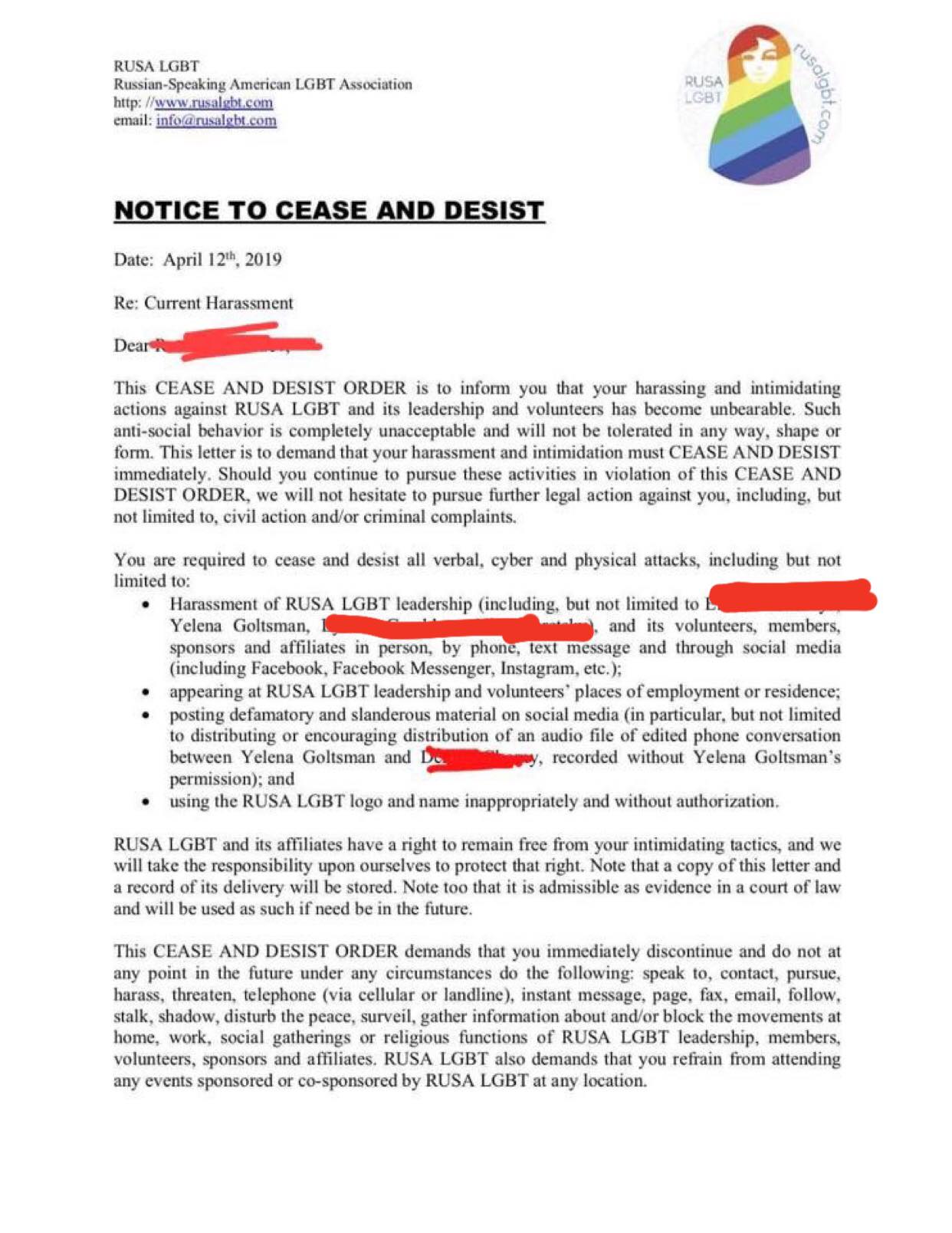
The man said a man in New York who is associated with RUSA LGBT, a group of LGBTI Russian speakers and their supporters, began to send “uncontrolled threats” to him after he criticized him for an “offensive and racist” Facebook post that he also described as xenophobic.
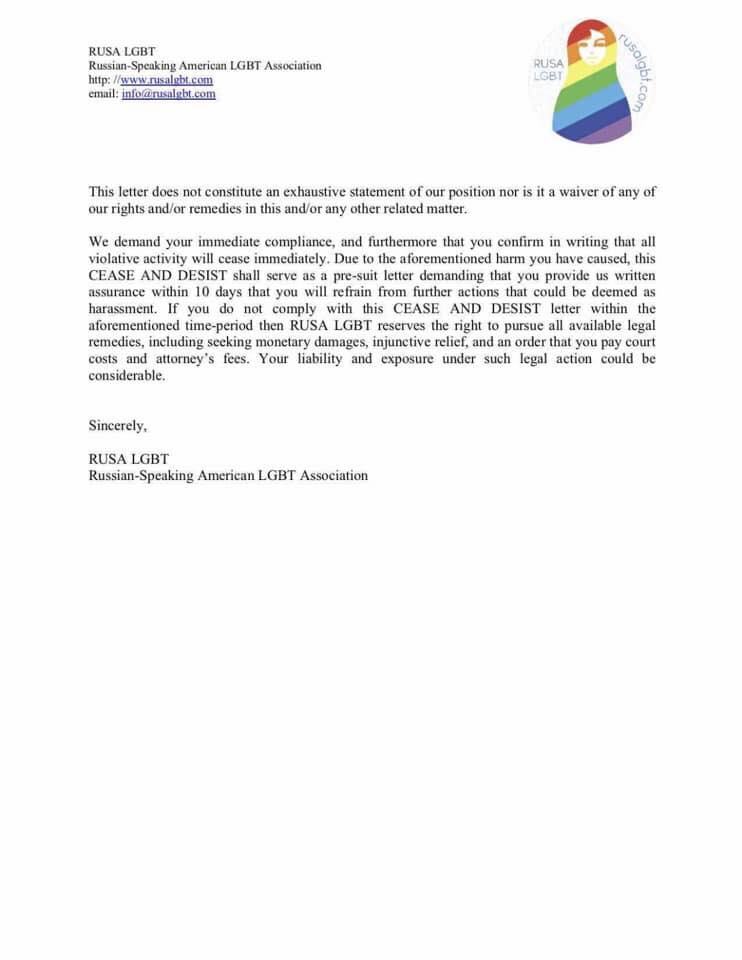
He said RUSA LGBT banned him from their event at a gay bar in Manhattan and sent him a cease and desist letter, which he claims is not valid, on April 12 that he showed to the Blade. Yelena Goltzman, founder and co-president of RUSA LGBT, in a lengthy statement denied the man’s allegations.
“The cease and desist letter was, in fact, sent to one of the people in the conflict on the advice of the attorney and the police who were called to the scene after his fourth unprovoked and unwelcomed visit to the workplace of RUSA LGBT’s co-president and as a consequence of his unrelenting harassment on social media,” Goltzman told the Blade on Tuesday.
Goltzman said Facebook “took down his posts about RUSA LGBT and warned him of further consequences.”
“Despite this, he continues to slander and harass RUSA LGBT leaders,” she said. “Unfortunately, we see the information he provided to you may further advance his harassment and slander against our group.”
Goltzman on Wednesday in a follow-up text message to the Blade said the man who the asylum seeker has accused of harassing him “is not a volunteer or a leader of RUSA LGBT and does not represent RUSA LGBT in any way.” The man with whom the Blade spoke on April 23 continues to dispute RUSA LGBT’s claims against him.
In the meantime, his asylum interview took place on Monday in New York. The man told the Blade he hopes “to realize my dream of being free and equal among equals, a worthy citizen and partner” if he were to receive asylum in the U.S.
“I know that in this country I can do this,” he said. “I hope that in the United States law, order and society will not allow any discrimination or threats against me from anyone, regardless of their position in society.”
“I want to start a new life in which there will be no place for xenophobia, transphobia, HIV stigma, Islamophobia, anti-Semitism from anyone,” added the man.
Association Shams, a notable LGBTI rights group in Tunisia, is facing closure after a legal challenge by the government.
Shams have condemned the move, describing it as discriminatory and ‘judicial harassment’ by the government.
The group has been operating in Tunisia since 2013 and is one of the most prolific LGBTI rights organizations in the Arabic world.
Shams say this is the seventh time the government has been tried to shut them down. Though the authorities failed to do so in a 2016 lawsuit, they are currently appealing the decision.
A hearing is set for Friday (3 May), which could determine the future of the group.
The group says that in this occasion is more serious as the authorities are invoking Shira law in their appeal.
Tunisia maintains laws prohibiting male homosexual sex. Despite this, the country also has a thriving LGBTI community.
‘The judicial harassment against our association has no legal basis’
The government claims that Shams’ operations violates the Law on Associations.
They argue that the Shams’ objective to protect sexual minorities goes against ‘Tunisian society’s Islamic values, which reject homosexuality and prohibit such alien behavior’.
The authorities also say that since there is a law banning homosexuality, allowing LGBTI rights group such as Shams to operate freely goes against the law.
Mounir Baatour, the president of Association Shams, hit out at the government’s latest legal challenge.
‘The judicial harassment against our association has no legal basis and reflects the homophobia of the Tunisian state and its will to discriminate and stigmatize the LGBT community, which is already marginalized,’ Baatour told the Guardian.
‘Such harassment makes our work difficult and creates a climate of tension and fear among the team working for our association.’
Reversing Tunisia’s anti-sodomy law
Shams is working to reverse Article 230 of Tunisia’s Penal Code of 1913. People convicted of sodomy face up to three years of imprisonment under the law.
The group registered with the government in 2015, as an organization supporting sexual and gender minorities.
Though the government filed a complaint about the group in 2016. A court ordered Shams to suspend activity for 30 days.
However, the court later lifted the suspension and ruled that Shams was not violating the law.
Though the authorities’ attempts to clamp down on LGBTI activists, Tunisia’s LGBTI scene is thriving.
The country’s four officially recognized LGBTI organizations all emerged following the 2011 revolution.
In January last year, the country’s first LGBTI film festival was hosted in capital city, Tunis. The festival was organized LGBTI rights organization Mawjoudin (We Exist).
However, Shams reports that the number of people arrested under Article 230 increased significantly in 2018.
The groups said that 127 arrests were made last year, compared with 79 in 2017. There have been at least 22 arrests this year.
Men have also reportedly experienced degrading treatment while in custody.
A recent Michigan settlement that bans state contracts with foster and adoption agencies that refuse to work with LGBTQ couples has sparked backlash.
On Monday, April 15, The Becket Fund for Religious Liberty filed a lawsuit in federal court on behalf of St. Vincent Catholic Charities and two adoptive families it’s served.
The lawsuit, alleging the new rules violated the group’s First Amendment rights, was filed against the Michigan Department of Health and Human Services Director Robert Gordon, Children’s Services Agency Director Herman McCall, Attorney General Dana Nessel, the federal Health and Human Services department and its secretary, Alex Azar.
“Faith-based agencies like St. Vincent consistently do the best work because of their faith, and we need more agencies like them helping children — not fewer. The actions by the Attorney General of Michigan do nothing but harm the thousands of at-risk children in desperate need of loving homes,” Mark Rienzi, Becket’s president, said in a statement.
The lawsuit was brought following Nessel’s announcement in March that taxpayer-funded adoption agencies with religious objections to placing children in homes of same-sex couples will no longer be able to cite their faith as a legitimate reason to opt out of providing that service.
Nessel settled a lawsuit with the ACLU of Michigan – that the ACLU of Michigan filed – that challenged the state’s practice of allowing state-contracted, taxpayer-funded foster care and adoption agencies to use religious criteria to exclude same-sex couples.
The plaintiffs, Kristy and Dana Dumont and Erin and Rebecca Busk-Sutton, wanted to become foster parents with the intention of adopting children who are wards of the state, but they were turned down by two faith-based agencies Bethany Christian Services and St. Vincent Catholic Charities. The adoption agencies have contracts with the state of Michigan to act on behalf of the state but turned the plaintiff’s down because of their own religious objections to accepting same-sex couples.
“Discrimination in the provision of foster care case management and adoption services is illegal, no matter the rationale. Limiting the opportunity for a child to be adopted or fostered by a loving home not only goes against the state’s goal of finding a home for every child, it is a direct violation of the contract every child placing agency enters into with the state,” said Nessel at the time.
According to MDHHS, each agency was providing foster care case management or adoption services for one or more children referred to them by MDHHS. Because the plaintiffs were not seeking direct-placement or private adoption services and because they were not referred to the agencies through MDHHS, the agencies could not reject them under existing state law.
When Nessel took office in January, she reviewed the facts of the case with her team of legal experts and determined that MDHHS could be subject to liability on the claims of the plaintiffs. As a result, Nessel strongly recommended resolving the case on terms consistent with the law and existing agency contracts and that best serve the health, safety and well-being of children in need of state-contracted foster care case management and adoption services. The plaintiffs and the attorney general’s office, on behalf of its client MDHHS, entered into negotiations and agreed to settle the case. According to reports, as of February, Bethany Christian Services, Catholic Charities and St. Vincent were responsible for more than 1,600, or 12 percent, of the state’s 13,000-plus foster care and adoption cases. Faith-based agencies have said they will shut down their adoption and foster care services rather than violate their religious beliefs. Kelly Rossman-McKinney, a spokesperson for Nessel, told MLive, “We have not had a chance to review the complaint. Based on the information provided during the plaintiffs’ counsel’s press conference, it appears that the plaintiffs’ attorneys do not understand the settlement agreement.” Rossman-McKinney explained, according to the MLive report, that “the state does not take action against faith-based adoption agencies that don’t take a state referral. If the agency accepts a state referral, however, the agency cannot refuse to provide the child with foster care or adoptive services that conflict with its religious beliefs.”
Sonoma County caregivers can earn $25 and become certified to care for older and disabled adults at free, LGBT+ Awareness Trainings in May and June. The four-hour classes help improve caregivers’ skills when working with two often hidden and underserved populations, LGBT+ older adults and LGBT+ adults with disabilities.
Family members who are care providers and professionals working for In-Home Supportive Services, private home care agencies, and assisted living or skilled nursing facilities are encouraged to attend.
· Thursday, May 2, 1 – 5 p.m., Petaluma Senior Center, 211 Novak Drive, Petaluma. Register: ihss050219.eventbrite.com.
· Thursday, May 16, Noon – 4 p.m., Adult & Aging, 3725 Westwind Blvd., Santa Rosa. Register: ihss051619.eventbrite.com.
· Thursday, June 6, 9 a.m. – 1 p.m., Employment & Training Division, 2227 Capricorn Way, Santa Rosa. Register: ihss060619.eventbrite.com
LGBT seniors are five times less likely to access mainstream health, housing and social services without knowing that providers value LGBT-inclusive practices. Class content builds awareness and understanding of the unique needs of LGBT+ older adults, how the caregiver’s approach affects clients’ care and ways to improve communications with and about LGBT+ older adults.
To earn a Certificate of Completion and $25, participants must: 1) register online by one week before the training, 2) arrive at the training on time, and 3) complete the four-hour class.
Certification is by SAGECare, the only national, LGBT aging, cultural competency training program. Clients of local senior service agencies and facilities will be informed that they can choose a caregiver who completed the training
The trainings are provided by the In-Home Supportive Services Public Authority, the Sonoma County Area Agency on Aging, SAGECare, which is part of the advocacy group SAGE, and LGBTQ Connections.Thetrainings funded and sponsored by the County of Sonoma, the Sonoma County Area Agency on Aging, In-Home Supportive Services Public Authority and the LBTQI Giving Circle Sonoma County. Sponsors hope to train and certify 180 local care providers through October in a total of eight workshops.
A group of trans women has realized its dream and will open their own hotel in Kerala, India.
The women planned to open the hotel called Hotel Ruchimudra in the state capital of Kochi in south east India.
Aditi Achuth, Saya Mathew, Preethi Alexander, Pranav, Ragaranjini and Meenakshi received US$14,320 in local government funding to set up the hotel.
The six women decided to start their own business to help promote a more positive representation of trans people in Kerala.
‘The major aim of ‘Ruchimudra’ is to change the negative attitude of the society towards transgenders,’ she told Mathrubhumi.
Along with the local government funding, the women also received funding from a charity. But the funding only covered some of the renovation costs of the four storey building. So the women decided to complete a lot of the work themselves in order to save money.
The building will house the hotel along with other support services for trans people. Those services will include counseling, office co-working space, shelter and yoga.
Kerala is one of the most progressive states in India when it comes to trans issues.
A man was shot and killed by a Walgreens security guard for being black and gay, the man’s sister has claimed.
Jonathan Hart was shot in the back of his neck and killed in December 2018.
Armed guard Donald Vincent Ciota II suspected Hart of shoplifting.
However, Hart’s sister Psykssyanna believes her brother was a victim of racism and homophobia.
A suit filed with the Los Angeles County Superior Court states Hart was ‘maliciously, wrongfully, internationally, negligently and/or carelessly’ shot and killed.
Ciota, Walgreens and two security companies are named in the suit.
What allegedly happened in that Walgreens store
Ciota, 28, allegedly confronted Hart and two of his friends inside the Hollywood, California store.
It is also alleged Ciota thought Hart was stealing.
The two men then got into a physical fight. Ciota then allegedly pulled out a gun and shot Hart as he fled.
Carl Douglas, an attorney for the man’s family, said Hart, who was in his early 20s, gay and homeless, was hit in the neck and died hours later at the hospital.
The complaint denies Hart was shoplifting. It also accuses Ciota of targeting Hart because of his race and sexual orientation.
According to the lawsuit, Hart and his friends had allegedly complained to a Walgreens employee. Apparently, prior to the shooting Ciota was acting in a ‘aggressive and hostile manner’.
Ciota, who had a Taser and a gun, allegedly grabbed his weapon, yelled ‘freeze’ and then fired a shot, according to the lawsuit.
The lawsuit states: ‘Jonathan committed no crime or other act against defendant Ciota, or any other person, to justify the use of deadly force against him.
‘He was unarmed and did nothing to cause defendant Ciota to believe he was confronting an imminent threat to his life or anyone else’s life.’
Charged with one count of murder
Ciota was charged in January with one count of murder.
In response, he pleaded not guilty during a court appearance.
Records, according to NBC, show Ciota is being held at a Los Angeles jail on $3 million bail.
Walgreens said any suggestion customers are racially profiled is ‘false and contrary to our deep commitment to inclusive diversity’.
The company added: ‘At the time this tragic incident occurred, we immediately terminated the security company that employed the guard involved.
‘We are fully committed to providing a safe environment for our employees and customers in the communities we serve.’