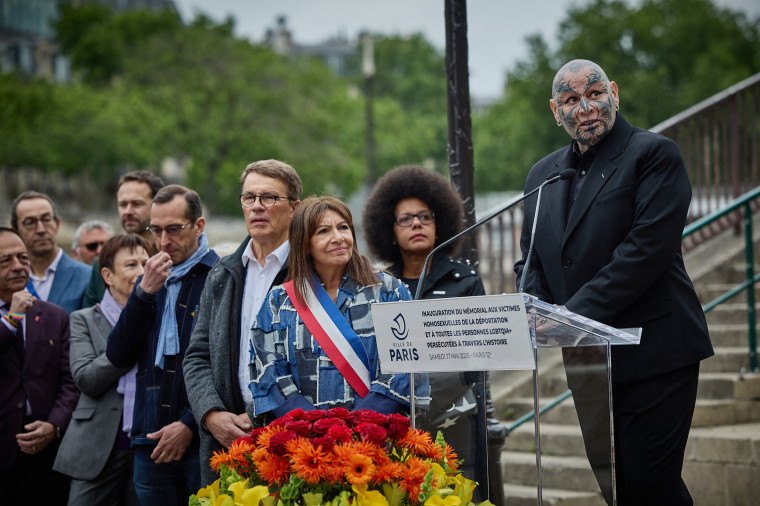
A memorial to the long-ignored gay victims of the Nazi regime and to all LGBTQ people persecuted throughout history has been unveiled in Paris on Saturday.
The monument, a massive steel star designed by French artist Jean-Luc Verna, is located at the heart of Paris, in public gardens close to the Bastille Plaza. It aims to fulfill a duty to remember and to fight discrimination, Paris Mayor Anne Hidalgo said.
“Historical recognition means saying ‘this happened’ and ‘we don’t want it to happen again,’” Hidalgo said.
Describing the sculpture that looks like a big star wand lying on the ground, Verna, a visual artist who also is a LGBTQ rights activist, said: “There’s a black side in front of us, forcing us to remember. … At certain times of the day, it casts a long shadow on the ground, evoking the dangers looming over, sadly.”
The other side of the star, silvery, reflects the sky. It represents “the color of time passing, with the Paris sky moving as quickly as public opinion, which can change at any moment,” Verna said.
Historians estimate between 5,000 and 15,000 people were deported throughout Europe by the Nazi regime during World War II because they were gay.
Jacques Chirac in 2005 was the first president in France to recognize these crimes, acknowledging LGBTQ people have been “hunted down, arrested and deported.”
Verna speaking next to Paris’ mayor Anne Hidalgo on Saturday.Kiran Ridley / AFP – Getty Images
Jean-Luc Roméro, deputy mayor of Paris and a longtime LGBTQ rights activist, said “we didn’t know, unfortunately, that this monument would be inaugurated at one of the worst moments we’re going through right now.”
In Europe, Hungary’s parliament passed this year an amendment to the constitution that allows the government to ban public events by LGBTQ+ communities, a decision that legal scholars and critics have called another step toward authoritarianism by the populist government.
The passage of Uganda’s Anti-Homosexuality Act in 2023 made life significantly more dangerous for lesbian, gay, bisexual, and transgender (LGBT) people and those who support them. The law, which includes the death penalty for so-called “aggravated homosexuality” and lengthy prison sentences for the “promotion of homosexuality,” has fueled a wave of arrests, raids on shelters, evictions, and public outings. Many LGBT people have gone into hiding.
Amid this repression, a small group of Ugandan mothers—some for the first time—began speaking publicly in support of their LGBT children.
In April 2023, eight of them signed an open letter to President Yoweri Museveni, urging him not to assent to the bill. They wrote: “We are not promoters of any agenda; we are Ugandan mothers who have had to overcome many of our own biases to fully understand, accept, and love our children.” They called on the president to protect all children from violence and discrimination.
He signed the bill anyway.
But the mothers did not retreat.
During 2024, Human Rights Watch met with several of these mothers in Uganda’s capital, Kampala, and the neighboring Wakiso district. In a country where public support for LGBT rights is rare and potentially criminalized, these mothers are leading with clarity, compassion, and conviction. Their stories illustrate the human cost of Uganda’s anti-LGBT laws and the quiet courage of the mothers who resist them out of love for their children.
Mama Joseph
One of the first to speak was Mama Joseph, a mother of five. Her eldest child, Joseph, now 26, identifies as gender-nonconforming. At 17, Joseph came out to their mother, saying they felt like a girl and was attracted to boys. The conversation was painful and confusing. “I cried a lot,” she said. “I knew my child was different. But it was hard.”
Like many parents, her initial reaction was to try to change her child. She sent Joseph to live with relatives, hoping they would help “correct” them. But as Joseph became depressed, Mama Joseph realized the move only caused more harm. Eventually, she brought Joseph home. “There is nothing you can do except harm,” when you try to make a child conform, she reflected. And as Joseph’s mother, she realized “No one is going to support them except me.”
Unfortunately, that support now comes with significant risk after the passage of the Anti-Homosexuality Act. Joseph lives in near-constant fear that is also affecting Mama Joseph. Simply being visible as a gender-nonconforming person can attract harassment or worse. The heated media attention on the law has created increased anxiety for LGBT people and the people who love them. “Whenever they talk about LGBT people, something bad is coming,” Mama Joseph said. But her position is clear: “No law will change my love for my child.”
Mama Denise
Mama Dennis, a woman in her late 40s, shared a similar journey. Her daughter, Dennis, is a 24-year-old transgender woman. From a young age, Dennis expressed herself in ways that challenged gender norms. She preferred dresses to trousers and loved playing with her sisters’ clothes. At 10, she entered a modeling contest against girls and won. Her mother remembers her confidence and strength.
In 2020, during the Covid-19 lockdown, when a morality-related crime happened near Dennis’s home, her neighbors took the opportunity to report Dennis’s gender expression and sexual orientation to police, even though they knew Dennis was not involved in the crime. The authorities then arrested Dennis and falsely accused her of other crimes. Her mother confronted the community directly, especially the men. “I asked them, ‘Has my child slept with any of you?’ They were embarrassed. I did not care.”
Today, because of the Anti-Homosexuality Act, Dennis is in hiding again. She no longer comes home to visit, and her absence left a silence in the house. “I miss her joy,” her mother said. “But I will keep defending her. Our children are not criminals.”
For these mothers, the law has brought not only fear, but also clarity. “This law shows us that we are not equal,” said Mama Dennis. “Our government is angry. They should use that energy to fight discrimination, not our kids.
Mama Arthur
Mama Arthur, a mother of five, has lived a different kind of struggle. Her eldest child, Arthur, was arrested in 2014 under Uganda’s previous anti-homosexuality law. Since then, Arthur has been in hiding, and their communication is limited and secretive. The real battle, though, has been at home. Her husband—Arthur’s father—has never accepted their child. “He constantly blames me,” she said. “He harasses me for having given birth to a cursed child.”
Her marriage has become a space of daily conflict. “I live like a single mom with a husband,” she said. “But I appreciate my kid very much. I accept Arthur the way they are.” She wants religious leaders, many of whom have supported the Anti-Homosexuality Act, to reconsider their messaging. “If you are a person of faith, you should preach love, not hate.”
More Mamas
The other mothers—Mama Rihanna, Mama Joshua, and Mama Hajjat—faced public scrutiny after their children were arrested in 2016 and 2022 respectively. The widespread national media coverage that followed, which included their children’s names, faces, and alleged offenses, had devastating consequences for the families. Each mother had to navigate the fallout alone.
One sold her only cow to pay legal fees and secure her child’s release. Another was forced to relocate after her neighbors turned hostile. The third hid her daughter from an abusive husband. In each case, the family’s safety, finances, and reputation were upended overnight.
Yet these mothers remain steadfast. “Sexuality doesn’t matter,” said Mama Hajjat, now in her 50s. And so she sheltered her daughter through the worst of the backlash. Over time, even her husband began to soften. “He saw what our daughter went through, what she was capable of. He started to change.”
For Mama Joshua, the issue is deeply political. “Our kids are the easiest target,” she said. “But they are not the problem.” She believes the government is scapegoating LGBT people to distract from broader governance failures. “None of this will bring jobs. It won’t build roads. It won’t feed children. It’s all distraction.”
There is evidence to support this claim. Anti-LGBT rhetoric in Uganda, as in other countries, often intensifies in moments of political or economic pressure. Leaders use moral panic to consolidate power, mobilize popular support, and deflect criticism. The Anti-Homosexuality Act, introduced and passed amidst corruption scandals and ahead of a critical election cycle, has served that purpose. But its cost—measured in fear, violence, and exile—is borne disproportionately by LGBT people and those who love them.
The mothers interviewed by Human Rights Watch are affiliated with PFLAG-Uganda, a social intervention project under Chapter Four Uganda’s Diversity Equity and Inclusion program. They do not identify as activists. Most are deeply religious, and several attend church or mosque regularly. Some are afraid of the consequences of speaking out. But none regret standing by their children.
They have formed quiet networks of solidarity since 2019, meeting regurlarly, sharing social advice and comforting one another when children disappear or flee the country. They know they are not alone, even if the state tries to isolate them.
“We are mothers,” said Mama Dennis. “We know our children. We love them.”
Their voices are clear and consistent. Some have spoken on community radio or attended court hearings. Others write letters, make phone calls, or otherwise simply refuse to abandon their children.
And their numbers are growing, with the support of Clare Byarugaba, the founder of PLFAG-Uganda.
Their message, despite everything, remains rooted in hope: That love can coexist with fear, that understanding can overcome indoctrination, and that change—however slow—is possible. “People can learn,” said one mother. “It is a matter of time.”
In Uganda, the public space for human rights has narrowed dramatically. But these women are carving out space in the most personal realm: the home. They are challenging political violence not through protest, but through presence. Through consistency. Through care.
Their resistance may not be visible on the streets, but it is steady. Their choice to love their children—and say so publicly—is both deeply personal and inherently political.
“I could never stop loving my child,” one mother said again, without hesitation.
A festival featuring the works of playwrights from countries where LGBTQ+ rights are suppressed is turning to fundraising after President Donald Trump’s National Endowment for the Arts cut its grant to the group. The National Queer Theater said they have created a GoFundMe page where the community can support the Criminal Queerness Festival taking place during NYC Pride 2025, NBC Newsreports.
The Criminal Queerness Festival takes place at the HERE Art Center in NYC on June 11-28. According to its website, the festival “showcases the works of international LGBTQ+ playwrights from countries where queer identities are criminalized or censored.” This year’s festival features plays reflecting queer life in Cuba, Indonesia, and Uganda.
The festival, which was created during WorldPride 2019, is the creation of Brooklyn’s National Queer Theater. The group depended upon a $20,000 grant from the NEA to fund the festival, which represented 20 percent of the festival’s budget for 2025.
The group was notified via email on Friday that their grants no longer aligned with Trump’s priorities, and the request for this year’s grant was denied.
“It’s devastating and upsetting, because we’re a very small organization,” Jess Ducey, co-chair of the company’s board, told NBC News. “That grant is absolutely integral to the funding.”
While the news was devastating, Ducey and the National Queer Theater do not view it as fatal. The group has created a GoFundMe page (@national-queer-theater) to help cover the lost grant. So far, the page has raised over $8,000 of its $20,000 goal.
The three plays to be performed this year reflect a mix of queer identities set in places hostile to the LGBTQ+ communities, both in foreign countries and the U.S.
Tomorrow Never Came by Jedidiah Mugarura is set in Uganda and tells the story of a gay man in a heterosexual marriage and also a same-sex love affair. What Are You to Me by Dena Igusti is about a lesbian romance in Indonesia cut short by the Jakarta riots and crackdown in 1998. The story is discovered years later by an “emerging zine writer in Queens” looking to share their story. frikiNATIONby Krystal Ortiz explores the lives of young punks in Cuba of the early 1990s who injected themselves with tainted blood to acquire HIV, knowing they would live better lives isolated in state-run sanitariums than trying to survive under Fidel Castro’s oppressive, homophobic regime.
The National Theatre Group is party to the suit, Rhode Island Latino Arts v. National Endowment for the Arts, filed by the ACLU in a Rhode Island federal district court. The suit has unsuccessfully sought to reinstate funding cut from the NEA by Trump.
A trans charity in Scotland has labelled the ban on trans women using female toilets in Scottish parliament an “unworkable” decision which will prevent trans folks “from participating in Scottish democracy”.
Following the UK Supreme Court ruling that the definition of ‘sex’ in the 2010 Equality Act refers to ‘biology’, the Scottish Parliamentary Corporate Body (SPCB) – which oversees accommodation at Holyrood – decided that as of Monday (12 May) use of “all facilities designated as male or female” will be based on “biological sex” to be “in line with the Supreme Court judgment”.
Alongside designating single-sex spaces as solely based on biology, gender neutral facilities, open to anyone, will also be installed in Holyrood.
Presiding officer Alison Johnstone said: “As Scotland’s legislature, it is vital that the Parliament fulfils its legal responsibilities.
“Our officials therefore took immediate steps following the publication of the judgment to review it in detail and to consider its implications for services and facilities at Holyrood.”
Johnstone said it was important to make this change now “not only to ensure we fulfil our legal responsibilities, but to give clarity to all those using the building” and ensure “confidence, privacy and dignity” for both staff and visitors.
In response, Scottish Trans and Equality Network wrote a letter to the SPCB condemning the decision as “rushed” and “unworkable” as well as one which will “exclude trans people from participating in Scottish democracy, whether as staff or as visitors to the Parliament”.
The letter went on to say the change will “make trans people feel significantly less welcome at Parliament”.
Trans people already avoid public toilets frequently – 80% of trans people have avoided them due to fear of being harassed, being read as trans, or being outed. Policies to restrict the use of toilets on the basis of “biological sex” and/or to insist that trans people must use separate, segregated facilities from others will make this worse,” the letter reads.
You may like to watch
“Trans people have been using toilets in line with our gender identities across Scotland and the UK for decades. Changes to policy and practice to restrict trans people’s access to facilities on the basis of our “biological sex” after the Supreme Court judgment will profoundly change trans people’s ability to participate in public life as who we truly are.”
It adds: “We cannot understand why this decision has been described as one that will bring “confidence, privacy and dignity” to everyone. It will not do so for trans people. It will exclude us and segregate us in the heart of Scotland’s democracy.”
A Scottish Parliament spokesperson said, as quoted by The Independent: “Holyrood provides a wide range of facilities so that it is an inclusive and welcoming space for all.
“The Supreme Court’s ruling had an immediate effect in law and after careful consideration the SPCB announced interim steps to ensure it fulfils its legal responsibilities.
“This included taking into account EHRC’s interim update to organisations.”
Organisers of four major Pride events in the UK have jointly banned all political parties, including Labour, from its Pride events this year.
Acting in solidarity with the trans community, organisers of Pride events in Birmingham, Brighton, London, and Manchester collectively said they would be “suspending political party participation” from this year’s Pride events unless the needs of trans people are urgently addressed.
In a joint public press release, organisations Birmingham Pride, Brighton Pride, Pride in London, and Manchester Pride, said they will not “stand by as the dignity, safety, and humanity of our trans siblings are debated, delayed, or denied.”
Organisers said the decision was based largely on the political reaction to a UK Supreme Court ruling, which argued the 2010 Equality Act’s definition of women and sex refers to “biological women” and “biological sex.”
A spokesperson speaking on behalf of the organisations said that the ruling underscores an “urgent need for immediate action,” adding that they plan to “stand firmer, louder, and prouder in demanding change that protects and uplifts trans lives.”
“This is not a symbolic gesture. It is a direct call for accountability and a refusal to platform those who have not protected our rights,” they continued. “We demand real commitments and measurable progress. “
Pressure for Pride organisations to ban Labour and similarly anti-trans parties from their marches and events came after prime minister Sir Kier Starmer said he was “really pleased” at the Supreme Court ruling and believed it had provided “much needed clarity.”
Asked whether he still believes trans women are women and trans men are men, a spokesperson for Starmer said: “No.“
You may like to watch
The ruling also prompted the Equality and Human Rights Commission (EHRC) to publish interim guidance which calls for the banning of trans people from all gendered public restrooms.
While the guidance is not legally enforceable, the EHRC’s position as an advisory board on human rights laws in the UK suggest it could be used to justify future anti-trans legislation.
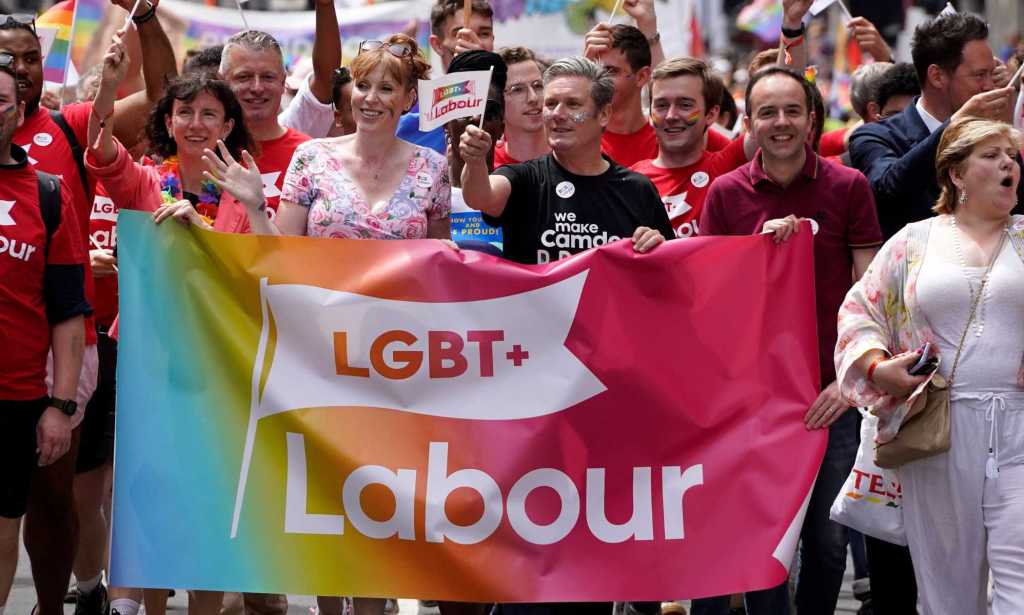
LGBT+ Labour march at a Pride event with leader Keir Starmer. (AFP via Getty Images/NIKLAS HALLE’N)
An open letter published by the Trans Safety Network and signed by over 140 LGBTQ+ organisations argued that Pride organisers have a duty to “take a stand” against Labour’s and anti-trans political parties’ continued “transphobia” by barring all political parties from future events.
‘This is the minimum. Anything less is not allyship’, says Pride organisers
Echoing calls from Trans Safety Network, the organisers wrote that political parties need to stand “unequivocally with every member of the LGBTQ+ community,” not just part of it.
The organisations jointly called for political parties to implement protections for trans people under the Equality Act, improve access to NHS gender-affirming healthcare, reform the Gender Recognition Act so that Gender Recognition Certificates (GRCs) are easier to obtain, and to issue “sustainable funding” for trans-led services in the UK.
“This is the minimum. Anything less is not allyship, it is abandonment,” the spokesperson continued. “To those in power: when you demonstrate true solidarity and tangible commitment to trans rights, we will stand with you.
“Until then, we will continue to speak truth to power and fight for a future where every trans person can live safely, freely, and proudly.”
Keir Starmer has been urged to discuss the future of trans rights legislation in the UK with several LGBTQ+ charities. (Getty)
As pressure on Labour to reverse much of its anti-trans commitments, several LGBTQ+ charities pleaded with the prime minister to schedule a meeting with representatives to discuss the rise of transphobia in the UK.
14 organisations, including Stonewall, Scottish Trans, the LGBT Consortium, and others, urged the prime minister to speak with the charities to help reverse the “confusion” that the Supreme Court ruling had caused.
The letter, shared by The Guardian, also criticised the EHRC’s interim guidance, saying that it amounts to “significant overreach.”
The Pentagon issued a memo directing all military leaders and commands to pull and review books that address anti-racism, diversity, or gender issues from libraries operated by branches of the military. He initially focused on removing any so-called pro-DEI reading material from libraries within DOD-run schools.
The memo is perhaps the Department of Defense’s (DOD) broadest and most detailed directive so far in Defense Secretary Pete Hegseth’s campaign to rid the military of diversity, equity, and inclusion (DEI) programs and materials.
The Associated Press (AP)obtained a copy of a memo which, signed Friday by Performing the Duties of Deputy Under Secretary of Defense for Personnel and Readiness Timothy Dill.
The memo on the latest library purge states educational materials at base operated libraries “promoting divisive concepts and gender ideology are incompatible with the Department’s core mission.” The memo directs department leaders to “promptly identify” books that are incompatible with these guidelines and sequester them by May 21.
The memo doesn’t mention what will happen to these books or whether they will be stored or destroyed, only stating that additional guidance will be provided on how to cull the initial list and determine what should be removed.
The memo indicates that the DOD will set up a temporary library committee to provide information on the reviews of and decisions upon reading material. The committee will set up a list of search terms to identify which works should be pulled for review.
These search terms include: affirmative action, anti-racism, critical race theory, discrimination, diversity, gender dysphoria, gender identity and transition, transgender, transsexual, and white privilege.
Books being purged include Maya Angelou’s autobiography, I Know Why the Caged Bird Sings, which explores Angelou’s experience as a black youth living in the southern United States during Jim Crow-era segregation.
Other books in this purge detailing the experiences of African American women in the 19th and 20th century include Half American, about African Americans in World War II; A Respectable Woman, about the public roles of African American women in 19th century New York.
Additionally books about the Holocaust written by survivors trying to make sense of their trauma or those memoralizing the victims of the horrific event where purged including Memorializing the Holocaust.
Last month, the American Civil Liberties Union (ACLU) — representing 12 plaintiffs from U.S. military schools —brought up a lawsuit against Pete Hegseth in his official capacity as Defense Secretary for ordering the removal of over 400 books from DOD school libraries. The plaintiffs argue that removing these books violates students’ First Amendment rights and denies these students the same educational opportunities as students in public schools.
On the same day that Dill issued his memo, Hegseth released a memo ordering military academies to admit students solely based on merit with “no consideration of race, ethnicity, or sex”, underlining the word “no.”
A nonbinary person in Brazil has been granted official documents with a neutral gender marker for the first time in a historic and unanimous court victory.
The case involves a person who originally requested to be recognized as male on their official documents after they started hormone replacement therapy, but they later regretted making this decision and appealed to the Supreme Court of Justice in Brasilia. The person’s name has not been published in the media.
A panel of five judges at the court ruled in their favor, with Judge Nancy Andrighi writing in her ruling: “This human being must be suffering greatly. To undergo surgery, take hormones, become what she thought would be good for her and then realize it was not the case.”
The case is currently sealed, but it represents the first time that someone in Brazil has been able to get gender neutral official documents in the country, according to the AP.
For over a decade, the organization I founded, Gays With Kids, has proudly stood as a beacon of support, education, and visibility for gay men on the path to fatherhood. From the beginning, our mission has been rooted in a singular belief: Every person, regardless of sexual orientation or gender identity, deserves the opportunity to create and raise a family. That belief hasn’t changed. But the world around us has.
Over the past year, we’ve watched with growing alarm as the movement against DEI (Diversity, Equity, and Inclusion) has moved from fringe rhetoric to mainstream policy. Politicians and influencers alike have declared open season on the very principles that helped us inch closer to equality, principles that affirmed our right not just to live openly, but to love, marry, and parent with dignity.
These attacks have consequences.
When laws are passed to defund DEI initiatives, or when universities are forced to shutter offices that serve LGBTQ+ students, or when healthcare providers are threatened for offering gender-affirming care, the ripple effect is felt across every aspect of LGBTQ+ life, including family building.
Surrogacy, adoption, foster care, and fertility access are already complex and costly journeys. For LGBTQ+ people, they’re even more so, compounded by legal roadblocks, discriminatory policies, and social stigma.
DEI frameworks were never about “special rights”; they were about leveling the playing field, ensuring that our families had the same opportunities, protections, and support systems as any other. Without these systems in place, the path to parenthood becomes steeper, narrower, and more uncertain.
That’s why I’m thrilled that the GWK Academy is officially expanding its services beyond gay men to support all LGBTQ+ people with their family-building needs. In doing so, we are transitioning into a 501(c)(3) nonprofit organization—a move that allows us to provide free, vital educational resources, advocacy, and community to anyone in our community hoping to become a parent.
This expansion comes at a critical moment. As anti-LGBTQ+ rhetoric becomes more emboldened, as rights and resources are rolled back in state after state, and as disinformation spreads regarding what it means to be an LGBTQ+ parent, we are doubling down on our commitment to serve the entire community: gay dads, lesbian moms, queer parents, transgender and nonbinary people, bisexual parents, and anyone who needs a trusted, affirming guide to help navigate the journey to parenthood.
We are doing this not just because it is right, but because it is necessary.
Let’s be clear: The current wave of efforts against DEI is not just a political maneuver. It is a targeted attempt to silence, erase, and disempower marginalized communities, including LGBTQ+ families. These policies don’t just remove language from mission statements; they remove critical support from the real people who need it. For LGBTQ+ prospective parents, that can mean losing access to affirming healthcare providers, adoption agencies, legal protections, and financial resources.
By becoming a nonprofit, GWK Academy is taking a bold step to insulate our work from these attacks. We are building partnerships with LGBTQ+ affirming clinics, agencies, and legal experts to ensure our community can access accurate, inclusive, and life-changing information. We are creating new educational programs tailored to all family-building paths, from IVF to foster care, from co-parenting to adoption. And we are advocating — loudly and proudly — for a world where LGBTQ+ parents and their children are not just accepted but celebrated.
This is a deeply personal mission. Like so many LGBTQ+ people, I grew up believing that being gay meant I would never be a dad. And yet, here I am — a proud father, raising children in a loving and supportive home. I know the joy that comes from becoming a parent. I also know the fear, the confusion, and the heartbreak that can come with navigating a system that wasn’t built for us.
GWK Academy exists to change that.
To every LGBTQ+ person out there wondering if parenthood is possible for you: Yes, it is. And we are here to walk that journey with you, every step of the way. Whether you’re just beginning to explore your options, deep into the legal paperwork, or already a parent looking to connect with community, we’ve got your back.
When you think about Bible study, images might pop into your head of kids learning principles like forgiveness or loving thy neighbor, and that’s just what LifeWise Academy advertises on its website: “A supportive and inclusive atmosphere where everyone feels valued.”
But for many parents and LGBTQ kids in at least 591 American public schools with LifeWise programs, that’s far from the truth.
One parent says their daughter was “mercilessly bullied by LifeWise kids for ‘looking like a Lesbian who is going to burn in hell.’” Another had to remove their transgender son from school after he was bullied following the presidential election, with the school fearing LifeWise staff and students would make things worse.
And a third parent—a queer mom—says, “As a member of the LGBTQ+ community, my children’s safety in the public school setting is compromised when students are permitted to be removed from the school… to be taught discriminatory and harmful things about my family.”
For an hour a week, students from kindergarten through 12th grade learn about religious concepts rooted—in part—in homophobia and transphobia. For example, students are taught that anything other than a nuclear family, with one mom and one dad who are married, is wrong and that there is no such thing as being transgender.
LifeWise even requiresitsemployees to agree to their worldview statement, which says, “God’s design for the gift of sex is for it to be exercised and enjoyed exclusively within the covenant relationship of marriage between one man and one woman. Additionally, a person’s sex has been given as a gift from God and should not be altered.”
“This is not just learning about a religion,” says Sloan Okrey Anderson, an assistant professor of social work at St. Catherine University who researches LGBTQ populations and Christianity. “The content is from a very specific, hyper-conservative, white American evangelical perspective, a very specific white nationalist-adjacent version of Christianity.”
Since its inception seven years ago, LifeWise has grown massively with 50,000 students projected to attend LifeWise classes across 29 states. The organization was founded in Ohio, which has at least 197 programs, and it has a disproportionate presence in the Midwest.
LifeWise’s growth in the U.S. reflects a trend of politicians and lawmakers attempting to incorporate Christianity in public schools and minimize LGBTQ representation. Last year, Oklahoma’s superintendent of public education announced all schools in the state would be required to teach students about the Bible—a decision which came shortly after Louisiana attempted to mandate that the Ten Commandments be displayed in every classroom. This is all occurring as the Supreme Court seems poised to side with Maryland parents who want to remove their kids from classes that are teaching LGBTQ-themed books.
How LifeWise Is Allowed to Operate
Since American public schools aren’t allowed to promote any one religion, LifeWise uses what’s known as Released Time Religious Instruction (RTRI), a precedent set in a 1952 Supreme Court case that allows public school students with parental consent to receive religious education off school property during the school day, although it was only meant to be used by individual families, not a nationwide organization.
RTRI prohibits public funds from being used to facilitate the program and schools from promoting it, but LifeWise gets around this by having children recruit their peers and bribing them with sweet treats. For example, LifeWise in Wauseon, Ohio, has provided children with “student business cards” to hand out to friends and has said, “If you [can] get 90 kids to come, [we’ll] give you an ice cream party.”
LifeWise Academy Wauseon, OH. Student business cards | Screenshot: Wauseon Character Academy on YouTube
Curriculum
LifeWise teaches elementary and middle school students a variety of Christian principles. But embedded in the core curriculum are more insidious, anti-LGBTQ teachings. In a sixth grade lesson plan obtained by Uncloseted Media, LifeWise teaches 11– to 12-year-olds that “God created people as ‘male and female’” and “God designed two separate, distinct genders to complement one another in relationship.”
But high school is where the curriculum really sinks its teeth into issues related to LGBTQ identities. LifeWise’s high school curriculum uses the “Foundations” series that starts with “Understanding the Times,” based on a book by the same name.
The original book was written in 2006 by Jeff Myers and David Noebel, two conservative evangelicals, and contains a plethora of harmful and untrue homophobic, transphobic and even Islamophobic teachings.
On page 324, they write, “Being raised by parents who have been involved in same-sex relationships is correlated with several negative social outcomes, including crime, substance abuse, and forced sexual encounters.”
And on page 409, they critique people who disavow heteronormative power structures: “This way of thinking continues to creep into judicial decisions, most recently … through the decision of Supreme Court Justice Anthony Kennedy to overthrow the Defense of Marriage Act because he viewed it as oppressive to people experiencing same-sex attraction.”
Okrey Anderson says that reducing LGBTQ identities down to worldviews is a distinct form of othering. “You’re granting permission to and empowering these kids to go out and see people’s identities and lived experiences as a worldview to be debated and you’re othering them. … Every scrap of misinformation that you spread about trans people translates directly into violence against trans people.”
Beyond the curriculum, LifeWise has a rulebook that gives instructors—who are not required to have teaching certifications from the Department of Education—guidance on how to answer “difficult questions from students.”
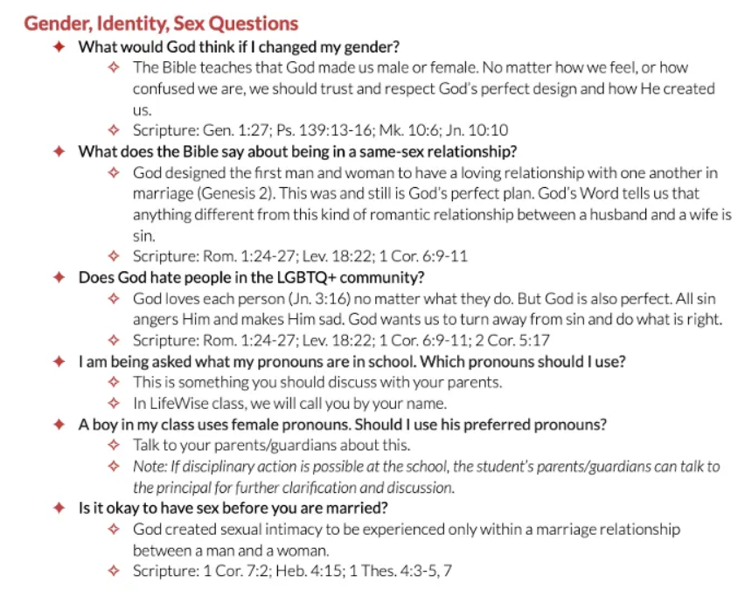
Excerpt from Lifewise’s Difficult Questions from Students document. | screenshot
The document explains that anyone who is experiencing gender dysphoria or is attracted to someone of the same sex should deny those feelings. If a child asks, “What would God think if I changed my gender?” LifeWise teachers are instructed to deny that trans, gender diverse and intersex people exist, and to explain that “God made us male or female. No matter how we feel, or how confused we are, we should trust and respect God’s perfect design and how He created us.”
If a kid asks about same-sex relationships, LifeWise instructs teachers to explain that “God designed the first man and woman to have a loving relationship with one another in marriage” and “anything different from this kind of romantic relationship between a husband and a wife is sin.”
“It’s grotesque,” says Olivia Murray, a professor at Portland State University whose research focuses on education. “From a child, youth and adolescent perspective, how does this build critical thinkers?”
Murray says social and emotional learning should teach children to “call out and question what we know and think deeper into the how and the why of knowledge.” She says a better approach might be to ask a question in return like, “What do you think of your friend who was presumed male at birth that uses female pronouns?” or “What’s your interpretation of the Bible and how might that impact your religion and relationships in the world?”
Policies and Staff
LifeWise operates with little diversity. According to its website, all of its senior leadership boast nuclear families, and three-quarters are men.
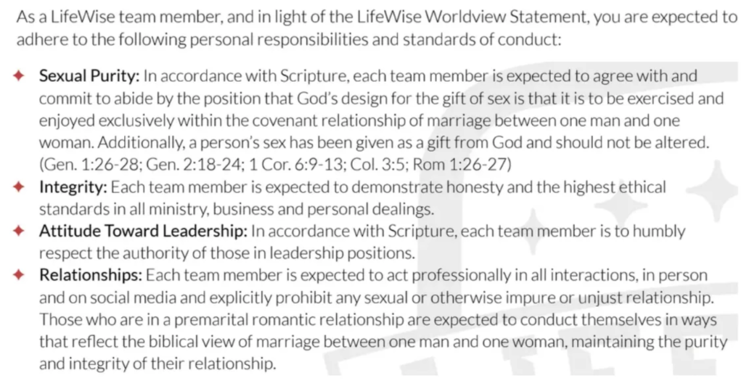
Staff are expected to remain abstinent, with the only exception being for those in heterosexual marriages.
Excerpt from LifeWise’s team member conduct policy. | screenshot
Christopher Elder was a volunteer at LifeWise’s chapter in Paulding Village, Ohio, until he was terminated shortly after he started dating his boyfriend.
“My identity in Christ, to me, looks like loving and supporting my boyfriend and everyone in the LGBTQ community,” Elder, 25, told Uncloseted Media. But when he told his director he had a boyfriend and asked if he could continue to volunteer, he was surprised by the answer. His director said, “Since the LifeWise Worldview Statement is that God’s design is for marriage to be between one man and one woman and your current choice doesn’t align with that stance, I think it’s best that you not volunteer at this time.”
Christopher Elder {right} and his boyfriend [left} | Photo courtesy of Elder
The director at LifeWise’s Paulding Village, Ohio chapter did not respond to Uncloseted Media’s request for comment.
“I thought that as long as Jason and I are abstinent, then I [could] still volunteer,” says Elder. “I’m not killing anybody, I’m not blatantly opposing the Bible, it’s just this one thing. … It’s unfair and unjust because my biggest passion is serving Christ.”
Murray says this discrimination creates an awful learning environment for teachers and students alike. “From an educator perspective, we need to teach with integrity and oftentimes that means adhering to our identity,” she says. “To teach in ways that are closeted or against our lived experiences or desires can be disingenuous and students can feel that.”
LifeWise’s repressive policies extend as far as using the bathroom. Their policy manual states that “team members and students attending LifeWise will use the bathroom that corresponds to the gender identified on their birth certificates.” If staff don’t abide, they will face disciplinary action. If students don’t follow, they’ll be outed to their parents.
“It’s always gonna be based on passing,” says Okrey Anderson. “Even cis kids who are maybe ambiguous-looking—they’re going to be targeted specifically by leadership for a conversation where they’re told ‘Hey, you need to dress more femininely’ or whatever it may be.”
LifeWise did not respond to Uncloseted Media’s request for comment.
Concerned Parents
As the program infiltrates public schools across the country, some school districts are deciding not to allow LifeWise to operate. Last year, at a Board of Education meeting in Westerville, Ohio, one mom explained to the Board why she and her wife decided not to opt their daughter into LifeWise.
“LifeWise has a clearly stated anti-LGBTQIA policy,” she said. “My daughter has explained on numerous occasions [that] she has been confronted by peers in LifeWise. She’s been asked to explain why she does not attend and pressed about if she believes in Christ, in God, in religion. … All of this seems incredibly counterproductive for a school district that otherwise is so clearly committed to diversity, equity, inclusion and student safety and wellbeing.”
But parents are pushing back beyond School Board meetings. Revere City Schools—also in Ohio—have been under pressure from Revere Citizens Against LifeWise Academy, a group fighting to keep the program out of their community.
“Public education is literally the cornerstone of our democracy and it is just one more thing that is being threatened along with book bans and teachers,” Gaines told Uncloseted Media, adding that they have upward of 14,000 group members on Facebook. “We wanted to bring awareness to that, and the more we looked into it, the more nefarious it became.”
Since 2023, Parrish and Gaines’ group has amassed a massive collection of documents and knowledge on LifeWise and its operations, most of which would likely still be kept behind closed doors if it wasn’t for their work. Their website contains resources to help parents make an informed decision about whether to opt their children in, as well as testimony from concerned parents.
Among their findings are 140 internal policy documents, information about LifeWise’s funding—which includes over $3.4 million in grants, including some from the notoriously anti-LGBTQ National Christian Foundation—and details about how LifeWise conducts background checks and trains its educators.
In one shocking discovery, they found that an Ohio teacher, who was previously fired from a public school for sexting with a student, was subsequently hired to be a local program director at LifeWise.
Their methods for obtaining this information landed Parrish a lawsuit from LifeWise last year that ended in a settlement agreement.
Despite pushback efforts, LifeWise has forged a clear path for growth. In at least 11 states, school districts are required to have a policy that greenlights programs like LifeWise, leaving communities with no mechanism to keep the Academy out.
LifeWise’s ultimate goal is for conservative Christian teachings to be embedded in public schools across America.
And in select schools, this is already happening. Starting later this year, the LifeWise chapter in Liberty Center, Ohio, will begin offering a for-credit class for high school students. If LifeWise has their way, this could spread across the country thanks to model legislation provided by the Released Time Resource Institute, a LifeWise-founded think tank that provides resources for legislators and educators.
“A lot of people from conservative backgrounds often fear the recruitment of queer and trans folks recruiting other people in, and I feel like it’s really flipped on its head here,” says Murray. “This grooming that’s occurring here … is incredibly damaging.”
Okrey Anderson agrees. “By exposing kids to this type of theology—whether that’s queer kids or not—you are potentially robbing those kids of a future spiritual life. … You could be poisoning them forever to have a meaningful relationship to deity in a way that feels safe and comfortable for them.”
This story was originally published in Uncloseted Media. For all their LGBTQ-focused journalism, consider becoming a free or paid subscriber at UnclosetedMedia.com.
Transgender / Genderqueer / Nonbinary / Genderfluid / Questioning This group is for anyone that has or is questioning their gender and has found themselves identifying with the masculine side of the spectrum. If you’re worried you aren’t trans enough, don’t be, you’ve found your people. We meet on the third Wednesday of every month in Santa Rosa from 6-7:30 pm with a optional social time until 8pm.
Email us for location, questions, or accessibility needs at: soco.tmasc.moc.sup@gmail.com