Cheryl King is producer of the Wednesday Weirdness performance series at The California, the latest new nightspot in Santa Rosa.
She recently interviewed Hector Zavala about his new solo show, Buscando al Último Hombre Gay (Seeking the Last Gay Man) prior to his upcoming performance at The California on November 30. Hector’s answers provide not only a great preview for the show, but also a thoughtful examination of many hot-button issues in current culture.
CK: First a question about the title – What does it mean? Who is doing the seeking? And who is the last gay man?
HZ: When I first wrote the show I wrote it based on the experiences of five of my closest friends and myself. We began talking about our recent break-ups and questioned what it meant to be in a relationship, what we gave up during our relationships and what we wanted from a relationship. After all, we all wanted the same thing, to be gay–happy. After several workshops and rewrites I came to the conclusion that I wanted to talk about the search for happiness. All of us humans want to be happy, gay. In this story, I take humanity as a whole as seeking that last moment of happiness.
CK: In your show you share some of your first experiences as a gay man – actually as a gay 16-year- old. At what point in your life were you aware that you were different, that you liked boys more than girls? How did that manifest itself?
HZ: I always knew I was different, I know it may sound/read cliche, but it’s the honest truth. I still feel different. But my complete awareness came after my coming out, which is a story I talk about in my show. I was “pushed out” of the closet after a night of romantic exploration with another young man my age. That night I knew I was different, I wasn’t gay, I didn’t know what that was, but I was pointed out as different.
As for my attraction to boys, I can say that I’ve always been attracted to both boys and girls. I wanted to be around girls all the time, play with them, dance with them… with boys, I felt my sexuality was more intrigued by them. Since I was very young. My first exploration was at the age of six with a boy my age.
CK: Your show compares the desire for sweetness and intimacy with the desire for sex. How do those two drives work together? How do they conflict?
HZ: Yes, my show also touches on the search for validation. Sex is a big motivation for acceptance and validation in the gay community and culture. In the story, this character is conflicted by his yearning for a love that is sweet and intimate, yearning for a successful romantic relationship, but as we all know, we do not have many positive examples of successful gay couples in media. So in his search, this character is trying very hard to fit to the standards of a community that has been outcast, ridiculed, and marginalized.
CK: Like many people in our culture, you seem to have reached out for the rebound relationship. Do you think there is a value to taking more time after the ending of a relationship to get on solid emotional ground before seeking out a new partner?
HZ: I truly believe that we all have our own journey and we each do the best we can in our search for happiness. A rebound relationship, for me, was the best thing that could happen after my separation.
Imagine believing in a fairy-tale idea of marriage, add the Catholic belief that “marriage is forever” imposed by a matriarchal family and words like “You wanted to get married; now suffer the consequences”. I felt like the worst human after deciding to leave my husband; I needed that human interaction I got from a rebound relationship.
CK: How can self-love heal the wounds of too-casual sex?
HZ: Self love allows for space to make decisions based on what the self truly wants. Sometimes he/she wants casual sex, sometimes he/she wants a burger. Casual sex with out self love can be fogged by the external search for validation and that’s where the troubles begin.
CK: You recently performed this show in Mexicali. What was your audience response there? Did you make any changes to the show based on that Mexican tour?
HZ: Well.. my first run was back in 2019. It was in English and I had a very limited budget. It was produced in the Bay Area and performed at the Marsh, SOMArts and the Queer Arts Fest in SF. For the Mexicali performance, which was part of my tour throughout Mexico, I was able to increase the production value with sets, costumes, props and original music, with the same budget I had in the Bay Area performances. I also translated into Spanish with the aid of a dramaturg and added a whole new concept to the piece by hiring an up-and-coming director in Mexico City.
Many people in the audience waited for me at the end of the show to hug me and talk to me about how the show spoke to and about them, both female and male. I had to go back and schedule three more shows.
CK: What do you see as the differences between how the Mexican culture treats homosexuals versus how they are treated in the US?
HZ: I’ve been a resident of the US since I was very young. I grew up in San Jose, CA with my mother, which is where I accepted my queerness. I saw Heklina in drag on TV on the Ricky Lake show at the age of 12. Queer folk were begining to take a space in media and the community. MTV released “My So-Called life”, a reality show, with a young gay Latinx man who had HIV. Space was being carved out in the US for folks like me. When I moved to Mexico to continue with my higher education, I was faced with a brick wall. I “had to hide” my gayness. Two of my dearest friends were un-a-lived for being gay. Three others were beaten and taken to the hospital. I can not compare, it would be unfair, because I can also say that Mexico has legalized same sex marriage in every state in the last two years.
CK: How can parents support their homosexual children’s life dreams and hopes in a world that still has difficulty accepting homosexuality?
HZ: How? I’m not a parent. Nor do I want to be. Lol. But maybe I can speak for what I wish I had. My father was such an understanding, trusting and playful Dad, he sadly was un-a-lived in a tragic accident. I think back on the Christmas before he passed. He asked me what I wanted. I told him I wanted a boombox. He then said, “Are you sure, I know you get up late at night and use your mother’s sewing machine to make dresses for your sister’s dolls. Do you want your own? If you keep using your mother’s you may break it and she won’t be happy”.
Allow space for children to dream, imagine and play. Don’t judge. Life it’s just a game. We are all here to have fun and be happy.
CK: What message, if any, do you want your audiences to take with them after seeing Seeking The Last Gay Man?
HZ: Enjoy life. Life is but a series of stories we create in our mind. It’s much more fun when we play with others, live in the present with awareness and we share our experience and desires with our “cast members”.
Showtime is 7:30 pm. Tickets are $19-$22 at https://www.caltheatre.com/wednesdayweirdness
The California State Historical Resources Commission (Commission) will hold a virtual meeting next Friday, October 21 to consider seven nominations for federal historic designation and one nomination for state historic designation.
A property being considered for nomination is Compton’s Cafeteria in San Francisco; its ground floor was the focus of a landmark 1966 incident of collective resistance against harassment by police that targeted members of San Francisco’s transgender community. Another nominated property is the Fort Ross Landing Historical and Archaeological Districts for its association with the doghole ports transportation network and associated maritime commerce.
Here are the nominated properties:
National Register of Historic Places Nominations
Bethlehem Shipbuilding Corporation Hospital
San Francisco, San Francisco County
The property was designed by well-known San Francisco architect Frederick H. Meyer as a company hospital for employees working at Bethlehem’s nearby Union Iron Works shipyard. Designed in the Italian Renaissance Revival style, the building served as a company hospital until 1931, until its acquisition in 1948 by the Kaiser Permanente Foundation to serve as the HMO’s first full-service hospital in San Francisco.
Compton’s Cafeteria
San Francisco, San Francisco County
Located in San Francisco’s Tenderloin neighborhood, the 1908 Italian Renaissance Revival style residential lodging house was designed by architect Abram Edelman. The cafeteria on its ground floor was the focus of a landmark 1966 incident of collective resistance against harassment by police that targeted members of San Francisco’s transgender community. The site is remembered as a turning point toward militant resistance in the LGBTQ, and particularly transgender, community.
Gottfried Maulhardt Farm
Oxnard, Ventura County
The nominated property is the surviving remnant of a much larger farm belonging to Gottfried Maulhardt, a German immigrant, and his family, early settlers of the Oxnard Plain in Ventura County. The 1872 farmhouse, 1876 winery/storehouse, 1890s carriage house and 1876 Canary Island Date Palm are the major contributing features of the remaining farm. The property is significant for its association with early settlement and farming in Oxnard and with early settler Gottfried Maulhardt, and for its architecture.
James Kleiser House
Arcata, Humboldt County
The 1858 Gothic Revival residence built by merchant James Kleiser consists of a thick frame of overlapping redwood planks, finished with 1-inch-thick horizontal plank siding. Unlike most of the surviving homes from this era in Arcata, Kleiser added Gothic Revival exterior trim and interior decorations imported from New York City, marking a turning point from the vernacular buildings in early settlements to the high Victorian styles in the newly established city. Kleiser only lived briefly in the house. From 1861 to 1971, the house was the home of the Nixon family, who purchased the home from its previous owners with 500 sacks of potatoes from the Nixon farm in lieu of cash.
Fort Ross Landing Historical and Archaeological District
Northern California Doghole Ports Maritime Cultural Landscape MPS
Jenner (vicinity), Sonoma County
The district encompasses 830 acres along the Sonoma County coast within Fort Ross State Historic Park and adjacent waters within the state historic park and Greater Farallones National Marine Sanctuary. As a property type associated with the doghole ports transportation network and associated maritime commerce, the district meets the registration requirements of the Northern California Doghole Ports Maritime Cultural Landscape Multiple Property Submission. The district includes Russian period resources repurposed and expanded by subsequent European and American landowners to support their business ventures in agriculture, ranching and timber—businesses that were the backbone of the doghole port’s success and longevity.
Miracle Mile Apartments Historic District
Los Angeles, Los Angeles County
The district, composed almost entirely of multifamily residences, is located in the Miracle Mile neighborhood of central Los Angeles’ Mid-City/Mid-Wilshire area. Two distinct scales represent the same time period. The smaller-scale apartment buildings (most commonly eightplexes and sixplexes) are two stories in height; the larger-scale apartment buildings (10 units or more) are three or four stories in height. The district represents an excellent collection of Period Revival architecture in the form of multifamily residences, associated with automobile-centered multifamily residential development tied to the growth of Wilshire Boulevard’s Miracle Mile. Architectural styles include Mission/Spanish Colonial Revival, French Renaissance Revival, Italian Renaissance Revival, Mediterranean Revival, Chateauesque, and Tudor Revival.
Ramelli Dairy Ranch
Chilcoot (vicinity), Sierra County
Located in Sierra County’s Long Valley, near the border of Washoe County, Nevada, the ranch includes a stone milkhouse (creamery), a wood granary and a concrete cistern. While no information specifically identifies Caesar Ramelli as the builder, the buildings’ construction and/or alteration reflect the farming and utilitarian building experience of Ramelli, who originated from northern Canton Ticino, an Italian Swiss cultural region. The property is associated with immigration patterns of the Italian Swiss to Sierra County and its early industry, and the Ramellis provided competitive local cheese products to Reno, Nevada, and the surrounding area.
California Point of Historical Interest Nomination
Hollister Hills Ranch
Hollister Hills State Vehicular Recreation Area, San Benito County
Hollister Hills is California State Parks’ first off-highway motor vehicle park. Located in the Gabilan Mountains, approximately one hour south of San Jose, the park covers over 6,800 acres and has nearly 200 miles of trails in scenic and varied terrain. The ranch is associated with David Pierce and Howard Harris, two individuals separated by nearly a century significant to San Benito County history. Hollister Hills is also the location of a significant experimental walnut orchard, as well as a late 19th century one-room schoolhouse.
California high school senior Landon Jones, 18, said he’s been bullied by his classmates since the fifth grade. But Jones, who is openly gay, said he’s no longer looking the other way.
“I have been called ‘faggot’ countless times at school, and it literally doesn’t bother me at all,” Jones said in a TikTok video he shared Oct. 1 that has gone viral. “The fact that they came to my house does.”
The video, which has 1.3 million views, appears to show two separate instances of Jones’ being subjected to anti-gay bullying. In the more recent incident, which occurred Sept. 29 and was caught on a home surveillance camera, a young man walks up to Jones’ home and starts to knock before Jones’ father opens the door.
“Does Landon live here?” the young man can be heard saying.
His dad responds, “Yes, why?”
“Someone said to come up here,” the young man mumbles before loudly yelling, “because he’s a faggot!” and running off the property.
Jones’ dad said the young man ran off and got in on the passenger side of a black Lincoln Navigator, which drove off.
“I remember being up in my room, hearing it, and I heard what he said. I immediately jumped out of bed and walked outside to see what was happening,” said Jones, who came out as gay in 2020. “I had no sleep that night. I was honestly really upset. I was crying.”
Jones recorded the other incident in his viral TikTok video in August. It shows a group of young men surrounding Jones’ car as he and his sister sit in a Starbucks parking lot. One of the men looks inside Jones’ car and says, “This f—— faggot.”
Jones said he decided to share both incidents on TikTok, where he has nearly 700,000 followers, because “I’m sick of being silent about it,” adding, “So I finally spoke up.”
Jones said the young man who’s visible in the Starbucks video and the person who was driving the black Lincoln Navigator both attend his high school, El Toro High School in Lake Forest, which is part of the Saddleback Valley Unified School District. He said he had heard from others that the young man who came up to his front door attends a nearby high school, although he doesn’t know which one and couldn’t confirm the accuracy of that information.
A spokesperson for the school district said the “unconscionable acts committed against Landon Jones do not reflect the feelings or values of Saddleback Valley Unified School District (SVUSD) and El Toro High School (ETHS).”
“ETHS and SVUSD administration, together with the Orange County Sheriff’s Department (OCSD), immediately launched a comprehensive investigation to uncover the facts of the incidents,” Wendie Hauschild, the school district’s director of communications and administrative services, said in an email. “We can confirm that the person seen in the surveillance video of the incident that took place at a private home is not a student in SVUSD. Due to the confidentiality that we are required by law to uphold for our students, as well as other minors, SVUSD is unable to share further information regarding the results of the investigation. SVUSD remains steadfast in its commitment to create inclusive, supportive, and safe environments for all students on our campuses.”
Asked about the Sept. 29 incident, an Orange County sheriff’s spokesperson said a school resource officer at El Toro High School was able to speak to “individuals that may or may not have been involved in this incident” or “possibly have knowledge of the incident.” The officer said the person who walked up to the Jones home hasn’t been identified, adding that the “investigation remains ongoing.”
While Jones still attends El Toro High School, he transitioned to virtual schooling at the start of the school year because of “bullying and a rough experience with the school,” he said.
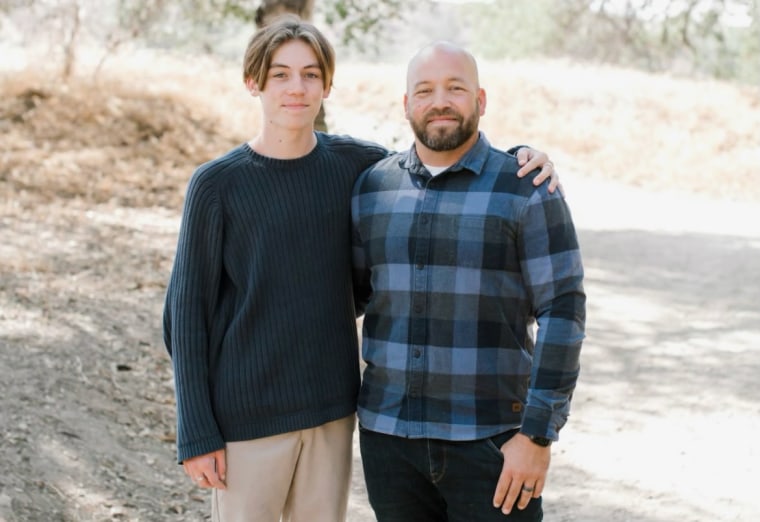
Landon Jones and his father, Nathan Jones. Desiree Keoshian
In a joint statement sent by email, Landon Jones’ parents, Lauren and Nathan Jones, said their son has been “called names and made fun of” since elementary school because of his appearance and because his interests never aligned with those of his peers.
“Kids and even adults can be so cruel to people that are different from them,” they said.
After the incident outside their home, Lauren and Nathan Jones said, they are determined to see the people bullying their son face consequences.
“Actions have consequences and we will keep pursuing this until those consequences are paid,” the couple said. “This behavior will not be tolerated and we will never turn a blind eye to injustices like these. We have a family to protect and that is our number one focus right now.”
The Jones family said they reached out to El Toro High School and told administrators that the driver of the Lincoln Navigator was a student at the school. They said no action has yet been taken that they are aware of.
Since Jones shared the video, over 11,000 people have shared comments, most of them supportive.
Former “American Idol” contestant David Archuleta, who came out publicly last year, was among the commenters: “Oh gosh… sorry you’re dealing with that there’s no justification for what they’re doing to you and so shallow of them.”
LGBTQ TikTok personality Josh Helfgott also commented, saying: “If there’s one thing I got from this video, it’s how STRONG you are & how weak they are. I’m so sorry this is happening. Keep shining, Landon.”
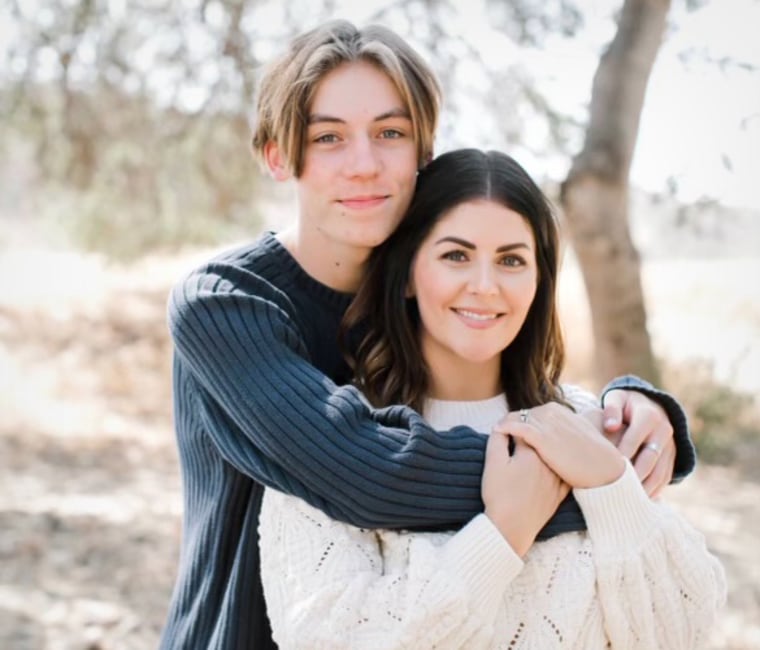
Landon Jones and his mother, Lauren Jones.Desiree Keoshian
Jones said, “One of the last things that I had expected was the amount of support from the community that I would have gotten.”
Lauren and Nathan Jones said they hope their son’s story will give more people voices and show “that no one should ever have to go through this alone.”
Jones isn’t alone when it comes to anti-gay bullying: A report published last year by The Trevor Project, a nonprofit LGBTQ youth crisis intervention and suicide prevention group, found the majority of LGBTQ youths (52%) enrolled in middle or high school reported having been bullied either in person or electronically in the year before they participated in the survey. LGBTQ middle school students reported higher instances of bullying (65%) than those in high school (49%).
Equality California, the nation’s largest statewide LGBTQ+ civil rights organization, announced endorsements of 30 pro-equality candidates Monday — the organization’s final endorsements ahead of the November 8 election. The newly endorsed candidates include twenty-seven openly LGBTQ+ candidates for local offices, part of an historic number of openly LGBTQ+ candidates running for office across California in 2022.
The full list of new endorsements can be found below:
California Board of Equalization:
District 1: Jose Altamirano
District 3: Tony Vazquez
California Assembly:
District 80: David Alvarez (Dual Endorsement – with Georgette Gómez)
Local Offices:
Adelanto Elementary School District Governing Board, TA 4: Resa Barillas
Alhambra City Council, District 1: Ari Gutiérrez Arámbula
Antelope Valley College District Board of Trustees, Area 2: Giovanni Christon-Pope
Baldwin Park City Council: Ralph Galvan
Chabot-Las Positas Community College District Board of Trustees, Area 3: Harris Mojadedi
Compton Community College District Board of Trustees, Area 1: Andres Ramos
Cupertino City Council, At-Large: Joseph “JR” Fruen
Desert Water Agency Board of Directors, Division 1: Marcus Miceli
Elk Grove Unified School District Board, Trustee Area 2: Michael Vargas
Helix Water District Board of Directors, Division 2: Andrea Beth Damsky
Hollister City Council, District 2: Rolan Resendiz
Imperial Beach Mayor: Paloma Aguirre
La Habra City School District Board of Education: Adam Rogers
Monterey Mayor: Tyller Williamson
Oakland City Council, District 4: Janani Ramachandran & Nenna Joiner (Dual Endorsement)
Palm Springs City Council, District 2: Jeffrey Bernstein
Redwood City Council, District 2: Chris Sturken
San Bernardino Community College District Board of Trustees, Area 4: Nathan Gonzales
San Francisco Board of Supervisors, District 4: Joel Engardio
San Mateo City Council, District 3: Sarah Fields
Santa Monica Rent Control Board: Danny Ivanov
San Leandro City Council, District 3: Victor Aguilar, Jr.
Santa Paula City Council, At-Large: Pedro Chavez
Signal Hill City Council: Keir Jones
Vallejo City Council, District 5: Tara Beasley-Stansberry
Victor Valley Union High School District Board of Education, District 2: Caleb Castaneda
Bold names indicate openly LGBTQ+ candidates.
For a complete list of Equality California’s 2022 endorsements, please visit eqca.org/elections.
###
Equality California is the nation’s largest statewide LGBTQ civil rights organization. We bring the voices of LGBTQ people and allies to institutions of power in California and across the United States, striving to create a world that is healthy, just, and fully equal for all LGBTQ people. We advance civil rights and social justice by inspiring, advocating and mobilizing through an inclusive movement that works tirelessly on behalf of those we serve. www.eqca.org
California Gov. Gavin Newsom signed a bill Thursday that aims to legally protect transgender youths and their parents if they flee conservative states that have restricted access to gender-affirming care.
The bill seeks to “offer refuge” to trans minors and their families “if they’re being criminalized in their home states,” state Sen. Scott Wiener, who introduced the bill, said on Twitter after Newsom signed it.
Wiener said states like Texas and Alabama “are seeking to tear these families apart,” referring to efforts in both states to bar parents from providing their trans children with medical care like puberty blockers and hormone therapy.
In February, Texas Gov. Greg Abbott called on the state’s Department of Family and Protective Services to “conduct a prompt and thorough investigation” of any reported instances of minors undergoing “elective procedures for gender transitioning.” He also encouraged anyone who works with children in the state and regular citizens to report parents providing such care.
In Alabama, Gov. Kay Ivey signed a bill that makes it a felony for medical professionals to provide gender-affirming medical care to people under 19.
“We should especially protect our children from these radical, life-altering drugs and surgeries when they are at such a vulnerable stage in life,” Ivey said in a statement at the time.
The bill Newsom signed is intended to protect families and children like those from prosecution in their home states if they travel to California for gender-affirming care or if they move to California after already receiving transition-related care elsewhere.
“We believe that no one should be prosecuted or persecuted for getting the care they need — including gender-affirming care,” Newsom said in a statement after signing the measure. “With the signing of this bill, California will ensure that these kids and their families can seek and obtain the medical and mental health care that they need.”
The legislation includes a variety of provisions that are meant to help protect families and trans kids. It prohibits California health care providers from releasing medical information in relation to other states’ laws prohibiting gender-affirming care for minors. It also prohibits the enforcement of a court order “based on another state’s law authorizing a child to be removed from their parent or guardian based on that parent or guardian allowing their child to receive gender-affirming health care or gender-affirming mental health care.”
The bill also authorizes a California court to take temporary emergency jurisdiction when a child hasn’t been able to receive gender-affirming health care elsewhere, which some on social media interpreted to mean that California courts will be able to take custody of children if they flee their home states because their parents don’t want to provide them with gender-affirming care.
But that isn’t accurate, according to Asaf Orr, a senior staff attorney and Transgender Youth Project director at the National Center for Lesbian Rights. Orr said that portion of the bill is related to a court’sjurisdiction in custody matters.
“State courts around the country have the authority to consider whether to retain jurisdiction over a custody matter involving a child who recently came into the state,” Orr told Reuters. “This typically occurs in instances of domestic violence or other crisis situations. This law simply clarifies that courts should retain jurisdiction in situations where a parent brings their child to California so that they can obtain medical treatment for gender dysphoria.” Gender dysphoria is a medical condition that involves a conflict between an individual’s sex assigned at birth and their gender identity.
California Gov. Gavin Newsom (D) has vetoed a bill that would have helped low-income LGBTQ people gain easier access to treatment and prevention services for sexually transmitted infections (STIs).
Newsom said he supported the STI Prevention & Treatment Fairness Act, but that there simply wasn’t enough funding to accomplish what it sought to do.
The bill, which was sponsored by Equality California, would have expanded access to STI health services to low-income people with confidentiality concerns (including LGBTQ people) through California’s Family Planning, Access, Care, and Treatment (PACT) program.
The news you care about, reported on by the people who care about you.
But Newsom explained that the bill would expand the definition of “family planning” beyond the federal definition, “thereby creating a state-only program that creates significant ongoing General Fund cost pressure not accounted for in the budget.”
“With our state facing lower-than-expected revenues over the first few months of this fiscal year, it is important to remain disciplined when it comes to spending, particularly spending that is ongoing,” Newsom also noted in his veto message, adding that “Bills with significant fiscal impact, such as this measure, should be considered and accounted for as part of the annual budget process.”
Craig E. Thompson, CEO of the LGBTQ Health nonprofit APLA Health expressed disappointment in Newsom’s veto.
“As the latest data from the CDC makes clear, the STD epidemic is only growing worse in California and across the U.S. — with syphilis rates up nearly 28% in the last year alone,” Thompson told the Bay Area Reporter. “APLA Health will continue advocating for forward-thinking policy and funding initiatives to address this crisis, including ensuring that all LGBTQ+ Californians have access to convenient, low-cost sexual health services regardless of ability to pay.”
A new law in California will help military service members who were discharged under “don’t ask, don’t tell” policies because of their sexual or gender identities to reestablish their eligibility for Veterans Affairs benefits, Gov. Gavin Newsom said Saturday.
“For decades, our bravest heroes, men and women who wore the uniforms of the armed services had to hide who they really were, and many were other than honorably discharged if their sexuality was discovered,” Newsom said in a statement after announcing he had signed the bill.
Gays and lesbians were banned in the military until the 1993 approval of “don’t ask, don’t tell,” which allowed them to serve only if they did not openly acknowledge their sexual orientation. Rather than helping, advocates say, the policy created more problems. In its entire history, the military dismissed more than 100,000 service members based on their sexual or gender identities — 14,000 of them during “don’t ask, don’t tell.”
Repeal of the law was approved by Congress and then President Barack Obama in late 2010 and took effect nine months later, allowing lesbian, gay and bisexual people to serve openly.
The Department of Defense subsequently created a path for veterans who had been discharged under the policy to receive the full range of veterans’ benefits.
“But many veterans sadly don’t know or can’t even access this important process,” Newsom said, adding that some veterans trying to reclaim benefits have had to hire expensive legal counsel and other assistance to navigate the process. “We’re taking steps to fix this.”
The law will require the California Department of Veteran Affairs to establish the Veterans Discharge Upgrade Grant Program to help advise LGBTQ veterans who were discharged under “don’t ask, don’t tell” and to help those who qualify to update and correct their records and access veterans’ benefits.
On Friday night, police were called to the scene of a stabbing outside popular Long Beach, California gay bar, the Mineshaft. Two men were attacked, and one has died.
The perpetrator is still at large.
The bar’s co-owner, Jeff Darling, said that around 11:30pm two patrons were standing outside the bar when an unidentified individual rode up on a bicycle. According to witnesses, an argument ensued. The incident escalated with the rider pulling a knife and stabbing both patrons in the chest. The attacker fled the scene.
Police arrived soon after and administered aid. The two victims were taken by ambulance to a local hospital, where one of the men, 28-year-old Christopher Finley of Long Beach, died of his injuries Saturday morning.
Finley was a “semi-frequent” regular at the bar, Darling told the Long Beach Post.
According to Darling, the man on the bicycle never entered the Mineshaft, but the “small argument” out front escalated into a stabbing when the two victims tried to get him to move along.
“After they were stabbed, they ended up in our doorway,” Darling said. “It appears to be a horrible random act.”
Just five minutes before the attack, Darling said, a customer was ejected for brandishing a taser. Police detained the man but did not arrest him.
“The investigation to determine his involvement, if any, is ongoing,” Long Beach Police spokesperson Allison Gallagher said.
According to LBPD, the motive for the stabbings remains under investigation and as such is not currently being investigated as a hate crime.
Darling called the incident a “very traumatic thing” and said he was planning a vigil for Finley and the other stabbing victim. He expressed his condolences and solidarity with the community in a post to Facebook.
“This is such a tragedy and I am deeply saddened by this senseless violence. My heart goes out to the loved ones of the person that lost his life and the family and friends of the person still hospitalized. Love will bring our neighborhood together and not let violence win. We have always wanted the Mineshaft to be a safe place in the community but this serves as a message that tragedy can strike at any time. Make sure to let those around you know that you Love them.”
There are those of us with more conservative fashion tastes, others who are willing to be more fashion-forward. But the question “Would you be caught dead in that outfit?” isn’t just one that you’d whisper to a friend on a shopping expedition—or behind a bridesmaid’s back at a wedding. For members of San Francisco’s Translatina community, the question is less an interrogative than a defiant statement.
Artists Julián Delgado Lopera, who curated the 2016 exhibition Noche de Ambiente with the GLBT Historical Society, and Rebeka Rodriguez are unveiling their new exhibition Would You Be Caught Dead In That Outfit?/¡Que Perra Mi Amiga!on September 22 at the Pacific Felt Factory in San Francisco’s Mission District. In photographs and through journals, the exhibition celebrates the legendary intergenerational histories of the city’s Translatinas, with a focus on the power of dressing up and kiki, or gathering together. Some of the exhibition materials and work generated by the show will be donated to the GLBT Historical Society’s archives.
We interviewed co-curator and photographer Rebeka Rodgriguez to learn more about the exhibition.
Tell us about the cultural importance to Translatinas of extravagant fashion and dressing up.
RR: Clothes become our armor out in the world. All those incredible gowns and sparkly suits. Dressing up as survival is one of the through-lines here: the power of certain outfits gives you the courage to go face the world. The dance floor is our church, where we go and worship each other and our community. One of the pieces on display is a dress that was given to Julián’s drag mother by a queen in the 1990s. So outfits have been handed down from queen to queen over time, and remixed and referenced.
What was the germination of this exhibition?
RR: Both Julián and I have a deep personal investment and long history creating work with Translatinas, specifically with El/La Para Translatinas, an organization that represents trans, intersex, and gender-diverse Latinx people; I’ve been photographing the women at El/La for more than a decade. Julián’s book ¡Cuéntamelo! Oral Histories by LGBT Latino Immigrants was republished by Aunt Lute Books in 2018 and that is when Julián and I worked on “Would You Be Caught Dead in that Outfit?”, a multimedia event at the Stud celebrating the aesthetics of 1980s and 1990s underground clubbing. There was a panel discussion which included one of the people featured in the book and we had a runway where everyone who wore their outfits got a chance to strut their stuff. I took photos, it was fun!
And then at the end of 2019 and beginning of 2020, we facilitated writing workshops with five El/La Translatinas members who shared stories, drew images and wrote about their memories of creating outfits and hitting the club. I was able to photograph some of them in the intimacy of their homes. The journals with their stories as well as prints of the photographs will be part of the exhibition. So it’s been an evolution, it’s a project that’s a living history, and this is the latest incarnation. And it’ll continue when the work becomes part of the GLBT Historical Society’s archives.
How is this exhibition also a very San Francisco show?
RR: Part installation, part archival project, this show centers the lives of transgender Latin American immigrants and their contribution to the glorious fabric of San Francisco’s queer history. The contributions of Translatinas to San Francisco’s queer history is vast, deep, textured and layered, both physically and metaphorically Translatinas have always been here, on stage, in the streets and on the dancefloor. WYBCDITO highlights Translatina creative brilliance and resilience. By centering this history we make space for all of us.
NOTE:Would You Be Caught Dead in That Outfit?opens September 22, 2022 at the Pacific Felt Factory at 2830 20th Street, San Francisco, and runs through mid-October.
Thursday, September 22 5:00 p.m. In-person program The Pacific Felt Factory2830 20th Street, San FranciscoFree
Join us for the opening reception of Julián Delgado Lopera and Rebeka Rodriguez’s new exhibition Would You Be Caught Dead In That Outfit?/¡Que Perra Mi Amiga! at the Pacific Felt Factory. Through dress-up and kiki, the exhibition celebrates the legendary intergenerational histories of trans Latinas on San Francisco’s 16th Street. Part installation, part archival project (with new material being donated to the GLBT Historical Society’s archives), this stunning visual collection centers the lives of transgender Latin American immigrants and their contribution to the fabulous fabric of San Francisco’s queer history. Would You Be Caught Dead is being mounted in collaboration with El/La Trans Latinas, the Transgender Cultural District, the GLBT Historical Society and AIRSF. More information is available here. No tickets are needed; entry is first-come, first-served.
Rebeka Rodriguez (she/her) is an artist, curator, and cultural producer whose work explores the body as a site for personal and collective histories, desire, community and queer aesthetics. She is currently working with Yerba Buena Center for the Arts, where she designs and implements creative programming, and is the Director for AIR-SF, a nonprofit project committed to supporting artists and producing relevant public art projects and expanding civic participation.