As the Sarasota County School Board convened for the final time this year on Tuesday, Bridget Ziegler entered the board chambers facing a rift largely driven by agenda item No. 1: a colleague’s resolution calling for her resignation.
Zander Moricz, who was the class president at Pine View School in Osprey and now attends Harvard, said Bridget Ziegler deserved to lose her job, but not because of her private sex life.
“That defeats the lesson we’ve been trying to teach you, which is that a politician’s job is to serve their community, not to police personal lives,” Moricz said. “So, to be extra clear Bridget, you deserve to be fired from your job because you are terrible at your job.”
Read the full article. The clip below has gone wildly viral with millions of views on TikTok, where I came across it a dozen times last night. Watch every second.
When marginalized groups face discrimination in the health care system, the results can be far-reaching and drastic. Across LGBTQ+ communities, this experience is all too well known. For years, activists have pointed out that health care for LGBTQ+ Americans is “under attack,” and bias is thriving. People frequently face gaps in health services, treatment, and outcomes.
There’s another aspect of this problem that needs to be addressed. It’s one that has a direct, immediate impact on the health and wellness of millions of people: an information gap. In many cases, LGBTQ+ Americans have learned not to trust traditional sources of health information. Many also have had trouble receiving the information they need from these sources when they ask for it. As a studyfound, “There is breadth of evidence documenting LGBTQ+ individuals’ experiences of heterosexism, homophobia, overt discrimination and pathologization in the health care setting, which has proven to be a barrier for LGBTQ+ individuals seeking health information from doctors.”
This problem doesn’t just apply to doctor’s offices. It also applies to other entities such as government health agencies, hospitals and pharmaceutical companies. We explored this in our new survey.
We found that LGBTQ+ Americans are substantially more likely to get sick due to a lack of information. Twenty-seven percent of LGBTQ+ respondents told us that they have gotten sick in the last 12 to 18 months because they did not have the information they needed to make decisions about their health. (Eighteen percent of non-LGBTQ+ respondents said the same.)
To be clear, LGBTQ+ Americans are active in seeking out health information. But the sources they’re turning to don’t always have all the accurate, relevant, inclusive information that they need.
We looked at where LGBTQ+ Americans are going when they need health information. Much like Black Americans, LGBTQ+ Americans have curated sources they trust. We call these “chosen circles.” Two findings in particular were striking.
Forty-one percent of LGBTQ+ respondents in our survey said they get health information from TikTok — a figure about twice as high as the 21% of non-LGBTQ+ respondents who said the same.
News reports have discussed the role of TikTok in reaching members of LGBTQ+ communities, particularly younger people. The San Francisco Chronicle podcast Fifth & Mission called the social media platform “a lifeline for LGBTQ youth.” Mashable reported that, according to the Trevor Project, TikTok is where LGBTQ+ youth of color feel safest and most comfortable online.
The fact that LGBTQ+ communities are specifically seeking health information on TikTok presents an opportunity for health agencies and organizations. They should build up their efforts on this platform. It’s up to them to make sure that videos are available, providing accurate, helpful information about a wide range of health topics.
They should also work with popular influencers on the platform to reach LGBTQ+ Americans with important health information. More than a third (36%) of LGBTQ+ respondents in our survey said that online influencers they follow are an important source of health information. And they share information as well. More than a third said they have shared their own health information, or reposted health information from other sources, on social media. So these platforms can be especially helpful in improving health outcomes.
In our survey, more than a quarter (28%) of LGBTQ+ respondents said they turn to mental health therapists and counselors for emotional support in making health decisions. Again, this figure is lower among non-LGBTQ+ Americans.
This offers another opportunity for health-focused agencies and organizations. By working with people who provide therapy and counseling to LGBTQ+ communities and getting them the latest, most useful information on all sorts of health problems, these agencies and organizations can reach people in need.
Our survey also finds that no matter where they’re getting information, LGBTQ+ Americans understandably want to see people like them front and center. They want information specifically designed to reach them, addressing their experiences and unique challenges. And in all communications, they want health information providers to show that they understand the broad diversity of LGBTQ+ communities, spanning different races, religions, gender identities and more.
The need for change is urgent. By listening to, learning from, and partnering with members of LGBTQ+ communities, health agencies and organizations can create real transformation, empowering people with information to live healthier lives.
Tayla Mahmud is the executive vice president of health equity and multicultural strategy with M Booth Healthm a health consultancy and communications agency. Peter Matheson Gay is its chief impact officer.
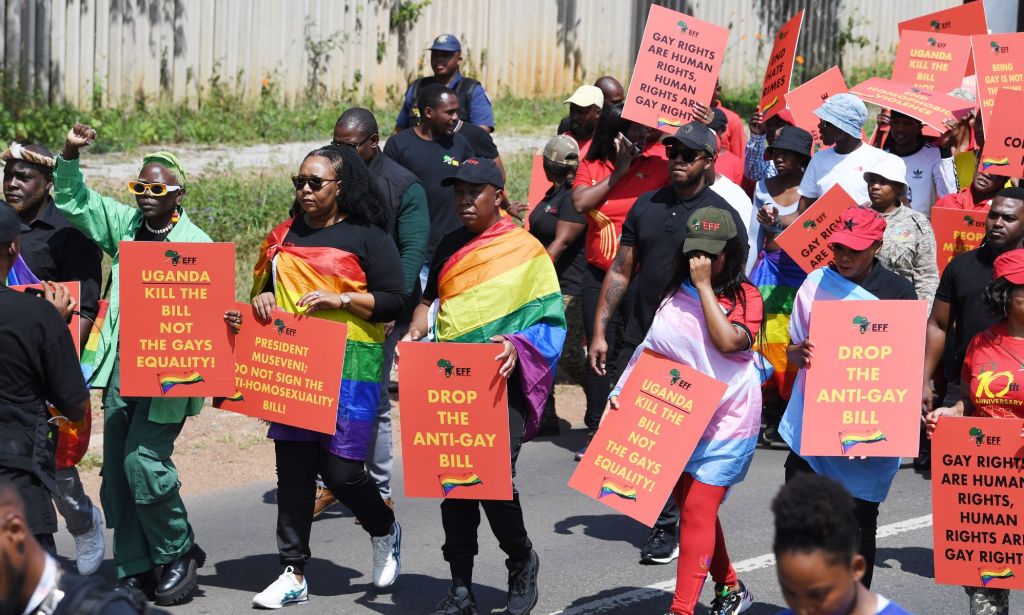
A gay man has expressed his horror and hopelessness after learning that he will be deported back to Uganda after living in Canada for five years.
The 25-year-old man, who came to Canada in 2018 as an international student, and has since worked in Edmonton, Alberta as a nurse, ran out of options this year when his work visa expired and his application for refugee status was rejected.
Uganda has become one of the most dangerous countries for LGBTQ+ people this year, with the introduction of its harsh Anti-Homosexuality Act.
A gay man is set to be deported to Uganda after failing to obtain refugee status in Canada because he cannot definitively prove his sexual orientation. (Getty)
Despite the inherent danger that awaits him at home, the man, who remained anonymous when speaking to Canada’s Global News to protect his identity, has had his refugee application and all subsequent appeals rejected.
The man, who is identified by the news outlet as “Sue”, explained that his refugee application was rejected because they couldn’t prove his sexual orientation.
“I don’t know how to prove… How am I supposed to prove that I’m a gay man? I just told you I am a gay man,” he said.
Lawyer Michael Battista, who also spoke to the publication, said that Sue had done his best to verify his sexual identity, providing evidence of his participation in the LGBTQ+ community in Edmonton, and an affidavit from a well-known Ugandan LGBTQ+ activist to verify that he is gay. But so far, this hasn’t made a difference in Sue’s case.
“I have nowhere to go,” Sue said. “I’m stranded and even the place I thought would comfort me is forcing me out.
“It’s hard to explain the feeling, but right now I feel like I have nowhere to go.”
Sue admitted that he had presumed that in Canada he would be “comfortable” and “fine as I am”.
He continued: “The fact that I have to prove my sexuality beyond reasonable doubt is quite ridiculous to me.
“This whole thing is a horror. I feel like I’m in a nightmare and I really want to wake up, but I cannot. I’m just praying and hoping that the government can intervene.”
If nothing changes, Sue, who began his application process back in April 2022, will be deported on Tuesday (19 December).
Battista noted that he couldn’t understand why Canada hadn’t put a moratorium on the deportation, which he said could be done for people who would be returning to communities where they’d be put in danger.
“Given the deterioration of the human rights situation in [Uganda], it would be, I think, a very good policy move on the part of the government of Canada,” he said.
While he waits in limbo for the next few days, it’s hard for Sue not to think about what might await him in Uganda.
“My whole family abandoned me so even if I reach the airport, I don’t know where I’m going to stay. I don’t know where I’m going to go. I’ve run out of options.”
“There is a very high chance that I’ll be arrested and tortured, just for identifying as a gay man. This is really something very, very disheartening that a fellow human being can treat someone harshly.”
Sue has also written to Alberta MP Randy Boissoneault about his case, the office of whom told Global News that they were aware of his situation and working with immigration officials.
Meanwhile, a spokesperson for CBSA (Canada Border Services Agency) told the outlet that the “decision to remove someone from Canada is not taken lightly” and “all individuals who ae subject to removal have access to due process and procedural fairness.”
Their statement read: “Canada is monitoring the situation in Uganda and remains committed to offer refugee protection to those who need it, including individuals who have been persecuted on the basis of their sexual orientation, gender expression, gender identity, and sex characteristics.”
Uganda’s Anti-Homosexuality Bill has sparked an enormous outcry from LGBTQ+ rights and human rights groups around the world, with the US going as far as to revise travel guidance to the country and imposing sanctions against Ugandan officials.
Still, the country has insisted that it won’t sway, and has accused the US of pushing “the LGBT agenda in Africa.”
Pope Francis has formally approved allowing priests to bless same-sex couples, with a new document explaining a radical change in Vatican policy by insisting that people seeking God’s love and mercy shouldn’t be subject to “an exhaustive moral analysis” to receive it.
The document from the Vatican’s doctrine office, released Monday, elaborates on a letter Francis sent to two conservative cardinals that was published in October. In that preliminary response, Francis suggested such blessings could be offered under some circumstances if they didn’t confuse the ritual with the sacrament of marriage.
The new document repeats that rationale and elaborates on it, reaffirming that marriage is a lifelong sacrament between a man and a woman. And it stresses that blessings should not be conferred at the same time as a civil union, using set rituals or even with the clothing and gestures that belong in a wedding.
Read the full article. Last week the Protestant Church of England made the same move, with similar stipulations. The cult already loathes Pope Francis, so expect today’s news to fuel even more screaming.
Wisconsin Democratic legislators are looking to write marriage equality and parental rights for same-sex couples into state law.
While the U.S. Supreme Court’s 2015 ruling in Obergefell v. Hodges made bans on same-sex marriage unenforceable, they remain on the books in several states. Wisconsin’s constitution and state statutes still define marriage as the union of one man and one woman. Democratic lawmakers unveiled legislation Wednesday that would change that.
They announced two bills at a press conference, The Cap Timesreports. One proposes a state constitutional amendment that would remove the “one man and one woman” language, which was added in 2006. If legislators approve the amendment in two consecutive sessions, it will go to voters for ratification. The sponsors hope to get it on next November’s ballot.
“It is long past time for our state constitution and statute to reflect that marriage equality is the law of the land and has been for nearly a decade,” Democratic Sen. Mark Spreitzer said at the press conference, according to the Times.
“One of the worst days in the legislature was when that constitutional amendment passed in 2006, and some of my colleagues came up to me afterwards and said, ‘Don’t take it personal,’” added Democratic Sen. Tim Carpenter, who is gay, Wisconsin Public Radio reports. “It’s been personal, and it’s been in our constitution for about 17 years, and it’s time to repeal it.”
“A second bill would increase legal protections for LGBTQ+ couples surrounding adoption, pregnancy, parental rights, insurance and benefits, among other areas, as well as change current language Spreitzer calls ‘outdated’ that refers to ‘husbands and wives’ to ‘spouses,’” the Times reports.
Jamie Gaffke, who lives in Madison, said she and her wife, Ruth Vater, have had to take legal action to assure they’re both recognized as parents. “We’ve spent a lot of money on legal fees and a lot of sleepless nights worried about the state of our family,” Gaffke said at the press conference, according to the Times. “Ruth is the legal parent of both of our children, but due to gendered language in the state statutes, we continue to protect ourselves legally with parentage orders and the need to go to court to secure parent rights.”
Writing marriage equality into state law would help protect it if the U.S. Supreme Court ever decides to reverse Obergefell, Wisconsin Attorney General Josh Kaul told the paper. The federal Respect for Marriage Act, which President Joe Biden signed into law a year ago Wednesday, assures that the U.S. government will continue to recognize same-sex and interracial marriages even if Obergefell is overturned, but it doesn’t require states to allow same-sex couples to marry.
“As we’ve seen in the abortion context, it’s important to ensure that laws are updated, because otherwise you can end up with laws in place that are inconsistent with what you want to see,” Kaul said.
Three Florida teachers are taking matters into their own hands and suing the state over a law that forbids them from using their preferred pronouns at work.
In a legal complaint filed against the state government in Tallahassee, the plaintiffs argued that not only is the law designed to “stigmatise” the trans community, but legislators have not explained how the law is supposed to “protect children” as they have claimed.
“Through all these laws, Florida intentionally sends the state-sanctioned, invidious, and false message that transgender and non-binary people and their identities are inherently dangerous, especially to children,” the complaint states.
“Florida’s goal behind these laws is to stigmatise and demonise transgender and non-binary people and relegate them from public life altogether.”
The state law, which took effect in July, forces school employees to use pronouns that do not match their gender identity, and bans them from requesting that students to refer to them by their preferred pronouns.
One of the plaintiffs, a transgender maths teacher identified as Ms Wood, was told by Lennard High School that she could no longer be referred to as “Miss” despite having legally changed her name and gender marker years prior.
While most students still call her Ms Wood, some have opted to call her “Teacher Wood” to prevent potential punishment for breaching the law. She is not allowed to correct a student if they misgender her.
Fellow plaintiff Mx Schwandes, who is non-binary, was fired from their job in October after they refused to stop using they/them pronouns or gender-neutral honorifics such as “Mx”
The plaintiff’s lawyers argue in the complaint that the law is a violation of Title VII of the Civil Rights Act, as well as Title IX of the Education Amendments and the 14th Amendment.
“Florida has stigmatised plaintiffs, threatened their psychological wellbeing, upended the respect that is owed to them as educators and that is necessary for a safe workplace and functioning classroom, and put their professions and families’ wellbeing on the line,” the complaint reads.
Under Ron DeSantis, the state has enacted a number of anti-LGBTQ+ laws that target schools, including the reviled ‘Don’t Say Gay‘ bill banning the discussion of LGBTQ+ issues and idenities in the classroom.
Florida extended thisa censorship in April after voting to ban classroom instruction on LGBTQ+ topics in all public school grades.
Experts have long explored what has come to be known as the “lesbian wage premium” – the fact that on average, lesbians around the world earn about 9% more than heterosexual women. The number is even higher in the United States, with lesbians earning about 20% more than straight women.
In a recent video, TikToker Aria Velz analyzed several studies to explain why this might be. “We can start at the obvious,” she said, “lesbians tend to be more educated than straight women, are less likely to have children, live more predominantly in cities, and have more professional jobs.”
Related:
But she explained that even when controlling for all of that, lesbians still earn more. So she brought up another hypothesis: Women in heterosexual relationships are still expected to take on more emotional and domestic labor than men, whereas lesbians tend to more equally share those duties. As such, heterosexual women are more likely to sacrifice career advancement for domestic responsibilities.
Never Miss a Beat
Subscribe to our daily newsletter to stay ahead of the latest LGBTQ+ political news and insights.
Velz also pointed to studies that show lesbians who have lived with a previous male spouse make less money than lesbians who have never lived with a man.
“The lesson here is not that lesbians are better at making money,” she said. “It reconfirms that the domestic labor situation at home contributes to how women earn more outside the home – and lesbians have just learned that lesson first.”
But it’s not all sunshine and rainbows. Despite the extra earnings for lesbians, Slate pointed out in 2015 (when the lesbian wage premium was first identified), that lesbians were still a lot are likely to be poor than straight women as well as the general population. And because women in general still make less than men, two women in a couple still tend to miss out on key earnings.
As Slate put it, “Any benefits to being lesbian are canceled out when couples’ earnings are considered in aggregate—there, lesbians fare the worst of anyone.”
Opponents of Connecticut’s policy letting transgender girls compete in girls high school sports will get a second chance to challenge it in court, an appeals court ruled Friday, which revived the case without weighing in on its merits.
Both sides called it a win. The American Civil Liberties Union said it welcomes a chance to defend the rights of the two transgender high school track runners it represents. The Alliance Defending Freedom, which represented the four cisgender athletes who brought the lawsuit, also said it looks forward to seeking a ruling on the case’s merits.
In a rare full meeting of all active judges on the 2nd U.S. Circuit Court of Appeals in Manhattan, judges found the cisgender runners have standing to sue and have described injuries that might qualify for monetary damages. The runners also seek to alter certain athletic records, alleging they were deprived of honors and opportunities at elite track-and-field events because they say “male athletes” were permitted to compete against them.
The case had been dismissed by a Connecticut judge in 2021, and that decision was affirmed by three-judge panel of the 2nd Circuit a year ago.
At least 20 states have approved a version of a blanket ban on transgender athletes playing on K-12 and collegiate sports teams statewide, but a Biden administration proposal to forbid such outright bans is set to be finalized by March after two delays and much pushback. As proposed, the rule announced in April would establish that blanket bans would violate Title IX, the landmark gender-equity legislation enacted in 1972.
Under the proposal, it would be much more difficult for schools to ban, for example, a transgender girl in elementary school from playing on a girls basketball team. But it would also leave room for schools to develop policies that prohibit trans athletes from playing on more competitive teams if those policies are designed to ensure fairness or prevent sports-related injuries.
In a statement Friday, the American Civil Liberties Union and the ACLU Foundation of Connecticut cast the ruling as a victory for the two runners they represent — Andraya Yearwood and Terry Miller — noting that the 2nd Circuit wrote that the transgender runners have an “ongoing interest in litigating against any alteration of their public athletic records.”
Roger Brooks, a lawyer for the Alliance Defending Freedom, said the decision was a victory “not only for the women who have been deprived of medals, potential scholarships, and other athletic opportunities, but for all female athletes across the country.”
In 2020, the Alliance sued on behalf of four athletes — Selina Soule, Chelsea Mitchell, Alanna Smith, and Ashley Nicoletti — over a Connecticut Interscholastic Athletic Conference policy that allows transgender girls to compete in girls’ athletic events.
Three of 15 judges who heard arguments earlier this year fully dissented on Friday, while five other judges dissented to portions of the majority ruling.
In a dissent to the majority ruling, Circuit Judge Denny Chin noted that three of the cisgender athletes alleged that only one track event in their high school careers were affected by the participation of transgender athletes while a fourth athlete alleged that four championship races were affected.
In a footnote, Chin wrote that all four plaintiffs currently compete on collegiate track-and-field teams, some after being awarded scholarships, while neither of the transgender athletes who intervened in the case have competed since high school.
And he pointed out that no one was able to cite any precedent in which a sports governing body retroactively stripped an athlete of accomplishments when the athlete complied with all existing rules and did not cheat or take an illegal substance.
“It is not the business of the federal courts to grant such relief,” Chin said.
The New Hampshire attorney general’s office filed a civil rights lawsuit against a neo-Nazi group on Wednesday alleging it disrupted a drag story hour at a café in June.
Attorney General John Formella filed the complaint against 19 unnamed members of the New England neo-Nazi group NSC-131, which stands for Nationalist Social Club, and their leader, Christopher Hood, 25, accusing them of violating the state’s anti-discrimination laws for trying to stop the café’s drag story hour through acts of intimidation.
The event, where drag queens read children’s books to kids, took place during Pride Month at Teatotaller, an LGBTQ-owned coffee shop in Concord, the state’s capital. A viral video posted by Juicy Garland, the drag queen hosting the event, shows the group of neo-Nazis wearing masks, sunglasses, baseball caps and matching shirts and pants, shouting, raising their right arms in unison and banging on the coffee shop’s windows.
“Acts of hate designed to terrorize an individual or business into violating our State’s antidiscrimination laws are simply wrong and will not be tolerated,” Formella said in a statement. “The Department of Justice will continue to enforce the State’s antidiscrimination laws to the greatest extent possible to ensure that people of all backgrounds can live free from discrimination, fear, and intimidation because of who they are.”
William E. Gens, an attorney for Hood, said he has not yet read the complaint but summed it up to “virtue signaling” by Formella.
“This attorney general has a rather narrow view of free speech and he’s lost and he’s going to try it again,” Gens said, referring to a similar complaint the attorney general filed against Hood in January that was later dismissed. “Maybe he thinks he’ll find a judge that thinks like he does. I hope not, not just for Chris Hood’s sake but for all our sakes.”
If Hood and the 19 unnamed men are found to have violated the state’s anti-discrimination law, they can face a $10,000 penalty, according to a news releaseissued by the attorney general’s office on Wednesday.
Emmett Soldati, the coffee shop’s owner, applauded the attorney general’s complaint, saying that it “sends a very strong message” of support to the state’s LGBTQ people.
“Though we have kind of gone on largely focusing on selling bubbletea and lattes and hosting shows since June, that this is still important to the attorney general’s office and to the state of New Hampshire is a demonstration to our community that we belong here,” Soldati said.
In his previous complaint, Formella accused Hood and another NSC-131 member of violating civil rights law when they hung a banner along a New Hampshire highway that read, “Keep New England White.” The charges were dismissed in June.
Gens said that since the case was dismissed, Hood has been “keeping kind of quiet” and paying attention to his newborn child.
Massachusetts Attorney General Andrea Joy Campbell’s office also filed a complaint against Hood and the neo-Nazi group last week, accusing them of violating the state’s civil rights laws in a series of incidents between July 2022 and October 2023.
Within the last few years, anti-LGBTQ demonstrations and acts of violence against the community have surged. Demonstrations against drag events and performances have been particularly pronounced.
Between June 1, 2022 and May 20, 2023, there were more than 200 anti-drag incidents across the nation, according to a June report by the Institute for Strategic Dialogue. The report also found that there were more demonstrations within the first five months of this year than in the last seven months of last year.
Gen Z has long been known as the generation with the most LGBTQ+ members, but recent research reveals that it is also the generation most likely to embrace unspecific labels.
Among 18- to 26-year-olds, 26 percent said they identify as “something other than straight,” according to a new poll from Business Insider and YouGov. This compares to 15 percent of Millennials, 11 percent of Gen X, and 7 percent of Baby Boomers.
Gen Z is more likely to identify under the umbrella-term of “queer” rather than a specific label. 5 percent self-identify as queer, compared to just 1 percent of Millennials and Gen X, and less than 1 percent of Boomers.
Gen Z is also more likely to embrace the “bisexual” label, as opposed to “binary terms that suggest they like only one type of person,” such as “gay” or “lesbian.” 13 percent of Gen Z identifies as bisexual, compared to 7 percent of Millennials and 4 percent of Gen X. Only 1 percent of Boomers identify as bisexual.
However, researchers noted that this does not necessarily mean there are more bisexual people in today’s generation, and that the data could instead suggest that more youth today feel comfortable coming out, and being open about their sexuality.
The data nonetheless shows Gen Z’s embrace of the term, as well as their embrace of the label queer. Many respondents stated that they alternate between labels depending on the context, using the term queer in tandem with those such as lesbian or gay.
One 24-year-old respondent said that she primarily uses queer, but added that “I also think ‘lesbian’ has a political meaning, so I like that word as well.” Another 21-year-old said he uses both queer and gay, but tends to use queer because “some people like to miscategorize [gay] as excluding people.”
Researchers noted that the data and personal examples reflect the fluidity of sexuality, and the attitude among LGBTQ+ youth that, as one respondent put it, “change can be good, too.”