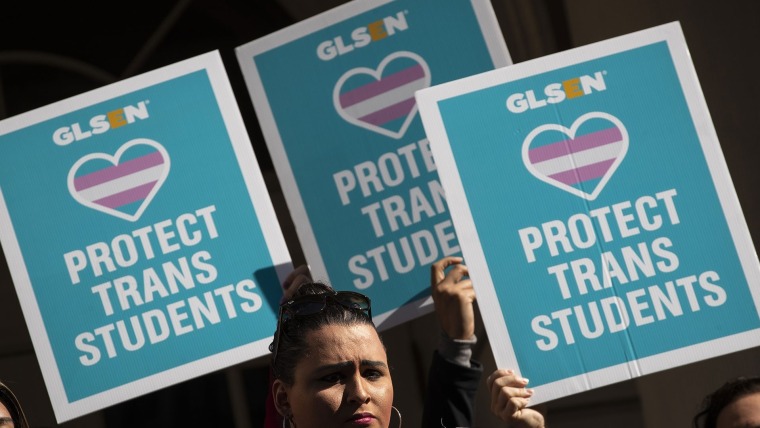
Former President Donald Trump vowed in a video released Tuesday that, if re-elected, he would punish doctors who provide gender-affirming care to minors and push schools to “promote positive education about the nuclear family” and “the roles of mothers and fathers” as part of a wide-ranging set of policies to use federal power to target transgender people.
In the straight-to-camera video posted on his Truth Social platform, Trump said he would task several federal agencies to police and ultimately “stop” gender-affirming care for minors, which he equated to “child abuse” and “child sexual mutilation.”
He said he would also prohibit any federal agency from doing work to “promote the concept of sex and gender transition at any age,” not just for minors.
The proposals are likely to be met with staunch opposition from LGBTQ rights advocates, who are fighting similar ideas across the country, calling them detrimental to trans people.
Gender-affirming care, according to the Department of Health and Human Services, “consists of an array of services that may include medical, surgical, mental health, and non-medical services for transgender and nonbinary people.”
Trump’s proposals are among the most draconian compared to the many that have circulated in state capitols in recent years, going so far as to suggest that he would push for a federal law recognizing only two genders.
Trump said he would push Congress to pass a law banning gender-affirming care for minors nationwide; order the Department of Justice to investigate the pharmaceutical industry and hospitals to see if they “deliberately covered up horrific long-term side effects of sex transitions in order to get rich;” and cut off doctors from Medicare and Medicaid — a potential career-ender for many doctors — if they treat trans youth with hormones or surgery.
In addition, he said he would make it easier for patients who later regret receiving gender-affirming care as a minor to sue their doctors, calling the procedures “unforgivable.”
Trump also said his policy changes would extend to education.
He has already vowed to create a “new credentialing body for teachers” regarding the teaching of race history, but added that the panel will “promote positive education about the nuclear family, the roles of mothers and fathers and celebrating, rather than erasing, the things that make men and women different.”
He said his Department of Education would impose “severe consequences” on any teachers or school officials who “suggest to a child that they could be trapped in the wrong body,” which could include civil rights penalties for the individuals and a loss of federal funding for schools.
“The left-wing gender insanity being pushed at our children is an act of child abuse. Very simple. Here’s my plan to stop the chemical, physical and emotional mutilation of our youth,” Trump said.
Trump’s proclamation comes as he looks to reignite momentum for his second presidential campaign and as conservatives nationwide have become increasingly concerned about trans issues, especially gender-affirming care for minors.
The hardline stance is a departure for Trump, who distinguished himself from more traditional social conservatives in the 2016 Republican presidential primary by openly courting LGBT voters.
The former Democratic donor from Manhattan said in 2016 that he was “fine” with same-sex marriage and would be a “real friend” of the LGBT community and has bragged about how he “did great with the gay population,” compared to other Republican presidential candidates.
Five Republican-leaning states have enacted bans or restrictions on gender-affirming care for minors over the past two years: Alabama, Arizona, Arkansas, Tennessee, Utah.
Lawmakers in at least 21 states have proposed bills so far this year seeking to ban or restrict gender-affirming care for minors.
Judges have blocked the laws in Alabama and Arkansas from taking effect, pending the outcome of lawsuits.
The ACLU of Utah and the National Center for Lesbian Rights have told NBC News they plan to file suit against Utah within two weeks over its law, which was signed by the governor on Saturday.
In the last three decades, some of the most egregious attacks on equality — the Defense of Marriage Act, Don’t Ask, Don’t Tell, not to mention the infamous 1950 “Employment of Homosexuals and Other Sex Perverts in Government” report — came from Congress. Some of the most significant advances – passage of the Matthew Shepard and James Byrd Jr. Hate Crimes Prevention Act in 2009 and the repeal of Don’t Ask, Don’t Tell in 2010 – also came from Congress.
And while the Supreme Court found in 2015 that some federal jobs protections against discrimination based on sex also protect LGBTQ+ people, the community is still fighting for the Equality Act, which would enshrine legal protections in civil rights law.
But Congress is unlikely to provide much help in 2023 now that Republicans have taken a narrow majority in the House of Representatives. Not only has the GOP historically opposed equality legislation, but many of the Republicans who won their midterm elections did so by weaponizing antipathy towards LGBTQ+ people, advocating for laws banning transgender people access to gender-affirming care, demagoguing equal treatment of transgender students in schools, slurring LGBTQ+ teachers and doctors as “groomers.”
And elections have consequences.
Former Congressman Mondaire Jones (D-NY) sat down with LGBTQ Nation to discuss the possibilities for change in Congress in the coming two years. Jones was first elected in 2020 and is one of the two first-out LGBTQ+ Black members of Congress; he lost his seat in 2022. He co-introduced the Respect for Marriage Act in Congress to ensure same-sex couples continue to have the rights associated with marriage should the Supreme Court overturn the marriage equality case Obergefell v. Hodges.
Jones helped get former President Donald Trump impeached for a second time after his supporters rioted in the Capitol in an attempt to overturn the results of the 2020 presidential election. During his time in Congress, he supported the John Lewis Voting Rights Act. He pushed for even tougher democratic reforms, including automatic voter registration, public financing of elections, and an end to partisan gerrymandering.
So it’s no surprise that Congressman Jones’s message now is that getting better people elected is the key to moving Congress toward equality.
LGBTQ NATION: As the president prepares to address the nation, what are the most vexing problems facing the LGBTQ+ community?
Mondaire Jones: The Supreme Court of the United States — specifically, the far right, six-three supermajority on the Court — continues to pose the greatest obstacle to the lives and livelihoods of community members.
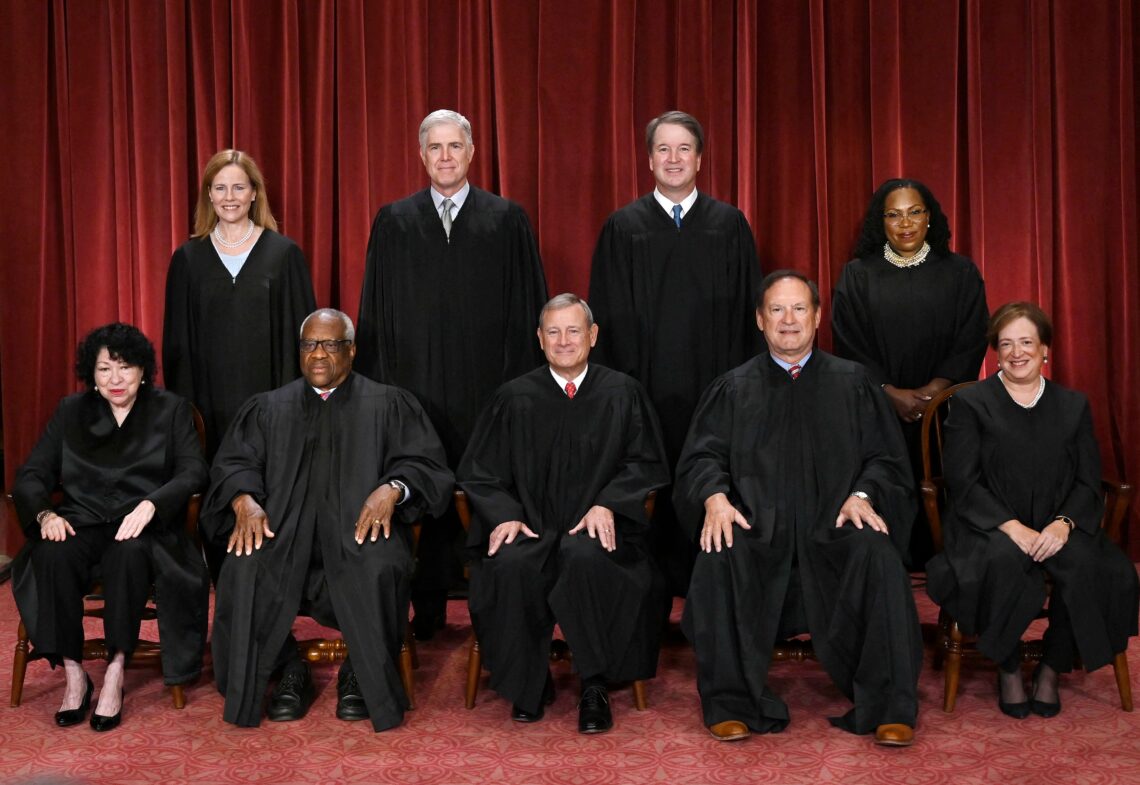
Justices of the US Supreme Court pose for their official photo at the Supreme Court in Washington, DC on October 7, 2022. (Seated from left) Associate Justice Sonia Sotomayor, Associate Justice Clarence Thomas, Chief Justice John Roberts, Associate Justice Samuel Alito and Associate Justice Elena Kagan, (Standing behind from left) Associate Justice Amy Coney Barrett, Associate Justice Neil Gorsuch, Associate Justice Brett Kavanaugh and Associate Justice Ketanji Brown Jackson. Photo by Olivier Douliery/AFP via Getty Images.
This majority is on a rampage against our rights. We see that in a case that will undermine the ability of same-sex couples not to be discriminated against in the marketplace [he was referring to 303 Creative v. Elanis], where the First Amendment is being weaponized to allow people to be bigoted.
We know that the Court is going to come for marriage equality. As proud as I am of having introduced legislation with Jerry Nadler that passed last year called the Respect for Marriage Act, it’s not lost on me that the Respect for Marriage Act still would not ensure marriage equality in every state in the union for same-sex couples.
More than protecting members of the LGBTQ+ community against discrimination, we’ve got to have our eyes set on creating equity, whether that is in the healthcare context, the housing context, or the student debt context, where members of the community disproportionately experience hardship. That was my project when I wrote a letter to CMS and the CDC asking them to require both public and private insurers to cover an injectable form of PrEP called Apretude at no cost-sharing to the patient.
LGBTQ NATION: What do you see as fighting for queer rights and 2023? What does that mean, and what does that entail?
MJ: Because of the Republican majority in the House of Representatives and too few Democrats in the United States Senate willing to get rid of the filibuster, we have to turn to state-level progress in beating back renewed assault on the LGBTQ+ community, such as these so-called “Don’t Say Gay” bills in Florida and elsewhere.
We also have to call on the Biden administration to use its executive authority to make discrimination less prevalent and to create equity.
LGBTQ NATION: So you brought up state-level legislation where things aren’t looking that good for us over the past few years. At least a hundred bills have been introduced to curtail rights. What can we do to stop that?
MJ: The good news is that we have won public opinion over the past decade when it comes to the community’s entitlement to the same rights and liberties that our cisgender, heterosexual counterparts enjoy.
However, because of an electoral system plagued by voter suppression, voter disenfranchisement, and unlimited spending by corporate special interests, the people we see in power often do not reflect the country’s mood.
We have to continue to build and renew the movement for liberation through organizing at the grassroots level and defeating those who are hostile to the humanity of our community.
While also making sure we take back the House and keep the Senate and the White House in the 2024 elections because only the Democratic majority in this country can be trusted to protect the LGBTQ+ community.
“We have to continue to build and renew the movement for liberation through organizing at the grassroots level and defeating those who are hostile to the humanity of our community.“Mondaire Jones
LGBTQ NATION: So you’re saying it comes down to who’s elected, but what does the community do once we have a group of people in Congress? You were in Congress. What did you see LGBTQ+ activists doing that maybe could have been more effective?
MJ: Well, I appreciate this question.
Several high-profile LGBTQ+-focused organizations spend more time patting themselves on the back for the work that they do and dining with their major donors than they are focused on electing champions to office and pressuring elected officials to enact the bold reforms that we urgently need.
Consider how long it took for certain organizations to come out for the filibuster reform, as we initially needed to pass the Equality Act and the Freedom to Vote: John R. Lewis Voting Rights Advancement Act. Consider how few organizations have supported my legislation with [Rep.] Jerry Nadler and [Rep.] Hank Johnson to expand the Supreme Court.
On a member level, I experienced very little outreach from some of the biggest LGBTQ+ rights organizations. And I was one of only nine openly gay members of the House. So we’ve got work to do.
LGBTQ NATION: You brought up democracy issues. You worked on the second impeachment of Donald Trump, which followed the January 6 Insurrection. How do you see the vitality of our democracy affecting LGBTQ+ issues in the coming years?
MJ: The crisis of our democracy is the biggest existential threat. If we do not have a truly representative government, if we do not have a pro-equality majority in both chambers of Congress and the White House, then we are going to continue to see this Supreme Court whittle away at our rights, including rights that were just gained over the past decade. And we’ll have no recourse because we won’t be able to pass legislation.
So we have to end partisan gerrymandering of congressional districts so that extremists like [Rep.] Marjorie Taylor Greene (R-GA) and [Rep.] Jim Jordan (R-OH) cannot coast to victory simply because they prevailed in the Republican primaries, despite their abuse being outside the mainstream. We have to get big money out of politics by enacting a system of public financing of congressional elections, which is what H.R. 1, which became known as the Freedom to Vote: John R. Lewis Act, would do.
We must enact automatic and same-day voter registration and do away with the voter suppression we’ve seen in places like Georgia, Florida, Texas, and Arizona. All these things will help us build a truly multiracial democracy in which we will have pro-equality majorities in state houses and Congress.
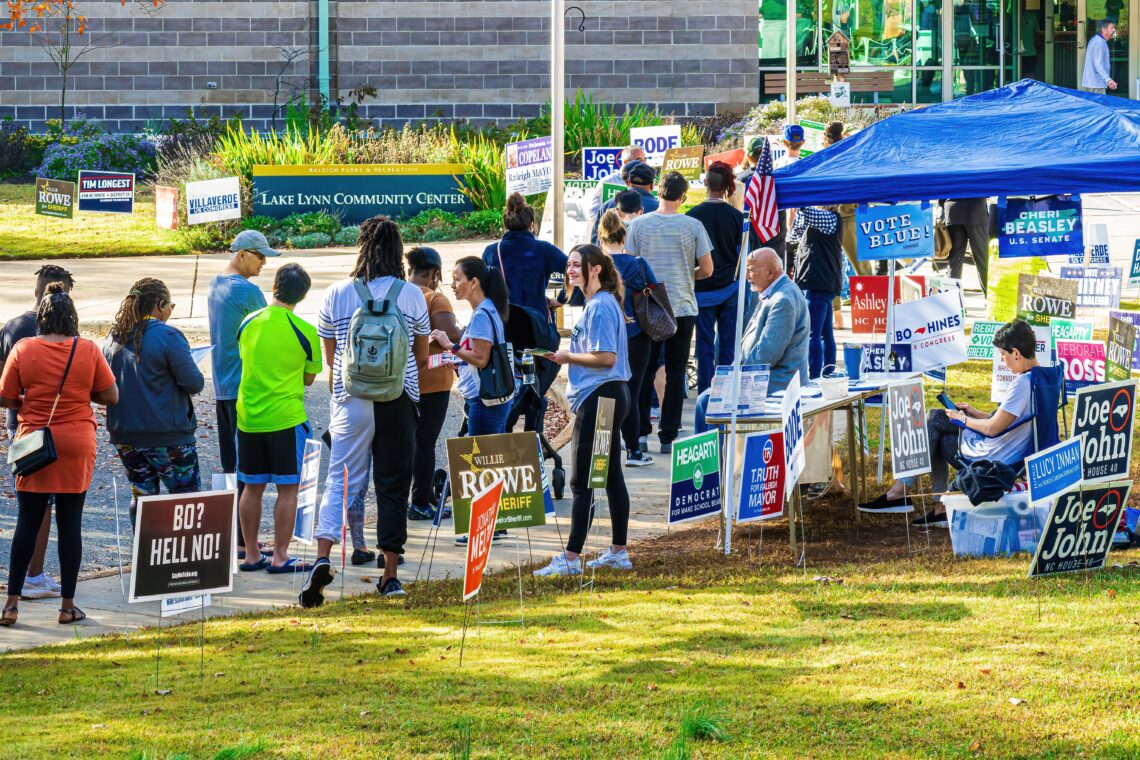
Volunteers hand out information about candidates while people stand in line to vote in Raleigh, North Carolina, on November 5, 2022.
LGBTQ Nation: Yes, it seems like something like the Equality Act is off the table for at least the next two years because of Republican control of the House, even though- I mean, I wish I had looked this up before now, the Equality Act polls pretty well. [A 2021 HRC poll found that 70% of American voters support the Equality Act.]
MJ: Of course it does! Look, just consider what happened last night. A Republican majority in the House of Representatives voted to gut the IRS by 87,000 agents. That is not economic populism, which is what that party says it ran on in 2022. That is a thinly veiled attempt to help billionaire tax cheats evade accountability.
That is something that, in a normal political environment, would be toxic and devastating for a party at the voting booth. However, because our democracy is so rigged in favor of corporate special interests and the super-wealthy, it is something that Republicans can get away with.
We have people in government who are not actually responsive to what their constituents want. Still, because of redistricting and specifically partisan gerrymandering, because of just the outsized role that wealthy people have in our system of campaign finance, aided in part by Citizen United, we see this.
“My project will be to ensure that Democrats take back the branches of government in 2024.”Mondaire Jones
LGBTQ NATION: A lot of the blame, then, for the lack of progress to be expected goes to Republicans, but is there something the Democratic Party should have been doing to get a majority that it hasn’t been doing?
MJ: Absolutely. We had majorities in both chambers of Congress, and [Sen.] Kyrsten Sinema (I-AZ) and [Sen.] Joe Manchin (D-WV) thought it was robbery to make an exception to the filibuster to pass democracy reforms, voting rights legislation, and the Equality Act. That was an abdication of their responsibility as legislators.
That is not to excuse the unanimous opposition by Republicans. It is to say that we’ve got some Democrats who are not where they need to be when it comes to the bold changes necessary to actually improve the lives of the American people.
The president only came out for an exception to the filibuster to pass voting rights legislation in December 2021.
LGBTQ NATION: You know what it’s like for LGBTQ+ people in Congress. Over the past few years, we’ve seen that most of the attacks have fallen on transgender people’s shoulders, specifically transgender minors. How good are your former colleagues at being familiar with essential issues for transgender people? Is there a good sense of understanding in Congress about their lives?
MJ: No, not particularly. My experience is that even the LGBTQ+ members in Congress, including myself, are continuing to learn about these issues. It would be awesome to have some trans people in Congress to bring that perspective.
And, of course, we’ve seen tremendous progress on these issues within the Democratic Party over the past several years. We see that in the inclusion of language specific to the trans community in the Equality Act and other legislation that we have passed. I’m very proud of having helped lead that.
But I know that the trans experience is not fully understood in Congress.
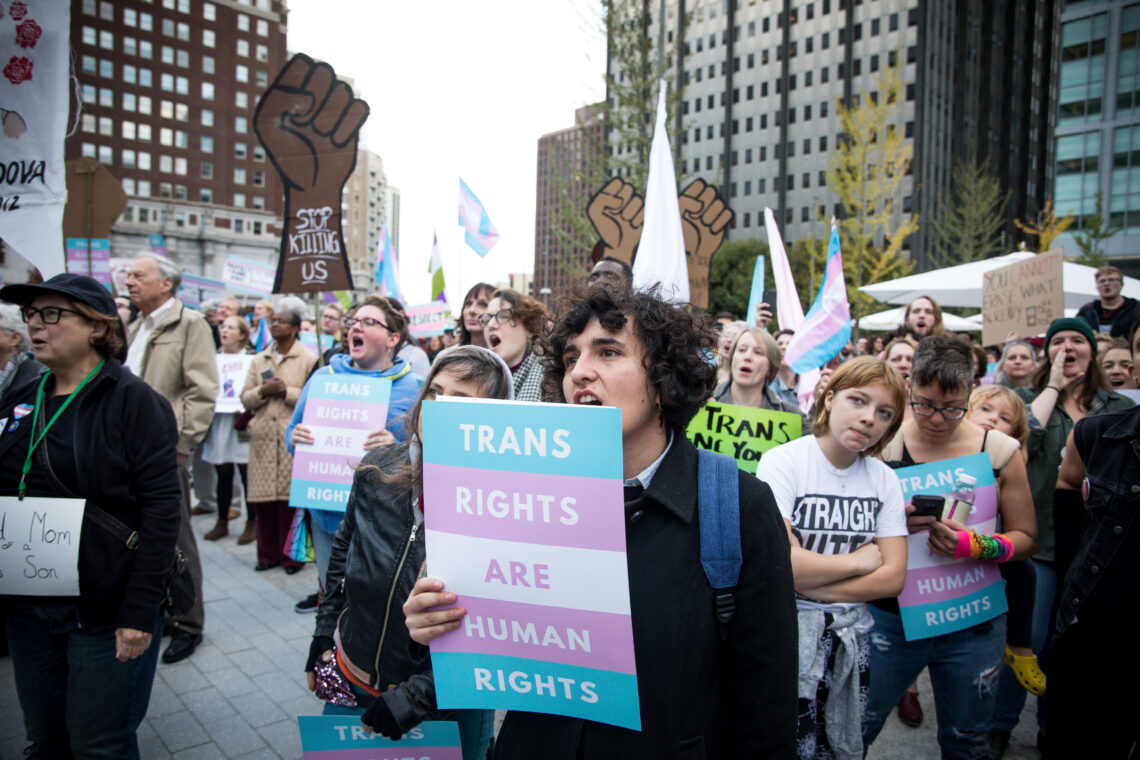
A transgender rights rally in Philadelphia.
LGBTQ NATION: What can LGBTQ+ people realistically expect on progress on our equality from Congress in the next two years?
MJ: I’m sad to say that because of the loss of the House to Republicans in November 2022, we cannot expect that Congress will pass the Equality Act to prohibit discrimination against the LGBTQ+ community in all facets of our society.
We will see the trans community vilified by House Republicans and Senate Republicans, even in the minority. We will continue to see LGBTQ+ individuals referred to, horrifically, as groomers and a Congress that will not respond meaningfully to the inevitable future violence against the community, especially gun violence.
That is the consequence of not having enough good people in the United States Congress.
So my project will be to ensure that Democrats take back the branches of government in 2024.
In her first State of the State address, New York Governor Kathy Hochul made history with a commitment to direct state resources to help fund housing for older New Yorkers.
Hochul directed New York State’s Homes and Community Renewal agency (HCR) to provide funding specifically for affordable housing projects that are affirming for New Yorkers among the state’s 800,000+ older LGBTQ+ population.
Only two housing developments in New York serve the community: Stonewall House in Brooklyn and Crotona Pride House in the Bronx. Those projects were developed and funded by SAGE, the LGBTQ+ elders advocacy group, along with BFC Partners and HELP USA.
The two developments are models for reducing housing insecurity and providing community support, dramatically improving the lives of low-to-moderate income and formerly unhoused older New Yorkers.
The commitment by Hochul follows policy recommendations presented by SAGE and AARP in their 2021 report “Disrupting Disparities: Solutions for LGBTQ+ New Yorkers 50+.” The report illustrated that many older New Yorkers face structural disparities, including social isolation, higher rates of poverty, and challenges finding and affording housing.
While the demand for affirming housing is high — 90% of older LGBTQ+ Americans are extremely, very, or somewhat interested in obtaining it — supply is low: only 13 states and Washington, DC, have housing developments targeting older LGBTQ+ Americans.
By 2030, over 70 million people will be age 65+, with about 7 million of those part of the community. That subset already faces a higher poverty and homelessness rate even before housing insecurity is factored in.
Officials at SAGE see this as a good start.
“I am thrilled that Governor Hochul and her administration are committed to expanding equitable access to housing for New York’s LGBTQ+ elders,” said SAGE CEO Michael Adams. “LGBTQ+ elders of color, transgender and non-binary elders face the highest levels of financial insecurity, and we know first-hand that LGBTQ+ friendly elder housing is vital in improving their lives.”
“The communities created at Stonewall House and Crotona Pride House,” added Adams, “are proof that this kind of housing improves the quality of life of residents. With the critical support of the Governor, New York will be providing crucial resources to elders so they can age with the dignity and support they deserve.”
Among the affirming housing options across the U.S. are The John C. Anderson Apartments in Philadelphia, Town Square Apartments in Chicago, and Triangle Square in Los Angeles.
In Washington, a new communal residence called Mary’s House for Older Adults is scheduled to break ground in March, while a new project in Detroit, Raymond E. Shepherd House, just received some creative financing in the form of a brownfield grant from the Michigan Department of Environment.
And in California, a new complex in Sacramento is the latest addition to the state’s affirming housing projects. Lavender House, with 53 units in the midtown neighborhood of the state capital, was developed and is operated by the nonprofit Mutual Housing California. There were over 600 requests for applications, with tenants chosen by lottery.
New data from the census 2021 confirms that more and more young people feel safe enough to come out as LGBTQ+.
Having released census data which captured the size of England and Wales’ LGBTQ+ population for the first time, the Office for National Statistics (ONS) has now shared a breakdown of the community by age and sex.
The statistics, published Wednesday (25 January), found that the 16-24 age group had the highest proportion of lesbian, gay and bisexual people.
Of the group, 6.91 per cent, 436,000, said they were lesbian gay or bi (the data did not consider gender identity).
This is more than twice the percentage (3.16 per cent) of the overall population.
Within the age bracket, four per cent identified as bisexual (252,000 people).
The new census data also reveals there are more queer women than men – 3.32 per cent of women (830,000) said they were LGB+ compared with 3 per cent of men (706,000).
Women were twice as likely as men to identify as bisexual (1.76 per cent vs 0.78 per cent), while men were more likely to identify as gay (1.95 per cent vs 1.15 er cent).
More males in England (3.02 per cent) identified as LGB+ than in Wales (2.65 per cent). Among women the percentages were almost identical – 3.32 per cent in England and 3.33 per cent in Wales.
The census data confirms that young people feel more comfortable identifying as queer, and that they are more likely to fall somewhere in the middle of the Kinsey scale.
Raquel, 21, is a bisexual cis woman and an ambassador for the LGBTQ+ young people’s charity Just Like Us.
She told PinkNews: “I think I feel so comfortable calling myself bisexual because we are all more informed and educated nowadays about different sexual orientations, so when I began to understand myself and who I am attracted to, it was very obvious to me that I was indeed bisexual.”
“Although I was not surprised to see that the younger populations identify more with LGBT+ labels, as there is less stigma and knowledge in the area, I think it should be equal throughout all age groups. I think the reason that older age groups do not identify as LGBT+ is because of a lack of education and negative stereotypes that unfortunately are difficult to unlearn. It is sad to think that there may be a lot of adults over 24 that may be LGBT+ but they don’t know or are too scared to come out.”
New census data is ‘a wake up call’ to politicians
LGBTQ+ charity Stonewall described the new cenus data as a “wake up call” to politicians, saying that the “Rainbow Generation” is the future.
“This data will allow national and local government to tailor their services, for example, we know that LGBTQ+ people can face discrimination in care settings – this will help in commissioning of care for older LGBTQ+ people,” Stonewall said.
“Soon these generations will be the biggest section of our workforce, the people who will be consuming our media, the talent pipeline for our sports, the audience for our cultural output, the people we want to nurture as our future voters.”
Nancy Kelley, chief executive of the charity, described the new data as another “historic” step forward after centuries of LGBTQ+ invisibility.
“This data is a reminder that our leaders, institutions and governments need to step up efforts to truly champion our communities rather than using our lives in a ‘culture war’ that does not resonate with the experiences and values of voters,” she added.
Dominic Arnall, chief executive of Just Like Us, said: “Sadly, we know that young LGBT+ people face disproportionate challenges, including being twice as likely to face bullying as their straight peers.
“The census data makes it clearer than ever that issues of bullying must be tackled and that inclusive education should be the norm across the UK, so that the increasing number of openly LGBT+ young people can thrive in schools which are happy, welcoming and safe environments.”
In January, census data revealed the size of the LGBTQ+ population in England and Wales for the first time.
Around 1.5 million people (3.2 per cent) identified themselves as LGB+, while 43.4 million people (89.4 per cent) identified as straight or heterosexual.
A total of 748,000 described themselves as gay or lesbian, 624,000 described themselves as bisexual, and 165,000 selected “other sexual orientation”.
More than 260,000 people identified themselves as trans.
Almost three months after Colorado Springs nightclub Club Q was the site of a deadly mass shooting, the venue has announced plans to reopen this year and restore its status as a beloved gathering place for LGBTQ residents.
“Our goal and intention has always been to return Club Q as a safe space for the Colorado Springs LGBTQIA+ community and (we) will continue to tirelessly work toward that effort,” a statement posted to the venue’s Instagram account Monday reads.
Club Q’s management expects to reopen by the fall with enhanced security measures and a permanent tribute to the five people who were fatally shot, the statement said. Their memories “will be carried forward and honored forever, while we work to make Club Q a forever home for our LGBTQIA+ community,” the nightclub’s statement read.
Police officials in London have warned people who use Grindr of an alarming string of robberies associated with the hookup app.
Between December 31 and January 9, four men were drugged and robbed by two men who Metropolitan Police officials say they met on Grindr.
The victims reported agreeing to meet up with individuals from the app but that they became unconscious during the encounter and woke up realizing they had been robbed of their belongings, according to a Metropolitan Police statement.
The drugs did not cause lasting damage to the victims, but the suspects were able to flee the country, police officials said.
Now London detectives are appealing to the public and asking anyone with information or who may have been a victim themselves to reach out.
“We believe other victims may have been targeted,” detective superintendent Dan O’Sullivan said.
“However, for personal reasons, [they] may not have wanted to report it. If you have been a victim, you can report in confidence to us or speak to an officer from the LGBTQ+ community.”
Before meeting up with people they met on Grindr, users are advised to consider their safety. Police officials recommend telling a trusted person about one’s arrangements, watching one’s drinks for signs of tampering, and removing valuables from sight.
One should also verify the identity of somebody one may meet up with by insisting on getting video or photo proof that the person is who their profile photo claims they are.
Other tips include using messaging apps instead of social media accounts to communicate for added security and using reverse image search tools to check on the authenticity of any photos a potential connection sends.
“Although the suspects have fled the country and the risk to the community is reduced, we are continuing to engage with our partners and those from LGBT independent advisory groups,” O’Sullivan said.
The U.S. Senate on Wednesday voted 51-47 to confirm President Joe Biden’s nomination of D.C. attorney Ana C. Reyes to become what D.C. Congressional Del. Eleanor Holmes Norton announced will be the first Latino woman and the first openly LGBTQ person to serve as a judge on the U.S. District Court for the District of Columbia.
Norton noted that Biden accepted her recommendation to nominate Reyes for the judgeship position in Norton’s role as D.C.’s congressional representative, similar to the role that presidents have historically given U.S. senators in recommending judicial nominees from their home states.
“Ana Reyes has the intelligence, temperament, and integrity to be an excellent federal judge,” Norton said in a Thursday statement. “She will also bring much-needed diversity to the federal bench. I look forward to her service.”
Teen girls in the United States experienced record high levels of violence, sadness and suicide risk in recent years, amid “significant” and “heartbreaking” declines in youth health and well-being overall, according to data published Monday by the US Centers for Disease Control and Prevention.
Responses for the CDC’s bi-annual Youth Risk Behavior Survey were collected in the fall of 2021, offering the first look at trends since the start of the Covid-19 pandemic.
“Many measures were moving in the wrong direction before the pandemic. These data show the mental health crisis among young people continues,” Kathleen Ethier, director of the CDC’s division of adolescent and school health, said at a media briefing. The findings are “alarming,” she said.
The survey found increasing mental health challenges, experiences of violence, and suicidal thoughts and behavior among all teens. More than 40% of high school students said that feelings of sadness or hopelessness prevented them from engaging in their regular activities for at least two weeks of the year.
Girls broadly fared worse than boys, and there is “ongoing and extreme distress” among teens who identify as lesbian, gay, bisexual or questioning (LGBQ+).
Most teen girls (57%) felt persistently sad or hopeless in 2021, double the rate for teen boys (29%). Nearly one in three teen girls seriously considered attempting suicide. Both rates “increased dramatically” over the past decade, according to the CDC.
Most LGBQ+ students (52%) have also recently experienced poor mental health and more than one in five attempted suicide in the past year.
“These data show a distressing picture,” said Dr. Debra Houry, CDC’s chief medical officer and deputy director for program and science. “America’s teen girls are engulfed in a growing wave of sadness, violence and trauma.”
Few measures of adolescent health and well-being showed continued improvement, including declines in risky sexual behavior, substance use and bullying at school. But most other indicators “worsened significantly,” according to the CDC report.
The latest data show increases in the proportion of youth who did not go to school because of safety concerns. There were also increases in teen girls experiencing sexual violence and teen boys experiencing electronic bullying.
Nearly one in five teen girls (18%) had experienced sexual violence in the past year and about one in seven (14%) had ever been forced to have sex.
“These data are clear: our young people are in crisis,” Ethier said.
CDC leaders, along with National PTA President Anna King, emphasized the important role schools play.
“Schools are on the front lines of the mental health crisis and they must be equipped with the proven tools that help students thrive,” Houry said.
Among those tools are training for staff to recognize and manage mental health challenges, counseling and mentorship programs and others that encourage connection and intervention.
King called for action from Congress to address the youth mental health crisis and emphasized the importance of regular conversations about mental health.
“It’s critical to talk with our children about what they’re feeling and their concerns,” she said. “I’m urging our families to come together, look for signs, look for ways that you can have these conversations with your children. Get to know them. Have these routine conversations all the time.”
Many of the challenges facing youth health and well-being are “preventable,” Houry said. “When I look toward our young people’s future, I want to be filled with hope, not heartbreak.”
If you are having thoughts of suicide or are concerned that someone you know may be, resources are available to help. The 988 Suicide & Crisis Lifeline at 988 is for people of all ages and identities. Trans Lifeline, designed for transgender or gender-nonconforming people, can be reached at (877) 565-8860. The lifeline also provides resources to help with other crises, such as domestic violence situations. The Trevor Project Lifeline, for LGBTQ+ youth (ages 24 and younger), can be reached at (866) 488-7386. Users can also access chat services at TheTrevorProject.org/Help or text START to 678678.
Elected officials, nonprofits, activists, and community leaders are pushing forward the idea of safe consumption sites in San Francisco, in order to prevent overdose deaths, improve the health of people who use drugs, and reduce outdoor and public substance use. Safe consumption sites and services are a well-accepted and effective public health intervention that exist in hundreds of cities around the world, but are slow to gain acceptance and be implemented in the U.S.
To gain traction and momentum for safe consumption services in San Francisco, in January Supervisor Hillary Ronen, from San Francisco District 9, organized a panel discussion with a group of experts to share their thoughts on the issue. The event was moderated by Heather Knight from the San Francisco Chronicle, and included Tyler TerMeer, PhD, CEO of San Francisco AIDS Foundation, Alex Kral, PhD, epidemiologist from RTI, Supervisor Matt Dorsey, Dr. Leslie Suen from UCSF, and Sam Rivera, the executive director of OnPoint NYC.
From what I’ve seen, the idea of supervised consumption services can provoke ire from people who don’t know much about the services, how they work, and how they improve the communities in which they exist. People may incorrectly assume they operate as free-for-all, legally-sanctioned, disorganized places that encourage and entice people to use drugs, or maybe enable people in their drug use. This couldn’t be further from the truth.
These are, of course, fears that are based on centuries-old stigma around illicit substance use and addiction, rather than the ample data we now have available from hundreds of sites around the world. The benefits of safe consumption sites are clear: The National Institute of Health shares that safe consumption sites “are associated with lower overdose mortality, 67% fewer ambulance calls for treating overdoses, and a decrease in HIV infections.” We know that safe consumption services increase use of social services–including addiction treatment–and reduce things like public drug use, improper syringe disposal and litter, and public costs spent on HIV/hepatitis C infections, emergency room visits, and overdose.
It was fascinating to hear from Sam Rivera, who is the executive director of OnPoint NYC–the nation’s first supervised consumption centers.
He shared how prior to OnPoint NYC’s opening, the business across from one site had been collecting around 13,000 syringes per month on their own from the surrounding streets. A month after OnPoint opened, that needle waste plummeted to only 1,000 syringes picked up off nearby streets. The site prevented public drug use in the area, which meant far fewer improperly discarded syringes.
NYC’s two sites have also successfully reversed hundreds of overdoses. Rivera talked about how sometimes the percentage of fentanyl in their attendees’ drug-of-choice was so high, people turned blue and started overdosing before they could even complete their injection. Having professionally trained staff on deck to jump in in this crisis situation was essential to saving their lives.
However, if I had to pinpoint the thing that was most notable to me from this panel discussion, it would be something a little less definable, something that doesn’t fit neatly onto a chart or graph to convince funders and politicians of its worthiness. That “X factor” was the unconditional love that was apparent in the way Rivera spoke about people visiting these sites.
As the panel discussion began, Rivera shared a story of a large, six-foot-four man who had come in for injection support. Rivera addressed him by name, and suddenly the man started crying. Rivera, assuming he had used the wrong name or somehow triggered this man’s trauma, apologized profusely. The man explained that Rivera did nothing wrong, he had just not been addressed by his name in such a long time. It was as if hearing his name had, in some inexplicable way, restored a part of his humanity that the streets–and those who so ruthlessly police them–had taken away.
“Just love people,” Rivera explained.
We could feel the authenticity of what Rivera was asserting. “Just love people,” he repeated. Rivera went on to discuss how these sites had unintentionally become a site of bonding–of remembering. “It’s hard to be in those rooms and not get emotional,” he shared. He described how many of the folks working these sites have their own lived experience around substance use, and how their success stories (which include continued use in addition to recovery) serve as a beacon of hope. “We are you,” Rivera said, recalling speaking to a client.
Rivera explained that for some people, safe consumption sites become a place where people explore reducing or ending their substance use. Staff at the site don’t need to constantly ask people about recovery, reducing use, or medication-assisted treatment, Rivera said. Most often, it’s the participants themselves who talk about drug treatment and changing their substance use. As staff get to know the clients who come in, they get to talking. They talk about their interests and their lives. “What we see happen,” Rivera shared, describing these contextual and peripheral conversations while the person is using, “is an [overall] reduction in drug use.”
At the end of the panel discussion, the moderator opened the conversation to audience questions. There were some community members who had shown up in opposition, or at least with extreme doubt in their hearts. They expressed fears that opening a site in San Francisco would attract people who use drugs across the Bay Area, like a lighthouse, cutting through Karl the Fog.
Rivera disputed this idea, sharing that in the year or so they’ve been open, they have not found this to be the case. “Drug users use where they purchase,” Rivera responded, reminding the audience that oftentimes people have an urgency to use, both chemically and also for fear of legal retribution. In NYC, there has been no influx from other areas. He went on to describe how these sites had actually improved relations with local police forces: officers who once indiscriminately arrested people using drugs publicly were now coming to OnPoint NYC in droves to observe and, ultimately, it became evident, to learn.
The question remaining in some audience members’ minds was along the lines of, “What’s your proof that this will work here, in San Francisco, like it has in New York City?” Of course, we won’t actually have definitive proof that it will until we’re able to open a site and measure its impact. But Rivera shared his hope and optimism that San Francisco will be able to implement these life-changing services. “Just be San Francisco,” he said. There was a beat of silence in the room. “Be San Francisco,” he reasserted. “San Francisco always had the gall to step up and do things really radical, really righteous.”
Can we move forward, San Francisco?
Nonprofits across the city are ready to step up and implement these services with City and San Francisco Department of Public health support, something San Francisco AIDS Foundation CEO Dr. Tyler TerMeer emphasized during the panel discussion.
Rivera’s plea to San Franciscans, to remember who we are (or at least once were), reminds me of a segment of the environmental protection movement known as “rewilding.” This form of ecological preservation aims to restore an area’s natural–wild–state. San Francisco has led the nation in many radical movements towards justice–towards love–most notably the gay liberation movement. Perhaps it is time that San Franciscans “rewild” ourselves, restoring our natural, radical roots to effectively address crushing social inequities.
We live in an age in which there is an observable, systemic, systematic callousness towards people who use drugs who may not have housing. The way our society treats folks who use drugs is causing nothing but pain and suffering. Public drug use is at an all-time-high, fatal overdose death rates are through the roof, and incarceration as a response has not worked to solve the issue in any meaningful way. It is time we abandon “tough love” approaches and shift towards something warm. Something radical. Something wild, unimaginable, and powerful. Something loving. We can choose to meet people where they are at–with openness, without judgment, and with unconditional love. Or we can continue down the grim path we’ve been on for decades. We do have a choice.
A new ad for Rihanna’s Fenty beauty brand features Mariana Varela and Fabiola Valentin, newlyweds who fell in love while competing as Miss Argentina and Miss Puerto Rico.
The ad is for Fenty eau de parfum and depicts the couple telling their love story while embracing, holding hands, and enjoying the scent.
They tell the story of how they met at a pageant in Thailand and immediately became inseparable.
“The details, like how we like our coffee, everything kept flowing,” they say.
They call theirs a story of “beautiful friendship” and add that it has been “magical” to find one another.
“What a special it was to work for the fenty eau de perfum fragance [sic],” Varela wrote on Instagram, adding “It’s beautiful when two bodies come together with love.”
The happy couple announced their marriage in October 2022 in a joint Instagram post featuring photos and video clips of their relationship.
“After deciding to keep our relationship private, we opened the doors to it on a special day. 28/10/22,” the post’s caption reads.
One clip shows the moment the couple got engaged, with “Marry Me?” spelled out in gold and silver balloons as Valentin slips a ring on Varela’s finger. Another shows the pair wearing white on the steps in front of the Marriage Bureau in San Juan where they were reportedly married.
Varela and Valentin met while competing in the 2020 Miss Grand International pageant, where they were both among the top 10 finalists. They’ve posted frequently about their close friendship, but as they noted in their post had chosen to keep their romantic relationship private until now.