When Hurricane Agatha battered a Mexican beach hamlet popular with LGBTQ residents and visitors earlier this week, members of the community sprang into action to help the town rebound.
Zipolite, located on the enchanting southern Pacific coast of Oaxaca state, found itself directly in the path of the storm on Monday. The storm touched down only about six miles (10 kilometers) west of the town as a Category 2 hurricane, damaging buildings and filling the beach with debris.
By Thursday afternoon a GoFundMe campaign had already raised over $21,000 to be used “for the reconstruction of this paradise,” the GoFundMe page said.
Zipolite Diverso, a group of over 30 LGBTQ-owned and LGBTQ-inclusive small businesses, organized the fundraiser to address such immediate needs as food and water and to help the community rebuild in coming months.
“None of us were expecting to have such a large response,” said Ricky Castellanos, one of the fundraiser’s organizers and the owner of a bed-and-breakfast that was damaged in the storm.
Castellanos said the donations could help “provide sustainable services to people who won’t be able to get back on their feet right away.”
The group raised its fundraising goal to $50,000 from $10,000, saying on its website the damage was huge.
“Thanks to all, Zipolite will come back, and stronger,” it added.
Get the Morning Rundown
Get a head start on the morning’s top stories.SIGN UPTHIS SITE IS PROTECTED BY RECAPTCHA PRIVACY POLICY | TERMS OF SERVICE
Zipolite is famous for being one of Mexico’s few nude beaches and has become increasingly popular in recent years with LGBTQ tourists attracted to the town’s laid-back attitude.
The popularity boom has strained the water supply and other services and has at times caused tensions between tourists and locals.
“We’re organizing this as members of the LGBTQ community, but the aid will be directed to those who need it the most, whether they’re part of the community or not,” said Thomas Flechel, an artist, business owner and coordinator of Zipolite Diverso.
On social media, the fundraiser was being shared far beyond Mexico’s borders.
Tristan McAllister, a brand strategist and podcast host in New York who has visited Zipolite since he was a child, said he had donated to the campaign so the community “can keep on creating the best possible place for the people that need it the most.”
“This is a place that young, queer Mexicans need. It’s a one-of-a-kind place for Mexico and for the world,” McAllister said.
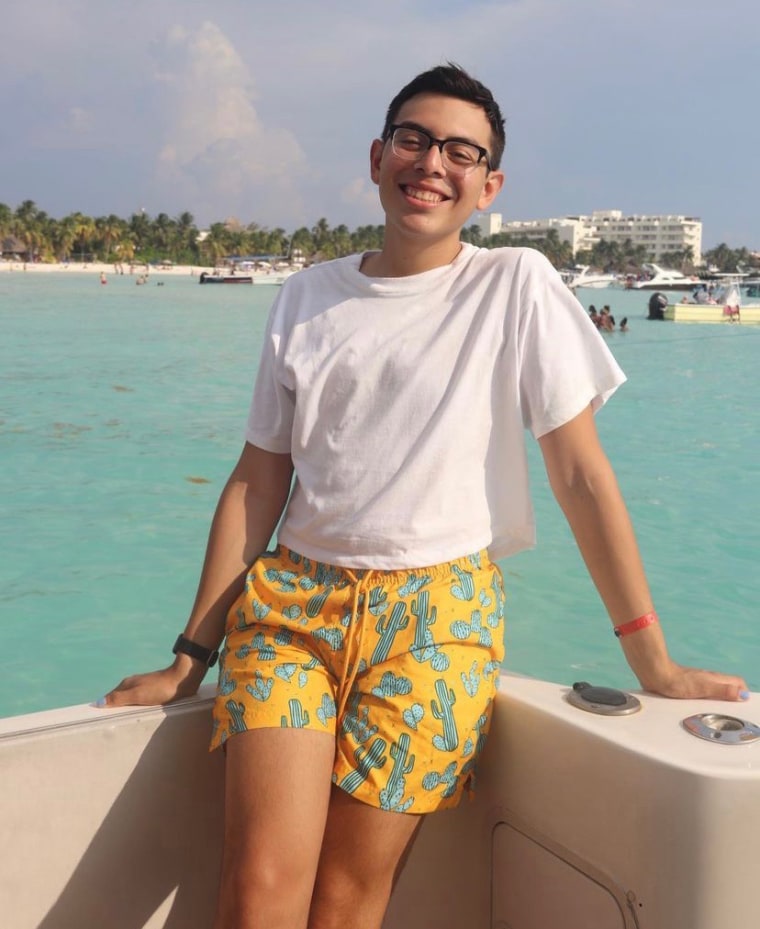
Social worker Julio Ramirez, 25, met up with a friend on April 20 for a night out in Hell’s Kitchen, a Manhattan neighborhood near Times Square in New York known for its lively restaurant and bar scene. Their last stop was the Ritz Bar and Lounge, a popular, multilevel gay venue in the heart of the neighborhood’s Restaurant Row.
Surveillance footage from a nearby security camera shows Ramirez walking away from the venue with three unidentified men at 3:17 a.m., according to his brother, Carlos, who said he was briefed by investigators. The four men then entered a nearby taxi, a police source said, but Ramirez was alone in the backseat at 4:10 a.m. when the taxi driver approached a police officer 3 miles away in Manhattan’s Lower East Side neighborhood to say his passenger was unresponsive.
Julio Ramirez.Family photo
Despite efforts to save his life by the officer and the Emergency Medical Services team, Ramirez was pronounced dead at a nearby hospital at 4:49 a.m. on April 21, a police source said, adding that the initial cause of death was listed as a “possible drug overdose.” Ramirez’s official “cause and manner of death are pending further study,” according to the medical examiner, who told NBC News in an email that this could take “at least a few weeks.” Ramirez was initially identified as “John Doe,” his brother said, because neither his wallet nor phone were with him when he died.
Now, more than a month later, Ramirez’s family and friends are left with more questions than answers as they try to piece together what happened in his final hours. Who were the men who entered the taxi with him? Was he drugged? Are investigators prioritizing his case? Where are his phone and wallet? Who drained his bank accounts in the days following his death?
A night out in Hell’s Kitchen
Ramirez’s friends described him as a “sweet” and “smart” young man, and, according to his brother, Ramirez “believed in serving underprivileged communities.” Originally from Long Island, New York, he had just moved to New York City last year after obtaining a bachelor’s degree and two master’s degrees from the University at Buffalo. He had been living and working in Brooklyn’s Bushwick neighborhood, where he was a bilingual mental health counselor.
On what would be his final night out in Hell’s Kitchen, Ramirez met up with his friend Carlos Camacho, a 24-year-old aspiring actor who lives in the neighborhood. Camacho said he and Ramirez met on April 20 at 7 p.m. and visited three venues all within a half-mile of each other: Rise Bar, a gay cocktail lounge; Mickey Spillane’s, a bar and restaurant; and, finally, Ritz Bar and Lounge.
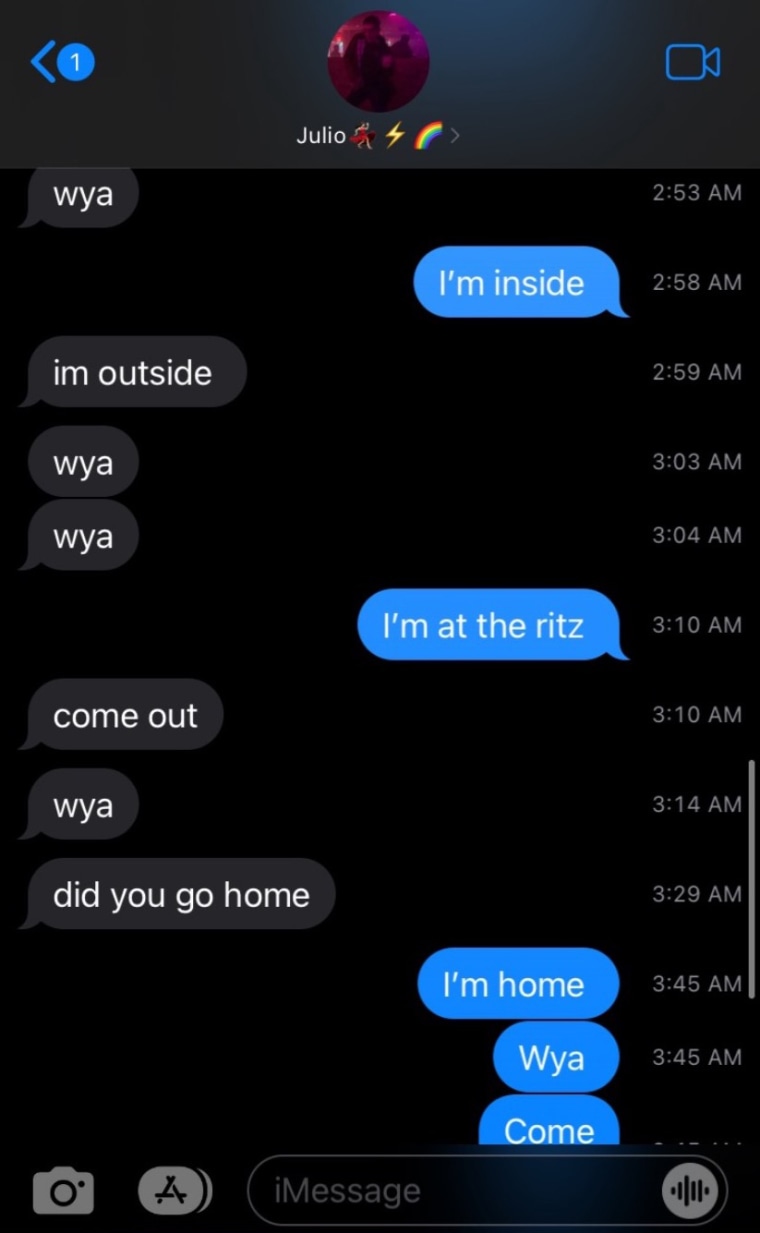
Julio Ramirez’ final message with Carlos Camacho.Courtesy Carlos Camacho
The two friends, who have known each other since June, got separated just before 3 a.m., according to their last text exchange, which Camacho shared with NBC News.
At 2:58 a.m., Camacho told Ramirez he was inside the Ritz, and a minute later, Ramirez responded saying he was outside the bar, according to the texts. At 3:10 a.m., Ramirez told his friend to come outside. After not receiving a response, Ramirez texted Camacho, who lives nearby, at 3:29 a.m. to ask if he went home. Camacho responded at 3:45 a.m. to confirm that he was home and asked his friend to come over. Ramirez never responded.
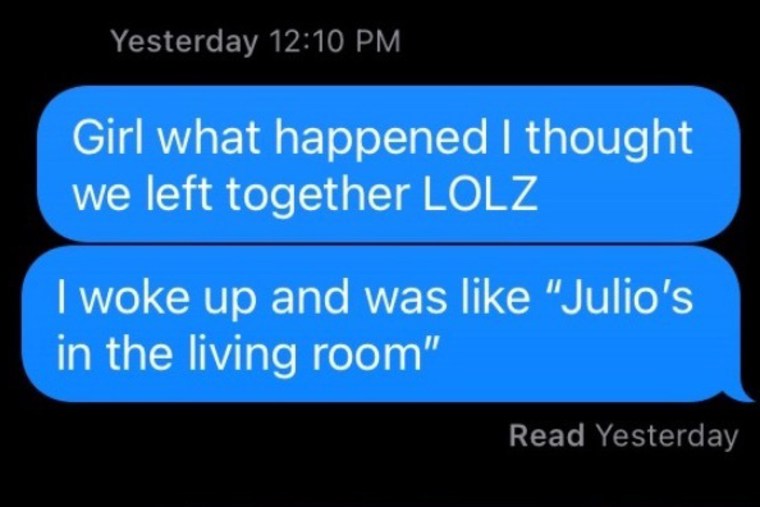
At 12:10 p.m. on April 21, Camacho sent a follow-up message to Ramirez asking him “what happened” the night before. An alert popped up notifying Camacho that his message to Ramirez had been “read,” though unbeknownst to Camacho at the time, his friend had been pronounced dead more than seven hours earlier.
Carlos Camacho
‘I knew something was up’
Earlier that evening, Ramirez had been texting with Shiva Campbell, a friend from Buffalo with whom he was in “constant contact,” according to Campbell. They were chatting about saving money and Adam Sandler movies before Ramirez stopped responding at 10:25 p.m. on April 20, according to their final text exchange, which Campbell shared with NBC News.
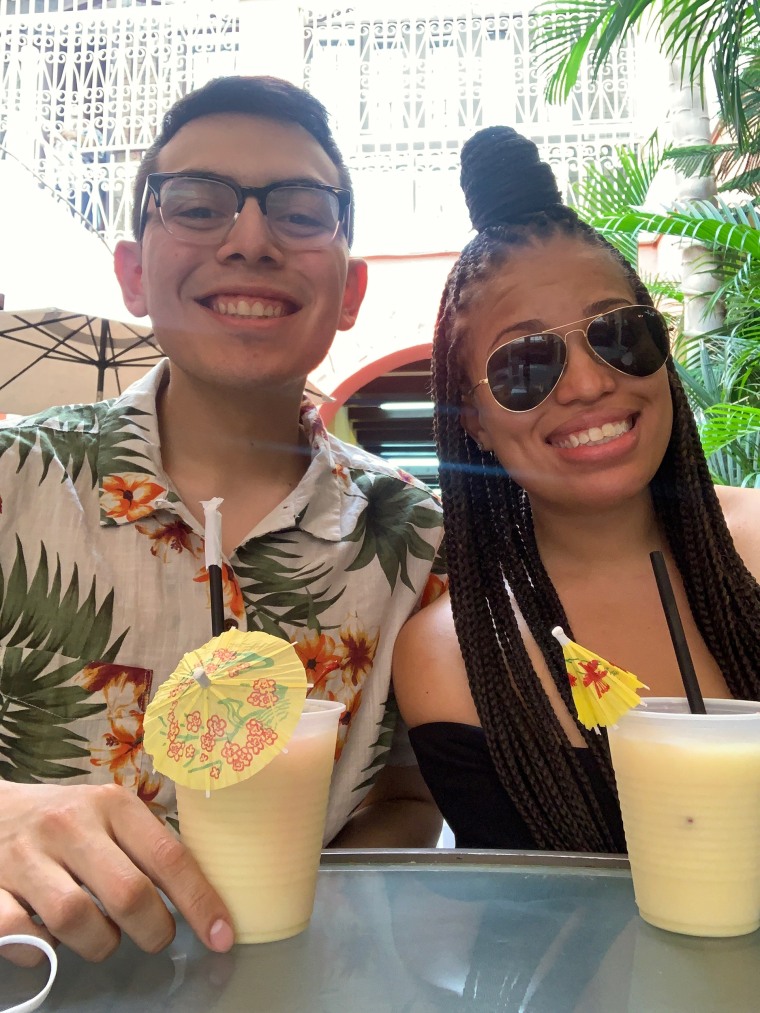
Julio Ramirez and Shiva Campbell.Courtesy Shiva Campbell
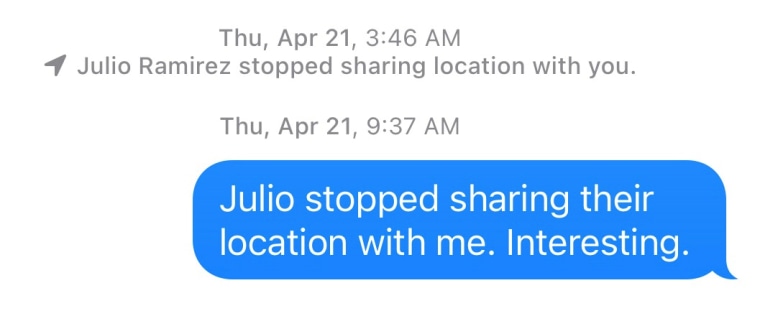
Campbell said she and Ramirez had remained close after meeting as college freshmen, and, like many young friends, they used the location sharing feature on their iPhones. They had done so for the past several years, so Campbell said she became concerned when at 3:46 a.m. on April 21 an alert popped up saying, “Julio Ramirez stopped sharing location with you.”
She continued to text Ramirez throughout the day on April 21 asking where he was and whether he was OK. Her concern turned to alarm when she noticed the color of the text messages she sent him turned from blue to green, which can indicate his phone had been turned off or had died.
“Julio never lets his phone die,” she said. “Even if he lost his phone, he would text me on his iPad, so I knew something was up.”
Campbell’s last text to Ramirez was on April 22 at 8:06 a.m.: “Ramirez, did something happen?” She would soon discover that he had been pronounced dead more than 24 hours earlier.
Get the Morning Rundown
Get a head start on the morning’s top stories.SIGN UPTHIS SITE IS PROTECTED BY RECAPTCHA PRIVACY POLICY | TERMS OF SERVICE
Shiva Campbell’s text thread with Julio Ramirez.Shiva Campbell
Theories and speculation
Carlos Ramirez, 32, said he called his younger brother in the afternoon on April 21 and found it strange that his phone appeared to be turned off. He had planned to call him later that evening but fell asleep before he had the chance, he said.
While he was at work on April 22, Carlos Ramirez received a call from his girlfriend around 11 a.m. telling him to immediately leave work and call his father. When he called, he discovered his parents had received a dreaded phone call 20 minutes earlier from Mount Sinai Beth Israel hospital in Manhattan informing them that their son Julio had died the prior morning.
“My dad said, ‘This is really hard, but Julio is dead,’ and he just started crying,” he recalled. “I just lost it. Wow, I couldn’t believe it yet. That was just the worst day of my life.”
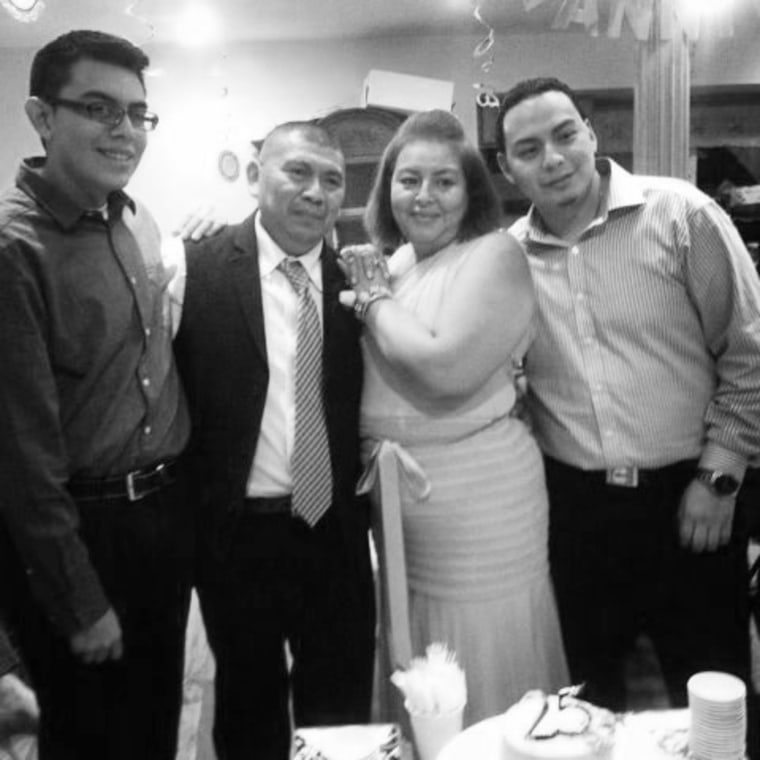
Julio Ramirez, left with his parents and brother.Family photo
Three days later, the Ramirez family went to Julio Ramirez’s apartment to collect some of his personal belongings. Eager for answers, Carlos Ramirez logged on to his brother’s laptop. He immediately noticed the Apple iCloud password had been changed, leaving him unable to access most of the applications on his brother’s computer. He was, however, able to access Julio Ramirez’s emails. He said that’s when he noticed unusual money transfers.
Between April 21, the day Julio Ramirez died, and April 25, his checking and savings accounts were depleted through purchases and third-party applications like Apple Pay and Zelle, Carlos Ramirez said.
“They had literally taken every dollar that he had, all his savings and all of his money,” Carlos Ramirez said, adding that approximately $20,000 was taken from his brother. He said he shared this information with investigators, though the NYPD would not confirm this detail to NBC News.
Given these details, and the information investigators shared with him based on surveillance footage, Carlos Ramirez said he believes his brother may have been drugged and robbed that night in a targeted attack.
Carlos Ramirez — who did not see the footage himself — said investigators told him the video shows his brother standing outside of the Ritz Bar and Lounge entrance by himself for 12 minutes shortly after 3 a.m. He is then seen walking away from the bar with two men, and as they turn the corner, a third man follows behind them.
“All three men end up in a cab with Julio,” Carlos Ramirez said investigators told him. He said the men have not been identified.
Based on the limited information they’ve pieced together, Carlos Ramirez and at least one of his brother’s friends, Karinina Quimpo, speculated that Julio Ramirez may have been slipped gamma-hydroxybutyric acid, or GHB, also known as the “date rape drug.” In liquid form, it is clear and colorless, and just a small amount can bring someone to unconsciousness; overdoses can lead to coma, respiratory arrest and even cause death.In recent years, health officials have seen a rise in GHB use among young Americans. Neither the police nor the medical examiner has indicated Julio Ramirez ingested GHB prior to his death.
‘Justice for Julio’
Julio Ramirez was buried at Pinelawn Cemetery in Farmingdale, New York, on April 30. Two weeks later, on May 14, his family and friends held a memorial service in Buffalo.
In the weeks following his mysterious death, his loved ones have been trying to raise awareness about his story as they wait for additional information from the NYPD and the city’s medical examiner.
In an Instagram post May 9, Quimpo shared some of the details surrounding his death and said his “story needs to be solved and heard.” She pleaded for “justice for Julio.”
“We urge you to raise awareness on the death of Julio Cesar Ramirez, to give a voice to gay Latino men who are victims of the crime in this city and to seek justice for the loved ones he left behind,” she wrote. “Julio’s story needs to be heard.”
As someone who has spent over three decades fighting for the rights of our LGBTQ+ communities, particularly safe spaces for our youth, I have seen and been part of many forward changes. I lead the LGBT Network, which held the first LGBTQ+ youth prom in America’s suburbs, started the first recognized Parent-Teacher Association in the nation to focus on LGBTQ+ youth, and opened America’s first LGBTQ+ senior affordable housing in suburbia. We have helped to start hundreds of gay-straight alliance clubs in our schools and have been a part of the many struggles, rallies, and fight for full equality and equity. After watching the most recent episode of HBO’s Real Time With Bill Maher, it feels like 1993 all over again, although this time it’s different and even more frightening.
On last Friday’s Real Time With Bill Maher, Maher said the number of youth identifying as LGBTQ+ is rising because it’s “trendy,” while he spewed other harmful, homophobic and transphobic rhetoric. Maher continued his vitriolic commentary by taking several more potshots at LGBTQ+ youth, including claims that society was “experimenting” on children through the use of puberty blockers and genital surgery as a means to perpetuate culture wars. Maher correlated his comments on “trendiness” with statistics on LGBTQ+ youth in California versus other states, like Ohio, claiming that “either Ohio is shaming them or California is creating them.”
Back in 1993, I would chalk this up to ignorance and truly believed education would help folks to critically think and change, and it did. But today is different, and the alarm bell is ringing — loud! The onslaught of attacks legislatively and in the media against our community goes well beyond ignorance; it is hateful, purposeful, and intentional. We need to wake up and be smart in our fight, as all our LGBTQ+ youth need us now more than ever. We need to speak up and hold everyone accountable, even those who purport to be “liberal and progressive.” That’s why I am calling for the LGBTQ+ community and supporters of LGBTQ+ youth to boycott HBO until Real Time With Bill Maher is removed from its platform. Maher has gone too far.
Now, I am not one for getting caught up in the extreme left and right’s battle on “cancel culture,” and I know many of us, including myself, will suffer from not being able to watch Jean Smart in Hacks. But the LGBTQ+ youth are the ones who are really suffering from being told that it is a trend to say you are LGBTQ+, while at the same time being shoved and kicked in school hallways, and HBO must take immediate action and remove Bill Maher and simultaneously take action to let every LGBTQ+ youth know they are loved.
The consequences of not doing anything can be deadly. Nearly half of LGBTQ+ youth seriously considered suicide in the past year, and it’s comments ones Maher’s thar give license to others to dehumanize and torment LGBTQ+ youth. Maher’s words are also nothing more than a dog whistle for those who seek to roll back the rights of the LGBTQ+ community which we are seeing happen throughout our nation. The trend is not willy-nilly identification as being LGBTQ+; it is the alarming measures being passed to deny LGBTQ+ people’s existence and rights. Whether it’s Florida’s “don’t say gay” law or the dozens of states that are banning trans athletes and rights, this is unfortunately the real trend we should be talking about and organizing around to change.
Our LGBTQ+ youth are perfect just the way they are — they need no fixing. They need supportive spaces and policies to be completely free and authentic and to achieve their full potential. What they don’t need are the rants on a platform like Bill Maher’s show, which pose the greatest risk to LGBTQ+ youth’s safety and well-being. Call on HBO now to take immediate action and remove Real Time from its lineup. Maher has simply gone too far. Our actions and voices will send a loud message that these types of careless and negligent behavior and speech will not be tolerated, and in doing so we can instead focus on the work of making sure that not one more kid contemplates taking their life simply for being who they are. It’s the least we could do as we get ready to celebrate Pride.
David Kilmnick is the founder and president of the LGBT Network, one of the largest LGBTQ+ advocacy groups in the U.S., which is based in New York City and Long Island, N.Y. The LGBT Network operates four LGBT community centers throughout the expansive Long Island and Queens region to reach and serve as many LGBTQ+ people and their families as possible.
North Carolina lawmakers advanced legislation on Wednesday that would prohibit classroom instruction on sexual orientation and gender identity for some public school students, a move decried by opponents as harmful to LGBTQ youth.
The “Parents’ Bill of Rights,” a broad piece of legislation that opponents say mirrors Florida’s so-called Don’t Say Gay bill, cleared the state’s Republican-led Senate and will head to the House of Representatives, which also has a Republican majority.
It could reach the desk of Governor Roy Cooper as soon as this week. Cooper, a Democrat, has spoken against the bill and is all but certain to veto it.
Advocates and civil rights groups have tracked hundreds of bills this year across state legislatures directed at lesbian, gay, bisexual and transgender people, including many that target transgender youth specifically.
Florida measure, officially titled the Parental Rights in Education Act, was signed into law in March. In April, the governor of Alabama signed a bill prohibiting classroom discussion of sexual orientation or gender identity in certain grades, and similar measures are being considered in Louisiana and Ohio.
The North Carolina measure would prohibit mention of sexual orientation or gender identity in curricula for students from kindergarten through third grade. Schools would also have to notify parents if a student requests to be addressed by a different name or pronoun.
The UK’s respected Office for National Statistics says that the number of young people (aged 16-24) who identify as lesbian, gay or bisexual has almost doubled in just four years. It’s risen from 4.1% in 2016 to 8% in 2020.
The figures come from an analysis of the country’s large-scale Annual Population Survey, which surveys around 320,000 households annually.
Breaking down that 8% figure, 2.7% of 16-24 year-olds identified as gay or lesbian, and 5.3% as bisexual.
Looking more broadly at all age groups, the proportion of all adults identifying as LGB stood at 3.1% in 2020. This is an increase from 2.7% in 2019 and nearly double the 1.6% in 2014 when the UK’s official estimates began.
Clearly, more and more people feel able to be their true selves – especially younger generations.
The number of adults identifying as heterosexual was 93.7% (a fall from 95.3% in 2014).
As a region, London had a higher number of people identifying as LGB than anywhere else in the country.
The survey did not ask about trans and non-binary identities.
The figures echo a trend seen elsewhere. An IPSOS survey of 27 countries released for Pride last summer, polled 19,000 people online. It found that 18% of Generation Z (born after 1997), identified as lesbian, gay, bisexual, pansexual, omnisexual or asexual (compared to 9% overall).
Four percent of Generation Z in that survey also identified as trans, non-binary or genderfluid, compared to just 1% of those over 40.
In the US, in a Gallup poll conducted in 2020, the proportion of LGBT people in the US was estimated at 5.6%, an increase from 3.5% in 2012. The data drew from 15,000 interviews with Americans aged 18 and older.
The UK figures, produced by a government agency, are significant because they draw from such a large sample size.
Robbie de Santos, Director of Communications and External Affairs at British LGBTQ advocacy charity Stonewall, told Queerty: “It’s wonderful to see that an increasing number of LGBTQ+ people can be their authentic selves. It’s important to remember that the number of LGBTQ+ people has not risen but these statics are a heartening sign that people are freer to be their true selves.
“Over the past decade, we’ve also seen an incredible increase in LGBTQ+ representation on our screens and in our culture – from Drag Race to It’s a Sin. Representation that normalizes being LGBTQ+ matters, and often helps people better understand who they are.”
Thanks to victories in primary runoffs Tuesday, Texas is poised to have its first Black gay male state legislators — and one Black lesbian, who won a special election just weeks ago to fill a vacancy, is likely to be elected to a full term.
Before Jolanda Jones’s victory in the special election, Texas had never had a Black member of the LGBTQ+ community in the state legislature. She won the special election May 7 in the Houston-area Texas House District 147 to succeed Rep. Garnet Coleman, who retired in February; that gave her the seat through December. In the Democratic primary runoff, she defeated Danielle Keys Bess, who had also been her opponent in the special election. In November’s general election, Jones will face Republican Damien Thaddeus Jones, but the district is heavily Democratic, so she is expected to win.
Jolanda Jones is a former member of the Houston City Council and the city’s school board. “Yet again, voters were excited by Jolanda’s exceptional experience and qualifications, proven track record and vision for the future,” Annise Parker, president and CEO of the LGBTQ Victory Fund, which had endorsed Jones, said in a press release. “She is a natural leader and fierce advocate who has dedicated her professional life to increasing fairness and equity in Texas, from increasing access to quality health care to improving public schools to safeguarding our right to free and fair elections. She knows how to build winning coalitions and get meaningful change done for her community. With so much prejudice plaguing our society, Jolanda’s win tonight is a beacon of hope and demonstrates voters are motivated to elect leaders that reflect the real America who are ready to enact meaningful change. We are confident Jolanda will continue being an effective leader and lawmaker and that her continued success will inspire many more LGBTQ and Black people to run for office.”
Venton Jones and Christian Manuel-Hayes are positioned to be the first Black gay men in the Texas legislature. Jones easily prevailed over Sandra Crenshaw in House District 100, in the Dallas area. No incumbent was in the race, and Jones’s only opposition in the general election will be Libertarian Joe Roberts. Jones, a veteran advocate for social justice and for HIV treatment and prevention, will be the first out HIV-positive member of the legislature.
Manuel-Hayes won in House District 22, centered on Beaumont. It was a narrow victory over Joseph Trahan in another race with no incumbent. One Republican and one independent are running in the general election, but again, the district is largely Democratic. Manuel-Hayes was a longtime staffer to the retiring incumbent, Joe Deshotel, eventually rising to chief of staff.
“In state legislatures across the country — and certainly here in Texas — we are seeing a disturbing rise in anti-Black and anti-LGBTQ laws passed by legislative bodies that do not represent our community,” Parker said in a statement. “Tonight, primary voters responded to those attacks by shattering a lavender ceiling and sending Venton and Christian to a general election where they are poised to make history. These two LGBTQ leaders are fighters and are determined to create a more accepting and equitable Texas and America. When they win in November, it will send a strong message that bigotry will not prevail long-term.”
A gay music teacher in Iowa was forced to resign from his high school after a blackmailer threatened him.
Matthew Gerhold began working at Valley Lutheran High School in Cedar Valley, Iowa last year. Although he told school officials that he was gay before he was hired, they later compelled him to resign or face termination after he was blackmailed.
Gerhold’s phone was hacked in January 2022 and the hacker blackmailed him by threatening to share private information about his sexuality publicly. Gerhold alerted the school about the hack and the blackmail, then resigned from his position at the high school after being told he would be fired following a school board meeting anyway, according to the Iowa Capital Dispatch.
Just after he reported the attempted blackmail, photos from his phone were posted to the school’s Facebook page. He was called to an administrator’s office and put on leave.
Gerhold had initially been told he could not disclose his sexuality or even date while employed by the school.
He said that he believes the school and the Lutheran Church-Missouri Synod view homosexuality as a problem and a choice, not an “involuntary attraction to one sex or another.”
“My sexual identity has absolutely nothing to do with my career in music and my love for music,” he said. “If the church as a whole doesn’t want to use me for whatever they are striving to achieve, then I shall go somewhere else that would love to have me to live out my vocation for others.”
After his resignation, he applied for and was granted unemployment benefits.
The school appealed that decision and a hearing was held on May 2 in front of Administrative Law Judge Blair Bennett, who ruled that Gerhold had a right to unemployment benefits as he had not violated in any way the conditions of his employment, nor had he been accused of workplace misconduct.
The “argument breaks down to [Gerhold] being told he would no longer have a job because of the actions of a third party, not controlled by [Gerhold], completely outside of work,” Bennett ruled.
A pair of vans, cosmetically weathered but carrying an unmeasurable amount of personality along with over 12,000 lbs of food, medicine, and hygiene supplies, were used by a motley group of heroes to deliver critical supplies to two towns still under attack in northeast Ukraine.
Agatha Williams, a metal fabricator from Denver, Colorado turned front-line aid worker aiding civilians amid the Russian invasion, joined the relief effort for the first time. Piloting one of the vehicles, Williams, who goes by the pronouns they/them and identifies as queer, left the United States for the first time to make a difference in the lives of those suffering through the daily horrors of war.
Members of the self-styled Renegade Relief Runners, 3XR for short, have been driving those vehicles across the war-ravaged countryside for the better part of two months, providing humanitarian aid in places that few international groups know exist.
On a recent trip to Zolochiv, which has a population of about 45,000 when counting the surrounding villages, the 3XR team rolled in, making their second trip in two weeks to the local administrative center.
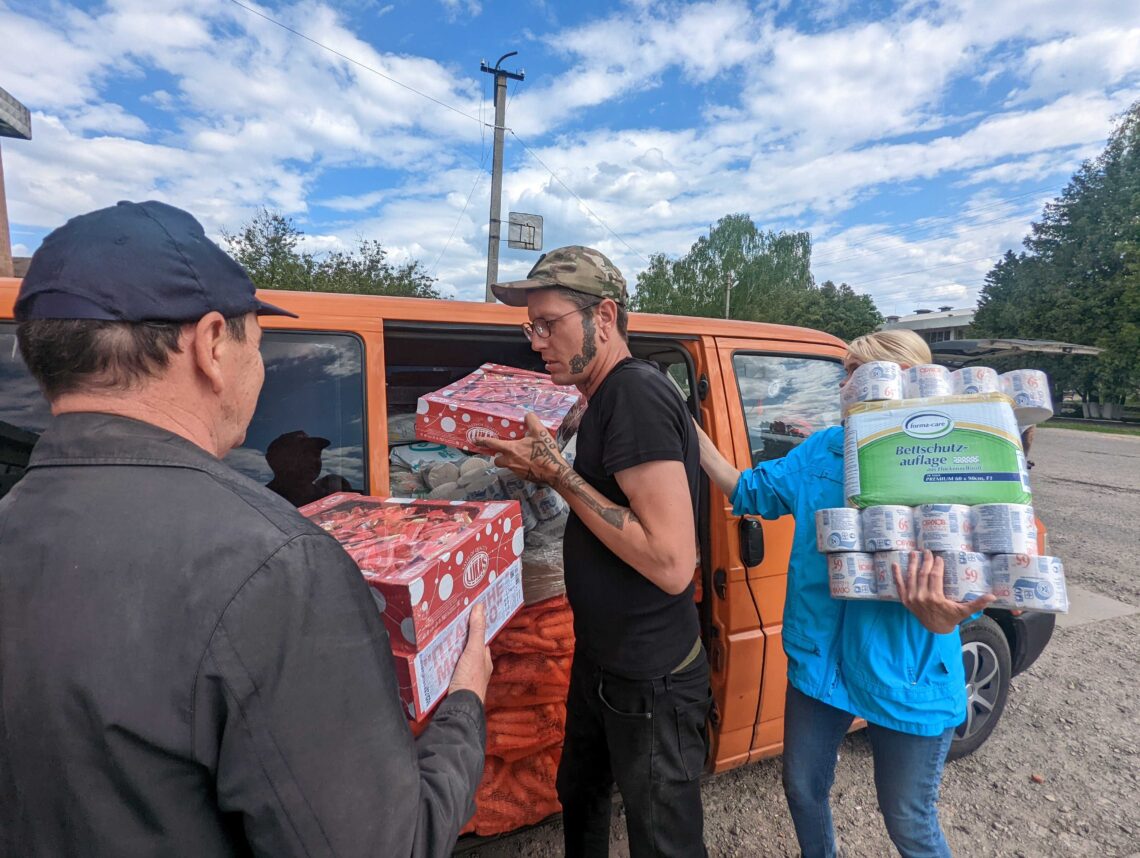
Agatha Williams handing out supplies in Kharkiv Oblast.
With tattoos running down the sides of their face, and stretched holes where gauges once sat in their ears, Williams cuts a striking figure, especially among the usually staid Ukrainian populace. On the day of the delivery to Zolochiv, they and their fellow members of the 3XR were given a heartfelt welcome by the town’s vice mayor. After offloading the first 4,000 pounds of food to residents dealing with the worst kind of food insecurity, Williams and the crew moved on to the local hospital.
After taking an in-depth tour around the destroyed medical complex, the chief doctor asked Williams and another 3XR member, Ken Brady from Oregon, to inspect the hospital’s generator system. As the sounds of artillery explosions thundered in the air above them, they tried to figure out why the generator was emitting diesel fumes.
Seeing how well they worked together, how did Brady think his openly LGBTQ associate was being received in the seemingly conservative nation?
“I admit some trepidation myself, about being out of place as a snarky, tattooed Asian-American, but together we have experienced zero prejudice that I’m aware of,” Brady responded.
He continued, “Ukraine needs and appreciates all help, and each of us is here to provide exactly that. In addition to Agatha, many of my LGBTQ friends at home will be equally surprised and, I hope encouraged, by the presence of a transgender reporter asking this question. Traveling to some of the hardest hit areas with members of the queer community has shown me Ukraine is not messing around, and that help is welcomed despite identity.”
On 3XR’s second day of deliveries, the mission took them west to Parkhomivka. This time more than 8,000 pounds were offloaded under the guidance of the town’s relief coordinator while the mayor came by to express his appreciation for the group’s lifesaving work.
Again, Williams was in the middle of the action.
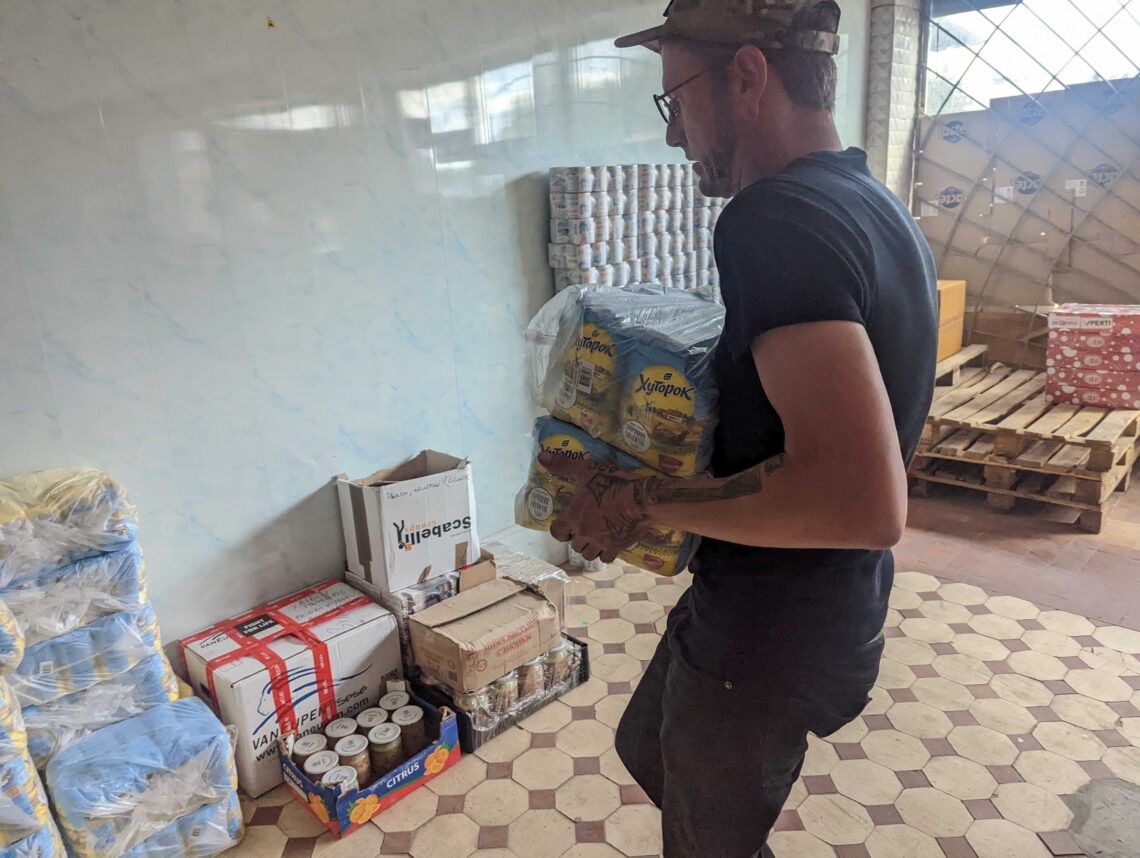
Agatha Williams carrying supplies in Parkhomivka.
While directing logistics, and bringing comfort to those around them, William’s body language expressed the clear sentiment of feeling ill at ease in the role of hero. Yet their teammates were full of praise for them.
Drew Luhowy, the 3XR’s resident Canadian, observed, “The collective diversity of those who came here to Ukraine to help push back against Russia has been strengthened because we found each other as a team, and thanks to our individual identities, we’ve been able to accomplish much of what we’ve set out to do so far.”
3XR’s Chris Tiller, an airline pilot from Nashville, Tennessee, who has been in Ukraine since early April and was the initial member of the Renegade Relief Runners, spoke directly to the challenges facing Williams on their mission.
“As soon as Agatha made their concerns known as to what adverse impact their identity could have on us in a country such as Ukraine that is thought of as conservative, we made it known, that not only would they never face repercussions for living their truth when we were together, we’d take 100% of Agatha if given the chance.”
“I don’t think my identity played a role in me coming here. It was more a product of how I grew up, in foster care,’ Williams said after everything was handed out and prior to departing Kharkiv with the others. “I’ve identified as queer, and have been Agatha for twenty years, and I’m 37 now, so I’ve always been me. The main reason I came, was to try to help do something to alleviate this senseless suffering.”
“Yes, people seem to keep a distance when they see me, but that is probably as much because of the war and them keeping to themselves as it is about how I look or who I am. Working with people here, Ukrainian or otherwise, has never been a problem.”
As they prepared to depart, I asked the four members what came next. Luhowy was succinct.
“Who knows? We’re all just here to help Ukraine.”
Members of the Renegade Relief Runners. From left in back: Ken Brady, Drew Luhowy, Chris Tiller, Agatha Williams. Front row: Ukrainian civilians Andre and Anna
As volunteer fighters Oleksandr Zhuhan and Antonina Romanova pack for a return to active duty, they contemplate the unicorn insignia that gives their uniform a rare distinction — a symbol of their status as an LGBTQ couple who are Ukrainian soldiers.
Members of Ukraine’s LGBTQ community who sign up for the war have taken to sewing the image of the mythical beast into their standard-issue epaulettes just below the national flag.
The practice harks back to the 2014 conflict when Russia invaded then annexed the Crimean Peninsula from Ukraine, “when lots of people said there are no gay people in the army,” actor, director and drama teacher Zhuhan told Reuters as he and Romanova dressed in their apartment for their second three-month combat rotation.
“So they (the lesbian, gay, bisexual, transgender and queer community) chose the unicorn because it is like a fantastic ‘nonexistent’ creature.”
Zhuhan and Romanova, who identifies as a nonbinary person with she/her pronouns and moved to the capital from Crimea after being displaced in 2014, met through their theater work.
Neither was trained in the use of weapons but, after spending a couple of days hiding in their bathroom at the start of the war, decided they had to do more.
“I just remember that at a certain point it became obvious that we only had three options: either hide in a bomb shelter, run away and escape, or join the Territorial Defense (volunteers). We chose the third option,” Romanova said.
Russia says its forces are on a “special operation” to demilitarize Ukraine and rid it of radical anti-Russian nationalists. Ukraine and its allies call that a false pretext for a war of aggression.
For Zhuhan and Romanova, their vocation gives them an added sense of responsibility.
“Because what Russia does is they don’t just take our territories and kill our people. They want to destroy our culture and … we can’t allow this to happen,” Zhuhan said.
Get the Morning Rundown
Get a head start on the morning’s top stories.SIGN UPTHIS SITE IS PROTECTED BY RECAPTCHA PRIVACY POLICY | TERMS OF SERVICE
‘No Bullying’
Their first tour of duty around Mykolaiv in southern Ukraine, about 135 km (80 miles) from the port of Odesa, changed their lives. They fought in the same unit and found it terrifying, Zhuhan contracted pneumonia, but, the couple says, their fellow fighters accepted them.
“There was no aggression, no bullying… It was a little unusual for the others. But, over time, people started calling me Antonina, some even used my she pronoun,” Romanova said.
There was much back-slapping as they joined their new unit at Kyiv’s central station for a second three-month stint. Some of the team Zhuhan and Romanova knew but the commanders were not at the station.
“I’m a little worried about that,” Zhuhan said, the mood becoming more somber as the unit headed towards their train as dusk fell. “I know that in some units, the rules are more strict … It wasn’t like that in our (first) unit.”
Zhuhan’s unease lifts as one commander makes clear his refusal to tolerate homophobia, and a more senior officer says the only important thing on the front line is to be a good fighter, he subsequently tells Reuters by phone.
But one overriding fear, voiced back in their apartment, remains.
“The thing I’m worried about is that in case I get killed during this war, they won’t allow Antonina to bury me the way I want to be buried,” Zhuhan said.
“They’d rather let my mum bury me with the priest reading silly prayers … But I am an atheist and I don’t want that.”
Openly LGBTQ lawmakers from across Latin America who gathered in Argentina’s capital last week agreed to work together to ban so-called conversion therapy in the region.
The second meeting of the Global Equality Caucus’ Latin America chapter took place in Buenos Aires. Those who attended agreed the effort to ban conversion therapy in the region would begin in countries where openly LGBTQ people have been elected to public office and where allies can be identified.
“Efforts to correct sexual orientation and gender identity (ECOSIG), also misnamed ‘conversion therapies,’ lack scientific support and are based on prejudices contrary to the human dignity of all people,” reads the document signed at the end of the meeting. “The practice of ECOSIG has been widely spread and institutionalized in our region, outside the law, which represents a threat to all LGBTI+ people and, especially, to the youngest members of the LGBTI+ community.”
Erick Iván Ortiz, who oversees the Global Equality Caucus’ work in Latin America, told the Washington Blade that “this is a pact that we also signed in Mexico and implies the commitment of legislators to advance laws and public policies that allow us to eradicate once and for all, these misnamed conversion therapies”.
According to the Global Equality Caucus representative, the meeting served “to demonstrate that congresses, national governments and local governments can and should work together to advance the rights of LGBTI people and how Argentina and Mexico are good examples and good practices.” Ortiz also stressed that from now on they will be able to face any threat from anti-LGBTQ groups in Latin America, “who seek to roll back, paralyze progress or simply deny our rights.
“What we need is a coordinated response from those of us who are and will remain in the struggle to advance the rights of LGBTI people,” said Ortiz.
The first part of the launch of the Global Equality Caucus’ Latin America chapter took place in Mexico City on April 1-2. The second meeting took place in Argentina from May 16-17.
Mercosur Parliamentarian María Luisa Storani, Argentine National Assemblyman Maximiliano Ferraro, Argentine National Sen. Guadalupe Tagliaferri, Peruvian Congresswoman Susel Paredes and Guatemalan Congressman Aldo Dávila, among others, attended the Buenos Aires meeting.
“The meeting met the expectations we had of having the opportunity to show the good practices and legislative and public policy experiences that Argentina has,” Ortiz stressed. “This is particularly important because they are experiences that come from the global south that are already, in the case of the gender identity law, a decade old and that have left significant changes in the realities of many LGBTI people.”
The Global Equality Caucus pointed out launch’s objectives are to share experiences and create a peer-to-peer learning process. The group at the same time also wants to form and strengthen networks among LGBTQ lawmakers and allies throughout Latin America and to build a working agenda on LGBTQ rights issues in the region.
Dávila, who is the first openly gay man and first person with HIV elected to the Guatemalan Congress, spoke with the Blade at the end of the meeting.
“It was fantastic,” he said. “We were able to identify the gaps that have been there forever and the need to get more members of the community into elected office, it’s key. We need to work more together to push for changes in favor of LGBTQ people.”
For him, the most important agreement “is the creation of law initiatives together.”
“In that sense, we agreed to launch law initiatives that are closely related,” said Dávila. “For example, we will fight to ban the misnamed conversion therapies and we will do it jointly in June. That will be an important step if we do it all together in the region, I think we will send a great message of union.”
Mexico City Assemblyman Temístocles Villanueva, who participated in the first Global Equality Caucus meeting in his country, had a similar opinion.
Villanueva explained to the Blade that “it was an event for the construction of the public, political and legislative agenda in the field of human rights of people of sexual diversity, having given priority to the search for bridges for cooperation, joining national and international actors.”
“We have focused on the need to share and transmit the Latin American experience for the struggle, recognition and defense of LGBTTTI+ rights through international platforms such as the caucus, connecting local work with regional and transnational cooperation networks for the defense of central causes,” added Villanueva.
Ortiz said “the next step is the construction of a consensus agenda, based on the inputs gathered in Mexico and Argentina, which will allow us to build a shared agenda that we can promote in a coordinated and articulated manner with the different members of the network.”