A group of determined New Jersey students defiantly staged a walkout in protest against a new policy that stops them from flying an LGBT+ Pride flag.
About 40 students, some wearing kaleidoscopic coloured items, in Passaic, New Jersey, took to the streets on Monday (28 March) for the right to fly the Pride flag, NJ.comreported.
The Passaic board of education recently enacted a policy that bans flag displays on school grounds with exceptions for the American flag, New Jersey state flag and school flags.
But students want to be able to raise the LGBT+ Pride flag. Several stood in front of the city’s three high schools and chanted “walk out” to encourage others to join in the protest against the new policy.
The brave students also called on school officials to allow them to “raise our flag”. The protest eventually moved from the schools to City Hall and then the board of education building.
Amari Gawthney led the group down to City Hall and declared “we’re not going to stop until we get what we want”.
“We put up the flag last year with no problem,” Gawthney said. “Then this new policy came from out of the blue, and they pushed it under the rug, actually.”
Last June, students in Passaic were allowed to raise the LGBT+ flag on school grounds for the first time to celebrate Pride Month. Flag displays were permitted until November when a group of community members questioned the school board on why the Pride flag was allowed to fly.
The board’s vice chairman L Daniel Rodriguez said it was easier to enact a blanket ban because it was “one of those issues [where] we want to make sure we were fair to everyone”, NJ.comreported.
Camila Perez, a freshman in Passaic, wore a rainbow flag as she spoke before trustees at a school board meeting last week. Perez argued the blanket ban is “unfair” and “discriminates” against the queer community.
“It bothers me, and it bothers the whole community,” Perez said.
The students at the protest called on the school board to rescind the policy and allow them to fly the LGBT+ flag in time for Pride Month, just two months from now.
Jaylie Barrett, a senior at Passaic PREP, argued the board “disrespected us as a community” and “won’t tell us why” they changed the policy.
Students across America have staged mass walkouts in protest of LGBT+ hate in the education system, discrimination against queer students and increasing restrictions on displays in support of the LGBT+ community.
Students across America are staging mass walkouts to protest LGBT+ hate in the education system, and schools are finding them harder and harder to ignore.
A short while later, hundreds of students in Texas marched out after a lesbian teacher was allegedly escorted off campus amid a row over stickers used by educators to show their classrooms were a ‘safe space’ for LGBT+ students.
Recently, the student organiser of massive school walkouts across Florida was suspended for distributing Pride flags during protests against the state’s ‘Don’t Say Gay’ bill.
Jack Petocz, a junior at Flagler Palm Coast High School in Florida, said he was “proud of who I am” and proud of all those who are “protesting these regressive bills”.
He called on students to “let our politicians know that no matter how hard they try, they cannot suppress our identities or silence our voices”.
“Gen Z will not stand idly by as our rights are stripped from us,” Petocz said. “It is now up to you to decide which side of history you will be on, the side that empowers us or the side that seeks to erase us.”
A food distribution program run by an Iowa LGBTQ couple was almost sabotaged by a fake volunteer – but the community rallied to save the day.
Every month, Together We Achieve holds a food box giveaway event in which it passes out over 1000 boxes of food to those in need.
One person, however, decided to sign up for 10 volunteer slots with a “hateful email” that was reportedly intended to hurt the leaders of the organization. At the organization’s helm is couple Raymond Siddell and Matthew Salger.
Fortunately, volunteers stepped in and filled the slots.
“It’s just amazing when you put a call out like this or show the community that there’s a need and you’re doing something about it, there are so many members that will show up from the community to help out in any way that they can,” Siddell told KCRG.
Siddell and Salger founded Together We Achieve after they first began providing relief to Iowa families who were effected by a destructive 2020 weather event called a derecho.
After the derecho hit Iowa, Siddell started a Facebook group where people could seek and offer resources. That initiative grew into the Iowa Storm Derecho Resource Center, which offered both information and crucial supplies.
Siddell said he and Salger launched the center out of frustration for the lack of centralized location for people to get help.
“I like to give back,” Salger said at the time. “I’ve always tried to give back either through time, talent, whatever you have.”
And after the effects of the storm had died down, the couple didn’t want to stop giving back. So, Together We Achieve was born.
“Our biggest need that we saw in the community was those families that fall between the cracks,” Salger explained. “To see that relief on their face. We don’t ask any questions. They’re not going to get turned away. There’s no qualifiers. If you need help, you just come here.”
In addition to food distribution, the organization provides cold weather gear in winter. Its equipment program also offers residents fans and space heaters.
According to the Together We Achieve website, it has served over 10,000 individuals and over 3000 households, and has distributed over 700,000 pounds of food and served almost 6000 hot meals.
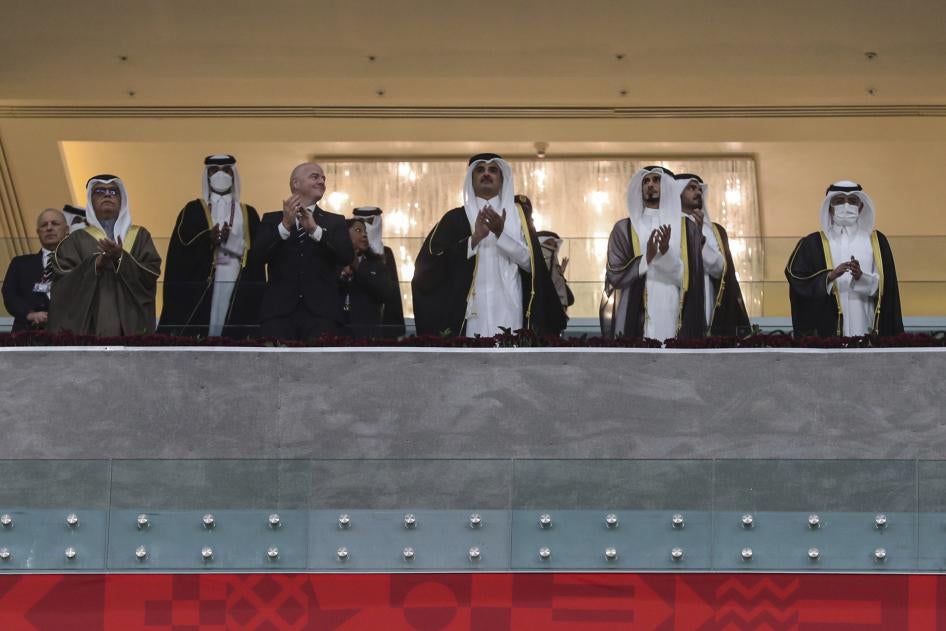
When FIFA convenes its 72nd Congress in Doha, Qatar, on March 31, 2022, in preparation for the World Cup, journalists, football associations, fans, and others should press both FIFA officials and Qatari authorities about human rights in the Gulf state, particularly the rights of migrant workers, women, and lesbian, gay, bisexual, and transgender (LGBT) people.
Since 2010, human rights organizations, trade unions, and media have consistently documented the rampant human rights abuses in the country, especially against migrant workers, including widespread wage theft, high recruitment fees, unexplained deaths, and passport confiscation, among others. While Qatar has introduced several reforms with much fanfare, they came too late, have proven to be woefully inadequate, and are poorly enforced. Similarly, the authorities have made no serious reforms to the severe discrimination in law and practice against women and LGBT people.
Despite repeated warnings and concrete evidence of rights violations, FIFA has not used its leverage or authority to pressure Qatar to follow through on its reform promises. Instead, FIFA has covered up for Qatar’s slow progress and championed the authorities’ reform narrative built around worker welfare that clearly does not reflect the reality for migrant workers.
FIFA has also failed to effectively push back on other repressive laws on press freedom, LGBT rights, and women’s rights. Not only has FIFA been a dismal steward for protecting and promoting human rights in Qatar, failing to use its leverage to truly push for football as a “force for good,” but it has also failed to fulfill its own human rights obligations under the United Nations Guiding Principles on Business and Human Rights (the Guiding Principles) that were adopted in 2016. As per the Guiding Principles, FIFA should step up and make reparations to the thousands of migrant workers or their families who experienced abuses, including unexplained deaths, to make the World Cup 2022 possible.
The FIFA decision to award Qatar with hosting the 2022 World Cup has been itself mired in controversy, starting with US Department of Justice allegations that FIFA officials were bribed to award Qatar the 2022 World Cup. FIFA made the decision despite the country’s poor human rights record and its massive infrastructure deficit, knowing it would rest on vulnerable migrant workers to build.
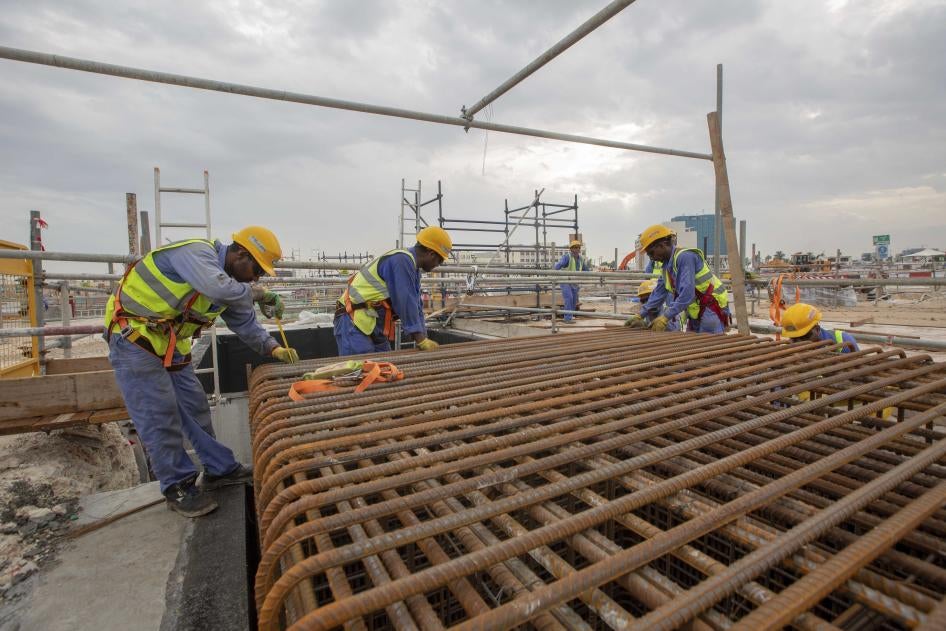
In March 2022, Human Rights Watch reported that workers at Bin Omran Trading and Contracting (BOTC), a prominent Qatari trading and construction firm, had not received their salaries for up to five months. BOTC’s projects include landscaping and underground utility works for Al Bayt Stadium, where the opening match will be held.
Indeed, Human Rights Watch research reveals that wage theft remains a systemic failure in Qatar with many employers getting away with it. Workers are still forced to pay exorbitant recruitment fees to secure jobs in Qatar, between US$700 and $2,600. This means they are already in debt before they arrive in Qatar, making them vulnerable to abuse and debt bondage.
Companies often withhold contractually guaranteed overtime payments and end-of-service benefits, and they regularly violate their contracts with migrant workers with impunity. In the worst cases, workers said, employers have simply stopped paying their wages, and the workers have often struggled to buy food.
Such abuses persist despite several reforms that Qatar has introduced since 2015 to improve wage protection for migrant workers. The government’s Wage Protection System (WPS), designed to ensure that workers receive their salaries through direct bank transfer by the seventh day of every month, allows the government to monitor wage payments and to impose sanctions on employers for noncompliance.
The Worker’s Support and Insurance Fund, which became fully operational in 2020, was established specifically to ensure that workers are paid wages they are owed when companies fail to pay or go out of business.
However, Human Rights Watch found that the Wage Protection System does little to protect wages and can be better described as a wage monitoring system with significant gaps in its oversight capacity. The authorities have yet to fully dismantle the causes for wage theft, which lie with the kafala (sponsorship) system; deceptive recruitment practices including high recruitment fees; and business practices including the so-called “pay when paid” clause, which allows the subcontractor to delay payments to workers until the subcontractor is paid and leaves migrant workers vulnerable to payment delays in supply chain hierarchies.
Had Qatar addressed the real causes of wage theft and had its announced reforms been well enforced, the WPS would have flagged companies like BOTC, which would have faced sanction, while workers would have been paid in a timely manner using the Workers Support and Insurance Fund. Instead, unpaid workers have been protesting collectively despite the risks, given that Qatar prohibits worker strikes.
One of the most prominent rights issues since Qatar was awarded the World Cup hosting rights in 2010 is the unexplained deaths of thousands of migrant workers.
Despite the global attention and consistent pressure on Qatari authorities for transparency, they have failed to publicize sufficient data on worker deaths. The numbers in the public discourse therefore vary widely. Qatari authorities say that the number of non-Qatari deaths between 2010 and 2019 is 15,021 for all ages, occupations, and causes. But because the data is neither disaggregated nor comprehensive, it is difficult to do any meaningful analysis on migrant worker deaths.
A Guardian investigation shows that between 2010 to 2020, there were over 6,751 deaths in Qatar of people from just five South Asian countries, which were neither categorized by occupation nor place of work. According to a recently commissioned report by the International Labour Organization (ILO), there were 50 work-related deaths in Qatar in 2020, and these have been disaggregated by key characteristics such as places of injury and death and the underlying cause where available.
Despite the widespread criticism, the authorities have dragged their feet in making comprehensive data on deaths of migrant workers publicly available. FIFA, too, has not used its leverage to push for more transparency around migrant deaths, but instead made erroneous remarks about them. According to media reports, FIFA President Gianni Infantino has even suggested that there have been just three work-related deaths in FIFA stadiums in Qatar, an incredible claim that is lower than even what Qatari authorities have announced.
According to the Guardian investigation, 69 percent of the deaths of migrant workers from India, Nepal, and Bangladesh between 2010 and 2020 were attributed to “natural causes.” A fifth of the 50 work-related deaths from 2020 were attributed to “unknown causes,” the ILO reported. According to Qatar’s Supreme Committee’s Workers’ Welfare progress reports, 18 of the 33 fatalities recorded between October 2015 and October 2019 attribute the cause of death to “natural causes,” “cardiac arrest,” or “acute respiratory failure,” terms that obscure the underlying cause of deaths, such as heat stress, and make it impossible to determine whether they may be related to working conditions.
When deaths are attributed to “natural causes” and categorized as non-work-related, Qatar’s labor law denies families compensation, leaving many of them destitute in the absence of their often-sole income provider. For a country with a highly advanced healthcare system, it is unfathomable that transparent data on worker deaths is not available and meaningful investigations of deaths have not been conducted but are simply attributed to “unknown” or “natural causes.” This does not prevent future deaths nor provide any consolation to the grieving families who are left in the dark.
Under the United Nations Guiding Principles on Business and Human Rights, FIFA too has the responsibility to provide reparations for abuses it caused or contributed to. As an entity that has immense resources, it has no excuse not to fulfill its obligations. In 2014, for example, the qualifying rounds and final tournament brought FIFA US$4.6 billion, with profits amounting to over $2 billion.
National football associations, which can be tarnished by association with rights abuses, also have leverage over FIFA that they can and should use. No player would want to be a complacent participant in a tournament that has caused such immense loss of migrant workers’ lives and livelihoods. It is encouraging that many national associations have started speaking up on the issue and should continue to push for tangible commitments including reparations to those who were subject to wage theft and to families who lost loved ones. This would ensure that thousands of families of migrants who lost their lives in Qatar while making the games possible are not left with nothing.
Human Rights Watch has obtained a circular from Qatar’s Public Works Authorities requesting companies to reduce their migrant labor workforce from September 21, 2022 to January 18, 2023. As per the circular, “All Contractors shall prepare a strategic plan for workers’ leave which maximizes the reduction in the number of workers in the country during the period. It should not adversely impact the migrant worker’s well-being and established RPD [Roads Project Department] projects’ targets and objectives.” According to Migrant Rights, construction companies – primarily subcontractors – also shared that the directive has been communicated to them informally.
Migrant workers hired for jobs in Qatar do not have the luxury to take unpaid leave for extended periods. A large majority of workers, especially the recently hired ones, have outstanding loans associated with their illegally imposed recruitment fees that will continue to pile up during the months they are back home if they are not paid. The wages in Qatar are also how workers and their families make ends meet on a paycheck-to-paycheck basis without any savings or support system to draw from. Workers who face early dismissal or whose contracts will not be renewed should be allowed time to find another employer in the country. All such workers should be paid all their outstanding payments due, including for any untaken vacation time, wages, overtime pay, end-of-service payments, and any severance pay.
It is important for Qatari authorities and companies to clearly communicate to workers the details of the arrangement, with strong systems in place to ensure that companies do not take undue advantage of the situation to cheat workers.
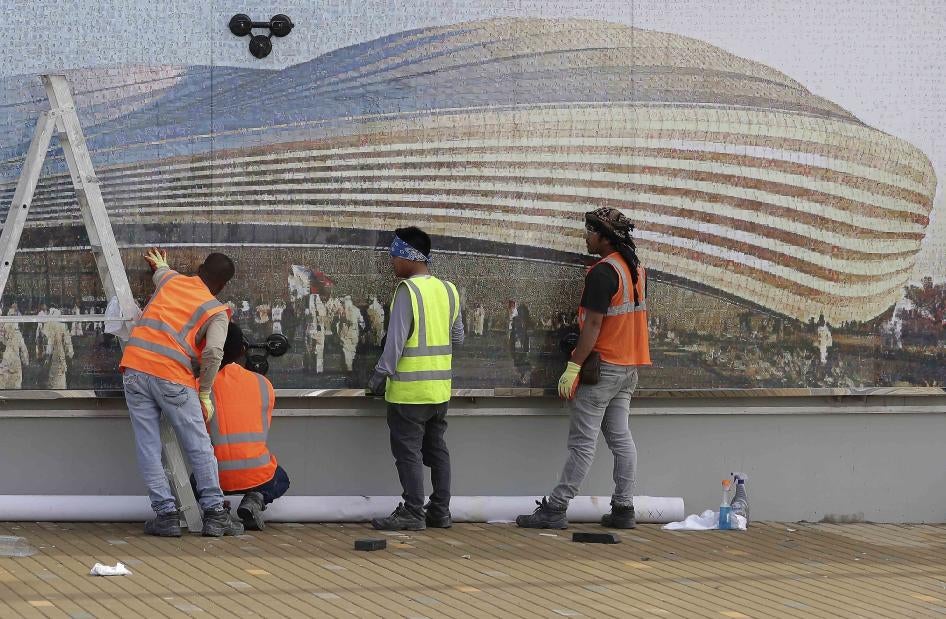
Just as the construction phase of the World Cup has rested almost entirely on the backs of migrant workers, who comprise over 95 percent of the Qatari workforce, the delivery of the World Cup will also be almost entirely dependent on migrant workers. They will serve players, fans, and other visitors as waiters, hotel workers, shop staff, housekeepers, stadium workers, security guards, and drivers. Recent evidence has shown that hotel workers and security guards have continued to pay high recruitment fees. Every worker that a fan or a player comes across could, therefore, potentially be a victim of some form of abuse, such as paying exorbitantly for the jobs.
The Worker Welfare Standards from the Supreme Committee for Delivery and Legacy, Qatar’s 2022 FIFA World Cup organizer, were originally developed for the construction sector, but have been extended to the hospitality sector. Stakeholders have come together to develop a guidance tool for fair recruitment and employment for the hospitality sector in Qatar that hotels are expected to follow.
Proper due diligence by national football associations is key to ensuring that they do not contribute to or are associated with the abuses. However, it is also important for news media to be aware that they should not have a narrow focus when covering how migrant workers are treated. Just as some coverage has focused on stadium workers who comprised only 1.5 percent of the migrant workforce, media focus should not be limited to service workers in companies serving elite visitors like players and coaches. Conditions for workers serving elite visitors will undoubtedly be under disproportionately higher scrutiny and standards, but they will be a tiny proportion of the total service sector workforce that will directly or indirectly cater to the 1.2 millionvisitors expected to visit Qatar for the tournament.
Migrant workers in Qatar are part of the estimated 3 billion viewers of the World Cup who, in addition, also were indispensable in making the World Cup in Qatar possible. A good illustration of the popularity of the game among migrant workers in Qatar is captured in the documentary The Worker’s Cup.
Now that fans are flocking in from all over the world, migrant workers’ freedom of movement should be respected. They should not be restricted to parts of the country or in cramped labor camps or worse, sent back to their home countries, out of the sight of visitors who would otherwise be appalled if they got a glimpse of their living conditions.
Football is often called “the beautiful game,” which means there should be no discrimination among fans, whether they are low-paid workers who built and serviced the stadiums and infrastructure for the World Cup or visitors who bought the most expensive tickets and flew in from afar. Migrant workers and visitors should be allowed to mingle with each other. Visitors, including journalists wanting to report on the migrant worker situation, fans, and stakeholders like national football associations, sponsors, and rights organizations should not be restricted from visiting labor camps.
Qatari authorities require women to obtain permission from their male guardians to marry, study abroad on government scholarships, work in many government jobs, travel abroad until certain ages, and receive some forms of reproductive health care. Some hotels require women to have a male guardian or be married to book and stay in a hotel room. Some events, such as concerts where alcohol is served, even ban Qatari women from attending. Such policies are discriminatory and facilitate violence against women.
Qatar moreover, has no domestic violence law and women who attempt to flee abuse can be returned to abusive families, arrested, or sent to psychiatric hospitals. A lack of transparency over discriminatory rules makes it difficult for women to challenge them. Women in Qatar have appealed to the authorities to repeal such laws. However, repressive laws limiting freedom of expression and association, government intimidation, and online harassment prevent women from challenging such rules or punish them when they do. There are no independent women’s rights organizations.
The authorities have made no serious reforms to the severe discrimination in law and practice they impose against women, affecting Qatari women and the many foreign women who live in the country. The authorities should eliminate all discriminatory male guardianship rules and practices, pass anti-discrimination law to end discrimination in practice, and repeal laws and practices that limit women’s civic participation to demand their own rights.
Qatari authorities criminalize extramarital sex, which disproportionately affects women, who can be prosecuted if they report rape and because pregnancy serves as evidence of the so-called crime. The penalties for these offenses are some of the harshest in the region, with up to seven years in prison, and floggings if they are Muslim. Police often do not believe women who report violence. Women are also required to show a marriage certificate to access certain forms of sexual and reproductive healthcare.
At major sporting events like the World Cup, the risk of sexual violence increases greatly, not just for fans, but particularly for migrant women in low-paid sectors. A Mexican woman who was a Supreme Committee official reported a physical assault by a man to the police in Qatar in June 2021. Instead of getting protection and justice, she found herself accused of the so-called crime of extramarital sex because the man claimed to be in a relationship with her, which she denied. Even though she managed to leave the country, the authorities proceeded to prosecute her on this charge and she remains on trial. Qatar should repeal legal provisions criminalizing extramarital sex, including article 281 of the Penal Code. The authorities should ensure support for survivors of sexual violence including medical, legal, and psychosocial – mental health assistance, and including emergency contraception, sexual health checks, and post-exposure prophylaxis for HIV. The authorities should allow all women access to sexual and reproductive health care without requiring a marriage certificate and should ensure that police and prosecutors have gender-responsive training.
Qatar has assured prospective visitors that it will welcome lesbian, gay, bisexual, and transgender (LGBT) visitors and that fans will be free to fly the rainbow flag at the games. However, prospective visitors including LGBT fans have been deterred from attending the games, as shared by the English Football Association Manager, Gareth Southgate based on his discussion with English fans.
People who have experienced government repression have told Human Rights Watch that the Qatari government surveils and arrests LGBT people based on their online activity. The authorities also censor traditional media related to sexual orientation and gender identity, including people who show support for LGBT individuals. They have effectively excluded LGBT content from the public sphere.
Suggestions that Qatar should temporarily suspend domestic laws and state practices during the games would reinforce the idea that same-sex desire and gender variance are a peculiar preoccupation of outsiders. That leaves LGBT residents of Qatar struggling to navigate their sexuality and gender identity in a repressive environment that risks resuming in full after the World Cup.
As Qatar advances its surveillance capabilities, including inside football stadiums, the possibility of LGBT Qataris being persecuted for publicly supporting LGBT rights will remain long after the international fans leave. Physical and virtual spaces free from surveillance are vanishing in Qatar as its data protection law allows broad exemptions that undermine the right to privacy. Digital targeting is combined with laws that target people based on consensual sexual conduct outside of marriage.
Long-term legal reform should prioritize the realities of LGBT residents of Qatar, including by introducing legislation that protects against discrimination on the basis of sexual orientation and gender identity, online and offline. The Qatari government should repeal article 285 and all other laws that criminalize consensual sexual relations outside of marriage.
Press freedom is curtailed in Qatar, which ranked 128 on the World Press Freedom list for 2021. Qatar also introduced an amendment to its penal code that imposes up to five years of prison for spreading rumors or false news with ill intent. It is not clear who determines what is a “rumor” or “fake news,” and what standards they will use in making such a determination.
In November 2021, two Norwegian journalists investigating migrant worker issues in Qatar were arrested and detained for 36 hours. Film showing evidence of the migrant worker situation in Qatar was destroyed. Separately, the same month, another Norwegian journalist was also held in solitary confinement for 24 hours. Such cases are common in Qatar, posing a credible threat to the narrative that the country is trying to build through its heavy public relations machinery.
Similarly, migrant workers who speak up about their realities and become important sources of information are also at great risk of immediate and arbitrary detention or deportation. Over the last year alone, Qatari authorities forcibly disappeared the Kenyan labor activist Malcolm Bidali before releasing him, and put Abdullah Ibhais, a Jordanian former employee of the Supreme Committee, on trial for bribery and misuse of funds, which some evidence suggests was in retaliation for his criticism of the poor conditions for migrant workers.
Qatar should have had every expectation of massive global media interest and coverage over the decade leading up to the World Cup and in the year of the tournament. It should not come as a surprise to Qatari authorities or FIFA that journalists who come to Qatar during the tournament will be interested in stories beyond the matches and who scores goals. They should be ensured that they will be safe and allowed to do their work with little interference. They should face no undue restrictions to report on social or economic issues should they wish to do so. Similarly, fans and other supporters should also not face any safety concerns for posting openly on social media platforms.
If Qatar and FIFA do indeed believe their own reform narrative, they should see the arrival of thousands of journalists and commentators from all over the world to the country as an important opportunity to bear witness to the positive transformation, not restrict their access or suppress their voices.
President Biden is a president who makes us proud. He clearly stepped up to the plate in difficult times. COVID, inflation, Ukraine are just a few of the volatile issues he is managing.
When it comes to international issues like Ukraine, the president represents the United States, not Democrats or Republicans. Yet today we are so divided there are Republicans willing to attack him trying to undermine our standing in the world. It was reported last week, “More than two dozen Senate Republicans demand Biden do more for Ukraine after voting against $13.6 billion for Ukraine.” One total jackass, Madison Cawthorn (R-N.C.), has managed to infuriate even some of the most evil members of his own party when he “called Ukrainian President Volodymyr Zelensky a ‘thug’ and the Ukrainian government ‘incredibly evil’.”
It is one thing to attack the president on domestic issues. But today we have a Republican Party hoping to see Biden fail without regard to the fact it would hurt the American people they have been elected to serve. Some individual Republicans have stepped up to the plate on one issue or another. Rep. Liz Cheney (R-Wyo.) did so on the Jan. 6 committee. Yet most act like they are the dregs of society. Some so outrageous they manage to embarrass the party that has shown they are immune to being embarrassed, having stood by Trump. A new meme surfaced last week about Rep. Marjorie Taylor Greene (R-Ga.) suggesting she represents what happens when ‘the ventriloquist dies and the dummy keeps talking.’
President Biden is showing how his years of experience in government, from the Senate to the VP’s office, are enabling him to effectively lead when working with NATO and our other allies. He has surrounded himself with some of the brightest, including National Security Adviser Jake Sullivan, and Secretary of State Antony Blinken. He is wisely choosing to get advice from experts like Fiona Hill, among others, an expert on Russia and Putin. In 2013, Hill wrote a well-respected book, “Mr. Putin: Operative in the Kremlin.” This week, Biden is in Brussels to meet with other NATO leaders for the first time since Russia invaded Ukraine. He will solidify the work that has been done and reinforce the close working relationships he has reestablished with our allies after four years of Trump working to tear them apart.
One of the things I most respect about our president is his willingness to speak truthfully to the American people. To talk about some of what we will face at home including rising gas prices and continued inflation, as we support the people of Ukraine in their fight for their country and democracy. Biden has been attacked by those who think he is doing too much and those who think he is doing too little. That is the divide in our country we can lay at the feet of Donald Trump. Thankfully our allies, and the overwhelming member nations of the United Nations, are supporting what we are doing.
All this will play out as Americans go to the polls in November 2022. Whatever the situation is at home, and around the world, at that time we will see if a majority of the country is willing to support the president and elect Democrats up and down the ballot. We will see if they give the president a Democratic Congress so he can move forward more of his agenda for America. I believe when it comes down to it, they will. They will understand America has reclaimed its position as a leader in the world and we can move a domestic agenda forward that will benefit all. An agenda to bring children out of poverty and provide all with good jobs, quality healthcare, and a good education. Most Americans understand we must do something to fight climate change and ensure equal justice and opportunity for all.
I am an optimist and believe that optimism in the American people is not misplaced. Since I first stood on a street corner in New York City at the age of nine handing out flyers for Adlai Stevenson for president; to running a local storefront after school in 1960 supporting JFK for president; after being in winning and losing campaigns, that optimism remains. Somehow the American people find it in them to do the right thing even if it takes much longer than I want it to.
Arizona’s Republican governor signed a series of bills Wednesday targeting abortion and transgender rights, joining a growing list of GOP-led states pursuing a conservative social agenda.
The measures signed by Gov. Doug Ducey will outlaw abortion after 15 weeks if the U.S. Supreme Court allows it, prohibit gender confirmation surgery for minors and ban transgender girls from playing on girls sports teams.
Bills targeting abortion and transgender rights have been popular with the conservative base in states where Republicans dominate but could be politically risky in a battleground state where Democrats have made significant inroads.
The Arizona abortion legislation mirrors a Mississippi law now being considered by the nation’s high court. The bill explicitly says it does not overrule a state law in place for more than 100 years that would ban abortion outright if the Supreme Court overrules Roe v. Wade, the 1973 case that enshrined the right to abortion in law.
“In Arizona, we know there is immeasurable value in every life — including preborn life,” Ducey said in a signing letter. “I believe it is each state’s responsibility to protect them.”
Ducey is an abortion opponent who has signed every piece of anti-abortion legislation that has reached his desk since he took office in 2015. He said late last year that he hoped the Supreme Court overturns the Roe decision.
Florida lawmakers passed a similar 15-week abortion ban early this month that Republican Gov. Ron DeSantis is expected to sign.
Other states are considering similar bans or passing versions of a ban enacted in Texas last year that bans abortions after about six weeks of pregnancy that the Supreme Court has refused to block.
The president of Planned Parenthood Advocates of Arizona called the 15-week ban just the latest in a series of “unrelenting attacks” on a woman’s right to choose by Arizona Republicans.
Get the Evening Rundown
A rundown of the day’s top stories and headlines.SIGN UPTHIS SITE IS PROTECTED BY RECAPTCHA PRIVACY POLICY | TERMS OF SERVICE
Meanwhile, Arizona joins at least a dozen other states with limits on sports participation for trans girls and becomes the third state to try and limit health care options for transgender teens.
Until two years ago, no state had passed a law regulating gender-designated youth sports. But the issue has become front and center in Republican-led statehouses since Idaho lawmakers passed the nation’s first sports participation law in 2020. That law is now blocked in court, along with another in West Virginia.
Republicans have said blocking transgender athletes from girls sports teams would protect the integrity of women’s sports, claiming that trans athletes would have an advantage. Ducey echoed that sentiment in his signing statement.
“Every young Arizona athlete should have the opportunity to participate in extracurricular activities that give them a sense of belonging and allow them to grow and thrive,” Ducey said.
Many point to the transgender collegiate swimmer Lia Thomas, who won an individual title at the NCAA Women’s Division I Swimming and Diving Championship last week.
But there are few trans athletes in Arizona schools. Since 2017, about 16 trans athletes have received waivers to play on teams that align with their gender identities out of about 170,000 high school athletes in the state, according to the Arizona Interscholastic Association.
Critics said the legislation dehumanizes trans youth to address an issue that hasn’t been a problem. They said decisions about health care should be left to trans children, their parents and their health care providers.
“We’re talking about legislating bullying against children who are already struggling just to get by,” Democratic Rep. Kelli Butler said during the House debate on the sports bill last week.
In a major judgment issued this week, a United Nations treaty body called on Sri Lanka’s government to repeal its law criminalizing adult, consensual same-sex conduct – including between women.
The case was brought under the Convention on the Elimination of All Forms of Discrimination against Women (CEDAW) by Rosanna Flamer-Caldera, an LGBT rights activist who faced harassment and discrimination for her sexual orientation and human rights advocacy on behalf of sexual and gender minorities.
The judgment by the UN Committee on the Elimination of Discrimination against Women concerned Sri Lanka’s Penal Code, a relic of British colonial rule that dates to 1883. Section 365 punishes “carnal intercourse against the order of nature” with up to 10 years in prison and a fine. Section 365A punishes “any act of gross indecency” with up to two years in prison and a fine.
These provisions are widely understood to criminalize consensual sex between same-sex partners. Section 365A originally criminalized same-sex relations between men; however, the provision was amended in 1995 after the law was criticized for being discriminatory on the basis of sex, to include same-sex relations between women.
Many countries only criminalize same-sex relations between men, and at least 38 countries criminalize same-sex conduct regardless of sex or expressly criminalize sexual conduct between women. At least 10 countries have, since 1986, explicitly enacted laws that criminalize sex between women as well as men, sometimes perversely framing this as a gesture toward equality – such as in the case of Sri Lanka.
Around the world, laws that criminalize same-sex relations are being repealed as courts and governments recognize they are discriminatory and harmful – including the Indian Supreme Court striking down penal code section 377 in 2018.
In a 2016 report, Human Rights Watch documented that Sri Lanka’s penal code casts a shadow over LGBT people’s lives, impacting their ability to access health care and housing, and creates pressure to conceal and conform their identities.
The CEDAW committee judgment noted that “the criminalization of same-sex sexual activity between women in Sri Lanka has meant that [Flamer-Caldera] has had difficulties with finding a partner, has to hide her relations and runs the risk of being investigated and prosecuted in this context.”
With this call for change from the CEDAW committee, Sri Lanka should urgently repeal its outdated and discriminatory law.
Proponents of the law continue to pretend that its limitations are narrow and only prohibit “teaching” young kids about sexuality. In reality, however, the bill is so broad and vague that it will likely be used to bully teachers and students from being out or acknowledging the existence of LGBTQ people. Contrary to claims that the law “only” impacts the lower elementary grades, as Mark Joseph Stern at Slate points out, it’s worded in such a way as to allow parents to sue high school teachers for, say, allowing students to form a Gay-Straight Alliance. Indeed, the impetus of the law was a case where parents wanted to sue the school for accepting a teenager’s gender identity.
Meanwhile, the mainstream press is still hamstrung by this fantasy that the courts will swoop in and stop this.
In an opinion piece for NBC News, NYU law professor Daniel Putnam responded to the law’s passage with a piece confidently asserting that the law is unconstitutional because “courts have consistently recognized that LGBTQ students and teachers have a basic First Amendment right to express who they are.”
There’s currently a sitting justice whose wife was involved in a fascist coup attempt — and that’s just the tip of the corruption iceberg. The Republican-appointed majority routinely ignores the plain letter of the law when imposing their right-wing ideology, such as in recent cases throwing out vaccine mandates and tearing up basic voting rights protections. The court recently signed off on a Texas law that bans abortion in direct violation of Roe v. Wade by pretending that they had no authority to block the “bounty hunter” provision that is being used to enforce the ban. Guess what? The Florida law uses the same provision to enforce the “don’t say gay” bill by empowering parents to sue schools that allow LGBTQ staff and students to be out.
The right-wing court’s total power and utter impunity is, in fact, empowering Republicans to expand their war on LGBTQ rights. And the “don’t say gay” bill is likely just the beginning.
Recent events show that, in addition to the ongoing war on trans people, Republicans are deeply interested in rolling back hard-won gay rights victories from recent years, including same-sex marriage.
Rep. Marjorie Taylor Greene of Georgia tipped her hand to this at a recent Donald Trump rally in Georgia, in which she bellowed that Transportation Secretary Pete Buttigieg “and his husband can stay out of our girls’ bathrooms.” This statement led observers to wonder if she was confused about which unhinged right-wing conspiracy theory is which. The “predators in women’s rooms” accusation is typically used these days to demonize trans women. But of course, Greene doesn’t actually believe gay men are scheming for ways to rape women. As Aaron Rupar of Public Notice wrote, by mixing up her conspiracy theories, Greene was signaling that “all the GOP talk about bathrooms was really just euphemized bigotry” that doesn’t need to make sense, even in their own lurid fantasies. Bathroom talk is just a new way of calling someone the F-word.
It also, importantly, functions as a signal that it’s not just trans rights that they’re coming for, but gay rights as well.
Greene has previously expressed a belief that violence is an appropriate response to feeling threatened by the existence of LGBTQ people. In light of that, her recent speech should be understood as a winking endorsement of gay-bashing. Nor is she an outlier.
Obergefell was a 5-4 decision in favor of gay rights. Since then, two of the justices who supported it have been replaced by Federalist Society-linked justices, who were picked in no small part to issue anti-LGBTQ decisions. For those who are counting, that means that if Republicans can find some way to relitigate the question, they likely have a 5-4 majority to overturn the legalization of same-sex marriage, or at least gut it significantly.
Needless to say, none of the events in question constitute sex education, especially of the how-to instruction that Paxton is implying is going on. (And let’s face it, teenagers already know the how-to part.) Events are based around themes like “Differences are Awesome” and “Creative Expression.” Paxton’s letter is riffing on the Republican fallacy that behaviors most people see as banal with regards to straight people — such as having a prom date or attending a wedding — become “sexual” when it involves LGBTQ people. By sending this letter, Paxton is attempting to achieve the same ends as the “don’t say gay” law in Florida: bullying schools from allowing LGBTQ students to be out. He just isn’t even bothering to go through the legislature first.
So while there has been, rightfully, a great deal of attention paid in recent years to how Republicans have “turned to” attacks on trans people, having lost the gay rights battle, these moves by Republicans show that they don’t, in fact, feel that their loss on gay rights is permanent. On the contrary, there’s a new escalation of attacks against gay rights that most Americans assume are inviolable The right to be out, the right to get married, the right to live your life safe from violence and discrimination are now all at risk. Florida’s bill is just the beginning.
Before Mike Pompeo served as secretary of state in the Trump Administration, he was director of the Central Intelligence Agency — a position he held from January 2017 to April 2018. According to Daily Beast reporters Jeff Stein and Howard Altman, it was during Trump’s first year in office and Pompeo’s months as CIA director that spy agency chat rooms first saw a major increase in hate speech. And it only got worse after that.
The Beast journalists report, “Dan Gilmore, who worked in an administrative group overseeing internal chat rooms for the classified Intelink system for over a decade from 2011, says that by late in the third year of the Trump Administration, the system was afire with incendiary hate-filled commentary, especially on ‘eChirp,’ the intelligence community’s clone of Twitter.”
Gilmore, who was e-Chirp’s administrator, said that the application “became a dumpster fire” of hate speech targeting non-whites, gays, women, transsexuals and Muslims. According to Gilmore, “Professionalism was thrown out the window, and flame wars became routine.”
Gilmore told the Beast, “There were many employees at CIA, DIA, NSA, and other IC agencies that openly stated that the January 6th terrorist attack on our Capitol was justified.”
According to Gilmore, “Hate speech was running rampant on our applications. I’m not being hyperbolic. Racist, homophobic, transphobic, (Islamophobic) and misogynistic speech was being posted in many of our applications.”
The Senate Intelligence Committee and the House Intelligence Committee, according to Stein and Altman, are looking into allegations of hate speech on intel agency platforms. But the Pentagon declined to be interviewed about the allegations.
“The Pentagon’s silence runs counter to its very public stance on battling extremism in the ranks,” Stein and Altman noted. “No less than Secretary of Defense Lloyd Austin has expressed concern about right-wing extremist sentiment in the military services. In the aftermath of the January 6, 2021 Capitol insurrection, he ordered a so-called one-day stand down across the military for leadership to address the issue of extremism with troops.”
In February news circulated that a 23-year-old transgender woman, Doski Azad, had been killed by her brother in the Kurdistan Region of Iraq. I read the news, having just concluded my research on armed groups’ killings, abductions, torture, and sexual violence against LGBT people in Iraq, and thought, how can LGBT people get justice and accountability when they can be killed and abused with impunity, even in their own homes?
Over the past six months, I interviewed 54 LGBT Iraqis who have survived harrowing violence at the hands of Iraqi armed groups and the police. Some of them also had intimate knowledge of other LGBT Iraqis who had been killed or disappeared by armed groups due to their gender presentation or perceived sexual orientation.
Our new report documents 8 abductions, 8 attempted murders, 4 extrajudicial killings, 27 instances of sexual violence, 45 threats to rape and kill, and 42 cases of online targeting by armed units within the Popular Mobilization Forces (PMF), groups nominally under the prime minister’s control since 2016, against LGBT people in Iraq. In eight cases, abuses by armed groups and police were against children as young as 15. In thirty-nine cases, the victims were able to identify the armed group behind the attack against them.
The numbers are most likely much higher. The attackers are known. Yet, as with so many killings and disappearances in Iraq, the perpetrators have not been held accountable.
Many of the people I interviewed were young enough to have just graduated from high school, yet the fear and isolation they described stretched as far as they could remember. Most had never spoken to anyone about what had happened to them. I found myself on several occasions setting aside my interview questions and just talking to them. I listened to a 27-year-old gay man describe how his boyfriend was tortured in front of him. “Then they shot him five times,” he said.
The story of one 21-year-old gay man stayed with me. He survived an attempt to kill him in November 2019, while three masked men stabbed the friend who was with him to death. He told me, gasping for breath, “They kept screaming: ‘Faggot! Faggot! You are faggot scum and deserve to die.’ One of them stabbed me in the shoulder, and I still don’t know how, but I ran for my life.”
His own father broke both his knees while beating him with a baton after he found him chatting with a man online. He said his father forces him to work at a family-owned laundromat for 16 hours per day in an underground room he called “a dungeon.” His father gives him leftovers from others’ plates and had previously thrown food in the garbage and told him to find it there.
Or the 31-year-old Iraqi transgender woman who was on her way home from work when six men in a Hummer with tinted windows stopped her next to a garbage dump in Baghdad. “They pulled out a razor blade and a screwdriver and poked and cut me all over, especially my ass, crotch, and thighs,” she said. “They sliced me up and poured around five liters of gasoline all over my body and face and set me alight….”
Her neighbors rescued her. Today, scars from her burns stretch from her neck to her feet. “They wanted me dead,” she said. “They have constrained my body, and I cannot love or be loved….I even contemplated suicide.”
Another transgender woman who had been kidnapped, tortured, and gang-raped in June 2020 by a PMF group, told me that after her abduction she stopped eating, failed her university exams, and attempted suicide. “I feel like the walking dead,” she said.
Where does justice begin for these individuals? No Iraqi laws protect LGBT Iraqis from violence. In fact, some provisions of Iraq’s Penal Code, like articles 41(1) and 128, empower attackers against them under the pretext of “honor,” knowing that the attackers can and most likely will get away with it. All of the people I interviewed said they would not report violence against them to the authorities because they are terrified that they would be targeted again, dismissed by the police, or detained.
The Iraqi government is responsible for ending the bloodshed and impunity, and it should start by investigating all reports of violence by armed groups or others against all victims including LGBT people and publicly condemning all such violence. The justice system should prosecute and appropriately punish those found responsible.
The government should take all measures to end torture, disappearances, summary killings, and other abuses based on sexual orientation and gender expression and identity, and compensate the families of all victims of unlawful killings and survivors of serious abuse. Justice only begins there.
Public school teachers in Florida are now banned from holding classroom instruction about sexual orientation or gender identity after Florida’s Gov. Ron DeSantis, a Republican, signed the controversial “Parental Rights in Education” bill.
The bill, which some opponents have called “Don’t Say Gay,” was signed by DeSantis on Monday. It reads, “A school district may not encourage classroom discussion about sexual orientation or gender identity in primary grade levels.”
But DeSantis was defiant in the face of critics, “I don’t care what Hollywood says. I don’t care what big corporations say. Here I stand. I am not backing down.”
Read the full article. Note that DeSantis had young children crowd around to applaud the signing.