The Bisexual Resource Center (BRC), America’s oldest national bisexual organization, will celebrate the 9th annual Bisexual+ Health Awareness Month (#BiHealthMonth) social media campaign throughout March 2022.
#BiHealthMonth, founded and led annually by the BRC, raises awareness about the bisexual+ (bi, pansexual, fluid, queer, etc.) community’s social, economic and health disparities; advocates for resources; and inspires actions to improve bi+ people’s well-being.
This year’s #BiHealthMonth theme is “Connection.” This theme has been chosen to highlight the importance of connecting bisexual+ people to each other, to supportive communities and to health care resources that are affirming of their identities.
While there are many different ways that bi+ people can connect, the goal of connection is to build safe, inclusive spaces — in-person and online, locally and globally — for bi+ people to share their experiences and create meaningful relationships. When bi+ people are connected, it greatly improves their physical, mental and social health, particularly for bi+ people living in historically oppressed, marginalized or isolated communities.
“This year’s #BiHealthMonth is all about connection,” said Belle Haggett Silverman, president of the Bisexual Resource Center. “How are we connected as people? As communities? As a movement? We know that, while connection comes in many forms, it is always crucial for people to thrive individually and collectively. When we create spaces for bi+ people to come together and support each other, we can build a healthier, happier bi+ community and improve health outcomes for bi+ people worldwide.”
Throughout the month of March, the BRC will partner with a diverse array of leading organizations, including #StillBisexual, AIDS United, Athlete Ally, the Battered Women’s Justice Project, BiArtsFestival, Bisexual Queer Alliance Chicago, Bi Women Boston, Fandom Forward, Fenway Health, Howard Brown Health, Human Rights Campaign, LGBT Center of Wisconsin, Los Angeles Bi Task Force, Magic City Acceptance Center, Mini Productions, Milwaukee LGBT Community Center, NARAL, North Shore Pride, the NYC LGBT Center, PFLAG National, the National LGBTQ Task Force, SAGE, SpeakOUT Boston, Step Up For Mental Health, TAIMI, the Visibility Impact Fund and others to feature engaging and informative content, events, research, resources and actions. The BRC invites individuals, organizations, media outlets, companies and anyone interested to participate all month long by posting online using #BiHealthMonth, hosting local community events, donating to the Bisexual Resource Center and more.
Some #BiHealthMonth highlights this year include a screening of the short film “Treacle,” hosted by April Kelley; panels on bi+ health featuring conversations with BRC board members Gabby Blonder, Andrea Holland, and River McMican; new, original content from bi+ advocates, including Robyn Ochs; and a full calendar of BRC-hosted online events including a Bisexual Social and Support Group (BLiSS) meeting (March 2), a Bi+ Crafternoon (March 6); and an in-person Bi/Pan Guyz+ Social Night (March 23).
For more on #BiHealthMonth, follow the Bisexual Resource Center on Twitter, Facebook and Instagram.
###
The Bisexual Resource Center works to connect the bi+ community and help its members thrive through resources, support, and celebration. Through this work, we envision an empowered, visible and inclusive global community for bi+ people. Visit www.biresource.org for more information.
Singapore’s highest court on Monday upheld a lower court’s decision to dismiss three challenges to a law that criminalizes sexual relations between men.
While delivering the judgment, given by a bench of five judges, Chief Justice Sundaresh Menon of the Singapore Court of Appeal said that the appeals are not about “whether (Section) 377A (of the penal code) should be retained or repealed, that being a matter beyond our remit.”
“Nor are they about the moral worth of homosexual individuals,” said Menon. “In the words of our prime minister, Mr. Lee Hsien Loong, homosexual individuals are ‘part of our society’ and ‘our kith and kin.’”
The appeal court went ahead and said the appeals are also “not about the fundamental nature of sexual orientation, whether immutable or not, which is an extra-legal question well beyond the purview of the courts.”
The court also suggested that political resolution of the issue is more appropriate than litigating it. The chief justice said that the advantage of the political process is its ability to accommodate divergent interests and opinions, while litigation is “not a consultative or participatory process.”
“This is so for good reason because litigation is a zero-sum, adversarial process with win-lose outcomes,” said Menon. “The political process, in contrast, seeks to mediate — it strives for compromises and consensus in which no one side has to lose all.”
The chief justice also said that it is “unnecessary” for the court to address a constitutional issue.
“They do not face any real and credible threat of prosecution under 377A at this time,” said Menon while delivering the judgment. “Therefore, (they) do not have the standing to pursue their constitutional challenges to that provision.”
“We, as organizations advocating for LGBTQ+ equality in Singapore, are disappointed with the Court of Appeal’s landmark ruling on Section 377A, which comes as a setback for all who were hoping for a resounding conclusion to this decades-long fight for equality,” said Ready4Repeal, a Singapore-based LGBTQ rights group, in a press release. “Despite recognizing the current situation as deeply unsatisfactory for the LGBTQ+ community, the Court of Appeal has still decided to retain the law, albeit with legal assurances on its unenforceability.”
Last year, three men, DJ Johnson Ong Ming, retired general practitioner Roy Tan Seng Kee, and Bryan Choong Chee Hoong, the former executive director of Oogachaga, an LGBTQ non-profit organization, decided to appeal against a Supreme Court’s decision to dismiss their cases against Section 377A.
“While this is a small step in the right direction, this simply does not go far enough to provide real protection to the LGBTQ+ community, who continue to be impacted by the cascading effects of Section 377A,” said Ready4Repeal. “The judges themselves acknowledged that even with the assurance of unenforceability, homosexual men will still be left open to police investigations as if a crime had been committed.”
Ready4Repeal started a petition in 2018 to pressurize the Singaporean government on repealing the colonial-era law. The petition has received 51,047 online signatures.
Section 377A is a highly debated law in Singapore that prohibits sexual relationships between two men. According to the law, any man in public or private who commits an act of gross indecency with another male shall be punished with to years in prison.
Last year, Home Minister Affairs K Shanmugam said that everyone in Singapore will be protected regardless of community and social, religious, or sexual beliefs. He also said that the government’s position is clear. He also said that amendments to the Maintenance of Religious Harmony Act make it an offense to urge violence on the grounds of religion or religious belief against any person or group.
Finance Minister Lawrence Wong last year reiterated that different sections of the society have valid concerns, and it needs to be addressed.
“Tribalism is inherently exclusionary, and it’s based on mutual hate: ‘us’ versus ‘them,’ ‘friend’ vs ‘foe,’” said Wong. “Once this sort of tribal identity takes root, it becomes difficult to achieve any compromise. Because when we anchor our politics on identity, any compromise seems like dishonor.”
Ankush Kumar (Mohit) is a freelance reporter, who has covered many stories for Washington Blade and Los Angeles Blade from Iran, India, and Singapore. Recently covered story for The Daily Beast. He can be reached at mohitk@opiniondaily.news.
The Texas Department of Health and Human Services appears to have removed resources for LGBTQ youths from its suicide prevention webpage.
On Feb. 1, the webpage included a subhead for the Trevor Project, describing it as “the leading national organization providing crisis intervention and suicide prevention services to lesbian, gay, bisexual, transgender, queer and questioning young people under 25.” The section provided the organization’s website, phone number and text line.
A few days later, on Feb. 5, the section was gone. Of the four suicide prevention phone or text lines, only The Trevor Project was removed.
Now, there are three crisis lines listed: the Suicide Prevention Lifeline, the Veterans Crisis Line and the Crisis Text line. The Trevor Project’s phone number is still included in a PDF of resources under “Parent and Youth Suicide Prevention” as it was previously, but it isn’t as easily accessible as the section that was removed was, and doesn’t state that The Trevor Project is an LGBTQ-specific organization.
The Health and Human Services Department has not returned a request for comment.
Sam Ames, director of advocacy and government affairs at The Trevor Project, said mental health is not a partisan issue, and removing suicide prevention resources from a government website “because they are specific to LGBTQ youth is not only offensive and wrong, it’s dangerous.”
“We’re talking about a group of young people who are more than four times as likely to attempt suicide compared to their peers,” Ames said, citing Trevor Project research. In another survey, the group found that more than 80 percent of LGBTQ youths said it was important that a crisis line include a focus on young LGBTQ people.
“Especially during this time of unprecedented political attacks against LGBTQ youth, we encourage all youth-serving organizations and government agencies to learn more about The Trevor Project’s lifesaving crisis services and to publicize them to the youth and families who most need support,” Ames said.
This isn’t the first time Texas officials have removed suicide prevention resources for LGBTQ youths — and The Trevor Project, specifically — from state websites.
In August, following criticism from one of Gov. Greg Abbott’s Republican primary challengers, Texas officials removed a webpagetitled “gender identity and sexual orientation” and a page devoted to Texas Youth Connection, a program run by the Department of Family and Protective Services, which included a link to The Trevor Project.
The page on sexual orientation and gender identity still shows an error message. The Texas Youth Connection website also displays the same message that it did in October: “The Texas Youth Connection website has been temporarily disabled for a comprehensive review of its content,” the website says. “This is being done to ensure that its information, resources, and referrals are current.”
Patrick Crimmins, the director of communications for the Texas Department of Family and Protective Services, said in October that the review of the webpages “is still ongoing” and would not provide further comment about why the pages were removed. He has not responded to a request regarding when or whether the pages will be restored.
Cameron Samuels, a senior at Seven Lakes High School in Katy, near Houston, and an activist, said the removal of LGBTQ-specific resources from state websites is “part of this larger attack on LGBTQ youth in Texas.”
As an example of this “larger attack” — which Samuels, who uses gender neutral pronouns, said is causing widespread fear among trans people in Texas — they cited a directive issued last week by Abbott that called on the state’s child protective services agency to investigate the parents of minors who are receiving gender-affirming medical care for child abuse. Abbott’s directive also called on “licensed professionals” and the general public to report the parents of trans minors if it appears that they are receiving gender-affirming medical care.
Samuels has also fought censorship of LGBTQ websites within their school district, the Katy Independent School District.
After student activism, they said the district removed its block on the website for the Montrose Center, a local LGBTQ group in the state, in December. In January, it removed restrictions on websites for three national organizations: the Human Rights Campaign, the largest LGBTQ advocacy group in the country; GLSEN, which advocates for LGBTQ students; and PFLAG, which supports LGBTQ people and their families, among other sites.
Samuels said the district has “remained insistent” that The Trevor Project continue to be blocked due to its chat function. But they noted that the chat feature is what allows students to message a trained counselor.
The district has not returned a request for comment, but an official told the Houston Chronicle in January that the Children’s Internet Protection Act has a requirement of “ensuring safe communications including electronic mail, chat rooms and other forms of direct electronic communications.”
“The Trevor Project website has a community space to ‘get advice and support within an international community for LGBTQ young people ages 13-24,’ which is available to anyone who chooses to ‘join now,’” said Maria Corrales DiPetta, manager of media relations for the district. “Minors communicating with adults, unmonitored, online is an area of concern for communication and chat rooms as outline in CIPA.”
Samuels said it’s disappointing to see Health and Human Services officials making decisions that “are very harmful to students and youth who they represent.”
“And this is in addition to the governor’s efforts to investigate parents of trans youth for child abuse and to remove LGBTQ books from school libraries,” they said. “It’s really concerning and disturbing to see this.”
CORRECTION (March 2, 2022, 3:50 p.m. ET): A previous version of this article misstated the month that the Texas Department of Family and Protective Services removed two webpages with resources for LGBTQ youths. It was August, not October.
Alabama lawmakers on Tuesday night approved legislation that would bar transgender students from using school bathrooms and locker rooms that match their gender identity.
The bill mandates K-12 schools require students to use multi-person restrooms and locker rooms that match the sex on their original birth certificate. The Alabama House of Representatives voted 74-24 for the bill after two hours of contentious debate where Republicans said it would address an ongoing problem in public schools but opponents said it targets trans youth to score political points. The bill now moves to the Alabama Senate.
“Right now, you’ve got males who are dressing up as females, who are identifying themselves as females, and wanting to use the female bathrooms,” Republican Rep. Scott Stadthagen of Hartselle told lawmakers.
Stadthagen said some schools are now being asked to accommodate transgender students who request to use the bathrooms that align with their gender identity. He said the bill is also about protecting girls’ privacy and safety.
“All you are doing is demonizing an already vulnerable population. It’s all under the guise of protecting children just to win cheap political points. That’s all it is,” Rep. Neil Rafferty, a Democrat from Birmingham, said during debate on the bill.
Rafferty said schools in his Birmingham district have handled accommodations for transgender student, “without targeting vulnerable youth that are already having issues with suicide, mental illness, bullying.”
Stadthagen, in urging support for the bill, cited sexual assaults that have happened in school bathrooms. But opposing lawmakers challenged him to name any bathroom assault where a transgender individual was the attacker.
“How many of those cases involved a transgender woman?” Rep. Merika Coleman, a Democrat from Pleasant Grove, asked. Stadthagen replied he didn’t know.
Similar policies in other states have resulted in litigation. The U.S. Supreme Court last year rejected a Virginia school board’s appeal to reinstate its transgender bathroom ban, handing a victory to transgender rights groups and a former high school student who fought in court for six years to overturn the ban.
The full 11th U.S. Circuit Court of Appeals was scheduled to hear oral arguments Tuesday in the case of a transgender student in Florida who was blocked from using the boy’s bathroom.
Republicans who spoke in favor of the bill said teachers and parents in their districts have expressed discomfort over transgender students using bathrooms that align with their gender identity.
Rep. Andrew Sorrell, a Republican from Muscle Shoals, said there is a transgender student using the girl’s bathroom at a high school in his district. Sorrell said he would not let his now infant daughter attend that school in the future without this bill.
“I think this is such a commonsense bill. I understand and appreciate that you are trying to protect our daughters,” Sorrell told Stadthagen.
The Human Rights Campaign, the nation’s largest LGBTQ civil rights organization, condemned the passage of the bill.
“Today, the Alabama State House of Representatives took steps to discriminate against transgender students who deserve the fundamental human dignity of being able to use the bathroom without being discriminated against or humiliated,” Human Rights Campaign Alabama State Director Carmarion D. Anderson-Harvey said in a statement.
The Alabama bill is the second targeting LGBTQ youths to advance in legislative committee this year. A Senate committee last week advanced a bill that would outlaw the use of puberty-blockers, hormonal treatments and surgery to assist transgender youth 18 and younger in their gender transition.
Last year, Alabama Gov. Kay Ivey signed into law a bill to block transgender girls from playing on female sports teams at public schools.
Dr. Mehmet Oz leans in to ask a little girl, “Do you remember when your parents thought you were a boy?”
The question was but a few seconds of a full 2010 episode of “The Dr. Oz Show” that focused on the experience of raising transgender children. But the clip now appears in an attack ad aired by a super PAC supporting one of his Republican primary opponents in the crowded and high-stakes race for U.S. Senate in Pennsylvania.
Another campaign ad, from Republican U.S. Senate candidate Vicky Hartzler in Missouri, targets transgender people in sports and has her referring to an NCAA athlete — Ivy League championship-winning University of Pennsylvania swimmer Lia Thomas — by her deadname and saying “women’s sports are for women, not men pretending to be women.”
And on Wednesday, Texas Gov. Greg Abbott, a Republican who is running for re-election, ordered the state’s child welfare agency to investigate reports of gender-confirming care for kids as abuse.
Derision and disparagement of transgender people, and even of those perceived as their allies, are proliferating on the airwaves and in statehouses across the country as 2022 election campaigns heat up. It’s a classic strategy of finding a “wedge issue” that motivates a political base, political observers say.
“They are just weaponizing the fact that most everyday Americans don’t yet realize that they know someone who is transgender,” said Rodrigo Heng-Lehtinen, executive director of the National Center for Transgender Equality. “It is easy to fall for a myth about a group of people you don’t know, and that’s just human. … It’s just really unfortunate to now see a group of politicians try to use that to their own advantage.”
Republicans use it because public opinion is on their side, said Neil Newhouse, a veteran Republican pollster.
The idea of restricting transgender athletes resonates with parents of high school athletes, motivates the Republican base, and carries swing voters by 2 to 1, Newhouse said.
In a primary, a Republican candidate can use it to establish their conservative credentials and to come out first or forcefully enough to own the issue, Newhouse said. Or it can be used to push a rival to the left, he said.
Asked for comment on the ad, which does not mention sports, Oz’s campaign — using inaccurate terminology to describe transgender women — said only that the celebrity surgeon doesn’t believe that “biological males should compete in women’s sports.”
The efforts to make political hay of transgender and other LGBTQ people extend well beyond just campaign ads.
At least 10 states have banned transgender athletes from participating in sports in a way that is consistent with their gender identity.
Indiana is poised to be the 11th, although federal courts have blocked laws in Idaho and West Virginia. And then there are states that are banning or investigating gender-confirming treatment, such as Texas.
The narrative of transgender people as a threat has strong parallels to bathroom-use and same-sex marriage bans and can be traced to Anita Bryant’s “Save Our Children” campaign in 1977, said Andrew Proctor, an associate professor of politics at Wake Forest University who studies and teaches LGBTQ politics.
The political framing is often around protecting girls, which is probably designed to broaden its appeal, Proctor and others said.
“It’s good messaging. Who doesn’t want to protect children?” said Don Haider-Markel, a University of Kansas political science professor.
Although examples like Lia Thomas are few across the country, Hartzler — who cites her experience as a high school athlete and coach — said in an interview that the issue of trans athletes is ad-worthy in a Senate race because it is a “representation of the wokeness that is being inflicted upon us from all sides and has gone beyond common sense.”
A spokesperson for University of Pennsylvania athletics said Thomas would not comment on the ad.
The NCAA in January adopted a sport-by-sport approach for transgender athletes to document testosterone levels before championship selections. For high school sports, states have a hodgepodge of policies.
In Pennsylvania, the TV ad from the super PAC supporting Republican David McCormick tries to characterize Oz as a “Republican in Name Only,” or not conservative enough.
The ad rips a few seconds from the episode and presents it without the context of a show that looked at transgender children from a measured standpoint, with input from a pediatrician and their parents on the kids’ newfound happiness.
The clip in the attack ad stops after Oz gently asks the girl, from a military family, if she remembers when her parents thought she was a boy. The full episode continues:
“A little bit,” the girl answers.
“Talk to me about that a little bit,” Oz says. “What do you remember?”
The girl’s mother, sitting next to her, says: “Like, how did it make you feel when I used to take you and get your hair cut at the barber shop on base?”
“It made me very angry,” Josie answers.
“You did not like your hair cut,” the mother says. “Why not?”
Josie answers: “Because I’m a girl, not a boy.”
A political consultant to Honor Pennsylvania did not return messages asking how that makes Oz not conservative enough. A McCormick campaign spokesperson did not return messages asking whether McCormick agrees with the ad’s attack.
Josie and her mother could not be located for comment on being featured years later in a political attack ad.
“I think it’s incredibly sad when a political leader finds that the only way that they can get themselves elected to office is by attacking vulnerable children and their parents,” said Lisa Middleton, the transgender mayor of Palm Springs, California. “Of all the issues that are before us in this world and this country today … to make it more difficult for a transgender child and their parents to navigate their life to adulthood is irresponsible. It’s un-American.”
Republicans aren’t the only party that uses wedge issues — Democrats often cast the wealthy in a negative light for political gain.
But the GOP’s targeting of transgender people may have a shelf life, just as both parties’ efforts against same-sex marriage shifted along with public opinion, said Paul Goren, a political psychology professor at the University of Minnesota. If it doesn’t pay off with electoral wins, he said, then Republicans will move on.
In Texas, Abbott’s letter came just a week before the state’s Republican primary, the nation’s first for the 2022 cycle. It aligns with a recent legal opinion from state Attorney General Ken Paxton, a Republican who is also running for re-election, that is directed at gender-confirming treatments incorporating puberty blockers and hormone therapy.
Pushback in Texas is coming from civil liberties groups, medical professionals and district attorneys in some counties.
Kimberly Shappley, a Texas nurse and mother of an 11-year-old transgender girl, Kai, said she was distraught and had begun looking for a job in another state. The family has already been on edge for years over efforts to prevent transgender children from using public bathrooms that match their identity, she said.
“As the parent of a trans kid, I can tell you that our close-knit community is just a wreck,” Shappley said on a video news conference organized by the American Civil Liberties Union. “It’s just been a lot of tears. It’s been a lot of, ‘Do we have our documents in order? Do we have our plan in place? Is this the time we have to move?’”
But it’s hard to know where to go, she said.
“The whole United States is on fire with anti-trans legislation. It’s not just Texas,” Shappley said. “What is the safe place that you think trans kids can live right now? Because there’s not that many left.”
While the One Male Condom is not markedly different from the hundreds of other condoms on the market, it is the first that will be allowed to use the “safe and effective use” label for reducing sexually transmitted infections during anal sex. It is also approved for use as a contraceptive and as a means to reduce STIs during vaginal intercourse.
“This landmark shift demonstrates that when researchers, advocates, and companies come together, we can create a lasting impact in public health efforts,” Davin Wedel, president and founder of Boston-based Global Protection Corp, maker of the One Male Condom, said in a statement. “There have been over 300 condoms approved for use with vaginal sex data, and never before has a condom been approved based on anal sex data.”
Courtney Lias, director of the FDA’s Office of GastroRenal, ObGyn, General Hospital and Urology Devices, noted that the risk of STI transmission during anal intercourse is “significantly higher” than during vaginal intercourse.
“The FDA’s authorization of a condom that is specifically indicated, evaluated and labeled for anal intercourse may improve the likelihood of condom use during anal intercourse,” Lias said in a statement. “Furthermore, this authorization helps us accomplish our priority to advance health equity through the development of safe and effective products that meet the needs of diverse populations.”
Anal sex poses the highest risk for contracting HIV, with the risk of HIV transmission from receptive anal sex about 18 times higher than receptive vaginal sex. Gay and bisexual men accounted for 69 percent of the 36,801 new HIV/AIDS diagnoses in the U.S. in 2019, according to the Centers for Disease Control and Prevention. Queer men of color were overrepresented within this group, with Black men representing 37 percent, Latino men representing 32 percent and white men representing 25 percent of these new diagnoses, according to the CDC.
One Male Condoms are available in standard, thin and fitted versions, and the fitted version is available in 54 different sizes.
A clinical trial of 252 men who have sex with men and 252 men who have sex with women found the One Male Condom has a failure rate of 0.68 percent for anal sex and 1.89 percent for vaginal sex, according to the FDA, which defined condom failure as condom slippage or breakage.
Dr. Will DeWitt, clinical director of anal health at the Callen-Lorde Community Health Center in New York City, said the newly approved condoms could be a helpful tool for HIV/AIDS prevention.
“The hope would be that people would be more willing to use condoms for anal sex and to have that direct encouragement would increase the rates of people using them,” DeWitt said. “Condoms still remain an important tool for people who don’t want to or can’t use PrEP.”
PrEP, or pre-exposure prophylaxis, is typically taken in the form of a daily pill to prevent HIV/AIDS in people who are not diagnosed with the virus. Last year, the FDA also approved an injectable PrEP shot that can be given every two months.
DeWitt did, however, add that he is worried the One Male Condom name and marketing could alienate those who engage in anal sex but do not identify as male.
“Anal sex really does belong to everyone,” DeWitt said. “Even if it’s the perspective of who has to wear the condom, it’s not just male bodies and male identified folks who need to use it.”
While health experts have long encouraged the use of condoms for STI prevention through anal sex, DeWitt said FDA’s official approval is long overdue.
“Here we are in 2022, and we are only now getting condoms approved for anal sex,” DeWitt said, noting that it’s been more than three decades since the start of the HIV crisis. “It’s a little frustrating that it’s taken this long to have this kind of official endorsement.
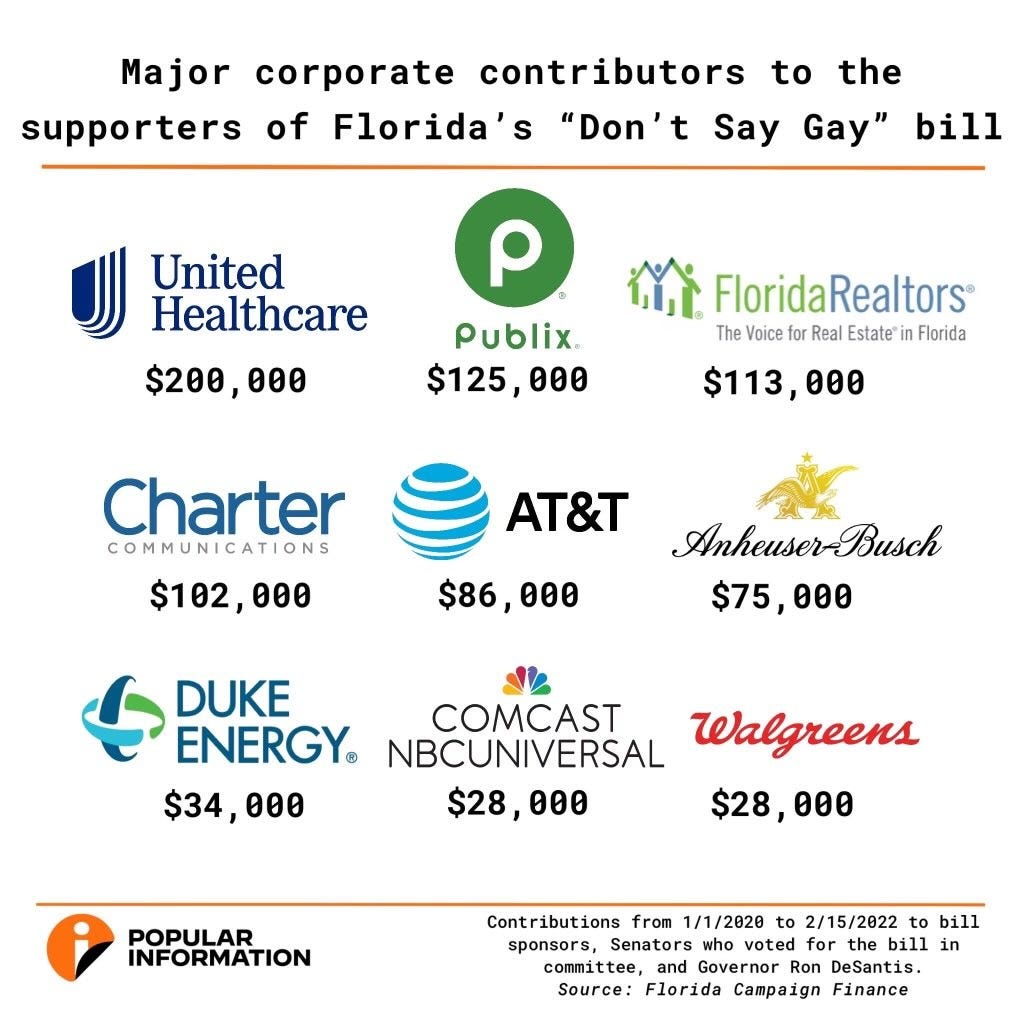
Some of the top companies in the U.S. that show public support for the LGBTQ community have donated thousands of dollars to the politicians behind a piece of Florida legislation opponents deemed the “Don’t Say Gay” bill.
The bill, which has versions in both the Florida House and Senate, would ban classroom discussions about sexual orientation and gender identity that are not “age-appropriate” in schools — though it is not clear what is considered “age-appropriate.” It also includes a provision that could effectively “out” LGBTQ students to their parents without their consent.
Despite opposition from Democrats and LGBTQ rights advocates, the “Don’t Say Gay” bill is gaining momentum in the Republican-controlled Florida Legislature.
Two weeks ago, Florida Republican Gov. Ron DeSantis appeared to voice support for the “Don’t Say Gay” bill, saying at a press event that it was “entirely inappropriate” for teachers and school administrators to have conversations with students about their gender identity.
“I know the ramifications of a bill like this could be detrimental to our LGBTQ youth,” out Florida state Senate candidate Eunic Ortiz told the Washington Blade.
Yet, a recent investigation from Popular Information, a political Substack newsletter run by veteran progressive journalist and political staffer Judd Legum, found some of the nation’s top companies — like Comcast/NBC Universal, UnitedHealth Group, Duke Energy, AT&T and Walgreens — have donated to the politicians behind the “Don’t Say Gay” bill.
Comcast/NBC Universal, for example, donated $1,000 to state Sen. Dennis Baxley, the main sponsor behind the bill in the Senate. In addition, the company gave a total of $28,000 to the top supporters of the anti-LGBTQ legislation since 2020, according to Legum and two other reporters, Tesnim Zekeria and Rebecca Crosby.
The Blade reached out to several representatives at Comcast but did not immediately receive a response, nor did Popular Information.
Comcast has publicly supported the LGBTQ community in recent years. “Some people may think the LGBTQ rights journey is done and the struggle is over, but it isn’t. Our job is to continuously educate,” said Yvette Miley, senior vice president of MSNBC and NBC News, on its website.
UnitedHealth Group has donated at least $200,000 to DeSantis since 2020 despite his public support for the “Don’t Say Gay” bill and other anti-LGBTQ legislation, according to the article.
The healthcare company has received perfect scores from the Human Rights Campaign, the nation’s largest LGBTQ organization, Corporate Equality Index. Its chief talent officer, Ryan Craig, has also said, “Strengthening the sense of community among our LGBTQ+ employees and allies” makes the company stronger. https://platform.twitter.com/embed/Tweet.html?creatorScreenName=WashBlade&dnt=true&embedId=twitter-widget-1&features=eyJ0ZndfZXhwZXJpbWVudHNfY29va2llX2V4cGlyYXRpb24iOnsiYnVja2V0IjoxMjA5NjAwLCJ2ZXJzaW9uIjpudWxsfSwidGZ3X2hvcml6b25fdHdlZXRfZW1iZWRfOTU1NSI6eyJidWNrZXQiOiJodGUiLCJ2ZXJzaW9uIjpudWxsfSwidGZ3X3NwYWNlX2NhcmQiOnsiYnVja2V0Ijoib2ZmIiwidmVyc2lvbiI6bnVsbH19&frame=false&hideCard=false&hideThread=false&id=1486716900079927308&lang=en&origin=https%3A%2F%2Fwww.washingtonblade.com%2F2022%2F02%2F19%2Ftop-lgbtq-supporting-companies-bankroll-dont-say-gay-bill%2F&sessionId=17ccd4a9af6d38b05809589364151bcde7d9ac4b&siteScreenName=WashBlade&theme=light&widgetsVersion=2582c61%3A1645036219416&width=550px
UnitedHealth Group did not immediately respond to the Blade’s request for comment. Public Information’s request also went unanswered.
Duke Energy, one of the largest electric companies in the U.S., has donated $34,000 to Florida legislators behind the “Don’t Say Gay” bill since 2020, including $25,000 to DeSantis and $1,000 to Baxley, according to the investigation.
“We are guided by our vision of an inclusive environment where employees feel a sense of belonging,” Cameron McDonald, Duke Energy’s vice president and chief diversity and inclusion officer, said in a statement. “We make sure to integrate diversity and inclusion into everything we do.”https://platform.twitter.com/embed/Tweet.html?creatorScreenName=WashBlade&dnt=true&embedId=twitter-widget-2&features=eyJ0ZndfZXhwZXJpbWVudHNfY29va2llX2V4cGlyYXRpb24iOnsiYnVja2V0IjoxMjA5NjAwLCJ2ZXJzaW9uIjpudWxsfSwidGZ3X2hvcml6b25fdHdlZXRfZW1iZWRfOTU1NSI6eyJidWNrZXQiOiJodGUiLCJ2ZXJzaW9uIjpudWxsfSwidGZ3X3NwYWNlX2NhcmQiOnsiYnVja2V0Ijoib2ZmIiwidmVyc2lvbiI6bnVsbH19&frame=false&hideCard=false&hideThread=false&id=1401954613226622982&lang=en&origin=https%3A%2F%2Fwww.washingtonblade.com%2F2022%2F02%2F19%2Ftop-lgbtq-supporting-companies-bankroll-dont-say-gay-bill%2F&sessionId=17ccd4a9af6d38b05809589364151bcde7d9ac4b&siteScreenName=WashBlade&theme=light&widgetsVersion=2582c61%3A1645036219416&width=550px
The Blade attempted to reach Duke Energy representatives by phone and email but have yet to receive a response. Legum’s team also couldn’t contact the company for comment.
AT&T has donated $86,000 to the politicians behind the bill, including $80,000 to DeSantis and $500 to Baxley, Popular Information reported.
The company has supported the LGBTQ community on social media, partnering with the national LGBTQ youth suicide group the Trevor Project during last year’s Pride month. https://platform.twitter.com/embed/Tweet.html?creatorScreenName=WashBlade&dnt=true&embedId=twitter-widget-3&features=eyJ0ZndfZXhwZXJpbWVudHNfY29va2llX2V4cGlyYXRpb24iOnsiYnVja2V0IjoxMjA5NjAwLCJ2ZXJzaW9uIjpudWxsfSwidGZ3X2hvcml6b25fdHdlZXRfZW1iZWRfOTU1NSI6eyJidWNrZXQiOiJodGUiLCJ2ZXJzaW9uIjpudWxsfSwidGZ3X3NwYWNlX2NhcmQiOnsiYnVja2V0Ijoib2ZmIiwidmVyc2lvbiI6bnVsbH19&frame=false&hideCard=false&hideThread=false&id=1401355695430291456&lang=en&origin=https%3A%2F%2Fwww.washingtonblade.com%2F2022%2F02%2F19%2Ftop-lgbtq-supporting-companies-bankroll-dont-say-gay-bill%2F&sessionId=17ccd4a9af6d38b05809589364151bcde7d9ac4b&siteScreenName=WashBlade&theme=light&widgetsVersion=2582c61%3A1645036219416&width=550px
“At AT&T we understand that unity starts in our own community, and we are committed to being a company that recognizes, embraces, and standings with LGBT+ people,” it said in a statement.
Warner Media, the company that owns AT&T, did not immediately respond the Blade’s request for comment.
Walgreens has donated at least $28,000 to DeSantis and four lawmakers who have voted in favor of the bill, according to Popular Information.
For Pride 2021, Walgreens Boots Alliance, its parent company, said it “created and encouraged everyone … to use a special Pride month background when they appeared on video during meetings to express their allyship.”
The company also did not respond to the Blade’s request for comment.
On 10 May, 1972, a University of Adelaide law lecturer was thrown by a group of men into the city’s River Torrens at a gay beat and drowned.
After nearly 50 years it remains one of the state’s most notorious unsolved murders. Yet it was the catalyst for the first, though unsuccessful, attempt in Australia to decriminalise male homosexual acts. When reform was finally achieved in 1975, South Australia had legislation which led the nation and the English-speaking world.
Dr George Ian Ogilvie Duncan – known as Ian – had arrived from Britain a mere seven weeks before his killing. Born in London, his family moved to Melbourne, Victoria, when he was seven. He was a brilliant student. His tertiary studies were on the back of firsts in French, Greek and Latin, but he was forced to withdraw when struck down by tuberculosis. After a period in a sanatorium he moved to Britain and was accepted into Cambridge University where he completed his doctorate in law. When he returned to Australia, aged 41, he had been away for 16 years.
It was ironic that he had arrived from Britain, where male homosexual acts had substantively been decriminalised in 1967, to a country where no state or territory had adopted such legislative change. The colonists brought their country’s law with them to Australia in 1788 and so buggery – anal sex – was punishable by death from the beginning. It was not until 1859 that the death penalty was removed in South Australia, although it had never been used. Over time the penalty was reduced but key changes to South Australian law meant that, by 1935, attempting to procure or committing a male homosexual act whether in public or private was outlawed. These were the restrictions in place when Dr Duncan arrived.
The community was appalled by the murder of someone as respected as an academic, especially when rumours started to surface that members of the Vice Squad may be implicated. The story was quickly picked up by the local and then national press. One newspaper pointed to regular police harassment of homosexuals at the Torrens beat involving the use of agents provocateur, and claimed that the killers had escaped in a vehicle that had later been identified as an unmarked police car.
An inquest was called. On the opening day the pathologist who carried out the autopsy said that his examination of Duncan’s body indicated that he had been a passive homosexual. This was because he had a ‘funnel-shaped’ anus. As one journalist remarked: ‘It is chilling to realise that the law can accept the definition of homosexuality in purely pathological terms’.
Three Vice Squad officers refused to answer questions put to them at the inquest on the grounds they could be incriminated. They were suspended from the police force and eventually resigned. The coroner brought down an open finding.
Public concern about the Duncan case was then so great that two detectives from New Scotland Yard were called in to investigate. Their report – which would not be released for another 30 years – described Duncan’s death in extraordinary terms: as “merely a high-spirited frolic which went wrong”. It also revealed that the detectives believed the three Vice Squad officers were guilty, but the Crown Solicitor had decided there was insufficient evidence to prosecute. The two detectives returned to Britain where they were both later jailed on unrelated charges.
The case went cold until 1985 when a former Vice Squad member came forward with claims of a police cover-up. Subsequently, two of the three ex-officers linked to the affair were charged with Duncan’s manslaughter and brought to trial; they were acquitted. The third was found to have no case to answer.
(The Death of Dr Duncan by Time Reeves)
Amid all the commotion soon after the drowning, however, there had been an unexpected development. A member of the state’s Upper House, Murray Hill – who was from the conservative side of politics – revealed that he would prepare a private member’s bill to enact decriminalisation. This was something that not even the progressive Labor Party had been able to achieve.
The bill was based on that introduced into the British parliament in 1967. It would allow consensual sexual acts in private between two men over the age of 21, even though the legal age of adulthood in the state was 18. Male homosexuality was still a major social taboo and many parliamentarians revealed in their speeches their ignorance and prejudices. The (Catholic) attorney general said male homosexual acts were a “perverted activity” and “intrinsically evil”, and he voted for the bill. There were also fears expressed – presciently, as it transpired – that homosexual marriage would follow, though that parliamentarian gave it only 10 years.
The bill was passed within three months, but with a debilitating amendment which meant that a private, consensual homosexual act between two men over the age of 21 would exist only as a defence in court. Homosexual men thus could still be dragged before the courts with the attendant publicity. It was clever but cruel politics from the hard-line conservatives.
In 1973, a newly elected Labor member, Peter Duncan (no relation to Dr Duncan), introduced a completely different and trailblazing bill. This provided for a code of sexual behaviour applicable to all persons regardless of gender or sexual orientation – a first in the English-speaking world. It established a common age of consent of 17, the same penalties for non-consenting acts, and the same restrictions on and penalties for public acts.
It abolished the offences of buggery, gross indecency and soliciting for homosexual purposes, but for the first time recognised male prostitution and homosexual rape. But a Labor member of the Upper House who supported law reform claimed he did not hear the bells calling for a division, and the bill failed by one vote.
An almost identical bill was introduced and passed on 17 September, 1975. As a measure of the advanced nature of the reform, Tasmania was the last jurisdiction in Australia to embrace gay law reform – and it took another 22 years, not until 1997.
The death of Dr Duncan is a case of a life tragically lost, but also of a state and nation ultimately transformed.
OutRight Action International has launched a fundraiser to support Ukraine’s LGBT+ community as Russian forces move across the country.
Click here to donate: https://outrightinternational.org/ukraine
Russian president Vladimir Putin launched a “special military operation” in Ukraine early Thursday (24 February) morning, prompting widespread condemnation across the world.
The organisation said that funding will be given to LGBT+ organisations in Ukraine that are preparing to receive queer people in “search of shelter, safety and security”.
“Already, people are leaving Ukraine’s capital Kyiv and the eastern part of the country for, at the moment, safer rural areas and the western parts of the country, while neighbouring EU countries work to prepare shelters for an influx of displaced people,” OutRight said.
“As we know all too well, in times of crisis, LGBTIQ people who are already marginalised face higher risks and cannot count automatically on access to humanitarian and/or social assistance.”
OutRight called on the LGBT+ community to come together “in solidarity” to give queer people “some sense of hope and help” by providing financial support they need to survive and the “resilience they need to thrive”
Emson said it is “not an easy situation to be in” and that there is “some anxiety” as well as “panic”. But he said people in Ukraine are “ready to fight” as “we want this to end” and “want peace”.
Emson said it was his “task as an LGBTQI activist” to “stay with my community and to help them to stay calm, to keep going and keep fighting”.
“Some people are panicking, and some people are anxious,” he said. “We cannot avoid it… but it’s how we manage this panic, how we manage this anxiety. This is what is important in my task as director of the biggest Pride organisations in Ukraine.”
He said that they have received “tonnes of emails, direct messages and posts in social media” showing their support for the LGBT+ community. Emson said this was needed as it helped people “feel that you’re not alone in this”.
He urged people to call on “local authorities, any professionals that you have access” and their governments to help Ukraine.
“Please call on them to stand up right now, to take political action to support Ukraine and to take action against this war,” Emson said. “We are really relying on your help.”
Oasis is nationally known for its culturally competent legal representation, case management and support systems for LGBTQ+ asylum seekers. Integral to winning each legal case is submitting proof that the types of harm the asylum applicant suffered, or fears of suffering in the future, are documented in their country of origin—so-called country-conditions documentation. Oasis has compiled extensive country-conditions research on the treatment of LGBTQ+ individuals and created up-to-date documentation packets for Mexico, Guatemala, Honduras, El Salvador, Colombia and Brazil (as well as multiple countries in Africa, Asia and the Middle East), including translations of foreign-language articles and reports. Our Mexico document packet alone contains hundreds of articles of supporting evidence. In 2021, Oasis solidified a partnership with University of California Hastings Center for Gender and Refugee Studies (CGRS) to make these documents available to asylum advocates and legal professionals nationwide representing LGBTQ+ asylum seekers. CGRS receives thousands of requests annually from advocates and attorneys throughout the U.S. for support with many different kinds of asylum cases. Between February 2020 and February 2021, for example, “[we] received around 800 requests in LGBTQ cases…for 79 different countries,” said Christine Lin, Director of Training & Technical Assistance at CGRS. Additional materials provided to advocates by CGRS now also include information about Oasis’s technical-assistance program, as well as access to specific guides for particular legal issues often faced by LGBTQ + asylum seekers. With the dissemination of these materials to the larger legal community, Oasis is excited to expand the capacity of attorneys and asylum advocates around the country to provide high-quality, culturally sensitive representation to LGBTQ+ asylum seekers.
To access CGRS’sTA Library, create an account on the CGRS website. To obtain resources for an asylum case, like those listed above, fill out a case intake form. Based on the information provided in the case intake, advocates will be given on-demand access to tailored CGRS resources. For further information, see the TA Library Instructionsand Technical Assistance FAQ.




 In 2021, Oasis solidified a partnership with University of California Hastings