Republican lawmakers and attorneys general on Monday submitted amicus briefs to the U.S. Supreme Court arguing that LGBTQ workers are not protected by federal civil rights law.
In two separate briefs, 48 members of Congress and 15 attorneys general argue that Title VII of the Civil Rights Act of 1964 — which bans employment discrimination on the basis of “race, color, religion, sex, or national origin” — does not protect against workplace discrimination due to a person’s sexual orientation or gender identity.
“[A]t the time Congress enacted Title VII, ‘sex,’ ‘sexual orientation,’ and ‘gender identity’ had different meanings,” the brief by the attorneys general states. “As a result, the word ‘sex’ in Title VII cannot be fairly construed to mean or include ‘sexual orientation’ or ‘gender identity.’ The Second Circuit and the Sixth Circuit erroneously conflated these terms to redefine and broaden Title VII beyond its congressionally intended scope.”
Both briefs also argue that the power to ban discrimination against LGBTQ people rests solely with Congress.
The issue of whether “sex” discrimination in Title VII is inclusive of anti-LGBTQ discrimination has caused a split in lower courts over the past several years, with some backing gay and trans workers and others the employers who have fired them.
The briefs submitted by the lawmakers and the attorneys general Monday concern three cases that the Supreme Court will hear in October. Two of the cases involve discrimination based on sexual orientation: a suit from Gerald Bostock, a gay man fired from his job as a child welfare services worker by Clayton County, Georgia, and a suit on behalf of the late Donald Zarda, a gay man fired from his job as a skydiving instructor by New York company Altitude Express. The third case involves Aimee Stephens, a transgender woman who was fired from a Detroit funeral home after she informed her employer that she was beginning her gender transition.
The Department of Justice submitted two briefs in the cases earlier this month: One argued that Title VII does not prohibit employment discrimination based on sexual orientation, while the other arguedthat it doesn’t prohibit employment discrimination based on gender identity.
In a brief submitted earlier this year by 153 congressional Democrats, the lawmakers argued if “a man is discriminated against in the workplace because he dates men, but his female co-workers who also date men are not discriminated against for the same conduct, sex is clearly both a ‘but for’ cause and a motivating factor in that discrimination.”
The argument by the attorneys general against such an interpretation relies on Judge Diane Sykes’ dissent in a ruling issued by the 7th U.S. Circuit Court of Appeals that expanded Title VII to cover discrimination on the basis of sexual orientation: “An employer ‘who hires only heterosexual employees’ is simply ‘insisting that his employees match the dominant sexual orientation regardless of their sex,’” the brief states.
That same brief argues that a court ruling against the 1960s interpretation of “sex” discrimination would deprive “the States of the opportunity to weigh in on that question through the political process,” and noted that Congress has repeatedly failed to pass a bill adding these categories to the bill.
The executive director of the Log Cabin Republicans is the latest official to resign from the conservative LGBTQ group after it recently endorsed President Donald Trump for re-election.
Less than a year after after she became the first woman to lead the group, Jerri Ann Henry, a lesbian activist who fought for the legalization of same-sex marriage within the Republican Party, told NBC News that she would not be issuing a statement regarding her resignation.
But former Log Cabin members say her departure further exemplifies factions within the group. Jennifer Horn, a former board member, and Robert Turner, the former president of the group’s Washington, D.C., chapter, also denounced the Trump endorsement and left the group last week.
GLAAD, the world’s largest LGBTQ media advocacy organization, today released the following background document to the media on former Illinois Republican congressman Joe Walsh, who announced Sunday morning that he would challenge President Trump in the upcoming Republican presidential primary. While President Trump has issued more than 124 attacks on the LGBTQ community since 2017, the former congressman has an anti-LGBTQ record that would likely continue to roll back acceptance for LGBTQ Americans across the nation.
Former Congressman Joe Walsh was a vocal supporter of Trump during the 2016 presidential election, but Walsh has become a critic of the President despite having used similar rhetoric against marginalized communities, including against LGBTQ Americans, in public life. Below is a sampling of Walsh’s anti-LGBTQ record.
BACKGROUND INFORMATION: Joe Walsh’s Long Anti-LGBTQ Record
— In Congress, voted to prevent government funds from being used in ways that ran counter to the so-called Defense of Marriage Act (DOMA).
— Campaigned against marriage equality: “Finally, I’m a strong supporter of traditional marriage and believe that a marriage can only exist between one man and one woman.”
— Wrote: “I don’t believe in the whole concept of “hate crimes.”
— Applauded the poor ratings performance of some LGBTQ-inclusive TV shows, writing “Good. Hollywood can’t shove it down our throats.”
— Tweeted: “I told Thomas Jefferson that the government was forcing a grandmother to arrange flowers for a gay wedding. He said, “Grab your Musket!!!”
— Referred to LGBTQ activists as “constitutional terrorists.”
— Tweeted: “At Transgender Summer Camp, kids as young as 4yrs are told they’re ‘normal.’ 4yrs old. That’s just wrong.”
— Claimed Christian vendors should be able to turn away LGBTQ people, calling a ruling in favor of an anti-gay photographer “a proper court ruling.”
— Tweeted: “I will now carry my gun anywhere, even in a “gun free zone” bakery. If a bakery can’t say no to your gay wedding it can’t say no to my gun.”
— Said openly gay figure skater Adam Rippon refusing to meeting with anti-LGBTQ Vice President Pence was an example of “the intolerant Left at it again.”
— Claimed “Islam hates #LGBT. Muslims hate gays. If you are gay, Islam wants you dead.”
— Insisted: “Liberals don’t care about gay people. They only care about gay votes.”
— Tweeted: “Go ahead & identify as a woman. Godspeed. But you can’t pee next to my 17 yr old daughter. Ok?”
The Kentucky county clerk who in 2015 gained widespread attention for refusing to issue marriage licenses to same-sex couples may be sued for damages by two of those couples, a federal appeals court ruled on Friday.
In a 3-0 decision, the 6th U.S. Circuit Court of Appeals in Cincinnati said Kim Davis can be sued in her individual capacity, though sovereign immunity shielded her from being sued in her former role as Rowan County Clerk.
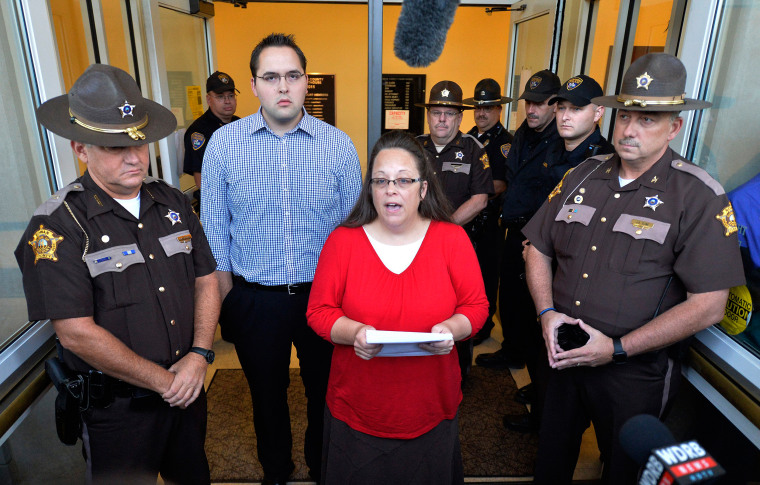
Surrounded by sheriff’s deputies, Rowan County Clerk Kim Davis, with her son Nathan Davis standing by her side, speaks to the media at the Rowan County Judicial Center in Morehead, Ky., on Sept. 14, 2015.Timothy D. Easley / AP file
Davis claimed that Obergefell v Hodges, the 2015 U.S. Supreme Court decision recognizing a constitutional right to same-sex marriage, did not apply to her because she stopped issuing licenses to everyone regardless of sexual orientation, and the plaintiffs could have obtained licenses elsewhere.
But the appeals court called the Supreme Court decision “as sweeping as it was unequivocal,” and said the respective couples – David Ermold and David Moore, and Will Smith and James Yates – could try to show that Davis acted unreasonably.
“In short, plaintiffs pleaded a violation of their right to marry: a right the Supreme Court clearly established in Obergefell,” Circuit Judge Richard Griffin wrote. “The district court therefore correctly denied qualified immunity to Davis.”
The decision upheld rulings by U.S. District Judge David Bunning in Covington, Kentucky and returned the lawsuits to him. Both couples are now married.
Davis lost her reelection bid as Rowan County clerk last year. She is now retired, according to Mat Staver, the founder of Liberty Counsel, which represented her.
“At the end of the day, she will ultimately prevail. She had no hostility to anyone, given that she stopped issuing all marriage licenses,” Staver said in an interview.
“The broader issue is what accommodation a court should provide someone based on their religious beliefs,” he added. “It’s a matter of time before such a case goes squarely before the Supreme Court.”
Michael Gartland, a lawyer for Ermold and Moore, said his clients may ask the full 6th Circuit to review the sovereign immunity issue. “No matter what happens, we’re going to trial against Ms. Davis in her individual capacity,” he said.
Kash Stilz, a lawyer for Smith and Yates, said his clients were pleased their lawsuit can continue.
The appeals court also upheld a separate attorney fee award to other couples who were denied marriage licenses by Davis.
Carnegie Hall announced on Saturday that Gazeta Polska Community of America, a U.S.-based group connected to the far-right Gazeta Polska newspaper in Poland, canceled its scheduled Oct. 24 concert.
“Carnegie Hall has been speaking with this rental group this week since we learned of the sticker campaign,” said Synneve Carlino, a Carnegie Hall spokesperson. “While they have told us that they don’t support the campaign, they informed us today that they will not present the performance.”
Gazeta Polska, a weekly Polish newsmagazine, has been criticized for its virulently anti-LGBTQ and anti-migrant content. Earlier this summer, it sparked global condemnation and an advertiser boycott in Europe after distributing “LGBT-Free Zone” stickers.
In addition, a summer 2019 issue featured an image of rainbow paint-stained hands desecrating a statue of the Virgin Mary and baby Jesus under the headlines “They want to destroy civilization” and “They want to stamp on everything that we have been.”
While Gazeta Polska Community of America claimed it is “independent and separate from the Gazeta Polska print media and it’s editorial board,” Rafal Pankowski, a sociology professor in Warsaw and member of the Polish anti-racism watchdog group Never Again, said the U.S.-based foundation “shares the political perspectives of the newspaper,” he added, Gazeta Polska’s controversial editor, Tomasz Sakiewicz, ” is very active in organizing it and leading it.”
The now-canceled Carnegie Hall concert had faced pushback from multiple performers, including pianists Jack Gibbons and Paul Bisaccia, both of whom turned down the event after learning more about the event host’s ties to the infamous Polish publication.
An African American transgender woman in the Chicago area is suing national convenience store chain Circle K, alleging she was fired from one of its stores and retaliated against after reporting co-workers’ use of racial and transphobic slurs against her.
Judi Brown claims in the lawsuit filed Wednesday in the U.S. District Court for the Northern District of Illinois that a manager and other Circle K employees at the store in Bolingbrook, Illinois, harassed her based on her race and being transgender.
Brown, 26, said she was fired after she complained about the alleged discrimination.
“The discrimination and harassment were traumatizing and needed to be called out,” Brown said in a press release by the American Civil Liberties Union, which is representing her. “It was not fair.”
The lawsuit comes a week after the Trump administration filed a brief with the Supreme Court arguing that transgender workers are not protected by civil rights laws.
In Illinois, the state’s Human Rights Act includes specific protections for employees on the basis of gender identity and sexual orientation, the ACLU said in its release.
When Brown worked as a Circle K cashier from May 2016 to June 2017, a store manager asked her “offensive and sexually explicit questions” about her romantic partners, sexual and reproductive anatomy and her plans for sexual reassignment surgery, the lawsuit claims.
She also alleges that a manager refused to refer to her by her chosen name in company documents and that another co-worker sometimes used male pronouns to refer to her and called her a “man in a dress.”
Brown also claims she “was forced to endure a racially hostile work environment” and that a manager used the N-word to refer to African American customers. The lawsuit says that a manager requested that employees closely watch African American customers and that another employee called Brown a n—–.
She says in addition that a manager made an “offensive comment” about the way “you people do your hair.”
Circle K said Wednesday in a statement that it “is an equal-opportunity employer with a diverse workforce, including transgender employees and fully cooperated with agency authorities during the previous investigation into this claim.”
When Brown reported the alleged harassment and discrimination, she said Circle K failed to act and instead retaliated against her by denying her a promised promotion, overscrutinizing her work and ultimately firing her, the lawsuit says.
Brown was scheduled to work on a Sunday during Chicago’s Pride celebration, even though she typically worked a Monday-to-Friday schedule, according to the lawsuit. She said her bosses knew that she intended to perform at the parade, and when she learned she was scheduled to work, she informed a manager that she could not. She said she was never notified that she was fired and found out when she couldn’t clock in for work during her next shift.
“I was in absolute shock after being fired,” Brown said. “I followed all the rules for taking off on that day so I could celebrate with my community — and they picked that day to terminate me. I felt so humiliated.”
Carolyn Wald, an attorney with the ACLU in Illinois, said Circle K’s actions were unacceptable and illegal.
“Employers should never advance the bigotry of some employees over the safety, well-being and success of others,” Wald said.
Brown is seeking unspecified compensatory and punitive damages, including for lost wages and benefits, attorneys’ fees and damages for emotional distress.
More than a year after boys were removed from a nonprofit in Burnet County, the couple who ran it are facing trafficking charges. A grand jury indicted Gary Wiggins, 49, and his wife Meghann Wiggins, 34, on Trafficking of Persons charges.
They are both accused of “knowingly” trafficking four underage boys and “through force, fraud or coercion” making them “engage in forced labor or services.” The two ran Joshua Home, which officials described as a place that “purports to be a residential home for troubled boys.”
According to the indictment, the trafficking allegedly occurred between May 17, 2018 and July 25, 2018. Eight boys between the ages of 10 and 17 were removed after a multi-agency investigation into allegations of abuse, neglect, labor violations, fraud, licensing violations and human trafficking.
Abderrahim El Habachi fled Morocco two years ago out of fear he could be imprisoned for his sexuality.
He said that he is now part of a “huge community” who have come to the UK “to live their lives in an authentic way”, but have faced poor treatment under the British asylum system.
“The Home Office is putting people through hell,” he told ITV News.
“They don’t believe our sexual orientations or the struggles we are facing in our countries.”
El Habachi said that in Morocco, LGBT+ people are considered criminals and live under the constant threat of violence.
The Home Office is putting people through hell.
“If people sense that you are gay, they can beat you and you have no right to complain.”
“You are the victim at that moment but in the eyes of the law, you are the criminal because you are gay.”
He said that he and many like him arrived in the UK with dreams of “following that rainbow, but somehow the rainbow is stripped from us”.
“We need allies to help us accomplish that dream,” he added.
Successful LGBT+ asylum seeker claims fall.
The Home Office has long been accused of undermining LBGT+ asylum seekers’ sexualities.
In July, the now-Liberal Democrat MP Chuka Umunna said that LGBT+ asylum seekers in his constituency had been “treated in the most grossly humiliating, disrespectful manner by the Home Office and our Border Force authorities”.
A 2018 report by the UK Gay and Lesbian Immigration Group (UKLGIG) showed that between 2015 and 2017, the rate of LGBT-related asylum claims being accepted fell from 39 per cent to 22 percent.
Leila Zadeh, executive director of UKLGIG, called the decline “extremely worrying”.
“Our research has shown that the Home Office routinely disbelieves LGBTQI+ asylum claimants and disregard statements from friends, partners and LGBTQI+ organisations testifying to a claimant’s sexual orientation or gender identity,” Zadeh said.
“The Home Office is setting the bar too high for LGBTQI+ people. They are not applying the correct legal standard of proof that it is ‘reasonably likely’ that someone will be persecuted.”
In a statement to ITV, the Home Office said “the UK has a proud record of providing protection for asylum seekers fleeing persecution because of their sexual orientation or gender identity”.
It added: “Each case is considered on its individual merits and all decisions on claims based on sexual orientation are reviewed by experienced caseworkers.”
This was commissioned “in order to alleviate any concerns about the way in which vulnerable claims are dealt with,” the then-immigration minister Caroline Nokes said.
“The aim will be to ensure that empathy is considered by decision makers when assessing these highly complex claims.”
PinkNews has contacted the Home Office for comment.
Limiting marriage to a relationship between a man and a woman will remain China’s legal position, a parliament spokesman said on Wednesday, ruling out following neighboring Taiwan in allowing same-sex marriage, despite pressure from activists.
Taiwan’s parliament passed a bill in May that endorsed same-sex marriage, after years of heated debate over marriage equality that has divided the self-ruled and democratic island.
China, which claims Taiwan as its territory, has a thriving gay scene in major cities, but there has been little sign the ruling Communist Party will legalize same-sex marriage.
Asked at a news briefing whether China would legalize same-sex marriage, Zang Tiewei, spokesman for parliament’s legal affairs commission, said Chinese law only allowed for marriage between one man and one woman.
“This rule suits our country’s national condition and historical and cultural traditions,” he said. “As far as I know, the vast majority of countries in the world do not recognize the legalization of same-sex marriage.”
Individual Chinese legislators have occasionally in the past few years proposed measures during the annual meeting of the largely rubber-stamp parliament every March to legalize same-sex marriage, without success.
There are no laws against same-sex relations in China and despite growing awareness of LGBTQ issues, the community has been the target of censors in recent months, fueling fears of a growing intolerance.
Activists have asked people in China to propose amendments to a draft civil code en masse, though they have admitted they see little chance of success. The parts of the code relating to marriage are expected to pass into law next year.
The code makes changes on issues such as sexual harassment, divorce and family planning, but does not further the rights of the LGBTQ community, drafts published by parliament show.
Zang said the marriage section of the draft civil code maintains the bond as being between a man and a woman.
Prominent gay rights activist Sun Wenlin told Reuters he was disappointed in the comments, but not surprised.
“I feel that my partner and I are sacrificing our happiness for the country’s legal system,” said Sun, who three years ago had his application to legally marry his partner rejected by a Chinese court.
“They are undermining our life plan of choosing to marry the person we love.”
He added, “I feel I am being excluded, and am absolutely not a consideration for policymakers.”
Another activist, who asked not to be named, told Reuters there were cases in China of same-sex partners who had lost their homes after one of them died, as they lacked the legal protection of marriage.
“We hope these tragedies don’t keen happening,” the activist said.
There is something reminiscent of black gay author James Baldwin in Alphonso David’s intense bearing, though the new president of the Human Rights Campaign is considerably more down-to-earth and welcoming than the defiant intellect who scorched racist America in “The Fire Next Time.”
For David, it is the fire this time that is fueling his drive for full equality and his fight against the dark amoral forces demolishing democracy through the rapacious black hole that is President Donald Trump.
David may be uniquely qualified to meet the LGBTQ leadership challenge of this historic moment.
Born in Silver Spring, Md., in 1970, he was one year old when his family moved to Monrovia, the capital of Liberia founded in 1822 by freed Black American slaves. David’s great uncle was the country’s president and his father was elected the city’s mayor in 1977 while his mother worked in the Liberian Department of Finance.
In 1980, David’s world was violently overturned as a military coup assassinated his uncle, imprisoned his father and kept the family under house arrest for 18 months. When his father was released a few years later, he applied for political asylum in the U.S., which was granted because Alphonso had been born in Maryland.
“My interest in the law is fairly self-evident,” David told The New Amsterdam News in 2014, “in part because of the war and understanding democracy and understanding how things work.”
After graduating from Temple University Law School, David clerked for Clifford Scott Green, the African-American District Court judge who found that there was, indeed, racial discrimination in the Philadelphia Police Department. David then joined a Philadelphia law firm before moving to Los Angeles for work as a litigation associate at Blank Rome LLP to help pay off “substantial” student debt. He also got heavily involved in pro bono work, such as helping victims of domestic violence.
David was in LA when the Supreme Court issued its watershed ruling in Lawrence v. Texas, decriminalizing homosexuality. That was an inflection point, motivating him to give up private practice to join Lambda Legal in 2004.
In 2007, David took a job as Special Counselor at the New York State Division of Human Rights, which led to Special Deputy Attorney General for Civil Rights under Attorney General Andrew Cuomo and eventually, in 2015, his historic appointment as the first black man and first openly gay man to serve as Chief Counsel to Gov. Cuomo. He was dubbed the third most powerful person in New York state government.
So why HRC?
“We are living in very complex, perilous times,” David tells the Los Angeles Blade in a brief interview at a Hollywood coffee shop. “I have worked in government for 12 years, but I thought, at this moment in time, it was more important for me to serve in this capacity as the head of the Human Rights Campaign to push for change on the national level, to educate people about the challenges that marginalized communities face, and affect change.”
David started Aug. 9 and is now on a 10-city/state swing to introduce himself to HRC activists and equality allies. But he quickly acts when action is required. Moments after the interview concluded, David was on Twitter producing a thread that excoriated Trump for his inane statement that he has the support of the LGBTQ community, citing the recent reelection endorsement by Log Cabin Republicans.
“Every credible LGBTQ organization is mobilizing to defeat Trump, Pence & their anti-LGBTQ extremist allies in 2020,” David tweeted. “Those who claim this administration is pro-LGBTQ are out of touch with facts and reality.”
David promises new plan rollouts soon but spoke to a few top priorities.
“First, we have to elect pro-equality candidates on every single level. We’re not only focused on the presidency, we’re focused on Congress. We’re focused on state elections, both Senate and House,” he says, and local elections if HRC should weigh in.
“We want to make sure that we are creating environments for people to be realized in the way that they should be realized, that their identities are being respected by government and by the law,” David says. “The electoral work is very, very important.”
Second, HRC is focused on making sure that “legislative priorities are being advanced at every single level,” with special attention on the Equality Act “that would protect LGBTQ people from discrimination, ranging from employment to credit.” Third is programmatic work that deserves more awareness and possible expansion such as the All Children, All Families program helping LGBTQ kids in the foster care system.
Another program deserving elevation focuses on historically Black colleges. “When we say ‘LGBTQ,’ I want to make sure that people are not looking at a white male face—that they see the spectrum of our community reflected and they understand that the Human Rights Campaign is representing all interests, not just some,” David says.
David is keenly aware that LA is mindful about intersectionality but understands that there are different LGBTQ communities living in silos. “Gay,” for instance, equates with rich, white, straight men in West Hollywood. A similar impression of HRC has followed suit.
“That’s part of the challenge,” says David, to change the old perception of HRC as catering only to one segment of the community. “I think we can make that change. With my appointment as the [first Black] president of Human Rights Campaign, I hope that people will see that the organization is really focused on all members of the community.”
Alphonso David pauses before having a James Baldwin moment. “I’m not going to put my reputation at risk to run an organization that will not put its money where its mouth is,” he says, believably. “So I’m going to make sure that people understand that when we are pushing the electoral work or the legislative work or litigation—you pick the category—we are representing the interests of the community, and our interests are very different, as a matter of fact. The lesbian community may have very different concerns than the transgender community and we need to make sure that all of those concerns are being represented equally.”
David is a data man, very familiar with Brad Sears and the Williams Institute. He intends to use some of their work to inform his own. He is also plugged into the “progressive web of organizations” his predecessor Chad Griffin cultivated, whose leaders he knows well.
“How we talk about issues is so important,” David says. “When we say there’s a problem in our community and we use a statistic to highlight that problem and we fail to identify certain communities or classify our language in a way that elevates that issue for a specific community, we’re not presenting a comprehensive picture.”
He wants to make sure that “we’re able to elevate the plight of the LGBTQ community in the various sectors, utilizing our various relationships, making sure that we are communicating in a very smart, strategic way because it’s not enough to say LGBT kids are homeless. We need to really talk about what actually is informing the homelessness. Why are they homeless? What are the resources that are being provided?”
Trump talking about ending AIDS is only a talking point, he notes as an example. The money he’s identified is insufficient and hasn’t been secured. Meanwhile, Trump wants to end the Affordable Care Act that protects pre-existing conditions like HIV/AIDS, among other disastrous rollbacks. “To now suggest that he’s interested in ending AIDS is laughable, and the Log Cabin Republicans are really divorced from reality, so I don’t want to even give them any additional time or attention.”
David intends to navigate the waters of political purity “with due diligence,” he says. “We should be focused on winning in 2020, making sure we have a sound, viable candidate who can beat Donald Trump,” as well as winning candidates down ballot. HRC will not automatically endorse an incumbent.
David also intends on strategizing HRC’s relationship with big corporations. Griffin effectively marshaled Hollywood corporations to threaten boycotts in Georgia and North Carolina when governors threatened to sign anti-trans bathroom bills. But an anti-big corporation sentiment resulted in a second Stonewall 50th anniversary march and presidential candidates Sens. Elizabeth Warren and Bernie Sanders are successfully bashing corporations as corrupt.
David thinks differently. “HRC’s Corporate Equality Index is a really important tool to change work environments,” policies and practices, he says. “They’re a lot more inclusive than they were before. So we’re going to be trying to get more corporations, more companies enlisted in the CEI because that benefits the bottom line for people that are working in companies across this country. I want to use it as a tool to make sure we improve workspaces.”
Additionally, “I want to enlist corporations directly in our fight for equality. I was privileged enough to write the marriage equality law in New York and I can tell you that we were able to successfully enlist corporate leaders [in their coalition] to change the perspectives of Republican senators in New York,” David says. “We need to do the same thing here. Private companies actually could have a very meaningful and positive role in helping us advance equality.”
But the new HRC leader needs a larger army to demonstrate LGBTQ power. “The Human Rights Campaign exists as an infrastructure to actually affect change and I want people to join us because we need every single person,” David says. “We need boots on the ground to make sure that we can affect change on the local level, at the state level and at the federal level. I need everyone to get involved.”
Perhaps Alphonso David might cite James Baldwin as he recruits new volunteers to the LGBTQ cause. “The point,” Baldwin once said, “is to get your work done, and your work is to change the world.”