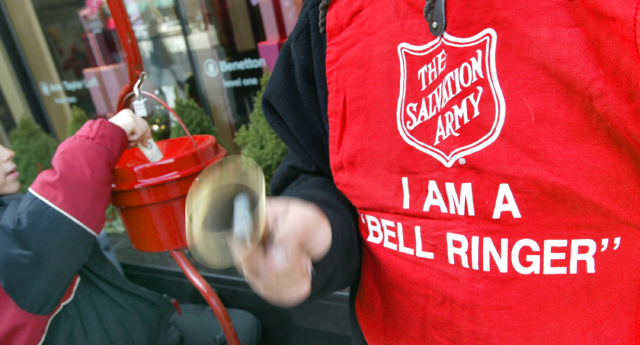
A donation is made as a Salvation Army bell ringer works outside a store (Tim Boyle/Getty)
The Salvation Army has warned members not to discuss their opposition to LGBT rights in public.
The religious charity, which has been dogged for years about its discriminatory approach to LGBT+ people, put out a warning to members in the US ahead of the Christmas season.
The guidelines, published by Fox News pundit Todd Starnes, warn Salvation Army volunteers to stay away from discussing “hot topic issues like LGBTQ Marriage” after an “increased number of complaints regarding comments made on social media by Salvation Army officers and staff.”
The group warned that officers and staff “must not take part in organised action in support of causes or movements,” describing controversy as a “threat to our reputation, our fundraising efforts, and ultimately our ability to serve people in need.”
The Salvation Army has a history of LGBT DISCRIMINATION
The evangelical-dominated organisation, which pulls in most of its funding across the Christmas season, has a record of LGBT discrimination that has previously led to calls for shoppers to boycott it.
In February 2018, the Salvation Army in Australia called for a broad ‘freedom to discriminate’ law.
In a submission to an Australia government inquiry, the Salvation Army advocated for legal exemptions from anti-discrimination laws for people and businesses who “hold, express or act on [beliefs about]… marriage, sexuality, gender and family.”
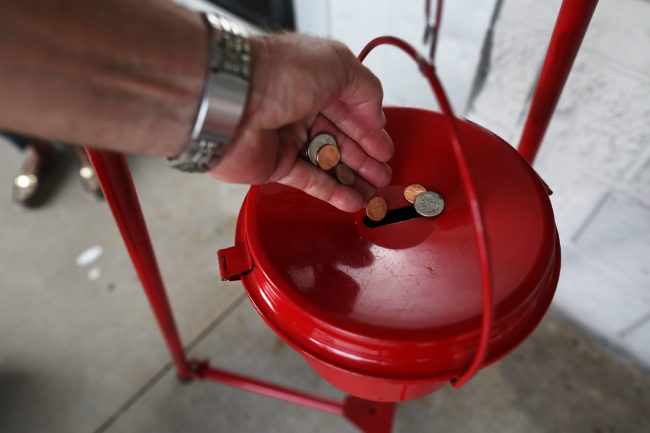
A donation is made into a Salvation Army red kettle (Joe Raedle/Getty)
The New York City Commission on Human Rights launched action against the Salvation Army in 2017, due to alleged discriminatory policies at four substance abuse centres in the city.
The commission found that one of the centres completely refused to accept transgender patients, with other centres insisting that transgender people would be housed according to their gender assigned at birth, rather than their actual gender identity.
The charity confirmed the guidelines are genuine.
In a statement, a spokesperson for the Salvation Army said: “The Salvation Army is highly visible during the Christmas season – a blessing that allows us to spread the gospel and support those in need.
“The heightened prominence also means that any, and all, Army representatives could be subject to controversies which might distract from our purpose: to serve in His name, without discrimination.
“The guidelines are a reminder to personnel that we must stay focused on our mission during this politically-charged time. As stewards of donors’ dollars, and soldiers of service, we must use every opportunity possible, including social media, to share the love of Christ.”
A Chinese erotic writer has reportedly been jailed for more than 10 years after including gay sex scenes in one of her novels.
State media reported that the writer, who uses the internet alias Tianyi, was sentenced to 10-and-a-half years in prison by a court in Anhui province for “producing and selling pornographic materials” in her 2017 novel Occupation, which features gay sex scenes.
The author was identified with the surname Liu by state media.Tianyi’s book details an illicit affair between a teacher and a student.
According to a television station in Anhui, it allegedly included “graphic depictions of male homosexual sex scenes,” reports South China Morning Post.
Internet pornography in China has been illegal since 2002.
novelist’s jail sentence over gay sex scenes sparks outcry
Occupation is believed to have sold around 7,000 copies online.
“Those found guilty of rape get less than 10 years in jail. This writer gets 10 years.”
— Weibo user
Tianyi’s prison sentence has sparked protests on Chinese social media.
“10 years for a novel? That’s too much,” one user wrote on Weibo, reports BBC.
Another social media user noted how rapists are frequently jailed for less than 10 years in China.
“Those found guilty of rape get less than 10 years in jail. This writer gets 10 years,” the Weibo user said.
LGBT+ people have no discrimination protections in China. (STR/AFP/Getty Images)
Gay sex was legalised in China in 1997.
However, LGBT+ people in the country have no discrimination protections and same-sex couples cannot adopt or marry.
China’s crackdown on LGBT+ content
The jailing of Tianyi comes amid reports of an increased crackdown on LGBT+ content by Chinese authorities over the past year.
In September, pop star Dua Lipa thanked fans for feeling “safe enough to show your pride” at her concert in Shanghai, China, after some gig-goers were reportedly removed by staff for waving rainbow flags.
Following her performance on September 12, attendees posted videos on social media, which appeared to show security guards forcibly booting out a number of fans.
In August, it was announced that Mr Gay World 2019 would no longer take place in China’s special administrative region Hong Kong.
This was reportedly because the events company was based in the People’s Republic of China and had been put under pressure by Chinese authorities.
And, in May, two LGBT activists were reportedly attacked by security guards in Beijing, China, for wearing Pride badges as part of a pro-LGBT gathering in the city.
A transgender woman who died in Immigration and Customs Enforcement custody at a privately operated detention center was likely physically abused there, according an autopsy report released Monday, and died after several days of severe, untreated dehydration.
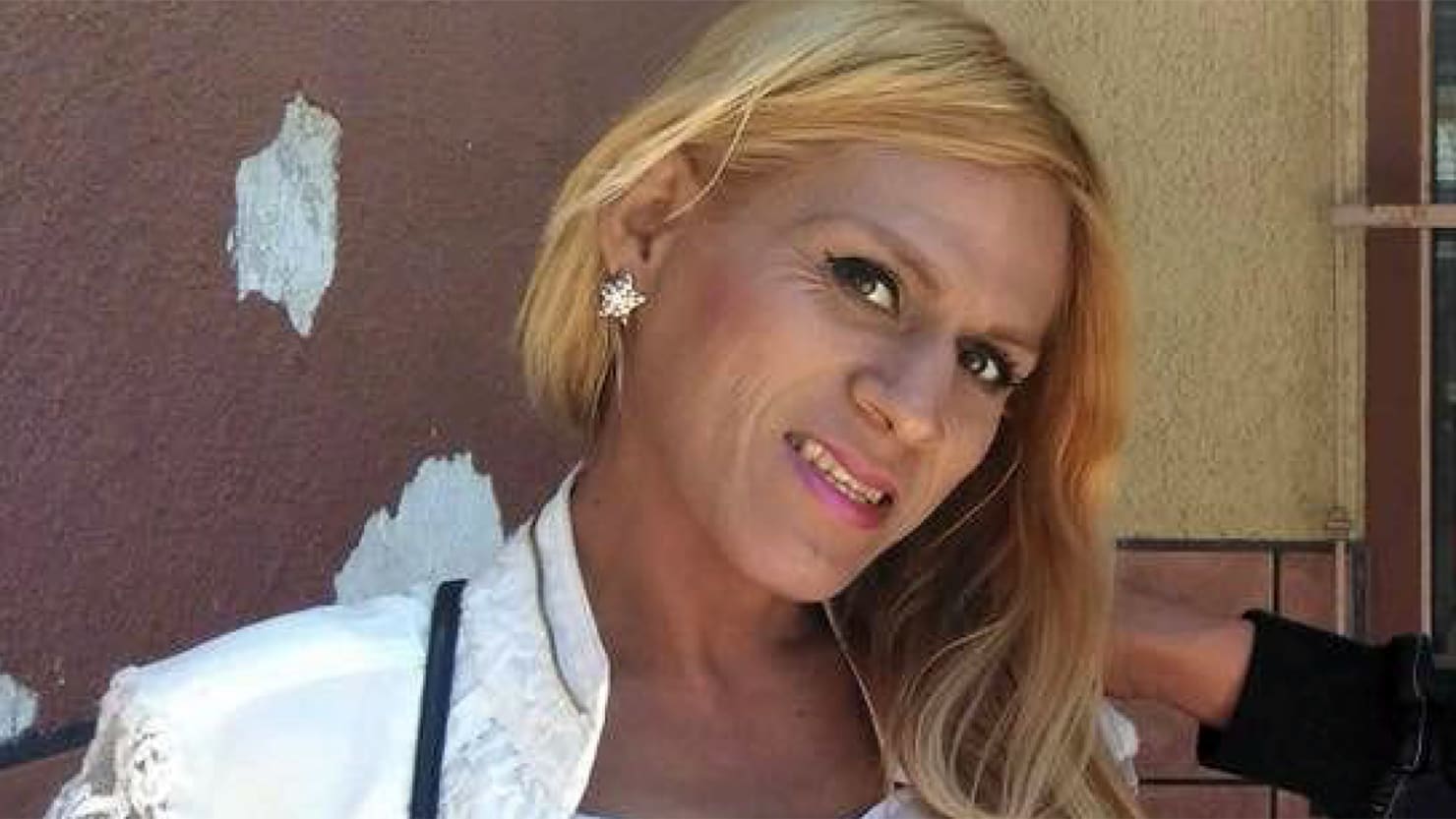
Roxsana Hernández Rodriguez, a 33-year-old transgender woman from Honduras, died on May 25, nine days after being transferred to a dedicated unit for transgender women at the Cibola County Correctional Center in New Mexico, which is operated under contract by CoreCivic, the second-largest private prison company in the United States.
“There she developed severe diarrhea and vomiting over the course of several days,” wrote forensic pathologist Kris Sperry, “and finally was emergently hospitalized, then transported to Lovelace Medical Center in Albuquerque, New Mexico, where she remained critically ill until her death.”
The autopsy concluded that Hernández Rodriguez’s cause of death was most likely “severe complications of dehydration superimposed upon HIV infection,” which made her susceptible to the physiologic effects of untreated dehydration.
“According to observations of other detainees who were with Ms. Hernández Rodriguez, the diarrhea and vomiting episodes persisted over multiple days with no medical evaluation or treatment, until she was gravely ill,” Sperry wrote.
Sperry’s autopsy, the second conducted on Hernández Rodriguez’s body following her death, also found evidence of physical abuse, with “deep bruising” on her hands and abdomen, evidence of blunt-force trauma “indicative of blows, and/or kicks, and possible strikes with blunt object.” An accompanying diagram illustrated long, thin bruises along Hernández Rodriguez’s back and sides, as well as extensive hemorrhaging on Hernández Rodriguez’s right and left wrists, which Dr. Sperry found were “typical of handcuff injuries.”
Andrew Free, an attorney representing her family, told The Daily Beast that her treatment in ICE custody went far beyond neglectful.
“She journeyed thousands of miles fleeing persecution and torture at home only to be met with neglect and torture in this country’s for-profit human cages,” Free said.
A spokesperson for ICE did not respond to a list of questions regarding whether requests for medical care were denied at any point during Hernández Rodriguez’s detention, under whose authority that decision would have been made, or who at the Cibola facility had access to batons and handcuffs as well as access to Hernández Rodriguez.
At the time of her death, ICE stated that she was admitted to the hospital with “symptoms of pneumonia, dehydration and complications associated with HIV,” and that “comprehensive medical care is provided from the moment detainees arrive and throughout the entirety of their stay.”
In response to similar questions, CoreCivic director of public affair Amanda Gilchrist told The Daily Beast that “we take the health and well-being of those entrusted to our care very seriously,” and are “committed to providing a safe environment for transgender detainees.”
CoreCivic, a publicly traded company whose motto is “Better the Public Good,” operates more than 65 prisons and detention facilities in the United States.
Even before her detention in New Mexico, Hernández Rodriguez had walked an extremely difficult path on her way to the United States. In an interview with Buzzfeed News a month before her death, Hernández Rodriguez said she decided to flee Honduras after she was gang-raped by four members of the MS-13 gang, resulting in her being infected with HIV.
“Trans people in my neighborhood are killed and chopped into pieces, then dumped inside potato bags,” Hernández Rodriguez said at the time. “I didn’t want to come to Mexico—I wanted to stay in Honduras but I couldn’t… They kill trans people in Honduras. I’m scared of that.”
LGBT people in El Salvador, Guatemala and Honduras are uniquely susceptible to violence and persecution, as well as during their travels in pursuit of asylum. The U.S. government has expressed skepticism about the veracity of these claims, as well as the number of LGBT people traveling in caravans headed for the border. In a telephone briefing with reporters last week, one senior DHS official told journalists that caravans pushed LGBT migrants “to the front of the caravan in an effort to gain sympathetic PR coverage.”
Hernández Rodriguez, known as “Roxy” to her friends, decided to travel more than 2,000 miles with 1,300 other migrants hoping to claim asylum in the United States, making a six-week journey across Mexico organized by Pueblo Sin Fronteras.
After arriving at the U.S. border and asking for asylum at the San Ysidro Port of Entry on the U.S.-Mexico border near San Diego, she was taken into custody on May 9.
After being held for five days, she was transferred to the Cibola facility that houses a dedicated “pod” for transgender women, which ICE says is run by medical and detention staff trained in “best practices for the care of transgender individuals.” Less than three weeks after arriving in the U.S., she was
An investigation by the Des Moines Register has revealed that pressure from the Trump Administration forced 4-H groups to drop guidance welcoming LGBTI youth.
4-H are a global network of agricultural youth organizations with over 6million members. The 4-H names derives from the group’s original motto: ‘head, heart, hands, and health.’
In the US, the organization’s administered by the National Institute of Food and Agriculture of the US Department of Agriculture (USDA). As such, the government has power over how it is run.
In March, 4-H introduced new guidance to ensure LGBTI members felt welcomed and supported. This included recognizing gender identity and allowing trans kids to use their preferred bathrooms.
Committed to not singling out LGBTI youth
The new guidance stated: ‘4-H shall not segregate or otherwise distinguish individuals on the basis of their sex, gender identity, gender expression, or sexual orientation, in any 4-H activities or the application of any 4-H rule.’
It also said, ‘If 4-H provides sex-segregated activities and facilities, transgender and intersex individuals shall be allowed to participate in such activities and access such facilities consistent with their gender identity.’
The guidance goes on to note that some people might object to these provisions. However, ‘As is consistently recognized in civil rights cases, the desire to accommodate others’ discomfort cannot justify a practice that singles out and disadvantages a particular class of individuals.’
Conservative and evangelical backlash
In March, several US states posted about the guidance.
However, local religious groups and conservatives criticized the new guidelines.
Shortly afterwards, in April, a National Institute of Food and Agriculture (NIFA) communications manager sent emails to at least two states — Iowa and New York — urging the 4-H organizations there to remove the LGBT guidance from their websites, reports the Register. The brief email did not offer explanation as to why it wanted the guidance removed.
Some states went along with the request. However, in Iowa, John-Paul Chaisson-Cardenas, a 4-H Youth Development Program leader, resisted.
He says he was to receive death threats for his support of the guidance. Right-wing websites such as WorldNetDaily extensively covered criticism of the new guidance and Chaisson-Cardenas’s defence of it.
Iowa State University Extension, which oversees the local 4-H group, later ousted Chaisson-Cardenas. Its Vice President says Chaisson-Cardenas issued the document as ‘policy’ and not as ‘draft guidance.’
Chaisson-Cardenas received particular criticism for his defence of the guidance, and several conservative 4-H donators threatened to discontinue their funding of the Iowa group.
Although offered the opportunity to resign at a disciplinary hearing in May, he refused to do so. His employment was terminated in August.
4-H instructed to remove guidance and amend it
In respect to 4-H removing the pro-LGBTI guidance, the Des Moines Registers quotes Sonny Ramaswamy, NIFA’s former director. He says he was asked to a meeting with Heidi Green, former chief-of-staff to USDA Secretary Sonny Perdue. Green asked him to remove the document.
He says he found the request ‘odd’, but compiled as the document went out without first crossing his desk – in accordance with standard NIFA procedure. It was later replaced with new guidance which removed the references to trans kids using sex-segregated facilities.
After Ramaswamy’s meeting with Green, NIFA’s web communications manager, Dianne Bell, sent the email to 4-H in Iowa and New York. She requested the removal of the guidance from their respective websites.
NIFA and officials at the US Department of Agriculture declined to answer questions fr0m the Des Moines Register.
Ramaswamy now says he regrets not taking more of a stand when asked to remove the 4-H guidance by Green.
‘I wish I had stood up and said, “Take a hike. We will not take it down”,’ he told the Register. ‘”So sue me; so fire me” — I should’ve stood up.’
‘Unconscionable’
News of the Trump administration’s role in the removal of the new guidance has prompted uproar from LGBTI advocates.
‘For over a century, the national 4-H youth program has taught tens of millions of children the importance of character and community,’ said JoDee Winterhof, HRC Senior Vice President for Policy and Political Affairs.
‘This latest action by the Trump-Pence Administration is an unnecessary and cruel attack on LGBTQ youth that seeks to destroy community rather than create it.
‘It is unconscionable that the anti-LGBTQ discrimination under this president has now inexplicably expanded into the Department of Agriculture. We are determined to get answers on how this came about and demand that Congress protect LGBTQ youth from this callous attack.’
The Trump administration has quietly gutted transgender rights guidance for federal employees, telling agencies to treat people based on “biological sex.”
ThinkProgress reports that revisions were made to public guidance on the website of the government’s Office of Personnel Management (OPM) to remove transgender rights protections.
The previous guidance, drawn up under President Barack Obama, instructed federal agencies to “review their anti-discrimination policies to ensure that they afford a non-discriminatory working environment to employees irrespective of their gender identity or perceived gender non-conformity.”A revision apparently made in the last week removed all mention of the words “transgender” and “gender non-conforming” while inserting language to effectively reverse several of the inclusive policies.
The new guidance states that employees in gender-specific roles should be treated “in accordance with the individual’s biological sex,” where the previous materials said they should be treated as their preferred gender.
Guidance that directed employers to move away from “gender-specific dress and appearance rules” have also been changed to now state that agencies are “encouraged” to enact “policies [that] require employees to follow dress and appearance rules consistent with the professional standards of their occupation.”
The webpage also erases sections on the “core concepts” of gender identity and gender non-conforming identities.
The OPM webpage now states that agencies should update their diversity and inclusion policies “with the plain meaning of Title VII of the Civil Rights Act of 1964.”
The reference to the “plain meaning” of the Civil Rights Act contradicts the widely-held Obama administration stance that civil rights laws banning discrimination based on sex also outlaw discrimination based on sexual orientation and gender identity.
The Trump administration has previously argued in court that the section should only be applied to direct gender discrimination.
The changes appear to substantiate reports of a leaked memo from the Department of Health and Human Services (HHS) setting out a new anti-transgender stance across the administration.
Speaking to reporters at the White House on October 22, he confirmed: “We’re looking at it. We have a lot of different concepts right now.
“They have a lot of different things happening with respect to transgender right now. You know that as well as I do and we’re looking at it very seriously.”
Asked if he would protect the LGBT+ community, he responded: “I’m protecting everybody.”
When a reporter told the leader that “transgender Americans say you’ve given up on them,” Trump replied: “You know what I’m doing? I’m protecting everybody. I want to protect our country.”
You can now report Twitter users for targeted deadnaming and misgendering.
Twitter updated its Terms of Service last night (23 November) to protect trans people from online abuse.
The new protection comes under the heading: ‘Repeated and/or non-consensual slurs, epithets, racist and sexist tropes or other content that degrades someone.’
It continues: ‘We prohibit targeting individuals with repeated slurs, tropes or other content that intends to dehumanize, degrade or reinforce negative or harmful steroetypes about a protected category.
‘This includes targeted misgendering or deadnaming of transgender individuals,’ it said.
Targeted misgendering is the process of deliberately using the wrong pronouns when addressing someone. While targeted deadnaming is deliberately using the birth name of someone who has legally changed their name to affirm their identity.
Twitter users can report these slurs by using the ‘It’s abusive or harmful’ option, then ‘Includes targeted harassment’ or ‘It directs hate against a protected category’.
Transgender advocates took to Twitter to commend Twitter for protecting trans people against online abuse.
One Twitter user wrote: ‘GOOD. It’s about time.’
Another tweeted: ‘A nice thing for Friday.’
Another wrote: ‘If we are going to have rules against harassment, these updated rules makes sense.’
LGBT Issues are emerging as a key issue in the speaker’s race between House Minority Leader Rep. Nancy Pelosi (D-Calif.) and Rep. Marcia Fudge (D-Ohio). (Washington Blade photo of Pelosi by Michael Key; photo of Fudge by Tim Evanson via Wikimedia Commons)
LGBT issues are emerging as a key factor in the challenge to House Minority Leader Nancy Pelosi’s bid for House Speaker, becoming a major source of distinction between the California Democrat and her prime competitor, Rep. Marcia Fudge (D-Ohio).
After having once wielded the gavel under the administrations of George W. Bush and Barack Obama and helping to usher into law the Affordable Care Act, the Matthew Shepard & James Byrd Jr. Hate Crimes Prevention Act and “Don’t Ask, Don’t Tell” repeal, Pelosi’s claim to the gavel in the 116th Congress is in question — and her competition may not be as supportive of LGBT rights.
Fudge — who has yet to declare her candidacy for speaker — has a consistent voting record in favor of LGBT rights, but has declined to support the Equality Act, a comprehensive LGBT rights bill that would amend the Civil Rights Act of 1964 to include sexual orientation and gender identity.
A former chair of the Congressional Black Caucus, Fudge has cited concerns about opening up the historic law to amendments on the House floor — a notion civil rights groups articulated when the bill was first introduced out of fear legislative activity would water down the entire statute.
“What I opposed was including the Equality Act in the current Civil Rights Act,” Fudge said last week in a statement. “The Civil Rights Act is over 50 years old and isn’t even adequate to protect the people currently in it. I want us to do a new and modern civil rights bill that protects the LGBTQ community and updates protections for this era. I do not believe it is appropriate to open and relitigate the current Civil Rights Act.”
Along with Rep. Dan Lipinski (D-Ill.), who has a reputation for being an anti-LGBT Democrat, Fudge in the last Congress was one of two Democrats who wouldn’t co-sponsor the Equality Act.
Fudge’s office didn’t respond to multiple requests from the Washington Blade to comment on whether she as speaker would allow the Equality Act to come up for a vote on the House floor even if she personally doesn’t support the measure.
Meanwhile, Pelosi championed the Equality Act since it was introduced. Prior to Democratic wins on Election Day, Pelosi signaled advancing the Equality Act would be a personal goal and the legislation would be assigned a low bill number in the next Congress signifying its importance.
“It isn’t in our ‘For The People’ agenda because it doesn’t get that specific, but there’s one more because it’s personal for me that I really want to do, and it’s called the Equality Act,” Pelosi said last month. “The Equality Act expands ending discrimination against LGBTQ people and women and adding that to the Civil Rights Act.”
Hilary Rosen, a lesbian D.C.-based Democratic activist, supports Pelosi in her bid to become speaker and drew a distinction between her and Fudge on LGBT issues.
“We don’t have a better champion than Nancy Pelosi,” Rosen said. “Rep. Fudge hasn’t even co-sponsored the bill. Her Democratic colleagues might be surprised to know that and it would concern me about electing her leader.”
Pelosi faces the challenges in her bid to become speaker despite the millions she raised for the Democratic Congressional Campaign Committee and massive wins for House Democrats on Election Day that exceeded expectations for the “blue” wave. (In contrast, Senate Minority Leader Charles Schumer (D-N.Y.), whose caucus lost in the mid-term election, faces no similar challenge.)
On Monday, a group of 16 House Democrats (who, with two exceptions, were men) went public with a letter asserting they’re committed to voting against Pelosi. Other Democrats who won on Election Day, including Rep. Conor Lamb (D-Pa.) have made campaign promises about voting against her, but aren’t signatories to the letter.
To keep that in perspective, Pelosi can only afford to lose 15 within her Democratic majority and still have the 218 votes necessary for her to become speaker. Keep in mind House Democrats can’t replace Pelosi with nothing and it is far from certain Fudge would be able to obtain the 218 votes to win election.
Despite the challenges she faces, Pelosi has repeatedly expressed confidence she’ll have the votes to become speaker in the 116th Congress.
“I intend to win the speakership with Democratic votes, if that was your question,” Pelosi said. “I have overwhelming support in my caucus to be speaker of the House, and certainly we have many, many people in our caucus who could serve in this capacity. I happen to think that, at this point, I’m the best person for that.”
The moment of truth will come soon. The party nominating vote within the Democratic caucus will take place on Nov. 28 and the floor vote within the entire House will take place Jan. 3.
Faced with prospects of investigations under the new House Democratic majority, President Trump has offered to help on Twitter and said he “can get Nancy Pelosi as many votes as she wants in order for her to be speaker of the House.” If Republicans during the vote for speaker on Jan. 3 vote “present,” that would lower the threshold needed for her to win election.
But asked if she’d accept Republican support to win the gavel, Pelosi replied, “Oh, please, no, never, never, never.”
Drawing on her major achievements for the LGBT community in her role as Speaker of the House during part of the Bush and Obama administrations, a group of 102 LGBT leaders have signed a statement “enthusiastically endorsing” Pelosi as speaker.
Cited in the statement are the landmark laws in favor of LGBT rights Pelosi ushered through Congress as speaker, such as the Matthew Shepard & James Byrd Jr. Hate Crimes Prevention Act and “Don’t Ask, Don’t Tell” repeal. For the time when Democrats were in the minority, the statement enumerates Pelosi’s call for support for marriage equality in the 2016 Democratic Party platform and support for Rep. Ted Lieu’s (D-Calif.) proposal to ban widely discredited conversion therapy.
Lane Hudson, a gay D.C.-based Democratic activist, signed the statement and said Pelosi has “been our most vocal and reliable ally from her first days in Congress to now.”
“That’s why so many LGBT folks are fighting very hard to ensure she wins election as speaker,” Pelosi said. “So far, potential contenders are more conservative than she is and far less reliable on our issues. Only Pelosi has signaled that the Equality Act will be introduced very early and voted on, which will be historic.”
What are LGBT groups doing to help Pelosi? Human Rights President Chad Griffin has publicly declared his support for Pelosi as speaker and staffers for the nation’s largest LGBT group — Sarah McBride, David Stacy and JoDee Winterhof — have along with him signed the LGBT letter in support of her becoming speaker, but the organization didn’t respond to multiple requests from the Blade to comment on whether it’s lobbying the Democratic caucus on Pelosi’s behalf.
Drew Hammill, a Pelosi spokesperson, said he doesn’t having anything to say in response to a Blade inquiry on whether HRC or any other LGBT groups are lobbying members in the speaker’s race for Pelosi or anyone else.
For her part, Pelosi is making efforts to renew her connections with the LGBT community. On Friday during the annual dinner in D.C. for the National LGBT Chamber of Commerce, Pelosi made a surprise appearance and celebrated the election of LGBT candidates to the U.S. House.
“We are proud that so many new LGBTQ members…represent every corner of our country,” Pelosi said. “LGBTQ members look like America: They’re mothers, business owners, people of color and members of the native nations.”
Jonathan Lovitz, senior vice president of the National LGBT Chamber of Commerce, also signed the statement and said Pelosi “absolutely deserves” to become the next speaker to continue advancing LGBT rights.
“A Democratic majority can resist the ongoing attempts to harm the LGBT community by passing the Equality Act, promoting LGBT-inclusive economic opportunities, and ensuring we are never erased,” Lovitz said. “Now is not the time for an untested Speaker. We need someone like Pelosi who affirms that protecting the livelihood of LGBT Americans is not some bargaining chip to pass legislation, but a nonnegotiable mandate that affirms who we are as an inclusive nation.”
The Blade is unaware of any prominent members of the LGBT community who are calling for new leadership in the Democratic caucus or who would back Fudge in a challenge to Pelosi.
El Salvador’s Ministry of Justice and Public Security on Nov. 12 launched a campaign that will implement an internal communications protocol on how to improve the way it responds to the LGBTI community’s needs. This effort — #HagoLoJusto or “I’m Doing What’s Right” — is part of the implementation of the policy and seeks to raise awareness of discrimination against people based on sexual orientation and gender identity and to make the aforementioned LGBTI policy known to ministry personnel and their subordinates.“I’m Doing What’s Right” is an effort the ministry is undertaking with the support of the Salvadoran LGBT Federation and its Rights and Dignity Project, a campaign that hopes to eliminate anti-LGBTI stereotypes. Most of the campaign’s activities prioritize the creation of spaces to exchange ideas and to learn with different people, emphasizing LGBTI rights are an issue of access to human rights that should be guaranteed by the ministry and their personnel.
“The launch of the LGBTI Community Care Policy reaffirms the ministry’s commitment to ensure comprehensive care for this important sector of society,” said Eva Rodríguez, subdirector of the Rights and Dignity Project.
“This campaign demonstrates this policy is moving forward and represents a great opportunity for ministry personnel to be able to serve the LGBTI community without discrimination,” she added during a conference.
“Over the last three months we have trained more than 1,000 ministry employees,” said Tatiana Herrera of the Salvadoran LGBTI Federation. “We will continue fighting for love, peace and justice.”
The campaign plans to organize protests, breakfast meetings, film screenings, training workshops, theatre presentations, a photography contest, use social media networks and audiovisual pieces, among other things. Four members of the Salvadoran LGBTI Federation will play a key role in some of these activities.
“These policies are important because, for example, I don’t want to go to a place where they are treating me bad, but now there is a policy that backs me up and personnel will be trained,” Aldo Peña, a member of the Salvadoran LGBTI Federation, told the Washington Blade. “From the moment they see me and I present my document and my name does not correspond with my identity, they will say that it is a transgender person if they are trained.”
The “I’m Doing What’s Right” campaign’s goal is to make personnel more sensitive, and ensure employees of the ministry’s different institutions can learn about all of the aspects of the ministry’s LGBTI Community Care Policy.
“With the launch of this campaign that is going to allow us to reach every one of the ministry’s employees, I am ordering the application of all components of the ministry’s LGBTI Community Care Policy,” said Justice and Public Security Minister Mauricio Ramírez Landaverde.
Protections in the new North American trade pact for LGBTQ people are roiling conservative lawmakers in the House, who are urging President Donald Trump to rescind them.
They are displeased that the new U.S.-Mexico-Canada Agreement contains requirements that workers be protected from discrimination on the basis of sex, including sexual orientation and gender identity.
“A trade agreement is no place for the adoption of social policy,” reads the letter, which carries the names of 40 lawmakers and was sent Friday.“It is especially inappropriate and insulting to our sovereignty to needlessly submit to social policies which the United States Congress has so far explicitly refused to accept.”
It’s one more landmine in the path of Trump’s biggest trade achievement. Already, labor groups have expressed some concern that mechanisms to enforce new worker protections aren’t sufficiently strong and hinted that the incoming Democratic House might seek changes.
Now the conservatives, including House Freedom Caucus chairman Mark Meadows and Rep. Steve King (R-Iowa), are hoping to revise the deal before it gets signed. Another signatory is Rep. Diane Black (R-Tenn.), a Ways and Means Committee member who is leaving Congress at the end of the year.
One congressman who led the effort on the letter said the issue could be a “deal-killer” for him supporting the pact.
“This is language that is going to cause a lot of people to reconsider their support of the trade agreement, and to the point that it may endanger the passage of the trade agreement unless something is done,” Rep. Doug Lamborn (R-Colo.) told POLITICO in an interview.
Adjusting the deal is a tall order.
The countries are expected to sign the agreement on Nov. 30 at a G20 summit in Argentina, the day before the current Mexican administration leaves office. The easiest way for the administration to address the conservatives’ concerns is to persuade Canada and Mexico to change the language before the agreement is signed. If those countries balk and the administration is concerned about having enough Republican votes to win approval, it could attempt to negate the language through the implementing bill. But that would be highly unusual and give many Democrats another reason to vote against the legislation.
Tweaks can be made through so-called side letters. But this particular demand is certain to leave Canada especially cold.
Lamborn said his understanding is that the administration could seek to alter the language without opening the deal back up. But “if it’s bad enough — and in my opinion it’s bad enough — they should consider taking it out,” he said. “At this point I’m a ‘no’ vote and I would encourage others to be a no vote unless something is done. And things could be done within the agreement.”
The LGBT provisions were a Canadian priority — part of the so-called progressive trade agenda championed by Prime Minister Justin Trudeau and described as a “big win” by his government. And the Trudeau government already is less than enthusiastic about entering the agreement while steel tariffs remain in place. Canada’s ambassador to Washington joked in a recent interview with POLITICO that the country might sign the pact with a “bag over its head.”
It’s unclear whether the LGBT clauses even have real teeth. Both Canada and the U.S. agree it wouldn’t require a new law.
But it’s unprecedented language in a U.S. trade agreement.
USMCA’s Chapter 23 on labor requires countries to implement policies that protect workers against employment discrimination on the basis of sex, sexual orientation and gender identity. Another provision in the same chapter requires countries to promote workplace equality with respect to gender identity and sexual orientation.
The conservatives say this would undo other administration policies.
The letter argues that USMCA contradicts other administration work on sexual orientation and gender identity, and would also make it impossible to end a pair of executive actions from the Obama administration forbidding workplace discrimination.
It accuses the Office of the U.S. Trade Representative of working against administration policies.
In reality, the federal government is somewhat divided about whether employment discrimination based on sexual orientation or gender identity is illegal under the 1964 Civil Rights Act, a question that turns on how judges interpret the word “sex” (one of the law’s protected classes, along with race, religion, and national origin).
Under the Obama administration, the Justice Department said that “sex” included sexual orientation and gender identity, and that discrimination on those bases was therefore illegal. After President Donald Trump was elected and Jeff Sessions became attorney general, the department reverted to the position that the 1964 law did not bar discrimination against LGBT individuals. In addition, the Justice and Education departments, in a two-page guidance letter to schools, scrapped an Obama directive aimed at protecting the rights of transgender students.
But the Equal Employment Opportunity Commission, which continues to retain a Democratic majority, still adheres to the Obama policy that the Civil Rights Act outlawed discrimination based on sexual orientation and gender identity. Federal appeals courts are split on the question, and the Supreme Court has never taken up the matter.
Earlier this year Trump issued orders to ban transgender troops who require surgery or significant medical treatment from serving in the military except in select cases — following through on a pledge under review by the Pentagon that is being fought out in the courts.
“It is deeply troubling,” the letter says, that the U.S. Trade Representative has approved language that contradicts LGBT policies in the departments of Justice and Health and Human Services. USTR did not respond to a request for comment.
The letter is otherwise supportive of Trump’s trade efforts. It begins with praise: “We applaud your hard work to negotiate a new trilateral free trade agreement with Mexico and Canada. Balancing the competing interests of three different countries is a monumental challenge.”
Photo: Facebook. Viccky Gutierrez, 33, was stabbed and had her body set ablaze inside her Los Angeles home on January 10.
The transgender community is still one of the most targeted minorities in the United States. Not only are gender-nonconforming individuals being harassed and attacked on the streets, but the government is attempting to erase their entire identity out of existence.
With National Transgender Day of Remembrance coming up on November 20, the City of West Hollywood is planning a ceremony for the trans lives lost this year at Jeremy Hotel from 6 – 9 p.m. In total, there were 29 deaths of transgender people in the U.S. in 2017. So far, there has been a total of 22 deaths due to fatal violence.
LIVES LOST:
• Christa Leigh Steele-Knudslien, 42, was found dead in her home on January 5, in North Adams, Massachusetts. Steele-Knudslien organized and produced the Miss Trans New England and other pageants, and was loved and known by many in both the local and national trans community.
• Viccky Gutierrez, 33, a transgender woman from Honduras was stabbed and had her body set ablaze inside her Los Angeles home on January 10. Friends described her as “a young trans Latina immigrant woman whose warm smile would give anyone comfort.”
• Celine Walker, 36, was fatally shot in a hotel room on on February 4 in Jacksonville, Florida. It was not known for several days that Walker was trans because local police claimed to not refer to victims as transgender. Investigators are still looking for a suspect in her death.
• Tonya Harvey, 35, was fatally shot on February 6 in Buffalo, New York. A friend of Harvey’s expressed her condolences on Facebook, writing: “I knew her since I started transitioning, she was so sweet and loving.” Police have confirmed they are looking into the incident as a possible hate crime.
• Zakaria Fry, 28, went missing in New Mexico in mid-January. Her body was later found 40 miles outside of Albuquerque on February 19. Albuquerque Police arrested and charged Charles Spiess with two open counts of murder. Fry’s loved ones shared comondolences on Facebook with one friend saying: “You were my older sister. You took care of me and loved me like family. I’ll forever love you. I’m sorry.”
• Phylicia Mitchell, 45, was shot and killed outside her home on February 23 in Cleveland, Ohio. On April 10, Cleveland.com reported that a warrant has been issued for the arrest of Gary Sanders. Sanders was charged with aggravated murder in Mitchell’s death. Her longtime partner, Shane Mitchell, described her as “funny and kind” and that “everyone loved her.”
• Amia Tyrae Berryman, 28, was fatally shot at a local motel on March 26 in Baton Rouge, Louisiana. Few details are known about the crime, and police report they have no suspects or persons of interest at this time.
• Sasha Wall, 29, a transgender woman of color, was fatally shot on April 1 in Chesterfield County, South Carolina. The FBI is assisting with local investigators, and are analyzing phone records and collecting DNA evidence. Donovan Dunlap, a friend of Wall’s, expressed condolences on Facebook, writing, “I will miss you my beautiful sister. I cannot sleep, I hope they find who did this.”
• Karla Patricia Flores-Pavón, 26, was found choked to death in her apartment in Dallas, Texas, on May 9. Dallas Police arrested 24-year-old Jimmy Eugene Johnson III on May 17, charging him with Flores-Pavón’s murder. “It hurts a lot, you were a good-hearted person. Sister, fly high. We will remember you with love. Your beautiful smile will stay with us,” a friend posted on her Facebook page.
• Nino Fortson, 36, was fatally shot in Atlanta on May 13. City police were nearby executing a traffic stop and rushed to the scene, but Forston later died at the hospital, said transgender advocate Monica Roberts.
• Gigi Pierce, 28, was fatally shot on May 21 in Portland, Oregon. When officers arrived they tried to administer aid, but Pierce died at the scene. Police investigators say they believe that Pierce was shot during an altercation with Sophia Adler, who has been charged with Pierce’s murder, according to KGW-TV.
• Antash’a English, 38, was fatally injured in drive-by shooting in Jacksonville, Florida on June 1. On her Facebook page, English described herself as an “independent” transgender woman who “thrives on being the best person” she can be. The Jacksonville Sheriff’s Office has declared an active murder investigation and asks anyone with information to contact their office.
• Diamond Stephens, 39, was found shot to death on June 18 in Meridian, Mississippi. In interviews with a local television station, family members said that Stephens had an “incredible personality.” As is too often the case in the reporting of anti-transgender violence, Stephens was originally misgendered in local police statements and media reports, which delayed our awareness of this deadly incident.
• Cathalina Christina James, 24, was fatally shot in Jacksonville, Florida, on June 24. In an interview with First Coast News, James’ mother described her daughter as having a “big and bold” personality, saying she loved to dance and travel. James is the third transgender woman murdered and the fourth shot in the Florida city this year.
• Keisha Wells, 54, was found dead with a gunshot wound to her abdomen in the parking lot of an apartment complex on June 24, according to Cleveland.com. A longtime friend of Wells described her as “the nicest person ever” but also a “tough cookie.”
• Sasha Garden, 27, was found dead with signs of trauma in Orlando, Florida, early July 19. Originally from Wisconsin, Garden is remembered by loved ones as a “firecracker” who “didn’t hold anything back.” Friend and local transgender activist Mulan Montrese Williams recalls that Garden was a talented and aspiring hair stylist and had been saving money to fund her transition.
• Vontashia Bell, 18, was fatally shot on August 30 in a neighborhood of Shreveport, Lousiana. The Louisiana Trans Advocates organization released a statement condemning the shooting and calling on the city’s leaders to help curb the violence against the trans community.
• Dejanay Stanton, 24, was found with a fatal gunshot wound to the head on August 30, according to media reports. After an autopsy, her death was ruled a homicide and the investigation is ongoing. “Every time you saw her she had a smile on her face,” said LaSaia Wade, executive director of Brave Space Alliance. “She was just trying to live her best life as a young girl.”
• Shantee Tucker, 30, was found with a fatal gunshot wound in the back in Philadelphia, Pennsylvania, on Sept. 5. Friends and family honored her life and mourned her death on Facebook, recalling that she was like “another big sister” to them and remembering her “beautiful spirit and fun aura.”
• Londonn Moore, 20, was found dead of multiple gunshot wounds in a remote area of North Port, Florida on Sept. 8. Moore is remembered by her family and other loved ones, who described her as “hilarious” and someone who “made everyone laugh all the time.”
• Nikki Enriquez, 28, was one of four women killed in Sept. in what local officials describe as a “serial killing spree” allegedly carried out by an intel supervisor for the U.S. Border Patrol. Enriquez, who also went by the name Janelle, is survived by numerous loved ones that were “sad and in disbelief” at her death. Cousin Veronica Castillo described her as a “very outgoing” person who loved to party and was beloved by the local LGBTQ community.
• Ciara Minaj Carter Frazier, 31, was fatally stabbed and her body left behind an abandoned building by a man with whom she was arguing on October 3 in Chicago. As reported in the Sun Times, Chicago police declared Frazier’s death a homicide after appearing on the scene. She is remembered by friends and loved ones, who said that she will “always be missed.”