A bipartisan group of lawmakers has introduced legislation helping bring financial equality to same-sex married couples.
Democratic Sen. Elizabeth Warren of Massachusetts and Republican Sen. Susan Collins of Maine reintroduced the Refund Equality Act on Thursday, the 10-year anniversary of the landmark Obergefell v. Hodges Supreme Court ruling, which legalized marriage equality as a constitutional right.
The act would allow married same-sex couples to amend tax returns dating back to when they were married, which would help them secure about $55 million in refunds, according a 2021 report by the Joint Committee on Taxation and cited by the senators.
The reintroduced bill would:
Allow same-sex couples who were married in jurisdictions that recognized same-sex marriage before 2013 – including Massachusetts, Connecticut, California, Iowa, New Hampshire, Vermont, and Washington, D.C – to file for income tax adjustments for those years, back to the date of their marriage.
Create exceptions for two tax code limitations: One that gives married couples three years to begin filing jointly after their most recent separate returns, and another, which requires a claim for tax credits or refunds to be filed within three years of the initial return.
Create exemptions that include adjustments to capital loss carryback and adjustments for retired service members who receive an award of disability compensation.
The bill is being reintroduced alongside Democratic Oregon Sen. Ron Wyden’s Equal Dignity for Married Taxpayers Act, which Senator Warren co-sponsors. That legislation would protect LGBTQ+ Americans from inequality and discrimination by removing gender-specific references to marriage in the tax code.
Warren’s office said that the legislation will be packaged together and reintroduced in the House of Representatives by U.S. Rep. Judy Chu, a Democrat from California, as part of the PRIDE Act.
Warren’s office also notes that the Democrat had originally introduced the act back in 2017 with more than 70 colleagues in Congress.
“No one should ever have to pay more in taxes because of who they love,” Warren said in a statement. “I’m fighting to reverse this discrimination and get couples the refunds they are owed.”
Collins echoed the sentiment in a statement.
“For years, legally married same-sex couples were not allowed to file joint tax returns and missed out on refunds they otherwise would have received,” Collins said. She added that the bipartisan bill would be a “practical step of giving those couples the opportunity to file amended returns and receive the full refunds they are entitled to.”
Chu brought up the Supreme Court’s Windsor decision, which forced the federal government to recognize marriage equality in the states where it was legal at the time. At the center of the case was widow Edie Windsor’s challenge that she and her late wife should have had the same financial benefits as opposite-sex couples.
“For years, same-sex married couples were denied the ability to file taxes jointly and claim tax refunds they had rightfully earned because of the Defense of Marriage Act. Twelve years ago, the Supreme Court’s Windsor decision corrected this injustice, but IRS rules about amending tax returns have prevented these couples from claiming all of the refunds they should have earned,” Chu said. “The PRIDE Act would finally address this by enabling same-sex couples to rightfully claim the tax refunds they deserve as well as update the tax code to promote dignity and equality by erasing gendered language of husband and wife that leaves out same-sex couples. This Pride Month, I am proud to join with my House and Senate colleagues in introducing this pro-equality legislation.”
Wyden said the legislation is needed as attempts to erode marriage equality increase by some conservative lawmakers.
“The right to marry whoever you love may be recognized as the law of the land, but the work toward true equality is far from over,” Senator Wyden said. “The opponents of marriage equality are working to roll back the clock on the progress we’ve made in recent years and decades. That’s all the more reason to root out the remnants of discrimination from the laws on the books, including in our tax code.”
Pete Hegseth likes to puff out his chest and wrap himself in the flag, replete with his eye-rolling star-spangled banner pocket square. His entire act is so phony, so immature, so beyond the realm of what gentlemen should be.
He screams “warrior,” but in reality he is weak, and weak on innumerable levels.
Hegseth tosses around phrases like “warrior ethos” as if he has a trademark on courage, sacrifice, and honor. But make no mistake, Hegseth, Donald Trump’sclueless Defense secretary and longtime right-wing provocateur, is not a warrior by any measure of what a warrior should be.
He is a coward. He is cruel. He is inhumane. Those who scream from the top of their lungs what they think of themselves, are usually the complete opposite. That describes the straw man that is Hegseth.
And his decision to remove Harvey Milk’s name from a U.S. Navy ship, during Pride Month no less, proves it. This is a family-friendly media outlet, but you can only imagine the expletive I would like to use to describe the horrible Hegseth. Let’s just put it this way: How petty can you be to remove the name of someone from a ship because you don’t like the fact that he was gay?
Let’s talk about real courage. Harvey Milk was a Navy veteran, serving his country honorably for four years as a diving officer aboard the USS Kittiwakeduring the Korean War and after. He was discharged at a time when gay people were not even allowed to exist openly in the armed forces, let alone serve.
He was given an “other than honorable” discharge for being gay. He did not hide who he was, and that took real courage, particularly during that era. Milk would not cower.
Still, Milk returned to civilian life not bitter but determined to fight, not with weapons but with words, ideals, and public service. He had fortitude.
Milk had a good life in New York but moved to San Francisco and decided to run for public office, not once or twice, but three times before finally winning a seat on the Board of Supervisors in 1977. Milk wasn’t a glutton for punishment. He was a picture of perseverance.
He did it openly as a gay man, at a time when to do so meant enduring a barrage of threats, slurs, and very real danger. He didn’t have a corporate PAC or a media empire behind him. He didn’t have bodyguards. He had guts. And he won.
And let me just say he had more guts than the soulless Hegseth would ever hope to have, but I digress.
Milk’s victory wasn’t just a personal triumph. It ignited a movement. His election inspired LGBTQ+ people across the country to come out, organize, and believe for the first time that they, too, could hold office, have a voice, and demand their rights.
He wasn’t just a politician. He was a symbol of hope. And for that, he paid the ultimate price. He was gunned down in cold blood in his own City Hall office just 11 months into his term.
Harvey Milk is a hero, a real honest to goodness hero..His bravery has been chronicled in books, documentaries, and the Oscar-winning film Milk, where Sean Penn’s portrayal captured the real stakes Harvey faced every day. Milk stood up for what was right when doing so could get you killed. That’s what a warrior looks like.
Now let’s look at the pathetic person that is Pete Hegseth, who will never hope to have a flattering book, documentary or movie about him. At best, maybe he’ll have his name someday etched into a prison wall.
This is a man whose resume reads more like a string of scandals than a record of service. Yes, he served in the military, but he’s best known for his post-service career as a Fox News host specializing in culture war tantrums and grievance politics.
Hegseth’s name has been tied to allegations of sexual harassment, infidelity, and alcohol-fueled misconduct. His recent tirade at the Pentagon, where he lashed out at reporters for their coverage of the military operation in Iran, was pure theater, a hysterical hissy fit.
This is not a man defending the troops. This is a man defending his ego. Can you imagine, for a moment, previous Defense secretaries, like Lloyd Austin, James Mattis, Leon Panetta, and Robert Gates doing something like that? Never! They were gentlemen with decorum. Hegseth is a rogue with indecorum.
And now, to score cheap points with the MAGA base, Hegseth has decided to erase the name USNS Harvey Milk. He says naming the ship after Milk was a “woke mistake.” But he’s lying. This is not about a name. It’s about Hegseth’s larger project to roll back LGBTQ+ inclusion in the military. And if you want my opinion, his goal to kick queers out for good!
He’s already moving to reimpose Trump-era bans on transgender service members. Make no mistake, removing Milk’s name is the opening salvo in a war against queer service members. Why does the madly, self-obsessed egomaniac hate queers so much?
Hegseth’s move is also a gut punch to every LGBTQ+ person who has ever served or who is serving this country with dignity, integrity, and pride. What are they supposed to think now? That their service is less valuable? That their sacrifices mean less? That their lives don’t count?
The truth is, Pete Hegseth could never hope to match the moral courage of Harvey Milk. Hegseth bullies from a podium. Milk stood his ground in the face of hate, knowing full well it might cost him his life. Hegseth panders to bigots, and the bigot in chief Donald Trump. Milk stood for the marginalized. Hegseth thinks valor is about bluster. Milk showed us it’s about conviction.
You can take a name off a ship, but you can’t erase a legacy. Harvey Milk’s name is etched into the history of this nation. Into the hearts of millions of LGBTQ+ Americans. Into the minds of those who still believe public service is about lifting others, not tearing them down.
Harvey Milk is an icon. Pete Hegseth is an idiot.
Milk once said, “Hope will never be silent.” The only thing we can hope for is that someday soon, Hegseth goes silent.
Hungary’s LGBTQ community is preparing for a face-off with the country’s autocratic government and plans to push ahead with a march in the capital on Saturday despite a government ban and threats of legal repercussions.
The populist party of Prime Minister Viktor Orbán in March fast-tracked a lawthrough parliament that made it an offense to hold or attend events that “depict or promote” homosexuality to minors aged under 18. Orbán earlier made clear that Budapest Pride — marking its 30th anniversary this year — was the explicit target of the law.
But on Friday, Pride organizers along with Budapest Mayor Gergely Karácsony, European Commissioner Hadja Lahbib and Vice President of the European Parliament Nicolae Stefanuta said the march will take place Saturday despite official threats of heavy fines for participants and even jail time for the liberal mayor.
They expect the march to be the largest ever Pride event in Hungary.
“The government is always fighting against an enemy against which they have to protect Hungarian people … This time, it is sexual minorities that are the target,” Karácsony told a news conference. “We believe there should be no first- and second-class citizens, so we decided to stand by this event.”
Hungary’s recent law allows authorities to use facial recognition tools to identify individuals that attend a prohibited event. Being caught could result in fines of up to 200,000 Hungarian forints ($586.)
Orbán, seen as Russian President Vladimir Putin’s closest ally in the European Union, has in recent years prohibited same-sex adoption and banned any LGBTQ content including in television, films, advertisements and literature that is available to minors.
His government argues exposure to such content negatively affects children’s development. But opponents say the moves are part of a broader effort to scapegoat sexual minorities and consolidate his conservative base.
Fines and facial recognition
After police rejected several requests by organizers to register the Pride march, citing the recent law, Karácsony joined with organizers and declared it would be held as a separate municipal event — something he said does not require police approval.
But Hungary’s government has remained firm, insisting that holding the Pride march, even if it is sponsored by the city, would be unlawful. In a video on Facebook this week, Hungary’s justice minister, Bence Tuzson, warned Karácsony that organizing Pride or encouraging people to attend is punishable by up to a year in prison.
At the news conference Friday, Karácsony sought to dispel fears that police would impose heavy fines on Pride attendees.
“Police have only one task tomorrow: to guarantee the safety and security of those gathered at the event,” he said.
Speaking to state radio on Friday, Orbán said that attending Pride “will have legal consequences, but it can’t reach the level of physical abuse.”
“The police could disperse such events, they have the right to do so. But Hungary is a civilized country,” he said.
Right-wing counterdemonstrations
On Thursday, radical right-wing party Our Homeland Movement announced it had requested police approval to hold assemblies at numerous locations across the city, many of them on the same route as the Pride march.
Later, a neo-Nazi group said it too would gather Saturday at Budapest City Hall, from which the Pride march is set to depart. The group declared that only “white, Christian, heterosexual men and women” were welcome to attend its demonstration.
European officials respond
Hungary’s Pride ban has prompted a backlash from many of the country’s partners and allies. Over 30 foreign embassies signed a joint statement this week expressing their commitment to “every person’s rights to equal treatment and nondiscrimination, freedom of expression and peaceful assembly.”
European Commission President Ursula von der Leyen posted on social platform X on Wednesday, calling on Hungarian authorities to allow Pride to proceed “without fear of any criminal or administrative sanctions against the organizers or participants.”
More than 70 members of the European Parliament, as well as other officials from countries around Europe, are expected to participate in Saturday’s march.
Lahbib, the European Commissioner, said Friday that “all eyes are on Budapest” as Pride marchers defy the government’s ban.
“The EU is not neutral on hate,” she said. “We cannot stay passive. We cannot tolerate what is intolerable.”
The monthlong celebration of LGBTQ Pride reached its rainbow-laden crescendo Sunday as huge crowds took part in jubilant, daylong street parties from New York to San Francisco.
Pride celebrations typically weave politics and protest together with colorful pageantry, but this year’s iterations took a decidedly more defiant stance as Republicans, led by President Donald Trump, have sought to roll back LGBTQ friendly policies.
The theme of the festivities in Manhattan was, appropriately, “Rise Up: Pride in Protest.” San Francisco’s Pride theme was “Queer Joy is Resistance,” while Seattle was simply “Louder.”
Lance Brammer, a 56-year-old teacher from Ohio attending his first Pride parade in New York, said he felt “validated” as he marveled at the sheer size of the city’s celebration, the nation’s oldest and largest.
“With the climate that we have politically, it just seems like they’re trying to do away with the whole LGBTQ community, especially the trans community,” he said wearing a vivid, multicolored shirt. “And it just shows that they’ve got a fight ahead of them if they think that they’re going to do that with all of these people here and all of the support.”
In San Francisco, Xander Briere said the LGBTQ+ community is fighting for its very survival in the face of sustained attacks and changing public sentiment, particularly against transgender people.
“We’re slowly rolling back the clock, and it’s unfortunate and it’s scary,” the program specialist at the San Francisco Community Health Center said. “It feels like the world hates us right now, but this is a beautiful community celebration of resistance, of history to show the world that we are here and we are not going anywhere.”
California State Senator Scott Wiener, center, at the San Francisco Pride Parade on Sunday.Josh Edelson / AFP via Getty Images
Manhattan’s parade wound its way down Fifth Avenue with more than 700 participating groups greeted by huge crowds.
The rolling celebration passed the Stonewall Inn, a Greenwich Village gay bar where a 1969 police raid triggered protests and fired up the LGBTQ+ rights movement. The first pride march, held in New York City in 1970, commemorated the one-year anniversary of the Stonewall uprising. The site is now a national monument.
Meanwhile, marchers in San Francisco, host to another of the world’s largest Pride events, headed down the California city’s central Market Street to concert stages set up at the Civic Center Plaza. Denver, Chicago, Seattle, Minneapolis and Toronto, Canada, were among the other major North American cities that hosted Pride parades Sunday.
Several global cities including Tokyo, Paris and Sao Paulo, held their events earlier this month while others come later in the year, including London in July and Rio de Janeiro in November.
Since taking office in January, Trump has taken specific aim at transgender people, removing them from the military, preventing federal insurance programs from paying for gender-affirming surgeries for young people and attempting to keep transgender athletes out of girls and women’s sports.
“We have to be visible. We have to come together. We have to fight. Our existence is trying to be erased,” said Jahnel Butler, one of the community grand marshals at the San Francisco parade.
Peter McLaughlin said he’s lived in New York for years but has never attended the Pride parade. The 34-year-old Brooklyn resident said he felt compelled this year as a transgender man.
“A lot of people just don’t understand that letting people live doesn’t take away from their own experience, and right now it’s just important to show that we’re just people,” McLaughlin said.
Gabrielle Meighan, 23, of New Jersey, said she felt it was important to come out to this year’s celebrations because they come days after the tenth anniversary of the Supreme Court’s landmark June 26, 2015, ruling in Obergefell v. Hodges that recognized same-sex marriage nationwide.
Manhattan also hosted on Sunday the Queer Liberation March, an activism-centered event launched in recent years amid concerns that the more mainstream parade had become too corporate.
Marchers holding signs that included “Gender affirming care saves lives” and “No Pride in apartheid” headed north from the city’s AIDS Memorial to Columbus Circle near Central Park.
Among the other headwinds faced by gay rights groups this year is the loss of corporate sponsorship.
American companies have pulled back support of Pride events, reflecting a broader walking back of diversity and inclusion efforts amid shifting public sentiment.
NYC Pride said earlier this month that about 20% of its corporate sponsors dropped or reduced support, including PepsiCo and Nissan. Organizers of San Francisco Pride said they lost the support of five major corporate donors, including Comcast and Anheuser-Busch.
Thursday, June 26 marks the tenth anniversary of the U.S. Supreme Court’s ruling in Obergefell v. Hodges, the 2015 ruling from the U.S. Supreme Court that cleared the way for the freedom to marry for same-sex couples nationwide.
A new report from The Williams Institute finds that the Obergefell ruling ”has had the most profound impact on the South. From 2014 to 2023, the percentage of cohabiting same-sex couples who were married grew by 21% in the South (38% to 59%), 16% in the West (46% to 62%), 15% in the Midwest (41% to 55%), and by 11% in the Northeast (50% to 60%).” A majority of Southern states (AL, AR, GA, KY, LA, MS, TN, TX) still had bans in place prohibiting same-sex couples from marrying until Obergefell, and every other Southern state (FL, NC, SC, VA, WV) had only stopped enforcing their bans 8 months prior to the ruling.
Overall, the Williams Institute found that, as of June 2025, there are an estimated 823,000 married same-sex couples in the United States, more than double the number of married same-sex couples in June 2015 when Obergefell was decided. These couples are raising nearly 300,000 children (299,000).
An additional recent report from The Williams Institute also found that the largest economic impact of allowing same-sex couples to marry was felt in the Southeast. An estimated $2.3 billion was spent on weddings between same-sex couples in the Southeast, around 40% of the estimated $5.9 billion total nationwide spending on weddings between same-sex couples from 2015 through 2025.
On Wednesday, June 25, 2025, the Campaign for Southern Equality will join with partner organizations in Alabama to mark the tenth anniversary; Alabama was one of the last states to continue to fight against marriage for same-sex couples, even passing a law attempting to stop issuing marriage licenses to any couple at all. The event, ”10 Years of the Freedom to Marry: Love Will Always Win,” will be held at the Birmingham Museum of Art, in partnership with Central Alabama Pride and Alabama Equality. Speakers include former U.S. Senator Doug Jones; Freedom to Marry founder and 2025 Presidential Citizens Medal recipient Evan Wolfson; Campaign for Southern Equality’s Rev. Jasmine Beach-Ferrara; Rev. Carmarion Anderson; Michael Rudulph, husband to Alabama’s only out LGBTQ+ lawmaker Neil Rafferty; and others. Learn more about the event here.
Polling in support of the freedom to marry remains at historic highs. There is majority support in every single state, according to 2025 PRRI data, ranging from a low of 50% support in Arkansas to 68% support in Virginia. Recent polling from just this month released by Centerline Liberties and Project Right Side found that public support is strongly bipartisan; 56% of Republicans said they supported allowing same-sex couples to marry, and 63% of Republicans said they believe a person who supports same-sex couples marrying can still be considered a Republican.
In the years leading up to the Obergefell ruling, the Campaign for Southern Equality pioneered the “We Do” campaign, in which couples requested marriage licenses in Southern states, provoking denials and shining a light on the urgent need for federal action on the freedom to marry. The effort, from 2011-2015, was the largest sustained campaign around marriage equality in the South, taking place at a time when many predicted it would be decades before the freedom to marry would be achieved in the region. The Campaign for Southern Equality was proud to be a part of lawsuits that brought the freedom to marry to North Carolina and Mississippi.
Adam Polaski, Communications & Political Director of Freedom to Marry, said today:
“Ten years ago, laws on marriage for same-sex couples were finally settled — and over the past decade, Americans have moved on, with the decision becoming deeply ingrained in our country and culture. The freedom to marry has helped millions of Americans take care of each other, build stability, and plan for the future. Nowhere is that clearer than in the South, where hundreds of thousands of people are leading lives that are strengthened by the freedom to marry. As we celebrate this tenth anniversary, our team is proud to have been a part of this historic movement, and we will continue working toward the lived and legal equality of LGBTQ+ people all across the South.
The Campaign for Southern Equality has helped hundreds of same-sex couples and their families share their stories about why marriage matters to them over the past ten years and beyond. If you are looking to connect with a same-sex couple or family member for your coverage of the Obergefell anniversary, please reach out to adam@southernequality.org.
##
Based in Asheville, NC, the Campaign for Southern Equality promotes full LGBTQ equality across the South. Our work is rooted in commitments to equity in race, gender, and class. Through our Trans Youth Emergency Project we provide logistical and financial support directly to the families of trans youth who are impacted by anti-transgender healthcare bans in the South. www.southernequality.org
In this rapidly changing landscape, MAP’s LGBTQ Equality Maps provide a detailed snapshot of the current state of LGBTQ laws and policies in the United States. See below for a listing of state level policy changes, plus MAP’s bill tracking and policy research updates, as of June 20, 2025.
▸▸ State Policy Updates Parental opt-out/opt-in for LGBTQ-related curriculumSee our Equality Map here and our supporting citations and additional information here.
May 1: Montana enacted a new law requiring parents to opt children in to LGBTQ-inclusive content in schools. It expands the previous law allowing parents to opt children out. It applies to all grades K-12 and will not go into effect until July 1.
Bans on transgender people’s use of bathrooms and facilitiesSee our Equality Map here and our supporting citations and additional information here.
There are now 19 states with a law or policy banning transgender people from using bathrooms according to their gender identity in various government-owned settings. Now, more than 1 in 4 (26%) transgender people nationwide live under some form of these policies.
May 1: North Dakota expanded its existing K-12 bathroom ban by adding new penalties and enforcements. Originally, the state’s 2023 ban had no penalties defined, but this 2025 law allows for complaints to be submitted against schools, for the state attorney general to take action via investigations or enforcement against schools, and for up to a $2,500 penalty for each violation of the ban. May 12: Arizona’s governor vetoed a K-12 bathroom ban. May 13: Oklahoma expanded its existing K-12 bathroom ban to also apply to state-owned prisons and correctional facilities. May 16: In Montana, a court granted a preliminary injunction, blocking enforcement of the state’s bathroom ban for the remainder of the ongoing lawsuit. This built on an earlier, temporary block of the bathroom ban. June 3: South Carolina renewed its existing K-12 bathroom ban. Because the ban was originally passed as part of the state’s annual budget, it must be renewed annually to remain in effect.
“Shield” or “refuge” laws protecting transgender health careSee our Equality Map here and our supporting citations and additional information here.May 12: Washington state expanded its existing shield law, adding new privacy protections. Read more details here.May 13: Vermont expanded its existing shield law in multiple ways. Read more details here.May 16 and May 23: Colorado enacted two new bills, expanding existing protections in multiple ways, including new privacy protections related to testosterone prescriptions.
Repealing HIV criminalization lawsSee our Equality Map here and our supporting citations and additional information here.May 20: Maryland fully repealed its HIV criminalization law, becoming the second state this year to do so after North Dakota in March.
Confirmatory adoptionSee our Equality Map here and our supporting citations and additional information here.May 23: Vermont became the 10th state with a confirmatory adoption process, a policy that helps protect the legal rights of many kinds of families, including LGBTQ families. Read more details here.June 3: Nevada became the 11th state to offer confirmatory adoption.
Bans on medical care for transgender youthSee our Equality Map here and our supporting citations and additional information here, including a chronology and details on effective dates, exceptions, lawsuits, and more.
There are now 27 states with a ban or restriction on medically necessary, prescribed health care for transgender youth. Now 2 in 5 (40%) transgender youth live in states with these bans. However, lawsuits have been filed against the bans in at least 18 of these states.
May 13: In Montana, a court ruled that the state’s ban on medically necessary care was unconstitutional under state law — meaning the ruling is not affected by the U.S. Supreme Court’s decision in Skrmetti — striking down the state’s ban. The state may yet appeal.May 28: A new lawsuit was filed against the ban in Kansas. Now there are at least 18 active lawsuits against state bans on medically necessary care for transgender youth. May 30: Following the 2022 Supreme Court ruling that overturned Roe v. Wade, Missouri banned abortion statewide. In November 2024, Missouri voters overturned that ban at the ballot box, making abortion legal again in the state.
But this May, the Missouri legislature disregarded the will of voters and initiated a ballot measure to ban abortion once again — and this time, to ban medically necessary health care for transgender youth at the same time. Even though Missouri already bans this health care for minors, this new ballot initiative would enshrine the ban into the state’s constitution (if successful).
The measure, currently known as HJR 73, is scheduled to appear on the November 2026 midterm ballot, and it will be the first statewide ballot initiative explicitly targeting transgender health care, as well as the first statewide ballot initiative that explicitly combines both abortion rights and transgender medical care.
SCOTUS Update: U.S. v. SkrmettiLast week, the U.S. Supreme Court issued its ruling in United States v. Skrmetti, upholding Tennessee’s ban on healthcare for transgender youth. This is a devastating ruling for transgender youth, their families, and their doctors across the country. The Court has failed to protect families’ freedoms and offered a green light for politicians’ continued efforts to control access to essential medical care.
It’s important, however, to remember that even after today’s decision, transgender young people will still be able to receive care in the states that have not banned it. We must protect access to this care in the states where it is available, resist efforts to restrict funding or insurance coverage, work to overturn bans, and ensure that no such bans are passed in other states. Families and doctors should be making these health care decisions — not politicians.
Medicaid coverage of transgender-related health careSee our Equality Map here and our supporting citations and additional information here.June 11: Iowa banned its Medicaid program from covering medically necessary healthcare for transgender people, regardless of age. Previously, the state was under court order to provide such coverage, as excluding the coverage was against the state’s transgender-inclusive civil rights law. However, this past February, the state removed gender identity nondiscrimination protections from its civil rights law, and now the state has also banned coverage of Medicaid benefits.
Conversion “therapy” lawsSee our Equality Map here and our supporting citations and additional information here.June 3: As part of South Carolina’s state budget, the state enacted a first of its kind law withholding state funds from any municipality that has a local-level law protecting minors against the dangerous and discredited practice of conversion “therapy.” The state’s capital, Columbia, is the only city in the state with these protections, so this law effectively directly targets Columbia and threatens to withhold nearly $4 million in state funding from the city unless they repeal their ordinance protecting youth.June 17: Under this threat, the Columbia City Council voted to repeal the ordinance, though the repeal will need to be voted on a second time before it becomes official. That second vote has not yet been scheduled, and for now the local law remains in effect.
Gender-neutral “X” markers on birth certificatesSee our Equality Map here and our supporting citations and additional information here.June 3: Puerto Rico will become the 18th state or territory (including D.C.) to allow a gender-neutral “X” marker on birth certificates. This court ruling will become final and binding in 30 days unless appealed, and then the state’s birth certificate registry will need to update its system before the option will be available to the public.
Bans on transgender kids playing school sportsSee our Equality Map here and our supporting citations and additional information here, including a chronology of laws and vetoes, a breakdown of grade applicability, and further analyses.
There are now 29 states that ban transgender students from participating in sports consistent with their gender identity. More than 2 in 5 (42%) transgender youth live in states with these bans.June 4: Nebraska became the 29th state with a ban on transgender youth’s participation in school sports. It applies to K-12 and higher education and will go into effect on July 1.
Changes in MAP’s Policy Tally categorizationsSee our Overall, Sexual Orientation, and Gender Identity Policy Tally maps here, summarizing states’ scores across all the 50+ laws and policies we track.South Carolina’s new law targeting local level conversion “therapy” protections dropped the state to “Negative” on our Sexual Orientation Tally. It was already “Negative” on both our Overall and Gender Identity Tallies.
▸▸ MAP’s LGBTQ Equality Bill TrackerTo continue highlighting trends across the country, included below are our current bill tracking counts for anti-LGBTQ bills in state legislatures.Note that these counts may differ from other organizations or public counts for a variety of reasons, and this work is greatly facilitated by the work of other organizations including the ACLU, Trans Formations Project, and the Equality Federation and their member state groups.
As of June 20, 2025, MAP is tracking over 715 anti-LGBTQ bills across 49 states – i.e., every state but Vermont.
▸▸ MAP Policy Research UpdatesMore and more religious exemption laws have been enacted across the country in recent years. As a result, MAP’s policy team has revised and expanded the Equality Maps that track these laws for easier viewing and better understanding.
Click above or below to view our newly organized Equality Maps:
Child welfare religious exemptions map shows states that permit child-placing agencies to refuse to place and provide services to children and families, including LGBTQ people and others, if doing so conflicts with their religious beliefs.
Medical providers religious exemptions map shows states that permit medical providers to refuse to serve LGBTQ people and others, if doing so conflicts with the provider’s (or provider’s employer’s) religious beliefs.
Marriage-related religious exemptions map shows two different kinds of marriage-related exemptions: those that permit private businesses to deny wedding-related services to same-sex couples, and those that permit public employees (such as those issuing wedding licenses) to refuse to work with couples of whose marriage they disapprove.
“Religious Freedom Restoration Acts” (RFRA) map shows states that permit people, churches, non-profit organizations, and sometimes corporations to seek exemptions from state laws that they say burden their religious beliefs. The individual person or organization must seek out an exemption, such as through court proceedings; this is distinct from the other types of exemptions above, which instead grant a blanket license to discriminate to any child welfare service provider, medical provider, or other depending on the focus on the bill.
To schedule an interview with a MAP researcher or for questions, please contact Dana Juniel at dana@mapresearch.org.
On Tuesday, Democrats in Washington, D.C., elected U.S. Rep. Robert Garcia of California as the new ranking member of the House Oversight and Accountability Committee, making him the first out gay immigrant to lead the party on one of Congress’ most powerful and combative panels.
House Democrats made the announcement official in a post on X, formerly Twitter, shortly before 11 a.m. Eastern. “House Democrats elect @RepRobertGarcia the Ranking Member of the @OversightDems,” they wrote.
At 47, Garcia is not just the youngest Democrat to lead a major committee — he’s also one of the most outspoken. A former Long Beach mayor, an immigrant from Peru, and an unapologetically queer political figure, Garcia has repeatedly called out far-right extremism and Trump-era authoritarianism. Now, he steps into one of the party’s most high-profile roles at a time when the Oversight Committee has become a central theater for Republican grievance politics.
Garcia’s election follows the death of Virginia Rep. Gerry Connolly, who led Democrats on the committee until stepping down this spring amid cancer treatment. With Connolly’s passing in May, Democrats faced a pivotal choice: maintain the old guard or signal a generational shift. They chose the latter. Garcia’s office did not immediately respond to The Advocate’s request for comment.
Garcia secured the Steering Committee’s recommendation on the first ballot — a surprise to many — and swept the full caucus vote after Reps. Kweisi Mfume of Maryland and Jasmine Crockett of Texas withdrew from the race. His final challenger, acting ranking member, Massachusetts Rep. Stephen Lynch, was unable to match the momentum behind Garcia’s bid.
It wasn’t just about age. Garcia framed his candidacy around lived experience and executive skill, pointing to his tenure running a port city during a global pandemic and his confrontations with far-right members in committee hearings. He positioned himself not just as a fighter but as someone who was already in the ring.
Garcia is the only Democrat who sits on every committee far-right Georgia U.S. Rep. Marjorie Taylor Greene does. He’s matched her culture-war provocations with fact-based, often viral, rebukes. When Greene brandished nude photos of Hunter Biden during a 2023 hearing, Garcia responded in February with an image of Elon Musk — deadpan calling it a “dick pic” — to spotlight hypocrisy and the spectacle that Oversight had become under GOP control during a Department of Government Efficiency subcommittee hearing.
Earlier this year, he led a fact-finding trip to El Salvador to investigate the deportation of gay asylum-seeker Andry Hernández Romero to the CECOT mega-prison after Romero came to the United States legally to attend an appointment the U.S. government gave him. In May, Garcia appealed to Homeland Security Secretary Kristi Noem to request a sign of life to send to Romero’s mother, but Noem refused to engage.
Born in Lima and raised in Southern California, Garcia became a citizen in his twenties, earned a doctorate in education, and eventually became Long Beach’s first out LGBTQ+ mayor. When he arrived in Congress in 2023, he was the first out gay immigrant elected to the House. Now, in his second term, he holds one of the chamber’s most visible Democratic roles.
Garcia will serve as a counter to the Oversight agenda of Republican Chair U.S. Rep. James Comer of Kentucky, who has utilized the committee to advance investigations aligned with President Donald Trump’s political interests, including attacks on former President Joe Biden’s family, public health officials, transgender students, and federal workers.
LGBTQ+ political leaders immediately celebrated the vote as a watershed moment. The Human Rights Campaign issued congratulations on social media. Equality PAC — co-chaired by gay New York Rep. Ritchie Torres and gay House Veterans’ Affairs Ranking Member Rep. Mark Takano of California — said Garcia’s election was both an institutional milestone and a powerful symbol of what pro-equality leadership can look like.
In a statement, Takano and Torres said Garcia’s new role “marks an historic achievement and a powerful moment for LGBTQ representation in Congress,” noting that he joins lesbianMinnesota U.S. Rep. Angie Craig, the ranking member on the House Agriculture Committee and Takano as one of three openly LGBTQ+ members now leading Democrats on House committees.
They added that Oversight “plays a critical role in holding Trump and his administration accountable, protecting democracy, and defending the rights and freedoms of all Americans,” and that Garcia “has been a fearless voice for truth and justice.”
Members of Australia’s national field hockey team have sported rainbow socks to mark Pride month – and support a gay teammate.
Davis Atkin was accidentally outed as gay to his coach at the University of Canberra by a team psychologist in 2021. The following year he told Outsports: “Last year, I was in a pretty dark place.”
The midfielder has now played for the Kookaburras 20 times, including in the 4-3 win over England in an FIH Pro League game on Saturday. A photo of the team posted on Instagram revealed they were all wearing Pride rainbow socks.
Atkin told Hockey Australia: “I said to the boys this morning that I really appreciate everyone being as inclusive as they are, and this was as simple as wearing socks. It paves the way for other people to follow that journey as a high-performance athlete.
“If I had grown up and seen my heroes run out in rainbow socks, that would have been immense, showing me that people at the top level are like me.”
Now 24, Atkin also posed with a Pride flag around his shoulders, and captioned the photo: “Being able to run out on to the pitch with Pride socks together as a team was something truly special. The inclusivity, the support and the joy in this group made it all feel surreal.
“You can’t be what you can’t see, and even something as simple as rainbow socks can be a powerful sign to someone out there that they are seen, valid and belong.”
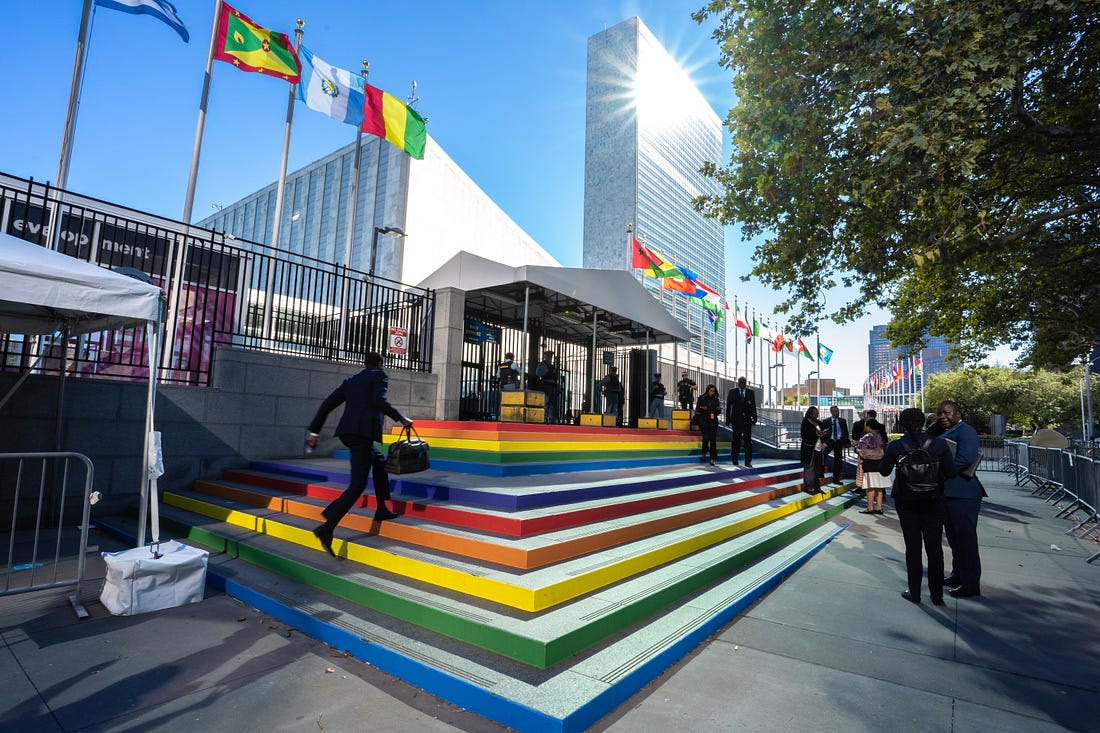
In November 2023, at the United Nations in New York City, the Political Network for Values held its fifth Transatlantic Summit event.
The conference was called “Affirming universal human rights: Uniting Cultures for life, family, and fundamental freedoms.” It was attended by a variety of far-right Christian groups that have historically advocated for anti-LGBTQ policies.
Subscribe for LGBTQ focused journalism:
One of those groups is Alliance Defending Freedom. At the conference, Emilie Kao, the group’s senior counsel and vice president of advocacy strategy, took the floor to express her outrage that a Finnish doctor was put on trial for referring to homosexuality as “a developmental disorder,” “a shame and a sin” and as a form of “genetic degeneration.”
“Thank God she was unanimously acquitted,” said Kao.
Austin Ruse, president of the Center for Family and Human Rights (C-Fam), who has supported laws that would criminalize homosexual behavior and has also said that hard left people that run modern universities should be “taken out and shot,” spoke about some of his group’s recent accomplishments. “There is no redefinition of the family because we stopped them. Sexual orientation and gender identity has never become a category of nondiscrimination in international law, because we have stopped them,” he said.
Kao, C-Fam and ADF did not respond to requests for comment. Ruse disputed that he called for the criminalization of gay sex, saying that he was only offering “a hypothetical.” He added that he has “never advocated that anyone be taken out and shot.”
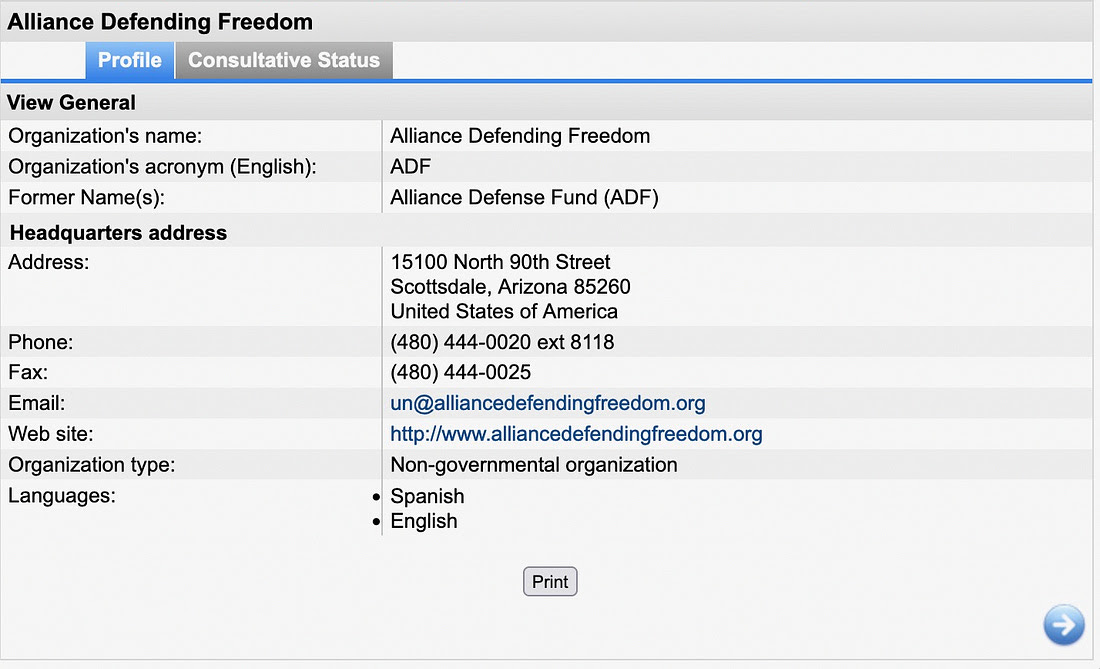
The access and influence of these anti-LGBTQ groups inside the UN isn’t limited to this summit. Both hold what’s known as Special Consultative status at the UN. And they’re not the only ones.
In a months-long investigation, Uncloseted Media found that at least six Southern Poverty Law Center (SPLC)-designated anti-LGBTQ hate groups hold this coveted status, which is granted by the UN’s Economic and Social Council.
“What’s astounding is I’m not sure anybody’s ever produced a list,” says Heidi Beirich, who oversaw SPLC’s annual designation of hate groups from 2012 to 2019. “These organizations have been stealthily inserting themselves into bodies whose beliefs they don’t share for years,” she told Uncloseted Media.
“Many of these organizations don’t even believe in the Universal Declaration of Human Rights,” she says.
Special Consultative Status—which is held by more than 5000 groups—gives members unique access to the UN and its subsidiary bodies, to the various human rights mechanisms of the organization and to special events organized by the President of the General Assembly.
The UN did not respond to repeated interview requests as well as requests for comment.
“You have access to member states, right? So I think the danger of all of this is access to the members who make decisions on resolutions. Who make UN policy,” says Gillian Kane, director of global policy and research at Ipas, a non-governmental organization that focuses on advancing gender equity and reducing the harm of U.S. foreign policy.
Kane, who attended the November Summit, says this status “legitimizes these groups” who have clear track records that conflict with the core principles of the UN, like the promotion of human rights and fundamental freedoms.
“There’s nothing subtle about what they do. They hate gays and they’re unapologetic to go after it,” Kane told Uncloseted Media.
Many of these groups have been around for decades, advocating against the LGBTQ community. Kao’s group, ADF, published a press release titled “ADF increases global impact with new status at United Nations” when they were granted consultative status in 2010. “ADF can now have a say when UN treaties and conventions are drafted that directly impact religious liberty and important matters related to the sanctity of life, marriage, and the family,” the release said. It goes on to say that “ADF will now be able to monitor and provide input on matters” affecting religious freedoms.
Screenshot / Southern Poverty Law Center.
The group, which consists of hundreds of lawyers in the U.S. and around the globe, was founded in 1994 by Alan Sears, who co-authored “The Homosexual Agenda: Exposing the Principal Threat to Religious Freedom Today.”Since then, they have advocated at the state and federal levels for laws that promote conversion therapy and that would ban gays from serving in the military. In addition, they’ve testified in favor of laws that would strip transgender folks of the right to use the bathroom that matches their gender identity, that would prevent them from changing the name on their birth certificate and that would ban their access to gender affirming healthcare.
Screenshot / UN
They have also been effective globally through their international arm, ADF International. In 2012 in Jamaica, they advocated for the retention of a law that criminalizes gay sex. That law remains in effect. And in 2013, members of ADF worked to defend a Belize statute that makes anyone engaging in LGBTQ sex subject to a punishment of up to 10 years in prison.
The other groups—which include the Howard Center for Family Religion and Society (now known as the International Organization for Family), Family Research Council, the Association of United Families International and the American Family Association of New York—all have similar track records.
“We put them on the hate list because they demonize the entire LGBTQ population in derogatory, dehumanizing language, just like the Klan would with Black people or Jewish people,” says Beirich, now the co-founder and chief strategy officer at the Global Project Against Hate and Extremism.
“People in the Christian right who have long demonized the LGBTQ community have political power in this country, and it’s more normalized to hate queer people than to hate Black people for no damn good reason. Which is what we’re talking about. So it’s the biblically informed aspect of it that somehow legitimizes it,” says Beirich, who adds that she has “absolutely no idea” how these groups secured this status.
So how do these groups get here? While they all conform to basic principles required for Special Consultative Status, such as being a registered nonprofit and having specialized expertise on issues relevant to the UN, they are also expected to act in conformity with “the spirit, purposes and principles of the Charter of the United Nations,” which specifically states that members must promote and encourage respect for human rights, take action “to strengthen universal peace” and—specifically for members with consultative status—must promote policies that encourage “social progress.”
Neil Datta, the executive director for the European Parliamentary Forum for Sexual and Reproductive Rights, says part of the reason these groups are granted this status is due to overworked civil servants who work for the NGO Branch of the UN and are in charge of a preliminary screening of these applicants.
Richard Koek / Ministerie van Buitenlandse Zaken.
“The folks reviewing these applications are not necessarily thematic experts on anything. So they’re tasked with a very dry job of processing different applications that come in, and very legitimately won’t know what all of these different groups are,” he says. “Imagine you had 15 climate groups applying and one didn’t believe in climate change. It’s not necessarily that easy to understand.”
Datta says it can be even harder to identify anti-LGBTQ groups because they often operate under the guise of protecting the family or the rights of the child.
“These groups have very nice names that aren’t obviously anti-LGBTQ. And so the people reviewing these applications may not be able to pick up on some of the subtleties,” he told Uncloseted Media.
In addition, Datta says these groups use “very clever vocabulary” that sounds well-meaning. But really, they are weaponizing this language to penetrate powerful institutions like the UN. “In reality, they’re using religious freedom as a fig leaf for hate speech.”
“But if you know your Catholic social doctrine, then you will recognize [this vocabulary] immediately.” Datta says common dog whistles such as “common good” or “human dignity” and “in favor of life [or] of the family” are used almost exclusivelyto limit the human rights of others, “usually in sexuality and reproduction.”
Datta says these “codewords” are another reason these groups go unnoticed within the UN. For example, during a three hour meeting at the November Transatlantic Summit event, participants used the term “human dignity” over 30 times.
After they get through the preliminary screening by UN civil servants, their application is reviewed by the NGO Committee—which meets twice a year—to decide who they will recommend for Special Consultative Status. After review, the recommended organizations are presented to ECOSOC for their final decision.
This committee includes 19 countries, including multiple countries that have extremely hostile policies against LGBTQ people, like Algeria, where homosexual activity is punishable by up to two years in prison; and Eritrea, where homosexuality is illegal and can be punished with jail time.
“It honestly depends on who’s sitting on that committee. So if you have countries that already have anti-LGBTQ policies in place, they’re going to be friendly to inviting these groups in and approving their status,” says Kane.
Once these groups officially gain this status, they use religious freedom as a justification for promoting policies and laws that limit the rights of LGBTQ people through the UN apparatus.
The UN Declaration of Human Rights does not yet explicitly protect folks who are discriminated against for their sexual orientation or gender identity. This lack of protection has given anti-LGBTQ groups leverage in their arguments to roll back the rights of LGBTQ folks.
Inside the UN, there are efforts to change this. In 2019, the Office on Genocide Prevention and the Responsibility to Protect published a Strategy and Plan of Action on Hate Speech that outlines what constitutes hate speech and how to combat it. In it, they describe hate speech “as any kind of communication in speech, writing or behavior, that attacks or uses pejorative or discriminatory language with reference to a person or a group on the basis of who they are, in other words, based on their religion, ethnicity, nationality, race, color, descent, gender or other identity factor.”
Unsurprisingly, this new guidance is opposed by the anti-LGBTQ hate groups. At the Political Network for Values Transatlantic Summit in November, ADF’s Kao said current hate speech laws protect too many different groups of people and in doing so infringe on religious freedom laws. “Who can possibly know what would fall under such an expansive definition of hate?” she said. “These laws give a veto to any offended person, allowing them to censor their neighbors.”
Beirich disagrees. “You can’t use religion as a foil for harming communities and tearing into their civil and human rights. I don’t care,” she says, adding that the Ku Klux Klan has weaponized religion as a means to discriminate against Black people since it was founded in 1865.
“It’s one thing to live your life however you want to live it biblically inspired. It’s a different thing to have that affect other people,” says Beirich. “Keep your views to yourself.”
As these groups continue to operate inside the UN, what can be done? Datta says NGOs applying for Special Consultative Status should be subject to more rigorous background checks, where an independent body thoroughly examines the track record of applicants.
“What are the positions … of these organizations and what have they actually done?” says Datta. “What other things have they done which could be seen as having undermined human rights—the UN’s Declaration of Human Rights?”
He says using an independent body for this review would reduce the potential of political influences in the decision-making process.
As for those who already have Special Consultative Status, their status can be revoked if they don’t “conform at all times to the principles governing the establishment.”
Beirich feels strongly that this should happen swiftly for all six anti-LGBTQ groups that currently hold this status. “The United Nations should revoke the consultative status of people who stand opposed to the Universal Declaration. It shouldn’t stand for policies that are rolling back human rights—it’s absurd.”
That’s according to recently published research from the Williams Institute at UCLA School of Law that looks at the impact of the June 26, 2015, Supreme Court ruling. The academic institution figures that there are roughly 823,000 queer married couples in the U.S. today, double the number at the end of 2014, the last full year when states could bar same-sex unions.
Before the court decision made clear that same-sex couples in every state had a constitutional right to wed a partner regardless of gender, many states, particularly in the South, prohibited such marriages. Thanks to that, the percentage of cohabitating same-sex couples who were married in the South jumped by 21 percent after the ruling, compared to a 16 percent leap in the West, a 15 percent jump in the Midwest and just an 11 percent spike in the Northeast, where many states allowed gay couples to marry before the ruling.
As a demonstration of the significance of the court decision, about 59 percent of all cohabiting same-sex couples in the country are now married, according to the Williams Institute. Wedded couples made up a majority of cohabiting same-sex couples every year since 2016, the first full year when the decision was in effect nationwide.
The decision also significantly impacted the makeup of modern families. Over 300,000 U.S. children are now being raised by married same-sex couples.
But the data also shows the number of families under threat as a growing number of right-wing politicians push to reverse marriage protection. Indeed, Supreme Court Justice Clarence Thomas made clear he’d be willing to overturnObergefell if given the chance when a conservative majority tossed the 50-year-old Roe v. Wade decision.
The Williams Institute noted that 433,000 married couples — and 305,000 unmarried ones — still live in states with laws banning marriage equality on the books. Those bans cannot be enforced because of Obergefell, but would immediately go into effect if the conservative majority brushed the decade-old decision aside.
A survey found 80 percent of same-sex couples were concerned about an overturning of the decision, with 41 percent “very concerned.” About 25 percent of couples have already taken steps to preserve their family, whether that means speeding up marriage, securing second-parent adoptions, or relocating to a state without laws on the books.
But for the moment, love remains the chief reason 93 percent of same-sex couples wed, while 74 percent list companionship and 75 percent cite legal protections. Wedded bliss brings mental health rewards as well, with 83 percent saying it improves a sense of safety and security, 75 percent proclaiming it boosts life satisfaction, and 67 percent saying it helps relationship stability.
All these gay weddings also brought a financial boon to states, whether they have bans on the books or not. Spending on same-sex weddings provides a $5.9 billion boost to economies across the country, generating $432.2 million in state and local taxes.

 We must protect access to this care in the states where it is available, resist efforts to restrict funding or insurance coverage, work to overturn bans, and ensure that no such bans are passed in other states. Families and doctors should be making these health care decisions — not politicians.