Equality California Institute, the nation’s largest statewide LGBTQ+ civil rights organization, has published its 2024 Safe and Supportive Schools Report Card, evaluating LGBTQ+ policies and programs from the 146 school districts that participated this year. The data, collected via the self-reported Equality California Institute’s Safe and Supportive Schools Survey, was sent to all 345 Unified School Districts statewide. This report reveals both the advancements made and the persistent challenges faced by school districts in creating a safe, inclusive environment for LGBTQ+ students, staff, and faculty.
“California has made substantial strides in advancing the rights of LGBTQ+ students by implementing robust anti-bullying policies and adopting inclusive curricula that foster acceptance and equality.” says Equality California Institute Programs Director Erin Arendse, “However, recent school district policies mandating the disclosure of a student’s transgender identity without consent have negatively impacted the well-being of transgender youth. Research shows that discrimination increases mental health risks and lowers academic performance among LGBTQ+ students, while supportive environments lead to better outcomes.”
The report serves as a valuable tool for educators, policymakers, and advocates, providing critical insights to help overcome challenges and create supportive environments that safeguard the rights and well-being of students. Visit schools.eqca.org to learn more.
###
Equality California is the nation’s largest statewide LGBTQ civil rights organization. We bring the voices of LGBTQ people and allies to institutions of power in California and across the United States, striving to create a world that is healthy, just, and fully equal for all LGBTQ people. We advance civil rights and social justice by inspiring, advocating and mobilizing through an inclusive movement that works tirelessly on behalf of those we serve. www.eqca.org
Hundreds of veterans who were dismissed from the U.S. military under the now-repealed “don’t ask, don’t tell” policy have been given honorable discharges following a yearlong review, the Pentagon announced Tuesday.
“Even though the majority of service members discharged for their sexual orientation … were honorably separated, nearly 2,000 were separated with less than fully honorable characterizations,” Christa A. Specht, a legal policy director at the Defense Department, said in a news release Tuesday.
After the repeal, those who were dismissed due to the policy could appeal for an upgrade to an honorable discharge, which would make them eligible for full military benefits. However, Specht noted, many people affected by the policy were unaware they could do so. The “proactive review” sought to address this.
Defense Secretary Lloyd Austin said 851 cases were proactively reviewed over the past year, and 96.8% of them, more than 800, qualified for “relief.”
“Brave LGBTQ+ Americans have long volunteered to serve the country that they love,” Austin said in a statement Tuesday. “Under President Biden’s leadership, the Department of Defense has taken extraordinary steps to redress the harms done by ‘Don’t Ask, Don’t Tell’ and other policies on these former Service members.”
The announcement comes just over a year after the department announced it would conduct a “proactive review” of service members who were dismissed under the policy, which prohibited gay and lesbian members of the military from being open about their sexual orientation. “Don’t ask, don’t tell” was in effect from February 1994 to September 2011 and resulted in the discharge of more than 13,000 service members.
“What this means is that of the nearly 13,500 individuals who were administratively separated under Don’t Ask, Don’t Tell policy, and served long enough to receive a merit-based characterization of service, 96% now have an honorable discharge,” Austin said in the statement.
Gays and lesbians dismissed from the military during the “don’t ask, don’t tell” era are part of a legacy that started well before 1994. Historians estimate at least 100,000 service members were forced out of the military due to their actual or perceived sexuality between World War II and 2011.
Italy’s parliament made it illegal on Wednesday for couples to go abroad to have a baby via surrogacy — a project of Prime Minister’s Giorgia Meloni party which activists say is meant to target same-sex partners.
Since taking office in 2022, Meloni has pursued a highly conservative social agenda, looking to promote what she sees as traditional family values, making it progressively harder for LGBTQ couples to become legal parents.
The upper house Senate voted into law a bill proposed by Meloni’s Brothers of Italy party by 84 votes to 58. The bill was already approved by the lower house last year.
The legislation extends a surrogacy ban already in place in Italy since 2004 to those who go to countries such as the United States or Canada, where it is legal, imposing jail terms of up to two years and fines of up to 1 million euros ($1.09 million).
“Motherhood is absolutely unique, it absolutely cannot be surrogated, and it is the foundation of our civilization,” Brothers of Italy senator Lavinia Mennuni said during the parliamentary debate.
“We want to uproot the phenomenon of surrogacy tourism.”
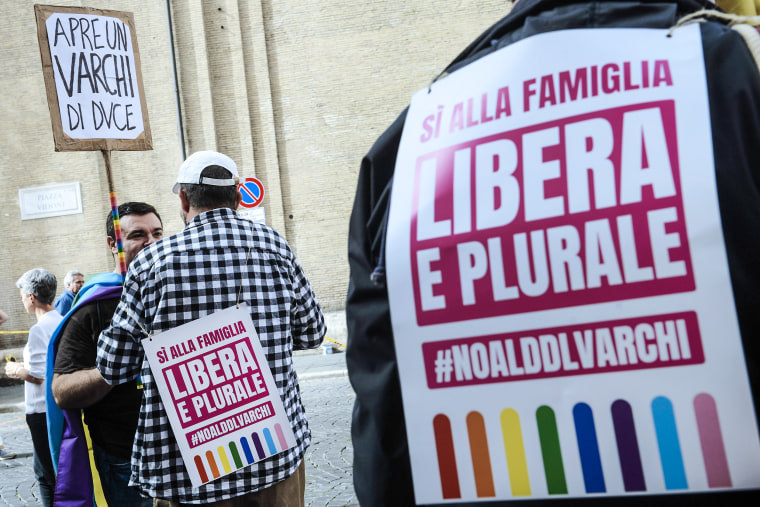
On Tuesday, demonstrators gathered near the Senate voicing their outrage at the bill, saying the government was lashing out at LGBTQ people and damaging those who wanted to have children despite the fact Italy has a sharply declining birth rate.
People participate in a demonstration Tuesday in Piazza Vidoni in Rome organized by Italian LGBTQ associations and political parties that oppose the Varchi bill.Simona Granati / Corbis via Getty Images
“If someone has a baby, they should be given a medal. Here instead you are sent to jail… if you don’t have children in the traditional way,” Franco Grillini, a long-time activist for LGBTQ rights in Italy, told Reuters at the demonstration.
Rainbow Families President Alessia Crocini said 90% of Italians who choose surrogacy are heterosexual couples but they mostly do so in secret, meaning the new ban would de facto affect only gay couples who cannot hide it.
The clampdown on surrogacy comes against the backdrop of falling birthrates, with national statistics institute ISTAT saying in March that births had dropped to a record low in 2023 — the 15th consecutive annual decline.
“This is a monstrous law. No country in the world has such a thing,” said Grillini, referring to the government’s move to prevent Italians from taking advantage of practices that are perfectly legal in some countries.
Texas Attorney General Ken Paxton sued a Dallas doctor Thursday accusing her of providing transition-related care to nearly two dozen minors in violation of state law.
Paxton alleged that Dr. May Chi Lau, who specializes in adolescent medicine, provided hormone replacement therapy to 21 minors from October 2023 to August for the purpose of transitioning genders. Texas enacted a law,Senate Bill 14, last year banning hormone replacement therapy and other forms of gender-affirming care for minors.
“Texas passed a law to protect children from these dangerous unscientific medical interventions that have irreversible and damaging effects,” Paxton said in a statement Thursday. “Doctors who continue to provide these harmful ‘gender transition’ drugs and treatments will be prosecuted to the full extent of the law.”
The statement alleged that Lau used “false diagnoses and billing codes” to mask “unlawful prescriptions.”
Neither Lau nor her employer, the University of Texas Southwestern Medical Center, immediately replied to requests for comment.
If Lau is found to be in violation of the law, her medical license could be revoked and she could face a financial penalty of hundreds of thousands of dollars.
Paxton’s suit is the first in the country by an attorney general against an individual doctor alleging violation of a restriction on transition-related care for minors.
Texas’ law includes a provision that allows physicians to continue to prescribe puberty blockers and hormone therapy to patients who began treatment before June 1, 2023, in order to wean them off the medications “over a period of time and in a manner that is safe and medically appropriate and that minimizes the risk of complications,” according to Paxton’s suit. Minors are required to have attended at least 12 mental health counseling or psychotherapy sessions for at least six months before they started treatment. It’s unclear whether Lau’s treatment of the minors could fall under that provision.
So far, a few attorneys general, including Paxton, have subpoenaed hospitals and practices that provide such care to minors for those patients’ records. Twenty-six states ban at least some forms of gender-affirming care for minors, according to the Movement Advancement Project, an LGBTQ think tank.
Gov. Greg Abbott signed Texas’ restriction in June 2023, and a court blocked itafter families and doctors sued. In September 2023, the Texas Supreme Court allowed the law to take effect pending an appeal from the state, and this June, it vacated and reversed the previous injunction, allowing the law to stand.
The U.S. Supreme Court is expected in its current session to hear oral arguments and rule on whether to strike down a similar law in Tennessee. How the court rules on the Tennessee law is expected to affect similar laws in other states.
The statement from Paxton’s office described gender-affirming care as “experimental, and no scientific evidence supports their supposed benefits.”
Major medical organizations, such as the American Medical Association and the American Academy of Pediatrics, disagree, arguing that transition-related care is an effective and medically necessary way to treat gender dysphoria, which is distress felt by people whose gender identities differ from their genders assigned at birth.
LGBTQ+ ballot initiatives have long been used as a wedge issue to turn out the conservative vote and to give or take away freedoms that are usually guaranteed by the government. The 2024 election is no different. This November continues a decades-long tradition of leaving LGBTQ+ civil rights up to public debate.
New Yorkers will consider whether to add sexual orientation, gender identity, and gender expression to their anti-discrimination amendment in the state constitution. Reproductive rights are on the ballot in 10 states as well.
And California, Colorado, and Hawaii voters will decide if their states will repeal their constitutions’ bans on same-sex marriage.
Same-sex unions have, in fact, always been the top issue on state referendums. 34 states have sent the question to voters since 1998, many passing state constitutional amendments against same-sex partnerships. Putting these amendments on the ballot was used as a strategy to turn out the conservative vote for George W. Bush in 2004, when 11 states passed them.
Marriage equality lost at the ballot box every time until 2012, when it was put to a vote in Maine, Maryland, Minnesota, and Washington and won in all of them. This followed national public opinion polls, where support for same-sex marriage crossed the 50% threshold around 2009.
All states’ anti-marriage equality constitutional amendments were rendered invalid in 2015 with the Obergefell v. Hodges Supreme Court decision, but the amendments remain in several state constitutions. As such, activists are fighting to repeal them, especially in the event the conservative-dominated Supreme Court overturns Obergefell – something Justice Clarence Thomas hinted was a possibility after the court overturned Roe v Wade.
“Saving” the children
The 1978 election in California introduced the first state ballot initiative related to LGBTQ+ rights. Prop 6, also known as the Briggs Initiative since it was sponsored by Orange County legislator John Briggs, garnered national attention and public denunciation from then-president Jimmy Carter (D), and even from then-California governor Ronald Reagan (R).
The initiative sought to ban anyone who engaged in “public homosexual activity” or “conduct” from working in California public schools. The proposal was part of a trend of other states repealing anti-discrimination measures, inspired by anti-gay activist Anita Bryant’s successful 1977 “Save Our Children” campaign to repeal Dade County, Florida’s ordinance banning discrimination based on sexual orientation, also done by popular vote. Harvey Milk helped to lead the campaign against Prop 6, which was defeated by a 16-point margin.
Other state ballot initiatives have sought to legalize or ban discrimination on the basis of sexual orientation or gender identity — and voters more often sided with anti-discrimination as the years went on. In Oregon in 1988, voters revoked the governor’s authority to ban discrimination based on sexual orientation, and in 2018, Massachusetts voters upheld a law prohibiting discrimination based on gender identity.
Maine and Oregon have most frequently put LGBTQ+ rights to a vote. In Maine, voters first blocked same-sex marriage in 2009 and then approved it in 2012, both times with 53% of the vote. Anti-discriminating protections for LGBTQ+ people in Maine were denied by referendum in 1998 and 2000 and then approved in 2005. In Oregon, voters defeated a “don’t say gay” measure in 2000 by a 5.7% margin.
The concept of using sexual orientation as a protected identity at all was also put to a vote multiple times as a conservative strategy to block “homosexuality” from being added to anti-discrimination ordinances. In the 1990s, the majority voted to allow sexual orientation to be a protected identity in Oregon, Idaho, and Maine.
And it isn’t just laws explicitly about LGBTQ+ rights that affect the community. Other ballot-driven Voter ID laws, including those in Arkansas and North Carolina, will no doubt prevent some trans folks from voting, as well as other LGBTQ+ people who are intersectionality marginalized.
Regardless of ballot measures, the state representatives voters choose this election will also have a significant impact on LGBTQ+ rights. Legislatures led by publicly-elected Republicans have introduced or passed hundreds of anti-LGBTQ+ bills in recent years, including banning or limiting access to gender-affirming health care, bathrooms, accurate IDs, inclusive education, inclusive books, drag performances, and sports participation. Voting for state-level and local candidates who support LGBTQ+ rights will impact laws for years to come, even when they are not put to referendum.
Vote like your rights depend on it
Civil rights for other groups have also gone to public referendum dozens of times since 1868, like the question of legality of discrimination on the basis of race, sex, and disability. Like sexual orientation, voters supported discrimination in earlier years and began to support equal rights later on. Women’s rights, however, gained approval in the 1970s while LGBTQ+ rights didn’t see popular support until the 2000s.
The decision to provide or deny civil rights is more often determined by courts and legislatures — which are becoming more conservative — and the idea that constitutional rights can be determined by public opinion has allowed racism, sexism, homophobia, and other forms of discrimination to become enshrined into law.
Public opinion about LGB and transgender rights is often conflicted and in flux, so ballot measures are not a safe option for gaining rights either, though the majority do currently support anti-discrimination laws for LGBTQ+ people.
Nevertheless, LGBTQ+ rights are on the ballot. As such, it’s essential to vote this year — both on the LGBTQ+ rights referendums and for candidates who will have the power to enact pro-equality legislation.
As the 2024 election looms, younger LGBTQ+ voters are navigating a uniquely stressful political landscape. The combination of targeted legislation, hate speech, and economic uncertainty has compounded an already intense election season for these communities, leading to a marked increase in anxiety and mental health concerns.
Despite these challenges, queer Gen Z voters are expected to mobilize in record numbers, driven by a desire for change.
For marginalized communities, like LGBTQ+ individuals, this anxiety can be even more intense due to fears of policies that could negatively impact their rights and lives. Symptoms can include trouble sleeping, constant worry, difficulty concentrating, and feelings of hopelessness.
Related
As politically charged rhetoric rises, many LGBTQ+ and Gen Z voters are feeling increasingly overwhelmed by the stakes of upcoming elections.
LGBTQ+ voter motivation is high, but mental health is at risk
LGBTQ+ voter turnout is expected to be strong in the 2024 election. According to a GLAAD poll, an overwhelming 94% of LGBTQ+ registered voters say they plan to cast their ballot this November. However, this motivation to engage in the political process comes with significant emotional costs. A striking 72% of LGBTQ+ individuals report that the current political climate has negatively impacted their mental health.
For queer Gen Z voters, the overall mental health picture is even more concerning, with 71% of LGB Gen Z adults reporting they experienced anxiety “a lot of the day yesterday,” compared to just 52% of their straight peers, according to Gallup. This general anxiety adds to the emotional burden many queer voters carry into this election season.
Elizabeth Douglas, MA, LADC, LPCC, a Minnesota-based therapist and owner of Yellow Wallpaper Therapy, who has spent over a decade working with the queer community, explains, “Recent legislation limiting access to gender-affirming care, banning discussions of LGBTQ+ issues in schools, and proposing restrictions on transgender individuals’ rights have contributed significantly to anxiety and stress.”
This stress is only heightened by the political polarization many LGBTQ+ voters feel, with some questioning whether their votes will make a difference in a system that often feels hostile to their identities.
The rise of LGBTQ+ voters as a political force
Despite the mental health challenges, the LGBTQ+ community is emerging as an influential voting bloc, particularly among Gen Z. According to the Human Rights Campaign, one in seven voters is expected to identify as LGBTQ+ by 2024—and that number could grow to one in five by 2040. In the 2020 election, LGBTQ+ voters made up 7% of the electorate, which is expected to rise in the coming years.
This growth in numbers is already being reflected in key election metrics. LGBTQ+ voters favor Vice President Kamala Harris over Donald Trump by a substantial margin, and in Congressional races, 77% of LGBTQ+ voters are likely to support Democratic candidates. However, this strong preference for Democratic candidates also underscores the deep political divide felt by many LGBTQ+ individuals.
The impact of anti-LGBTQ+ rhetoric and legislation
The surge in anti-LGBTQ+ legislation and hate speech has left many queer voters feeling vulnerable. Nearly half of LGBTQ+ voters report experiencing real-world bullying, further contributing to the sense of anxiety surrounding the election.
And it’s not just rhetoric—laws targeting transgender youth, banning gender-affirming care, and limiting discussions of LGBTQ+ issues in schools are having profound effects on mental health and overall well-being.
Douglas highlights how these stressors are affecting the younger LGBTQ+ generation: “The rise in hate crimes and public anti-LGBTQ+ rhetoric, especially on social media, has contributed to a pervasive feeling of vulnerability. These factors drive political engagement but may deter some from voting out of fear for safety, especially in public polling places.”
Related
Gen Z’s unique perspective and mental health crisis
Gen Z is the most diverse generation yet, with 28% identifying as LGBTQ+ according to the latest data from the Public Religion Research Institute. This group is redefining what it means to be politically engaged, but they’re also dealing with overwhelming mental health challenges. Only 38% of queer Gen Z adults rate their mental health as “excellent or good,” compared to 63% of their straight counterparts.
The emotional toll is evident in how they approach political engagement. While many Gen Z voters are leading the charge for progressive change, they are also grappling with the pressure to balance activism with self-care.
According to Douglas, building safe communities, both online and offline, can offer some relief, but the systemic pressures queer Gen Z faces make it difficult to avoid burnout.
How to manage election anxiety
Election anxiety is not going away, but there are strategies to help alleviate its impact. For LGBTQ+ voters, especially Gen Z, advocacy can provide a sense of control and empowerment. Engaging in activism can offer a constructive outlet for stress.
Douglas suggests several strategies:
Engage in advocacy through voting, organizing rallies, and joining LGBTQ+ activist groups
Build safe online and offline communities
Practice digital hygiene to limit exposure to harmful content
Participate in therapy or peer support groups
Support LGBTQ+ candidates and grassroots campaigns
In addition to the strategies already mentioned, managing election anxiety can also involve setting healthy boundaries with news consumption. Limiting your exposure to the 24/7 news cycle—particularly avoiding doomscrolling before bed—can protect your mental well-being. Focus on trusted, LGBTQ+ affirming news sources, and only check in at specific times during the day.
Another way to reduce feelings of helplessness is to focus on what you can control, such as volunteering for LGBTQ+ organizations or helping others register to vote. Taking tangible actions, no matter how small, can provide a sense of empowerment.
However, it’s also important to know when to take a step back and protect mental health. It’s about finding balance—staying involved and informed, but not overwhelmed.
Related
Empowering change and supporting well-being
As the election approaches, queer Gen Z voters are stepping into their power. While the challenges they face are immense, their collective voice is reshaping the political landscape. Understanding the unique factors driving election anxiety for LGBTQ+ voters is key to ensuring their voices are heard—and their mental health is supported.
With a rapidly growing LGBTQ+ electorate, their votes will not only shape the outcome of the 2024 election but will also define the future of political discourse in the U.S. As Sarah Kate Ellis, President and CEO of GLAAD, puts it, “LGBTQ Americans are ready to exert their significant power to shape electoral politics, choose responsible leadership, and use their voices to advocate for equality.”
And that includes young, queer individuals who are coming of age and using their voices to demand change and hold politicians accountable, as well.
Sign up for the INTOnewsletter and get your twice-weekly dose of stories that shape the queer experience, culture, and lifestyle.
Stand with Trans, founded in 2015 by Roz Keith, is a nonprofit based in Farmington, Michigan helping trans youth “build resilience, gain confidence and find hope for a future filled with joy.”
Keith launched the organization when she was in search of resources for her own child who, in 2013, came out as transgender.
Since the COVID-19 pandemic, virtual programming with a blend of in-person programming has helped to maximize their reach and potential as an organization. As a result, the group has expanded accessibility to be a global force for transgender empowerment and erase stigma surrounding trans identities, all while equipping and supporting families of all backgrounds, shapes and sizes. Each year, Keith and her staff pick a new theme for Transgender Week of Empowerment. This year the conference’s 2024 theme is “Beyond the Binary.”
This theme introduces important topics from autonomy in healthcare, Democracy, reproductive health, parenting, substance use, sports, sibling, parent, and grandparent ally panels, media representation talks and so much more.
“I have loved being in touch with so many folks from the trans community and our allies while putting the programming together. Everyone I’ve spoken with is excited and motivated to support trans and nonbinary youth,” Dubbs Weinblatt, Transgender Empowerment Month program coordinator, told GLAAD.
Raving over the words of Sen. Sarah McBride and others at the launch party, Keith said the start of this year’s event is amazing so far. Scheduled speakers include RuPaul Drag Race Alum, Peppermint, Equality Michigan’s Emme Zannotti, and former Muslim Youth Leadership Council (MYLC) member, Ameera Khan, and so many more.
“We really want to explore the diversity of gender, the intersectionality of different identities, and provide an opportunity for young people to feel like they can connect,” Keith said about this year’s theme, “where they can be inspired, they can have models of possibility for adult caregivers. It’s a place for them to come and learn, and get that education in a credible space.”
In the first year, the Transgender Empowerment Month conference was made up of 45 young people, all trans identified. Keith said many youth were nervous about what to expect, but each year since 2015 the conference has only grown, outsized venues, and broadened the community, says Keith.
The importance of the conference then and now is to allow transgender youth to have a space that’s organized for them to experience.
Logann Finkel met Roz in 2018. “I was transitioning and I was looking for support getting to and from my doctor’s appointments, and somebody had mentioned [that] there is this group, and you could reach out,” Finkel told GLAAD.
That group was Stand With Trans. From Michigan, Keith found someone in New Jersey that could help take Finkel to and from their transgender healthcare appointments.
Since they met, Finkel has been presenting at Transgender Empowerment Month, but this year, they’re excited to be an observer and a participant.
Like Keith, Finkel praised the launch of Transgender Empowerment Month 2024 and the programming ahead. Programming was paused between Oct. 2 and Oct. 4 for Rosh Hashanah observance, and resumed on Oct. 6 in the Jewish New Year with an open mic night.
“The guest speakers [on Oct. 1] were fantastic. It was done in a way that built so much excitement and interest in what we’re about to embark on over this month,” Finkel said. “I would just say I’m really excited.”
There will be more than 30 panels, workshops, and programming strewn throughout the entire month, and people can register at any point in October here.
In a state like Georgia that has a Republican trifecta — a Republican governor and a party majority in both chambers of the state legislature — queer community leaders and political strategists are working diligently to prove Atlanta isn’t the state’s only allegedly progressive community.
Georgia has roughly 8 million registered (active and inactive) voters. Georgia’s Secretary of State online data hub indicates there have been 121,898 more active voters since the December 2022 runoff election, and each one will count in a battleground state that could determine the nation’s future.
In September, the Georgia State Election Board voted to have all cast ballots counted by hand. Many consider this rule change an ongoing effort to undermine or at least delay election results. Democrats, who were once pushing Gov. Brian Kemp (R) to hold an ethics hearing, filed a lawsuit to have a judge push Kemp to remove some of the members of the elections board believed to be former President Donald Trump loyalists. While one judge dismissed the case in early October, a Fulton County Superior Court Judge issued an injunction blocking the hand count rule on the first day of early voting in the state. The judge felt the new rule was approved too close to Election Day and would create “administrative chaos.”
Related:
Your LGBTQ+ guide to Election 2024
Stay ahead of the 2024 Election with our newsletter that covers candidates, issues, and perspectives that matter.
Georgia’s narrative as a battleground state has been a major talking point in recent years. According to some reports, Stacey Abrams’ 2018 gubernatorial campaign was a test case to prove if the Democratic party mounted a “sustained voter outreach campaign,” the state could flip from red to blue. In Georgia, Joe Biden narrowly beat Trump by 11,779 votes during the 2020 election, garnering him the Electoral College votes needed to become the 46th president of the United States and strengthening the argument that Georgia could be a viable player on the national stage. Two years later, Sen. Raphael Warnock’s runoff win over Republican challenger Herschel Walker solidified the state’s status as a bonafide swing state.
How has this happened? An increasing number of LGBTQ+ community leaders and political strategists have worked tirelessly to galvanize voters of all ages, backgrounds, and identities to build a coalition beyond the state’s capital, Atlanta. They have also proven, to some extent, that they carry political power in the state and have built effective grassroots efforts in their local communities.
Georgians are fighting for people over politics
FTR Political Strategies co-founder Mo Pippin.
At 28, Mo Pippin (they/them) is one Georgian hoping to turn the state from purple to blue. In 2023, they co-founded FTR Political Strategies out of a need for greater engagement in local elections and voter education.
“Here in Roswell — which is just a hop, skip, and a jump away from Athens — we’re doing the work to boil down these large, sometimes scary federal issues to local and state issues that are digestible, recognizable, and salient to people; and trying to connect them with better representatives,” Pippin told LGBTQ Nation. “I believe fully that young people have been primed to have conversations with people who are different from us. One of the primary things that we do to engage voters is we canvas; we knock on doors.”
Pippin said voters have warned them to be careful in their neighborhood whenever they canvass in traditionally conservative areas of Roswell. They believe the warning is rooted in an assumption that other residents in the region will not be welcoming and potentially combative.
“If I’m looking at our state government and I don’t see people who look like me or who act like me or who share the same values as I do, it’s an easy assumption that, because of what we’re told about democracy, these people who got into office through the means of popular vote naturally represent our entire population,” they said. “But that’s not the case. Our voter turnout in the state is incredibly low. The system is made that way. There are all of these structural reasons – getting their children to school, getting to work themselves, making sure their families are fed, and their health needs are met – why people are not able to engage in the [political process] in our state. People are too tired and too busy to vote.”
Organizations like Georgia Equality, the state’s largest and oldest LGBTQ+-centered advocacy organization, are actively working to engage, educate, and advocate. This past year, it played an integral role in helping defeat the nearly 20 anti-LGBTQ+ bills introduced in the state legislature by appearing regularly at the state Capitol for hearings, votes, and meetings alongside other pro-LGBTQ+ groups. The organization also leveraged the community, organizing more than 5,000 people to make calls to their representatives during the session.
“Our priority is not to leave any LGBTQ+ Georgian behind,” Noël Heatherland (they/them), statewide organizing manager for Georgia Equality, told LGBTQ Nation. “And making sure that everyone, especially those who do not live inside the bubble of the city of Atlanta, is remembered and included throughout the year, especially during a time where our civic engagement and letting our voices be heard is so important.”
The queer experience in the state’s southern region comes with its own set of issues and specific concerns, said Heatherland, a native of Albany, Georgia. While recent reports suggest that most LGBTQ+ voters are motivated to support the Democratic party and concerned about issues like restricting women’s rights and banning medical care for transgender youth, Heatherland said queer Georgians are also concerned with a lot of the same issues that impact people across various communities and demographics.
Omarion Smart agrees. A senior at Georgia State University, Smart is a native of Bainbridge, Georgia, in the southwest region. He’s also policy director for Voters of Tomorrow, a social welfare organization for Gez Z, by Gen Z. Housing, food security, and the cost of living are key issues queer voters are taking to the ballot box this November, he said. Healtherland adds queer voters in the state are also concerned about quality education for their children and the safety of their children in schools. According to the Williams Institute at the UCLA School of Law, the LGBTQ+ population makes up about 4.7% of the population in the state of Georgia, with 27% of them having children.
“The majority of Georgians agree on these things,” Smart said. “We agree that housing should be affordable. We agree that we should have health care and that Medicare and Medicaid should be expanded. The economy. Housing. As well as the rise of transgender hate ideology and reproductive rights. They are all important issues to voters in Georgia. No one issue has priority over the other. Yet we have those in the legislature that do not reflect the population of our state, and it’s time that we change that.”
Smart’s concerns manifested this August when Georgia Lt. Gov. Burt Jones (R) launched the Georgia Senate Special Committee on the Protection of Women’s Sports “to ensure that female athletes across Georgia have the right to compete on a fair and level playing field.” Smart believes the committee and its purpose are “disgusting.”
“It’s not even intended to learn about these issues,” Smart said. “That’s just how the politics in our state are. Their goal is to spew their blatant hate and not be called out on their hatred.”
“We have those in the legislature that do not reflect the population of our state, and it’s time that we change that.”Omarian Smart, policy director, Voters of Tomorrow
normal
As far as Shawn Harris is concerned, the energy behind anti-LGBTQ+ and transgender legislation by the conservative party is a smokescreen. Harris is challenging Rep. Marjorie Taylor Greene (R-GA) for Georgia’s 14th congressional district, which includes Rome, Calhoun, and Dalton in the northwest. He said that Greene has created a narrative about the region that makes it seem problematic. Harris, however, says local voters are more focused on quality of life, including jobs and affordable housing.
“People get up every day from our area and drive either to Atlanta to go to work or they drive to Chattanooga, Tennessee. They get up every morning at 4 a.m. to beat the traffic,” Harris told LGBTQ Nation. “They’re not home when it’s time for their kids to get off from school. They’re not home for their kid’s soccer games or whatever. They do this for a good-paying job with insurance. And they need affordable housing.”
As election day gets closer, queer voters in Georgia have an impressive slate of candidates to consider: Gen Z Democrat Ashwin Ramaswamy is running for state Senate District 48, challenging Trump loyalist Shawn Still, who was indicted in the Fulton County election interference case last year; RaShaun Kemp won the Democratic primary to fill state Senate seat District 38 and is reportedly the first openly gay man elected to the state Senate; and Laura Judge is running for the County School Board, Post 5.
Rashaun Kemp. Photo via rashaunforgeorgia.com.
“The Cobb County school system has been implementing a ton of book bans against a variety of different books and also enacting discriminatory policies,” said strategist Pippin. “If she wins, control of the Cobb Board of Education would flip and stop the madness happening there. Her district is extremely competitive, and I’m cheering for her big time.”
One candidate with personal stakes is JD Jordan, running against John Albers for Georgia Senate District 56.
“He is running to protect his children from harmful state policies. The incumbent is a co-sponsor of anti-trans legislation that threatens healthcare access for JD’s children,” said Pippin. “He has five kids between the ages of 14 and 19, and two of them identify as transgender.”
Georgia Equality’s Heatherland said Albers is not cordial to LGBTQ+ people or allies and is not willing to listen to them when they are at the Capitol to discuss issues – even if they are his constituents. The district is now trending as one of the state’s most “flippable” districts.
“It’s one thing to speak up on behalf of LGBTQ+ children, and specifically transgender people, when you’re running for something in Atlanta and like 85% of the people you’re talking to agree with you,” added Pippin. “It’s another to do that in a district that is red like SD56, and JD is out here fighting that fight and helping dispel all the misinformation that is spewed about the queer community. He is the dad many of us in the community wish we had growing up.”
Police are investigating a threatening, homophobic e-mail sent to WNBA power forward Breanna Stewart‘s wife as the New York Liberty compete in the finals.
Police did not identify the person who filed the report, but said a 33-year-old woman made an aggravated harassment report on Oct. 10 after receiving “a threatening email.” Stewart confirmed the threats and that her wife filed the report after practice during an interview Tuesday.
The email in question said the couple, “don’t deserve to live and I hope you both die.”
Stewart, 30, who plays for the New York Liberty, is married to former WNBA player and Spanish National Team athlete Marta Xargay Casademont, 33. They married in July 2021 and share two children together.
The Hate Crimes Task Force is investigating the matter as a possible bias incident on the grounds of sexual orientation discrimination. The New York Postwas the first to report on the threat.
“The fact it came to Marta’s email is something she (had to) see. The level of closeness was a little bit different,” she told reporters, according to The Associated Press. “Make sure that myself and Marta are okay, but that our kids are the safest.”
Stewart said she reported the threat to the team and league and Xargay filed a complaint with police. “Being in the Finals and everything like that it makes sense to file something formal,” Stewart said.
The threat came after the Liberty lost in Game 1 of the WNBA finals against the Minnesota Lynx. In that game, Stewart missed a free throw with less than a second left in regulation that would’ve given the Liberty the lead, and later missed on a layup that would have tied the game at the end of overtime.
“Sometimes people are taking things a little bit too far and too out of context. And Marta had gotten homophobic death threats. A few other things have happened,” she said. The two-time MVP said they reported the matter to make sure “we’re doing as much as possible to continue to make sure that our team and the league is aware of the situation and continue to keep everybody safe.”
NBC News has reached out to the New York Liberty and WNBA for comment.
WNBA Commissioner Cathy Engelbert also spoke on the rising amountof hateful speech players have received on social media in her address before Game 1.
She said the leaguewill meet with the players association, players and teams to address the matterusing technology and prioritizing mental health and reinforcing security.
“First of all there’s no place in sports for this,” Engelbert said. “It just is something where we have to continue to be a voice for this, a voice against it, condemning it, and making sure that we find every opportunity to support our players, who have been dealing with this for much longer than this year.”
The Liberty and Lynx face off again for Game 3 on Wednesday night.
Today the Movement Advancement Project (MAP) and CenterLink released the 2024 LGBTQ Community Center Survey Report, which showed that 73% of LGBTQ centers surveyed reported they had experienced anti-LGBTQ threats or harassment over the past two years, much of which were specifically in response to anti-LGBTQ politics or rhetoric.
The 2024 LGBTQ Community Center Survey report had 199 participating LGBTQ community centers in 42 states, Washington D.C., and Puerto Rico. The biennial survey series started in 2008, highlights the crucial role these centers play in the broader LGBTQ movement, offering an invaluable link between LGBTQ people and local, state, and national efforts to advance LGBTQ equality.
“As attacks on LGBTQ people escalate year after year, we applaud these centers’ ongoing dedication to serving on the front line – meeting both the immediate and long-term needs of LGBTQ people, their families, and their communities across the country,” said Tessa Juste, LGBTQ Movement Building and Policy Researcher from the Movement Advancement Project. “This report illustrates the vital difference these centers make in people’s everyday lives, while also highlighting the urgent need for continued funding and support of these centers and the lifelines they provide.”
The report also showed that the 199 participating LGBTQ community centers collectively serve over 58,700 people each week, or over 3 million people per year, with many centers primarily serving people and communities that are historically under-resourced and under-served, including low-income, people of color, transgender people, and those under the age of 18.
“This report is a crucial guidepost for us to see the positive impact of LGBTQ centers across the U.S. as well as what areas need additional resources,” said Denise Spivak, CEO of CenterLink. “As we celebrate our 30th anniversary, this report makes clear the importance of LGBTQ centers in our communities.”
Additional Key Findings The report breaks down program priorities, constituencies and services, infrastructure, fundraising, and staff, board, and volunteer capacity, in addition to the rising threats to safety and security experienced by centers.
Programs & Services 66% of LGBTQ community centers directly provide physical health, mental health, and/or anti-violence services or programs—and this number jumps to 95% of centers when including those that provide referrals to LGBTQ-friendly health providers. Half of centers (50%) offer computer resources or services to the public, providing needed tools for job searching and career development, social services, schoolwork, and more.Nearly all centers (92%) engage in advocacy, public policy, or civic engagement activities, across a wide range of issues and areas, including over half engaging in voter registration efforts. More than one-third of centers listed anti-transgender legislation or other focus areas as their top priority, reflecting the increasingly hostile political and legislative landscape today. Center Capacity Although LGBTQ community centers reported a collective 2024 budget of over $366 million across all centers, the report shows that the financial realities of LGBTQ community centers vary greatly. Over one-third of centers have budgets of less than $250,000. In addition, over 98% of that collective budget belongs to big budget centers (budgets of $250,000 or more).
Funding sources also vary across the different size centers: the largest share (41%) of big budget centers reported that government grants were their top single source of revenue in 2023, while the largest share (41%) of small budget centers said individual contributions were their main source of revenue in 2023.Government grants provide key resources to centers and are used to provide key services to LGBTQ and non-LGBTQ people alike in local communities across the country.
Over six in ten (64%) responding LGBTQ community centers reported currently having a government grant, totaling more than $117 million in funding for needed services like health and housing.While nearly half of all centers remain thinly staffed, 84% of responding centers employ paid staff, providing jobs to 3,100 people.In 2023, roughly 11,600 people volunteered over 421,000 hours at responding community centers, helping centers with and without paid staff to significantly expand their reach and impact.
MethodologyThe survey was conducted online in July 2024 and was distributed to LGBTQ community centers in the United States that are CenterLink members. The survey was jointly developed by MAP and CenterLink. Further details are available in the report.
About MAP: MAP’s mission is to provide independent and rigorous research, insight and communications that help speed equality and opportunity for all. MAP works to ensure that all people have a fair chance to pursue health and happiness, earn a living, take care of the ones they love, be safe in their communities, and participate in civic life. www.mapresearch.orgAbout CenterLink: For 30 years, CenterLink has been at the forefront of empowering LGBTQ community centers. Our mission is clear: to strengthen, support, and connect LGBTQ community centers, enabling them to effectively serve their communities across social, cultural, health, and advocacy areas. CenterLink facilitates over $1.5 million in collaborative funding annually, ensuring our centers have the resources to continue making a meaningful impact. We provide essential resources, guidance, and a collective voice to our emerging and established centers. www.lgbtqcenters.org