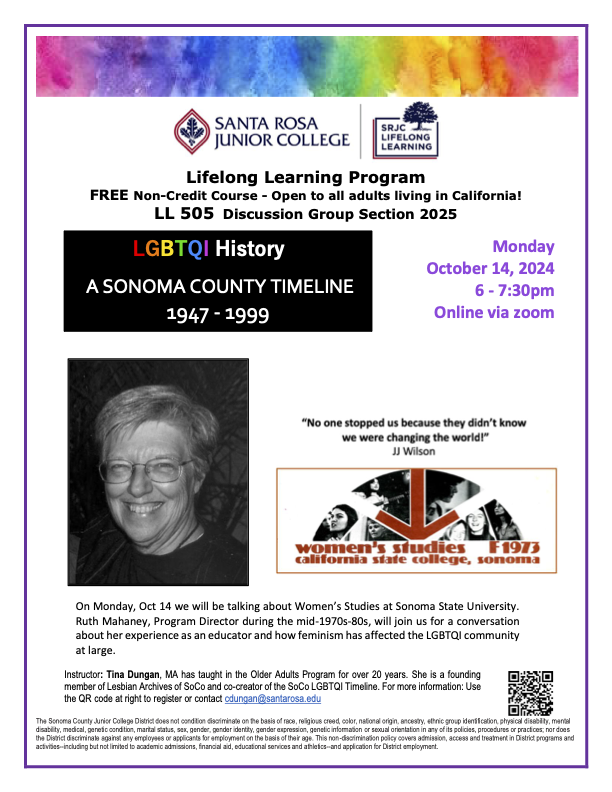
LGBTQI History: A Sonoma County Timeline 1947-2000 Mondays 6-7:30pm. Online via Zoom through SRJC LifeLong Learning. On Oct 14, we will be talking with Ruth Mahaney and others about the interface between Lesbian liberation and the Women’s Movement in SoCo in the 1970s. Please contact me to enroll in this FREE class and receive a Zoom link: cdungan@santarosa.edu
The 2024 election is consequential for LGBTQ people and our equality. LGBTQ voters are poised again to be the decisive edge in close-contest states in the presidential race as well as the elections that will determine the balance of power in the U.S. Senate and U.S. House of Representatives.
But it’s not just about choosing candidates. Here are issues and proposals up for a vote that will have an impact on the LGBTQ community, including in the battleground states and states that have passed legislation targeting LGBTQ people.
According to the results of a GLAAD and Pathfinder poll released earlier this year, abortion is the second most important issue for LGBTQ voters in the 2024 election. LGBTQ people can and do get pregnant and need reproductive health care. Many of the same states with abortion bans also have enacted bans and restrictions on transgender health care.
According to the results of a GLAAD and Pathfinder poll conducted earlier this year, abortion is the second most important issue in the 2024 election.
Ten states have ballot initiatives to protect access to abortion, including the battlegrounds of Arizona and Nevada, as well as Colorado, Florida, Maryland, and New York. Nebraska has competing ballot initiatives – one expanding access to abortion, one restricting it to the first trimester of pregnancy. Since the Dobbs decision, voters in every state with ballot initiatives have passed expanded protections and access to reproductive care – eight elections and counting.
Arizona
Proposition 139: Amend the state constitution to define as fundamental the right to abortion“through fetal viability,” or about 24 weeks. Current law allows for abortions “until 15 weeks of pregnancy.” In April, the Arizona Supreme Court ruled 4-2 to uphold an 1864 law “prohibiting abortion in most circumstances except to save the life of the mother.” The following month, Arizona Gov. Katie Hobbs cast her signature to revoke the law.
“This election is more than a presidential election. In Arizona, like many states, the outcomes of these ballot initiatives could drastically change rights and freedoms granted to individuals in our state including the quality and availability of reproductive health care for Arizona families,” said Michael Soto, president of Equality Arizona.
“Make sure you don’t forget to vote on the ballot initiatives like Prop 139, in fact the most effective way to vote this year in Arizona is to start with the propositions and work your way up to the presidential race. Our rights and freedoms are on the line, and your vote will matter more than it ever has in this election.”
Arizona’s U.S. Senate race features Rep. Ruben Gallego and former gubernatorial candidate Kari Lake. Lake has promised to make Arizona a “sanctuary state” for the unborn, called abortion the “ultimate sin” and endorsed a federal ban on abortion before flipping support. Rep. Gallego supports Prop 139 and “restoring abortion access” in Arizona.
GLAAD has documented the LGBTQ records of Gallego and Lake.
Colorado
Amendment 79: Protect Coloradans’ right to abortion and prevent governmental interference, denial, or discrimination. Allow for Medicare and other state-funded insurance to “cover abortion services.” As a constitutional amendment, this proposal requires at least 55% voter approval to pass.
Florida
Amendment 4: Add abortion protections to the Florida Constitution’s Declaration of Rights. A “yes” vote would enshrine abortion protections “before viability” or to protect the health of the patient. Unchanged will be a current provision requiring parents “to be notified before a minor can receive an abortion.” Recent polling shows 76% of voters expressed support for the proposal. Florida currently has a ban on abortions after six weeks of pregnancy, one of the strictest bans in the country, as well as a ban on health care for transgender people, which can currently be enforced as the law is appealed.
Florida’s incumbent Sen. Rick Scott is running for re-election to the U.S. Senate. Scott has backed Florida-based anti-LGBTQ extremist book banning group Moms for Liberty, and opposes Florida’s Amendment 4.
In recent years, The Hill reports, Floridians passed amendments restoring voting rights to felons who have served their time, voted to increase the minimum wage, and legalized medicinal marijuana.
In 2023, Illinois’ legislature passed, and Gov. J.B. Pritzker signed into law, a bill enshrining the right to abortion and maternity care. The bill was sponsored by out state Rep. Kelly Cassidy, who said: “While all around us opponents are using misinformation and misogyny to justify attacks on bodily autonomy, I’m proud that here in Illinois, we’ve declared unequivocally that we trust patients and doctors to make these decisions safely and privately.”
Maryland
Question 1: Enshrine reproductive freedom rights within the Maryland Constitution’s Declaration of Rights. The right to reproductive freedom includes, “the ability to make and effectuate decisions to prevent, continue, or end one’s own pregnancy.” A simple majority is needed for the measure to pass.
Maryland’s race for U.S. Senate includes former Gov. Larry Hogan, who vetoed a bill to expand access to abortion in 2022. His opponent, Prince George’s County Chief Executive Angela Alsobrooks, said Hogan would be the “51st vote” swinging the Senate majority to the party that would not vote to restore the rights of Roe nationwide.
Alsobrooks told the Associated Press “there will never be a vote as to whether or not we should codify Roe in federal law if the Republicans are in the majority… they have made it clear, they’ve essentially declared war on reproductive freedoms, and we know that that vote would never happen.”
Missouri
Amendment 3: Enshrine reproductive freedom rights, including “prenatal care, childbirth, postpartum care, birth control, abortion care, miscarriage care, and respectful birthing conditions” into the state constitution through an amendment. Previously threatened with removal from the November ballot, the Supreme Court of Missouri “reversed a lower court ruling against the measure.”
Incumbent Sen. Josh Hawley, who is running for re-election this year, lied about Amendment 3 while also attacking essential health care for transgender people that’s supported by every major medical association.
“Hawley’s fear mongering on trans health care for youth referenced practices that are already largely restricted in Missouri,” St. Louis Public Radio reported. “In 2023, the state passed a sweeping ban on gender-affirming care for minors.”
Supporters of Amendment 3, including the ACLU and Hawley’s Senate race opponent, Lucas Kunce, called Hawley’s remarks false, outlandish, and an attempt to distract voters, KSMU reports.
Hawley’s LGBTQ record is documented on the GLAAD Accountability Project. Hawley is among five senators who voted to object to the Electoral College counts showing Donald Trump lost the 2020 election, casting their votes hours after the deadly insurrection at the United States Capitol. Hawley went on to co-sponsor a bill targeting transgender students. The five senators voting to protect Trump’s lie, then targeting transgender youth, are Sen. Tommy Tuberville of Alabama, Sen. Josh Hawley of Missouri, Sen. Cindy Hyde-Smith of Mississippi, Sen. Roger Marshall of Kansas, and Sen. Ted Cruz of Texas.
Montana
CI-128: Amend the state constitution to enshrine reproductive rights, “including the right to abortion,” and to “travel for medical services” without government interference “up until the point of fetal viability.”
Montana’s race for U.S. Senate is among those that will determine whether the Senate remains in the control of the pro-equality majority.
In a September 30 debate, incumbent Sen. Jon Tester supported the ballot measure and a person’s fundamental right to make private health care decisions: “I believe women should be able to make their own health care decisions. That’s the bottom line. It shouldn’t be the federal government. It shouldn’t be a bureaucrat. It shouldn’t be a judge,” Tester said. Tester also supports federal legislation to protect abortion access before fetal viability — generally considered to be around 24 weeks, according to Montana Public Radio.
U.S. Senate candidate Tim Sheehy is anti-abortion and calls Tester’s stance extreme. Sheehy has said “I am proudly pro-life.”
Nevada
Question 6: The Right to Abortion Initiative. A “yes” vote supports providing for a state constitutional right to an abortion.
“Abortions in Nevada are currently legal up to 24 weeks after the start of pregnancy and after 24 weeks if a physician believes the pregnant person’s life or health is at risk,” the Nevada Current reports
“Those protections were put in place via a citizen-driven referendum passed by voters in 1990 and would require a direct vote of the people to change. Question 6 would establish abortion as a fundamental right in the state constitution, which also requires a vote of the people to amend.”
“This doubles down on the protections on statute,” Lindsey Harmon, president of Nevadans for Reproductive Freedom told the Current. “It makes it twice as hard to repeal or amend the referendum.”
Incumbent Sen. Jacky Rosen is running for her second term in the Senate and supports Question 6. Her opponent, retired Army Capt. Sam Brown has said he is “pro-life,” that he’s “not for changing existing law,” and in 2022 told the Reno Gazette-Journal that he will “continue to protect life by voting against any federal funding of abortion and by voting to confirm justices who protect life.”
GLAAD has documented the LGBTQ records of Rosen and Brown, here.
The Supreme Court’s 2022 ruling overturning Roe v. Wade revealed that marriage equality under Obergefell v. Hodges is far from safe. And while the Respect for Marriage Act would protect same-sex marriages that have already taken place legally, it does not “prevent states from refusing to license the unions.” In order to enshrine these rights, the following states have proposed legislation that would protect marriage equality:
California
Proposition 3: Repeal the now infamous Proposition 8, a 2008 ballot initiative defining “marriage as a union between one man and one woman.” A “yes” vote would establish as fundamental the right to marry. Prop 8 was overturned in the U.S. Supreme Court case Hollingsworth v. Perry, in 2013.
Vice President and former California Attorney General Kamala Harris officiates the wedding ceremony (2013) for the lead plaintiffs in a case that led to the overturning of the state’s same-sex marriage ban. (Credit: MSNBC)
Colorado
Amendment J: Remove the ban on same-sex marriage in the Colorado Constitution. Currently, the state constitution still defines marriage as “only a union of one man and one woman,” wording that was nullified with the U.S. Supreme Court’s 2015 Obergefell decision. Justice Clarence Thomas has called on Obergefell to be “reconsidered” in his concurrence overthrowing Roe.
“Marriage has been many things throughout history, but for queer people, it’s always been about more than just a legal union—it’s been a defiant act of love and resistance.” said Jax Gonzalez, political director at One Colorado, the state’s leading LGBTQ advocacy organization.
“The Obergefell decision was a monumental step forward, but with the fall of Roe, we know we can’t rely on Supreme Court precedent to protect the freedom to marry. Removing the ban on same-sex marriage from the Colorado Constitution isn’t just about love or legal protection—it’s about affirming that our love, our dignity, and our equality are not up for debate. We owe it to the generations who fought before us, and to the future we’re building, to ensure these rights are secure.”
Of particular note: One Colorado reported that no-anti transgender initiatives made it to the November ballot. This comes after an anti-LGBTQ political action committee announced in August that they failed to collect enough signatures to advance anti-transgender legislation onto the 2024 ballot.
According to a report by The Williams Institute, more than 210,000 transgender adults could “face barriers to voting this fall” because their forms of identification don’t match their gender. State agencies in Missouri and Texas have removed protocols for trans people to correct their birth certificates. Ballot measures this year are targeting ways candidates appear on the ballot and can campaign.
Among the higher profile state ballot initiatives is Ohio’s Issue 1, which aims to fix the current manipulation of maps designed to favor one party over another (gerrymandering).
Ohio Issue 1: Establish a 15-member Ohio Citizens Redistricting Commission composed of five each of Democrats, Republicans, and Independents. Currently, the redistricting commission is comprised of politicians. Issue 1 would mandate politicians be excluded, along with lobbyists and political consultants.
Equality Ohio explained the measure to its followers on TikTok and Instagram: “Gerrymandering leads to extreme legislation—it hurts LGBTQ+ Ohioans, period.”https://www.instagram.com/reel/DAZJKfVyS03/embed/captioned/?cr=1&v=14&wp=1080&rd=https%3A%2F%2Fglaad.org&rp=%2Fvoting-for-equality-lgbtq-related-proposals-on-the-ballot-this-year%2F#%7B%22ci%22%3A0%2C%22os%22%3A336%2C%22ls%22%3A193%2C%22le%22%3A193%7D
Gerrymandered maps have helped create an extremist supermajority in the Ohio state legislature that last year passed a combination bill banning medically necessary health care for transgender youth and banning trans youth from school sports. Ohio has successfully worked around the gerrymandered supermajority with ballot measures, including two measures that helped codify the right to reproductive health care last year.
In August 2023, Ohio voters passed a ballot measure that protected a majority vote for ballot measures, then in November 2023, voters passed an amendment to add abortion rights to the state constitution, with robust voter turnout for an off-year election. Extremist lawmakers opposed both measures.
Signal Cleveland spelled out the stakes of Issue 1: “Under the current maps, Republicans hold about 66% of Ohio’s congressional and state legislative seats – giving them a veto-proof majority in the General Assembly – although their share of the vote is closer to 56%.”
If Ohio voters pass Issue 1, the state would join Michigan and Wisconsin, which have successfully broken down partisan gerrymandering, ensuring accurate representation in the state’s voting districts.
Additional states with measures about voting procedures and methods include:
Arizona
Proposition 133: Update the state constitution to “require partisan primary elections for partisan offices,” thus preventing all candidates from running in the same primary. Under the proposed amendment, political parties would nominate their own candidates to open positions, as has already been the practice.
Proposition 134: Establish within the state constitution an amendment requiring citizens pursuing a ballot measure to gather a percentage of signatures from every legislative district; 10% for statutory amendments and 15% for statewide initiatives.
Proposition 137: Replace term limits for state Supreme Court justices and superior court judges with “terms of good behavior.” If passed, this proposal would strip voters of the right to decidewhether or not to retain state Supreme Court justices. “Any justices on the November ballot would also automatically stay in office if the measure passes, even if voters choose to reject them.”
Proposition 140: Create open primary elections, requiring “all candidates for a specific office,” regardless of political affiliation, to “run against each other in a single primary election.” Lawmakers would then have the option to establish “a top-two general election featuring the top primary candidates,” or a ranked-choice voting system in the general elections “featuring the top primary candidates.”
Colorado
Proposition 131 (Initiative 310): Eliminate partisan primaries and place all qualified candidates“on the same primary ballot.” The four candidates with the top number of votes would move on to the November general election, which would ask voters to rank them based on their “order of preference.”
Florida
Amendment 1: Require school board candidates to list their party affiliation on the ballot, starting with the November 2026 general election.
Amendment 7: Amend the state constitution to limit voting to U.S. citizens who are 18 years of age or older. In addition, the proposal would “prohibit the ranking of candidates by limiting voters to a single vote per candidate or issue,” and advance one winner from the primary elections to the general election.
Montana
CI-126 and CI-127: CI-126 would create ranked-choice primaries for candidates running for “governor, lieutenant governor, state executives, state legislators, and congressional offices.” Following the election, the top-four candidates would advance to the general election, “regardless of party.” Meanwhile, CI-127 would require candidates for the following offices to win a majority of the vote, rather than a plurality, in order to secure the election: “governor, lieutenant governor, secretary of state, auditor, attorney general, superintendent of public instruction, state legislature, and congressional offices.”
Wisconsin
Citizenship Voting Requirement Amendment: Amends the state constitution to stipulate “that only U.S. citizens who are 18 years old or older can vote in federal, state, local, or school elections.” Current language states “every” U.S. citizen can vote, but the proposal would change this to “only.” If passed, the measure would capitalize on fear mongering about noncitizen voting, “but noncitizens cannot legally use their IDs or licenses to register and vote.”
To learn more about statewide initiatives that will appear on your ballot, we recommend familiarizing yourself with them through nonpartisan sites like Ballotpedia (also linked from the title of each ballot proposal).
Few older Africans participate openly in the lesbian, gay, bisexual, and transgender (LGBT) rights movement. But Francisca Ferraz, 53, known as “Yaa Sissi,” aims to change that.
Yaa Sissi, who lives in Geneva, Switzerland, is a pioneering voice in her community. Born in Brazzaville, Republic of the Congo, to a Portuguese father and a Congolese mother, Yaa Sissi moved to Geneva in 2008, where she raised her two daughters, now 25 and 21.
There, early in 2023, she founded Afro LGBT, Geneva’s first LGBT rights association focused on those of African descent.
Today, Afro LGBT creates a safe space for people, many of whom experience fear and discrimination based on their race and their sexuality. Even though she’s seen people like herself come out and live openly in Europe, she notes that many older people, especially those of African descent, still struggle to embrace their identities fully. “People my age hide a lot, and yet there are so many of them,” she says. “But among ourselves we know very well, who is who.”
She speaks of the importance of coming out, of freeing oneself from the heavy burden of secrecy: “I had the courage to do it because I’d been through so much. It wasn’t easy to accept myself.”
Yaa Sissi told her story to Human Rights Watch for the International Day of Older Persons, October 1, sharing her journey through love, identity, and community that has spanned decades, continents, and challenges.
Discovering Love, Confronting Silence
Yaa Sissi discovered her sexuality as a teenager while living in Brazzaville. At age 17, she fell deeply in love with G., a girl four years her junior. Their relationship was intense but short-lived. After high school graduation, Yaa Sissi moved to the neighboring Democratic Republic of Congo for professional training, and they lost touch.
Fourteen years ago – more than 20 years after she was together with G. – a rumor that G. had died led Yaa Sissi to track her down. They rekindled their bond, though they still live in separate countries.
I met Yaa Sissi in her apartment, alongside G, who was visiting.
“There Are So Many People My Age Hiding”
Yaa Sissi speaks fondly of “Carine,” a cultural term from Congo and Democratic Republic of Congo that was used to describe intimate friendships between girls and women. “Our great-grandmothers had ‘Carines,’” she says. “G. was my ‘Carine.’” These relationships, forged in school and village life, were sources of deep companionship and affection. “With your ‘Carine,’ you could exchange gifts, kiss, and make little love gestures,” she says.
Over the years, Yaa Sissi’s relationships have included many women older than her??, including married women. “In my country, many of my lovers were married women,” she recalls. Some held high positions where they worked. She met them through her late husband, who was a prominent government official in the Democratic Republic of Congo.
Creating Afro LGBT – “To Put an End to Fear and Isolation”
Though initially involved in other local LGBT organizations, Yaa Sissi felt unseen and unheard as an Afro-descendant. “We Afros were always a bit in our corner. Nobody came up to us to find out what brought us there, how we felt,” she says. “We wanted to be listened to. We’re all in very different situations, even though we’re all LGBT.”
Yaa Sissi became a trusted figure in her community, with many LGBT youth turning to her for support. “It hurt so much to see such injustice,” she says, recalling a child who came to her after being kicked out of their home for identifying as transgender. “Young Afro LGBT people need to be listened to and protected.”
“I’ve Stopped Crying”
Yaa Sissi’s journey has not been easy. In a country like Switzerland, opportunities to make one’s voice heard are more available, but the journey of self-acceptance can be lifelong. “I knew I’d been attracted to women for a very long time, but I fought it with all my might,” she says. The social norms of the Congo, coupled with the teachings of the church, kept her struggling against her own desires. “I sought deliverance in the churches. They prayed over me. I sincerely thought it was a demon.”
Her marriage was also a struggle; she tried to preserve it despite knowing her truth. Her late husband, who held her in high regard in the beginning of their marriage, when she started openly struggling with her sexuality. He went with her to churches and traditional healers to cast homosexuality out of her. But when that didn’t “work,” he became abusive, eventually abandoning her and their two children in Geneva. “It took me over 30 years to come out with myself,” she says tearfully. “Before I said stop, I don’t want to suffer anymore. I used to be Francisca. Reserved, shy in my corner. Today I’m international. The one talking to you now is Sissi. I’ve stopped crying.”
Facing Discrimination as an Older Afro Lesbian
The intersection of age, race, and sexuality poses unique challenges for Yaa Sissi. “When you’re an Afro lesbian, it’s hard enough. I got married because I didn’t want that life,” she explains, adding that she has known many women who felt compelled to marry men and have children to avoid the stigma of being openly lesbian. “I’ve seen people beaten up, insulted, raped, and sometimes forcibly married.”
Despite living openly in Switzerland, Sissi sometimes faces ageist insults. “People call me an ‘old lesbian.’ They say I want to warp their children away.” Yet, she has also experienced support from unexpected places. One day, a man tried to attack her in a bar because he learned she was a lesbian. Also, she was sitting at a table with a woman who said no to his advances several times. But customers stood up for her and demanded he calm down.
“Despite everything my late husband said about me, there’s respect in my family, too. I’m a generous, unifying person.”
A Message for International Day of Older Persons
On this day, Yaa Sissi wants to highlight the experiences of older African LGBT people. “We mustn’t forget Afro LGBT seniors. They’re out there. They also have a lot of problems,” she says. Many seek support but struggle with the idea of mixing with younger generations. “When we talk about Afro LGBT, we mustn’t just look at the people on social media. You also have to think about older people who are often very isolated and live in hiding.”
As I left Yaa Sissi’s apartment, the heart-shaped furniture in her living room caught my eye. “Love is the color of power,” she says with a smile.
A much-needed affordable housing project for LGBTQ+ seniors in San Francisco’s Castro District has hit a setback, as state agency funding was denied, even though the proposal was described as “a great project,”The Bay Area Reporter wrote.
Mercy Housing California, a senior living facility for elderly LGBTQ+ people, had applied for nearly $39 million from the Affordable Housing and Sustainable Communities (AHSC) Program, a joint initiative by California’s Department of Housing and Community Development and the Strategic Growth Council. The funds would have funded a 187-unit affordable housing development in the Castro, the city’s historically gay neighborhood.
Amar Cid, deputy director of Community Investments and Planning, said the project had limited funds and much competition, with other applicants scoring higher.
“Round 8 of the AHSC program had many transformative, impactful community projects. Like every round, total project requests far exceeded the available funds. This year, requests were more than double what we could grant. It was a highly competitive process,” he told The Bay Area Reporter.
Cid emphasized that the rejection doesn’t mean the project isn’t valuable.
“The team met with the 1939 Market Street project team in mid-September to discuss ways to increase their score if they choose to apply in a future round,” he said, emphasizing that he told its organizers to apply again in the future. ”
“[It’s] a great project … [and] we hope they consider applying in a future round,” he said.
“Why some projects may have been awarded with a lower score than the 1939 Project has to do with other projects perhaps meeting specific [disadvantaged communities] and/or program priorities,” Cid said.
The affordable housing developer is partnering with Openhouse, a San Francisco nonprofit that provides services for LGBTQ+ seniors, to create their third building of below-market-rate apartments, primarily for LGBTQ+ seniors. Previously, the two organizations collaborated on 119 units of affordable, LGBTQ+-friendly senior housing spread across two buildings located at 55 and 95 Laguna Street — both are near the Castro District.
The push for affordable housing in the Castro is especially crucial as LGBTQ+ seniors face unique challenges in finding safe, inclusive living spaces. Mercy Housing’s commitment to resubmitting their application is a step forward, but the struggle for adequate funding continues.
Mercy Housing California said that it will reapply for funding in 2025. In a statement to Bay Area Reporter, the organization expressed hope for next year.
“Unfortunately, this does push the schedule back one year. However, we remain committed to delivering 187 units of LGBTQ+ friendly housing as soon as possible,” the organization said.
These four friends grew up making music together, and it shows. They cut their teeth early, and were soon sharing the stage with high-profile artists at major venues. They continued to hone their skills over the years through extensive touring and live performances in other projects – these are accomplished musicians.
Their new project, Made of Mana, is a modern rock band out of the San Francisco Bay Area that has been strongly influenced by the California coast they call home. Their songwriting includes strains of blues-rock guitar à la Jimi Hendrix and John Mayer, paired with soulful vocals sharing stories of longing, loss, and growth.
They are here to share the pure love and expressive power of music, removed from the glitz and glamor that typifies the music industry today. This is aspirational music, yearning for each of us to become the best versions of ourselves, but with expectations that have been tempered by the hard lessons learned through a life fully lived. “We play music because we love it. So, when we share our music with an audience, we are sharing an expression of love, and that is the most powerful force in the universe.”
Opening Act: Parson Jones Tickets: $15 at the door Venue: Arlene Francis Center 99 6 th Street, Santa Rosa, CA 95401 arlenefranciscenter.org
Date: Friday, October 18, 2024 Time: 7pm-11pm BAND WEBSITE: madeofmana.com
Two San Francisco city supervisors are trying to make it easier for new gay bathhouses to open in the city.
Last week, Supervisor Rafael Mandelman, whose district includes the historically gay Castro neighborhood, introduced legislation that would repeal the San Francisco Police Department’s Article 26. According to local Fox affiliate KTVU, the section of the city’s police code puts the burden of permitting new bathhouses on the SFPD.
“We’ve come a long way on the way to bring back gay bathhouses to San Francisco,” Mandelman, who is gay, told KTVU. “It’s encouraging that there are entrepreneurs who are actually trying to open these venues, although it is frustrating that we keep finding new barriers in their way.”
Article 26, Mandelman said, is the reason some potential business owners have spent months waiting for the SFPD to issue permits so they can open gay bathhouses in the city.
Mandelman’s ordinance would also repeal regulations passed at the height of the AIDS crisis in the 1980s that required bathhouses in San Francisco to maintain a daily register of patrons and prohibited locked doors in the venues. Mandelman’s office said that the crackdown on gay bathhouses in the ’80s contributed to the stigma around HIV/AIDS.
“Opening a new business in San Francisco is difficult enough,” Joel Aguero, owner of Castro Baths, said. “Supervisor Mandelman and his office are removing a significant blocker to the permit process, accelerating the opening of Castro Baths, and supporting the growing community of would-be bathhouse operators and attendees who seek to revive San Francisco’s once-thriving bathhouse culture.”
Mandelman previously passed legislation to do away with ’80s era health code restrictions affecting gay bathhouses in 2020, and in 2022 he passed legislation allowing bathhouses to open in LGBTQ+ neighborhoods like the Castro and the Tenderloin.
“I’m thankful to Supervisor Mandelman for his leadership in removing outdated barriers to reopen bathhouses in San Francisco,” said city supervisor Matt Dorsey, who co-sponsored Mandelman’s ordinance.
“The South of Market neighborhood I represent has a long and storied history with these establishments. With hindsight, we now know that restrictions adopted decades ago at [the] advent of the AIDS crisis likely deprived at-risk communities of sex-positive spaces where information about safer sex practices might have saved lives.”
Dorsey, who is also gay and the only openly HIV-positive member of the San Francisco Board of Supervisors, noted that with advancements in HIV prevention and treatment like antiretroviral therapy and PrEP, “It’s past time for anti-bathhouse restrictions to go.”
The controversy over gender-affirming care for trans minors is coming to the U.S. Supreme Court in its new term, which begins Monday — the first Monday in October. A hearing date has not been set, but the case, U.S. v. Skrmetti, over a Tennessee ban on such care, will surely attract much attention when it comes to the court. The American Civil Liberties Union, one of the groups representing the Tennesseans who sued over the law, predicts the hearing will be scheduled for December. Here’s what you need to know about the case, which is the high court’s first opportunity to rule on the issue.
What is the U.S. v. Skrmetti Supreme Court case?
In March 2023, Tennessee Gov. Bill Lee, a Republican, signed Senate Bill 1 into law. It bans surgery, puberty blockers, and hormone treatment for the purpose of gender transition for people under 18. The following month, three families with transgender children and one doctor filed a federal lawsuit challenging the law.
The suit was brought by Samantha and Brian Williams of Nashville and their 15-year-old transgender daughter, two other plaintiff families filing anonymously, and Dr. Susan Lacy of Memphis. They are represented by Lambda Legal, the ACLU and its Tennessee affiliate, and the law firm of Akin Gump Strauss Hauer & Feld LLP. The suit was filed in April 2023 in U.S. District Court for the Middle District of Tennessee.
It names as defendants Skrmetti, the Tennessee Department of Health, the Tennessee Board of Medical Examiners, and various state officials.
The suit argues that the law violates the U.S. Constitution’s guarantees of equal protection and due process as well as the Affordable Care Act’s Section 1557, which bans sex discrimination in health care, the suit asserts.
“It was incredibly painful watching my child struggle before we were able to get her the lifesaving health care she needed. We have a confident, happy daughter now, who is free to be herself, and she is thriving,” Samantha Williams said in a Lambda Legal-ACLU press release when the suit was filed. “I am so afraid of what this law will mean for her. We don’t want to leave Tennessee, but this legislation would force us to either routinely leave our state to get our daughter the medical care she desperately needs or to uproot our entire lives and leave Tennessee altogether. No family should have to make this kind of choice.”
What’s at stake here for gender-affirming care?
“Our legal challenge is limited to the provisions of Tennessee’s ban targeting hormone therapies — such as hormone replacement therapy and puberty blockers — and does not implicate surgical care,” the ACLU explains on its website, as genital surgery is almost never performed on minors.
“Tennessee’s ban, like every other passed by politicians in recent years, specifically permits these same hormone medications when they are provided in a way that Tennessee considers ‘consistent’ with a person’s sex designated at birth,” the ACLU continues. “This means, for example, a doctor could prescribe estrogen to a cisgender teenage girl for any clinical diagnosis but could not do the same for a transgender girl diagnosed with gender dysphoria.”
A ruling upholding the law could have implications for other types of health care, the ACLU warns. “When arguing against transgender people and their families, states with bans like Tennessee’s have relied heavily on the Supreme Court’s opinion Dobbs v. Jackson Women’s Health Organization, which overturned Roe v. Wade and allowed states to ban abortion,” the organization notes. “U.S. v. Skrmetti will be a major test of how far the court is willing to stretch Dobbs to allow states to ban other health care. The court’s ruling could serve as a stepping stone towards further limiting access to abortion, IVF, and birth control.”
How did U.S. v. Skrmetti get to the Supreme Court?
Solicitor General Elizabeth Prelogar, representing the Biden administration, emphasized the need for the court’s intervention, highlighting the “profound uncertainty” faced by transgender adolescents and their families due to conflicting lower court decisions. “This Court’s input is urgently needed to resolve whether these bans are discriminatory,” she said in the government’s petition to the court.
It’s anyone’s guess. The court delivered a major victory for LGBTQ+ people in 2020 in Bostock v. Clayton County, in which it ruled 6-3 that workplace discrimination based on sexual orientation or gender identity is sex discrimination and therefore banned by Title VII of the Civil Rights Act of 1964. Justice Neil Gorsuch, Donald Trump’s first Supreme Court appointee, wrote the ruling. He was joined by another conservative, Chief Justice John Roberts, and the court’s four liberals — Ruth Bader Ginsburg, Elena Kagan, Sonia Sotomayor, and Stephen Breyer. Dissenting were conservatives Samuel Alito, Brett Kavanaugh, and Clarence Thomas.
Now the court’s makeup has changed, however. Ginsburg died in 2020 and was replaced by a conservative, Amy Coney Barrett. Breyer retired in 2022 and was succeeded by another liberal, Ketanji Brown Jackson, the first justice appointed by President Joe Biden.
And while Gorsuch and Roberts joined in the Bostock ruling, now the conservatives appear to have dug in, as indicated by the Dobbs ruling, the 6-3 presidential immunity ruling, and the ruling in 303 Creative Services v. Elenis,also 6-3. In the latter, the majority held that Colorado’s LGBTQ-inclusive nondiscrimination law violated a web designer’s freedom of speech — the designer was willing to create wedding websites for heterosexual couples only.
But the plaintiffs have many on their side. In addition to their legal team, they have numerous friend-of-the-court briefs supporting their case. Such briefs are filed by parties not directly involved in a case but wanting to offer an opinion. They have come from both Democratic and Republican politicians, Planned Parenthood, the American Bar Association, the American Psychological Association, the National Women’s Law Center, the American Academy of Pediatrics, trans youth, and many more. Of course, there have been briefs filed supporting Tennessee as well. So we’ll see who convinces the justices.
A Pennsylvania middle school installed a window in its gender-inclusive restroom, making its interior visible from the school hallway.
The window was constructed at Emory H. Markle Middle School in Hanover, Pennsylvania, which is roughly 5 miles north of the Maryland border. Gender-inclusive bathrooms are commonly used by transgender and nonbinary people for privacy and safety reasons.
Matthew Gelazela, the board president of the South Western School District, said the district decided to add the window as it “engages in renovating multiuser restroom facilities.”
“It has an interest in opening a view into the non-private area of those facilities in similar fashion to what has existed for years in our elementary schools,” Gelazela said in a statement to NBC affiliate WGAL in Lancaster. “In making the area outside of stalls more viewable, we are better able to monitor for a multitude of prohibited activities such as any possible vaping, drug use, bullying or absenteeism.”
Parents in the South Western School District in Hanover, Pa., are taking to social media to call out their school board after pictures surfaced showing construction of gender-inclusive bathrooms.WGAL
Gelazela added that the window does not provide a “view into those private stall spaces from outside of the restrooms.”
The district did not immediately respond to NBC News’ request for additional comment.
Jennifer Holahan, whose son attends school in the district , said the new window is a “deterrent” to keep students from using the restrooms and a way to single out LGBTQ students who may be more likely to use a gender-inclusive facility.
“I can understand needing to have supervision over middle and high school students, especially in the bathrooms. I was a teenager once; I know it’s a tough spot,” Holahan told WGAL. “But I also think windows aren’t a solution. I think if it was a real issue, it wouldn’t just be gender-inclusive restrooms.”
Emory H. Markle Middle School in Hanover, Pa.WGAL
The American Civil Liberties Union of Pennsylvania condemned the installation of the window, calling it “discriminatory.”
“Schools should be a welcoming and safe environment that nurture students’ curiosity and well-being,” a spokesperson for the group said in an email. “Discriminatory policies like this one not only undermine those goals, they also make students less safe.”
The issue over whether trans people should be able to use the restroom that aligns with their lived gender has played out in the U.S. for roughly a decade. A transgender “bathroom ban” in North Carolina — which barred trans people from using restrooms and changing facilities that matched their gender identity in most public spaces — caused a national uproar in 2016. (The North Carolina law, HB 2, was partially repealed in 2017.) However, similar laws have rebounded in recent years with legislative success and more muted opposition.
Thirteen states across the country have laws that prohibit transgender people from using bathrooms and facilities consistent with their gender identity in K-12 schools, according to the Movement Advancement Project, an LGBTQ think tank. Some of those state laws — also known as “bathroom bans” — also bar trans people from using restrooms that correspond with their gender identities in some or all government buildings.
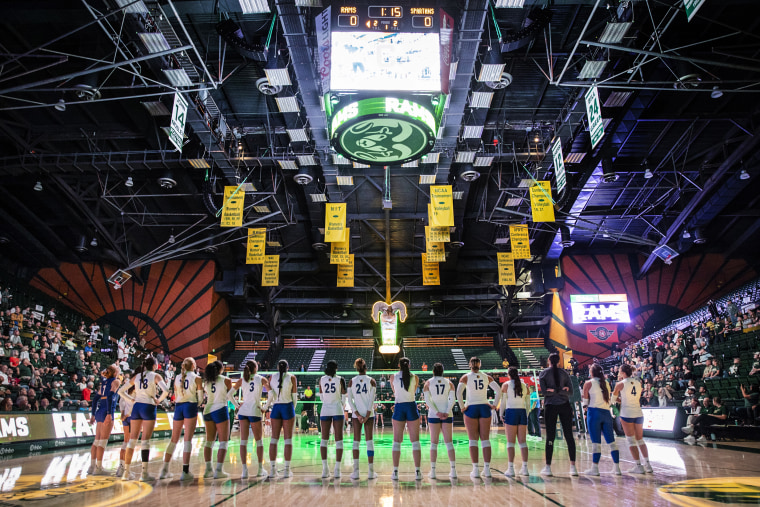
A fourth university has forfeited its women’s volleyball match against San José State University following controversy over the gender identity of one of the team’s players.
Utah State University said in a brief statement Tuesday that it would not play its Oct. 23 match against SJSU, joining the University of Wyoming, Boise State University and Southern Utah University, which have all forfeited matches against the California school over the last three weeks.
The San Jose State University Spartans line up for the playing of the national anthem and player introductions for their NCAA Mountain West women’s volleyball game against the Colorado State University Rams in Fort Collins, Colo., on Oct. 3, 2024. Santiago Mejia / San Francisco Chronicle via Getty Images
None of the universities explained their decisions, though the University of Wyoming said the decision was made “after a lengthy discussion.” The universities have not responded to requests for additional comment.
Michelle Smith McDonald, senior director of media relations for SJSU, said the university will not address the gender identity of any student due to the Family Educational Rights and Privacy Act, a federal student privacy law.
“It is disappointing that our SJSU student athletes, who are in full compliance with NCAA and Mountain West rules and regulations, are being denied opportunities to compete,” McDonald said in an emailed statement on behalf of the university. “We are committed to supporting our student-athletes through these challenges and in their ability to compete in an inclusive, fair, safe and respectful environment.”
The forfeitures began after months of speculation in conservative websites about the gender identity of one of SJSU’s players. In April, the far-right website Reduxx published an interview with an anonymous parent of an SJSU player who said there were “rumors” that one of the other players was a transgender woman.
The teammate in question did not return requests for comment. NBC News is not using her name because she has not made a public statement about her identity or confirmed that she is trans.
On Sept. 23, SJSU player Brooke Slusser joined a lawsuit filed by more than a dozen women athletes against the NCAA, which oversees collegiate athletics, arguing that its policy allowing trans women to compete on women’s teams violates Title IX, a federal law protecting students against sex discrimination in federally funded schools and programs. The suit is led by Riley Gaines, a former 12-time NCAA All-American swimmer who competed for the University of Kentucky and objected publicly to the participation of University of Pennsylvania swimmer Lia Thomas, the first trans woman to win an NCAA championship.
In the lawsuit, Slusser says the teammate who was the subject of the media coverage told her she was a trans woman. When Slusser asked the teammate, whom Slusser had roomed with on team trips, why the teammate hadn’t shared this information with her before, the teammate said “there never seemed to be a good time to bring it up,” and that she was afraid Slusser would not be her friend if Slusser knew the truth, according to the suit, which uses “he” pronouns for the teammate. Slusser said she told the teammate she didn’t want her to be bullied but that she questioned whether it was safe or fair for the teammate to play on the women’s team.
Soon after, according to the suit, SJSU officials convened a meeting to address the news article about the teammate’s gender identity, and told members of the volleyball team that they shouldn’t speak about the teammate’s gender with anyone outside of the team. Slusser says that the teammate was stronger than other members of the team and that volleyball hits from the teammate caused more bruising and pain than hits from other players.
The suit says Slusser has experienced “physical and emotional injuries, embarrassment, humiliation, emotional distress, mental anguish and suffering” due to the teammate’s participation on the team and the NCAA’s policy that allows trans women to compete. Slusser did not return a request for additional comment.
The NCAA said in a statement that it “will continue to promote Title IX, make unprecedented investments in women’s sports and ensure fair competition for all student-athletes in all NCAA championships.” Michelle Brutlag Hosick, director of external communications for the NCAA, declined to comment further.
Trans rights advocates have noted that the teammate hasn’t confirmed her gender identity, but, if she is trans, it appears the information has been shared and spread without her permission, outing her nationally. Her profile with the team indicates she has played on women’s teams since at least high school and also played at SJSU for two previous seasons without public controversy.
Tony Hoang, the executive director of Equality California, said that in forfeiting matches against SJSU, school administrators are harming all students involved.
“Let’s be clear — this isn’t actually about sports; it is part of a coordinated nationwide attack on the LGBTQ+ community led by extremist right-wing politicians,” Hoang said in a statement Thursday.
The Republican governors of both Utah and Idaho publicly supported decisions by Southern Utah University, Utah State University and Boise State University to cancel their matches against SJSU.
Idaho Gov. Brad Little applauded Boise State for working “within the spirit” of a bill he signed to prohibit trans student athletes from playing on the school sports teams of their gender identities in K-12 schools and colleges, though the law is currently blocked by a lawsuit.
Conservatives have increasingly attempted to restrict trans inclusion in sports, among a variety of other LGBTQ-related issues. Half of states, including Idaho, Utah and Wyoming, prohibit trans student athletes from participating on the school sports teams that align with their gender identities as opposed to their assigned sexes at birth. Idaho’s and Utah’s laws are currently blocked by lawsuits.
Previously, trans athletes’ participation in sports was regulated by state sports associations, school districts and, in college athletics, the NCAA. In January 2022, the NCAA updated its trans athlete policy to adopt a sport-by-sportapproach that allows sports governing bodies to determine their own eligibility criteria. USA Volleyball requires trans women athletes to submit documentation of their testosterone levels to ensure they do not exceed the upper limit of the normal female range.
A gang of teenage girls gather in an abandoned treehouse to summon the ghost of Pablo Escobar. Are they messing with the actual spirit of the infamous cartel kingpin? Or are they really just messing with each other? A roller coaster ride through the danger and damage of girlhood – the teenage wasteland – has never been so much twisted fun. A thriller about four high school girls whose seemingly harmless fun turns into something threatening when the limits of imagination are tested.
Alexis Scheer’s breakout play was the Off Broadway hit OUR DEAR DEAD DRUG LORD (NYT Critics Pick, John Gassner Award; LTC Carnaval of New Latinx Work; Kilroy’s List), and she recently made her Broadway debut adapting the book for Andrew Lloyd Webber’s BAD CINDERELLA. Her new play BREAKING THE STORY will premiere Off Broadway at Second Stage this spring directed by Jo Bonney. Other plays include LAUGHS IN SPANISH (Kennedy Center’s Harold & Mimi Steinberg Award) and CHRISTINA (Roe Green Award; O’Neill Finalist). Her plays have been produced by Second Stage, WP Theater, Center Theatre Group, Denver Center, Boston Playwrights’ Theatre, and more. Alexis is currently under commission by Manhattan Theatre Club, Miami New Drama, and Seaview. Television/Film: “Pretty Little Liars: Original Sin” (HBO Max), and projects developed for HBO Max/Salma Hayek’s Ventanarosa and Sony/Netflix.