With drag shows and performers under attack around the nation, the LGBTQ-friendly city of Palm Springs, Calif., has taken a stand for them.
Greater Palm Springs Pride has announced that the theme for Pride Week, to be held in November, will be “Drag Now. Drag Forever,” and that the city will be a sanctuary for drag and all forms of self-expression.
“Greater Palm Springs Pride declares Palm Springs, the Mother Church for Drag in the Coachella Valley, supports drag queens, kings, drag mothers, and baby queens regardless of their realness, flawlessness, disheveled presentation, or fierceness,” reads a press release from the group. “Drag is not a crime. Drag is art. Drag is entertainment and has existed for hundreds of years and is part of everyday life.”
“‘Drag Now. Drag Forever’ is a theme that calls on the community to unite and support the drag community,” Palm Springs Pride President and CEO Ron deHarte said in the release, issued Tuesday along with a proclamation. “Drag is not a crime. Our country has a rich history of drag as an artistic expression, standard of activism, and the backbone of fundraising in the community. We call on everyone to support the drag community and fight all anti-LGBTQ+ bills that threaten the freedom and equality of all.”
“Facing a legislative landscape of increased attacks on members of the LGBTQ+ community coupled with physical violence, we must gather to support one another and be unified against fear and intimidation,” he added. “The fight for freedom continues.”
The primary Palm Springs Pride activities, including a parade and festival, will be held November 3-5 in the city’s downtown area. It will be the 37th annual celebration. Pride Week is the largest annual event in Palm Springs and the largest multiday gathering of LGBTQ+ people in Southern California’s Coachella Valley. In 2022, official Pride Week events attracted 200,000 attendees and generated a $38 million direct economic impact for area hotels, shops, restaurants, and other local businesses, according to the release.
Twitter has quietly removed a policy against the “targeted misgendering or deadnaming of transgender individuals,” raising concerns that the Elon Musk-owned platform is becoming less safe for marginalized groups.
Twitter enacted the policy against deadnaming, or using a transgender person’s name before they transitioned, as well as purposefully using the wrong gender for someone as a form of harassment, in 2018.
On Monday, Twitter also said it will only put warning labels on some tweets that are “potentially” in violation of its rules against hateful conduct. Previously, the tweets were removed.
It was in this policy update that Twitter appears to have deleted the line against deadnaming from its rules.
“Twitter’s decision to covertly roll back its longtime policy is the latest example of just how unsafe the company is for users and advertisers alike,” said Sarah Kate Ellis, the president and CEO of the advocacy group GLAAD. “This decision to roll back LGBTQ safety pulls Twitter even more out of step with TikTok, Pinterest, and Meta, which all maintain similar policies to protect their transgender users at a time when anti-transgender rhetoric online is leading to real world discrimination and violence.”
Twitter did not immediately respond to a message for comment Tuesday.
A wave of robberies that took place after the victims were drugged has left at least seven clubgoers dead in New York City, The Guardian reported. There have been at least 43 known druggings — mostly taking place at LGBTQ-themed nightclubs — since September 2021, and police are saying the deaths are not isolated incidents.
So far, police have arrested four suspects who conspired to “approach intoxicated individuals upon exiting a bar or nightclub, engage them in conversation, and offer and administer dangerous and illicit substances to them for the purpose of causing their incapacitation,” according to the Manhattan District Attorney’s Office.
Last month, police found that the death of a rising New York fashion designer, Katie Gallagher in July was due to her being robbed while drugged. No suspects have been arrested in her case.
Linda Clary, whose deceased 33-year-old son John Umberger was one of the victims, says she’s worried more robberies are going unnoticed.
“I’m convinced that there are significantly more cases because I think out of embarrassment, shame or fear, victims have not come forward,” she told The Guardian.
NYPD chief of detectives, James Essig, says he doesn’t think LGBTQ people are being solely targeted, but many in the community say they feel particularly vulnerable, especially since hate crimes are on the rise.
“The truth is, I do let my guard down when I come out to these places, because you’re yearning for connection. And I think for homosexuals especially, we want to co-mingle, want to let others into our friend groups,” said Miguel Tavares, who’s frequented clubs in New York City for over a decade.
Saturday April 22 @ 8 pm. Marley’s Ghost at Occidental Center for the Arts. Join us for a fun evening of great music and lively energyI Composed of singer/multi-instrumentalists Wheetman, Jon Wilcox, Mike Phelan, Ed Littlefield Jr., Jerry Fletcher, and Bob Nichols, this iconic band can sing and play anything with spot-on feel, from roots to rock, blues to bluegrass, gospel to stone country, which is what they’ve been doing – to the ongoing delight of a fervent cult that includes many of their fellow musicians – for over 30 years.Tickets are $32 GA, $27 for OCA members at occidentalcenterforthearts.org; or at the door. This show will sell out – get your tickets early! Fine refreshments for sale, Art Gallery open, accessible to patrons in wheelchairs. 3850 Doris Murphy Ct. Occidental, CA. 95465. 707-874-9392. Become an OCA Member for discounted admission to all events.
The Florida Board of Education has voted to expand restrictions on classroom instruction related to sexual orientation and gender identity.
This rule would build on the Parental Rights in Education law Florida Gov. Ron DeSantis signed in March 2022. The law bans classroom instruction on sexual orientation or gender identity for students in kindergarten through third grade.
Supporters of the rules argue that “there is no reason for instruction on sexual orientation or gender identity to be part of K-12 public education. Full stop,” according to a spokesperson for DeSantis.
Ugandan lawmakers have passed extreme legislation, that includes the death penalty for repeat offenders, requires people to report anyone suspected of being gay or lesbian to the authorities, and could send activists to jail for 20 years. President Yoweri Museveni has 30 days to sign the bill for it to become law.
This is an apt moment to recall Pope Francis’s recent statements that laws criminalizing homosexuality are “unjust,” and that the Catholic Church can and should oppose them. Recognizing that certain Catholic bishops support such laws, the Pope remarked on the need for change within the Church and emphasized the importance of recognizing the dignity of all human beings. Anglican and Presbyterian church leaders joined the Pope in condemning criminal penalties for same-sex conduct.
Yet, religious leaders in Uganda, including the Anglican Archbishop, Rt. Rev. Stephen Samuel Kaziimba, had been urging the passage of this insidious bill. The Ugandan bill expands the existing criminalization of same-sex conduct to create a legal framework for systematic persecution and social exclusion based on sexual orientation and gender identity. Ugandan Catholic clergy used the occasion of Ash Wednesday, a Christian ritual of repentance, to condemn homosexuality in the strongest terms, adding to a chorus of denunciation by public figures that has stoked a moral panic in Uganda.
Bishop Sanctus Lino Wanok, depicted homosexuality as “not human” and akin to “death”, while Fr. Agabito Arinaitwe, a curate in the important parish of the Uganda Martyrs Catholic Shrine, which commemorates the execution of early Catholic converts who refused the sexual advances of Mwanga II, the 19th century Buganda king, said, with reference to homosexuality: “It’s time we turn away from our evil deeds and turn back to the Lord.”
Since the passage of the bill, Catholic leaders have undertaken to discuss the content of the bill and announce ‘the position of the Catholic Church in Uganda.
“Being homosexual isn’t a crime,” Pope Francis said. “We are all children of God, and God loves us as we are and for the strength that each of us fights for our dignity.” He subsequently added that “Criminalizing people with homosexual tendencies is an injustice.” And that “Criminalization is a serious problem.” These are welcome statements from Pope Francis, renewing emphasis on existing Catholic Church doctrine that condemns violence, criminal penalties, and unjust discrimination based on sexual orientation.
Similarly, 10 years ago, South African Anglican Archbishop Thabo Makgoba called on everyone to “Respect the gift of difference,” adding, “I cannot allow people to be discriminated, and I cannot allow people to meet violence, just on the basis of their sexual orientation”.
For nearly a decade, Human Rights Watch has called on the Vatican to condemn government practices that condone violence and unjust discrimination, including the criminalization of same-sex conduct.
As we wrote to the Pope in 2014, while human rights principles and Church teaching are not always aligned when it comes to issues of gender and sexuality, we can agree that “respect for human dignity requires concrete actions to create an environment in which people in sexual and gender minorities can live peacefully as full members of society.”
As we have repeatedly documented, laws criminalizing homosexuality are not only unjust, they foment violence and abuse against LGBT people, as examples in Jamaica, Cameroon, Uganda, and Uzbekistan vividly testify.
Sadly, as the Pope acknowledges, Catholic leaders have often failed to condemn anti-LGBT laws, at times explicitly or implicitly endorsing them. In Zambia, for example, Catholic bishops recently reiterated that “[p]racticing homosexuality constitutes a criminal offence . . . and the law has to be respected.” Singapore’s archbishop initially opposed the recent repeal of a colonial-era anti-sodomy law, and only after the law was repealed stated the local church did not “seek to criminalise the LGBT [but to prevent so-called] reverse discrimination [against Catholics].” Some 67 countries still criminalize same-sex sexual activity, and a number of them can or do impose the death penalty.
Yet despite the reticence of local leaders, there is an opportunity for change. In October of this year, Catholic leaders will converge in the Vatican for a meeting of the Synod of Bishops. This meeting marks the culmination of a two-year consultation process with Catholic clergy and laity from around the world. Encouragingly, the Vatican’s working document for the Synod acknowledges the need for “a more meaningful dialogue and a more welcoming space” for those marginalized by the Church, including LGBT people.
Religious leaders should speak out unequivocally against a bill that metes out lengthy jail terms, or even death, for consensual same-sex relations, curtails any advocacy on the rights of LGBT people, and requires people to report anyone thought to be gay or lesbian to the police. Pope Francis himself could fall foul of this odious law.
A 10-year study has found that Australia could become one of the first countries to “virtually eliminate” HIV transmissions, with new infections decreasing dramatically.
The findings, published inLancet HIV, showed that HIV infections decreased by 66 per cent between 2010 and 2019 in New South Wales and Victoria, while there was a 27 per cent rise in people accessing effective HIV treatment.
Increased access to HIV treatment and PrEP (pre-exposure prophylaxis) – the medication that prevents a person from contracting HIV – was cited as a key reason for decreased transmissions.
The journal also endorsed the public health strategy “treatment as prevention” or TasP, explaining that HIV treatment “results in virally suppressing the HIV virus”, which reduces a person’s risk of transmitting HIV to another person to zero.
“We examined 10 years of clinical data from over 100,000 gay and bisexual men in New South Wales and Victoria,” Dr Denton Callander, who led the research at UNSW’s Kirby Institute, told the University of New South Wales.
“We found that over time, as viral suppression increased, HIV incidence decreased. Indeed, every percentage point increase in successfully treated HIV saw a fivefold decrease in new infections, thus establishing treatment as prevention as a powerful public health strategy.”
Dr Callander also underlined the importance of access to HIV testing, as well as the “widespread availability” of PrEP.
Professor Mark Stoové from the Burnet Institute, co-senior author on the paper, added that the success of Australian measures such as education on HIV and reduced patient treatment costs could see the country “virtually eliminate” new HIV transmissions.
“Australia is on track to become one of the first countries globally to virtually eliminate the transmission of HIV,” Professor Stoové said.
“The results of this research show that further investment in HIV treatment – especially alongside PrEP – is a crucial component of HIV elimination.”
HIV experts have explained how medical breakthroughs have transformed the treatment and prevention of the virus.
In fact, U=U means that if a HIV-positive person has been taking effective HIV treatment, and their viral load has been undetectable for six months or more, they cannot pass the virus on through sex.
In the UK, former health secretary Matt Hancock committed to ending new HIV transmissions by 2030, however, charities and activists have expressed doubt that the country will be able to meet its target.
Richard Angell, campaigns director at the Terrence Higgins Trust, told PinkNews that it’s now “possible but not probable” that the UK will reach the 2030 goal.
Some “huge successes” were praised in terms of UK HIV prevention, but experts explained that inequality and stigma, as well as a lack of resources, were still hurdles to overcome in order to meet Hancock’s aim.
Mission Local is informed that the San Francisco Police Department early this morning made an arrest in the April 4 killing of tech executive Bob Lee, following an operation undertaken outside the city’s borders. The alleged killer also works in tech and is a man Lee purportedly knew.
We are told that police today were dispatched to Emeryville with a warrant to arrest a man named Nima Momeni. The name and Emeryville address SFPD officers traveled to correspond with this man, the owner of a company called Expand IT.
Multiple police sources have described the predawn knifing last week, which left the 43-year-old Lee dead in a deserted section of downtown San Francisco, as neither a robbery attempt nor a random attack.
Rather, Lee and Momeni were portrayed by police as being familiar with one another. In the wee hours of April 4, they were purportedly driving together through downtown San Francisco in a car registered to the suspect.
Some manner of confrontation allegedly commenced while both men were in the vehicle, and potentially continued after Lee exited the car. Police allege that Momeni stabbed Lee multiple times with a knife that was recovered not far from the spot on the 300 block of Main Street to which officers initially responded.
This scenario would explain, in part, why Lee was walking through a portion of Main Street in which there is little to no foot traffic at 2:30 a.m. That was one of several incongruous circumstances surrounding Lee’s violent death, which law-enforcement sources, from the get-go felt made it far from a straightforward or random crime.
Nevertheless, some of Lee’s fellow tech luminaries and a chorus of other influential voices portrayed this killing as part and parcel of a city awash in violent crime and on a descent into further chaos. While Lee is one of a dozen homicide victims in San Francisco this year, his is the only killing that has garnered national coverage — or, in most cases, even cursory local coverage.
San Francisco’s other homicide victims in 2023 are Gavin Boston, 40; Irving Sanchez-Morales, 28; Carlos Romero Flores, 29; Maxwell Maltzman, 18; Demario Lockett, 44; Maxwell Mason, 29; Humberto Avila, 46; Gregory McFarland Jr, 36; Kareem Sims, 43; Debra Lynn Hord, 57; and Jermaine Reeves, 52.
San Francisco is home to much in the way of visible public misery, unnerving street behavior and overt drug use. Its property crime rate has long been high, and the police clearance rate for property crimes has long been minimal. But the city’s violent crime rate is at a near-historic low, and is lower than most mid-to-large-sized cities.
Today’s arrest would appear to undermine the premise that Lee’s violent death was due to street conditions in San Francisco. If the police do have their man, this was not a robbery gone bad nor a motiveless assault by some random attacker, but an alleged grievance between men who knew one another, which the suspect purportedly escalated into a lethal conflict.
Lee’s death, however, was packaged in the media and on social media into a highlight reel of recent San Francisco misfortunes and crimes: large groups of young people brawling at Stonestown; the abrupt closure of the mid-market Whole Foods, leaving San Franciscans just eight other Whole Foods within city limits; the severe beating of former fire commissioner Don Carmignani in the Marina District, allegedly by belligerent homeless people — it all adds up to a feeling of a city coming undone.
This manner of coverage, however, does not capture the actual lived experience of the vast majority of San Franciscans. It also omits potentially mitigating details of the individual events. Carmignani, for instance, was brutally struck in the head with a metal rod and hospitalized. But the lawyer for his alleged attacker claims that the former fire commissioner first pepper-sprayed the homeless man accused of beating him — which certainly would color this incident.
Of note, police sources say that a series of homeless people had previously been pepper-sprayed in the Marina District prior to this instance.
The arrest in the Lee case is a breaking story. We will update or follow this article as soon as possible.
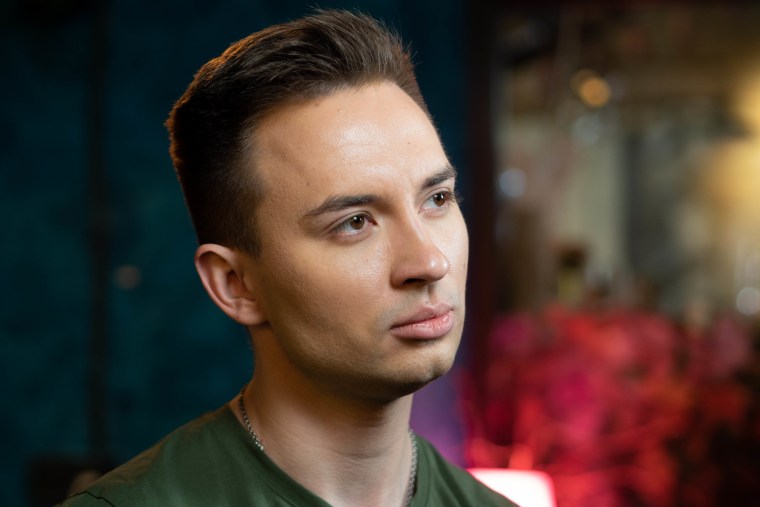
On a riotous Instagram profile featuring pole-dancing, cross-dressing and fierce makeup, a picture of Ivan Honzyk in high heels and stockings next to an image of him in military uniform has gotten the most likes by far.
The junior sergeant’s posts are a bold statement in socially conservative Ukraine, where pride parades were often attacked before the war and swaths of the country are occupied by forces loyal to Russia, one of the world’s most conspicuously homophobic states.
But as more members of the LGTBQ community fight on the front lines, the greater visibility of gay and lesbian military personnel appears to be a catalyst for acceptance in wider society, and opinion polls show attitudes are changing.
Honzyk, 27, said his uncompromising self-expression, combined with his work in places like Bakhmut — the city in eastern Ukraine that has seen some of the bloodiest battles of the war, while serving as a potent symbol of the country’s defiance — is helping to further the cause of LGBTQ rights in the country faster than any pride marches could.
“My fellow soldiers are really impressed with what I’ve done in Bakhmut, the massive scale of work that I did there, and after that they just don’t care about who I sleep with,” Honzyk, whose medical unit evacuates wounded soldiers and provides emergency first aid, said in a hip café in Ukraine’s capital, Kyiv, while on leave from the front line.
Plenty of other gay and lesbian soldiers have also posted photos and videos of themselves online, some sporting unicorn insignia on their uniform, the mythical creature an ironic riposte to the idea that there are no LGBTQ people in the military.
In the U.S., lesbian, gay and bisexual people were allowed to serve openly in the military only in late 2011. Ukraine’s armed forces did not have rules preventing the LGTBQ community from serving, but homophobia was rife in the ranks, reflecting a more widespread societal attitude.
Honzyk said gay and lesbian soldiers were helping change homophobic attitudes in the socially conservative country. Mo Abbas / NBC News
But in apparent recognition of their services, Ukrainian lawmakers recently tabled draft legislation that would recognize same-sex relationships and address the lack of inheritance, medical and other rights for the partners of LGTBQ soldiers killed or wounded fighting pro-Moscow forces.
“The parades and pride events were not enough,” said Honzyk, who has served for four years. “The better way to change attitudes is what we’re doing now. We entered the military and we’re showing that we’re worthy. We’re not hiding somewhere at the back. We’re doing real missions, dangerous missions.”
LGBTQ ‘propaganda’
Across the border, President Vladimir Putin has maintained that he launched the invasion in February 2022 to protect Russian-speaking people in Ukraine’s east, while attempting to frame what he calls the “special military operation” as a defense of morality against un-Russian liberal values promoted by the West.
Putin has frequently espoused “traditional values” in his speeches and framed gender-transition surgery and same-sex parenting as morally degenerate Western imports. In December he signed a law expanding Russia’s restrictions on promoting what it calls “gay propaganda,” in effective outlawing any public expression of LGBTQ behavior in Russia.
Any action considered an attempt to promote homosexuality in public; online; or in films, books or advertising could incur a heavy fine.
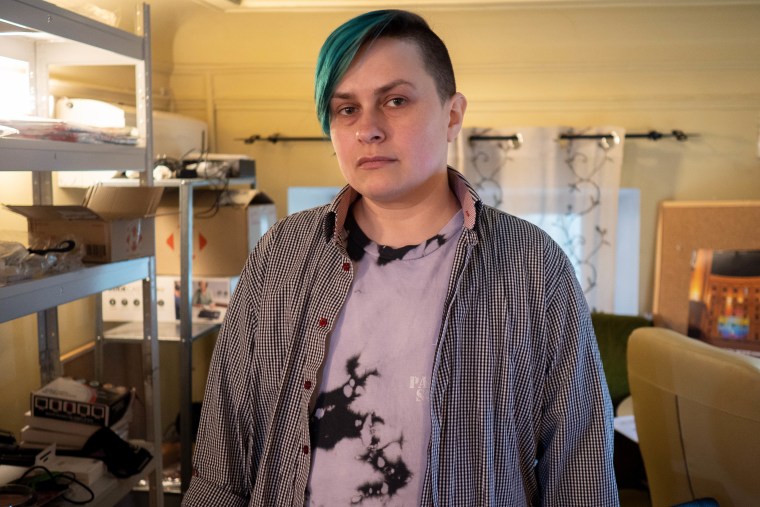
Activists like Edward Reese, 37, a nonbinary communications officer with KyivPride, said Russia’s invasion had sharpened Ukraine’s sense of its own distinct identity and caused many of his countrymen to show more empathy toward their LGBTQ compatriots.
“People see that homophobia, transphobia, sexism, racism are Russian values,” he said. “People understand that they don’t want to have anything in common with Russia. So that’s why they start to rethink their own homophobia here in Ukraine.”
KyivPride Communications Coordinator Edward Reese.Mo Abbas / NBC News
Reese said he had a tough upbringing and was sent for so-called conversion therapy by religious parents who followed the Ukrainian branch of the Russian Orthodox Church.
The church has been outspoken against LGBTQ people, and last year its leader, Patriarch Kirill of Moscow, said the “sin” of gay pride parades justified the war in Ukraine.
But his influence and that of his church has plummeted in recent years in Ukraine. In 2019 the Orthodox Church of Ukraine split from its Russian counterpart.
Kyiv has since accused Russian Orthodox priests of spying for Moscow, charges they deny.
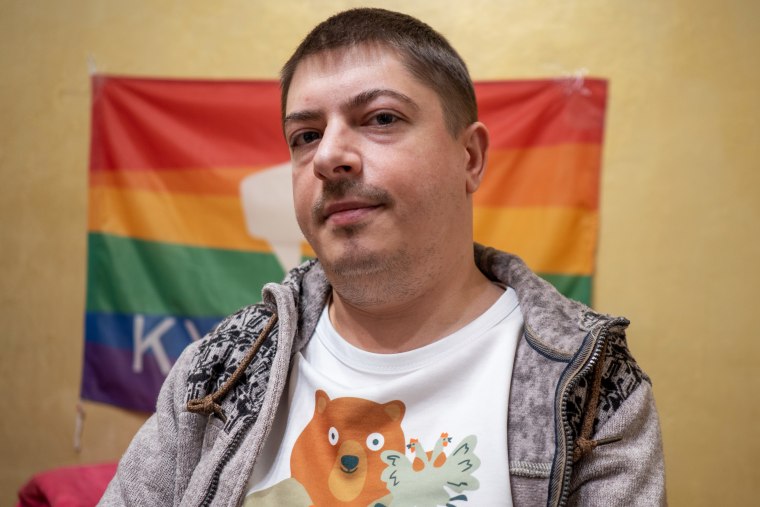
“Ukrainian civil society is trying to kick out the Russian Orthodox Church, and they are the most anti-gay people in Ukraine,” said LGBTQ activist Maksim Mishkin, 40, speaking at KyivPride’s offices.
“Today most religious people in Ukraine are either positive or neutral towards us.”
Somebody to hate
Away from the battlefield, LGBTQ groups in Ukraine and abroad have helped evacuate and house people displaced by the fighting and raise money for the military.
Mishkin said he had held fundraisers to send care packages to serving personnel, the appreciative soldiers sending back photos of themselves brandishing coffee mugs and other items featuring LGBTQ-affiliated logos.
Such efforts may have contributed to growing acceptance in Ukraine.
Ukrainian LGBTQ activist Maksim Mishkin at KyivPride’s offices.Mo Abbas / NBC News
A January survey by the U.S.-based National Democratic Institute, a nonprofit, nongovernmental organization that works to increase the effectiveness of democratic institutions in developing countries, found that 58% of Ukrainian respondents agreed that LGBTQ “people should have the same rights as others.”
That contrasts with a 2016 survey by the Kyiv International Institute of Sociology that showed 60.4% of respondents viewed LGBTQ people negatively. Last year a similar poll found that percentage had shrunk to 38.2%.
Ukrainian politician Inna Sovsun hopes to harness the positive momentum to pass a draft bill she introduced in parliament last month recognizing same-sex relationships.
“When a person in uniform says, ‘Look, I have a loved one. If I am killed in action protecting this country, protecting every single one of you, my partner will not be able to make decisions about where to bury me because there is no legal connection between us,’ that is something that society cannot say no to, because they are in uniform and risking their lives every single minute for us,” she said.
“Right now it’s not just the right thing to do, it’s also the politically smart thing to do, because the majority of Ukrainians actually support it,” she added.
However, she cautioned that the level of support for LGBTQ rights in Ukraine can be overstated.
Outside of the country’s main metropolitan centers, life for LGBTQ people can be difficult, she said, adding that not all LGBTQ military personnel were accepted by their peers and some had been bullied.
For Honzyk, life’s too short to worry about the haters before he heads back to the front line.
“If you accept yourself, then the world will accept you too. You need to remember a lot of people are wearing masks, but you shouldn’t do that because you have only one life, and any day a missile may kill you,” he said.
“Don’t care about what other people say, because they’ll always find somebody to hate.”