Salvadoran president Nayib Bukele agreed on December 15 to implement an Asylum Cooperative Agreement with the US government. It allows US immigration authorities to transfer non-Salvadoran asylum seekers to El Salvador, instead of allowing them to seek asylum in the US.
US President-elect Joe Biden has pledged to terminate the deeply flawed agreement, a deeply flawed deal that presupposes El Salvador can provide a full and fair asylum procedure and protect refugees. But for some groups, including lesbian, gay, bisexual and transgender (LGBT) people, El Salvador provides no safe haven. Its own LGBT citizens lack protection from violence and discrimination.
A recent Human Rights Watch report confirms the Salvadoran government’s own acknowledgmentthat LGBT people face “torture, inhuman or degrading treatment, excessive use of force, illegal and arbitrary arrests and other forms of abuse, much of it committed by public security agents.” Social and economic marginalization further increase the risk of violence. Many LGBT people flee from home.
Between January 2007 and November 2017, over 1,200 Salvadorans sought asylum in the US due to fear of persecution for their sexual orientation or gender identity. In a groundbreaking judgment, a UK court recently granted asylum to a non-binary Salvadoran, finding that their gender expression exposed them to police violence and daily abuse and degradation.
Five years ago, El Salvador seemed poised to champion LGBT rights. It joined the UN LGBTI Core Group. It increased sentences for bias-motivated crimes. Its Sexual Diversity Directorate trained public servants and monitored government policies for LGBT inclusiveness.
Bukele, then a local official, pledged to be “on the right side of history” on LGBT rights. When he ran for president, his promises dissolved. He opposed marriage equality, effectively shut down the government’s sexual diversity work, and refused to support legal gender recognition for trans people. Despite the landmark conviction of three police officers in July for killing a trans woman, violence remains commonplace, and justice out of reach, for many LGBT people.
The Salvadoran government should back a gender identity law and comprehensive civil non-discrimination legislation, prosecute anti-LGBT hate crimes, and reestablish a well-resourced office to promote inclusion and eradicate anti-LGBT violence. It should axe the Asylum Cooperative Agreement.
As things stand, El Salvador fails to provide effective protection to its own LGBT citizens, let alone LGBT people fleeing persecution elsewhere.
The SF IndieFest is pleased to screen the following LGBTQ+ themed films as part of the 23rd anniversary of the festival which returns February 4-21, 2021. More information at www.sfindie.com.
DENNIS: THE MAN WHO LEGALIZED CANNABIS Brandon Moore Local Film This is the story of veteran, LGBTQ+ and cannabis activist, Dennis Peron, who fought to get cannabis to HIV/AIDS patients in 1990s San Francisco despite repeated arrests and intimidation from authorities.He’s known as the “father of medical marijuana.” He was an early advocate of its health benefits for HIV/AIDS patients and, with his partner John Entwistle Jr., started the first Cannabis Buyer’s Club to distribute cannabis to AIDS patients and others in medical need.
EACH AND EVERY NIGHT Julie Robert Since childhood, Lea has been seeing ghostly deer looming around her. Now that she is in a relationship with Maud, the visions are getting worse. How can she prove to her girlfriend, and to herself, that this is a real problem to be dealt with?
GNT Sara Hirner, Rosemary Vasquez-Brown Glenn is a woman on an unwholesome mission, but just how far will she go to conquer the clique – and social media at large?
JUMBO Zoé Wittock Jeanne (Noémie Merlant) is a shy, young woman that lives at home with her uninhibited bartender mother and works the graveyard shift as a cleaner at an amusement park. Her mother wants her to meet a man, but Jeanne prefers tinkering in her bedroom with wires, light bulbs, and spare parts, creating miniature versions of theme park rides. During her late-night shifts she begins spending time with the alluring new Tilt-A-Whirl ride that she decides to call Jumbo. Finding herself seduced by “his” red lights, smooth chrome, and oily hydraulics, Jeanne concludes that the thrilling new relationship she wants to pursue is with the park’s newest attraction, Jumbo.
MORGANA Josie Hess, Isabel Peppard US Premiere After 20 years as a dutiful housewife stuck in a loveless, sexless marriage, Morgana has had enough of her dreary life. Desperately lonely and starved of intimacy, she books a male escort for one last hurrah before ending it all. Her final night takes an unexpected turn when her relationship with the escort opens up a new world of personal and sexual freedom. After hearing about a competition for first time erotic filmmakers, Morgana directs and stars in a film about her own story, Duty-Bound. Unexpectedly, her film wins, catapulting her into the international Feminist Porn community. Life merges with art as Morgana uses erotic filmmaking as a tool for creative catharsis, while struggling with demons from her past.
THE PASSING ON Nathan Clarke Three professions ushered Black former slaves from poverty to the American dream: preacher, teacher, and undertaker. Today, renowned embalmer James Bryant puts his faith in a new generation to continue this vanishing legacy. He’s met with resistance from his young intern, Clarence Pierre, who himself is conflicted about his commitment due to the judgment he feels from the Black community as a queer, Christian man.
With the coronavirus raging and leaving a deadly wake in Sonoma County, the nearly monthlong lockdown set to be lifted Saturday has been extended at least another month.
County Health Officer Dr. Sundari Mase confirmed Friday the local public health stay-home order that strictly limits daily life and commercial activities will remain in place four more weeks. The directive had gone into effect Dec. 12 to counter an alarming increase in COVID-19 transmission and help contend with expected challenging weeks of the infectious disease.
With 3,029 new virus infections the past two weeks and deaths mounting in January at a record pace, it’s unsurprising the lockdown will continue into February.
On Friday, local public health officials reported five more people died of complications of COVID-19, raising the weekly death toll to 23 and to 27 so far this month. Now, 219 county residents have lost their lives to the contagion since the pandemic began last March.
And this winter resurgence of the coronavirus is expected to claim more lives in the coming weeks, as one local infectious disease doctor on Thursday called the number of deaths “the tip of the iceberg.”
The physician, Dr. Gary Green, at Sutter Santa Rosa Regional Hospital predicted: “I really think that January is going to be, probably, the most deadly month in the pandemic so far.”
Mase has issued a blunt warning to county residents to adhere to the public health order because the area is experiencing “really widespread community transmission now with a case rate that is three to four times higher than what it was just six to eight weeks ago.”
Much like the widespread restrictions issued in March at the start of the pandemic, the county’s extended lockdown will deliver yet another blow to some of the county’s core economic sectors and small businesses. Restaurants, breweries and wineries only can sell food and beverages for takeout or delivery. A slew of personal care salons will remain closed for haircuts, manicures and pedicures, among other services. Hotels are barred from booking leisure travel guests.
Retail operations will be allowed to continue at 20% of customer capacity, or 35% capacity for stand-alone grocery stores.
Residents are advised to stay home, except for essential work and errands and outdoor recreation to remain healthy. All gatherings outside the home of any size are temporarily banned. Outdoor services are allowed at places of worship. Families can take their children to playgrounds.
Last month, the county’s return to a shutdown came a week after Gov. Gavin Newsom issued a stay-home order for all regions of the state where hospital intensive care unit bed availability dropped below 15%. At that time, the ICU capacity for Bay Area hospitals was 17.8%. This week, as of Tuesday, the latest data available, that ICU availability has plunged to 7.4% for the region.
However, Sonoma County hospitals still have roughly 28% of intensive care beds open. For the most part, they continue performing elective surgeries and keep balancing treating virus patients and those suffering with other illnesses.
Although the rampant virus spread is assaulting a broad part of the county, once again the pandemic is tormenting skilled nursing centers and residential care homes for the elderly. The virus devastated these sites in August but had ebbed, only to come roaring back. There’s been about 150 new infections at senior care homes of the county most vulnerable residents the past two weeks, and 10 residents have died from COVID-19.
For nursing home residents, death from COVID-19 is one of extreme isolation and misery, said Jenny Fish, a local hospice physician and one of the founders of HPEACE, a health care advocacy organization. Fish works with a number of hospice nurses who care for patients in local senior care homes.
When news organizations projected that Democrat Raphael Warnock had won one of Georgia’s two critical Senate runoffs on Tuesday, Ian Webb sat in his Atlanta apartment and cried.
“I’ve grown up believing that Georgia is a red state, and that I was a blue dot,” Webb, 24, told NBC News. “Since I turned 18, I’ve been volunteering on Democratic campaigns at every level of government, and to be quite frank, I became accustomed to losing and essentially being told that as a queer individual, I don’t deserve the same rights as my straight brothers and sisters.”
Warnock and fellow Democrat Jon Ossoff, who won the other runoff, ran on a platform that explicitly backed pro-LGBTQ policies, including nondiscrimination protections at the federal level.
“I also am just excited to have two senators representing Georgia who believe that love is love, trans rights are human rights, and that everyone is equal under the law and the constitution,” Webb said. “We have leaders who represent Georgia with love and conviction.”
Both Ossoff and Warnock are on record as supporting the Equality Act, federal legislation that would modify existing civil rights protections to include protections against discrimination based on sexual orientation and gender identity in employment, housing, public accommodations, jury service, education, federal programs and obtaining credit.
The legislation passed in the Democrat-controlled House but was never given a vote in the GOP-controlled Senate. With Democrats now controlling both chambers of Congress, thanks to the results in Georgia, President-elect Joe Biden has said he hopes to sign the legislation within his first 100 days in office.
Organizers in Georgia told NBC News that the candidates’ support for the LGBTQ community goes beyond just supporting federal legislation.
Jeff Graham, executive director of Georgia Equality, a statewide LGBTQ advocacy group, said the Ossoff and Warnock campaigns were “the first time anyone from Georgia running for federal office actively engaged the LGBT community” in his 12 years leading the group.
Graham said the candidates’ efforts to actively engage with the LGBTQ community and develop platforms that cater to the community’s specific needs was an important part of their winning coalition. Georgia Equality, he added, engaged around 650,000 pro-equality voters — both LGBTQ Georgians and allies who support LGBTQ rights —as part of the organization’s comprehensive get-out-the-vote effort.
The Human Rights Campaign, the nation’s largest LGBTQ advocacy group, said it deployed a dozen staff members to the state and had hundreds of volunteers dedicated to mobilizing its 1.3 million “equality voters,” including its estimated 356,000 voting-age LGBTQ residents.
“I hope that, first and foremost, they will remember that the LGBT community helped them win their elections on Tuesday. But second of all, to really recognize that, as senators from the South, it’s incredibly important for them to continue to engage LGBT communities around the state,” Graham said. “This is not something that LGBTQ folks in Georgia, or frankly in the South, are used to having.”
The Rev. Jasmine Beach-Ferrara, executive director of the Campaign for Southern Equality, a North Carolina-based organization that works to promote LGBTQ equality across the South, said she would like to see the Democrat-controlled Senate prioritize LGBTQ discrimination protections at the federal level.
“For the one-third of LGBTQ Americans who live in the South, inaction from the federal government has caused significant harm, delaying solutions on everything from Covid-19 dangers, economic hardship and health care disparities to anti-LGBTQ discrimination and the violence of white supremacy,” Beach-Ferrara said. “Finally, following these important Senate victories, there is a pathway forward for addressing these societal challenges.”
‘Hoped for the best, expected the worst’
For some LGBTQ Georgians, like Roxy, a 36-year-old lesbian who lives in the Atlanta suburb of South Fulton, the election results came as a total shock. Roxy said she didn’t even bother to stay up late Tuesday night to see the results.
“I didn’t have any expectations, especially with so many more people believing the rhetoric that progress equates to losing privileges,” she said. “I cast my vote, hoped for the best and expected the worst.”
“As a Black lesbian, I am glad that we have elected politicians that will push progressive policies,” she added, noting that she voted for both Warnock and Ossoff. “I have faith that, at least for these next four years, my rights are protected, but enforcement of those protections is yet to be seen. We are living in a very polarizing time in history.”
Roxy declined to have her full name published out of fear that being publicly identified as a Black lesbian could put her in danger.
Jen, a 45-year-old bisexual woman who lives outside Atlanta, said the election of Ossoff and Warnock brought relief for her and her transgender child. She said the exhaustion she felt after participating in volunteer efforts to get both Democrats elected was offset by seeing her child’s reaction on Wednesday morning upon learning of the election results.
Jen, who asked that her full name not be published to protect the privacy of her transgender child, said the real work has only just begun. She expressed hope that Congress and the incoming Biden administration will work to reverse the Trump administration’s rollback of LGBTQ rights, including its ban on transgender service members serving openly in the military and its removal of transgender discrimination protections in health care.
“I don’t feel our job is done,” she said. “LGBTQ issues and rights are human rights — they are everyone’s rights. We should all be fighting for these rights, and I want to see them fighting for them.”
An Ontario, Canada, court has ruled that a trans woman must pay the travel costs for her two children to move in with their mother in Washington, US.
Increasingly isolated from her family, the upshot of a legal custody battle has seen Darcy feel she is drifting from her children after her former spouse divorced her in 2017.
Her ex is now remarried to a man who works for Microsoft, theOttawa Sunreported. Darcy and her family were then plunged into a custody battle that sowed division and fear, she said, as her former partner wished to relocate to Washington as her new husband’s job is there.
In the judgment released last month, justices ruled that Darcy’s youngest children can move some 4,000 kilometres away to stay with their mother, step-father and half-sibling.
“I’m in shock, just shock,” the 37-year-old told the outlet.
“They’re moving my kids to a place I can’t go and the idea that I somehow should pay their costs to take my children away seems kind of unfair.”
Ontario Superior Court justice David Broad considered that while a joint custody agreement would be in the best interests of the children, they need to be allowed to move with their mother.
It’s a decision that has left Darcy reeling, weary of both the rampaging coronavirus keeping country borders shut as well as a US she feels is unwelcoming of trans folk.
“The likelihood of me seeing my kids now is just so low because of COVID,” she explained, finding little respite in the virtual access judges granted her alongside extended long weekends, four weeks in the summer and a week over Christmas vacation.
To her list of woes, she added that as a trans person she “doesn’t feel comfortable” in the US. “I used to travel there for work and I won’t anymore,” she added, worrying that her children would be exposed to transphobia if raised there.
But Broad disagreed. Writing in his judgement: “It was clear from her testimony that the applicant’s concerns respecting these issues are sincere and strongly held.
“However, no expert evidence was led that would suggest that living in the State of Washington, with exposure to the local culture, would adversely affect the children’s development and best interest.”
The number of coronavirus deaths in Sonoma County is soaring, a grim reminder of rampant virus transmission in the community as the infectious disease infects many more of the county’s most vulnerable residents in senior care homes and the general population.
In just the first seven days of the year, county health officials have reported 22 deaths linked to COVID-19. Ten were reported by county officials on Thursday after eight on Tuesday, boosting pandemic deaths to 214.
The 10 fatalities are the most county officials have revealed in a single day since the pandemic started last March, mirroring California’s record deadly virus trend.
With virus-related deaths clearly mounting, the county Sheriff’s Office recently acquired a refrigeration trailer that can hold 56 bodies if the county morgue gets “bombarded with deaths” and reaches its limit, Sheriff’s spokesman Juan Valencia said.
“We have not peaked in the second wave yet; we haven’t seen the worst of it,” said Dr. Gary Green, an infectious disease specialist at Sutter Santa Rosa Regional Hospital. “I really think that January is going to be, probably, the most deadly month in the pandemic so far.”
Raising the alarm, Green and other health care experts said COVID-19 is spreading in the community at a greater extent now compared with the summer months. That means more residents sick with the virus are being hospitalized, and eventually more people will die, Green said.
Dr. Sundari Mase, the county’s health officer, said the spike of deaths and people hospitalized with the respiratory disease shows how prevalent the virus is in the county. Mase stressed the importance of adhering to public health orders and personal safety rules, including masking, hand-washing and social distancing.
“We have widespread, really widespread community transmission now with a case rate that is three to four times higher than what it was just six to eight weeks ago,” she said.
Mase and other health care experts said a larger share of the local deaths linked to the virus now are occurring in the general population, compared to last summer when COVID-19 fatalities were mainly driven by infections in skilled nursing centers and residential care homes for the elderly. These residents still remain vulnerable to being hospitalized and dying from the virus.
Coronavirus-related deaths among senior care home residents comprised 40% of the 40 fatalities since Dec. 10, showing the dramatic swing from the start of the pandemic to last month when such elderly residents accounted for 65% of virus deaths. Among these 40 latest deaths, 15% originated from household transmission of the virus, 8% were tied to Thanksgiving gatherings, while the virus source is unknown for 35% of these fatalities, local health officials said.
Of the 18 fatalities reported so far this week, at least nine were residents living in either skilled nursing or residential care sites, while eight were people in the general population. One was disclosed late Thursday night and no information was immediately available about that fatality.
All who were living in senior care homes were 64 or older, as were four of the eight people living at home. Three of the deceased who lived at home were between 50 and 64 and one was between 18 and 49 — a stark reminder the virus can be deadly in young residents.
On Thursday, California public health authorities reported a record two-day total of 1,042 coronavirus deaths, as many hospitals statewide grapple with unprecedented numbers of patients afflicted with the virus.
The state Department of Public Health’s website listed 583 new deaths, after 459 deaths Wednesday. The previous two-day record total was 1,013 deaths at the end of December. California’s death toll since the start of the pandemic has eclipsed 28,000.
It is 20 years today since the age of consent was finally equalised in the UK after a bruising, years-long campaign from LGBT+ activists.
Today, queer people enjoy many of the same rights as their straight counterparts in the UK – but that wasn’t always the case. Homosexuality was illegal in all circumstances up until 1967, and same-sex marriage was once just a distant dream.
Among the many legal hurdles queer people had to overcome was the battle to equalise the age of consent. Gay and bisexual men had been governed by a separate age of consent for decades, pushing them further into the shadows in the process.
On 8 January, 2001, the Sexual Offences (Amendment) Act finally came into force after it was passed by parliament on 30 November, 2000, lowering the age of consent for gay and bisexual men to 16 in England, Scotland and Wales, and 17 in Northern Ireland – finally granting queer people the autonomy over their bodies they so desperately craved.
The debate surrounding the age of consent for gay and bisexual men in the UK began as early as 1957, when the Wolfenden Report first recommended that the ban on homosexuality be overturned. Crucially, that same report also recommended that the age of consent for gay and bisexual men be set at 21, a full five years later than for straight people.
A decade on, the recommendations made in that report finally made it into law in the form of the Sexual Offences Act 1967, which partially decriminalised homosexuality in England and Wales. As was recommended in the Wolfenden Report, gay and bisexual men would be allowed to have sex, but only in certain circumstances – and only when they were aged over 21.
According to historian Florence Sutcliffe-Braithwaite, this “discriminatory provision” was added to the law to reflect “the longstanding association between homosexuality and corruption, particularly the corruption of the young by the older, supposedly ‘hardened’ homosexuals”.
The House of Lords blocked efforts to equalise the age of consent
In the years that followed, the debate around the age of consent continued – but it wasn’t until 1994 when the law finally started to change. Conservative MP Edwina Currie, joined by more than 40 Tory MPs, proposed an amendment to the Criminal Justice and Public Order Bill to equalise the age of consent in 1994. The amendment was voted down by parliament, but MPs did agree to lower the age of consent for gay and bisexual men to 18.
However, the fight was not yet won, with queer men still not granted the same rights as their straight counterparts.
In 1998, Labour MP Ann Keen introduced an amendment to the Crime and Disorder Bill in an effort to equalise the age of consent, and it passed with a majority of 207 in the House of Commons. But when it went to the House of Lords, it was firmly rejected by a majority of 168.
The government dropped the bill temporarily, but it was revived later that year and once again sailed through the Commons only to be blocked by the Lords. This second rejection prompted the government to invoke the Parliament Acts of 1911 and 1949, which limited the powers of the House of Lords to block acts. Finally, the age of consent was on track to be equalised.
On 30 November, 2000, speaker Michael Martin announced the passage of the act and it received Royal Assent several hours later.
This is a piece of legislation driven by Metropolitan, London attitudes and is completely out of step with the rest of the country.
But the government’s decision to effectively bypass the House of Lords did not pass without controversy. Baroness Young, the former Tory minister who fought tirelessly against equalising the age of consent, said the government’s invoking of the Parliament Acts was a “constitutional outrage”.
As violent white supremacists attacked the US Capitol, and democracy itself, on Wednesday (6 January), Mary Trump called out her uncle for ‘orchestrating’ the insurrection.
An armed, extremist mob of Donald Trump supporters breached the US Capitol, storming the rotunda and breaking into the Senate chamber to fire tear gas at senators in a bid to overturn the US election result as the Electoral College votes were counted by Congress.
The election has now been certified by Congress as a win for Democratic president-elect Joe Biden and his vice president-elect Kamala Harris.
The pro-Trump rioters descended on the Capitol on the president’s instructions, moving from the “March to Save America” to the seat of the legislative branch of the US government, violently breaching the complex while holding Confederate flags, tearing down four layers of security fencing and fighting federal police.
Four people were killed during the riots – one woman was shot by police, while three others died as a result of “medical emergencies”, officials said. Fourteen police officers were injured.
As the terrifying chaos was unfolding, the lame duck president’s lesbian niece Mary Trump took to Twitter to call out her uncle for his role in the attack.
“Make no mistake, the so-called leader of our country, who swore to protect and defend the Constitution, directed a horde of white supremacist domestic terrorists to stage a coup to overturn a legitimately decided election,” she said.
“He isn’t just encouraging them, he IS them.
As the riots continued, she added: “Why are these f**king traitors not being held at gunpoint, handcuffed, and arrested
“It’s not a mystery – this was allowed to happen.”
Hours after the Capitol riots began, the president finally made a video statement via Twitter, which has since been removed by the social media platform, in which he told the extremists: “We love you, you’re very special.
Mary Trump responded: “Pouring gasoline on the fire under the guise of pretending to put it out. None of his statements should be aired.”
As well as criticising her uncle, she denounced the “abject failure of the DC police force” in combatting the riots, and added that “every seditionist House member who supported and encouraged this attempted coup needs to be expelled”.
Christy Holstege, mayor of Palm Springs in California, has slammed the “white privileged people” flocking to resorts for holidays as coronavirus cases surge.
Many queer people have been watching in horror in recent weeks as influencers – many of them white gay men – flocked to resorts such as Puerta Vallarta in Mexico to attend “circuit parties” as COVID-19 spirals out of control in many parts of the world.
One of those high-profile “circuit parties” ended in disaster when the boat the party was taking place on capsized – but many queer people struggled to feel sorry for those on board.
Holstege, who made history when she became the first out bisexual mayor in the United States in December 2020, has hit out at those travelling abroad and jeopardising the health and wellbeing of others.
She shared a screenshot of a post from GaysOverCovid, an anonymous Instagram account dedicated to calling out the gay men travelling abroad for circuit parties during the pandemic, and wrote: “Throwing and attending [a party] in Mexico as an American is super problematic.”
Christy Holstege says it’s ‘unacceptable’ to host ‘massive parties’ right now.
Holstege doubled down on her criticism on her Instagram Stories, sharing a screenshot of a comment she left on another post in which she laid out her views on those travelling abroad.
In the post, Holstege said it was “unacceptable” for people to be holding “massive parties during the height of the global pandemic”.
“It violates the state’s stay at home orders which prohibits non-essential travel, it’s dangerous that people attending will be coming back to our communities, especially considering our LGBTQ community is particularly at risk and traumatised from the HIV pandemic, and it’s especially problematic as [it’s] mostly white privileged people travelling to a lower income country and communities of colour that can’t afford to keep out infected tourists,” she wrote.
“I am hearing from tons of residents of Palm Springs who are extremely concerned about this.”
Holstege went on to praise the GaysOverCovid Instagram account, saying she was “grateful” to them for calling out members of the community who were deliberately flouting coronavirus restrictions.
Many in the LGBT+ community have expressed their shock and dismay at seeing huge numbers of (mostly white) gay men flocking to resorts abroad for parties in recent weeks.
The GaysOverCovid Instagram account has attracted international media attention for calling out those partying through the pandemic, and it has racked up more than 100,000 followers in the process.
Much of the world is currently facing into a huge surge in coronavirus case numbers, with California experiencing a significant rise in the number of people infected with COVID-19.
An estimated 1.85 million people have died worldwide with COVID-19 since the virus first appeared in Wuhan, China, in 2019.
The Trump administration has spent the past four years stacking the courts with anti-gay judges, according to a new report from LGBTQ civil rights group Lambda Legal.
Nearly 40 percent of President Donald Trump’s confirmed federal appellate judges have demonstrated anti-LGBTQ bias, the organization claimed, from opposing same-sex marriage and protecting businesses’ rights to reject gay customers to helping implement the military’s transgender ban.
Lambda Legal CEO Kevin Jennings said the report is a “call to action” for President-elect Joe Biden.
“While Donald Trump’s presidency may be coming to end, his devastating impact on our federal courts will take decades to reverse,” Jennings said in a statement. “When the basic human rights of LGBTQ+ Americans are so often challenged in court, we cannot accept a judiciary stacked with judges who would disenfranchise these vulnerable groups.”
The report, Courts, Confirmations & Consequences, also claims that the outgoing administration has seated judges faster than any other in recent history: 54 of Trump’s circuit court nominees were confirmed in four years, while President Barack Obama had only 55 confirmed in his eight years in office.
Of Trump’s 57 nominees for federal appellate judgeships, Lambda Legal opposed 22 because of their anti-LGBTQ records, including three who received lifetime appointments in 2020.
Among them is Andrew Brasher, who was confirmed in February to the 11th U.S. Circuit Court of Appeals. Previously, Brasher worked with the Alliance Defending Freedom on an amicus brief that argued that same-sex marriage was “harmful to children.”
In another amicus filing, Brasher claimed that a New Mexico wedding photographer had the right to turn down a gay couple because her involvement would suggest “approval, validation and celebration of the ceremony.”
Lambda Legal senior attorney Sasha Buchert called Brasher’s appointment an “affront to civil rights.”
“Judge Brasher’s record to undermine the rights of LGBTQ people and years of advocacy to suppress voting rights should not have been rewarded with the lifetime promotion that he just received from Republicans in the U.S. Senate,” Buchert said in a statement at the time.
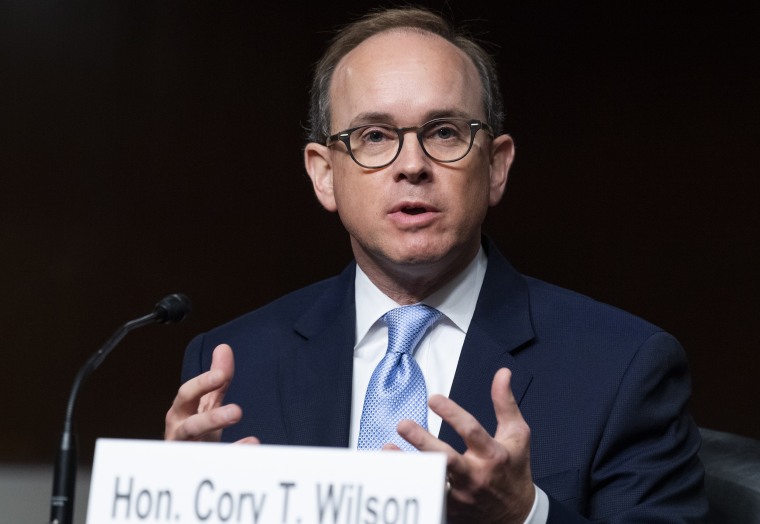
Appeals Judge Cory Wilson testifies during his confirmation hearing on Capitol Hill on May 20.Tom Williams / CQ-Roll Call, Inc via Getty Images
Cory Wilson, who was appointed to the 5th Circuit court in June, called same-sex marriage “a pander to liberal interest groups” in a 2012 op-ed for the Press-Register of Mobile, Alabama. In another piece the same year, he defended Chick-fil-A CEO Dan Cathy’s donations to anti-LGBTQ causes, complaining that private citizens were being “bashed, banned, and bankrupted, simply for expressing their views.”
As a state legislator, Wilson backed Mississippi’s HB 1523, a controversial religious freedom law that allows businesses, state employees and even health care providers to refuse service to LGBTQ people based on “deeply held religious beliefs or moral objections.”
A month before Justin Walker was appointed to the D.C. Circuit court in September, he ruled in favor of a Christian photographer who ran afoul of the Fairness Ordinance in Louisville, Kentucky, when she advertised that she shoots only heterosexual weddings.
“America is wide enough for those who applaud same-sex marriage and those who refuse to,” Walker, then a district judge for western Kentucky, wrote in a 27-page opinion. “The Constitution does not require a choice between gay rights and freedom of speech. It demands both.”
Other confirmed Trump nominees whom Lambda Legal has opposed are D.C. Circuit appeals Judge Gregory Katsas — who, as deputy White House counsel, provided legal advice for the administration’s ban on transgender service members — and 5th Circuit appeals Judge Kyle Duncan, who represented the Virginia school district that tried to ban transgender student Gavin Grimmfrom using the bathroom aligning with his gender identity.
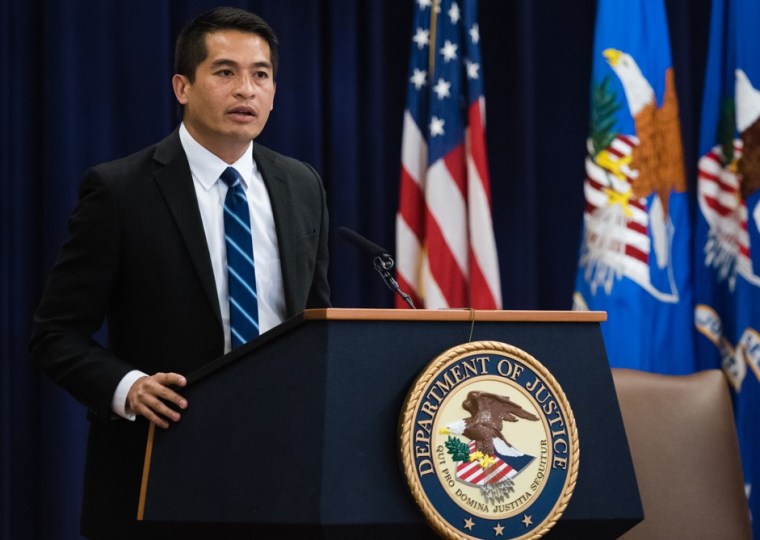
Lambda Legal did not oppose the nomination of Patrick Bumatay, now the first openly gay judge on the 9th Circuit appeals court. In February, Bumatay issued a dissent saying the Idaho Corrections Department was under no obligation to approve a prisoner’s request for gender-affirming surgery.
Patrick BumatayDept. of Justice
The country’s 13 federal appellate courts (12 circuit courts representing different regions across the U.S. and the Federal Circuit Court in Washington, D.C.) sit just one level below the Supreme Court. They are the final arbiters in tens of thousands of cases annually, because the Supreme Court traditionally takes up only a hundred or so.
“Circuit court judges exert tremendous influence in shaping our nation’s laws and have a profound impact on the everyday lives of Americans,” the report reads.
Trump appointees account for nearly a third of the 179 circuit judges. In nine of the 13 circuits, his picks are a quarter of the active-duty (i.e., non-senior status) judges. He also appointed 174 of the 644 judges on federal district courts.
White House deputy press secretary Judd Deere praised Trump’s “unmatched record” of appointing judges who believe in applying the Constitution “as written, not legislating from the bench.”
“The President has always been transparent with the American people about the qualifications he considers paramount and who he would consider for a seat on the High Court in order to ensure this exceptional nation built on the rule of law continues for generations to come,” Deere said in an email.
Before he leaves office on Jan. 20, Trump will also have appointed three Supreme Court justices: Neil Gorsuch, Brett Kavanaugh and Amy Coney Barrett.
While Lambda opposed all three, Gorsuch issued the majority opinion last year in Bostock v. Clayton County, Georgia, a landmark decision that determined that the Civil Rights Acts of 1964 barred workplace discrimination based on sexual orientation and gender identity.
“Those who adopted the Civil Rights Act might not have anticipated their work would lead to this particular result,” Gorsuch wrote in the ruling in June. “But the limits of the drafters’ imagination supply no reason to ignore the law’s demands.”
Sharon McGowan, Lambda Legal’s chief strategy officer and legal director, warned that there are many other areas in which Gorsuch has “been much more skeptical about the rights of LGBT people.”
She pointed to his joining Justice Clarence Thomas’ concurring opinion in the 2018 Masterpiece Cakeshop case, in which Thomas argued that the Colorado Civil Rights Commission violated baker Jack Phillips’ right “to freely exercise his religion” by requiring him to sell a wedding cake to a gay couple.
And in a dissenting opinion in Pavan v. Smith, Gorsuch argued in 2017 that the court’s landmark 2015 Obergefell v. Hodges ruling, which made gay marriage legal nationwide, didn’t guarantee the right of same-sex parents to have both their names appear on their children’s birth certificates.
“While some arguments can reach him … he’s certainly not a reliable vote,” McGowan said.