Queer author Robin Stevenson has condemned an Illinois school for cancelling her visit in response to a complaint from a ‘homophobic’ parent.
Robin Stevenson is the award-winning gay Canadian author of Kid Activists: True Tales of Childhood from Champions of Change. She was due to give a talk about the book at Longfellow Elementary School in Wheaton, Illinois.
The school’s vice president asked for a list of the activists mentioned in the book, then abruptly informed her the day before the visit that they would be cancelling without explanation.
Stevenson later learned that the reason was one parent’s objection to their child reading the book, which includes a chapter on the childhood of Harvey Milk, a politician and gay rights pioneer.
Milk was the first openly gay man to be elected to public office in California (Bettman/Getty)
“This action sends a very harmful message to students, particularly students who are themselves LGBTQ+ or have family members who are part of the LGBTQ+ community,” Stevenson wrote in an open letter to the school.
“It says their lives can’t be talked about, that their very existence is seen as shameful or dangerous. It says that no matter how significant their accomplishments, or how much they contribute to the world, they can be erased and made invisible because of who they are. It reinforces ignorance and bigotry.”
Stevenson added that the decision has had a “real, immediate and distressing” impact, revealing that a closeted LGBT+ student at the school reached out to her two weeks after she was due to give the talk.
“They wrote that they had been thinking about finally coming out, but as a result of homophobic comments made by adults in their community regarding my book and cancelled visit, they are now feeling apprehensive and afraid to do so. I hope this concerns you as much as it does me,” she said.
Kid Activists is a biography about several activists in the world, focusing on their lives when they were children (Amazon)
School officials have reportedly attempted to distance themselves from Stevenson’s allegations, claiming that the parent had complained about “the process we utilise to inform parents about author visits and the contents of the presentation and promotion.”
The local book store that sponsored the visit expressed doubt that there was any reason for the cancellation other than Harvey Milk’s chapter, telling The Daily Herald that this is only the third time in 30 years that the school district has cancelled on an author.
Stevenson also rejected the school’s explanation on Twitter.
To be clear, parents were given the usual notice. They were told an author was visiting, and given an opportunity to order a copy of Kid Activists. Were parents specifically warned that not all the activists in the book were cis and straight? No, and this should not be necessary.
“In choosing to cancel the presentation … you legitimised a concern rooted in homophobia, gave this priority over the wishes of the school administration and staff who had requested the visit, and made the climate in the school less safe for LGBTQ+ staff and students,” she wrote.
Students at a Catholic high school in California have staged a walkout after teachers threatened to out a gay classmate to her parents if she didn’t attend counselling.
High school senior Magali Rodriguez is one of two openly LGBT+ students at Bishop Amat Memorial High School, the only other one being her girlfriend.
The school has no written policy barring same-sex relationships, but when the pair started dating Rodriguez was forced into disciplinary meetings and counselling with the school psychologist, and barred from sitting next to her girlfriend at lunch.
None of these rules applied to straight students, and Rodriguez says she was told that if she refused to comply she would be outed to her parents.
Her classmates were appalled to hear how she’d been treated, and the next day they showed their support in an amazing way – by staging a mass walkout.
Teachers at the Catholic high school told the student she could not even sit next to her girlfriend at lunch. (bishop_amat_hs/ Instagram)
Around 200 students walked out of their classes on Friday afternoon in protest. “I decided to walk out because I wanted to take a stand,” one told Buzzfeed.
“I didn’t agree with what the administration did with the situation and I feel like it was a good idea for the student body to stand as one to show our support for Magali.”
Another said: “I never would’ve imagined Amat to be an environment like this. Once I started to read about the article I was in full shock. I decided to walk out to stand up for her.”
“I feel as if the principal knew they messed up,” a third student added. “Before the bell rang for lunch he made an announcement saying he was aware of the news article.”
Some teachers apparently commented that there were “two sides to every story,” but none tried to stop the protest.
The school’s president and principal tweeted an official statement acknowledging the matter, claiming that the school “is committed to providing a supportive and inclusive learning environment for all students, irrespective of their sexual orientation.”
The winners have been announced in a global competition to design a memorial set to be built on the site of the Pulse nightclub.
The competition was held by the onePULSE Foundation with the purpose of selecting a design team to realize a permanent memorial to honor the victims and survivors of the Pulse shooting, which took place on Sunday June 12, 2016 when a 29-year-old security guard entered the Orlando gay night club with two semi-automatic weapons and opened fire on the crowd. 49 people were killed and 68 wounded. The gunman was shot and killed by police after a three-hour standoff. It was at the time the largest mass shooting in US history, and it remains the nation’s deadliest attack targeting LGBTQ people to date.
The onePULSE Foundation was established, according to its mission statement, “to create a sanctuary of hope following the tragic day in American history… to honor the 49 angels that were taken, the 68 others who were injured and the countless first responders and healthcare professionals who treated them.
“This fund is intended to support a memorial that opens hearts, a museum that opens minds, educational programs that open eyes and endowed scholarships that open doors. All donations will be used for the construction and operation of the National memorial and museum, educational programs and 49 Legacy Scholarships. This is a defining mission and healing initiative that we hope inspires supporters who share our vision and understand the solemn and sacred responsibility to which this community has been entrusted.”
Design concept for the new National Pulse Memorial and Museum (image Coldefy & Associés with RDAI/onePULSE Foundation)
The design was chosen out of 68 submissions from 19 countries. It was selected by a blue-ribbon jury comprised of onePULSE community members, civic decision-makers, global thought leaders and world-renowned architects following a public viewing and comment period in early October. Informed by over 2,300 comments from victim’s families, survivors, first responders and the public, the Jury felt the winning concept best reflected the interests expressed by the community, demonstrated design excellence, inventiveness, creativity and alignment with onePULSE’s core values.
The winning design concept was created by Coldefy & Associés with RDAI, Orlando-based HHCP Architects, Xavier Veilhan, dUCKS scéno, Agence TER, and Prof. Laila Farah. It features looping paths, a reflecting pool, and a garden planted with 49 trees — all created in a color palette of 49 colors. The museum, which will be located at 438 West Kaley Street, will feature interactive sculptures, vertical gardens, and a rooftop promenade.
Barbara Poma, a former co-owner of the club and the CEO of the onePULSE Foundation, created the nonprofit in the wake of the shooting. In a statement, she said the site, which will include a memorial and a museum, will serve as both a gathering place and educational center. She expressed her hope that it would teach “visitors and future generations [about] the profound impact the tragedy had on Orlando, the U.S., and the world.”
Orlando Mayor Buddy Dyer, a member of the jury that selected the winning design, also issued a statement calling this unveiling an important step for the community.
“We will never bring back the 49 innocent victims whose lives were taken on June 12, 2016, or erase the pain that the horrific act brought to so many,” he said, “but the establishment of this memorial is an important part of our community healing process.”
A temporary memorial (also created by onePULSE is currently located on the site. The new permanent memorial, as well as the nearby museum, will begin construction in 2021, with a projected opening in 2022.
When transgender people undergo sex-reassignment surgery, the beneficial effect on their mental health is still evident — and increasing — years later, a Swedish study suggests.
Overall, people in the study with gender incongruence — that is, their biological gender doesn’t match the gender with which they identify — were six times more likely than people in the general population to visit a doctor for mood and anxiety disorders. They were also three times more likely to be prescribed antidepressants, and six times more likely to be hospitalized after a suicide attempt, researchers found.
But among trans people who had undergone gender-affirming surgery, the longer ago their surgery, the less likely they were to suffer anxiety, depression or suicidal behavior during the study period, researchers reported in The American Journal of Psychiatry.
Surgery to modify a person’s sex characteristics “is often the last and the most considered step in the treatment process for gender dysphoria,” according to the World Professional Association for Transgender Health.
Many transgender and gender-nonconforming individuals “find comfort with their gender identity, role, and expression without surgery,” but for others, “surgery is essential and medically necessary to alleviate their gender dysphoria,” according to the organization.
While the new study confirms that transgender individuals are more likely to use mental health treatments, it also shows that gender-affirming therapy might reduce this risk, coauthor Richard Branstrom of the Karolinska Institutet in Stockholm told Reuters Health by email.
Branstrom and colleague John Pachankis of the Yale School of Public Health in New Haven, Connecticut found that as of 2015, 2,679 people in Sweden had a diagnosis of gender incongruence, out of the total population of 9.7 million.
That year, 9.3 percent of people with gender incongruence visited a doctor for mood disorders, 7.4 percent saw a doctor for anxiety disorders and 29 percent were on antidepressants. In the general population, those percentages were 1 percent, 0.6 percent and 9.4 percent, respectively.
Just over 70 percent of people with gender incongruence were receiving feminizing or masculinizing hormones to modify outward sexual features such as breasts, body fat distribution and facial hair, and 48 percent had undergone gender-affirming surgery. Nearly all of those who had surgery also received hormone therapy.
The benefit of hormone treatment did not increase with time. But “increased time since last gender-affirming surgery was associated with fewer mental health treatments,” the authors report.
In fact, they note, “The likelihood of being treated for a mood or anxiety disorder was reduced by 8 percent for each year since the last gender-affirming surgery,” for up to 10 years.
Transgender individuals’ use of mental health care still exceeded that of the general Swedish population, which the research team suggests is due at least partly to stigma, economic inequality and victimization.
“We need greater visibility and knowledge about challenges people are confronted with while breaking gender and identity norms,” Branstrom said.
Dr. Joshua Safer, executive director at Mount Sinai Center for Transgender Medicine and Surgery in New York City, told Reuters Health by email, “If anything, the study likely under-reports mental health benefits of medical and surgical care for transgender individuals.”
Safer, who was not involved in the study, said the fact that mental health continued to improve for years after surgery “suggests (surgery provides) extended and ongoing benefit to patients living according to gender identity.”
Five men in Malaysia have been jailed, fined and caned for attempting homosexual sex in the Muslim-majority country.
Selangor Shariah High Court near Kuala Lumpur sentenced four of the men to six months in jail and six strokes of the cane as well as fines of RM4,800, local newspaper Harian Metro reported.
Their crime: “Attempting intercourse against the order of nature.”
A fifth man was sentenced to seven months jail, six strokes of the cane and a RM4,900 fine for the same offence, although it’s not clear why he was singled out for harsher punishment.
Homosexuality and all same-sex sexual acts are illegal in Malaysia and carry prison sentences of up to 20 years, although convictions are usually rare.
The five men were detained along with seven others by Islamic enforcement officers during a November 2018 raid on a two-storey apartment.
“The facts show that there was an attempt to carry out intercourse outside of the order of nature and that it was not in the early stages of preparation,” said judge Mohamad Asri Mohamad Tahir, reported by Reuters.
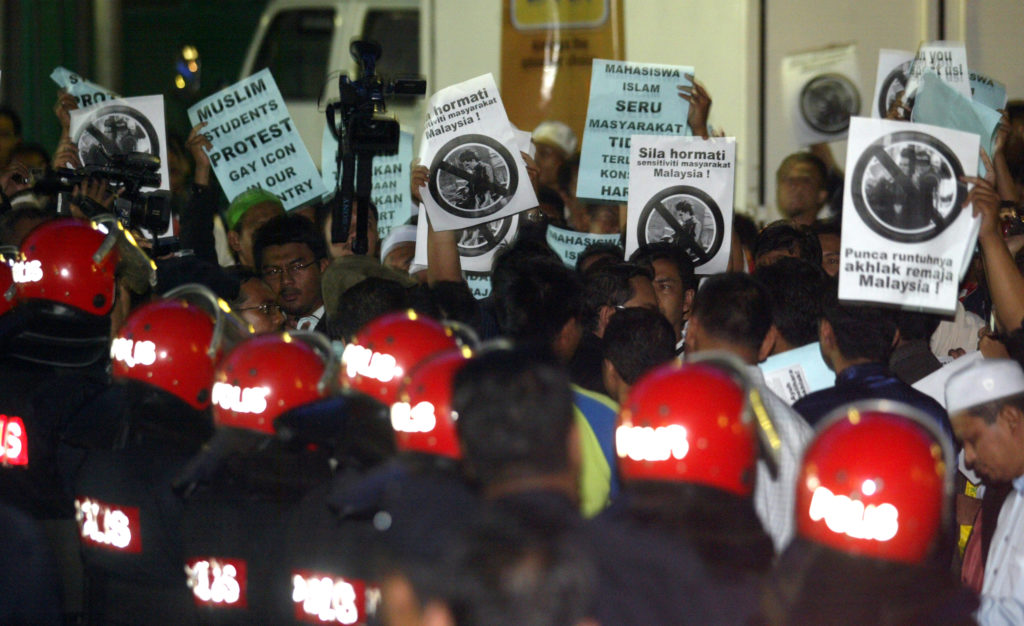
Police block Malaysian Muslim students as they protest against a performance of the openly gay US singer Adam Lambert in Bukit Jalil, outside Kuala Lumpur (AFP/Getty)
LGBT+ rights in Malaysia.
Homosexuality is doubly illegal in Malaysia as it is banned by the country’s secular, colonial-era legal code, as well as its special Islamic courts.
The Human Rights Watch says discrimination against LGBT+ people in the country is “pervasive”, and the capital, Kuala Lumpur, was recently ranked as one of the top 10 worst cities in the world to be LGBT+.
In 1994 the Malaysian government banned all LGBT+ people from appearing in the state-controlled media. Later in 2010 the Film Censorship Board of Malaysia announced it would allow depiction of homosexual characters, but only as long as the characters “repent” or die.
The Malaysian prime minister has repeatedly rejected the notion of LGBT+ rights, dismissing it as “Western values” and comparing LGBT+ acceptance to “walk[ing] around naked”.
The government currently runs a gay ‘rehabilitation programme’ and last year claimed it had ‘cured’ 1,450 people of homosexuality.
Thursday, November 21 7:00–9:00 p.m.The GLBT Historical Society Museum4127 18th St., San Francisco$5 | Free for members
With its plate-glass windows looking out on the corner of Castro and Market Streets, the landmark San Francisco gay bar Twin Peaks Tavern is not only one of the Castro’s most beloved establishments, but also a living testament to the revolutionary idea that LGBTQ people should be seen and celebrated rather than hidden in the darkness of alleys and behind blacked-out windows.
Filmmakers Petey Barna and Bret Parker will present their new documentary, “Through the Windows” about the history of Twin Peaks Tavern, featuring deeply personal interviews that illuminate the history of the bar and the lesbian owners who transformed it from a straight working-class tavern into a gay landmark in 1972. The film recounts the ways this establishment has provided a feeling of home, family and emotional nourishment for its patrons every day of its 47-year history.Tickets are available online here.
Champion baseball player Sean Doolittle has declined an invitation to a ceremony in the White House because he disagrees vehemently with the policies of Donald Trump.
Doolittle – who plays for the Washington Nationals – told the Washington Post that he cannot justify visiting the White House as he finds Trump’s policies offensive.
He revealed that part of the reason he refused to visit the White House is because his wife has two mothers and he wanted to “show support for them”.
“I think that’s an important part of allyship, and I don’t want to turn my back on them.”
Sean Doolittle refused to visit White House over Donald Trump and his ‘divisive rhetoric’.
“There’s a lot of things, policies that I disagree with, but at the end of the day, it has more to do with the divisive rhetoric and the enabling of conspiracy theories and widening the divide in this country,” Doolittle said.
“At the end of the day, as much as I wanted to be there with my teammates and share that experience with my teammates, I can’t do it. I just can’t do it.”
I think that’s an important part of allyship, and I don’t want to turn my back on them.
Elsewhere in the interview, Doolittle drew attention to Trump’s treatment of race issues, refugees and disabled people.
“I feel very strongly about his issues on race relations,” he said. Doolittle spoke about the Fair Housing Act, the Central Park Five as well as Trump’s comments about white supremacy as examples of problem areas.
Doolittle said that Trump has disrespected the office of the president.
“I have a brother-in-law who has autism, and [Trump] is a guy that mocked a disabled reporter. How would I explain that to him that I hung out with somebody who mocked the way that he talked or the way that he moves his hands? I can’t get past that stuff.”
The baseball player also revealed that some people have taken issue with his refusal to visit the White House and said he should be respecting the office of the president.
However, Doolittle feels that Trump himself has disrespected the office on a number of occasions – and believes that this is the most important issue.
Doolittle and his wife Eireann Dolan have advocated for the rights of LGBT+ people on a number of occasions.
In less than three days a protest organized by students against the increase in subway fares turned into an imposing and unexpected national protest over years of inequalities in Chile that completely paralyzed the country and put the entire Chilean political class on notice. Millions of people have taken to the streets over the last few days to demonstrate their discontent.
Some of the massive marches have nevertheless ended with protesters attacking businesses, torching and looting supermarkets in the worst unrest the country has seen in decades. Chilean President Sebastián Piñera declared a state of emergency, deployed soldiers to the streets and imposed a curfew that deepened the conflict by unleashing the worst cases of human rights violations in the last 30 years in the Latin American country. A group of lawmakers have announced a constitutional complaint against Piñera.
“These weeks have been a time bomb that we all knew was going to explode, but we did not know that it would explode now and with such intensity,” said Alessia Injoque, executive president of Fundación Iguales, a Chilean LGBTQ organization. Franco Fuica, legislation and public policy coordinator of Organizando Trans Diversidades (OTD), a trans advocacy group, has a similar opinion.
“We are living a social revolution,” he affirmed.
The crisis in Chile has been brewing for a long time. Dictator Augusto Pinochet in 1973 staged a coup to topple Salvador Allende, Latin America’s first democratically elected Socialist president. Pinochet reversed Allende’s model and began to implement a diametrically opposed economic formula. The country became a sort of neoliberal laboratory and a cruel dictatorship that persecuted, tortured and killed its opponents.
A group of liberal economists who were educated at the University of Chicago, where they learned the ideas of Americans Milton Friedman and Arnold Harberger, who were known as the “Chicago boys,” led Pinochet’s economic changes. They implemented economic and social reforms that privatized everything, and were enshrined in Chile’s 1980 constitution that was adopted in 1980 and remains in place.
Chile is the only country in the world where water is privatized, retirement pensions are low, health is bad and the majority of households have difficulties making ends meet at the end of the month. A report the U.N. Economic Commission of Latin America and the Caribbean (ECLAC) published in January that analyzed the evolution of poverty, spending and social inclusion revealed Chile continues to maintain its high rates of inequality. “1 percent of the population holds 26.5 percent of wealth,” the investigation concludes.
“We have been in an unfair system for years, where everything is done to ensure the same people always win. Beyond that injustice, there was impunity where nothing happened to people who caused a lot of damage that runs from pain to frustration. The government was indolent and everything came to a head,” said Injoque. The trans activist said they were truly afraid.
“I had chills when I found out that soldiers were out on the streets,” they said.
“Piñera declared war against my grandchildren on national television, deployed the army to shoot and kill them for peacefully protesting (against) their enormous suffering and the people realize there is complicity there and I hear another loud clamor: ‘Resign Piñera,’” Pamela Jiles of the Frente Amplio, a new political force in the Chilean Congress who has lead the impeachment movement, told the Washington Blade.
“My duty as a lawmaker is to constitutionally accuse Piñera, as Humanist Congresswoman Laura Rodríguez would have done, using a parliamentary procedure and a constitutional provision, to turn my back to the elite and face the people,” Jiles explained. “It cannot be anything else because he has already seriously jeopardized the nation’s security, has plunged the country into misgovernment and is the main — although not the only — person responsible for the deaths of those they should have protected.”
Brutal cases of human rights violations allegedly committed by the Chilean armed forces have been reported since the onset of this social revolution. Repression, abuse of power, indiscriminate violence, illegal detentions and deaths prompted U.N. High Commissioner for Human Rights Michelle Bachelet, who is Chile’s former president, to decide to send a team of observers to verify the cases, which include a young gay man who was illegally detained, tortured and sexually abused by the police.
Josué Maureira, a medical student at the Pontifical Catholic University of Chile who was arrested while bringing first aid to injured protesters, claims he was beaten until he was unconscious, mistreated because of his sexual orientation and gender identity, beaten again until his septum was broken, violated with a baton, threatened with death and jailed because of alleged attacks against police officers. The National Human Rights Institution has filed a sexual torture complaint.
“The states of emergency authorize the restriction of free movement, but not attempts to take people’s lives. The ‘exit from the crisis’ as the elite likes to say, is only Piñera’s exit. it is our obligation to stop the killing of innocent people,” said Jiles.
Shane Cienfuegos, an activist and investigations coordinator of Colectiva Neutres who in recent weeks has managed to unify the majority of LGBTQ groups, mentioned that “I have been in the streets since the subway evasion, activating constituencies. We summoned all the organizations and more than 50 came. We made a diagnosis and discovered that we were vulnerable.”
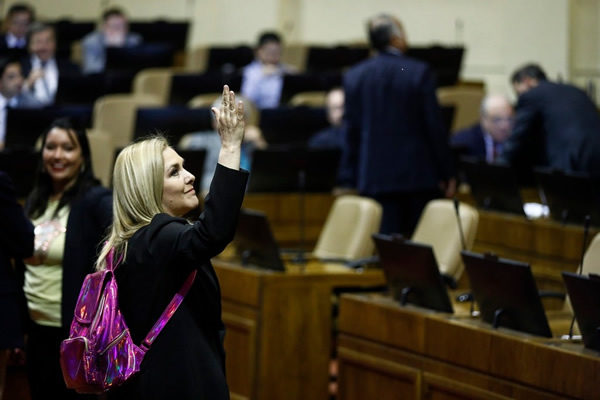
Congresswoman Pamela Jiles told the Blade “we grandmothers of this country will not allow Piñera to continue killing people, wounding children, violating men and women in police stations and in particular abusing and denigrating sexually diverse people. (Photo courtesy of Pamela Jiles)
A massive demonstration across the country was called for Oct. 25. #LaMarchaMásGrandeDeChile (Chile’s biggest march) was a trending topic on Twitter around the world and television stations across covered the historic protest, which drew more than 1.5 million people. “The other thing that I was going to say, that we have also forgotten to mention, is apart from soccer teams and Chilean flags that are very important, there are many flags from the LGBTQ movement, many people with different sexualities are also present and they are movements that are protesting today and their flags are there in the streets,” interrupted Mónica Rincón, a CNN reporter and LGBTQ ally, on live television.
The majority of Chilean LGBTQ institutions on their social media networks backed the protests, while people of diverse sexualities were deployed in groups to participate. “We went out with a lot of passion and creativity to rise up with force and at the same time claim our rights that have been violated by the Chilean state for decades and go against a neoliberal system that oppresses us,” added Cienfuegos.
Chile in 1999 decriminalized sodomy, and in 2012 enacted an anti-discrimination law — to which activists have pointed as inadequate — and same-sex couples since 2016 have been able to enter into a civil union. A gender identity law that will recognize trans people’s right to identity will take effect in December of this year. There are also public policies that benefit sexual and gender diversity, but however, there is still much to do to win full equality in the country.
“We created a roundtable with 19 civil society organizations with a presence throughout Chile, to be able to work on certain matters of law that need to be modified to be able to ensure recognition, rights and guarantees to the LGBTQ+ community,” said Natalia Castillo, a young member of the Chilean House of Representatives from the leftist Frente Amplio party who is behind a multiparty group for the rights of lesbians, gays, bisexuals, trans and queer called the “Diversity Caucus.”
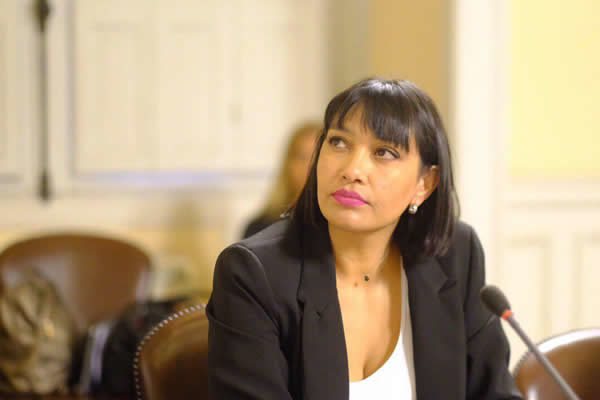
Congresswoman Natalia Castillo has become known for defending and promoting the rights of sexually and gender diverse Chileans since she took office. (Courtesy photo)
A marriage equality bill stalled in the Senate’s Constitution Committee more than a year ago. The “Diversity Caucus” led by Castillo, on the other hand, is working on the creation of other legislative initiatives in favor of sexual and gender diversity that will be presented in the coming weeks.
“I think that it is a great opportunity to perfect the anti-discrimination law, to promote a law that penalizes the incitement of hatred, and perhaps, this is the moment that LGBTQ+ people will be compensated by the Chilean state for their historic violation,” Fuica concluded.
The Bill and Melinda Gates Foundation has teamed up with the National Institute of Health (NIH) to develop revolutionary gene-based cures for HIV and sickle cell anaemia.
They are now giving an additional $100 million which, combined with the NIH’s investment, will amount to at least $200 million over the next four years – a huge boost to researchers fighting the diseases.
It’s particularly vital as scientists recently announced they have discovered a new strain of HIV for the first time in nearly two decades.
Dramatic advances in genetics over the last ten years have made effective gene-based treatments a reality, including new treatments for blindness and certain types of leukaemia.
However, the high cost of these breakthroughs makes them largely inaccessible to much of the world – particularly for those in the resource-poor countries hit hardest by HIV.
But Bill and Melinda Gates and the NIH have vowed that the cures funded by their investment will be affordable and available for all.
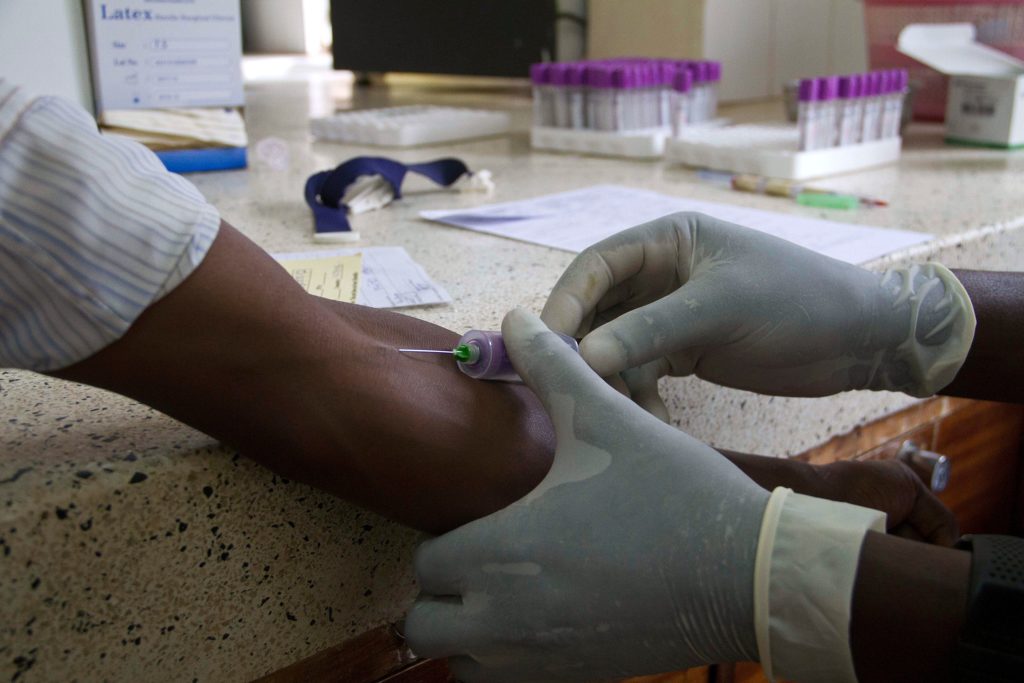
A lab technician draws blood from a patient for HIV testing at the AIDS Information Centre in Kampala, Uganda (ISAAC KASAMANI/AFP/Getty)
The idea is to focus “on access, scalability, and affordability … to make sure everybody, everywhere has the opportunity to be cured, not just those in high-income countries,” NIH Director Francis Collins said in a statement. “We aim to go big or go home.”
They hope to bring safe, effective and durable gene-based cures to clinical trials in the United States and sub-Saharan Africa within the next seven to 10 years.
Anthony S Fauci, director of the NIH’s National Institute of Allergy and Infectious Diseases, agreed that it was an “ambitious” step.
“[We are] harnessing the most cutting-edge scientific tools and NIH’s sizeable global HIV research infrastructure to one day deliver a cure and end the global HIV pandemic,” he said.
“We are taking into account those with the greatest need at the foundation of this effort, to ensure that, if realised, this exceptional public health achievement will be made accessible to all.”
The “rainbow wave” of the 2018 elections continued Tuesday, with 99 of 200 known LGBTQ candidates winning their races — including a number of successes in historically conservative states such as Virginia and Kentucky.
The Victory Fund, a group that trains, supports and advocates for lesbian, gay, bisexual, transgender and queer candidates who are pro-choice, said 80 of its 111 endorsed candidates emerged victorious Tuesday. So far in 2019, the organization found 144 LGBTQ contenders won in 382 races, for an overall victory rate of 38 percent.
LGBTQ men ran in much higher numbers than their women counterparts, though queer women had a higher success rate, 46 percent to 37 percent, according to Victory’s election tracker. Trans women specifically — who won in state races in Virginia, Utah, Massachusetts and Iowa — had a success rate at 56 percent. The vast majority of LGBTQ candidates (83 percent) ran as Democrats, with just 2.4 percent running as Republicans. LGBTQ Democrats had a success of 40 percent, compared to 33 percent for their GOP counterparts.
Among Tuesday’s noteworthy winners were twice-elected transgender state Rep. Danica Roem, gay, black Muslim school board member N.J. Akbar, and the new LGBTQ members of the Indianapolis City Council.
Akbar, who won a seat on the Akron Board of Education in Ohio, became one of the first gay, Muslim, African Americans ever elected to any office in the U.S., according to the Victory Fund.
“As one of the first openly LGBTQ Muslims elected in United States history, N.J. will become a role model for so many LGBTQ students, students of color and Muslim students who too rarely see people like them in positions of power,” Annise Parker, president and CEO of the Victory Fund, said in a statement.
In Virginia, State Delegate Danica Roem, the first openly trans person elected to statewide office, won a second term. In 2017, Roem ran on expanding Medicaid to her constituents and fixing the traffic-clogged Route 28 in Manassas.
“I’m grateful to represent you because of who you are – never despite it,” Roem wrote on Twitter. “I’ll see you Nov. 20 at our next #fixRoute28 public hearing.”
The Indianapolis City Council tripled its number of LGBTQ representatives by re-electing Zach Adamson and newly electing Alison Brown and Keith Potts. Brown is the first out LGBTQ woman elected to that body.
Not all noteworthy races in question have been called. The nationally watched race for Texas’ 28th state legislative district is heading for a runoff with no candidate having secured an outright majority. Democrat and out lesbian Elizabeth Markowitz ran against six Republicans and won roughly 40 percent of the vote. Markowitz will now face Republican Gary Gates in a runoff election that has not yet been scheduled by the governor.
Anti-trans ads: A losing strategy?
In several states that saw transphobic political attack ads flop against LGBTQ-supportive candidates, political watchers are asking whether such ads will be effective heading into 2020’s general election.
The apparent victory of pro-LGBTQ Democrat Andy Beshear in Kentucky in the race for governor, signaled that outside efforts to use transphobic election scare tactics — like one that implied transgender inclusion in sports, would mean that “anyone at any time could change teams for any reason” — are not a clear path to electoral victory.
Chris Hartman, executive director of Kentucky’s Fairness Campaign, a LGBTQ advocacy group, said the anti-transgender ads run in Kentucky “looked initially like a desperate ploy” and noted that he and his LGBTQ friends were heavily targeted with these ads on YouTube and Hulu.
“As more information came out, we learned that we were a testing group for what the conservatives thought was going to be their new election tactic, in the way that trans bathrooms used to work for them, in the way that gay rights used to work for them,” Hartman said. “They’re testing the field to see if anti-trans bias is strong enough to propel them to victory in places that have unpopular candidates.”
Don Haider-Markel, a professor of political science at the University of Kansas, said that a 2015 ballot measure in Houston, used “fear-based advertising” around transgender people’s access to public accommodations and bathrooms.
“It’s clear that that was effective,” Haider-Markel said. However, “the ads in Kentucky about high school sports and things like that don’t seem to have the same traction.”
“Tagging that to a candidate instead of an issue on the ballot is something different,” Haider-Markel continued. “For LGBTQ candidates, success doesn’t come from what your sexual orientation or gender identity is, success comes from focusing on the issues that people care about in their local community.”
Danica Roem is “a prime example of that,” Haider-Markel said.
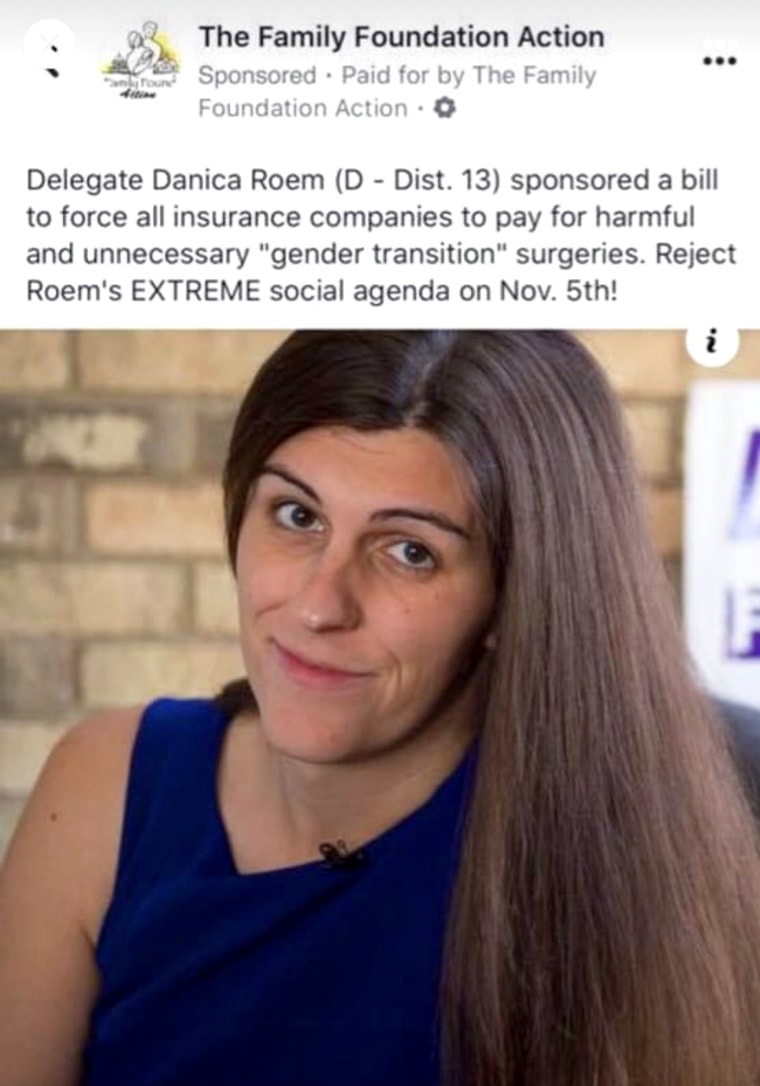
An ad attacking Delegate Danica Roem from The Family Foundation Action on Facebook.via Facebook
Danica Roem, a transgender woman who was elected to the Virginia House of Delegates in 2017, was the highest ranking LGBTQ winner Tuesday. Her re-election makes her the longest serving transgender state legislator in U.S. history, and the first to ever win re-election.
Although she is a history maker and was targeted because of her transgender identity, Roem has become known to her constituents for her laser focus on her district’s Route 28 — a traffic-clogged artery that many of her district’s voters struggle with on a daily basis as they commute into Washington, D.C.
“The success of trans candidates this Election Night – in states red and blue – is a warning to those using cynical campaign tactics to divide communities for their own political gain,” Victory’s Parker said in a statement.
Alphonso David, president of the Human Rights Campaign, echoed Parker, saying “the biggest topline takeaway” from Tuesday’s results is that “voters care about equality.”
“What we saw in Virginia specifically is that anti-equality candidates have been using an outdated and offensive playbook that is not working anymore,” David said.