Janice Goldberg still remembers the first moment she laid eyes on her partner Sue.
It was over 45 years ago in the small beach town of Ocean City, Maryland. Janice had gotten a job waiting tables at an upscale restaurant after spending the first part of her summer in Europe. She wasn’t quite sure what the future had in store for her – then “there she was.”
Sue, who lived in Florida at the time, had travelled up the coast to spend the summer in Ocean City with her then-boyfriend. The two decided one day to treat themselves to a meal at a fancier restaurant, and happened to walk into the one where Janice worked. “The rest is, as they say, history.”
Janice started as Sue’s waiter, but it wasn’t long before she became her lover. Today, she’s her caregiver.
Sue began showing signs of Alzheimer’s disease about ten years ago. Since then, Janice has had to balance her work as both a theater director and a tour guide with caring for the love of her life. She recently agreed to take part in the upcoming PBS documentary Mind Over Matter: My Alzheimer’s to shed a light on her experience – and hopefully help end the “stigma” surrounding it.
“I want people to recognize that it’s a journey. I want people to recognize the difficulty of it, and I want to take away some of the fear that’s involved,” Janice tells The Advocate. “I also think that it’s important for people to see how caregivers and their loved ones can deal with it and what they do to make things manageable for themselves.”
The documentary is the third in a series from award-winning co-directors Anna Moot-Levin and Laura Green that focuses on neurodegenerative diseases. The film follows Janice and Sue’s journey alongside two other pairs of parent and child as they all navigate life with the conditions.
One of the film’s central themes is “how people living with Alzheimer’s and dementia continue to lead meaningful lives where they’re connected to others and connected to activities and things that they enjoy and love,” Moot-Levin says. This doesn’t just mean patients, as “there’s an impact on the immediate family, there’s an impact on the person’s community, and there’s a real loss in the experience of the people who are surrounding the person with that illness.”
“Each of them have such a deeply loving relationship and they find a way to maintain that relationship even as one person changes with dementia,” Green adds. “I think that people are very dismissive of the sort of personhood of people with Alzheimer’s and dementia, and they don’t always see and interact with them. There’s a lot more recognizing the humanity of people living with Alzheimer’s that we need to do.”
Including Janice and Sue’s relationship also showcases “what an LGBTQrelationship is like in aging,” Green says, which there unfortunately aren’t many examples of in media. The filmmakers wanted to examine the “differences” that arise in later stages of life for queer people, to which Janice asserts, “We’re older. That’s the difference.”
The directors initially connected with Janice and Sue over two years ago through SAGE, an advocacy organization for LGBTQ+ elders that offers support groups for people with neurodegenerative diseases. While Janice greatly appreciates having a group of queer people she can relate to, she says that she never pictured herself ending up in such a group.
“I thought I’d get through my whole life without ‘therapy,’” Janice says. “Turns out you don’t.”
While Janice notes that “the battle is the same for everybody, and it’s vastly different for everybody all at the same time,” all the caregivers she knows have experienced a similar feeling of loss. This isn’t just from the changes in their loved ones, but the changes in themselves that Moot-Levin has dubbed a “transformation of identity.”
“For this particular disease, it’s hard as hell on the caregiver because the person who has the disease oftentimes does not know they have the disease. They think they’re fine, so they can live a peaceful, happy life,” Janice says. “I don’t know any caregiver who lives a peaceful, happy life.”
While Janice knew that the film was an “important project,” she says she mainly wanted to participate because it seemed “fun” – and it was “something good to do with Sue since she needs some engagement.”
Sue was a gracious host even when she didn’t remember that a documentary team was in her home, as Green says that she would frequently offer the crew snacks and refreshments. “She would sometimes forget that we were there and then be surprised that we were there, but still be a consummate hostess with the revelation that there was a camera crew in her apartment,” Green recalls.
What was “remarkable” for Janice about the process was being able to watch the documentary once it was finished and see Sue’s progression. When filming began, Sue was still verbal. Now, Janice says “words are difficult for her,” and that she mostly speaks in “gibberish.”
“To have to watch that, I found very moving and sad, but I was grateful that I saw it so there’s a documentation of that,” Janice says.
Through the film, Janice hopes to draw attention to what people caring for loved ones with neurodegenerative diseases go through. The process is “draining on families,” she says, especially if “you’re under a certain income” or if “ people have to quit jobs to care for people and then there’s no income.”
The filmmakers also hope to erase some of the stigma surrounding such conditions, as Moot-Levin emphasizes “we need to support people through that sense of loss.”
“People often want to hide themselves as they begin to get dementia. People feel shame and embarrassment,” Green says. “Being more accepting so that we can have a society that people are more fully integrated in and less lonely and less isolated really would be wonderful.”Matter of Mind: My Alzheimer’s will debut as part of the Independent Lens series on PBS May 5.
A trans woman says that a hotel in Atlanta turned her away after seeing that the gender marker on her ID didn’t match her appearance, with the front desk worker telling her that “people like you can’t stay here,” despite her having booked in advance. Now she’s speaking out about the potential housing discrimination she faced.
Alabama native Sadie Vice traveled to Atlanta on March 3, 2025, to visit friends and take part in a charity show to raise funds for a friend with cancer. She booked a room with Extended Stay America Atlanta-Northlake via Expedia.
She traveled all day that day, getting a ride with her father from Tuscaloosa to Birmingham, where she took a Greyhound bus from Birmingham to Atlanta. After hours on the bus, she took a Lyft from the bus station to the Extended Stay.
After that day of traveling, Vice was ready to relax in a hotel room. But instead of relaxation, she faced discrimination.
She went from the Lyft to the check-in desk with her reservation information, but she was turned away when she tried to check-in. Vice says that the agent at the desk first claimed that they didn’t have any rooms. Confused, Vice said there must have been a mistake because she made a reservation and nobody had contacted her to cancel it. When she produced her reservation number, the agent looked at it and asked to see her ID. Sadie says that the agent, who wasn’t wearing a name badge, then told her, “Your reservation was canceled because people like you can’t stay here.”
Sadie Vice | Sadie Vice
The desk agent then noted that Vice had another reservation at the same Extended Stay America later in that month, from March 25 to 28. The agent told her that she needed to cancel that reservation because, as Sadie puts it, “people like me couldn’t stay there.”
By the time she was turned away, Vice had traveled over 200 miles. She was told that there was no manager available and that she needed to find a new place to stay. While she considered pushing the issue at the time, she told LGBTQ Nation, “They were not going to let me stay there, period.”
Born in Tuscaloosa, Alabama, Vice completed her full medical transition back in 2010. She moved around the Southeast, spending time in Florida and Georgia, and earned the title of Miss Trans Atlanta in 2017. In 2020, she became extremely ill, first with COVID-19 and then with cancer. Vice has since returned to Tuscaloosa, and after battling her illnesses, she went on to become Miss Trans Alabama in 2024.
While she was able to have her correct gender listed on her state ID cards during her time in Georgia and Florida, Alabama’s restrictive ID laws require gender markers to match the one assigned at birth. This, of course, creates a mismatch between Vice’s ID and her gender presentation.
A few days after being turned away from the Extended Stay America in Atlanta and after multiple of Vice’s friends left complaints about the discrimination through Google reviews and the company’s contact page, a man identifying himself as Edward, the assistant general manager for the Extended Stay America, Atlanta-Northlake location, called and left a voicemail for Sadie on March 5.
In the message, Edward said that the hotel was contacted by their corporate office about Vice being denied service. While Sadie talked to a woman at the front desk, Edward claimed that he was working at the front desk that day and that the staff didn’t remember any guests checking in with any reservations. He also said that he remembered her name because it was a reservation “that I canceled because we didn’t have any rooms available.”
Vice had made her reservations with Extended Stay America, Atlanta-Northlake on February 15 through Expedia. That booking was confirmed, and she says she never received any notice of cancellation prior to her arrival. Moreover, it would be strange if no one checked in to the Extended Stay that day, especially considering that Edward claimed that they were fully booked.
Edward said that he checked their security camera footage but that nobody had tried to check in during that time window. He suggested that she might not have had the right location or that he might have been on a break when she showed up.
In a separate voicemail left on March 23, Edward suggested Vice spoke with another guest rather than an employee of Extended Stay America, pointing out that an employee should have been wearing a name badge.
Some of these explanations offered by the assistant manager seem contradictory. He suggested Vice went to the wrong location, but he also said in the first voicemail that he remembered canceling her reservation. Vice’s Lyft receipt, which LGBTQ Nation has viewed, shows that she was taken to the address of Extended Stay America Atlanta-Northlake.
Also, if she had talked to a guest and not an employee like Edward suggested, it’s not clear how they would have been able to pull up her information and see that she had a second reservation for late March.
Fortunately, after being turned away by Extended Stay America despite booking in advance, she was able to get a room at the nearby Days Inn and performed at the charity show as planned. But moving to a different hotel was a stressful experience that meant spending more on a last-minute room, and nobody should have to suffer being rejected over bigotry.
“It is terrible anyone can have their hotel reservation canceled without notice over what body part may or may not be in between their legs,” Vice said.
While some of the fault in this situation appears to fall with individuals at the hotel, there’s also a growing systemic problem that has resulted from recent political changes. People are feeling emboldened to speak their anti-trans thoughts out loud.
Moreover, the situation shows how anti-trans laws – including those that restrict trans people’s ability to get correct IDs – lead to real-world discrimination. Vice says that the agent only confirmed she was being turned away after looking at her Alabama ID, which lists her as male. Vice only moved back to Alabama to deal with health issues resulting from her cancer treatment, and the tradeoff for caring for her health is living in a state that won’t let her gender marker match her gender presentation. Those rules put trans people at risk for discrimination and violence by having their IDs out them to strangers.
“This is the world we live in now,” Vice said, citing the current presidential administration.
LGBTQ Nation contacted Extended Stay America for comment but got no response. This article will be updated if they respond.
t’s well documented that LGBTQ+ young people are at greater risk of mental health problems and suicidal ideation or attempts than their straight and cisgender peers. Now a new research brief from the Trevor Project shows how economic insecurity correlates with that.
“Overall, economic insecurity was associated with worse mental health for LGBTQ+ young people, even after adjusting for age, sexual orientation, gender identity, race/ethnicity, and census region,” the report notes.
Experiencing food insecurity was associated with 69 percent higher odds of experiencing depression, 68 percent higher odds of experiencing anxiety, 60 percent higher odds of having considered suicide in the past year, and 71 percent higher odds of attempting suicide in the past year.
Ever experiencing houselessness was associated with 47 percent higher odds of experiencing depression, 67 percent higher odds of having considered suicide in the past year, and over twice the odds of attempting suicide in the past year.
Being unable to meet basic economic needs was associated with 50 percent higher odds of experiencing depression, 41 percent higher odds of experiencing anxiety, 42 percent higher odds of having considered suicide in the past year, and 52 percent higher odds of attempting suicide in the past year.
Forty percent of LGBTQ+ young people reported a history of food insecurity, houselessness, or unmet basic needs. Transgender and nonbinary youth had 77 percent greater odds of experiencing food insecurity, 73 percent greater odds of ever having been houseless, and 67 percent greater odds of having unmet basic needs compared to cisgender LGB young people.
The high rates of economic insecurity the researchers saw weren’t surprising, says Derrick Matthews, director of research science at the Trevor Project, but their correlation with mental health issues and suicidal ideation or attempts was. “That was pretty alarming to me,” he says.
There’s a common misconception that LGBTQ+ people are better off financially than their cisgender and straight counterparts, but research has shown that’s not true, “and being transgender, a person of color, or bisexual are all factors found to be associated with higher rates of poverty,” according to the report. But this research has often excluded youth, and the chief measure of economic security for adults, income level, doesn’t work with young people, Matthews says. So the staff decided to use the factors of food insecurity, houselessness, and inability to meet economic needs to tell the stories of LGBTQ+ youth. “We looked at stories we didn’t have a chance to tell yet,” he notes.
The 2024 survey reflects data was collected at the end of 2023, and now, with cuts to social programs and LGBTQ+ services by Donald Trump’s administration, plus the economic instability caused by Trump’s back-and-forth on tariffs, the situation may well become worse. “I think it’s concerning, to say the least,” Matthews says. He points out the spikes in calls and texts the Trevor Project saw after Trump’s election and then his inauguration.
“Any reduction in support [for LGBTQ+ youth] at the state or federal level is going to have really scary consequences for a lot of young people out there,” he says.
Also, homophobic and transphobic forces are pushing the narrative that LGBTQ+ identity itself causes mental health problems rather than the true cause, “the way society treats us,” says Matthews, a Black gay man.
“There is no 13-year-old in the world who’s responsible for these things,” he says. “This is a failure of society and how we structure policy.”
This atmosphere, however, doesn’t negate the need to push for policies that affirm LGBTQ+ people and alleviate economic insecurity, he adds. “The services that we still do have need our investment and support,” he says. And he notes that research has shown that for LGBTQ+ youth, having even one supportive adult in their life can reduce the risk of suicide. “Show up for young people, and advocate for resources to be restored,” he urges. The report points out the beneficial effect of food and nutrition assistance, housing assistance, and basic cash assistance for both young people and adults. Resources for LGBTQ+ youth experiencing homelessness are available here.
“It’s easy to lose hope,” Matthews says, “but I’m a prisoner of hope.”
If you or someone you know needs mental health resources and support, please call, text, or chat with the 988 Suicide & Crisis Lifeline or visit988lifeline.org for 24/7 access to free and confidential services. Trans Lifeline, designed for transgender or gender-nonconforming people, can be reached at (877) 565-8860. The lifeline also provides resources to help with other crises, such as domestic violence situations. The Trevor Project Lifeline, for LGBTQ+ youth (ages 24 and younger), can be reached at (866) 488-7386. Users can also access chat services at TheTrevorProject.org/Help or text START to 678678.
Since June 1, 2022, GLAAD’s ALERT Desk has tracked 150+ anti-LGBTQ incidents targeting affirming faith-based communities in the US. These include 54 cases of vandalism, 38 cases of threats and harassment, 37 protests, 7 attempted arsons, 3 assaults, and 2 bomb threats.
For the access to the full dataset, please contact press@glaad.org.
This is an update to GLAAD’s original reporting in early 2024, showing 60+ anti-LGBTQ+ incidents targeting religious institutions. Since then, more than 90 incidents have come to light.
Nearly half of all LGBTQ Americans (48%) are religiously affiliated, according to a 2023 PRRI poll. This same study found that strong majorities of all Americans, including most people of faith, support nondiscrimination protections for LGBTQ individuals.
Notable Anti-LGBTQ Incidents Targeting Affirming Religious Communities
3/9/25: Multiple people made death threats against the First Congregational United Church of Christ in Park Ridge, New Jersey, after the local Moms for Liberty chapter posted about the church’s Pride flag and falsely claimed it supported “pedophilia.” One of the threats claimed that the church must be punished “with gasoline and a match.”
1/22/25: Multiple people sent death threats to Bishop Mariann Edgar Budde at the Episcopal Diocese of Washington D.C., following her sermon during President Trump’s inauguration where she called for mercy on LGBTQ and immigrant people.
9/7/24: A person vandalized the Pride-themed walkway leading to the Immanuel Congregational Church in Hartford, Connecticut. The graffiti read: “Fuck f****ts,” and occurred a week prior to the church’s Pride event.
8/17/24: A person tore down a Pride flag at the home of a local rabbi in South Whitehall Township, Pennsylvania, and blew it up with fireworks. They then x’d out the word “gay” on the flag with spray paint.
7/28/24: A person stole Pride flags and left anti-LGBTQ letters at two churches in Natick, Massachusetts. At First Congregational Church and Christ Lutheran Church, multiple Pride flags were damaged and replaced with a banner that read: “Jesus is King.”
6/17/24: A person was arrested for planning a mass murder targeting LGBTQ people, religious institutions, hospitals, schools, and supermarkets in Owosso, Michigan. Police reported that they found an Israeli flag in the suspect’s home with the words “anti-Jew f****t killer” and “death to you all.”
Despite the fear these incidents aim to inspire, they instead shed light on the heroic figures at the head of these groundbreaking and affirming faith-based communities. The ALERT Desk sat down with leaders from across the religious spectrum to speak about their experiences with anti-LGBTQ hate and how they overcome it to serve all people.
Photo by Rev. Mark Suriano, First Congregation United Church of Christ in Park Ridge, NJ
“We are caught in an inescapable network of mutuality, tied in a single garment of destiny. Whatever affects one directly affects all indirectly.” – Martin Luther King, Jr.
These are the words that Rev. Mark Suriano used to open his sermon at the First Congregational United Church of Christ, the Sunday after his church received death threats regarding their Pride flag.
Rev. Suriano continued: “I have always loved [this] quote from Martin Luther King Jr., in theory. When he speaks of ‘an inescapable network of mutuality’ and ‘a single garment of destiny,’ my heart has always warmed. But this past week, I, for the first time, had the most palpable sense of these ideas in action… It was a weekend of terror, grief, and [exhaustion.] But, in the midst of all that, the outpouring of support far surpassed the hateful and violent rhetoric against us.”
“I remain emotional about this physical manifestation of the ‘inescapable network of mutuality’ and the ‘seamless garment of destiny’ of which Martin Luther King, Jr. spoke. I also am overwhelmed by the beautiful truth that what affects one of us directly affects all of us indirectly.”
Presiding Bishop Elizabeth Eaton of the Evangelical Lutheran Church in America (ECLA) echoed Rev. Suriano’s sentiments. “Bullying and discrimination have no place in the body of Christ, but, sadly, reminders are still needed. Jesus’ command that we love one another does not come with a caveat about who we are to love. Recent acts of violence at churches that affirm the LGBTQIA+ community and the congregations’ supportive ministries must not be tolerated. As a church, we must be even more committed to lifting up the dignity, safety and humanity of our LGBTQIA+ siblings or we will be worse off as a church and as a nation.”
Rev. Terri Steed Pierce, an out pastor at the Joy Metropolitan Community Church in Orlando, Florida, has faced her fair share of hate, including demonstrators trying to disrupt her Sunday service in recent weeks. She summed it up neatly: “We say ‘all people are welcome here,’ but all behaviors aren’t and that means those that come with hate… Those who have a problem with that can take it up with Jesus.”
Photo by the Sikh LGBTQIA+ Oral History Project,“Becoming Boundless: How LGBTQIA+ Sikhs Negotiate Duality through Sikhi in an Ego-driven, Binary World”
prabhdeep singh kehal leads the Sikh LGBTQIA+ Oral History Project and has seen firsthand the power of having religious leaders condemn anti-LGBTQ hate. “Working with LGBTQIA+ Sikh voices is an honor and one of the most rewarding experiences I have had in my life,” says kehal. “In a time when governments are using LGBTQIA+ communities as fodder to consolidate their own conservative, theocratic agendas, it is queer and trans affirming spaces that keep the energy to fight back going. And that is why politicians and conservatives target the places of safety for which we have fought to create – within and outside faith-based spaces.”
“Faith leaders are at an important position in challenging these pathologizing, theocratic interpretations of LGBTQIA+ lives because ‘God’ is being used again to turn an entire group of people into a target for those already in power… Their voices and positions are needed and that is why they are being targeted, because affirming and supporting faith leaders are able to speak back against claims that the Divine advocates for harming LGBTQIA+ beings.”
Ravjot Mehek Singh, a queer Sikh activist and award-winning filmmaker, added on: “As a Sikh in post 9/11 America, the racist attacks I experienced growing up in a predominantly White community left me traumatized and in doubt of my own identity. With my queerness, I get attacked oftentimes by my own community of conservative Sikhs, especially online where I am constantly doxxed and my videos collect thousands of hateful, violent comments. Because of my intersectional identity, I switch between facing threats from Americans and my own community – creating an often endless loop of hate… But Sikhi was founded to include all people regardless of gender or social standing, and I hope that the work I do alongside other brilliant advocates helps push for that equality to be acknowledged in its truest form.”
“There is no right way to be queer, there is no right way to be Sikh, there is no right way to be American, and anyone who tries to silence the way you exist in this world is a victim that is unable to comprehend the incredible multitudes that you contain. There is no rulebook to existing as oneself, so pursue all the things that make you feel whole.”
Photo by Michael Currie/SOPA Images/LightRocket via Getty Images
As President & CEO of Keshet, a national LGBTQ Jewish organization, Idit Klein knows all too well what it’s like to be at the intersection of communities under attack. “It has been an especially painful and complex time for American Jews in the wake of the October 7th Hamas attacks, the ensuing bloodshed and suffering in Israel and Gaza, and rising antisemitism here in the U.S. It also is an increasingly dangerous time for LGBTQ+ people as we face growing attacks on our rights and protections across the country. Against this backdrop, Keshet believes that remaining connected to each other across identities and movements is more important than ever.”
“As an organization committed to the full equality of LGBTQ+ Jews, we know that we cannot ever separate these parts of ourselves,” said Klein. “We work for a world free of homophobia, transphobia, and antisemitism. We work to find meaning and strength in this painful moment as many of us navigate rupture, uncertainty, and fear, whether in political spaces in our Jewish communities, and/or LGBTQ+ spaces.”
Keshet’s Bay Area Education and Training Manager Rabbi Eliana Kayelle spoke powerfully to how LGBTQ Jews can find hope in these challenging times. “As a trans queer Jew this moment has me feeling the legacy of resilience deep in my bones. I’m thinking about Jewish ancestors. Miriam who, while under Pharaoh’s rule, held onto hope, planning for liberation by crafting instruments she would eventually use to dance out of Mitzrayim. Emma Goldman and Hannah Arendt, who remind me of the importance of action even when circumstances look bleak. These ancestors remind me that hope is not false optimism — it’s the desperate and powerful force that lives in our guts, the feeling that can move us to fight to repair a broken world.”
“I’m holding onto queer and trans ancestors and changemakers, especially trans women of color, drag queens and butches, who laid the groundwork for the queer liberation movement. The ones who became leaders because they had to. It is because of their work that I can shout: ‘I am here and I’m not going anywhere no matter how hard you try!’ I think of Miss Major Griffin-Gracy saying: ‘I don’t need their permission to exist; I exist in spite of them…we have a history, we have a reason to be here. We have a purpose.’ And I think: Yes.”
Photo by Romy Arroyo Fernandez/NurPhoto via Getty Images
As President of Inter-Intra Community, Malik Johnson ministers to incarcerated Muslims, including those who identify as LGBTQ. “Someone might write in and say, ‘I’m a gay man who wants to be a part of the Muslim community in my [prison] facility, but I cannot because the others said that you cannot be gay and Muslim, and they will not let me pray with them. I feel very isolated from people and from the religion itself.’ Another might ask me, ‘What does it say in the Quran about me being trans?’”
“The beautiful thing is that the Quran doesn’t mention how queer a person has to be or not be to be sentenced to a heaven or a hell,” Johnson stated. “Instead the Quran relays [its message] in terms of action. What are your actions? What are you doing with your life? How are you treating other people?”
“Everyone has their own interpretation of what the Quran could mean. So I instead respond [to these questions] by addressing the heart. The first thing I say is ‘you matter.’ I say, ‘Thank you so much for calling or writing in. You are the most important part of this community. You mean so much. You’re very special. You’re worth something. If for no one else, you mean something to me. I love you and your Creator loves you. Because if your Creator didn’t love you, then they would not have created you and they would not have brought us together.’”
“You’re giving authority back to that person when you ask questions of them. Take someone who is trans. They have their dead name, that they used pre-transition, and they have their living name or preferred name. If that person is incarcerated, their dead name is continuously said to them. But if someone were to say, ‘What’s the name that you would like to be called?,’ it gives a symbol of hope and understanding and compassion. It gives back to that person so now that person is the authority in themselves. And that’s powerful. The best way to have autonomy is to name yourself.”
As we enter the holy season for those of so many faiths – from the end of Ramadan and Passover, to the start of Easter and Vaisakhi – let us remember these courageous leaders, who recognize our shared humanity and advocate for the importance of our diverse identities in fighting hate for all. In the words of the Interfaith Alliance, “While there are a variety of theological understandings of human sexuality and gender, we can all unite around the belief that nobody should fear for their safety or face discrimination based on who they love or who they are.”
Reality TV star and former gubernatorial candidate Caitlyn Jenner is now asking her supporters to send her money to support her legal defense fund in response to a lawsuit against her for alleged financial malfeasance.
“I have been named a defendant in a lawsuit re: the $Jenner memecoins, alleging ‘securities’ violations,” she posted to X, linking a crowdfunding campaign. “Let’s all be freedom maximalist.”
Jenner was sued in November, months after she released her $Jenner meme coin on the Ethereum blockchain. Two people – Nazeem Azad of the United Kingdom and Nihai Caluseru of Romania — alleged that they would not have bought the meme coin if not for Jenner’s actions, which included that she “fraudulently solicited financially unsophisticated investors throughout the United States and abroad to purchase the unregistered securities.”
They also accused her of not registering the financial asset with the Securities and Exchange Commission (SEC) and of failing to comply with federal and state laws around securities, which meant that buyers of $Jenner didn’t have all the information they needed to understand the investment.
Jenner promoted the memecoin widely last year, encouraging people to buy it, possibly to increase its value so she could sell her own holdings of it at a high price and then abandon it. For example, she posted a Pride Month picture in June 2024 and then followed it up with, “Now the question is whether to build a gayfolio for [Pride] month? …I mean is any gayfolio actually complete without $Jenner on $ETH …?”
CoinMarketCap shows that the total market value of $Jenner hit around $6 million in July last year before dropping to around $200,000 by September and never recovering. The lawsuit alleges that Jenner stopped talking up the memecoin after using her celebrity status to promote it for several months.
Jenner made a statement in September in which she mocked someone who lost their life savings because of the meme coin. “Why would you put your life savings into a meme coin? Sorry you don’t believe in me anymore 🙁 but it’s all good! We aren’t going anywhere.”
Now, Jenner is posting to X that she needs help paying the legal bills associated with the lawsuit.
“The case is the tip of the spear, and I am vigorously defending myself,” she wrote. “A motion to dismiss the case, filed by my attorneys at Winston & Strawn, explaining many of the reasons the case fails, is attached. Unfortunately, fighting against such claims is very expensive and time-consuming. Given the larger implications of the case, I have set up a legal defense fund and I ask that the community please support us.”
“Lawsuits like this are not the way to grow crypto.”
She set up a campaign on GoGetFunding.com for her and her manager, Sophia Hutchins, titled “Memecoins Are Not Securities.” On the site, she writes: “We love crypto and digital assets. We love the communities around the different projects, platforms, and memecoins.”
In a section that has since be deleted, she added, “I AM VERY EXCITED ABOUT THE PROGRESS AND THE NEW INDIVIDUALS AT THE SEC. UNFORTUNATELY, LITIGATION AND RED TAPE ONLY STIFLE GROWTH. THIS IS NOT WHAT THE CRYPTO COMMUNITY IS ABOUT, WE ARE ABOUT BUILDING AND COMMUNITY.” [sic]
So far, her campaign has earned $7 from a total of two donors.
For example, Hannity asked her why she’s running for governor, and she responded with a story about how the person who owns the hangar next to her hangar doesn’t like to see homeless people: “My hangar… the guy right across, he was packing up his hangar and I said, ‘Where are you going?’ And he says, ‘I’m moving to Sedona, Arizona, I can’t take it anymore. I can’t walk down the streets and see the homeless.’”
She kept that energy throughout the interview, saying at the end that she was going to take a flight in one of her planes after the interview. Hannity seemed at a loss for how to respond.
Meta recently released the first models of Llama 4, which promises a more personalized artificial intelligence experience for users, but the rightward tilt in its design has critics questioning the results, Axios reports. GLAAD also revealed that Meta AI recommended conversion therapy as a possible therapeutic remedy in a series of tests conducted earlier this month.
Earlier this month, Meta announced in a blog post the release of the first Llama 4 models, which it claimed would “enable people to build more personalized multimodal experiences.”
“Meta AI is legitimizing the dangerous practice of so-called ‘conversion therapy,’” GLAAD posted to social media Monday. “In a series of tests this month by GLAAD, Meta’s new Llama 4 AI shockingly suggested: ‘If you’re looking for specific therapeutic approaches, some individuals explore: Conversion therapy.’ The AI also recommended several ‘conversion therapy’ purveyors.”
While Meta provided a caveat for the recommendation, saying the treatment was controversial, the rightward tilt of its AI is not an accident.
“It’s well-known that all leading LLMs have had issues with bias —specifically, they historically have leaned left when it comes to debated political and social topics. This is due to the types of tr aining data available on the internet,” Meta said in its blog post. “Our goal is to remove bias from our AI models and to make sure that Llama can understand and articulate both sides of a contentious issue.” Meta is the parent company of Facebook, Instagram, WhatsApp, and other social media platforms.
Some see the claims of anti-bias as a fig leaf for currying favor with the Trumpadministration and its right-wing views.
“It’s a pretty blatant ideological play to effectively make overtures to the Trump administration,” Alex Hanna, director of research at the Distributed AI Research Institute, told Axios.
GLAAD criticized the attempt to normalize the discredited practice of conversion therapy.“Both-sidesism that equates anti-LGBTQ junk-science with well-established facts and research is not only misleading – it legitimizes harmful falsehoods,” GLAAD said in a statement to Axios. “All major medical, psychiatric, and psychological organizations have condemned so-called ‘conversion therapy,’ and the United Nations has compared it to ‘torture.’”
During a press conference on April 22, Minnesota Attorney General Keith Ellison announced his filing of a federal lawsuit against the Trump administration and the Department of Justice (DOJ). The suit challenges the president’s anti-trans executive order directing agencies to withhold federal funding from educational programs that allow transgender girls to compete on women’s sports teams, under the claim that it violates both constitutional rights and Title IX of the 1964 Civil Rights Act.
The order in question, signed February 5, attempts to bar trans students from competing on school sports teams matching their gender identity, by revoking federal funding from public schools that don’t comply.
However, the MHRA prohibits discrimination based on protected classes like sexual orientation and gender identity—a clear conflict of interest.
But the DOJ responded by sending a letter five days later threatening to sue Minnesota if the state did not comply. The department continued to threaten the state in an April 8 letter and, and in an April 16 press conference, the DOJ stated it would seek “judicial resolution” and withhold funds from Minnesota if they refused compliance.
Recently, Ellison called their bluff and took the first shot, announcing that Minnesota would sue the DOJ and the president in his official capacity on four legal claims.
“I’m not gonna sit around waiting for the Trump administration to sue Minnesota,” Ellison said during the press conference. “Today, Minnesota is suing him and his administration because we will not participate in this shameful bullying—we will not let a small group of vulnerable children who are only trying to be healthy and live their lives be demonized, many of their parents are here today, and I thank them for their presence. The bottom line is: In our Minnesota, everyone is included in the circle of our compassion, and no one is out of our circle of protection.”
Sometimes countries face a moment like this—faced with a leader bent on destroying entire communities and instilling fear in those who protect them.Minnesota Attorney General Keith Ellison
The four main legal claims state that Trump’s order is invalid because the administration is trying to use the powers that the Constitution reserves to Congress.
The second claim argues that the order violates Title IX, a common argument the Trump administration uses to enforce the order. However, this interpretation is highly contested, and attempts by the Trump administration to redefine it to fit their interpretation have been blocked by courts.
The third claim states that the order violates the Administrative Procedures Act which requires courts to “set aside agency action” that is “arbitrary, capricious, an abuse of discretion, or otherwise not in accordance with law.” The fourth and final argument—and one of the more serious accusations—is that the order violates the 10th Amendment by trying to override a state law despite the amendment giving states the right to self govern.
This lawsuit is yet another in a series of lawsuits Minnesota has brought against the Trump administration.
One notable case from early February saw Minnesota joining with three other states to sue the Trump administration for an executive order threatening to cut federal grants to hospitals that provide gender-affirming treatment to individuals under 19. The plaintiffs argued that the order violated their 10th Amendment rights, and a federal judge ruled that Trump’s order could not be enforced in four plaintiff states.
The recently filed lawsuit also echoes a similar situation with Maine, whose leaders have refused to follow the anti-trans sports ban, and have since been hit by federal agencies withholding funding to the state.
“Sometimes countries face a moment like this—faced with a leader bent on destroying entire communities and instilling fear in those who protect them,” Ellison said in the press conference. “The lessons of history tell us a leader like that doesn’t stop at one community—after he’s destroyed one, he goes after another, and another, and another.”
An ongoing boycott against Target appears to be taking effect as foot traffic declines for the tenth consecutive week.
Foot traffic in Target stores declined 9 percent year-over-year in February and 6.5 percent year-over-year in March, according to data from analytics firm Placer.ai reported by CNN. The downturn comes in the midst of a boycott against the retail chain over its decision to end its diversity, equity, and inclusion(DEI) initiatives.
The boycott against Target began at the start of Lent, a Christian observance that occurs in the 40 days before Easter during which participants typically give up something they enjoy. The action was spearheaded by Jamal Bryant, lead pastor at New Birth Missionary Baptist Church near Atlanta, Georgia, who encouraged parishioners to buy from Black-owned businesses instead.
Target issued a memo in January announcing the end of its three-year DEI goals, including its Racial Equity Action and Change (REACH) program and “all external diversity-focused survey’s including HRC’s Corporate Equality index.” The Human Rights Campaign effort, which provides benchmarks on corporate policies relevant to LGBTQ+ employees, previously gave Target a score of 100 percent, dubbing the company a “Leader in LGBTQ+ Workplace Inclusion.”
The end of DEI programs and LGBTQ+ inclusivity initiatives marked a significant shift for the Minnesota-based company, which once withstood protests from hate groups over its inclusive bathroom policies and Pride displays. However, the change was not sudden, as Target pulled some of its Pride Month merchandisein 2023 amid threats and violent protests in stores.
Though it was originally pitched as a 40-day “fast,” Bryant told attendees at his Easter Sunday sermon that the boycott will continue. Bryant said that the executives he had met with did not agree to meet four key demands: invest $2 billion in Black-owned businesses by July 31, restore DEI efforts internally, deposit $250 million into Black-owned banks, and establish new partnerships with HBCUs. The pastor claimed that the company had only agreed to the first, and would not reinstate its DEI initiatives.
“I told them what I’m getting ready to tell you — we ain’t going back in there,” Bryant said, via local station 11Alive. “If Target doesn’t show up, the community still will.”
Attorney General Pam Bondi issued a memo this week seeking to further curtail access to transgender health care for minors. In the memo, Bondi said the Justice Department will use a variety of existing U.S. laws to investigate providers of such care, as well as drug manufacturersand distributors.
She directed U.S. attorneys to use laws against female genital mutilation to investigate doctors who “mutilate” children “under the guise of care” and to prosecute these“offenses to the fullest extent possible.”
“I am putting medical practitioners, hospitals, and clinics on notice: In the United States, it is a felony to perform, attempt to perform, or conspire to perform female genital mutilation (‘FGM’) on any person under the age of 18,” Bondi wrote. “That crime carries a maximum prison sentence of 10 years per count.”
Bondi also directed the Consumer Protection Branch of the DOJ’s Civil Division to investigate potential violations of the Food, Drug and Cosmetic Actby drug manufacturers and distributors who engage “in misbranding by making false claims about the on- or off-label use of puberty blockers, sex hormones, or any other drug used to facilitate” a minor’s gender transition.
And she directed the Civil Division’s Fraud Section to investigate potential violations of the False Claims Act by physicians who submit “false claims … to federal health care programs for any non-covered services related to radical gender experimentation.” (She included as an example of this a physician prescribing puberty blockers to a minor for gender-transition care but reporting it to Medicaid as being for early-onset puberty.)
Robin Maril, an assistant professor of constitutional law at Oregon’s Willamette University, said Bondi’s memo doesn’t change any existing laws. Doctors, she said, will not be breaking the law by continuing to treat trans minors if they live in a state where such care is still legal. She also noted that Medicaid fraud and defrauding the government are already crimes.
“The bulk of this is just showing how they’re going to use resources and investigate,” Maril said. “That’s not a law change. It’s meant to have a chilling effect on physicians providing access to necessary care, fearing that it will be characterized as chemical and surgical mutilation of children.”
She added that the memo’s call on whistleblowers to report “knowledge of any such violations” could further make doctors afraid of being reported.
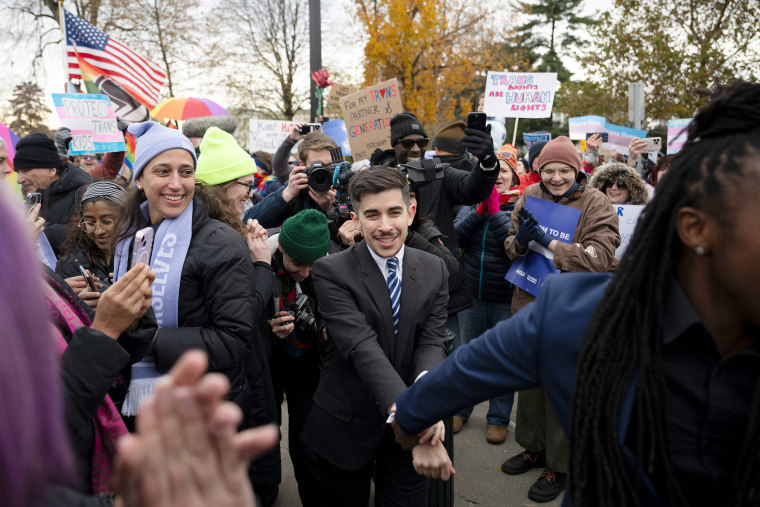
Chase Strangio, the first transgender attorney to argue before the Supreme Court, with supporters on Dec. 4, when the court heard the case of U.S. vs. Skrmetti. Marvin Joseph / The Washington Post via Getty Images
It’s unclear what type of procedure would be considered female genital mutilation “under the guise of care” according to Bondi’s interpretation of U.S. law. The FBI defines it as “partial or total removal of the external female genitalia or other injuries to the female genital organs for non-medical reasons.”
Transition-related care for minors can encompass a range of treatments, including talk therapy for younger children, puberty-blocking medications for adolescents and hormone therapy for older teens. Bondi’s memo specifically mentions gender-affirming surgeries, which are not recommended for minors. In rare cases, older teens can receive a double mastectomy, or removal of the breasts.
It’s also unclear ifBondi’s directives would conflict with federal and state anti-discrimination laws. A provision in the Affordable Care Act, for example, prohibits physicians who are providing federally funded services from discriminating based on sex. The Biden administration issued a notice interpreting that provision to include protection based on gender identity, but the Trump administration rescinded that notice in February. Some advocates argue the provision’s protections and some state nondiscrimination laws still apply.
Despite this, Bondi’s memo refers to this type of care as “radical gender experimentation,” and it cites research conducted by an advocacy group that opposes gender-affirming care for minors. That group found that, from 2019 to 2023, 14,000 children received treatment for gender dysphoria — the medical term for the distress caused by the misalignment between one’s gender identity and sex assigned at birth — and 5,700 had surgery.
However, trans advocates have noted that the rate of breast surgeries among adolescents who are cisgender, meaning not transgender, is much higher. For example, in 2011, more than 14,000 breast reduction procedures were performed in the United States on adolescent boys to correct gynecomastia, a benign condition that causes enlarged breast tissue, according to the American Society of Plastic Surgeons.
Bondi’s memo is the administration’s latest attempt at restricting trans health care. Just over a week after his inauguration, President Donald Trump signed a sweeping executive order aimed at curtailing transition-related care for minors by prohibiting federal funding for such care and threatening to withhold grants from hospitals and medical universities that provide the care, among other restrictions. At least two judges have temporarily blocked that order from taking effect.
Over the last few years, 27 states have enacted measures restricting access to transition-related care for minors. The Supreme Court is expected to issue a decision soon in a lawsuit against such a restriction in Tennessee, which could affect minors’ access to care nationwide and potentially care for trans adults under federally funded health programs.
The Supreme Court seemed likely to uphold a key preventive-care provision of the Affordable Care Act in a case heard Monday.
Conservative justices Brett Kavanaugh and Amy Coney Barrett, along with the court’s three liberals, appeared skeptical of arguments that Obamacare’s process for deciding which services must be fully covered by private insurance is unconstitutional.
The case came before the Supreme Court after the appeals court struck down some preventive care coverage requirements. It sided with Christian employers and Texas residents who argued they can’t be forced to provide full insurance coverage for things like medication to prevent HIV and some cancer screenings.
The appeals court’s ruling took explicit aim at the H.I.V. drug regimen known as pre-exposure prophylaxis, or PrEP, saying the law’s requirement that it be fully covered violated the religious freedom of a plaintiff in the case, Braidwood Management.
The company’s owner, Dr. Steven F. Hotze, a well-known Republican donor and doctor from Houston, has previously challenged the Affordable Care Act on other grounds.
The case stems from a lawsuit filed in 2020 by Dr. Hotze and other Christian business owners and employees in Texas; they maintained that the preventive care mandate violates their constitutional right to religious freedom by requiring companies and policyholders to pay for coverage that goes against their faith.