The American Academy of Pediatrics (AAP), the largest U.S. professional association of pediatricians (representing an estimated 67,000 members), has condemned a report opposing gender-affirming care recently released by the U.S. Department of Health and Human Services (HHS). As such, the AAP has directed its pediatric healthcare providers to “continue to support pediatricians and the well-being of all children” by continuing to provide gender-affirming care to youth as endorsed by almost all major U.S. medical associations.
“This report misrepresents the current medical consensus and fails to reflect the realities of pediatric care,” said AAP President, Dr. Susan J. Kressly, M.D., in a statement. “AAP was not consulted in the development of this report, yet our policy and intentions behind our recommendations were cited throughout in inaccurate and misleading ways. The report prioritizes opinions over dispassionate reviews of evidence.”
“As we have seen with immunizations, bypassing medical expertise and scientific evidence has real consequences for the health of America’s children,” Kressly’s statement continued. “Patients, their families, and their physicians—not politicians or government officials —should be the ones to make decisions together about what care is best for them based on evidence-based, age-appropriate care.”
AAP’s statement was co-signed by the American Academy of Family Physicians, American College of Obstetricians and Gynecologists, American College of Physicians, American Osteopathic Association, and American Psychiatric Association.
At the start of May, the Trump administration’s HHS released a 400-page review of trans youth healthcare that called the current best practices for gender-affirming care— endorsed by the World Professional Association for Transgender Health (WPATH) as well as mainstream medical organizations and professionals — “unproven.” The report was completed in just 90 days, identified none of its contributors, and underwent no peer review process before publication.
The report ignored numerous studies in which trans people expressed happiness with their transitions and instead pointed to a 1988 study of low employment and romantic partners among trans people as evidence of trans people doing “poorly” after receiving gender-affirming care. The report also pushed conversion therapy to change the gender identities of trans youth and promoted long-debunked claims that trans youth identify as such due to a mass “social contagion,” and are likely to just be gay or to return to a cisgender identity later in life.
The report also pushed claims that European countries are “pulling back” on gender-affirming care after the review of the United Kingdom’s Cass Review, a four-year-long study of trans healthcare research that excluded numerous studies showing the benefits of gender-affirming care. Despite this claim, major medical associations from France, Germany, Austria, and Switzerland have all released reports condemning the Cass Review’s findings.
The AAP has roundly criticized legislative efforts to outlaw gender-affirming care. The AAP joined five other medical organizations representing 600,000 physicians and medical students opposing Republican infringements on the patient-physician relationship, including the Trump administration’s elimination of $477 million in related research grant funding-affirming treatments, removing gender-affirming care as a covered benefit for the children of federal employees and military members, and an April 22 memo from Attorney General Pam Bondi threatening physicians with felony charges for providing certain types of gender-affirming care.
Transgender / Genderqueer / Nonbinary / Genderfluid / Questioning This group is for anyone that has or is questioning their gender and has found themselves identifying with the masculine side of the spectrum. If you’re worried you aren’t trans enough, don’t be, you’ve found your people. We meet on the third Wednesday of every month in Santa Rosa from 6-7:30 pm with a optional social time until 8pm.
Email us for location, questions, or accessibility needs at: soco.tmasc.moc.sup@gmail.com
Airyn De Niro: model, voice actress, future counselor, and Them’s newest cover star! Daughter of legendary actor Robert De Niro and model and actress Toukie Smith, Airyn sat down with Them reporter Ava Pauline Emilionefor her first-ever interview since starting her gender transition.
She spoke about how for much of her life, her parents tried to keep her out of the limelight, to protect her. “Obviously no parent is perfect, but I am grateful that both my parents agreed to keep me out of the limelight. They wanted it very private. They have told me they wanted me to have as much of a normal childhood as possible,” she said.
Now, 29 and nearly 6 months into her hormone therapy treatment, Airyn is ready to show the world who she really is. “There’s a difference between being visible and being seen,” Airyn said. “I’ve been visible. I don’t think I’ve been seen yet.”
Beginning this journey in November of 2024, Airyn told Them, “I think a big part of [my transition] is also the influence Black women have had on me,” she says. “I think stepping into this new identity, while also being more proud of my Blackness, makes me feel closer to them in some way.”
She continued to talk about how as an aspiring model, she hopes to provide more diverse representation for trans people. “I want queer people of color and bigger-bodied people to have an Alex Consani. I want queer people of color and bigger-bodied people to have a Hunter Schafer,” she said. “A part of me has always wanted to model and sort of follow my mom’s footsteps. Honestly, if I could be on the cover of Vogue with her or recreating one of her pictures, that would be a dream come true.”
With the term “nepo-baby” popping up constantly these days, Airyn shared that she hopes to find success on her own, sharing “I wasn’t brought up having a side part in one of dad’s movies or going to business meetings or attending premieres. My dad was very big on us finding our own sort of path,” Airyn says. “I would want [success] to happen on my own merit.” She continued, “I had two auditions for this video game, League of Legends. It’s one of the biggest video games I play all the time with friends. I was like, ‘Oh my God. That’d be so cool. It would be a make-it-or-break-it moment for me.’ Obviously it didn’t happen. I was like, ’What’s the point?’ It’s the really big auditions that you’re like, ‘Fuck, this could have been life-changing, but it just I wasn’t the right fit.’ And sometimes it’s hard to not internalize that.”
On top of modeling and voice acting, Airyn shared that she is also studying to become a mental health counselor, stating, “People of color and queer people definitely need more mental health advocacy and support. So I’m hoping I’m able to do that,” she says. “The field originally was so catered to white cis hetero men — what they deem as wrong or right or mentally ill or whatever, that is from their lens.”
Going forward, Airyn said that, “I wish people saw someone who is trying their hardest to heal from growing up not feeling good about themselves, and in the process of that, trying to make other people feel good about themselves.”
The Supreme Court on Tuesday allowed President Donald Trump to implement his ban on transgender people serving in the military.
The justices granted an emergency request from the Trump administration to lift a nationwide injunction blocking the policy while litigation continues.
The court’s brief order noted that the three liberal justices dissented.
“No more trans @ DoD,” Defense Secretary Pete Hegseth said on X. In a separate Defense Department post earlier Tuesday, before the decision was issued, Hegseth said in a video: “No more dudes in dresses. We are done with that s—.”
Just over 4,000 transgender people currently serve in the military, according to Defense Department data, though some activists put the figure much higher. There are around 2.1 million active service members in total.
Among those affected with be the seven individual transgender service members, led by lead plaintiff Emily Shilling, a Navy commander, who had sued to block it.
“Transgender service members have served this nation with courage, skill, and selflessness for years,” Shilling said in a statement Tuesday. “We’ve flown combat missions, led sailors, commanded troops, and stood watch. We are not a theory. We are not a policy debate. We are real people, doing real jobs, in defense of a nation we still believe in, even when it struggles to believe in us.”
“I know this decision will cause fear and doubt in the ranks. To those feeling shaken, I say this: stand tall. You are not alone. You are part of a community that will fight for you, stand beside you, and never stop pushing forward,” she added.
Lambda Legal and the Human Rights Campaign Foundation, two groups representing the plaintiffs, said in a joint statement that the Supreme Court decision was a “devastating blow” to transgender service members.
The policy “has nothing to do with military readiness and everything to do with prejudice,” they added.
In a separate case, a judge in Washington, D.C., also blocked the policy nationwide, but the U.S. Court of Appeals for the District of Columbia Circuit put that ruling on hold temporarily while it heard arguments on whether to block it more permanently.The court has yet to rule.
The policy, announced in February, is much more comprehensive ban than a similar proposal implemented during the first Trump term. It “generally disqualifies from military service individuals who have gender dysphoria or have undergone medical interventions for gender dysphoria,” Solicitor General D. John Sauer said in court papers.
In asking the Supreme Court to intervene, Sauer said that judges are required to show “substantial deference” to the Defense Department’s judgment on military issues.
In implementing the policy, the government relied on a Pentagon report from the first Trump term that said people with gender dysphoria are a threat to “military effectiveness and lethality.”
The challengers argued in court that the ban violates the Constitution’s 14th Amendment, which requires that laws apply equally to everybody, as well as other constitutional provisions.
Transgender service members have shown in recent years that they can serve just as well as anyone else, their lawyers said in court papers. Then-President Joe Biden had rolled back Trump’s earlier restrictions.
“An unprecedented degree of animus towards transgender people animates and permeates the ban: it is based on the shocking proposition that transgender people do not exist,” the lawyers wrote.
A federal judge in Washington state blocked the policy March 27, saying “it is not an especially close question.” The San Francisco-based 9th U.S. Circuit Court of Appeals declined to put the ruling on hold, prompting the Trump administration to turn to the Supreme Court.
During a press conference on April 22, Minnesota Attorney General Keith Ellison announced his filing of a federal lawsuit against the Trump administration and the Department of Justice (DOJ). The suit challenges the president’s anti-trans executive order directing agencies to withhold federal funding from educational programs that allow transgender girls to compete on women’s sports teams, under the claim that it violates both constitutional rights and Title IX of the 1964 Civil Rights Act.
The order in question, signed February 5, attempts to bar trans students from competing on school sports teams matching their gender identity, by revoking federal funding from public schools that don’t comply.
However, the MHRA prohibits discrimination based on protected classes like sexual orientation and gender identity—a clear conflict of interest.
But the DOJ responded by sending a letter five days later threatening to sue Minnesota if the state did not comply. The department continued to threaten the state in an April 8 letter and, and in an April 16 press conference, the DOJ stated it would seek “judicial resolution” and withhold funds from Minnesota if they refused compliance.
Recently, Ellison called their bluff and took the first shot, announcing that Minnesota would sue the DOJ and the president in his official capacity on four legal claims.
“I’m not gonna sit around waiting for the Trump administration to sue Minnesota,” Ellison said during the press conference. “Today, Minnesota is suing him and his administration because we will not participate in this shameful bullying—we will not let a small group of vulnerable children who are only trying to be healthy and live their lives be demonized, many of their parents are here today, and I thank them for their presence. The bottom line is: In our Minnesota, everyone is included in the circle of our compassion, and no one is out of our circle of protection.”
Sometimes countries face a moment like this—faced with a leader bent on destroying entire communities and instilling fear in those who protect them.Minnesota Attorney General Keith Ellison
The four main legal claims state that Trump’s order is invalid because the administration is trying to use the powers that the Constitution reserves to Congress.
The second claim argues that the order violates Title IX, a common argument the Trump administration uses to enforce the order. However, this interpretation is highly contested, and attempts by the Trump administration to redefine it to fit their interpretation have been blocked by courts.
The third claim states that the order violates the Administrative Procedures Act which requires courts to “set aside agency action” that is “arbitrary, capricious, an abuse of discretion, or otherwise not in accordance with law.” The fourth and final argument—and one of the more serious accusations—is that the order violates the 10th Amendment by trying to override a state law despite the amendment giving states the right to self govern.
This lawsuit is yet another in a series of lawsuits Minnesota has brought against the Trump administration.
One notable case from early February saw Minnesota joining with three other states to sue the Trump administration for an executive order threatening to cut federal grants to hospitals that provide gender-affirming treatment to individuals under 19. The plaintiffs argued that the order violated their 10th Amendment rights, and a federal judge ruled that Trump’s order could not be enforced in four plaintiff states.
The recently filed lawsuit also echoes a similar situation with Maine, whose leaders have refused to follow the anti-trans sports ban, and have since been hit by federal agencies withholding funding to the state.
“Sometimes countries face a moment like this—faced with a leader bent on destroying entire communities and instilling fear in those who protect them,” Ellison said in the press conference. “The lessons of history tell us a leader like that doesn’t stop at one community—after he’s destroyed one, he goes after another, and another, and another.”
Attorney General Pam Bondi issued a memo this week seeking to further curtail access to transgender health care for minors. In the memo, Bondi said the Justice Department will use a variety of existing U.S. laws to investigate providers of such care, as well as drug manufacturersand distributors.
She directed U.S. attorneys to use laws against female genital mutilation to investigate doctors who “mutilate” children “under the guise of care” and to prosecute these“offenses to the fullest extent possible.”
“I am putting medical practitioners, hospitals, and clinics on notice: In the United States, it is a felony to perform, attempt to perform, or conspire to perform female genital mutilation (‘FGM’) on any person under the age of 18,” Bondi wrote. “That crime carries a maximum prison sentence of 10 years per count.”
Bondi also directed the Consumer Protection Branch of the DOJ’s Civil Division to investigate potential violations of the Food, Drug and Cosmetic Actby drug manufacturers and distributors who engage “in misbranding by making false claims about the on- or off-label use of puberty blockers, sex hormones, or any other drug used to facilitate” a minor’s gender transition.
And she directed the Civil Division’s Fraud Section to investigate potential violations of the False Claims Act by physicians who submit “false claims … to federal health care programs for any non-covered services related to radical gender experimentation.” (She included as an example of this a physician prescribing puberty blockers to a minor for gender-transition care but reporting it to Medicaid as being for early-onset puberty.)
Robin Maril, an assistant professor of constitutional law at Oregon’s Willamette University, said Bondi’s memo doesn’t change any existing laws. Doctors, she said, will not be breaking the law by continuing to treat trans minors if they live in a state where such care is still legal. She also noted that Medicaid fraud and defrauding the government are already crimes.
“The bulk of this is just showing how they’re going to use resources and investigate,” Maril said. “That’s not a law change. It’s meant to have a chilling effect on physicians providing access to necessary care, fearing that it will be characterized as chemical and surgical mutilation of children.”
She added that the memo’s call on whistleblowers to report “knowledge of any such violations” could further make doctors afraid of being reported.
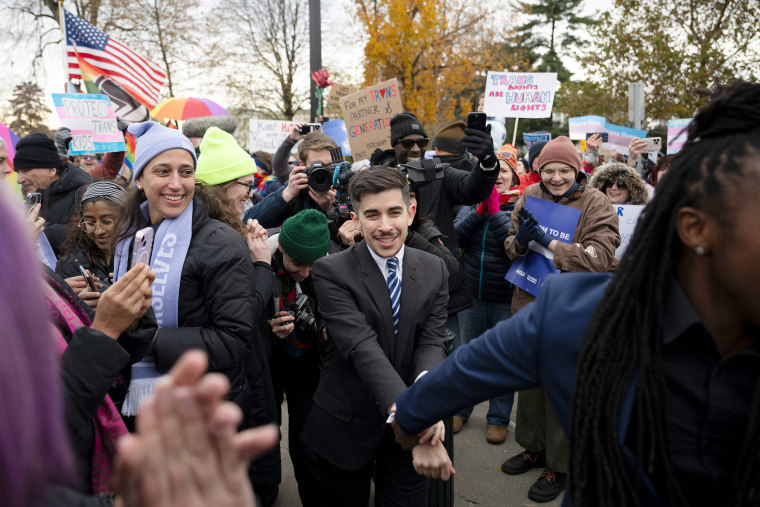
Chase Strangio, the first transgender attorney to argue before the Supreme Court, with supporters on Dec. 4, when the court heard the case of U.S. vs. Skrmetti. Marvin Joseph / The Washington Post via Getty Images
It’s unclear what type of procedure would be considered female genital mutilation “under the guise of care” according to Bondi’s interpretation of U.S. law. The FBI defines it as “partial or total removal of the external female genitalia or other injuries to the female genital organs for non-medical reasons.”
Transition-related care for minors can encompass a range of treatments, including talk therapy for younger children, puberty-blocking medications for adolescents and hormone therapy for older teens. Bondi’s memo specifically mentions gender-affirming surgeries, which are not recommended for minors. In rare cases, older teens can receive a double mastectomy, or removal of the breasts.
It’s also unclear ifBondi’s directives would conflict with federal and state anti-discrimination laws. A provision in the Affordable Care Act, for example, prohibits physicians who are providing federally funded services from discriminating based on sex. The Biden administration issued a notice interpreting that provision to include protection based on gender identity, but the Trump administration rescinded that notice in February. Some advocates argue the provision’s protections and some state nondiscrimination laws still apply.
Despite this, Bondi’s memo refers to this type of care as “radical gender experimentation,” and it cites research conducted by an advocacy group that opposes gender-affirming care for minors. That group found that, from 2019 to 2023, 14,000 children received treatment for gender dysphoria — the medical term for the distress caused by the misalignment between one’s gender identity and sex assigned at birth — and 5,700 had surgery.
However, trans advocates have noted that the rate of breast surgeries among adolescents who are cisgender, meaning not transgender, is much higher. For example, in 2011, more than 14,000 breast reduction procedures were performed in the United States on adolescent boys to correct gynecomastia, a benign condition that causes enlarged breast tissue, according to the American Society of Plastic Surgeons.
Bondi’s memo is the administration’s latest attempt at restricting trans health care. Just over a week after his inauguration, President Donald Trump signed a sweeping executive order aimed at curtailing transition-related care for minors by prohibiting federal funding for such care and threatening to withhold grants from hospitals and medical universities that provide the care, among other restrictions. At least two judges have temporarily blocked that order from taking effect.
Over the last few years, 27 states have enacted measures restricting access to transition-related care for minors. The Supreme Court is expected to issue a decision soon in a lawsuit against such a restriction in Tennessee, which could affect minors’ access to care nationwide and potentially care for trans adults under federally funded health programs.
In 2022, after living as a boy and going by a new name for several years, a 15-year-old from Madison, Wisconsin, wanted to make it official. Like most teenagers, he dreamed of getting his driver’s license, and his family wanted his government identification to reflect who he really was.
But Wisconsin law has a caveat: He would have to publish his old, feminine name and new name in the local newspaper for three weeks — essentially announcing to the world that he is transgender.
In many instances, if he had committed a crime, the law would afford him privacy as a minor. But not as a transgender teenager changing his name.
His parents worry the public notice now poses a risk as President Donald Trump has attacked transgender rights, asserted that U.S. policy recognizes only two sexes and described efforts to support transgender people as “child abuse.” The publication requirements endanger the community, lawyers working with trans people say, by creating a de facto dataset of likely transgender people that vigilantes and even the government could use for firing, harassment or violence.
Transgender people are over four times more likely to be victims of violence, research shows. Most transgender people and their families agreed to be interviewed for this story only if they weren’t named, citing safety concerns.
“Publication requirements really leave folks open and vulnerable to discrimination and to harassment more than they already are,” said Arli Christian, senior policy counsel at the American Civil Liberties Union. “It can put people at risk of violence and blatant discrimination simply because of who they are.”
Wisconsin’s legal process stems from a 167-year-old law, one of many statutes across the country that Christian said were intended to keep people from escaping debts or criminal records. Changing one’s name through marriage is a separate process that does not require publication in a paper.
Although the right to change one’s legal name exists in every state, the effort and risk required to exercise it vary. Less than half of states require people to publicize their name changes in some or all cases, according to the Movement Advancement Project, a think tank that tracks voting and LGBTQ+ rights.
Wisconsin law grants confidentiality only if a person can prove it’s more likely than not that publication “could endanger” them. But the statute does not define what that means. For years, some judges interpreted that to include psychological abuse or bullying, or they accepted statistics documenting discrimination and violence against transgender people nationwide.
In 2023, however, a state appeals court set a stricter standard after a trans teenager was denied a confidential name change in Brown County, home to Green Bay. The teen said he had endured years of bullying, in which peers called him slurs and beat him up. Court records show the Brown County judge asserted that publishing the teen’s name wouldn’t expose him to further harm because his harassers already knew he was transgender.
The teen argued that a public process would create a record available to people he met in the future. While the appeals court conceded a “reasonable judge” could agree, it found the Brown County judge had not improperly exercised her discretion in denying the request. Crucially, the appeals court determined that “endanger” meant only physical harm. The case wasn’t appealed to the Wisconsin Supreme Court.
Both of these trans girls living in Wisconsin requested the confidential name-change process after the 2024 presidential election. First image: A 14-year-old likes cuddling her cat, playing video games and practicing piano. Second image: A 12-year-old shares her artwork. Illustrations by Shoshana Gordon/ProPublica. Source images obtained by ProPublica.
The combination of Wisconsin’s public requirement, the restrictive ruling and the Trump administration’s anti-trans policies has dissuaded at least one person from going through with a name change.
J.J Koechell, a 20-year-old LGBTQ+ advocate from suburban Milwaukee, tried to change his name in November but decided against it after a judge denied his request for confidentiality, ordering him to publish his change in the local paper and create a public court record if he wanted to proceed.
“That’s already dangerous,” Koechell said of a public process, “given our political atmosphere, with an administration that’s trying to erase trans people from existence completely, or saying that they don’t exist, or that there’s something wrong with them.”
At the end of March, Wisconsin Democrats announced plans to introduce a bill that would eliminate the publication requirement for transgender people, so long as they can prove they’re not avoiding debt or a criminal record. Republicans, who control the Legislature, will decide whether it will receive a hearing or vote.
There has been a push in some states to make it easier and safer for transgender people to update their legal documents. Michigan and Illinois laws removing publication requirements took effect earlier this year. And a California lawmaker introduced a bill that would retroactively seal all transition-related court records.
Assembly Speaker Robin Vos, R-Rochester, did not respond to emails and a phone call to his office seeking comment. Wisconsin Watch and ProPublica sought comment from four other Republican leaders in the Assembly and Senate. Of the two whose offices responded, a staffer for Assembly Majority Leader Tyler August, R-Walworth, said, “It doesn’t look like something we’d consider a priority,” and a staffer for Senate Assistant Majority Leader Dan Feyen, R-Fond du Lac, said he was not available for comment.
Asked about the safety concerns people raised, a White House spokesperson said, “President Trump has vowed to defend women from gender ideology extremism and restore biological truth to the Federal government.”
No Exceptions for Minors
Wisconsin’s law requires a transgender person to publish the details of their identity to change their name whether they are an adult or a child. The notice requirement makes no distinction based on age.
This is less privacy than the legal system typically affords young people, confirmed Cary Bloodworth, who directs a family law clinic at the University of Wisconsin Law School. Bloodworth said both child welfare and juvenile courts tend to keep records confidential for a number of reasons, including that what happens in a person’s youth will follow them for a lifetime.
“I certainly think having a higher level of privacy for kids is a good thing,” Bloodworth said, adding that she thinks the publication requirement is unnecessary for people of any age.
A mom living near the Wisconsin-Illinois border whose 11-year-old daughter recently went through the name-change process said these proceedings should automatically be private for children.
“The fact that we still have to fight to get something as simple as a confidential name change for a minor who is obviously not running away from criminal or debt charges is just so frustrating and overwhelming,” she said.
The judge deciding their case seemed reluctant to grant confidentiality at first, questioning whether her daughter was being threatened physically, she said. The judge granted the confidential change. But the family remains shaken.
“We live just in constant terror of the wrong person finding out that we have an 11-year-old trans child,” she said. “All it takes is one wrong person getting that information, and what we could end up going through, becoming a target, is horrifying.”
Right before the pandemic, a teenager told her parents she was transgender. She spent much of that first year of her transition at home, attending virtual school like the rest of her peers in the Madison school district. She came out to only a few friends and wanted to keep her gender identity private, so she kept her camera off and skipped her high school graduation.
When she decided to legally change her name, the prospect of publicizing her transition terrified her, according to her mom.
“I explained to her that it’s in tiny, tiny print, and it’s in some page of the paper that no one is going to read,” her mom said. “But it felt to her like she was just standing out there in public with a ‘TRANS’ sign on her.”
While fewer people read physical newspapers these days, much of their content gets published online and is easily searchable. The court case, too, becomes a public record that is stored online and sometimes aggregated by other websites that show up at the top of search results.
The parents of the then-15-year-old boy who changed his name before getting his driver’s license discovered that happened to their son. When anyone — say, a prospective employer — searches the young man’s name, one of the first results shows his old name and outs him as trans.
“This is what somebody would use as their first judgment of him,” his mom said. “We certainly don’t want that to be something that people would use to rule him out for a job, or whatever it is he might be doing.”
Like many other states, Wisconsin does not have laws that ban discrimination against transgender people in credit and lending practices or in public spaces like stores, restaurants, parks, doctor’s offices and hotels. However, Gov. Tony Evers, a Democrat, issued an executive order in 2019 banning transgender discrimination in state employment, contracting and public services.
After Trump took office again and began issuing executive orders attacking trans rights, the boy’s family started to investigate how they could retroactively seal the court records related to the name change. It wouldn’t change what was in the newspaper, but it could help them remove the online records. The court records also contain sensitive information like their home address that someone could use to harass them.
A friend who was a retired attorney helped their son craft an affidavit describing his experiences. His mom read from it during an interview. “‘Because of recent political events, I fear violence —’” she said before breaking off. “Oh God, I hate even reading this. ‘I fear violence, harassment, retribution because of my status as a transgender person.’”
Her son, who is now 18, shared a statement over email.
“At this moment in time I’m probably more scared about being a trans person than I ever have been before, with the public record if you have my first and last name you can easily find my deadname and therefore find out I’m trans,” he said. “I would love to say that I feel safe and valued in our society but unfortunately I can’t, at times I feel that my personhood is being stripped away under this government.”
Anne Daugherty-Leiter, who has guided transgender clients and their families through the name-change process as board president of Trans Law Help Wisconsin, said where a person lives in Wisconsin, and therefore what court they must petition, affects their likelihood of getting a confidential change.
Confidentiality is important, she said, because of how the state handles changes to birth certificates. Wisconsin birth certificates that are issued through a confidential name change show only the new name. But if a person has to announce their name change publicly, birth certificates are amended to list both the person’s old and new names. Any time the person has to use that document, at the DMV or while getting a loan, it outs them, she said.
“This Is Not Who I Am”
Koechell, a trans man and LGBTQ+ activist, was unwilling to go through with the name-change process after being denied confidentiality by a judge late last year.
Koechell lives in Waukesha County, a Republican stronghold where multiple schools have enacted policies critics have called anti-LGBTQ+.
In a letter to the judge, Koechell wrote that people had sent him multiple threats and posted his family members’ addresses online, all for “being an advocate and being transgender openly in my community.”
“I do not want to publish my deadname for people to use against me,” he said in an interview, using a term common among transgender people to refer to their birth names. “I don’t see a reason why people who are not particularly fond of me wouldn’t show up at a hearing like that and try and cause trouble.”
Court records show the judge denied Koechell’s confidentiality request and his request to reconsider. The judge’s order referred to Koechell, a trans man with a masculine voice and beard, as “she” and “her.”
Koechell decided the public process wasn’t worth the risk. But it’s hard, he said, to move through life with his old identification.
“When I go to a new doctor or new appointment or something, then that’s the name on my chart, and then I get called that in a waiting room full of people, and it’s super uncomfortable. I just want to disappear,” Koechell said. “Then eventually, I have to correct the doctors, and I’m like, ‘Hey, just to let you know, I don’t go by that name. This is not who I am.’”
Data from the latest U.S. Transgender Survey found that 22% of people who had to show an ID that did not match their identity experienced some form of negative consequence, including verbal harassment, discrimination or physical violence.
If the U.S. Senate passes the SAVE Act, which would require voters to prove citizenship with a passport or birth certificate, those consequences could include disenfranchisement. Transgender people who can’t change the name on their birth certificate or passport would be ineligible to vote, according to the liberal think tank Center for American Progress.
U.S. Rep. Chip Roy, a Texas Republican and chief sponsor of the bill, has said the legislation directs states to create a process for citizens with a “name discrepancy” to register. “No one will be unable to vote because of a name change,” he said.
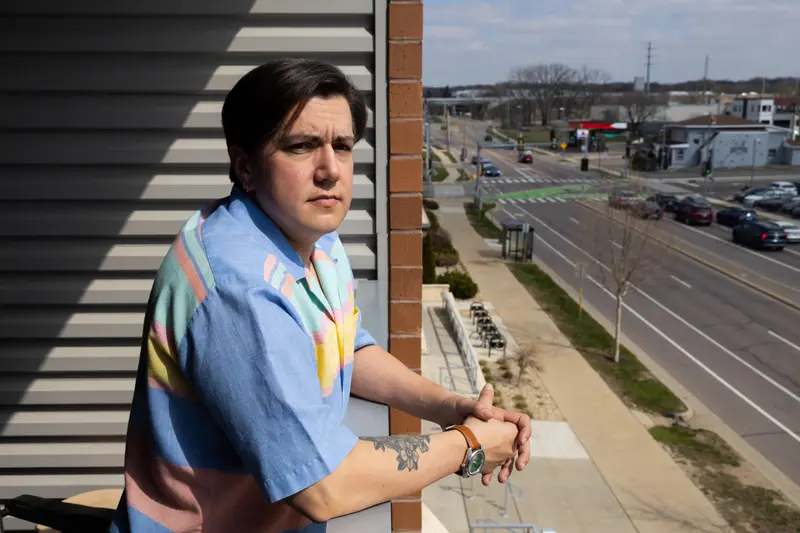
Trace Schlax, a trans man in Wisconsin, has tried to change his gender marker and name on official documents. Joe Timmerman/Wisconsin Watch
After Trump won in November, Trace Schlax, a 40-year-old IT project manager, decided to expedite changing his gender marker on his passport, figuring he could update his name later in state court.
“It matters,” Schlax said. He loves to travel but has encountered extra scrutiny from airport security with outdated documents. “I get comments from TSA when I go through to travel domestically, about my hair, about how I look. I get extra pat-downs.”
He sent his application in early December and crossed his fingers. He received it back in February, rejected. By that time, Trump had issued an executive order banning trans people from changing the gender markers on their passports.
Schlax decided to continue updating what records he could, like his birth certificate and driver’s license. He worries about having conflicting documents. Will he get accused of fraud? Will he have trouble flying?
But in the end, he decided it was still important to change his name and update his license to improve his day-to-day experience.
And he decided to go about it publicly. It felt less painful, he said, to accept the risks rather than detail his personal, traumatic experiences to a judge only to have them decide he hadn’t endured sufficient danger.
“Me changing my name and my gender marker affects absolutely no one but me,” said Schlax, who has a court date to change his name in late April. “Why does this have to be so hard? Why do I have to prove myself so hard?”
The Trump administration has cleared the way for people to report doctors who provide gender-affirming care to minors — and now says they can do so without violating federal medical privacy laws.
In new guidance issued Monday, the U.S. Department of Health and Human Services announced that health care workers, clinic staff, and even third parties may file complaints against providers offering gender-affirming care and, in many cases, even disclose protected patient information under HIPAA’s whistleblower provisions. Under HIPAA, the Health Insurance Portability and Accountability Act, medical professionals must keep a patient’s health information confidential. The guidance, issued under President Donald Trump’s January 28 executive order titled “Protecting Children from Chemical and Surgical Mutilation,” establishes a new federal portal to collect these reports.
Civil rights and LGBTQ+ health advocates say the move weaponizes patient privacy law against the very people it was designed to protect — and targets providers in a sweeping campaign to scare them out of delivering medically necessary care.
“At a time when trans health is already becoming more and more difficult for patients to access, this guidance is a page out of the anti-abortion activism playbook,” said Adrian Shanker, a national LGBTQ+ health policy expert and senior HHS official under the Biden administration. “That’s the clear goal: to instill fear among providers of best-practice transgender medicine. That’s unfortunate — but it’s also dangerous for the needs of transgender patients who rely on qualified providers with specializations and training to provide that care.”
The new policy doesn’t stand alone. It follows a sweeping federal letter issued just days earlier by the Centers for Medicare and Medicaid Services advising state Medicaid agencies that they may restrict or eliminate coverage of gender-affirming care for minors. The CMS letter explicitly referenced federal sterilization regulations — originally created to protect against coerced sterilization—as justification for blocking puberty blockers and hormone therapy. Advocates called it a dangerous distortion of the law.
The online complaint form from HHS invites users to name doctors, identify hospitals or clinics, and describe the alleged “mutilation of children” — a term the administration uses to refer to evidence-based gender-affirming care. The department encourages people to cite the executive order and offers guidance on reporting providers to multiple federal agencies.
Shanker said the real consequence isn’t theoretical — it’s already happening. “It’s two sides of the same coin because it’s diminished access to care — period,” he told The Advocate. “If providers become fearful of providing the care, fewer providers will offer it.”
For those on the front lines, that fear is palpable. A pediatric gender-affirming care provider at a major children’s hospital in the Midwest told The Advocate that they’re seeing the trust that underpins medicine unravel in real time.
“It feels very chilling,” the provider said, speaking on the condition of anonymity due to security concerns. “We’ve been under the microscope for a long time, but now it feels like they’ve got a free pass to do whatever they want. It’s terrifying for our patients, and it’s terrifying for us as providers.”
The provider said colleagues were asked where their “line in the sand” was at a recent staff meeting—what it would take to stop practicing.
“All of the prescribing providers said, ‘Jail, I guess,’” they said. “That’s my line in the sand. And it feels like we’re inching closer to that every day, especially with this new hotline to report things.”
Even inside their own hospital, they no longer feel safe.
“I know there are people who work here who don’t support the gender program. I’ve heard them say things like, ‘This is over the top — why don’t these kids just get therapy?’ And now they could call this hotline and report me. What does that do to my license? To my safety as a provider?”
The guidance, legal experts say, is both sweeping and unlawful.
“This is blatantly unlawful for multiple reasons — because it discriminates against transgender people because it violates statutory and constitutionally protected medical privacy rights, and because it has no legal basis and is therefore arbitrary and capricious,” Shannon Minter, legal director of the National Center for Lesbian Rights, told The Advocate.
He added that the policy deliberately distorts the concept of whistleblower protection. “This is stretching the definition of a whistleblower to absurd lengths and is plainly designed to encourage the harassment of doctors and others providing needed medical care to transgender people.”
The provider said the guidance only deepens patients’ mistrust of the medical system. Many already wait a year or more to be seen.
“Our waitlist has never been shorter than a year,” they said. “By the time patients get to me, they’ve often had multiple suicide attempts. Nobody walks in and gets hormones. And I’ve never had a minor patient undergo genital surgery—ever.”
Still, the damage is done. “I don’t tell people what I do anymore. I used to say I worked in pediatrics and gender health. Now, I just say pediatrics. I’ve scrubbed all my public social media. The network of providers I refer to has gotten smaller — I only trust people I know personally. That’s what it’s come to.”
When asked what they wanted the public to understand about the care they provided, the provider didn’t hesitate.
“These medical treatments are lifesaving. I’ve seen adolescents go from depressed and suicidal to just thriving and living their best selves. If anyone saw what I see in clinic every day, they’d know this is care that works.”
The guidance claims whistleblowers are protected under several federal laws, including the False Claims Act and the Church Amendments, and outlines how HIPAA’s whistleblower provisions can shield those who report providers to oversight agencies or law enforcement.
However, medical experts and legal advocates point to a glaring omission: gender-affirming care is supported by every major medical association, including the American Academy of Pediatrics, the American Medical Association, and the Endocrine Society.
“Evidence-based policymaking would rectify this,” Shanker said. “Instead, they’re using political rhetoric around so-called mutilation rather than following the science.”
Minter is confident that if enforced, the policy would be struck down. “This is yet another example of this administration overreaching and seeking to dictate private medical decisions that belong to families and individuals — not the government.”
A ruling Wednesday from the top court in the United Kingdom that says the legal definition of a woman is someone whose birth sex is female is the latest high-profile action globally involving the issue of what legal recognitions transgender people are allowed. The spectrum of protections around the world ranges widely, from none at all in a number of countries to the existence of anti-discrimination protections and legal gender identity changes in some others.
Here’s a look at actions in some countries recently:
United Kingdom
The decision from U.K. Supreme Court revolved around the U.K. Equality Act, which bars discrimination along protected categories including age, race and sex. The court’s ruling said that for the purposes of the act, the definition of a woman is someone born biologically female, which excludes transgender people. The unanimous decision means trans women can be barred from places like women-only changing rooms and homeless shelters and kept from groups like those offering medical or counseling services only to women. But the ruling also said the decision didn’t mean transgender people were without any legal protection, because the Equality Act also recognizes gender reassignment as a protected category.
Supporters of For Women Scotland, the group that brought the suit, celebrated the decision while advocates for transgender rights called it a setback.
Hungary
Rights for transgender people were restricted as part of a wider crackdown on LGBTQ communities in Hungary through an amendment to its constitution passed on April 14. The measure was proposed by the ruling coalition led by populist Prime Minister Viktor Orbán, and easily sailed through Hungary’s parliament.
Under the new amendment, the nation’s constitution says there are two sexes, male and female. A government spokesman called it “a clarification that legal norms are based on biological reality.” It lays a constitutional groundwork for denying transgender people the ability to have their gender identities protected.
Critics of the amendment said it was about humiliating and excluding people, and part of the ruling party’s moves toward authoritarianism. The amendment also banned any public events from LGBTQ communities, which Hungary’s government has strongly campaigned against in recent years.
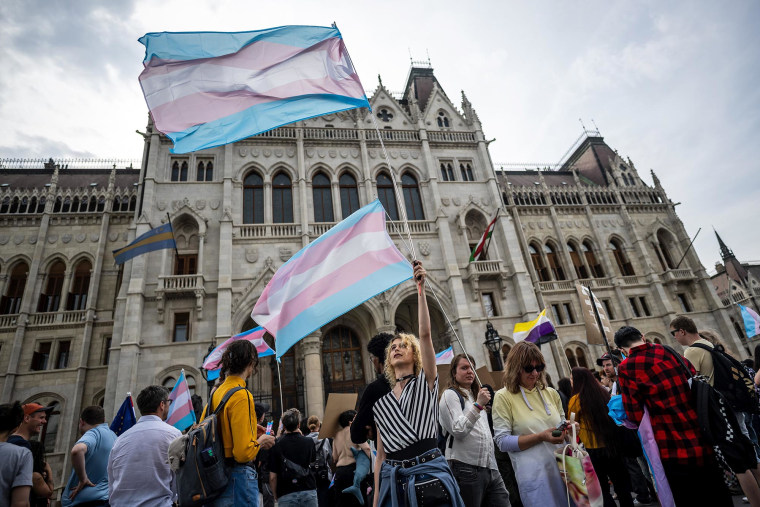
Activists wave transgender flags in front of the Hungarian Parliament in Budapest during the Trans Pride march on May 11, 2024. Marton Monus / dpa via Getty Images file
United States
President Donald Trump has made a ban on transgender participation in sports a central focus of his administration. On Wednesday, he sued the state of Maine for not following an executive order he signed that banned transgender athletes from participating in girls’ and women’s sports.
In a February meeting with state governors, Trump called out Gov. Janet Mills for not complying with his order, and threatened to pull federal funding, to which Mills replied, “We’ll see you in court.”
The administration’s lawsuit calls for Maine to be ordered to tell its schools that it’s prohibited for males to participate in athletic competition designated for females.
Another of Trump’s executive orders insists on a rigid definition of the sexes, rather than gender, for federal government purposes. The orders are facing court challenges. For its part, Maine sued the administration after the Department of Agriculture said it was pausing some money for the state’s educational programs. A federal judge on Friday ordered the administration to unfreeze funds intended for a Maine child nutrition program.
It’s not just on the federal level; the question of legal protections for transgender people is a political issue in many American states as well. In twenty-six states, transgender girls from are banned from girls school sports. Other issues around the country include access to gender-related health care for minors and bathroom access in public spaces like schools and government buildings.
Trans Canadian singer Bells Larsen has been forced to cancel his US tour over the administration’s anti-trans visa rules.
Larsen cancelled his tour following the Trump administration signing legislationthat required IDs, including passports and visas, to show a person’s sex as “either male or female”. The requirement has already been implemented by US citizenship and Immigration Services.
Taking to Instagram, Larsen confirmed that his tour will be cancelled following the American Federation of Musicians stating that he can no longer apply for a visa that aligns with his gender.
The post added: “To put it super plainly, because I’m trans (and have an M on my passport), I can’t tour in the States.
“I hesitate to include a ‘right now’ or an ‘anymore’ at the end of my previous sentence, because – in this sociopolitical climate – I truly don’t know which phrasing holds more truth.”
Larsen added that the “irony” of the cancellation is that it comes exactly two weeks before the release of his album, which is about his transition.
The singer had intended to tour this spring in Boston, New York, Los Angeles and San Francisco, among other areas, but refunds will now be available to those who purchased tickets for his US shows.
His Instagram announcement added that he had contemplated going ahead with the tour by travelling with a cisgender man, performing in “exclusively blue states” and handing border agents a visa and passport with “M” markers on. However, “distressing stories, texts and updates kept multiplying,” leading him to think “through a trans lens,” which he said “made everything all the more complicated”.
He concluded that there is “no way to move forward here”.
Comments under Larsen’s post have sent support his way, with many sharing that the update is “devastating”.
“I’m so very sorry. And as an American so truly embarrassed… I look forward to the day when America is safe for you again,” a comment that has been liked more than 670 times reads.
Another reads: “Reading this breaks my heart! You are amazing. Thank you for sharing your story!”
The Williams Institute at UCLA’s School of Law estimated that around 16,700 non-binary people requested a passport using an X gender marker each year. This represents 1.4 per cent of the non-binary population in the US, which the institute estimates is around 1.2 million adults in the country.