Gender dysphoria diagnoses in the United States increased in all but one state in recent years, suggesting that a growing number of transgender people are seeking health care.
Gender dysphoria “refers to psychological distress that results from an incongruence between one’s sex assigned at birth and one’s gender identity,” according to the American Psychiatric Association.
Not all transgender people experience dysphoria. Treatment can include social shifts, such as wearing different clothing or going by a different name, or medical affirmation, which can involve puberty blockers, hormone treatment, and surgery. Medical treatment — gender-affirming care — typically requires a diagnosis from a health care professional before patients can receive it.
Despite a growing number of states seeking to ban gender-affirming care for minors and restrict the care for adults, more people are beginning to seek it by receiving a diagnosis, a recent report from Definitive Healthcare found.
Virginia, Indiana, and Utah were the states with the greatest increase in diagnoses between 2018 and 2022 The only state to see a decrease was South Dakota, which banned gender-affirming care for minors in 2023.
South Dakota lawmakers had attempted to pass legislation banning care in 2020, which the report stated likely had “the dual chilling effects of reduced access to sympathetic providers and the self-directed seeking of care in states where long-term access was protected.”
The report also noted that “other states with bans on gender-affirming care for youth have seen year-to-year dips in gender dysphoria diagnoses, too,” though this does not necessarily indicate that less transgender residents are seeking care, but rather “possibly indicating that shifting social and political climates have pushed young patients and their parents to seek diagnoses in states that are friendlier to trans people.”
For patients under the age of 18, gender dysphoria diagnoses increased from 17.5 percent to 20.4 percent during the four-year period. The report notes this could be reflective of transgender identities becoming “more accepted by society,” in spite of the legislators pushing health care bans.
The Williams Institute estimates that 1.6 million people in the U.S. are transgender, nearly 20 percent of them being between the ages of 13 and 17. Among transgender youth, 35.1 percent (105,200 total) live in states that have restricted access to gender-affirming care, according to the Human Rights Campaign.
The family of a transgender volleyball player has added a South Florida school district as a defendant in a federal lawsuit that challenges a 2021 state law banning transgender girls from playing on female sports teams, claiming school officials have placed the family in danger.
Attorneys for the family filed an amended complaint Thursday that adds the Broward School Board, the school district’s superintendent and the Florida High School Athletic Association. The school officials had been named as defendants when the lawsuit was initially filed in 2021 but were dropped the next year, leaving just the Florida Department of Education and Education Commissioner Manny Diaz as defendants.
“While we can’t comment on pending litigation, Broward County Public Schools remains committed to following all state laws,” district spokesman John J. Sullivan said in a statement. “The District assures the community of its dedication to the welfare of all its students and staff.”
U.S. District Judge Roy Altman, a Trump appointee, ruled in November that state officials had a right to enforce a 2021 law that bars transgender girls and women from playing on public school teams intended for student athletes identified as female at birth but allowed the family to file an amended complaint.
The law, which supporters named “The Fairness in Women’s Sports Act,” was championed and signed in by Republican Gov. Ron DeSantis, who is running for president and has leaned heavily into cultural divides on race, sexual orientation and gender.
The transgender student, a Monarch High School 10th grader who played in 33 matches over the past two seasons, was removed from the team in November after the Broward County School District was notified by an anonymous tipster about her participation.
According to the lawsuit, the student has identified as female since before elementary school and has been using a girl’s name since second grade. At age 11 she began taking testosterone blockers and at 13 started taking estrogen to begin puberty as a girl. Her gender has also been changed on her birth certificate.
The girl’s removal from the volleyball team led hundreds of Monarch students to walk out of class in protest. At the same time, Broward Superintendent Peter Licata suspended or temporarily reassigned five school officials pending an investigation, including the girl’s mother, an information technician at the school.
The Associated Press is not naming the student to protect her privacy.
The initial lawsuit didn’t identify the student or her school, but the amended complaint said the family lost all privacy when the school district began its investigation. The student’s mother issued a statement at the time calling the outing of her daughter a “direct attempt to endanger” the girl.
The Human Rights Campaign, an LGBTQ+ rights organization, has been supporting the family.
“The reckless indifference to the well-being of our client and her family, and all transgender students across the State, will not be ignored,” the group’s litigation strategist, Jason Starr, said in a statement last month.
A new law in Maryland requires Medicaid to cover “medically necessary” gender-affirming care for residents — including care well beyond hormones or surgery.
The law went into effect on January 1. It requires coverage for “gender-affirming treatment in a nondiscriminatory manner.”
Voice therapy and lessons, scar and hair removal, hormone therapy, puberty blockers, fertility preservation, and “alterations” to the abdomen, genitals, chest, buttocks, neck, and face are all included. Patients cannot be denied unless a healthcare professional decides the treatment would be detrimental to their health.
“This order is focused on ensuring Maryland is a safe place for gender-affirming care, especially as other states take misguided and hateful steps to make gender-affirming care cause for legal retribution,” Moore added. “In Maryland, we are going to lead on this issue.”
Lt. Gov. Aruna Miller (D) said the order shows that “This administration is saying to all LGBTQIA+ Marylanders: You deserve to be your authentic selves, during Pride month and every month. You deserve to live safely, openly, and freely; and receive the gender-affirming care you need.”
Lee Blinder, Executive Director of Trans Maryland, said, “This legislation emerged from the trans community experiences shared with our organization at Pride festivals and support groups around Maryland about barriers of access to care,. We are grateful to every individual who worked toward passing this groundbreaking bill. Thanks to the Moore-Miller Administration, Maryland is a sanctuary state for transgender people, and we will continue to work closely with the Administration to ensure expansion of access continues.”
Renee Lau, a state resident who started transitioning about five years ago, told CBS News, “I plan on having some surgeries and having consultations within the next two months. I would not believe the relief it is for me, because I never could have paid for [these services] out of pocket.”
Gender-affirming care is considered safe and essential to the well-being of trans people by the American Academy of Pediatrics, the American Medical Association, the American Psychological Association, and other major U.S. and world health organizations.
Alabama can begin immediately enforcing a ban outlawing the use of puberty blockers and hormones to treat transgender people under 19, a federal appeals court ruled Thursday, granting the state’s request to stay a preliminary injunction that had blocked enforcement of the 2022 law.
The 11th U.S. Circuit Court of Appeals had previously ruled that the injunction should be vacated, but the decision had been effectively on hold while families with transgender children asked the full appellate court to reconsider the decision. The Thursday order will allow the ban to take effect while the full court decides whether it will revisit the decision.
The state Attorney General Steve Marshall called the order a “significant victory for our country, for children and for common sense.”
“The physical and psychological safety of our children can now be better protected from these untested and life-altering chemical and surgical procedures through the implementation of the Alabama Vulnerable Child Compassion and Protection Act,” Marshall said.
Lawyers representing parents of transgender adolescents who challenged the ban said the decision will “hurt parents and children in the state.”
“Alabama’s transgender healthcare ban will harm thousands of transgender adolescents across the state and will put parents in the excruciating position of not being able to get the medical care their children need to thrive,” read a joint statement from GLBTQ Legal Advocates & Defenders, the National Center for Lesbian Rights, the Southern Poverty Law Center and the Human Rights Campaign.
Alabama Gov. Kay Ivey signed the Vulnerable Child Compassion and Protection Act into law in 2022, making it a felony punishable by up to 10 years in prison for doctors to treat people under 19 with puberty blockers or hormones to help affirm their gender identity.
At least 22 states have now enacted laws restricting or banning gender-affirming medical care for transgender minors, and many of them face lawsuits or blocked enforcement. Courts have issued mixed rulings, with the nation’s first law, in Arkansas, struck down by a federal judge who said the ban violated the due process rights of young transgender people and their families.
Attorneys representing Tennessee transgender teens and their families have asked the U.S. Supreme Court to block the state’s ban on gender-affirming care for minors that a lower court allowed to go into effect. The court is expected to decide later this year if it will hear the case.
Four families with transgender children ranging in ages 12 to 17 challenged the Alabama law as an unconstitutional violation of equal protection and free speech rights, as well as an intrusion into family medical decisions. The U.S. Department of Justice joined their lawsuit, seeking to overturn the law.
U.S. District Judge Liles Burke, nominated to the court by then-President Donald Trump in 2017, ruled when issuing the preliminary injunction that Alabama had produced no credible evidence to show that transitioning medications are “experimental.” Alabama appealed the decision to the 11th Circuit. The challenge to the Alabama ban is scheduled to go to trial early this year.
A coalition of 17 Republican state attorneys general have filed an amicus brief urging the Supreme Court to take up a case about a school’s policy allowing teachers to not out trans and gender-nonconforming students to their parents.
The brief, filed last week, opposes a lower court decision upholding the Montgomery County, Maryland, Board of Education’s guidelines on student gender identity. First adopted by the district during the 2020–2021 school year, the guidelines do not require school staff to inform parents if a student requests to socially transition at school. Instead, school staff must first “ascertain the level of support the student either receives or anticipates receiving from home” before determining whether to speak to their parents.
“This egregious policy completely sidesteps parents’ rights and severs them from having involvement in their child’s physical, emotional, mental, and social well-being,” West Virginia Attorney General Patrick Morrisey (R) said in a January 4 statement.
Morrisey led the coalition, which also included attorneys general from Alaska, Florida, Georgia, Idaho, Kansas, Louisiana, Missouri, Montana, Nebraska, North Dakota, Oklahoma, South Carolina, South Dakota, Texas, Utah, and Virginia.
The district’s policy “disrupts ‘perhaps the oldest of the fundamental liberty interests recognized by the Court,’ the right of parents to direct the care and custody of their children,” the coalition wrote in the brief, quoting the Supreme Court’s 2000 decision in Troxel v. Granville.
In October 2021, three parents, identified in court filings as “John and Jane Parents,” sued the Montgomery County Board of Education over the guidelines, which they characterized as a “Parental Preclusion Policy,” claiming that they violated state law and the U.S. Constitution by encouraging school staff to keep a child’s gender identity hidden from their parents. In August 2022, a federal judge ruled against the parents, writing that the guidelines are, in fact, meant to be flexible and don’t necessarily instruct school staff to hide information from parents.
The parents appealed, and last August the U.S. Court of Appeals for the Fourth Circuit upheld the earlier decision, ruling in a 2–1 decision that the plaintiffs did not have standing to challenge the district’s guidelines.
“Simply put, the parents may think the Parental Preclusion Policy is a horrible idea,” Judge A. Marvin Quattlebaum Jr. wrote. “They may think it represents an overreach into areas that parents should handle. They may think that the board’s views on gender identity conflict with the values they wish to instill in their children. And in all those areas, they may be right. But even so, they have alleged neither a current injury, nor an impending injury or a substantial risk of future injury. As such, these parents have failed to establish an injury that permits this court to act.”
In their brief, the state AGs claimed that the Fourth Circuit’s decision presents a catch-22: “Parents can show standing only if they overcome Montgomery County’s secrecy efforts and discover their child is transitioning. That may be an impossibility, as schools have even been known to alter documentation to hide that information… But even if the parents do find out about enough information to show standing under the Fourth Circuit’s test, then their secrecy injury dissipates in the same moment, and they don’t need a claim at all anymore.”
LGBTQ+ youth are at a higher risk of homelessness than straight, cisgender youth, and outing them to their parents without their consent can increase their risk of harm.
“These high rates of familial rejection and abuse dramatically increase the risks of suicidality, substance abuse, and depression,” the ACLU argues. “Not every child can be their true selves at home without risking their physical or emotional well-being.”
The attorneys general of Alaska, Florida, Georgia, Idaho, Kansas, Louisiana, Missouri, Montana, Nebraska, North Dakota, Oklahoma, South Carolina, South Dakota, Texas, Utah, and Virginia signed the brief.
Five trans youth and their families have joined a group of LGBTQ+ advocacy organizations in suing the state of Louisiana over its gender-affirming care ban.
The ban took effect on January 1st after the state legislature overrode a veto by former Gov. John Bel Edwards (D).
H.B. 648 bans doctors and nurses from providing safe and medically necessary gender-affirming care like puberty blockers and hormone therapy to transgender youth. It prevents trans youth from receiving both gender-affirming medications and surgery (though surgery is almost never performed on trans youth). It would also punish doctors for providing this care by taking away their licenses for at least two years.
The lawsuit alleges the bill violates parents’ rights to make health care decisions for their children, according to a press release from Lambda Legal. It also claims the law violates the state constitution by denying trans kids equal protection by discriminating based on gender identity and sex. It also says the law violates the kids’ constitutional right to accept or reject medical care based on the support of their parents and doctors.
The plaintiffs in the case range from ages 9 to 16 and have all used pseudonyms. In a statement, one called the law “so upsetting.”
“Growing up, I was intensely self-conscious of my body, which led to a near-constant state of discomfort,” he continued. “Oftentimes I was incredibly uncomfortable and anxious and even found it hard to talk. However, being able to access gender-affirming hormones and be my true self has been a lifesaver. I am now far more comfortable and confident and feel less distress. This health care has allowed me to be happy, healthy, and my true authentic self – the boy I know I am. I am terrified of what the Health Care Ban will do and worry about how my mental health might deteriorate.”
The Center for Health Law & Policy Innovation at Harvard Law School, as well as a state law firm, have joined Lambda Legal to represent the plaintiffs.
“The Health Care Ban prohibits the only safe and effective treatment available for trans youth, putting their health and well-being at great risk,” Suzanne Davies, Senior Clinical Fellow at the Center for Health Law and Policy Innovation, said in a statement. “By selectively banning such treatments for trans youth, this law deprives Louisiana adolescents of equal access to medically necessary, and often life-saving care that is effective in treating gender dysphoria and addressing other serious health conditions such as depression, anxiety, and even suicidal ideation that can occur when gender dysphoria is left untreated.”
Omar Gonzalez-Pagan, Counsel and Health Care Strategist for Lambda Legal, added, “Denying medical care to youth just because they are transgender is both unlawful and inhumane – especially when the same treatments remain available to all other minors. The Health Care Ban represents broad government overreach into the relationship between parents, their children, and their health care providers.”
In June, former Gov. Edwards vowed to veto any anti-LGBTQ+ legislation sent to his desk, comparing the Republican attempts to target the LGBTQ+ community with opposition to the Civil Rights Movement. But in July, The House voted 75 to 23 to override the gender-affirming care veto, and the Senate voted 28 to 11 to do the same.
In a statement, Edwards pointed out that he has issued 319 vetoes in his eight years acting as a Democratic governor with a Republican legislature, and that more than 99% of the vetoes have held.
“Just two of my vetoes have been overridden,” he wrote. “Today, I was overridden for the second time, on my veto of a bill that needlessly harms a very small population of vulnerable children, their families, and their healthcare professionals. I expect the courts to throw out this unconstitutional bill.”
Edwards’ original veto letter was six single-spaced pages, and blasted the GOP leaders for trying to “generate concern and outrage where none was warranted.”
Edwards, who was term-limited, completed his tenure as governor on Monday. He has been replaced by Republican Gov. Jeff Landry, who reportedly supportsthe anti-trans health care ban.
Arienne Childrey is running to be the first transgender member of the Ohiolegislature — and she’s running against a state representative who sponsored a drag ban and supported bills restricting gender-affirming care and trans participation in school sports.
“If you’re going to attack our communities, then you’re gonna have to compete against someone from our community,” Childrey told the Ohio Capital Journal.
Childrey has declared her candidacy in the Democratic primary in Ohio House District 84, located in the northwestern part of the state. No other Democrat has entered the race so far. The incumbent is Republican Angela King.
King and Rep. Josh Williams are the lead sponsors of House Bill 245, which would ban drag performances outside of adult entertainment venues. Penalties for violation would include criminal charges. It’s awaiting action in a House committee. In testifying for the bill in November, King voiced objections to a drag show held during a Pride event in her district last summer. Childrey organized a protest against the bill.
King also supported a bill that would ban gender-affirming care for minors and one that would bar trans girls and women from participating in female sports in public schools. The legislature has passed these bills, but Gov. Mike DeWine vetoed them last week. An override is possible.
Childrey, a Virginia native, has lived in Ohio since 2014. She is the founder of Northwest Ohio Trans Advocacy. This is her first run for elected office.
“It’s well past time that we’ve got somebody who goes to the statehouse who’s actually interested in dealing with those issues — issues that actually impact people that can help our lives — rather than somebody who’s more focused on who they can hurt rather than who they can help,” Childrey told the Capital Journal.
Her priority issues, in addition to LGBTQ+ rights, include support for public education and job creation, expanding broadband access, and strengthening unions. “I’m committed to being accessible to our constituents, so that together we can make a real difference in our district, and state,” her campaign websitesays.
“You should have representation that actually cares about your day-to-day life and people that are actually working to make things better,” she said in the Capital Journal interview. “Together, we can actually make some real change one step at a time.”
Childrey, who is 40, transitioned at age 34. “I know what gender-affirming care is for me,” she told the publication. “I know that it was lifesaving. I know the years that I wasted … before I transitioned. … I’ve never regretted my transition.”
“The only thing that could possibly make me more happy than being the first trans woman elected in the state of Ohio is to not be the only trans person elected in the state of Ohio,” she added.
A transgender man’s murder in August has become a teaching opportunity in progressive Wayne County, Michigan, as mourning friends and family members were forced to defend his gender identity after death.
The senseless killing of 26-year-old Jean Butchart, shot in the head by a stranger on a hot August evening in Belleville, shocked his loved ones. But a cascade of misinformation based on conflicting reports about his gender worsened their heartbreak.
Related:
As police searched for Butchart’s killer, conflicting information on the victim’s driver’s license led police and the media to misgender him as a woman.
“It was an honest mistake,” Julisa Abad, a trans woman who serves as director of transgender outreach for the advocacy group Fair Michigan, told news outlet MLive.
On the day of his murder, Butchart had started a new job doing landscape maintenance at a mobile home park. First responders found him motionless on the ground with no pulse and a gunshot wound to the head. He was declared dead at the scene.
While Butchart’s driver’s license identified him as male, his name had yet to be changed on the document. As such, his license reflected his deadname. Though Michigan has made changing sex on identity documents relatively easy and affordable, a name change is more complicated, time-consuming, and, for some, prohibitively expensive.
Witnesses at the crime scene identified Butchart as Jean, using the French pronunciation common in the Great Lakes region close to Quebec, so police were aware of the victim’s male gender identity.
“They called him Jean,” Van Buren Township Police Chief Jason Wright said. “That’s how we knew.”
Over the next few days, as the crime was reported internally and to the public, conflicting information on his driver’s license became a source of grief.
First, the Van Buren Township Police Department posted a news release about Butchart’s death in association with the capture of Matthew Torrey Tiggs Jr., 22, who was charged with Butchart’s killing as well as an attempted murder and assault in two other incidents over 10 days in August.
That release identified the victim as “26-year-old Jean Butchart” with no gender indication.
Then, when the prosecutor’s office issued a news release, the release identified Butchart by their deadname with “Jean” added in quotes, as is customary with nicknames.
“Because the names were female names with no explanation of the gender identity of the victim, it was wrongly assumed that the entry ‘male’ [for Butchart] was a mistake,” explained Maria Miller, the prosecutor’s office director of communications.
That misinformation was amplified in news reports and on social media, leading to frustration and anger among Butchart’s friends and family, who overwhelmed officials with an email campaign demanding a correction and a formal apology.
“We apologize to his family, friends, and to the transgender community,” Miller said in an email. “We immediately corrected this error after we confirmed Mr. Butchart’s gender identity. There was never any intent to misgender Mr. Butchart.”
While the mistake was traumatic for Butchart’s friends and family, Miller called the case “helpful” in spurring cultural competence training for officials in Wayne County.
Now, 18 area police departments have attended a special training session, with more planned for other Wayne County police departments and the sheriff’s office.
“We have to realize that not everything is coming from a place of malice,” said Fair Michigan’s Julisa Abad. “We’re all still learning all the alphabets of the LGBTQ+ umbrella – I don’t even know all of it.”
Trans woman Meghan Riley Lewis, who was shot dead in Bel Air, has been remembered as an “incredible person”.
On Wednesday (27 December), Lewis, who was a mum-of-two, was shot and killed in the parking lot of her apartment complex.
Brian Delen, 47, has been arrested and charged with second-degree murder, first-degree assault and firearms charges in relation to the incident. He is currently being held without bond.
Bel Air Police said Delen was delivering food at around 6.30pm to the English Country Manor neighbourhood when he got into an argument with Lewis that turned physical. Dylan pulled out a gun and shot Lewis once in the torso.
“He was standing there, pretty much surrendered to us, so officers placed him in custody and they recovered a firearm from his person — a loaded firearm,” Bel Air Police Chief Charles Moore said.
Lewis was found in the parking lot and taken to hospital where she died.
She wrote that Lewis was a “fixture in the community and loved by many”, adding: “we were just chatting only a few days ago about how she was devoting her life to feeding hungry and unhoused queer people.”
In a message shared by Reed, Lewis shared her work with the hungry and homeless queer community. She signed off the message “stay sparkly”.
According to WJZ, friends of Lewis said she was “a very open, loving and sparkly individual,” and “her catchphrase for everything was ‘stay sparkly.’”
They added that she founded a patient support group for trans individuals coming to Baltimore for life-saving surgery, and she opened her door to anyone who needed support.
So far in 2023, The Human Rights Campaign has recorded the deaths of at least 30 trans and gender non-conforming people whose lives have been tragically and inhumanely taken through violent means.
Four days of waiting under the flickering fluorescent lights of UNC Hospitals’ emergency room left Callum Bradford desperate for an answer to one key question.
The transgender teen from Chapel Hill needed mental health care after overdosing on prescription drugs. He was about to be transferred to another hospital because the UNC system was short on beds.
With knots in his stomach, he asked, “Will I be placed in a girls’ unit?”
Yes, he would.
The answer provoked one of the worst anxiety attacks he had ever experienced. Sobbing into the hospital phone, he informed his parents, who fought for days to reverse the decision they warned would cause their already vulnerable son greater harm.
Although they initially succeeded in blocking the transfer, the family had few remaining options when a second overdose landed Callum back in UNC’s emergency room a few months later. When the 17-year-old learned he was again scheduled to be sent to an inpatient ward inconsistent with his gender identity, he told doctors his urge to hurt himself was becoming uncontrollable, according to hospital records given by the family to The Associated Press.
“I had an immense amount of regret that I had even come to that hospital, because I knew that I wasn’t going to get the treatment that I needed,” Callum said. “That moment of crisis and shock and fear, I would wish anything that that hadn’t happened, because I truly think that I took a step backwards from where I was before in terms of my mental health.”
As the political debate over health care for transgender youth has intensified across the U.S., elected officials and advocates who favor withholding gender-affirming medical procedures for minors have often said parents are not acting in their children’s best interest when they seek such treatment.
Major medical associations say the treatments are safe and warn of grave mental health consequences for children forced to wait until adulthood to access puberty-blocking drugs, hormones and, in rare cases, surgeries.
Youth and young adults ages 10–24 account for about 15% of all suicides, and research shows LGBTQ+ high school students have higher rates of attempted suicide than their peers, according to the Centers for Disease Control and Prevention.
Some transgender teens say the negative rhetoric popularized by many Republican politicians in recent years has become too much to bear. In North Carolina, legislators enacted new limits to gender-affirming care for trans youth this year while barely discussing flaws in the psychiatric care system. It’s one of at least 22 states that have passed laws restricting or banning gender-affirming medical care for transgender minors. Most face legal challenges.
North Carolina lacks uniform treatment standards across hospitals and runs low on money and staff with proper training to treat transgender kids in crisis. That means the last-resort measures to support patients like Callum often fail to help them, and sometimes make things worse.
Sending a transgender child to a unit that does not align with their gender identity should be out of the question, no matter a hospital’s constraints, said Dr. Jack Turban, director of the gender psychiatry program at the University of California, San Francisco, and a researcher of quality care barriers for trans youth in inpatient facilities.
“If you don’t validate the trans identity from day one, their mental health’s going to get worse,” Turban said. “Potentially, you’re sending them out at a higher suicide risk than they came in.”
When North Carolina lawmakers allocated $835 million to shore up mental health infrastructure earlier this year, none of the money was specifically allocated to the treatment needs of trans patients. Though the funding may benefit everyone, a lack of direct action has left trans youth at the mercy of a system ill-equipped to help them when they need it most.
Callum Bradford, center, and his team, carry their boat to the ramp as they get ready for a rowing club practice at Jordan Lake, in Apex, N.C., on Oct. 6, 2023. Erik Verduzco / AP
A nationwide dearth of pediatric psychiatric beds was compounded by the COVID-19 pandemic, which saw an unprecedented number of people seeking emergency mental health services, according to a report by the American Psychiatric Association. Demand has yet to return to pre-pandemic levels.
A “dire shortage” of at least 400 inpatient psychiatric beds for North Carolina youth has left UNC with no choice but to send patients to other facilities, even those that cannot accommodate specific needs, said Dr. Samantha Meltzer-Brody, chair of the UNC Department of Psychiatry.
Emergency rooms are not designed for boarding, nor can they provide comprehensive mental health treatment. That creates an immediate need to place patients left waiting in the ER for days or even weeks before a bed opens up, Meltzer-Brody said.
While UNC’s own inpatient program assigns all children to individual rooms on co-ed floors, it sends overflow patients to some hospitals that don’t make such accommodations.
“We have no choice but to refer people to the next available bed,” Meltzer-Brody said of the University of North Carolina-affiliated hospital. “If you’re talking about the LGBTQ+ community and seeking trans care, you may be sent to a place that is not providing care in a way that is going to be most optimal.”
Callum exploded when he was told about plans to place him in a unit for girls, his records note. He shouted and cried hysterically until he ended up in an isolation room. Doctors later found him banging his head against the wall in a trance-like state.
“It was almost as if sort of my brain had turned off because of such a shock,” he recalled. “I had never acted on such severe self-harm without even realizing that I was doing it.”
UNC declined to comment on Callum’s case, despite the family’s willingness to waive its privacy rights. But Meltzer-Brody did broadly address barriers to gender-affirming treatment for all psychiatric patients.
The public hospital system’s policy on gender-designated facilities recommends inpatient assignments based on a patient’s “self-identified gender when feasible.” But with the ER overrun in recent years, Meltzer-Brody said meeting that goal is a challenge.
The issue extends beyond transgender youth, affecting patients with autism, addiction and acute psychiatric disorders who are sometimes sent to facilities unfit to provide specialized care.
It doesn’t help, she said, that there is no national standard for how psychiatric hospitals must cater to transgender patients.
The LGBTQ+ civil rights organization Lambda Legal has outlined best practices for hospitals treating transgender patients under the Affordable Care Act. The organization says denying someone access to a gender-affirming room assignment is identity-based discrimination, based on its interpretation of the law.
But such cases rarely end up in court, because the burden falls on families to advocate for their rights while supporting a child in crisis, said Casey Pick, law and policy director at The Trevor Project, a nonprofit focused on LGBTQ+ suicide prevention.
“These are circumstances that are themselves often inherently traumatic, and adding a layer of trauma on top of that in the form of discrimination based on an individual’s gender identity just compounds the issue,” Pick said. “The last thing we should have to do is then add the additional trauma of going to court.”
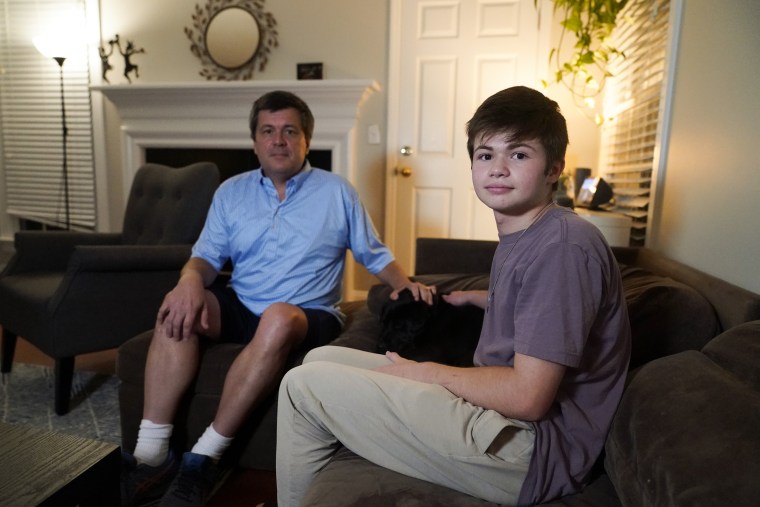
Dan Bradford, left, and his son Callum, at their home in Chapel Hill, N.C., on Sept. 14, 2023. Erik Verduzco / AP
Parents including Callum’s father, Dan Bradford, describe feeling helpless while their children are receiving psychiatric care involuntarily, which isn’t uncommon after attempted suicide. Callum’s involuntary commitment designation also temporarily stripped his mother and father of many parental rights to make medical decisions for their son.
A psychiatrist himself, Dan Bradford always has supported his son’s medical transition, which began with puberty-blocking drugs, followed by a low dose of testosterone that he still takes. Eventually, Callum underwent top surgery to remove his breasts. Irreversible procedures like surgery are rarely performed on minors, and only when doctors determine it’s necessary.
“In Callum’s case, the gender dysphoria was so strong that not pursuing gender-affirming medical treatments, like pretty quickly, was going to be life-threatening,” his father said, wiping tears from his eyes. “Any risk that might be associated with the treatments seemed trivial, quite frankly, because we were afraid we’re going to lose our kid if we didn’t.”
North Carolina law bars medical professionals from providing hormones, puberty blockers and gender-transition surgeries to anyone under 18. But some kids like Callum, who began treatment before an August cut-off date, can continue if their doctors deem it medically necessary.
Although he retained access to hormones, Callum said it has been brutal seeing the General Assembly block his transgender friends from receiving the treatments he credits as life-saving.
“When these public policies are discussed or passed, that sends a really strong message to these kids that their government, their society and their community either accepts them and validates them or doesn’t,” said Turban, the researcher at UC San Francisco.
His research has found that many medical providers still lack training about LGBTQ+ identities and make common mistakes, such as printing the wrong gender designation on a hospital wristband or placing a transgender patient in a single-occupancy room when everyone else has a roommate.
Fearing the plan to place his son in a girls’ ward would be deeply traumatizing, Dan Bradford secured a spot at a residential treatment center in Georgia. He pleaded with UNC to release Callum early and convinced the North Carolina hospital that was supposed to take him to reject the transfer.
The teen then spent 17 weeks in an individualized treatment program in Atlanta, recovering from the circumstances that landed him in the ER and the added trauma he endured there. He has since returned home and is taking care of his mental health by playing keyboard and rowing with his co-ed team on the calm waters of Jordan Lake. For the first time in years, Callum said he’s thinking about his future.
There are some positive developments on the horizon for North Carolina youth facing mental health crises.
The new state funding for mental health services approved in October has enabled UNC Hospitals to open a 54-bed youth behavioral health facility in Butner, 28 miles (45 kilometers) north of Raleigh. State Department of Health and Human Services Secretary Kody Kinsley said the facility should alleviate some barriers to individualized care, including for transgender patients. And UNC has announced plans to open a freestanding children’s hospital within the next decade.
Leaders of the Butner facility, which began its phased opening this month, have promised to take a whole-family approach so parents are not shut out of their child’s treatment plan. Nearly every patient will be placed in an individual room on a co-ed floor.
The new facility and funding will allow more patients to stay in single-occupancy rooms at UNC, but overflow patients may still be sent elsewhere, Meltzer-Brody said. The hospital system has not changed its policies on transgender patient referrals, and other facilities across the state that receive those patients still lack uniform standards for treating them.
Although Callum said his experiences eroded his trust in the state’s inpatient care network, he is optimistic that the new resources could give others a more gender-affirming treatment experience, if they are paired with policy changes.
“I’m still here, and I’m happy to be here,” he said. “That’s all I want for all my trans friends.”