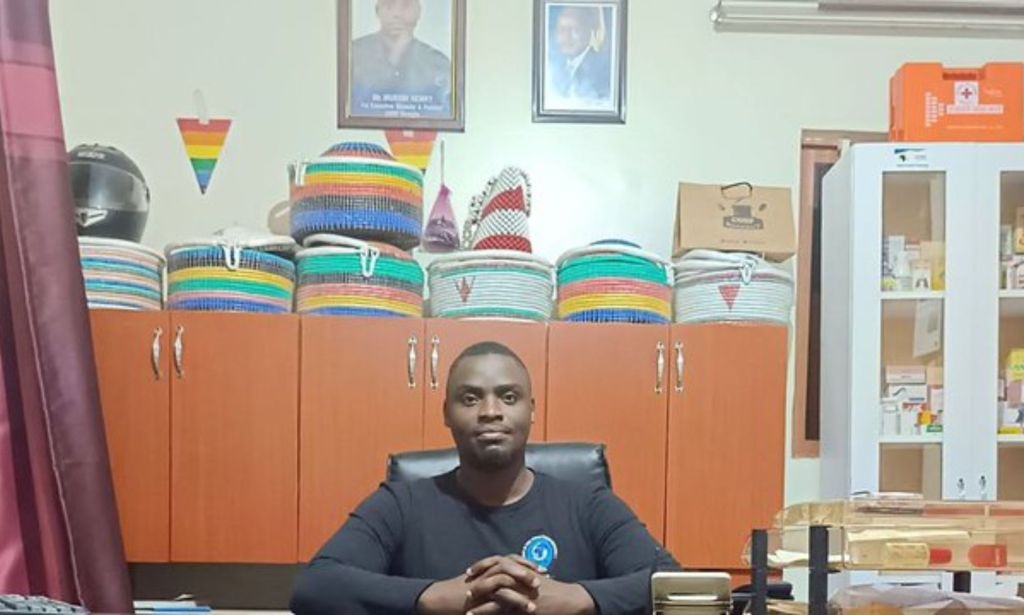
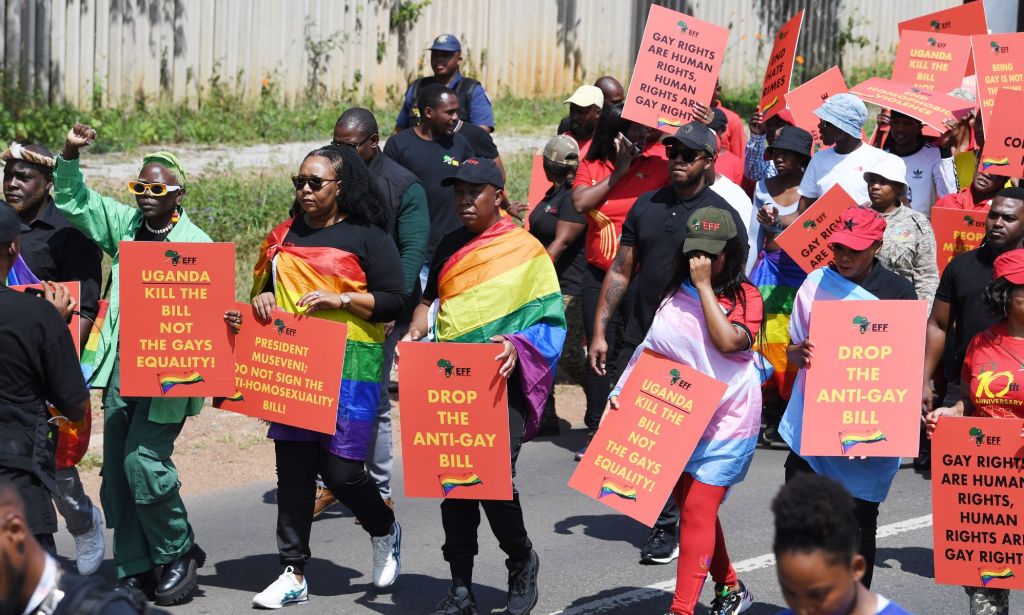
The World Bank will aim to ensure gay and transgender Ugandans are not discriminated against in its programs before resuming new funding, which was halted in August over an anti-LGBTQ law, a bank executive said.
World Bank project documents will make it clear that LGBTQ Ugandans should not face discrimination and that staff will not be arrested for including them, Victoria Kwakwa, the bank’s head for eastern and southern Africa, told Reuters.
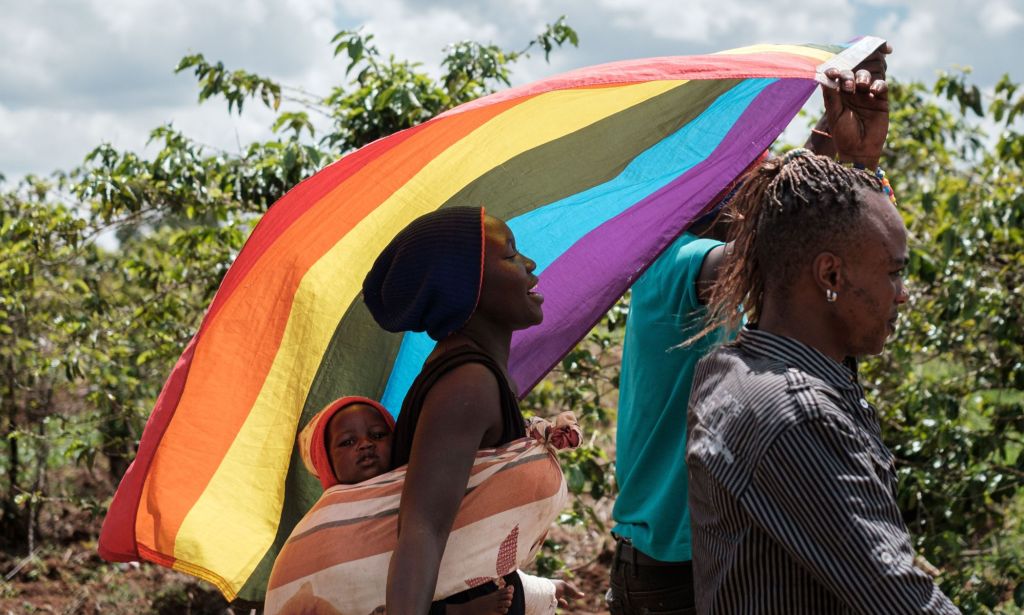
Rights groups have said that the Anti-Homosexuality Act (AHA), which was enacted in May and prescribes the death penalty for certain same-sex acts, has unleashed a torrent of abuse against LGBTQ people, mostly by private individuals.
“We’re doing all this to clarify this is not what you should be doing in World Bank-financed projects and to say you are allowed to do it the right way and you will be not be arrested,” Kwakwa said, on the sidelines of the World Bank and International Monetary Fund’s annual meetings in Marrakech, Morocco.
She declined to give a timeline for assessing the measures’ efficacy and moving to a decision on whether to resume new funding for Uganda.
“We have discussed this at length with government. Government is comfortable with that,” Kwakwa said.
When the World Bank suspended new funding, Ugandan officials accused the development finance institution of hypocrisy, saying it was lending to countries in the Middle East and Asia that have the same or harsher laws targeting LGBTQ people.
The government would need to revise its budget to reflect the suspension’s potential financial impact, a junior finance minister said at the time.
The World Bank’s portfolio of projects in the East African country was $5.2 billion at the end of 2022. These have not been affected by the decision to suspend new financing.
Max and Sasha are just two of the many LGBTQ+ people who have joined the mass exodus fleeing Russia to avoid violence, discrimination and war.
Now, the queer Russian-Ukrainian couple are left with the scars of living under Vladimir Putin’s repressive regime.
Putin’s obsession with rejecting what he sees as Western “degradation” has led to Russia toughening anti-LGBTQ+ legislation in recent months. At the same time, the Kremlin has clamped down on free speech, human rights and dissent as the war in Ukraine drags on.
Max and Sasha fled Russia this time last year. They joined the hundreds of thousands of people trying to find safety in other countries bordering the huge nation.
They made it to the the Latvian border, hitching a ride with a stranger.
When the queer couple got to the crossing, guards confronted them, demanding to know why they were leaving Russia.
Unable to reveal their real reasons, they had “full-on panic attacks just trying to hold back tears” as they waited hours to be let them through, the pair tell PinkNews.
“When we got there and we gave our passports, the guard looked at Sasha’s, and he was like: ‘I can’t see the visa, so what are you doing? What are your plans? What are you thinking? What are you doing there?’” Max, who is Ukrainian, recalls.
“We were like: ‘There are some people waiting for us there’. We were trying to say at least something. You’re completely stunned… we were standing there trying not to cry because they took our passports.
“We were like: ‘What next? What are they doing with our passports? They’re not letting us go’.”
A growing number of people, like Max and Sasha, have left Russia via land border crossings into other countries. (Getty)
Several countries – including Latvia, Lithuania, Estonia, Poland and Finland – have put in place measures to restrict the entry of Russian citizens, limiting the chances for people to use them as safe havens.
At one point, the border guards let Sasha, who is Russian, through but said that Max couldn’t join him. However, the couple knew they had to stay together so they regrouped in Russia and used “some other ways to cross the border”.
‘The scariest thing was that people were delusional about Russia’
Eventually, they made it into one of the Baltic states and began the process of applying for asylum. But they encountered difficulties with access to resources because of their differing citizenships, given the ongoing war.
Max feels he has a “lot of privilege as a Ukrainian” because he can travel, and it’s “easier” to find a job. Sadly, he can’t share that same level of support with Sasha because the pair aren’t married yet.
The LGBTQ+ community in Russia has faced a growing crackdown by authorities, which has only increased in ferocity since Russia’s invasion of Ukraine. (Getty)
The queer couple’s asylum application was initially denied because the person reviewing it argued that it’s merely “hard” for gay people in Russia – refusing to recognise the very real abuse LGBTQ+ people face.
“The arguments were: ‘It’s hard for gay people in Russia, but you did go to work. You did finish at school’,” Max explains.
“We were basically going around the streets, pretending we are someone who we are not. No matter how [hard] we try, people always figure everything out.
“We were standing near a subway station and hearing a guy talk to his wife like: ‘Oh my God, you won’t believe it. I’m standing next to the most disgusting f*****s. Come save me. They’re gonna rape me right now’. People don’t understand that it’s not possible to get any proper help.
“At [one] point, we were shot at. There were four guys passing us by in a car. They stopped to ask if we’re f*****s, and we said ‘no’. They said: ‘We saw you guys kiss’. We weren’t kissing.
“When we were talking about this in our [asylum] interview, they were like: ‘Why didn’t you go to the police?’ It’s pointless, you’ll leave the police station feeling worse.”
Sasha and Max, who have since been granted asylum after appealing the first ruling, say that people react with shock when they discover the true level of discrimination and violence LGBTQ+ people face in Russia.
“I think the scariest thing was, when we arrived, that people were delusional about Russia,” Sasha says. “They don’t know anything, what happens there and how it happens, which also affected our case.
“They don’t understand that, if you go to the police, you can be assaulted or even killed there, and no one will know. People have no idea what it is like… I was so scared after all that, that while being [in the country that last year], I wouldn’t go out of my house because I was so scared of people, men specifically.”
Anti-LGBTQ+ ideology has been a central axis of political propaganda in Russia over the past decade
Sasha and Max still feel the impact of the Russia’s oppressive anti-LGBTQ+ laws, which have led to hate and violence on the streets. As they put it: “You left Russia, but Russia never left you.
“It’s been a year, and when we got the asylum status approved, it was a relief, but I did not feel safe,” Sasha says. “It’s still hard for me to get out of the house. I’m still wearing a hat outside when I dye my hair.
“Yes, I understand that I don’t live in danger any more. I’m not in Russia. A rational part of me knows I’m not there, and it’s not as scary as I think it is outside [and] I can express myself with clothing more.”
It’s been a year since Max and Sasha fled anti-LGBTQ+ persecution in Russia, but Sasha says it’s “still hard for [him] to get out of the house”. (Getty)
Anna-Maria Tesfaye, the co-founder of LGBTQ+ not-for-profit organisation Queer Svit, says many LGBTQ+ people think they can “leave this bulls**t behind” when they flee Russia, but they realise they are still “mentally” trapped in the country’s politics of terror.
“You finally have the ability to think because you’re not in Russia any more,” she says.
“You don’t need to do anything, then it hits you. You understand that maybe you’re out of Russia, but you’re in Russia mentally. A lot of people understand that it’s probably post-traumatic stress disorder.”
Max and Sasha say they still “scan every corner [and] every street” for “scary-looking people” and the police because of their Russian experiences.
The pair are feeling a “little more freedom” in their new home, but it’s still difficult to live fully in the moment given the hate they endured.
Two lower courts in Nepal have denied a couple recognition of their marriage, in defiance of the Supreme Court’s recent interim order to register same-sex marriages while legislative change is pending. The couple – Maya Gurung and Surendra Pandey – are considering seeking redress at the Supreme Court.
Gurung, a transgender woman who is legally recognized as male, and Pandey, a cisgender man, held a Hindu wedding ceremony in 2017, and first attempted to register their marriage in June at the Kathmandu District Court, following the Supreme Court’s order. When that court rejected their registration, saying it did not need to recognize a couple that was not one legal male and one legal female, they appealed to the Patan High Court.
In their ruling, the high court judges said that because the Supreme Court order named the Prime Minister and Council of Ministers, it was the responsibility of the federal government to change the law before the lower courts could register such marriages.
Nepal’s civil code currently only recognizes marriages between one man and one woman. The Supreme Court attempted to rectify that by ordering the creation of an interim registry for nontraditional marriages until parliament changes the law. The two lower courts are now reversing the logic by claiming that the national law must be changed first.
Nepal’s Supreme Court has a globally-recognized record of rulings upholding the rights of lesbian, gay, bisexual, and transgender (LGBT) people, although implementation has been piecemeal. In 2007, the court ordered the government to form a committee to study same-sex marriage. In 2015 that committee recommended the government “grant legal recognition to same-sex marriage on the basis of the principle of equality.” However, successive governments failed to bring legislation to the parliament, leading to further court rulings. Earlier this year the court ordered the government to recognize the marriage of a Nepali man who had married a German man.
Marina Machete became the first transgender woman to win Miss Portugal last week, making her one of two trans contestants so far to compete for Miss Universe later this year.
Machete, a 28-year-old flight attendant, thanked her supporters for the “positive and empowering” messages she has received since being crowned Thursday.
“To all of you watching, I just want to say that, just like the universe, your possibilities in life are limitless,” she said in a video shared on Instagram over the weekend. “So don’t limit yourself to any dream that you have.”
She added that she is excited to meet the other delegates at the 72nd Miss Universe pageant in El Salvador in November.
“Yes I’m trans and I want to share my story but I’m also Rikkie and that’s what matters to me,” she wrote in an Instagram post at the time. “I did this on my own strength and enjoyed every moment.”
“I thought we were really accepting … in the Netherlands, but the hate comments show the other side of our society. I hope that’s a wake-up call,” she told Reuters at the time. “For now, I fully ignore it. I focus on the good things coming my way.”
It appears that Machete and Kolle will be the only transgender contestants among the 90 women who will compete for the crown on Nov. 18. There are two more qualifying pageants — in Mongolia and China — before the Miss Universe pageant next month, and no local reporting has identified any trans contestants.
In 2021, Kataluna Enriquez became the first trans woman to compete in the Miss USA pageant after she was crowned Miss Nevada, though she did not go on to compete in that year’s Miss Universe pageant. In February, Daniela Arroyo González became the first trans woman to compete in Miss Universe Puerto Rico, where she finished within the top 10 finalists, according to her Instagram.
However, not all pageants have been open to including trans women.In July, more than 100 transgender men entered the Miss Italy pageant after the pageant’s organizer said Miss Italy wouldn’t allow trans women to compete.
Turkey’s President Tayyip Erdogan said on Saturday he did not “recognize LGBT” and vowed to combat “perverse” trends which he said aimed to destroy the institution of family in the country.
Turkey’s government, led by Erdogan and his Islamist-rooted AK Party, has toughened its stance on LGBTQ freedoms in recent months, particularly while campaigning for this year’s elections in May.
Homosexuality is not a crime in Turkey, but hostility to it is widespread, and police crackdowns on Pride parades have become tougher over the years.
Speaking at an AK Party congress in Ankara, Erdogan, who has frequently labeled members of the LGBTQ community as “deviants,” said neither his party, nor their nationalist MHP allies, recognized the LGBTQ community.
“We do not recognize LGBT. Whoever recognizes LGBT can go and march with them. We are members of a structure that holds the institution of family solid, that strongly embraces the family institution,” he said.
“We will dry the roots of sneaky acts aiming to destroy our family institution by supporting perverse political, social and individual trends,” he told tens of thousands of flag-waving and chanting supporters.
After the United Nations General Assembly in New York last month, Erdogan complained that he was uncomfortable with the use of what he described as “LGBT colors” at the U.N., which at the time was decorated with bright colors promoting the Sustainable Development Goals.
Polish opposition leader Robert Biedroń symbolically wed his partner, Krysztof Śmiszek, during a theatrical performance to protest the country’s lack of marriage equality. The two men, politicians from The Left (Lewica) party, have been together for 23 years.
Poland is considered the worst country in Europe for LGBTQ+ rights.
The video features some of Poland’s biggest and most visible LGBTQ politicians, celebrities and activists.
“I performed hundreds of weddings as mayor of Słupsk, but this is the first time I’ve stood on the other side,” Biedroń said during the ceremony. “It’s a beautiful feeling that needs to be shared. That’s why we should do everything so that two adults can experience a wedding whenever they want. Because love is love.”
The ceremony was part of a play, Spartacus: Love in the Time of Cholera, that looks at the difficult situation queer people in the country face. Each performance ends with the wedding of a non-heterosexual couple.
The actress who performs the ceremony uses all the language used in a traditional wedding, but alters the end, saying instead, “I declare that contrary to the regulations in force in the Republic of Poland, the marriage of [the couple’s names] has been concluded.”
Many couples invited to participate treat the ceremony seriously, inviting their friends to witness their union.
Biedroń’s party supports marriage equality. Queer people regularly protest the country’s anti-LGBTQ+ laws in creative and impactful ways to build support for civil rights laws.
In 2020, a Polish gay couple went to self-declared “LGBT-free zones” in their country to hand out rainbow face masks during the COVID-19 pandemic, hoping to promote tolerance.
“What a wedding!” Śmieszek tweeted after the event.. “There were nerves and emotions. But there was also anger that in 2023, in the middle of Europe, two people who love each other are not recognized by their country…That instead of respect and dignity, hundreds of thousands of people in Poland receive contempt.”
“We can change this on 15 October!” he declared, referring to the upcoming parliamentary elections. “Let’s vote for respect, dignity, and equality. I won’t rest until we achieve this normality!”
Śmieszek’s party is the second-largest opposition group. The biggest, the centrist Civic Platform, supports civil unions for LGBTQ+ people.
A popular Iraqi TikTok personality was shot dead on Monday in Baghdad, an Iraqi security source told CNN.
Known on social media as “Noor BM,” 23-year-old Noor Alsaffar had over 370,000 followers collectively on Instagram and TikTok. Alsaffar mostly posted short videos showing dresses, hair and makeup styles, often dancing to music. Following news of the shooting, many posted commentslamenting Alsaffar’s death. Some others cheered it, celebrating the man who fired the shot.
The Iraqi security source told CNN that “an investigation has been opened,” speaking on condition of anonymity as they were not authorized to speak to the media. “The deceased has been taken to the forensic department.”
Khaled Almehna, spokesperson for the Iraqi police, described the attack as a “criminal incident” on Tuesday, adding that he will provide “important updates” at a later time.
The killing comes as Iraq cracks down on LGBTQ expression and moves to criminalize it in law. While being queer is not explicitly banned under current Iraqi legislation, LGBTQ people are often targeted under vague morality clauses in its penal code.
Before the shooting, Alsaffar faced online abuse, as well as questions about sexuality and gender. In a 2020 interview on Iraq’s Al Walaa channel, Alsaffar said: “I’m not transgender and I’m not gay. I don’t have other tendencies, I’m only a cross-dresser and a model.” Alsaffar identified as male who worked as a model and makeup artist.
Alsaffar spoke in videos about facing threats on social media over choices of dressing.
In a 2021 YouTube interview with Iraqi blogger Samir Jermani, Alsaffar said: “I’m cautious but not afraid” in response to a question about the TikToker’s appearance.
The Iraqi LGBTQ rights group, IraQueer, posted about Alsaffar’s death, adding the hashtags #Transphobia and #MuderOfTransPeople on X, formerly known as Twitter.
Rights groups have decried growing crackdowns on LGBTQ communities in the Middle East, including what Human Rights Watch found to be digital targeting based on online activity.
Online targeting is often followed by extreme punitive measures, including arbitrary detention and torture, the rights watchdog said in February after examining LGBTQ rights violations in Egypt, Iraq, Jordan, Lebanon, and Tunisia.
The consideration and passage by Uganda’s government of one of the world’s harshest anti-gay laws have unleashed a torrent of abuse against LGBTQ people, mostly committed by private individuals, rights groups said on Thursday.
The Anti-Homosexuality Act (AHA), which was enacted in May, prescribes the death penalty for certain same-sex acts. At least six people have been charged under it, including two accused of the capital offense of “aggravated homosexuality”.
But the report, authored by a committee of the Convening for Equality (CFE) coalition, said the main perpetrators of human rights abuses against LGBTQ people this year — including torture, rape, arrest and eviction — were private individuals.
It said this pointed to the way the law and the rampant homophobic rhetoric that preceeded its passage earlier in the year had radicalized the public against the LGBTQ community.
For example, the report said mob-aided arrests had become increasingly common “because AHA has put LGBTIQ+ persons on the spot as persons of interest, and the public seems to be the custodians of enforcing the witch hunt.”
Between Jan. 1 and Aug. 31, researchers documented 306 rights violations based on the victim’s sexual orientation and gender identity, with state actors the perpetrators in 25 of those cases.
By contrast, reports by rights activists in 2020 and 2021 found that state actors were responsible for nearly 70% of the rights violations documented in those years. The report did not provide comparative figures for 2022.
Ugandan Information Minister Chris Baryomunsi was not immediately available for comment.
The report’s authors said they had documented 18 instances in which the police conducted forced anal examinations of people in their custody to gather “evidence” of homosexuality.
“Surviving a forced anal examination at police is something that lives with you forever,” it quoted one survivor as saying.
Police spokesman Fred Enanga said he had not yet read the report and could not comment.
The report cautioned that its statistics could not be considered exhaustive given the difficulties LGBTQ people face reporting violations.
The climate of fear and intimidation unleashed by the law has also led to rising cases of mental health conditions in the LGBTQ community, including suicidal thoughts, it said.
The UN refugee agency (UNHCR) has hit back at UK Home Secretary Suella Braverman’s highly controversial comments on the international asylum system.
Braverman faced heavy backlash this week when she publicly criticised the 1951 refugee convention, claiming it was no longer fit for purpose.
Elsewhere in her speech, given at the American Enterprise Institute in Washington DC, Braverman claimed that being discriminated against for being LGBTQ+ or a woman is not enough of a reason to qualify for asylum.
“Let me be clear, there are vast swathes of the world where it is extremely difficult to be gay, or to be a woman,” Braverman said in her speech on Tuesday (26 September).
“Where individuals are being persecuted, it is right that we offer sanctuary. But we will not be able to sustain an asylum system if, in effect, simply being gay or a woman, and fearful of discrimination in your country of origin, is sufficient to qualify for protection.”
Currently, it is illegal to be LGBTQ+ in 64 UN member states.
Braverman also suggested that the UK government would do “whatever is required” to tackle the issue of migrants illegally arriving, even if it meant leaving the convention.
In a rare public statement, the UNHCR responded to Braverman’s comments and defended the 1951 refugee convention.
“The need is not for reform or more restrictive interpretation, but for stronger and more consistent application of the convention and its underlying principle of responsibility-sharing,” a statement from the agency read, per BBC News.
“Where individuals are at risk of persecution on the basis of their sexual orientation or gender identity, it is crucial that they are able to seek safety and protection,” the statement read.
The statement also made a pointed reference to the UK’s sky-high backlog of asylum claims.
Just last month, the Home Office released statistics that revealed a record-high number of asylum seekers, with 175,000 applications waiting to be decided on.
“An appropriate response to the increase in arrivals and to the UK’s current asylum backlog would include strengthening and expediting decision-making procedures,” the UNHCR suggested.
The UNHCR has responded to Braverman’s speech. (Getty)
Braverman has also been condemned by LGBTQ+ asylum charity Micro Rainbow, who accused the Home Secretary of using LGBTQ+ people as scapegoats.
“LGBTQI people often face death, imprisonment, and violence. When they come to the UK to seek safety, they have to go through an asylum system that is re-traumatising and dehumanising. In addition, the standard of proof is very high,” founder and chief executive Sebastian Rocca told PinkNews.
Listen to this article
2:38 / 4:18
“The system, as it is, is incredibly difficult. These comments seek to scapegoat migrants and LGBTQI people for political gain once again.”
The Labour party has also lambasted Braverman’s comments.
“In many countries, persecution of LGBTQ+ people is rife, while discriminatory laws mean they face prison or even the death penalty simply for being themselves,” said Nadia Whittome, the Labour MP for Nottingham East.
“Those fleeing to the UK are already put through dehumanising ‘tests’ to prove their identity and are still regularly disbelieved by the Home Office. Braverman encouraging the international community to turn its back on LGBTQ+ refugees increases the risk that people are sent to their deaths.”
There has also been backlash from Braverman’s own party following the speech.
Conservative member of the London Assembly Andrew Boff told BBC News that Braverman was “victim-blaming” to distract from the “appalling backlog of asylum claims.”
Another Conservative MP, who wished to remain anonymous, noted that unless Prime Minister Rishi Sunak “gets rid” of Braverman, there was a danger it “reflects poorly on him.”
Downing Street confirmed to the national broadcaster that it had signed off on Braverman’s speech.
Suella Braverman questioned the United Nations Refugee Convention in a speech in Washington, arguing that “simply being gay, or a woman” should not be by itself grounds for international protection. The British government has made the fight against illegal immigration a priority.
With a general election due next year, which the opposition party Labour is widely tipped to win, the ruling Conservatives’ stance against asylum seekers is becoming increasingly hardline. Speaking at the American Enterprise Institute, the UK home secretary questioned the role of the 1951 Geneva Convention, which defines refugee status.
In 12 countries around the world, people can be put to death for having a same-sex relationship, while in 66 states private, consensual same-sex sexual activity is criminalised, according to the Human Dignity Trust.