Category: National

  • Meet the gay couple who exploited a legal loophole to marry way back in 1971

    Long before the push for marriage equality truly began, before Obergefell v Hodges, before the Defense of Marriage Act, there was Jack and Michael McConnell.

    This year Jack and Michael will celebrate 51 years of happy marriage, making them longest-wed same-sex couple in the world. They were also the very first.

    Thanks to a clever legal loophole they managed to do it as early as 1971, exchanging vows before a Methodist pastor and a dozen guests in a friend’s apartment.

    Their journey began in 1966, at a Halloween party in Oklahoma where the pair first laid eyes on each other.

    “I was looking for the three T’s: tall, thin and 23. And believe it or not, at 24, I thought that time had passed me by!” Jack laughs. “But there was Michael, and the three T’s were standing right in front of me.”

    Michael wasn’t quite as enamoured at first, though.

    “Well, I was a little taken aback, because Jack had been in the Air Force and he had his hair in a really short, flat top style,” he said. “At that time most people in our community were doing the long Beatles-type hair. So I looked at him and thought, ‘I don’t know about this guy.’

    “But my friend Cruz said, ‘Michael, you don’t know what you’re talking about. You two are destined to be together.’ And I think Cruz was absolutely right.”

    Sure enough, their love blossomed as the couple went to movies or plays or secret parties with friends, always careful to stay under the religious radar to avoid attacks. After a year together Jack came to Michael with a proposal: he wanted someone to grow old with.

    The question caught Michael off guard. “OK, I will commit,” he said, “but only on one condition. If we’re going to do this, you must try to find a way for us to get legally married.”

    Jack gave him a long look, then said simply: “Well, I guess I’m going to law school.”

    As promised, he enrolled the University of Minnesota and immediately set to work.

    The first rule of law school was simple – what’s not forbidden is permitted. Jack seized upon this, realising the statutes only referred to marriage between “two parties”, not man and woman, which meant he could technically apply for a marriage license.

    When their first attempt in 1970 was denied they fought it in the Supreme Court, where they lost their case in a one-sentence dismissal: “The appeal is dismissed for want of a substantial federal question.”

    Undeterred, the couple simply figured out another loophole.

    First Michael legally adopted Jack, which gave them inheritance and other legal protections. Then Jack changed his first name to the gender-neutral “Pat Lyn”, and Michael went to apply for a license alone. And this time, it worked.

    The pair were wed before officials could change their mind; unfortunately, when it was revealed that Jack and Michael were both men, those officials declared the license invalid. Jack refused to accept their decision.

    “Something as simple and totally obvious to a law student was not that obvious to the rest of the world,” he said. “It was a fight. We’ve been fighting ever since.”

    They quickly understood that the biggest challenge was in changing public perceptions. At the time, many queer people were focused on repealing sodomy laws and stopping raids on gay bars, which Jack and Michael supported – but it wasn’t their focus.

    “We knew the lies and the ignorance about gay people in our culture was going to be a big fight. It was going to be an educational fight. So we committed to educating the public.”

    The couple made the decision to throw themselves into the public eye as spokesmen for gay equality, taking their love on tour by broadcasting their relationship to audiences in the millions.

    It was an incredible step at a time when gay people were vilified as “sexual deviants” and the majority of states still criminalised consensual same-sex relations. But they could see it was the only way forward.

    What we spoke to was love

    “The discussion was focused greatly on sexual orientation, that is, defining our relationship as sexual in nature. That is not what we talked about,” Michael said.

    “We talked about love, commitment, relationships, friends and family and building a life together. Sex is certainly a part of our life, a part to be celebrated, but it’s not who we are. We are much more than what we do in private.”

    As Jack and Michael travelled round the state over the next decade, they estimate they spoke face-to-face with around 500,000 people in lecture theatres, halls and churches, and far more via TV and radio.

    While they might’ve expected to be met with an enormous backlash, in reality the reaction was more mixed, even in religious circles.

    It was years before the homophobic rhetoric of the AIDS crisis; many people were simply curious and peppered them with questions. How exactly did their relationship work, they asked, and what did they want to accomplish?

    More often than not, straight couples would shyly approach them after the event for advice about intimacy problems.

    “We actually did not encounter any bullying or any harm at all,” Jack recalls. 

    “Because what we spoke to was love, our commitment and our relationship, almost everyone could understand that,” Michael says, finishing his husband’s thought.

    We’ve jerked everybody 45 years into the future

    Ultimately though, Jack and Michael McConnell were just a few decades ahead of their time.

    As the 70s passed and marriage equality was no closer, Jack says they realised “we’ve jerked everybody 45 years into the future, and it’s gonna take them a while to catch up”.

    The couple eventually took a step back to focus on their careers and allow a new generation of LGBT+ activists to continue the fight. But they never lost sight of their goal, and refused to accept their marriage was invalid.

    And nearly five decades later, they were finally proven right. The Supreme Court referenced them by name in the momentous marriage equality battle, Obergefell v Hodges, which officially overturned the case against their marriage.

    “I saw it as vindication,” Jack said. “I knew from day one we’d followed the letter of the law, and [the Supreme Court] verified that what was intuitively obvious to a second year law student in 1971 was indeed correct. It only took, what, 40 years?”

    “44 years,” Michael says.

    Now as the couple look back on a life and a love that’s spanned the entirety of the modern equality movement, they feel hopeful: love is winning, as they always predicted it would, and it keeps on winning.

    But even so, they can’t help but draw parallels between their experience and today’s struggle for trans rights.

    “These right-wing crazies can’t attack gay marriage anymore, because it means attacking people like Jack and me, or their brother, their uncle, their aunt, their cousin. So now they’re going to try to find other people that they can label and lie about,” Michael said.

    “And it’s not going to work. I can tell you, it’s not going to work, because it’s not natural. We’re all human beings. As long as we stand together, they’re not going to win.”

    Now they’re leaving the fight to younger generations who are battling for the next round of LGBT+ rights – and it’s for these people that they’ve penned a book about their lives.

    “We wanted to leave a story for them about how you can find your way and find the love you want,” Michael said. 

    “What I see in younger generations now is inspiring: they’re highly intelligent, they’re well connected all around the planet. And they have a vision that I agree with. It’s one that is based on love, not only for one another, wherever we come from, but for this planet that sustains us all. 

    “You can’t ask for more than that.”

    Jack and Michael McConnell’s book, “The Wedding Heard ‘Round The World: America’s First Gay Marriage,” is out now in Paperback Original.

  • Former foster child abandoned for being gay ‘wouldn’t be alive’ if not for his two dads

    A former foster child adopted by two fathers after being abandoned for his sexuality has urged Congress not to stand in the way of loving LGBT+ families like his.

    On Wednesday Weston Charles-Gallo, a former youth ambassador for the Human Rights Campaign, bravely testified in support of the bipartisan Every Child Deserves a Family Act (ECDF).

    he bill would prohibit any federally-funded child welfare services from discriminating against prospective parents based solely on their sexual orientation, gender identity or marital status, as well as the sexuality or gender identity of the child involved.

    This law is critical for young people like Weston, who entered the foster care system at 14 when his parents neglected him for coming out as gay. He experienced a year of hospitalisations, shelters and foster home placements before finally, at 15, he received the amazing news: “I was going to be adopted.”

    “I have since learned that many, many LGBT+ foster youth never get that news,” he told lawmakers.

    Weston was lucky: he found a loving home with two fathers and six siblings, who gave him the love and support he needed to grow into his authentic self.

    “My dads showed me what it was like to witness a true marriage and live a normal life, expressing the meaning of family,” he said. “Before I lived with them I never pictured myself marrying someone or even having a family, but they proved to me that anything is possible.

    “Without them in my life constantly supporting and encouraging me I don’t know where I would be, or even if I would be alive today. I finally found a home where I can live my authentic self.”

    He stressed that in the conversation about same-sex couples fostering and adopting, all too often the message of giving needy children “safety, stability and love” is forgotten.

    Why keep qualified parents from giving children the lives they deserve but never imagined?

    “I urge committee member to focus on that mission, not on the personal beliefs of adults,” Weston said.

    “If it wasn’t for my two dads taking a chance on me and helping me embrace my sexual orientation, the colour of my skin and who Weston is, I wouldn’t be here to share my story.

    “When a child enters the foster care system they just want to find a family that loves them unconditionally and supports them continuously. Why keep qualified parents from giving children the lives they deserve but never imagined? Because that is exactly what my fathers did for me.”

    Many states like Florida, Utah, Mississippi, Nebraska and Utah have policies that directly disadvantage LGBT+ and unmarried parents, leaving children vulnerable to the individual biases of agencies and case workers.

    As well as increasing adoption rates, proponents of the ECDF bill say it would decrease risk factors for youth in foster care, yielding an annual cost savings of $3-$6 billion.

    But most importantly, the legislation is about putting the needs of the child before all else.

    “We should find more loving families like my dads that can be affirming of all kids in care,” Weston told members of Congress. “I want to ask all policy makers, foster care parents and social workers to take the time to put yourself in our shoes and think about what you wanted as a child.

    “LGBT+ youth aren’t going anywhere, we’re here, and we’re asking to be heard and loved for who we are.”

  • 20 states and DC allow a gender marker of “X” on driver’s licenses, and 13 states allow an “X” gender marker on birth certificates

    An estimated 476,000 transgender adults in the U.S. are without any form of identification with the correct gender marker, according to a new report by the Williams Institute at the University of California Los Angeles School of Law. Michigan has the highest percentage of transgender adults without an ID that lists the correct gender (78%), and Delaware has the lowest (31%).

    Using data from the 2015 U.S. Transgender Survey (USTS), researchers estimated the number of transgender people nationally and by state without accurate IDs and examined the relationship between state-level policies and having accurate IDs.

    Findings show that transgender people in states with the fewest policy barriers to updating their gender marker are significantly more likely to have accurate birth certificates and driver’s licenses than those in states with the most barriers. States with the most burdensome requirements may require proof of gender-affirming surgical care to update a gender maker. States with less burdensome requirements may require individuals to fill out specified forms or submit an affidavit.

    “Having inaccurate IDs can lead to harassment and discrimination for transgender people, which can negatively impact mental health,” said lead author Jody L. Herman, Scholar of Public Policy at the Williams Institute. “State and federal policymakers should enact policies that make gender marker changes on IDs less burdensome and more accessible for transgender people.”  

    KEY FINDINGS

    • 55% of respondents to the 2015 USTS did not have any IDs with the correct gender marker.
    • In states with the fewest policy barriers, 47% of transgender people have corrected the gender markers on their driver’s licenses, compared to 26% of those living in states with the most policy barriers.
    • In states with the fewest policy barriers, 16% of transgender people have corrected the gender markers on their birth certificates, compared to 8% of those in states with the most policy barriers.
    • 26% of transgender people with an incorrect gender marker on their driver’s license had the name or gender on their ID questioned by TSA officers, compared to 9% of those with the correct gender marker.
    • 18% of those with an incorrect gender marker on their passport had the name or gender on their ID questioned by TSA officers, compared to 6% of those with the correct gender marker.
    • Currently, 20 states and the District of Columbia allow a gender marker of “X” on driver’s licenses, and 13 states allow an “X” gender marker on birth certificates.

    Read the report

  • 57% of states fall short in providing comprehensive legal protections for LGBTQ+ residents

    When making a decision about where one should live, several factors come into play for everyone: housing costs, availability of medical services, access to entertainment, and more. But for the LGBTQ+ community, other questions are top-of-mind. Will I be welcome here? Will I be safe?

    To help these individuals make an informed decision about the best places to live, our research team compiled state-by-state rankings from over a dozen sources (including the FBI, UCLA School of Law, the U.S. Census, and more). Through this research we’ve created comprehensive safety rankings that highlight some of the best and worst states to live from the perspective of LGBTQ+ safety. 

    Key Takeaways

    • Vermont and California scored the highest for LGBTQ+ safety, while North Dakota scored the lowest.
    • States with higher populations of LGBTQ+ residents also had higher than average rates of hate crime against the LGBTQ+ community, even in states that scored highly on the index regarding protection in the workplace, healthcare, and community. 
    • LGBTQ+ focused adoption laws are not consistent across the country — 22 states’ adoption laws do not explicitly state they allow same-sex couples the right to second-parent adoption
    • Only half of U.S. states have laws (including the District of Columbia) that include one or more LGBTQ+ nondiscrimination health care provisions for private insurance.
    • On average, states have more laws in place protecting LGBTQ+ public employees than private employees. 59% of states have laws that protect employees of state and local governments from discrimination based on sexual orientation, while 41% of states have laws that protect employees in the private sector from discrimination based on gender identity or gender expression.

    What is the LGBTQ+ State Safety Ranking?

    We gathered publicly available data on the following aspects of LGBTQ+ community safety and protection in all states: population, crime, work, marriage & family, and children. We then ranked these states on efforts they’ve taken to support LGBTQ+ rights both through public initiatives and private endeavors. (For our full methodology, please scroll to the end of this article.) 

    The Current State of LGBTQ+ Safety Nationally

    According to the FBI,16.7% of hate crimes across the nation target the LGBTQ+ community. A history of civil rights legal achievements such as Title VII of the 1964 Civil Rights Act or The Federal Fair Housing Act has established a baseline off which states can springboard with more specific LGBTQ+ protections. As the LGBTQ+ voice grows stronger, federal and state laws have begun to evolve in an attempt to keep pace. While some states are moving quickly in expanding protections for LGBTQ+ rights, other states have progressed more slowly. 

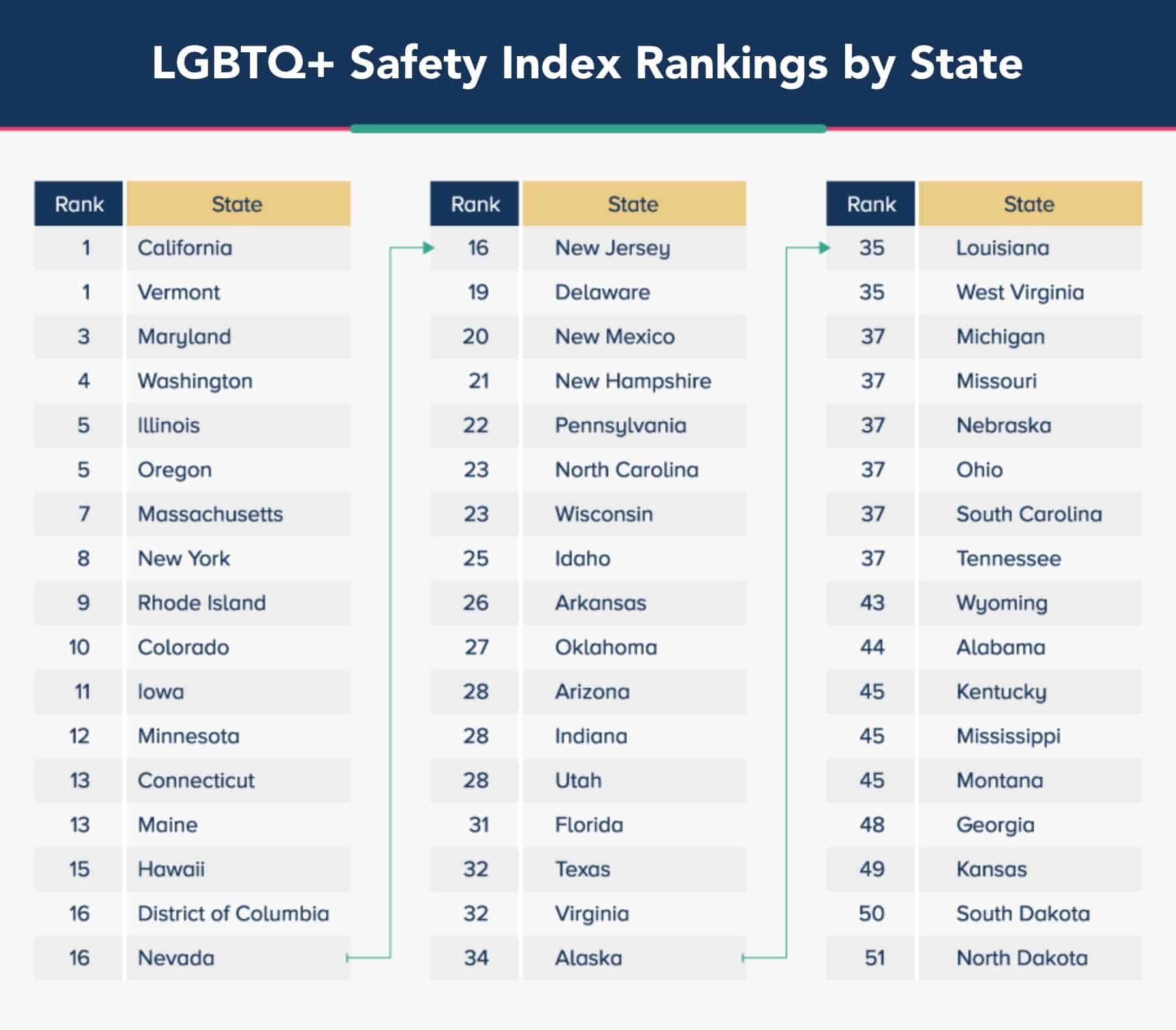
    LGBTQ+ Safety Index Rankings by State

    The Top States for LGBTQ+ Safety

    #1: California & Vermont (tie)

    California and Vermont scored the highest for LGBTQ+ safety and equality. Both states have taken numerous legislative measures to support LGBTQ+ residents in recent years.

    California | Safety Index Score: 100

    Positive Factors: California LGBTQ+ Families

    Even though California is below the national average for LGBTQ+ family populations, this state ranks at the top in protecting LGBTQ+ family structures. California allows same-sex couples the right to second-parent adoption, and it enables unmarried individuals and domestic partners to second-parent adopt. 

    Positive Factors: California LGBTQ+ Support in the Workplace

    California scores highly for LGTBQ+ friendly work environments, protecting employees in state and local government and private sectors from discrimination based on sexual orientation, gender identity, and gender expression. 

    According to the Corporate Equality Index (CEI), which rates workplaces on LGBTQ+ equality, California is home to 154 top-scoring employers, averaging 92.5 out of 100 on the CEI. 

    Negative Factors: Hate Crimes against LGBTQ+ residents in California 

    California performs slightly poorer than the national average in terms of LGBTQ+ directed hate crimes. 

    Nationally, for every 100,000 LGBTQ+ residents, there are 10 hate crimes directed toward LGBTQ+ individuals. In California, that number increases to 12.8.

    Vermont | Safety Index Score: 100

    Positive Factors: Vermont LGBTQ+ Support in the Workplace

    Like California, Vermont scores very high on the Corporate Equality Index, a national rating system for LGBTQ+ equality amongst participating companies and Fortune 500 companies, earning a perfect 100 rating. Vermont also scores highly in this category due to state laws that protect LGBTQ+ workers in public and private state enterprises. 

    Positive Factors: LGBTQ+ Supportive Healthcare in Vermont 

    Vermont has a robust regulatory matrix in place for LGBTQ+ safety and protection in healthcare. It also features a substantial number of LGBTQ+ allied professionals and has a trans youth clinic presence. Vermont state law bans transgender exclusions in health insurance and discrimination against patients based on sexual orientation or gender identity. 

    Negative Factors: Hate Crimes against LGBTQ+ residents in Vermont

    Like California, Vermont does not perform as well regarding hate crimes targeted against the LGBTQ+ community. Per every 100,000 LGBTQ+ residents, 30.8 hate crimes occur in Vermont against LGBTQ+ members of the community. 

    #3: Maryland 

    Safety Index Score: 97

    Positive Factors: Hate Crimes against LGBTQ+ residents in Maryland

    For every 100,000 LGBTQ+ people, Maryland sees just 2.8 LGBTQ+ targeted hate crimes, well below the national average of 10 per 100,000 LGBTQ+ residents. 

    Positive Factors: Anti-discrimination in Maryland Schools

    Maryland legislators have enacted laws that prohibit bullying, cyberbullying, and discrimination in public and private schools, including negative actions based on gender identity or sexual orientation. 

    Negative Factors: LGBTQ+ Supportive Healthcare in Maryland

    Maryland’s healthcare protections have helped protect LGBTQ+ patients from discrimination. However, Maryland does not currently have a law that explicitly bans transgender exclusions in health insurance. 

    #4: Washington

    Safety Index Score: 94 

    Positive Factors: LGBTQ+ Public Accommodations Support

    Washington has a higher portion of the general population that’s LGBTQ+ compared to the rest of the country, and supports it by implementing public accommodations protections based on sexual orientation and gender identity. 

    Positive Factors: Anti-discrimination in Washington Schools

    Washington scores highly on the index in protecting children due to their multiple laws prohibiting bullying and cyberbullying in public schools while specifically targeting children based on gender identity and sexual orientation.

    Negative Factors: Washington LGBTQ+ Families

    While state law does protect same-sex marriage, it does not offer any other type of relationship recognition for same-sex couples. 

    #5: Illinois & Oregon (tie)

    Both Illinois and Oregon made the top five on the LGBTQ+ safety index due to their public accommodation laws for LGBTQ+ residents, anti-bullying regulations, and high scores on the Corporate Equality Index. 

    Illinois | Safety Index Score: 92

    Positive Factors: Hate Crimes against LGBTQ+ residents in Illinois

    For every 100,000 LGBTQ+-identifying people, 4.2 experience hate crimes in Illinois. This number is significantly below the national average of 10 per 100,000 LGBTQ+ residents. 

    Positive Factors: Illinois LGBTQ+ Support in the Workplace

    The Corporate Equality Index, which rates workplaces on LGBTQ+ equality, has awarded Illinois a 90 out of 100 on their index, well above the national average. Additionally, Illinois has laws on the books that prohibit discrimination based on gender identity, gender expression, or sexual orientation for government and private sector employees. 

    Negative Factors: LGBTQ+ Supportive Healthcare in Illinois

    Illinois has many mechanisms to support positive healthcare for the LGBTQ+ community, such as banning transgender exclusions in health insurance and similar laws. However, this state does have a lower than the average number of allied health providers, according to the GLMA

    Oregon | Safety Index Score: 92

    Positive Factors: Oregon LGBTQ+ Support in the Workplace

    Oregon scores 88 out of 100 on the corporate equality index. Oregon law also has protections against discrimination in both the public and private workplace based on gender identity, gender expression, or sexual orientation. 

    Positive Factors: LGBTQ+ Public Accommodations Support

    Oregon has the highest percentage (6%) of LGBTQ+ residents of any state. (If considered a state, the District of Columbia would beat Oregon with their 10%.) As such, Oregon protects its residents with laws that provide public accommodations support for the LGBTQ+ community. 

    Negative Factors: Hate Crimes against LGBTQ+ residents in Oregon

    Oregon has higher than average hate crime occurrences against LGBTQ+ individuals. For every 100,000 LGBTQ+ residents, 14 LGBTQ+ targeted hate crimes occur.

    #7: Massachusetts

    Safety Index Score: 89

    Positive Factors: Anti-discrimination in Massachusetts Schools

    Current Massachusetts law prohibits bullying, cyberbullying, and discrimination based on gender identity or sexual orientation in public schools and private non-religious schools. 

    Positive Factors: Massachusetts LGBTQ+ Support in the Workplace

    The Corporate Equality Index gives Massachusetts companies high marks: 96 out of 100 for the state overall, well above the nationwide average of 87. The state hosts 49 employers alone that score 100 on the CEI.

    Negative Factors: Massachusetts LGBTQ+ Families

    A below-average percentage of LGBTQ+ families call Massachusetts home compared to the national state average (21% for Massachusetts compared to the national average of 27%). Massachusetts law recognizes same-sex marriage, but it does not provide for any other relationship recognition for same-sex couples. 

    The Worst States for LGBTQ+ Safety

    #45: Mississippi, Kentucky, & Montana (tie)

    Safety Index Score: -56 for all three states

    Mississippi, Kentucky, and Montana tied for the fifth-lowest state in providing LGBTQ+ safety. None of these states have laws in place that ban transgender exclusions from health insurance or fight discrimination based on sexual orientation or gender identity. None of these states have trans youth clinics. In terms of adoption, neither Mississippi, Kentucky, nor Montana law explicitly states any allowance for same-sex couple second-parent adoption. 

    #48: Georgia

    Safety Index Score: -58

    Georgia has no measured protections in place through state law for public accommodations, anti-discrimination in healthcare, or employment protection from discrimination. LGBTQ+ residents living in Georgia must take extra care in understanding employers’ stances on LGBTQ+ employees’ rights and ensure they carry health insurance that voluntarily and explicitly supports LGBTQ+ protections. 

    #49: Kansas

    Safety Index Score: -61

    Although Kansas law prohibits bullying and cyberbullying, no language specifically references bullying or discrimination based on gender or sexual orientation. Kansas law also fails to protect LGBTQ+ employees in private and public workplaces. No laws prohibit the denial of coverage for transgender individuals by health insurance providers. 

    #50: South Dakota

    Safety Index Score: -67

    South Dakota produced low scores in nearly every category, failing to implement significant protection against discrimination of LGBTQ+ individuals in school settings, employment, healthcare, and public accommodations. South Dakota witnesses 15 LGBTQ+ directed hate crimes per every 100,000 members of the LGBTQ+ community, which is 1.5 times higher than the national average. 

    #51: North Dakota

    Safety Index Score: -78

    North Dakota is the number one worst state for LGBTQ+ safety according to our ranking. This state does not provide public accommodation protections based on gender identity or sexual orientation. North Dakota experiences a higher than average rate of hate crimes against the LGBTQ+ population (14.6 for every 100,000 LGBTQ+ individuals).

    There are no high-ranking companies on the corporate equality index in North Dakota. Nor are there any legal protections in place in the public or private employment sector that safeguard LGBTQ+ anti-discrimination rights. North Dakota law prohibits bullying and cyberbullying in schools but contains no language specifically to protect LGBTQ+ youth. North Dakota adoption law does not explicitly allow same-sex couples the right to second-parent adoption. 

    Conclusion

    States with higher concentrations of LGBTQ+ residents performed better in our rankings with the exception of Georgia (#48). However, in terms of hate crimes against the LGBTQ+ community, these high-performing states collectively averaged 19.9 hate crimes per 100,000 LGBTQ+ residents, far above the national average of 10 per 100,000. 

    The disparity underscores the room for improvement all states have in providing a safe living environment for LGBTQ+ residents regardless of performance in our rankings. States like California, Vermont, Maryland, Washington, Illinois, Oregon, and Massachusetts are leading the way in safeguarding LGBTQ+ rights, while other states such as Kentucky, Mississippi, Montana, Georgia, Kansas, South Dakota, and North Dakota have much more work to do to close the gap. 

    Methodology 

    To create our rankings, we gathered data from multiple sources indicating various protections issued by states to the LGBTQ+ community in critical areas: community support, crime, healthcare, workplace protection, marriage and family rights, and protections for kids. 

    Population

    We researched public accommodations made for the LGBTQ+ population by state.

    Crime

    Since crime is a crucial safety indicator, we included levels of LGBTQ+ hate crimes state-by-state in our rankings.

    Work

    We incorporated state laws concerning LGBTQ+ employee protection in both public and private sector positions. 

    Marriage & Family 

    States that had more mechanisms in place to support LGBTQ+ families ranked higher than states without such means. We also took states that had higher concentrations of LGBTQ+ families into consideration. 

    Children

    We evaluated each state in terms of its ability to protect children in public and private schools from bullying, cyberbullying, and discrimination.

    Scoring Rubric

    From these sources, we could answer specific yes/no questions in each critical area that would indicate a particular state’s ability to create a safe environment for the LGBTQ+ community. Questions included (but aren’t limited to) the following: 

    • Does state law expressly protect employees of state and local governments from discrimination based on gender identity or gender expression?
    • Does the state offer any other type of relationship recognition for same-sex couples?
    • Is there a state anti-discrimination law that applies (or may apply) to schools?
    • Does the state explicitly ban transgender exclusions in health insurance?

    States were rated 1 or -1 depending on whether their actions were helpful or harmful to the LGBTQ+ community. State scores were totaled and then indexed, resulting in a possible score range between 100 and -100 per state — 100 being the best and -100 being the worst. 

    To conduct this research and create this index, we relied on data from the following sources: 

  • GLAAD’s second annual 20 Under 20 list features a diverse collection of young changemakers

    GLAAD, the world’s largest lesbian, gay, bisexual, transgender and queer (LGBTQ) media advocacy organization, today revealed its second annual 20 Under 20 list, spotlighting twenty young LGBTQ people, ages 20 and under, who are accelerating acceptance of LGBTQ people while shaping the future of media and activism. GLAAD’s 20 Under 20 list is presented by Google, with Official Sponsors UGG® and Shutterfly.

    GLAAD’s 20 Under 20 list launched this morning in Teen Vogue, featuring individual portraits of each honoree captured on the Google Pixel 5 by Mayan Toledano of Pixel’s Creator Labs. See the full list here.

    “More than ever before, young LGBTQ people are changing the way the world sees and understands LGBTQ people, while leading the charge to create a safer, more inclusive and equal society for all,” said GLAAD President & CEO Sarah Kate Ellis. “Whether it’s driving LGBTQ visibility and representation in national politics, local activism, music, or Hollywood, the honorees on this year’s 20 Under 20 list are a testament to the power that young LGBTQ people have to create lasting cultural change.”

    Full profiles of the 20 Under 20 honorees can be found at TeenVogue.com. This year’s honorees include:

    • Amiri Nash, he/him, 19. Amiri is an artist, activist, writer, and a DC Youth Poet Laureate who co-founded Sign of Justice, a project that creates signs in predominantly white neighborhoods to raise awareness about racial injustice and other social issues.
    • Andrea Alejandra Gonzales, they/she, 20. Andrea is a Mestiza queer activist and organizer, currently working as the Director of Operations for Youth Over Guns and an Instructor through New Yorkers Against Gun Violence Education Fund’s school program, ReACTION.
    • Andrew Adams, he/him, 20. Andrew is student and activist from Florida who successfully sued his school board for restricting him from using the men’s restroom because he is transgender, becoming the country’s first trial involving a transgender student’s equal access to restrooms.
    • Ashton Mota, he/him, 16. Ashton is a GenderCool Project Champion who is well known for being a public face for the “Yes on 3” movement in Massachusetts, which successfully upheld a law allowing people to use restrooms and public facilities that align with their gender identity.
    • Austin Houck, he/him, 20. Austin is the founder of Homoglobin, a nonprofit dedicated to advancing queer equality in healthcare and education, which was instrumental in helping to pass HB 916 in Virginia in 2020.
    • Cyn Gómez, they/them/elle, 18. Cyn is a LGBTQ and mental health activist who serves as a member of the Mental Health America’s Youth Leadership Council, an ambassador for the Tangible Movement, and a Commissioner on Homelessness for the City of Berkeley.
    • Darid Prom, any pronouns, 20. Darid is a queer immigrant who has worked with GLSEN, GLAAD, and multiple nonprofits to promote the liberation of LGBTQ people of color, and has testified in front of the House Committee on Oversight and Reform on the impact of anti-LGBTQ bills on LGBTQ youth.
    • Eli Bundy, they/them, 17. Eli is a trans and non-binary student and activist who led their school’s Gender and Sexuality Alliance in successfully striking down South Carolina’s “No Promo Homo” policy, the first time such state law has been abolished by a federal court on constitutional grounds.
    • Gia Parr, she/her, 17. Gia is a GenderCool Project Champion who uses her platform to educate the public about trans youth. In addition to guest starring in season 2 of Pose, she recently released a book titled, “A Kids Book About Being Transgender,” which helps start conversations between children, parents, and families about what it’s like to be a young trans person.
    • JoJo Siwa, she/her, 18. JoJo is a global popstar and one of the most influential teenagers in the world, with over 45 million social media followers across platforms. Earlier this year, JoJo came out as a member of the LGBTQ community and continues to use her platform to promote necessary messages of LGBTQ acceptance and equality.
    • Kaylyn Suji Ahn, she/they, 17. Kaylyn is a queer student and activist who organizes monthly projects in their community centered on social justice, advocacy, and community service. Kaylyn spearheaded a “March for Asian Lives” demonstration in Arlington Heights, Illinois to call for an end to anti-Asian hate following the horrific Atlanta shooting in March 2021.
    • Max Prestigiacomo, he/him, 19. Max is a student, community organizer, and politician who was elected to the Madison Common Council in April 2020, becoming the youngest elected official in the country and the youngest ever to sit on the Madison Common Council. He also became one of the first out LGBTQ candidates ever elected in Madison.
    • Molly Pinta, she/her, 15. Molly is a bisexual student and activist who founded a nonprofit called The Pinta Pride Project to increase LGBTQ awareness within suburban communities in Illinois. She also launched her town’s first-ever Pride celebration in 2019 and served as the Youth Grand Marshal of the 2019 Chicago Pride Parade.
    • mxmtoon, she/her, 20. mxmtoon is a bisexual artist, songwriter, actor, designer, and gamer with over 2.9 million social media followers. Well known for playing the ukulele and her unique bedroom pop anthems, including her hit single prom dress, mxmtoon’s music has been streamed over 500 million times across platforms.
    • Onyx (E. Smith), they/them, 19. Onyx is a Black, queer, non-binary activist who founded the Central Texas GSA Coalition to enhance the impact of GSAs in the Austin, Texas area. They also created a project called Q+ EDU, an interactive virtual experience designed to connect, inform, and empower LGBTQ and allied students, parents, and educators.
    • Soleil Wheeler a.k.a Ewok, he/him, 15. Ewok is a professional Fortnite player who is part of the FaZe Clan, and recently signed an exclusive streaming deal with Twitch, where he has over 346,000 followers. On National Coming Out Day in 2020, Ewok publicly disclosed that he is transgender and bisexual, becoming the first transgender man in the T1 esports organization.
    • Stella Keating, she/her, 16. Stella is a GenderCool Project Champion and aspiring politician who made history by becoming the first transgender teen to testify in front of the U.S. Senate when she spoke during a hearing on the Equality Act in March 2021.
    • Trevor Wilkinson, he/him, 18. Trevor is an openly gay student from Texas who, after being suspended from his high school for wearing nail polish, successfully influenced his school administration to adopt a gender-neutral dress code policy following the launch of a petition signed by over 400,000 supporters.
    • Ve’ondre Mitchell, she/her, 17. Ve’ondre is a Black and Latinx transgender social media star who uses her platform to amplify conversations about trans inclusion and representation to her more than 3.6 million followers across TikTok and Instagram. In 2021, she was nominated for the first-ever “TikTok Queer Advocate of the Year” award at the 32nd Annual GLAAD Media Awards.
    • Yasmin Finney, she/they, 17. Yasmin is a rising Black British trans actress who rose to prominence on TikTok with videos sharing her experience as a Black trans woman. She is set to star as the lead role in Orion Pictures’ coming-of-age film What If?, directed by Billy Porter, as well as in Netflix’s upcoming series Heartstopper.

    “As a GLAAD board member, I’m so inspired by these 20 individuals who are creating a safer and more inclusive world for LGBTQ+ people,” said Adrienne Hayes, Vice President of Marketing at Google and Co-Global Executive Sponsor of PRIDE at Google. “Across Google, we’re constantly striving to make our products and platforms more inclusive for everyone and I am so proud that Google Pixel could play a role in celebrating these honorees.”

    The honorees on GLAAD’s 20 Under 20 list were selected by an internal committee at GLAAD, specializing in LGBTQ entertainment, media, and activism. Honorees were chosen based on the following criteria: 1) The honoree works to positively affect marginalized communities, particularly LGBTQ people; 2) The honoree has been featured in or a part of broad regional or national news media stories, public media campaigns, or other public media initiatives; 3) The honoree enhances representation for LGBTQ people through media advocacy; 4) The honoree utilizes an intersectional approach to LGBTQ advocacy.

    GLAAD launched its inaugural 20 Under 20 list in June 2020, featuring model Aaron Philip, rapper Kidd Kenn, actors Ian Alexander, Joshua Rush, Josie Totah, and Logan Rozos, activists X González, Jazz Jennings, Jamie Margolin, and Sarah Rose Huckman, among others. Check out last year’s list here.

    GLAAD’s 20 Under 20 honorees gain access to a network of resources made available by the largest LGBTQ media advocacy organization in the world. 20 Under 20 honorees will receive the opportunity to participate in an exclusive live-stream media training hosted by the GLAAD Media Institute. Throughout the year, GLAAD will also help give greater visibility to the 20 Under 20 honorees in the media, including opportunities such as helping to secure media placements, elevating projects on social media, and connecting honorees with unique industry resources for achieving their future goals.

    For more information about the 20 Under 20 program, visit www.glaad.org/20under20.

  • Texas court throws out judge’s lawsuit after she refuses to wed same-sex couples

    A judge in Texas who refused to marry same-sex couples has had her lawsuit against the state agency that oversees judicial misconduct thrown out of court. She filed the lawsuit in late 2019 after the agency warned her she needed to change her ways or stop officiating weddings.

    Justice of the Peace Dianne Hensley works in Waco, McLellan County. A devout Christian, she filed a class-action lawsuit to enable her, and other justices of the peace in the state, to decline to marry same-sex couples.

    Related: Judge who refuses to marry same-sex couples files legal action in Texas

    She was backed by the First Liberty Institute, an organization that has helped others to fight to express their religious beliefs. The lawsuit, against the State Commission on Judicial Conduct, was moved to Travis County last year.

    On Monday, the Waco Tribune-Herald reported that Judge Jan Soifer threw the case out of court.

    Soifer ruled the State Commission on Judicial Conduct had sovereign and statutory immunity from the claims. She also said Hensley had failed to exhaust other legal avenues before filing her action.

    SCOTUS ruled in 2015 that same-sex couples could marry across the US. Some officiants and judges have stepped down from performing marriage ceremonies because they believe having to wed gay couples goes against their religious beliefs.

    In fact, it was reported last summer that all but one of the other five McLennan County justices of the peace have stopped doing weddings since the Supreme Court decision.

    In Texas, officiating weddings is an optional duty for justices of the peace. Performing them can help those officiating to earn thousands of dollars in extra income.

    Between August 2016 and late 2019, Hensley conducted over 300 wedding ceremonies, all for opposite-sex couples. Hensley earned around $25,000 for these duties, according to the Houston Chronicle.

    If her office was approached by any same-sex couples, they were given a document explaining her reasoning for declining and providing a list of others who could perform the ceremony.

    Related: Our favorite celebrity same-sex weddings and where they married

    Hensley made her opposition to marrying gay couples public knowledge. In 2017, she told local news station 25 News KXXV, “I have no desire to offend anybody, but the last person I want to offend is God.”

    Hensley’s suit was seeking $10,000 in damages for the money she claims she lost while the commission investigated her. She also wanted a ruling allowing her to continue to refuse to marry same-sex couples. In throwing out the case, Judge Soifer also ordered Hensley to pay court costs associated with her lawsuit.

  • Texas Men Get Stiff Prison Terms In Hate Crimes Case

    Via press release from the Justice Department:

    Three Texas men were sentenced yesterday for violent crimes. Michael Atkinson, 28, Pablo Ceniceros-Deleon, 21, and Daryl Henry, 24, were sentenced to prison terms for their involvement in a scheme to target gay men for violent crimes. Atkinson was sentenced to over 11 years in prison, Ceniceros-Deleon was sentenced to 22 years in prison, and Henry was sentenced to 20 years in prison.

    “These three men participated in and committed acts of violence against innocent victims because they believed the victims were gay men,” said Assistant Attorney General Kristen Clarke of the Justice Department’s Civil Rights Division. “This type of bias-motivated violence runs contrary to our values and violates our federal civil rights laws. The Department of Justice’s Civil Rights Division will aggressively investigate and prosecute those who target members of the LGBTQI community.”

    “These defendants brutalized multiple victims, singling them out due to their sexual orientation. We cannot allow this sort of violence to fester unchecked,” said Acting U.S. Attorney Prerak Shah for the Northern District of Texas. “The Department of Justice is committed to prosecuting hate crimes. In the meantime, we urge dating app users to remain vigilant. Unfortunately, predators often lurk online.”

    On Dec. 11, 2017, the conspirators used Grindr to lure five men to a vacant apartment in Dallas where they held the men at gunpoint, kidnapped, carjacked, and assaulted them. As part of his plea agreement, Henry admitted that he used violence and threats of violence to hold the victims in the backroom and closet of the vacant apartment while other conspirators used the victims’ vehicles to drive to local ATMs to steal cash from the victims’ accounts.

    Atkinson and Ceniceros-Deleon admitted that they traveled in the carjacked vehicles to take cash from the victims’ accounts. While the victims were held at gunpoint, some were physically assaulted, at least one victim was sexually assaulted, and all of the victims were taunted with gay slurs.

    In 2019, Atkinson pleaded guilty to one count of conspiracy to commit hate crimes, kidnapping and carjacking and one count of kidnapping. Ceniceros-Deleon pleaded guilty in 2019 to one hate crime count, one count of carjacking, and one count of use of a firearm during and in relation to a crime of violence. Henry pleaded guilty in 2019 to one hate crime count and one count of conspiracy to commit hate crimes, kidnapping and carjacking.

  • “American LGBTQ+ Museum” Planned For Manhattan

    The American LGBTQ+ Museum will have a permanent home in the expansion of the New-York Historical Society’s headquarters on Central Park West, with a $35 million infusion in capital funds from the city.

    The capital funds represents a quarter of the historical society’s $140 million expansion to add more than 60,000 square feet onto the lot directly behind its headquarters, which was acquired in 1937 by the society’s trustees in anticipation of their eventual growth. Among the plans for more classrooms, galleries and exhibit space is a permanent home for the American LGBTQ+ Museum, which has been in the works since 2017.

    “Several years ago, as we really faced a huge shortage, a huge deficit of space in our main building, and also began to think through the new stories that we would like to tell in addition to those we’ve been telling in our headquarters, we were introduced to the board of the American LGBTQ+ museum,” said Louise Mirrer, president and chief executive officer, in a phone interview Saturday. Through discussions, Mirrer said, the historical society decided to “use the new building as a place both to fulfill our needs and ambitions and accommodate them.”

    “We’re delighted to partner with New York’s foremost museum of history to build a new museum dedicated to an exploration and celebration of the richness and diversity of LGBTQ+ history and culture in America,” Richard Burns, the chair of the board of directors for the American LGBTQ+ Museum, said in a statement. “The respect and rigor with which New-York Historical has approached this process, including their consultation with local communities, mirrors our own commitment to building a thoughtful, welcoming, queer, and inclusive experience for our visitors and partners.”

    The New York City Council and the city Department of Cultural Affairs allocated $35 million for the expansion, which will be designed by Robert A.M. Stern Architects. The expansion will also include more classrooms for the society’s Academy for American Democracy program, an educational program for sixth-graders, and a new storage facility for the historical society’s Patricia D. Klingenstein Library.

    The new museum will occupy the entire fourth floor, two galleries, have access to the roof garden, and areas for offices and storage. Mirrer said she believes this will be the first LGBTQ+ museum with a historical focus in the country.

    The historical society has mounted exhibits about the legacy of the Stonewall riots and is currently exhibiting Safe/Haven about the roots of the LGBTQ+ community in Cherry Grove on Fire Island.

    The new collaboration between the venerable historical society and the nascent LGBTQ+ museum “really makes it clear that the history of the LGBTQ+ community is part of American history,” Mirrer said. “It’s not a sideshow to American history. It is part of the mainstream of American history.”

  • Nevada pageant winner to become 1st transgender Miss USA contestant

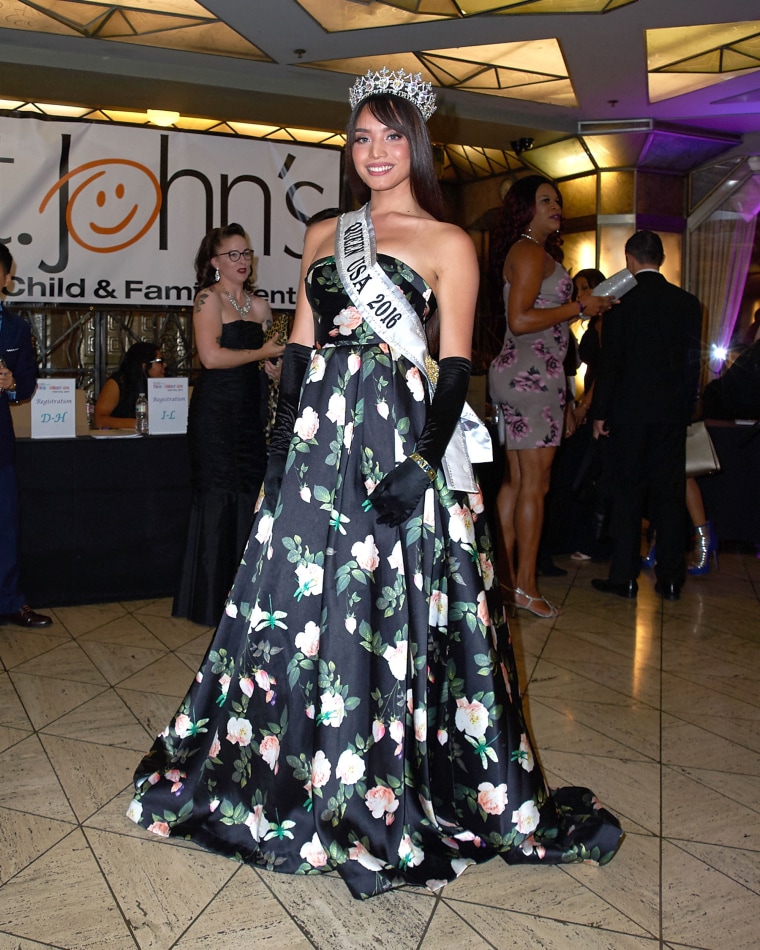
    Kataluna Enriquez, who was crowned Miss Nevada USA on Sunday, will become the first openly transgender woman to compete in the Miss USA pageant.

    With a platform centered on transgender awareness and mental health, Enriquez, 27, beat out 21 other contestants at the South Point Hotel Casino in Las Vegas. https://iframe.nbcnews.com/xImrqkG?app=1

    “I didn’t have the easiest journey in life,” she said, according to KVVU-TV. “I struggled with physical and sexual abuse. I struggled with mental health. I didn’t have much growing up. I didn’t have support. But I’m still able to thrive, and I’m still able to survive and become a trailblazer for many.” 

    After her win, Enriquez thanked the LGBTQ community on Instagram, writing, “My win is our win. We just made history. Happy Pride.” 

    The Miss Nevada USA organization congratulated Enriquez for her historic win on social media and shared the hashtag #bevisible.https://iframe.nbcnews.com/QywZSoD?app=1

    In March, Enriquez, who previously competed in trans-specific pageants, became the first transgender woman crowned Miss Silver State USA, the main preliminary for Miss Nevada USA.

    During the pageant’s question-and-answer segment, Enriquez said being true to herself was an obstacle she faced daily.

    “Today I am a proud transgender woman of color. Personally, I’ve learned that my differences do not make me less than, it makes me more than,” she said, the Las Vegas Review-Journal reported. “I know that my uniqueness will take me to all my destinations, and whatever I need to go through in life.”  

    2nd Annual TransNation Festival Closing Gala "Eleganza" - Arrivals
    Kataluna Enrique attends the 2nd Annual TransNation Festival in Los Angeles on Oct. 21, 2017.Unique Nicole / Getty Images file

    Enriquez, who is Filipina American, designs her own outfits, including a rainbow-sequin gown she wore Sunday night in honor of Pride Month “and all of those who don’t get a chance to spread their colors,” she posted on Instagram

    “Pageantry is so expensive, and I wanted to compete and be able to grow and develop skills and create gowns for myself and other people,” Enriquez said, according to the Review-Journal.

    She will represent Nevada at the 2021 Miss USA pageant, being held Nov. 29 at the Paradise Cove Theater at the River Spirit Casino Resort in Tulsa, Oklahoma.

    The Miss Universe pageant system, of which Los Angeles-based Miss USA is part, began allowing transgender entrants in 2012. If she is crowned Miss USA, Enriquez will be the second trans contestant in a Miss Universe pageant, after Spain’s Angela Ponce in 2018

    Miss America, a separate organization headquartered in New Jersey, did not immediately reply to an inquiry about whether transgender women or nonbinary individuals are allowed to compete in its annual competition. As of 2018, the pageant was reportedly only open to “natural born women,” according to the Advocate.

    In February, a federal judge upheld the right of another organization, Nevada-based Miss United States of America, to bar transgender contestants from its pageant.

  • Over 100 Groups Urge Biden to Fully Rescind Title 42 Expulsions

    Honorable Joseph R. Biden, Jr.
    President of the United States
    1600 Pennsylvania Avenue
    Washington, DC 20500

    Dear President Biden:

    We, the 105 undersigned organizations, write to express our alarm and disappointment that your administration is reportedly considering plans to continue to use the unlawful Title 42 expulsion policy to block and expel adult asylum seekers for at least two more months and may use punitive measures such as ankle monitors and expedited removal in processing families. Not only does the Title 42 policy violate U.S. refugee law and treaties, but it also endangers people seeking U.S. protection, with over 3,250 kidnappings, rapes, and other attacks on people expelled or blocked at the U.S.-Mexico border since you took office. This number rises every day your administration fails to end this policy. We urge your administration to fully rescind this policy for all populations, comply with U.S. refugee law, and ensure that Black, LGBTQ and other adult asylum seekers, many of whom have been turned back or expelled at ports of entry, as well as families and children, have swift access to the U.S. asylum system.Over 100 Groups Urge Biden to Fully Rescind Title 42 ExpulsionsOver 100 Groups Urge Biden to Fully Rescind Title 42 Expulsions 

    Many of our organizations have repeatedly called on your administration to end the Title 42 expulsion policy and restart asylum processing for people seeking refuge. Rational, science-based measures, recommended by public health experts exist to mitigate COVID-19 concerns and safely process asylum seekers at the border. The use of Title 42 – described as a “Stephen Miller special” by a former Trump administration official – was implemented over the objections of senior Centers for Disease Control and Prevention (CDC) experts and has been widely discredited by epidemiologists and public health experts who have confirmed it has “no scientific basis as a public health measure.” These experts provided detailed recommendations for the safe processing of asylum seekers to your transition team, the CDC, and other officials in your administration. In May 2021, medical experts for the Department of Homeland Security (DHS) filed a whistleblower disclosure condemning the policy for lacking a public health justification and for fueling widespread family separation and detention of children. Medical professionals providing care in encampments and shelters in Tijuana have also decried the expulsion policy as threatening the health and safety of migrants.

    Human rights organizations and the media have documented the escalating dangers faced by asylum seekers and migrants subjected to the Title 42 policy, many of whom have been forced into squalid and dangerous conditions in several new camps near the border. Legal and humanitarian staff who work with migrants subjected to the policy have also faced serious risks to their safety. The Title 42 policy has also driven family separations as it presents families with the impossible choice of keeping children in danger or sending them alone across the border for their safety. As a result, many of the single adults who are now stuck in Mexico are desperately trying to reunite with their children in Office of Refugee Resettlement custody or with family in the United States.

    The expulsion policy has disproportionately affected asylum seekers from Africa, the Caribbean, and elsewhere, who were not placed in the Migrant Protection Protocols (MPP) and are not eligible for processing into the United States under Phase 1 or Phase 2 of its winddown. Black and LGBTQ asylum seekers blocked in Mexico under the expulsion policy and unable to request protection at a port of entry continue to experience targeted discrimination and violence. Recent reports indicate that while your administration may end the policy in July for families, it may continue to subject adult asylum seekers to the policy for at least two months – an unacceptable delay that would prolong disparities in access to protection and disproportionately impact Black asylum seekers from African and Caribbean countries, as well as LGBTQ refugees and others who are not traveling with children. Such an approach would be completely indefensible. Public health safeguards in no way require or justify disparate treatment between families and adults arriving alone. Moreover, such an approach is contrary to U.S. asylum law and the non-discrimination provisions of the Refugee Convention.

    We are concerned that this administration continues to look to deterrence as a strategy to address processing of asylum seekers at the border. Ankle monitors, budget requests for expansive detention, and expedited removal are part of a deterrence strategy that is inhumane and ineffective. Such a cruel strategy is the physical manifestation of the statement “Don’t come.” Electronic monitoring devices are a particularly intrusive measure that causes physical and emotional harm without a positive impact on appearance rates as compared to appropriate, community-based case management services. With respect to expedited removal, many of our organizations, as well as the bipartisan U.S. Commission onInternational Religious Freedom, have long noted failures by Customs and Border Protection officers and Border Patrol agents to follow basic required procedures to identify individuals who must be referred for credible fear interviews, as well as intimidation and coercion of asylum seekers to withdraw requests for protection.

    While we greatly appreciate your administration’s ongoing efforts to process into safety certain asylum seekers subjected to MPP, we remain gravely concerned that the Biden administration continues to block and expel asylum seekers to the same dangers under the Title 42 policy. In a rare public statement calling on this country to uphold its legal obligations, the U.N. High Commissioner for Refugees recently urged the United States to swiftly end this policy and “restore access to asylum for the people whose lives depend on it, in line with international legal and human rights obligations.”

    With the 70th anniversary of the Refugee Convention approaching in July, we urge your administration to end its misuse of Title 42 public health authority immediately, restore asylum processing in line with U.S. refugee laws and treaties for all asylum seekers – including at U.S. ports of entry – and set an example for the rest of the world by welcoming refugees with dignity.

    Respectfully,
    The Advocates for Human Rights
    Al Otro Lado
    Aldea – The People’s Justice Center
    Alianza Americas
    American Friends Service Committee
    American Immigration Council
    American Immigration Lawyers Association 
    American Gateways
    America’s Voice
    Amnesty International USA
    Angry Tias and Abuelas of the RGV Asylum Access
    Asylum Access México (AAMX) A.C. 
    Asylum Seeker Advocacy Project (ASAP) 
    Austin Border Relief
    Bay Area Border Relief
    Bellevue Program for Survivors of Torture 
    Black Alliance for Just Immigration (BAJI) 
    BORDER ANGELS
    Border Kindness
    California Collaborative for Immigrant Justice 
    Catholic Legal Immigration Network, Inc.
    Center for Gender & Refugee Studies
    Center of Excellence for Immigrant Child Health and Wellbeing, UCSF Benioff Children’s Hospitals
    Children’s Defense Fund
    Christian Reformed Church, Office of Social Justice Church World Service
    Coalition on Human Needs
    Columbia Law School Immigrants’ Rights Clinic 
    Comunidad Maya Pixan Ixim
    Cooperative Baptist Fellowship 
    Desert Support for Asylum Seekers 
    Detention Watch Network
    Diocesan Migrant & Refugee Services, Inc. 
    Disciples Immigration Legal Counsel Fellowship Southwest
    First Focus on Children
    Florence Immigrant & Refugee Rights Project Freedom For Immigrants
    Geopaz. Instituto de Geografía para la paz AC (IGP) / Geopaz. Institute of Geography for Peace Grassroots Leadership
    Haitian Bridge Alliance 
    HIAS
    Houston Immigration Legal Services Collaborative 
    Human Impact Partners
    Human Rights First
    Human Rights Initiative of North Texas 
    Human Rights Watch
    Immigrant Allies of Marshalltown
    Immigrant Defenders Law Center 
    Immigrant Legal Defense 
    Immigration Equality
    Innovation Law Lab
    Instituto para las Mujeres en la Migración (IMUMI) 
    International Refugee Assistance Project (IRAP) 
    International Rescue Committee
    Jesuit Refugee Service/USA
    Jewish Family Service of San Diego 
    Justice for our Neighbors El Paso 
    Justice for Our Neighbors Michigan 
    Kids in Need of Defense
    Kino Border Initiative 
    Laredo Immigrant Alliance
    Latin America Working Group (LAWG) 
    Law Office of Jodi Goodwin
    LUCHA Ministries, Inc.
    Lutheran Immigration and Refugee Service 
    Migrant Center for Human Rights 
    Migration Matters
    National Immigrant Justice Center 
    National Immigration Law Center 
    National Justice for Our Neighbors
    National Network for Immigrant & Refugee Rights 
    NETWORK Lobby for Catholic Social Justice 
    New York Justice for Our Neighbors, Inc.
    NM Comunidades en Acción y de Fe (CAFe) 
    Physicians for Human Rights
    Project Blueprint
    Project Corazon, Lawyers for Good Government 
    Project Dignity Legal Team
    Project Lifeline
    Proyecto de Ayuda para Solicitantes de Asilo (PASA) 
    Public Counsel
    Rainbow Beginnings
    Rainbow Bridge Asylum Seekers 
    Refugee Congress
    Refugees International
    San Diego Immigrant Rights Consortium 
    Sanctuary for Families
    Save the Children 
    Seguimos Adelante
    Sin Fronteras Nuevo Mexico
    Sisters of Mercy of the Americas Justice Team
    Southern Border Communities Coalition 
    Southern Poverty Law Center
    Tahirih Justice Center
    The Advocates for Human Rights
    The Legal Clinic / HI Coalition for Immigrant Rights 
    The Sidewalk School
    UndocuBlack Network 
    United Stateless 
    VECINA
    Wind of the Spirit Immigrant Resource Center 
    Witness at the Border
    Women’s Refugee Commission